
Observations from the road: The vacation reading edition
Summer reading on lying, grace, baseball, and architecture.
Summer reading on lying, grace, baseball, and architecture.

How pro wrestling explains Donald Trump’s presidency.
Last week I referenced Dr. Mindy Fullilove’s book Root Shock with a story that spoke to how emotions flow through places. I wrote before the events in Charlottesville—and the reactions to that weekend—brought place, memory, and emotion to the forefront of our national conversation. Stephanie Meek’s statement on Confederate memorials and the confronting of difficult history speaks to how emotions that arise from place are not always built upon strong, positive memories. Of course, Dr. Fullilove understands this all too well. Root Shock is focused on the difficult history of urban renewal, something seen in Charlottesville’s destruction of the African-American community of Vinegar Hill in the 1960s. At the Trust, as Stephanie notes, “we believe that historic preservation requires taking our history seriously. We have an obligation to confront the complex and difficult chapters of our past, and to recognize the many ways that our understanding, and characterization, of our shared American story continues to shape our present and future.” That is especially true of our Civil War history, and the fact that many of …
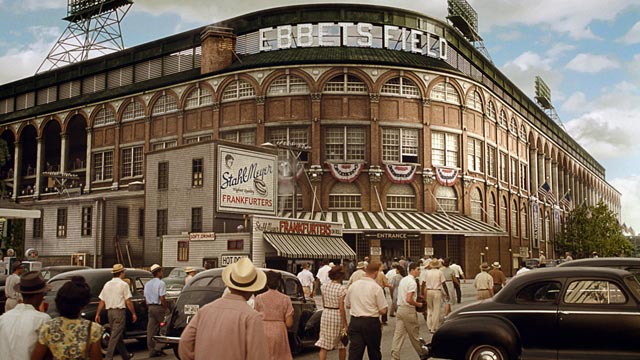
It will surprise no one that I read a couple of baseball books and watched several games while on vacation. But it may surprise you to know that the best piece of writing I read which included baseball as its subject came from the opening pages of psychiatrist Mindy Fullilove’s 2004 book Root Shock: How Tearing Up City Neighborhoods Hurts America, and What We Can Do About It. She begins chapter one with several powerful paragraphs. I’m going to quote extensively from those two pages. “Every once in a while, in a particular location and at a particular time, people spin the wheel of routine, and they make magic. One such location was Ebbets Field in the heart of Brooklyn, where, through World War I, the Roaring Twenties, the Great Depression, World War II, and the postwar struggles for equality in America, hard-working people enjoyed baseball. That small, unpredictable, and intimate ballpark was a gallery for characters to strut their stuff, and the characters in the stands took as much advantage of the opportunity as …
Virtually every reviewer of this 2016 work about the race to save some of the world’s most precious ancient manuscripts calls out the “unfortunate” or “inappropriate” title. And they are right. But then, in the comments section, reader after reader says something to the effect of “I wouldn’t have read this book (or your review) except for the title.” And they are right. So there you have it. Don’t let the title turn you off of this marvelous little book. But also, don’t go into the work thinking that the librarians of Timbuktu are a modern-day version of Indiana Jones. The tale is good enough on its own, but I suspect the author (and his publishers) thought that “The Very Persistent and Dedicated Librarians of Timbuktu” simply wasn’t going to set books flying off the shelf. Joshua Hammer, a former bureau chief for Newsweek who now serves as contributing editor to Smithsonian, is a talented writer who combines a strong journalism sense, travel writing sensibilities, a grasp of the culture and disputes of a …
Babe Ruth — when asked in 1930 why he made more money than President Herbert Hoover — replied, “But I had a better year than Hoover.” I had a fine last week in July. Much better than Donald Trump’s week, I hasten to add. What made my week so special? I went to two games at Nats Park, where the Nationals lost both games and looked pretty sleepy while doing so But… The weather was clear and cool, with highs around 80 degrees and a light breeze adding to the perfect atmosphere. Ryan Zimmerman — in the midst of a monster comeback year — hit a home run on Tuesday night that gave him the lead for most career home runs by anyone playing for a Washington franchise. (He passed Frank “Hondo” Howard for the honor.) Any day at the ballpark beats a day without a game. And… …oh yeah, Andrew and Claire each joined me for a game at the old yard. With Claire in Washington for a month before heading back to graduate …

“We are all in this together, and that addressing our own suffering while learning not to inflict it on others is part of the work we’re all here to do. So is love.”
A poem by Kilian McDonnell for a midsummer Monday. Perfection, Perfection I have had it with perfection. / I have packed my bags, I am out of here. / Gone. As certain as rain / will make you wet, perfection will do you / in. It droppeth not as dew / upon the summer grass to give liberty and green / joy. Perfection straineth out / the quality of mercy, withers rapture at its / birth. Before the battle is half begun, cold probity thinks / it can’t be won, concedes the / war. I’ve handed in my notice, given back my keys, signed my severance check, I / quit. Hints I could have taken: Even the perfect chiseled form of / Michelangelo’s radiant David / squints, the Venus de Milo / has no arms, the Liberty Bell is / cracked. We’ve all known grumpy perfectionists “who hold that anything less than total victory is failure, a premise that makes it easy to give up at the start or to disparage the victories that are …
In her essay “False Hope and Easy Despair,” historian and author Rebecca Solnit speaks to how hope requires action. “Hope” she quotes author Ernst Bloch, “is in love with success rather than failure.” That seems obvious, but Solnit drives home her point by noting that failure and marginalization are safe. Despair has many causes and varieties. Denying one’s power and possibility allows us to “shake off” our sense of obligation. We can make our point too easily when the point becomes “the demonstration of one’s own virtue rather than the realization of results.” On the other hand, “Hopefulness is risky, since it is after all a form of trust, trust in the unknown and the possible, even in discontinuity. To be hopeful is to take on a different persona, one that risks disappointment, betrayal…” I have spent recent weeks studying strategic plans, business models, trends in nonprofit organizations, and other materials that look backward to history to make sense of what’s ahead. They begin by looking backward because, as I’ve said earlier, hope is grounded …
Earlier today, my brother and sisters and I received an email from our older brother Steve. He had just read a book review in the Washington Post concerning a new Library of Congress book entitled The Card Catalog: Books, Cards, and Literary Treasures. It brought back memories, and I’ll let Steve’s note to the four of us take it from here. This story took me back to all those days in libraries…Cookeville and Murfreesboro public, at Tennessee Tech & Western Michigan (where I almost lived while doing my thesis– I even had a private cubicle!), and the 2 church libraries. I spent lots of time at the one in Cookeville where Mom was a one-woman staff for a long time. I would help bind books, glue return card pockets, and watch her type cards for the ubiquitous card catalog. I loved all that. Now I read on my pad and search online, rarely going to an actual library except to find a book old enough to not be available digitally. This article reminded me of …
 MORE TO COME...