Latest Posts

A stunning work of great pain and grace

It is important to continue to put forward searing, difficult histories in the hope that they will break through the malaise of indifference. We hear “never again” to the point that there is a danger these words lose their impact. The genocidal treatment of the Jews during the Nazi-led holocaust, however, is history that should never be forgotten much less repeated. When indifference appears to be universal, this part of the past should always be there to inform and shape our individual and collective responses to evil. As those years recede into history, it is far too easy to stop telling the stories and dismiss the terrors of those times.

Thankfully, we have true accounts of the horrors of those years to shake us out of our complacency. They often demonstrate how easy it is to respond to the demands of authoritarians with self-serving collaborations and justifications.

I just finished one such work that I simply cannot get out of my mind. I write today to recommend it as a book you’ll never forget.

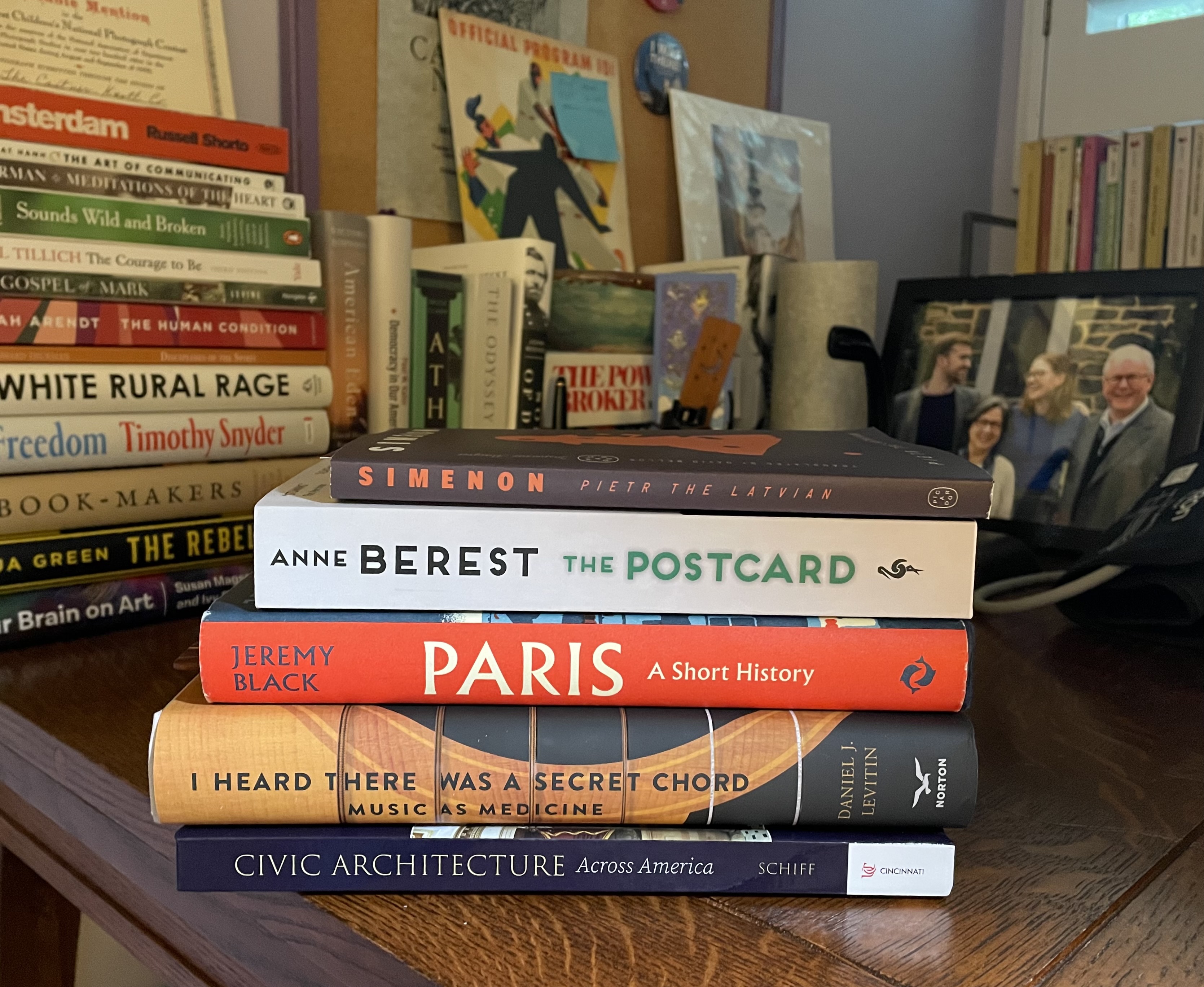
The Postcard (2021; translation from the French in 2023) by Anne Berest is a compelling and timeless work that is so necessary for our current moment. In January of 2003 an anonymous postcard is delivered to the Berest family home, arriving alongside the usual holiday mail. On the front, a photo of the Opéra Garnier in Paris. The back contains only the first names of Anne Berest’s maternal great-grandparents, Ephraïm and Emma, and their children, Noémie and Jacques. There were five members of the Rabinovitch family. These four were all killed at Auschwitz. The fifth—an older sister to Noémie and Jacques—is Myriam, Anne Berest’s grandmother, who never spoke about the loss of her family or acknowledged her Judaism. Although she had a harrowing escape from the Nazis and then worked for the Resistance, she was traumatized; filled with guilt and grieving. After the war Myriam assimilated into France. The quest to uncover who sent the postcard and why leads Anne and her chain-smoking mother Lélia Picabia on a multi-year journey of discovery.

The haunting, anonymous postcard that arrived in January 2003

Early in the book Anne—the author and narrator—is on bed rest and about to have her first child. She asks Lélia to tell her what she knows about the family to help her fill in what is essentially a blank canvas.

“These people were my ancestors and I knew nothing about them. I didn’t know which countries they’d traveled to, what they’d done for a living, how old they’d been when they were murdered. I couldn’t have picked them out of a photo lineup.” 

What follows is an autobiographical novel full of both pain and grace. The phrase un roman vrai—a true novel—describes what Berest has produced. Lélia is a retired professor who, in reaction to her mother’s silence, has spent her life searching for her family’s history. Her home office is filled with archive boxes of government documents and personal letters. As one commentator notes, the way Lélia speaks to Anne about her story “is a straightforward, effective way to tell readers about the making of the novel they are holding:”

“I should warn you,” she began now, “that what I’m about to tell you is a blended story. Some of it is obviously fact, but I’ll leave it up to you to decide how much of the rest comes from my own personal theories. And of course, any new documentation could flesh out those conclusions, or change them completely.”

In a book that moves along at the “pace of life,” the reader is confronted again and again with scenes that remind us of the psychological and physical terror of the treatment of the Jews in the decades leading up to and including World War II. The Rabinovitch family are Russian Jews who flee their home country as anti-Semitism rises early in the 20th century. Ephraïm and Emma move the family to Riga, Latvia—a place of remembrance for Jews—then to Palestine before finally returning to Europe and settling in France in 1929.

Ephraïm is an engineer, inventor, and business owner who is determined to assimilate his family, working unsuccessfully for years to obtain French citizenship. Emma teaches piano on a treasured family instrument. Noémie, whose photograph graces the cover of the book, is a budding writer whose tragic story of talent lost—a story that holds true for the entire family—clearly touches the author at her core. Jacques is just a young boy of 16 when he is murdered.

The story moves back and forth in time as Anne digs into her family’s past; recreates scenes based on historical fact; uses shifting narrators; and grapples with her relationships between grandmother, mother, and the author’s daughter. As translator Tina Kover notes, “[t]he book is deeply personal, breathtakingly emotional, raw and intense and beautiful. My translation had to be just right.”

“Climbing inside the story of Ephraïm, Emma, Noémie, and Jacques” [writes Kover] “meant that I would suffer their loss, and even though I was prepared for it, translating that part of the book was excruciatingly painful. But the revelation came in the happiness I felt as I was translating their lives. They were vibrant and funny, warm and smart and strong, and they lived. That’s what has stayed with me after finishing the translation, and what I hope will stay with readers, too. Their aliveness.”

Berest, in the sections where fact and fiction come together, is reclaiming the stories of her family. She is also reclaiming her Jewish identity and heritage which will pass along to her children.

So why is this book so important today?

Berest and her mom are discussing why foreign Jews, such as the Rabinovitch family, were among the first to be deported. They didn’t have the support systems that the “French Jews” had and so they were vulnerable. “They existed in the gray area of indifference. Who would take offense if someone attacked the Rabinovitch family?” The Nazis and their collaborators pulled families apart, working systematically to put Jews into a “separate” category. Anne speaks directly to her mother in this discussion:

“Maman . . . there comes a point when you can’t just keep saying ‘but people didn’t know . . . Indifference is universal. Who are you indifferent toward today, right now? Ask yourself that (emphasis added).”

That paragraph reminded me of recent writings by Quaker activist Parker J. Palmer on ways we can fight the indifference to injustice and evil in today’s world.

We could bear witness . . . that our commitment to human rights, the rule of law, the claims of truth, and constitutional democracy demand that we resist a tyrannical regime that refuses to abide by those cherished norms.

In bearing witness to those trying to isolate us today, Palmer asks that we recall . . .

  • that ICE is holding 65,000 immigrants in “detention,” working with a goal demanding at least 3,000 more detentions per day.
  • Of the 65,000 men, women and children now in custody, 72% have zero felony convictions, only 7% are classified as serious criminal threats, and none has been afforded due process.
  • We should also make it clear that immigrants—those who are being targeted—are NOT a major source of U.S. crime—in truth, they commit fewer crimes than U.S.-born citizens
  • Congress has just funded a massive $150 billion expansion of our ability to catch, cage and disappear racially profiled human beings. (The budget for building new ICE detention centers alone is 62% larger than that of the federal prison system.)
  • “These are your taxes and mine at work financing inhumanity and systematic injustice.”

The dear friend and former colleague who recommended The Postcard called it “painful at a profound level, of course, and yet somehow resilient and inspiring.” Well chosen words for a book that is both timeless and so necessary in today’s world.

More to come . . .

DJB


For further information, listen to this Scott Simon interview with author Anne Berest.


Photo of Auschwitz, Poland, World Heritage Site (credit UNESCO).

A history of the City of Light

There have been volumes written celebrating Paris, the City of Light. However, too few of the accounts have been by professional historians; one of the best recent ones being a rather long single volume by Colin Jones. Wanting to dig into the history of the city in a year when we’ll be spending time in Paris, imagine my delight to discover a concise history of the city so many people visit and love. And I was even more pleased to have the opportunity to include this work as the most recent installment of my Author Q&A series.

Paris: A Short History (2024) by Jeremy Black, MBE is a succinct and incisive look at how the city, founded in the first century BCE, was shaped by cultural circumstances and then grew to have impacts across the country, Europe, and the world. Black is emeritus professor of history at the University of Exeter and the author or editor of over 100 books, many of which concern aspects of eighteenth century British, European and American political, diplomatic and military history. He brings that deep experience and understanding to this look at Paris as he explores and explains how a small Gallic capital was transformed into a flourishing medieval city full of spectacular palaces and cathedrals. Black brings the illustrious reigns of Louis XIV and XV—a time when Paris became one of the most beautiful and cosmopolitan capitals in the world—to life. And his chapters on the Revolution, the reigns of Napoleon and Napoleon III, and the shifting fortunes of France during the 18th through the 20th centuries are among the strongest in what is already a vibrant book.

Black ends by considering present-day Paris and the opportunities and challenges which lie ahead for the city. As others have noted, this history of Paris is about more than just a city: it is the history of a culture, a society, and a state that has impacted the rest of the world through centuries of changing fortunes.

In addition to this work on Paris, Black has also published France: A Short History (2021) as well as A Brief History of London (2022). I was delighted when Jeremy agreed to answer a few questions about this latest book in the series for our readers. Knowing of his deep expertise with maps, we began our conversation there.


DJB: Jeremy, each section of the book has a map showing the evolution of the city. What do maps in general contribute to understanding the history of a place, and what key points did you take away from these maps you included?

Jeremy Black, MBE

JB: I have written very widely about maps notably in Maps and Politics and Maps and History. Maps reveal and also direct you to particular features, the latter sometimes overly simplistically described as misleading. The maps I have selected for this book illustrate the developing shape and increasing shape of Paris which are important aspects of its history.

Conversely other maps could also be reproduced, as for other cities, both to show the detailed topography of the city and, very differently, to indicate its relationship to broader geographical patterns, and notably so in communications and politics.

I was intrigued by the point-of-view in your history. What do you think North American readers (and specifically readers in the U.S.) could gain from reading a history of Paris from the perspective of a British historian?

The question about points of view is a fascinating one because it implies, as do most reviewers, that people think primarily in national terms. This is not the case. There are many perspectives, contexts and paradigms including religious, class, gender, age et al. There are also major differences in expertise and interest. Plus the particular conventions, tropes and issues of scholarship.

So it is useful to look at places and periods from inside and outside. The latter is especially necessary for scholars: I obviously do not live in the Eighteenth Century. I do not so much see myself as a Brit commenting on Paris but rather as a dixhuitianist (i.e., eighteenth centuryist) trying to offer a broader perspective. Bright Americans do not need history served up in nationalised dollops.

Jeremy, I agree completely with that last statement.

Throughout the book you sprinkle these wonderful vignettes about people, events, and places that help bring Paris to life: for instance the wartime activities of Coco Chanel and the introduction of American fast food into Parisian life. What stories like this surprised you as you researched the history of Paris, and do you have a favorite?

The period about which I knew the least was that prior to 1000, as it is not full of anecdotes especially for the Roman and pre-Roman periods. But the saint carrying a decapitated head is striking. As Christianity began replacing the imperial pantheon of gods there were martyrdoms along the way. Saint Denis, first bishop of Paris, was allegedly beheaded on the hill of Montmartre around 250, during the persecution of Christians carried out by the emperor Decius (r. 249-51). It was said that he picked up his decapitated head and walked for some distance, preaching as he went.

For those traveling to Paris in the near future, what are the places off the beaten track that you would recommend for someone wanting to know more about the history and essence of the city?

The Canal and its route from Arsenal via Stalingrad; Asnieres as example of a swallowed community; Vincennes for history that few visit; mint tea at the main Mosque. Also, I recommend a visit to the Hotel de Sens for its late medieval splendour.

Thank you, Jeremy.

More to come . . .

DJB

Photo of Arc Triomphe by Rodrigo Kugnharski on Unsplash

From the bookshelf: July 2025

My monthly intention is to read a minimum of five books on a variety of topics from different genres. I’ll never catch up with Dan Pelzer, who read 3,599 books in his lifetime, but I generally have a plan for what I do read, which I lay out for MTC readers in these monthly updates. However, I also note that all plans are subject to change at the whims of the reader . . . and that happens often as it did this month. I go to the theatre and decide I want to return to the source book for reference. Or I get hooked on one murder mystery and decide I just have to have another (like taking that second cookie!)

Nonetheless, I hope that you’ll enjoy seeing what I did end up reading in July of 2025. As always, if you click on the title, you’ll go to the longer post on MORE TO COME. And don’t hold me to my plan for August (he says with a sly smile.)


The Age of Acrimony: How Americans Fought to Fix Their Democracy, 1865—1915 (2021) by Jon Grinspan considers the economic and technological disruptions following the end of the Civil War and dives deeply into the aggressive tribal partisanship that grew to be a defining feature of that era. Extremely close national elections, frequent changes in control of Congress, stolen elections, a presidential impeachment, and widespread political violence were all common in those years. Fights on election day, including stabbings and shootings, were frequent. And yet voter turnout was off-the-charts, often reaching 75-80% of the eligible population. The upper classes felt that democracy was in crisis, looking on in horror as new immigrant groups from Europe and newly enfranchised Black Americans exercised their right to vote. The resulting story of what it cost to cool our republic has lessons both positive and negative for today’s period of political crisis.


A Wrinkle in Time

A Wrinkle in Time (1962) by Madeleine L’Engle is often described as a teenage or young adult novel, which does it a great disservice. From the opening scene it stretches the mind and expands the heart for readers of all ages. In the midst of a storm the teenaged Meg Murry; her small and brilliant brother Charles Wallace; and her beautiful mother—patiently waiting for her husband’s return after a long, mysterious absence—have come down to the kitchen for a midnight snack. Suddenly they are interrupted by the arrival of Mrs. Whatsit, a most disturbing stranger bundled up in clothes, wrapped in scarves of assorted colors, with a man’s felt hat perched on top of her head. It seems that Charles Wallace has met Mrs. Whatsit—and her two friends Mrs. Who and Mrs. Which—before. As she prepares to leave, she says, “Let me be on my way. Speaking of way, by the way, there is such a thing as a tesseract.” And the magical story about time travel in the fifth dimension—along with the power of imagination, friendship, and love—begins.


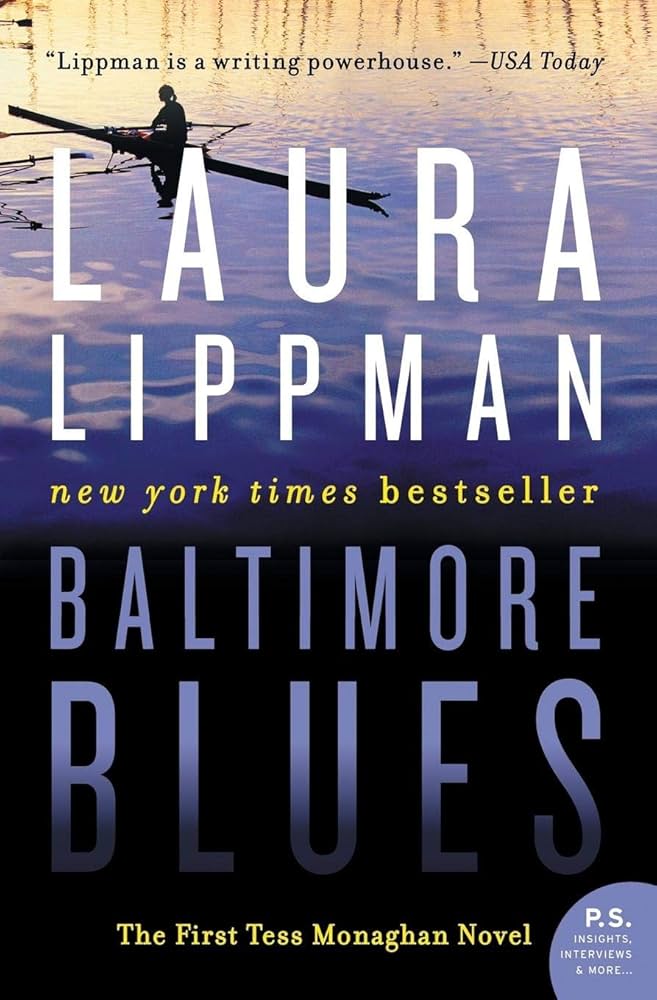
Baltimore Blues (1997) by Laura Lippman introduces us to Tess Monaghan, an out-of-work newspaper reporter who needs to solve the mystery surrounding the death of a prominent attorney in order to exonerate her good friend Darryl “Rock” Paxton. Tess and Rock row together each morning and when he becomes concerned about falsehoods told by Ava, his fiancé, he offers to pay Tess to check it out. She needs a new job and so agrees to become a private investigator. Tess discovers that Ava and her boss Michael Abramowitz, an attorney everyone loves to hate, meet each day for “lunch” at a nearby hotel. Tess confronts Ava and the fiancé turns around and gives her side of the story to Rock. Abramowitz is found brutally murdered the next morning and the police, naturally, suspect Rock. There are twists and turns as Tess navigates the many confusing and compromised relationships, but by the second half of this debut mystery novel Lippman has hit her stride and we move quickly through the pages to a very surprising conclusion.


Lawless: How the Supreme Court Runs on Conservative Grievance, Fringe Theories, and Bad Vibes (2025) by Leah Litman describes in fresh and accessible language how the combination of the court’s power and a poor understanding of its work by the public makes it a dangerous entity in today’s America. While lower courts concluded that “the Fourteenth Amendment barred Trump from holding office under the provision that disqualifies people who, after having taken an oath to the United States, ‘engaged in insurrection or rebellion against the same’” all of the Supreme Court’s January 6-related interventions “cleared the way for Trump to run for president again and to ultimately be reelected.” If we aren’t paying attention or we think we misunderstood the decision because it couldn’t possibly be that ridiculous, then the Court can get away with what is obviously ridiculous. We cannot, Litman reminds us, let one (really bad) Court kill our democracy. She ends this astute assessment of our condition with: “They’ve stolen a Court and they are practically daring anyone to challenge them. It’s time to call their bluff.”


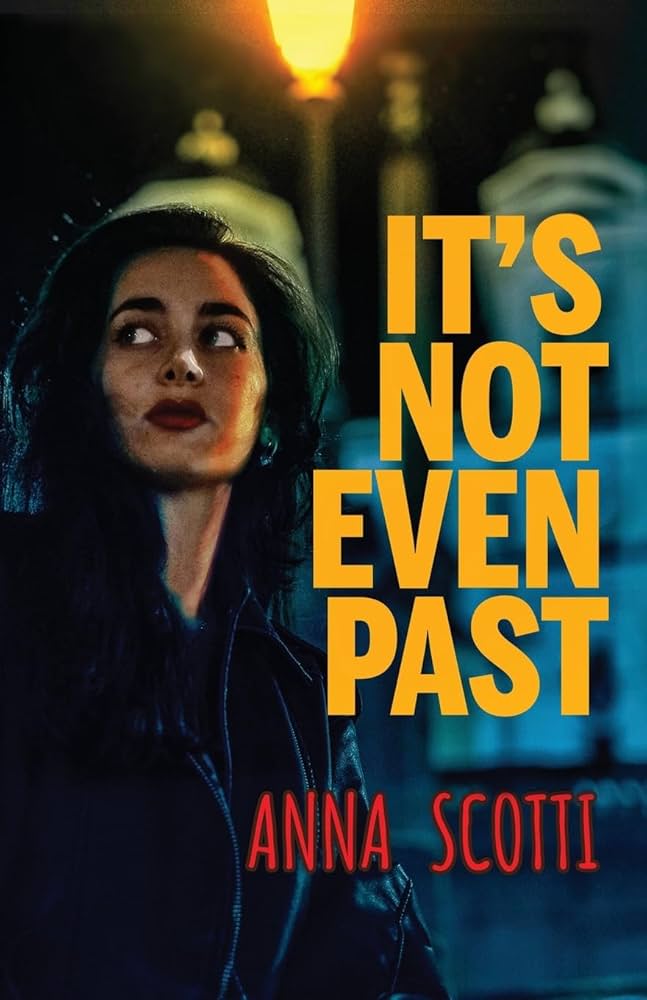
It’s Not Even Past (2025) by Anna Scotti is a brilliantly conceived set of murder mysteries involving the librarian originally known as Lori Yarborough. Lori moves through several aliases, multiple locations across the U.S., and a variety of rather menial jobs in order to stay a step ahead of her ruthless ex and his cartel henchmen. In each place our protagonist has an uncanny ability to find herself in the midst of trouble and murder; her ingenuity in solving those crimes inevitably forces her to move on, often to a new city with a new WITSEC-provided identity. Nine of the eleven chapters were originally published as short stories in the Ellery Queen Mystery Magazine. Those original stories are book-ended with two new pieces, the first to help set up Lori/Cam’s saga and then the final one which adds a coda to this part of her life after the years have so fundamentally changed this once naive librarian.


What’s on the nightstand for August (subject to change at the whims of the reader)

Keep reading!

More to come . . .

DJB


NOTE: Click to see the books I read in June of 2025 and to see the books I read in 2024. Also check out Ten tips for reading five books a month.


Photo by S O C I A L . C U T on Unsplash

Observations from . . . July 2025

A summary of the July posts from the MORE TO COME newsletter.

As I’ve looked back over this past month—with all its heat, humidity, storms, mosquitos, and more—it would have been tempting to simply stay indoors with a book or in front of a screen. But the surprise is that July turned out to be a wonderful time to connect.

“Connect and commit” is one of my rules for the road of life. It is at the heart of living together as humans. To connect and commit we have to communicate.

It isn’t a rule I always adhere to, although it is among my aspirations. But in July I surprised myself, going to a ballgame with former colleagues, hosting a cookout with mates from grade school, indulging in my monthly meal at a favorite French cafe to gather pearls of wisdom from George, and spending the weekend with a treasured couple from Staunton.

There were multiple lunches to talk baseball, politics, spirituality, children, cars, hockey, existential crises, and just life. We had a picnic and night of live music with two couples. There was spicy Mexican food and a long, reflective conversation with a kind and thoughtful young woman dealing with a world that is often neither kind nor thoughtful. At the end of the month I’ve been trying—not always as successfully as I would like—to support Candice as we deal with life’s transitions and remember a life well lived

In thinking about how best to navigate difficult times in life few things work better for me than simply connecting with other people. Madeleine L’Engle wrote that even “in the midst of near despair” something can happen just beneath the surface and we’re suddenly “returned to a state of love again.” I believe, as does L’Engle, that we have the strength and gifts needed to resist despair. Love will return.

Let’s jump in and see how these thoughts played out in the MORE TO COME posts this month.


TOP READER FAVORITES

Lone Cypress

What constitutes a good life? was the top post of the month in terms of reader views. It was timed to arrive on the 100th anniversary of my father’s birth on July 5th. Tom Brown was not a wealthy man in the eyes of the world. But he was rich in so many ways that count. In his faith. In love of his wife, children, and extended family. In friendships that stretched across the globe. In his insatiable curiosity. In a deep belief in community and a deep, deep love for people. Making connections was who he was. Love was at the heart of a good life for Tom Brown.

Stories of the brainy librarian who confounds her handlers while running from a murderous ex was the other top-viewed post in July. Librarian on the run reviews a new work by Anna Scotti, a brilliantly conceived set of murder mysteries involving the librarian originally known as Lori Yarborough. It is sure to delight.


FROM THE BOOKSHELF

In addition to Scotti’s It’s Not Even Past, I featured reviews of four other books in the MTC newsletter this month.

  • Madeleine L’Engle is a writer I turn to again and again, often during hard times. Love will return is my take after rereading her classic A Wrinkle in Time.
  • In the past we have seen both extreme ugliness and bold reform when it comes to our democracy. Historian Jon Grinspan considers the disruptions following the end of the Civil War and dives deeply into the aggressive tribal partisanship that grew to be a defining feature of that era, as I note in The capacity for change.
  • Having one murder mystery wasn’t enough, so I dipped back into that pool and read the first in what is now the 11-book Tess Monaghan series. I review Laura Lippman’s work in The dark secrets of Charm City.

MUSICIANS WHO CAUGHT MY EAR

I was able to reconnect with music this month through these three MTC posts:

  • Musical lineages was a piece tracing the work of new roots musicians back to the sources.

SEEKING BEAUTY AND UNDERSTANDING

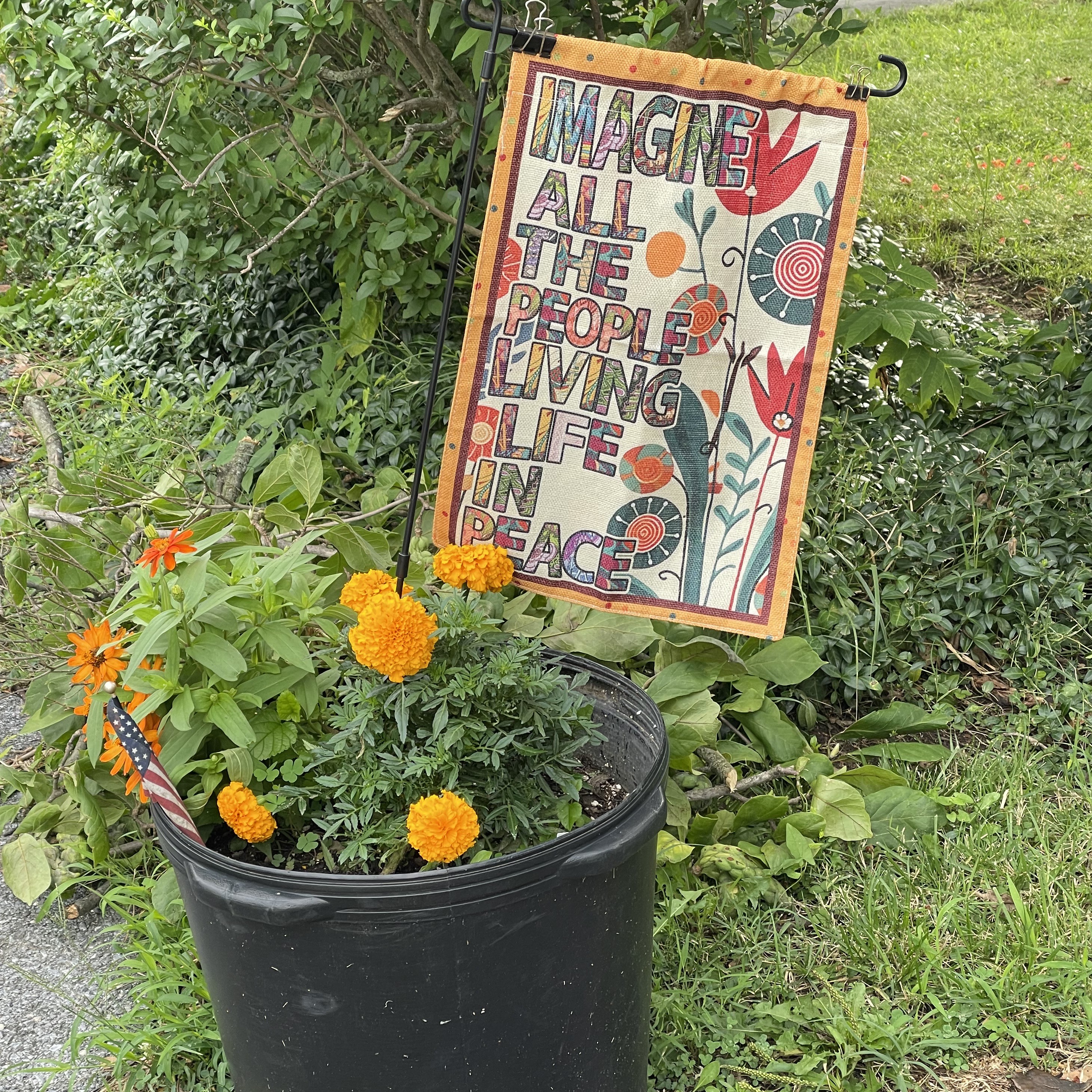
Gardening, like so many good things in life, is about imagination coupled with effort, as I consider in With gratitude for the patience and hope of gardeners. And as we celebrated the 249th anniversary of Independence Day, Sustaining the dream through turbulent times was intended to remind us that there is still much work to do.


COMMENTS I LOVED

Two readers commented on Love will return and my review of the classic A Wrinkle in Time. Brilliant reader Anna wrote: “One of my favorite books as a child, and it holds up in adulthood!” Brilliant reader Sarah added that the book “. . . mesmerized me when I read it as a child and it has to be one of my favorite books ever. I am definitely going to reread it now. I also recommend Walking on Water: Reflections on Faith and Art by L’Engle.”

My thoughts on What constitutes a good life? elicited a number of kind remarks.

Similar to others, brilliant reader Ed saw reflections of his father in my remembrances. “I love that your Dad went out at all hours, to make sure someone in the Valley had her or his electricity. My Dad did the same thing, as a general practitioner with his small brown bag full of stethoscopes & tongue-depressors and other tools of his trade. Dad had patients all over Rockford, including the toughest part of town. Once, when I was about 12, I saw a pistol in that brown bag. When I finally mustered the courage to ask him why the pistol, he said ‘I never load it, but in some parts of South Rockford there are desperate people in the middle of the night who want the drugs a doctor might be carrying, and I’d hope that the pistol might scare them away.'”

Brilliant reader Sara, who I’ve known since elementary school days, wrote to say this about Tom Brown: “TB is an icon of goodness to me.”


DON’T POSTPONE JOY

Thanks, as always, for reading. Your friendship, support and feedback mean more than I can ever express.

As you travel life’s highways be open to love; thirst for wonder; undertake some mindful, transformative walking every day. Recognize the incredible privilege that most of us have and think about how to put that privilege to use for good. Women, people of color, LGBTQ+ individuals, immigrants, public servants, and others can feel especially vulnerable . . . because they are. Work hard for justice and democracy as the fight never ends.

But also keep some room in your heart for the unimaginable. Take time to dawdle and dream. Leave enough empty space to feel and experience life. Those gaps are where the magic begins. When times get rough, let your memories wander back to some wonderful place with remembrances of family and friends. But don’t be too hard on yourself if a few of the facts slip. Just get the poetry right.

Remember that “we are here to keep watch, not to keep.” Pay attention. Be astonished. Tell about it. And bash into some joy along the way.

Life is finite . . . love is not.

Try to be nice. Always be kind.

More to come . . .

DJB


For the June 2025 summary, click here.


You can subscribe to MORE TO COME by going to the small “Follow” box that is on the right-hand column of the site (on the desktop version) or at the bottom right on your mobile device. It is great to hear from readers, and if you like them feel free to share these posts on your own social media platforms.


Photo from Getty Images via Unsplash.

Finding space beyond the to and ‘fro

The North Carolina-based folk duo Watchhouse has a new album entitled Rituals. It is the first album of original music that Andrew Marlin and Emily Frantz have produced since 2021.

Two posts that continue to capture the interest of visitors to this site are my 2020 review of The warm, intimate, and compelling music of Watchhouse. and the 2023 review Watchhouse Duo goes back to the basics. I first heard Andrew and Emily—then known as Mandolin Orange—at the 2014 Red Wing Roots Music Festival and was instantly smitten. From the beginning they have crafted songs that are simple yet compelling.

Emily and Andrew back in the Mandolin Orange days

Over the years these two musicians have become a family with children, the band has expanded to include other musicians, and they continue to produce warm, intimate music even as they became more widely known, explored new sonic palettes, and played larger venues.

The new record begins with Shape—Marlin’s lead vocal supported by the beautiful fiddle work of Frantz. As in so much of their work, Watchhouse is focused sonically and lyrically on beauty that takes us away from life’s everyday challenges. “Let’s find someplace to go/Beyond this to and fro” Marlin sings. The stripped down live version from the Bluebird Music Festival is just lovely. 

The album’s first single, All Around You, focuses on home and happiness. With a nice tenor guitar backing and beautiful duet vocals, home, the band tells us, is wherever happiness lies. “Can’t you feel it right behind you | Ain’t it always just ahead and all around you too.”

The live version of Glistening provides another great example of the sonic tone and lyrical imagery that Watchhouse is producing on this new album.

“Go fire your cannonball, go and fire away (fire away) | When the ashes fall we’ll start a brand new day | I love it when we talk like this | Red velvet in our eyes | It’s the only time we seem to understand

For seventeen years (seventeen years) and seventeen days (seventeen days) | The dawn breaks, and the morning birds sing | All the flowers by her head | turn and face the sun | Gilded by the dеw, just glistening”

I’m one who thinks the band would benefit by giving Emily more of the lead vocals. They do so on Firelight, which was captured in an April concert in Connecticut.

Finally, I love this live version of Patterns because it goes back to the band’s roots. As one reviewer has written,

“. . . the album’s last track, Patterns, is where Watchhouse, no matter their name, has always made its bread and butter—mandolin, gorgeous harmonies and warm imagery: ‘Ain’t it something, all the little patterns/That lead us home through our lives.’ Indeed, it’s a pattern that’s served Marlin and Frantz well.”

Rituals is another beautiful project by a band that continues to inspire year after year. Recommended.

More to come . . .

DJB

Photo Credit: Shervin Lainez

The dark secrets of Charm City

I had just finished a satisfying debut murder mystery and—like a kid going back for a second cookie—I had to have another bite. So I stopped in Takoma Park’s People’s Books (just named “Best Bookstore” in the Washington City Paper‘s Best of DC 2025 rankings) and asked the friendly staff for some recommendations. They suggested I look at Laura Lippman’s first book in the Tess Monaghan series because it was a good read and had the added bonus of being set in nearby Baltimore.

Sold!

Baltimore Blues (1997) by Laura Lippman introduces us to Tess Monaghan, an out-of-work newspaper reporter who needs to solve the mystery surrounding the death of a prominent attorney in order to exonerate her good friend Darryl “Rock” Paxton. Rock is a nationally ranked rower who works a day job as a scientific researcher and has a very attractive fiancé, Ava. Life is good. Tess and Rock row together each morning and when he becomes concerned about Ava’s lying he offers to pay Tess to check it out. She needs a new job and so agrees to become a private investigator. Tess discovers that Ava and her boss Michael Abramowitz, an attorney everyone loves to hate, meet each day for “lunch” at a nearby hotel. Tess confronts Ava and the fiancé turns around and gives her side of the story to Rock, who leaves abruptly. Abramowitz is found brutally murdered the next morning. The police, naturally, suspect Rock.

There are twists and turns as Tess navigates the many confusing and compromised relationships, including her on-again/off-again sexual relationship with a former boyfriend and star reporter for the paper that didn’t hire Tess when her paper folds. Jonathan Ross—who has a girlfriend in the suburbs—is onto a big story when he is hit and killed by a car after spending the night with Tess. Being a former reporter has its benefits as she knows how to follow a story, but Tess constantly puts herself and her friends in danger. There is a murder a day in Baltimore, and yet the Abramowitz case continues to generate publicity above what would normally be expected.

If it sounds complicated, it is. However, by the second half of the book Lippman has hit her stride and we move quickly through the pages to a very surprising conclusion.

A big plus is the setting in Baltimore, or Charm City as it is known. For those outside the area, the city probably means the Inner Harbor and Ft. McHenry. But to those of us who live nearby (and have had family who have called the city home for a while), Baltimore is a real, gritty city with great inequalities of wealth, historic architecture ranging from magnificent to working class, and a riveting history. Lippman—who lives in the city—captures this allure in Baltimore Blues and uses it to her advantage.

One reviewer likened this work to “a debut album from a promising new artist. It may not be perfect, but it showcases undeniable talent and leaves you excited for what’s to come.”

That seems like a good take to me. Lippman has now produced 11 books in the Tess Monaghan series, and I’m sure I’ll return to read more about the adventures of the accidental P.I. in the future.

More to come . . .

DJB

Photo by MeSSrro on Unsplash. Baltimore pictures from Unsplash and Pixabay.

With gratitude for the patience and hope of gardeners

I’ve never had a green thumb.

Gardening requires patience and hope. Some would say it has taken retirement for me to acquire enough of both to even think about spending time with the soil. But then there is that willingness to put up with mosquitos and other types of bugs . . . and no amount of time is going to change that flaw in my character.

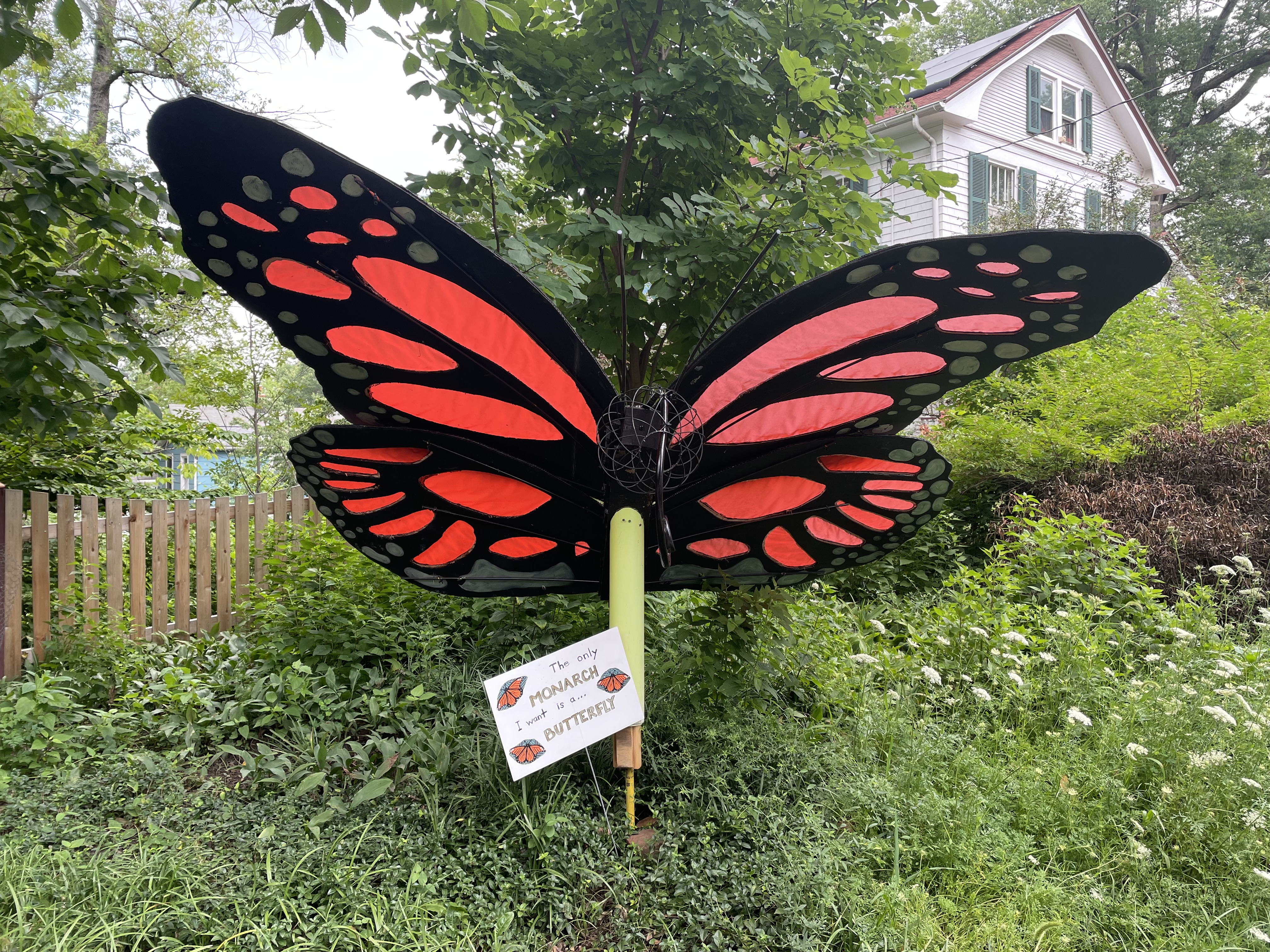
Now there are some insects I actually treasure . . . like this one seen along the July 4th parade route in Takoma Park. The sentiment on the sign fits perfectly for our times:

“The only Monarch I want is a butterfly.”

I agree! We can all enjoy celebrating true royalty of this variety!

But there are some parasites out in the world that one should take great pains to avoid.

Seriously, we have a lot going on in Silver Spring this summer, beginning with the unrelenting heat. And humidity. And mosquitos. And the purple line light rail construction on what seems like every block of downtown.

Not to mention all the challenges of the current regime in Washington, where the collective greed that is killing America is reaching its logical conclusion.*

But I’ve come to realize how much the work of gardeners is helping me make it through this summer. Nature of all types “gives us a model of persistence and the promise of new life.” So in the grand scheme of things it is important to preserve places such as forests and wilderness.

But in urban spaces crowded with people and buildings, much of what we see of nature is planned. Thankfully places such as flower beds also have an important role to play in helping us keep our sanity. Not only do the flowers, bushes, and trees model persistence, but so, too, do their gardeners.

Studies show that flowers lower stress, boost mood, and make you feel more connected.** And I know it is true because I’ve loved walking through our neighborhood, feeling my blood pressure drop; smelling the fragrances; treasuring the natural beauty of the drops of water on the petals; admiring the bees at work extracting the nectar and pollen.

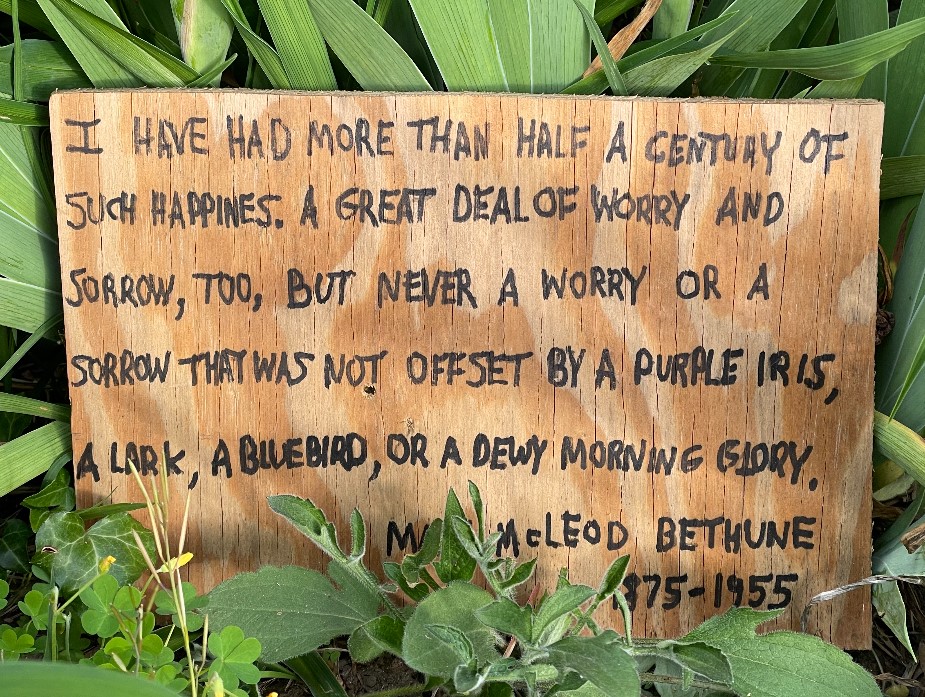
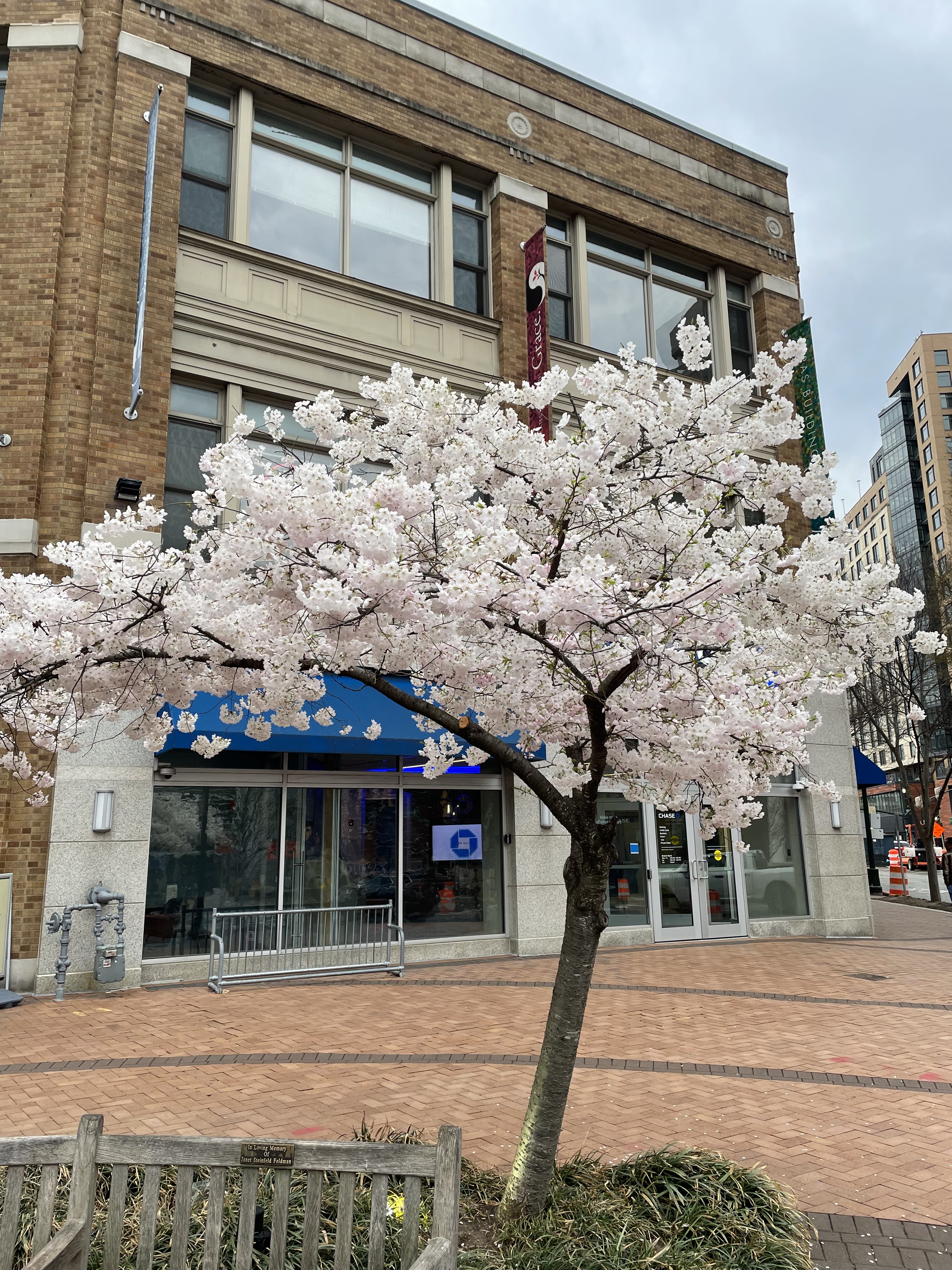
Earlier this year flower gardens full of early risers, including some old chestnuts like the purple iris, my mother’s favorite, began to bring spring’s color and promise back to the streets of our town.

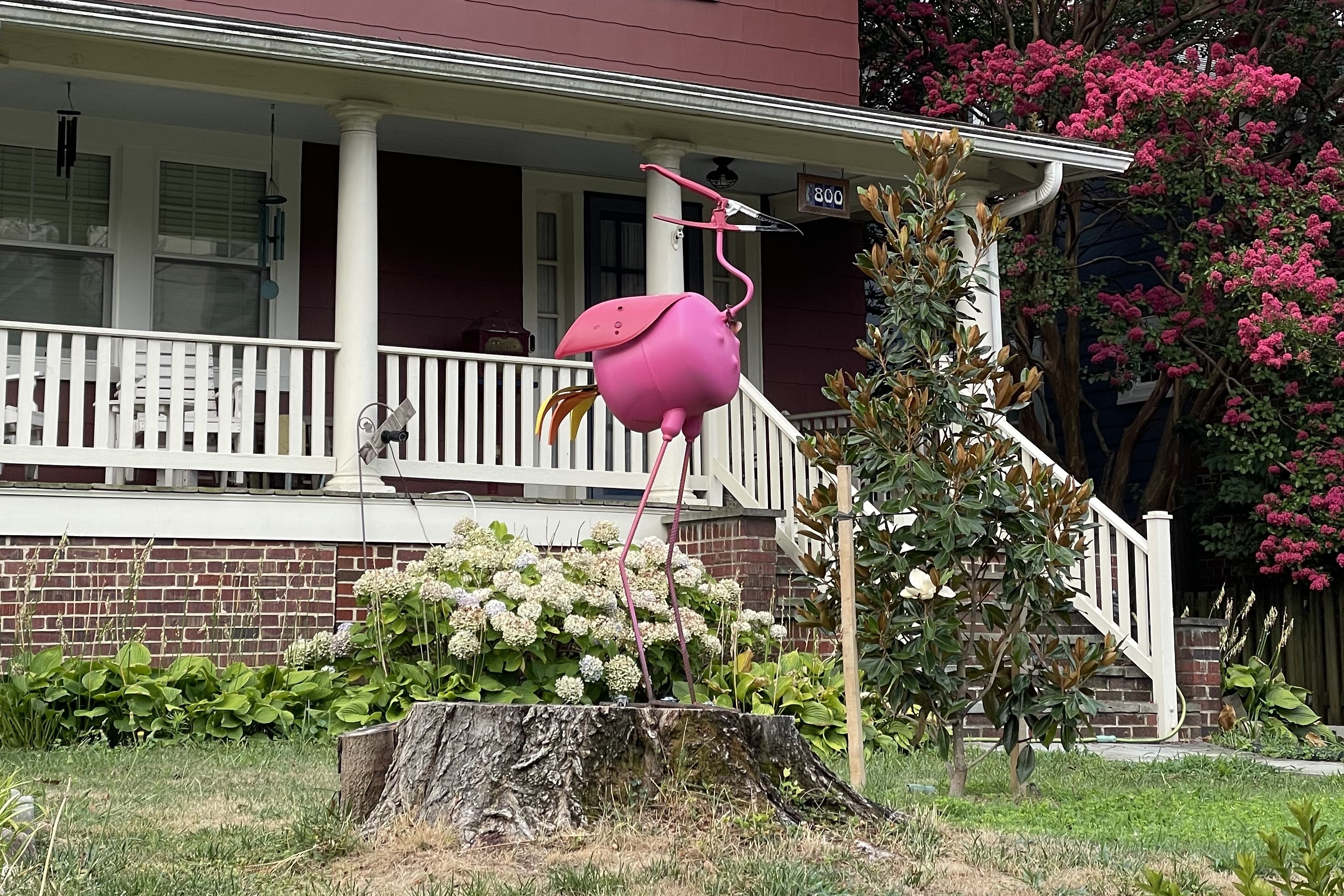
And now that we are in the heart of a hot but humid and wet summer, nature is bursting at the seams. Gladiolus are another old-fashioned flower, this one favored by my late mother-in-law. In our part of the world we also see the Black Eyed Susan, Maryland’s state flower, and sunflowers. The crepe myrtles—in a variety of colors—have been especially glorious this year.

I am not a flower expert by any stretch of the imagination. I just like to stop, enjoy, and occasionally photograph what I see along my morning journey.

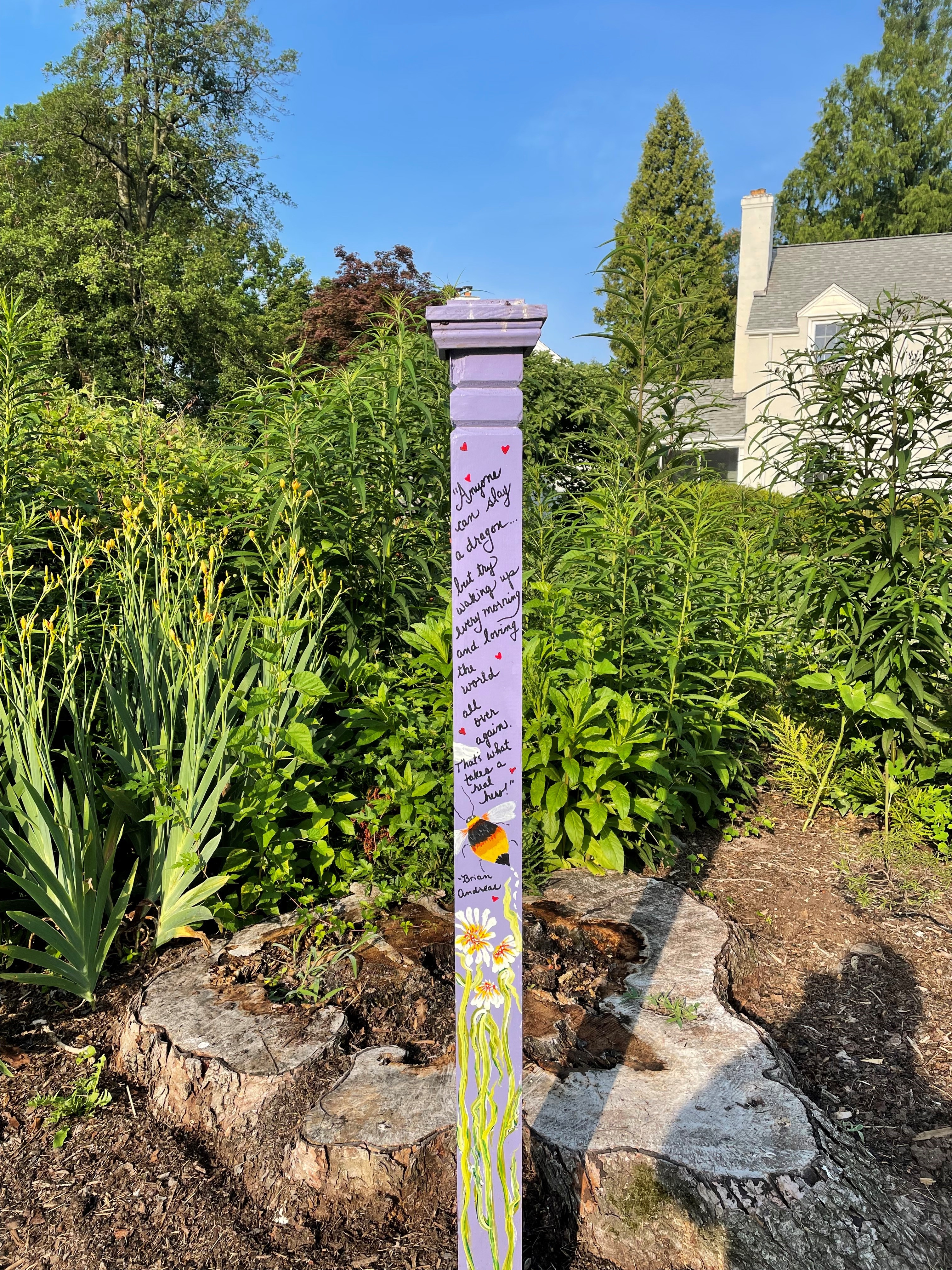
Some of the flowers are in beds begun long ago, while others come from newer creations. In every instance the gardener had a vision; prepared the soil; planted seeds, cuttings, or a sapling; waited (sometimes for years with the flowery bushes); and hoped.

Gardening, like so many good things in life, involves imagination, effort, patience and hope. Every morning I say thank you—either silently, or in person when I come across someone working in their yard—for the patience and hope of gardeners.

More to come . . .

DJB


*Thanks to the Jeffrey Epstein case, some folks are just waking up to other facts about our president. Donald Trump:


**Halivand-Jones, J., et al (2005) An Environmental Approach to Positive Emotion: Flowers. Evolutionary Psychology.


All photos by DJB from walks through Silver Spring and Takoma Park except for the parasite sign (photographed by Claire Holsey Brown in Alameda, CA); the monarch butterfly (the real one, not the “No Kings” version in Takoma Park); and the gardening photo (the last two are from Unsplash).

The best Irish band in bluegrass

When the Irish find their prodigal son was last year’s MTC post about the music of the Irish/bluegrass band JigJam. Earlier this week these terrific musicians were back in the Washington area, set to play one of the summertime Lawn Concerts at the Strathmore Music Center in nearby Bethesda, Maryland.

Only the weather didn’t cooperate. Or perhaps it did in the end.

The forecast on Wednesday was for hot, muggy temperatures with a very good chance of thunderstorms. So what else is new. To be safe, the Strathmore folks moved the concert into the world class music hall.

As lead singer and guitarist Jamie McKeogh said as they arrived on stage, “Well, it is a little smaller than the rooms we’re use to playing, but it will do.”

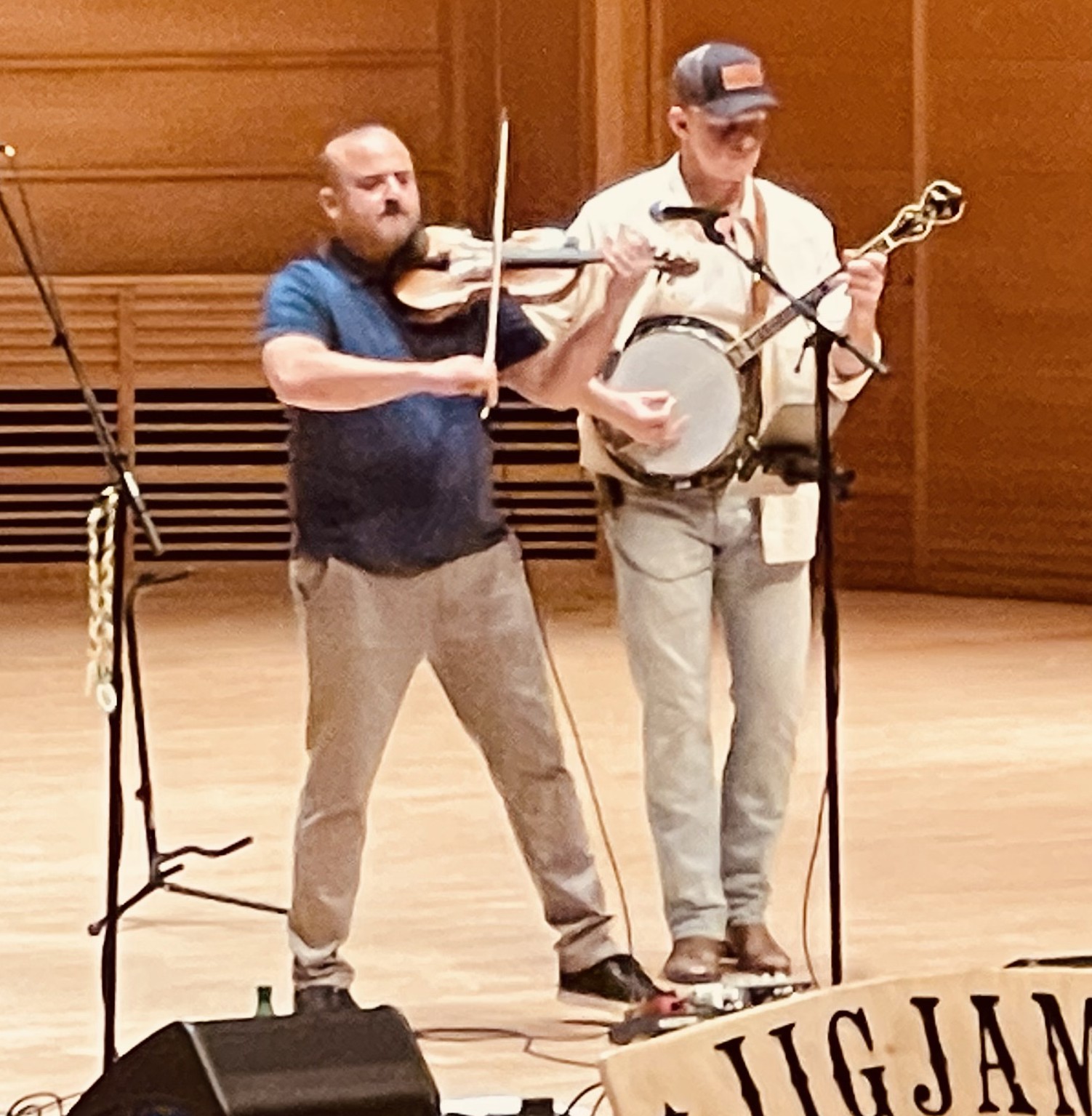
JigJam’s 90 minute show—held in the cool, mosquito-free, dry, and acoustically marvelous concert hall—was a delight . . . and I suspect few missed the miserable heat or the downpour that was pelting the lawn as the band was playing its final notes for the evening.

Besides McKeogh (lead singer and guitar) and Daithi Melia (5 string banjo and dobro), both from Offaly, Ireland; JigJam is composed of Tipperary-born Gavin Strappe (mandolin and tenor banjo); and the only non-Irish member of the band, Kevin Buckley (fiddle) from Missouri. On Wednesday New York native Matty Mancuso—the regular fiddler for the Irish band The Jerimiahs—sat in on fiddle as a quick substitution for Buckley.

Mancuso didn’t miss a beat.

JigJam opened Wednesday’s show with the classic Good Ole Mountain Dew.

Bluegrass, as I noted last year, was formed out of a number of cultural influences, but among the strongest is Irish music as brought over by the Irish diaspora. And while there are many examples of American bluegrass and roots musicians who travel to Ireland to explore their musical heritage, there are not a lot of examples of bluegrass bands from Ireland who cause a stir in America.

Until now.

JigJam is rectifying that oversight and making waves throughout the roots music community. Across the Pond, released in 2024, is the band’s most recent album, and music from that set as well as earlier efforts were spotlighted during the Strathmore show. The reimagined old Irish song The Wild Rover was a big hit with the knowledgeable concert audience.

The band handles all sorts of instrumental pieces exceptionally well. Bluegrass Today called out the “exceedingly jaunty” sound of The Appalachian Irishman as well as the “infectious Cluck Ole Twig, a play on the Appalachian favorite, Cluck Old Hen.” The latter is a great jam tune for these four musicians, and they make the most of it.

Many writers and fan have compared the band’s progressive sound to the seminal New Grass Revival. On the most recent album they included a NGR classic, This Heart of Mine.

Appropriately they ended Wednesday’s very satisfying show with their original Time to Go Home.

JigJam continues to tour this summer, so look for them at a venue or festival near you.

More to come . . .

DJB

Band photo credit JigJam.ie; photos of JigJam in concert by DJB; photo of Strathmore exterior credit Judy Davis for Strathmore; interior photo credit American Hardwood Export Council.

Love will return

Last weekend we went to Arena Stage to see A Wrinkle in Time: A New Musical. It was an adventurous and not-all-together successful adaptation of Madeleine L’Engle’s Newbery Medal-winning classic novel.

After we saw the production, I came home and immediately reread L’Engle’s best-known work. I’ll talk more about the musical, which is in production through this Sunday; but let me first tell you why I love the book.

A Wrinkle in Time

A Wrinkle in Time (1962) by Madeleine L’Engle is often described as a teenage or young adult novel, which does it a great disservice. Although it is one of the books that begins with what has been celebrated as a horrible opening line—“It was a dark and stormy night”—it quickly stretches the mind and expands the heart for readers of all ages. In the midst of the storm the teenaged Meg Murry, who can always see her faults all-too-well; her small and brilliant brother Charles Wallace; and her beautiful mother, patiently waiting for her husband’s return after a long, mysterious absence have come down to the kitchen for a midnight snack. Suddenly they are interrupted by the arrival of Mrs. Whatsit, a most disturbing stranger bundled up in clothes, wrapped in scarves of assorted colors, with a man’s felt hat perched on top of her head. It seems that Charles Wallace has met Mrs. Whatsit—and her two friends Mrs. Who and Mrs. Which—before. As she prepares to leave, she says, “Let me be on my way. Speaking of way, by the way, there is such a thing as a tesseract.”

And the magical story begins.

“Meg’s father had been experimenting with this fifth dimension of time travel when he mysteriously disappeared. Now the time has come for Meg, her friend Calvin, and Charles Wallace to rescue him. But can they outwit the forces of evil they will encounter on their heart-stopping journey through space?”

Each of the children has gifts. Charles Wallace is different, as Mrs. Murray once described to Meg. His “difference isn’t physical. It’s in essence.” Calvin is a good communicator. Meg’s faults are actually her gifts, as her anger and impatience will help as they navigate time and space and are sucked into a world where they are exhorted to give up the essence of what makes them human.

I have read A Wrinkle in Time at several different stages of life. Probably first as a young adult. Certainly again in my early 30s. Then I pulled out my treasured copy, signed for me by Madeleine L’Engle at a writing workshop, and reread it in my early 60s. And now, at age 70, I once again removed it from the bookshelf and was reminded all over again of the power of imagination, friendship, and love. Above all love.

Signed copy of A Wrinkle in Time
A prized copy of “A Wrinkle in Time” which Candice had the author sign at a writing workshop at Kanuga, NC.

The book has frequently shown up on banned books lists (go figure) because some members of the Christian right cannot think outside a rigid box of their own construction. L’Engle had a different concept of time, wonder, and love than that of many more traditional believers. I, for one, have always been comforted by her suggestion that we are “still every age we’ve ever been.” It is yet another way of pushing back against a linear concept of time.

L’Engle is a writer I turn to again and again, and often during hard times. I’ve included her Two-Part Invention: The Story of a Marriage on past lists of the most influential books I’ve read. The jacket blurb describes it well: “The story of a marriage of true minds and spirits—a brilliant writer’s tribute to lasting love.” While I don’t always hit the mark personally, I am always blessed when I read L’Engle’s short but lovely book. Her Glimpses of Gracewhere “she affirms the virtues of imagination, intuition, and intelligence” (no small feat these days)—is also a favorite.

A wonderful and graceful writer, L’Engle returns to the theme of love throughout her books. In The Irrational Season she writes about the difficulties one encounters in any long-term relationship.

“No long-term marriage is made easily, and there have been times when I’ve been so angry or so hurt that I thought my love would never recover. And then, in the midst of near despair, something has happened beneath the surface. A bright little flashing fish of hope has flicked silver fins and the water is bright and suddenly I am returned to a state of love again—till next time.”

L’Engle’s granddaughter, Charlotte Jones Voiklis, writes that she loves this quotation, which has resonance beyond what happens in a marriage. “This flashing fish of hope flicking its silver fins until a state of love returns feel like what happens over and over and over again in many different contexts. It’s what Meg learns in A Wrinkle in Time—that she has the strength and gifts needed to resist IT and the shadow—that love will return.”

If you’ve never read A Wrinkle in Time . . . or if it has been a while . . . let me encourage you to pick it up and dive into the world of tesseracts, friendly beasts, quantum physics, interstellar space, IT, and love.

While the new musical hits on some of the wonders of Wrinkle, it also misses the boat in other areas. First, it helps to have an understanding of the story, because you may not always know what is happening in this new production. Most of the actors (some are Broadway vets) are good, the music to my ear is one of the highlights, and the singing is excellent. Everyone agrees that it is too long. The actor playing Charles Wallace is a terrific singer, but seems too old to make the story work in its original context. There are generally positive reviews, very mixed reviews, and several “don’t go see this production” reviews. Adapting a classic is difficult.

This is a world premier that will be taken out on the road. If the producers decide it is worth it (and I think it is), they’ll rework it and rework it, stage other productions, and eventually try to get it to Broadway. We actually saw very early pre-Broadway productions in Washington of Dear Evan Hansen and Come From Away. Both needed a good bit of work. Both ended up being big successes once they made it to New York.

I don’t know if A Wrinkle in Time: The Musical has that in its future, but I do give the team that put it together all the credit for trying. This is a story that, while perhaps hard to adapt, deserves to be told.

More to come . . .

DJB

Image: NASA’s James Webb Space Telescope First Images – Star-Forming Region

Grievance, fringe theories, and bad vibes

If it is a day that ends in Y, there is a good chance that the U.S. Supreme Court will release another decision disconnected to the rule of law and the Constitution. It happened again on Monday with a decision (6-3 and unsigned) allowing the dismantling of the Department of Education. Professor Steve Vladeck suggested that “comparing Monday’s unexplained grant of emergency relief in the Department of Education downsizing case to how the justices handled President Biden’s student loan program is … telling.” Journalist Marcy Wheeler made the impact more understandable for the general public, writing that “John Roberts just gave a billionaire wrestling promoter accused of letting an employee sexually exploit boys sanction to start destroying local school programs.”

Justice Sotomayor, in her strong 19-page dissent, wrote that “it is the Judiciary’s duty to check … lawlessness, not expedite it.” 

Ann Telnaes reacts to Monday’s ruling with a cartoon on her OPEN WINDOWS Substack newsletter entitled “SCOTUS flunks Separation of Powers again”

A constitutional law scholar and court watcher recently suggested that the citizens of the U.S. need to adjust how we view the nation’s top court. “We often think of law as something that is objective and determinant, where there are right answers,” she said.

But as Leah Litman told writer Sharon Morioka, the “aha” moment that this was not the way our current Supreme Court approaches the law “came a few seasons ago when she was reading a Supreme Court decision and decided that it was influenced by the justices’ own biases toward the issue.” 

The result of that revelation was a book which makes another strong case about how seriously off track this court has driven the country.

Lawless: How the Supreme Court Runs on Conservative Grievance, Fringe Theories, and Bad Vibes (2025) by Leah Litman describes in fresh and accessible language how the combination of the court’s power and a poor understanding of its work by the public makes it a dangerous entity in today’s America. While lower courts concluded that “the Fourteenth Amendment barred Trump from holding office under the provision that disqualifies people who, after having taken an oath to the United States, ‘engaged in insurrection or rebellion against the same'” all of the Supreme Court’s January 6-related interventions “cleared the way for Trump to run for president again and to ultimately be reelected.” If we aren’t paying attention or we think we misunderstood the decision because it couldn’t possibly be that ridiculous, then the Court can get away with what is obviously ridiculous. However, if you are among those convinced that Republicans, and especially white male Republicans, are treated unfairly by an increasingly diverse society that no longer shares their views, then the move to make decisions based on conservative grievance, fringe theories, and bad vibes is an easy step to take.

“Conservative grievance” as Litman describes it, is the idea held by some of the justices that “conservatives are the victims” of a society that doesn’t share their views. “Fringe theories” suggests that the court is drawing on views held by a minority of the country. And “vibes” are the most subjective of all; they’re your innermost feelings. “By suggesting the court is drawing on vibes rather than law,” Litman notes, “it’s meant to suggest that what they are doing is imparting more of their own views into the law that governs all of us.”

Lawless is similar to Adam Cohen’s 2020 book Supreme Inequality. Both look at the longer view and their arguments are very serious. Unlike Cohen’s important work, however, Litman’s writing “is far from dry, with humor woven throughout the book.” Some of it doesn’t work for me. Using LOL as an aside seems more appropriate for an online newsletter. However, Litman is writing for a broader and younger audience, so I do appreciate her taking the justices to task with humor. For instance, she notes that Samuel Alito (a frequent and sometimes too-easy target) made excuses for the upside down American flag associated with the Stop the Steal movement flying at his house a few days after January 6th.

“But fear not, America—Justice Alito insisted he ‘had no involvement in the flying of the flag.'”

“Alito said it was his wife’s doing: Mrs. Alito is apparently ‘fond of flying flags’ and ‘has the legal right to use the[ir] property as she sees fit.’ (Sam Alito, the author of the 2022 opinion overturning Roe v. Wade and women’s right to choose, thinks that [some] women can have [some] rights!)”

Litman looks at how the theory of originalism is used to advance ideological and political agendas. She makes it clear that Senator Mitch McConnell, perhaps better than anyone, understood that appointing the right people in concert with the Federalist Society was essential to furthering Republicans’ political agendas. She provides background on how discredited candidates such as Brent Kavanaugh made it to the Supreme Court and then were deeply involved in questionable (some might say nefarious) decisions, such as plotting the precise timing of how the future of abortion rights would play out to help game the politics of the moment.

In five chapters, Litman dives deeply into the Dobbs anti-abortion decision overturning a fifty-year right to choose, and the ominous implications for other rights for women (a “jurisprudence of masculinity”); the attempts to undermine the Obergefell decision permitting same-sex marriages; voting rights (a particular issue for Chief Justice Roberts throughout his career); bolstering minority rule (especially for the very rich); and the Court’s attack on government itself.

Republican justices “have had more than a few things to say about power and who gets to have it. (Republicans; it’s always Republicans.) Telling democratically elected legislatures they cannot enact laws guaranteeing equal treatment for historically marginalized groups is one thing. But it is far from the only thing,” maintains Litman. And she brings the receipts.

Justice Elena Kagan succinctly spelled out so many of the problems with this current court in her 2023 dissent to Biden v. Nebraska:

“…the Court, by deciding this case, exercises authority it does not have. It violates the Constitution.”

This involved a decision which rewrote a federal law which explicitly authorized the loan forgiveness program and relied on a fake legal doctrine known as “major questions” which has no basis in any law or any provision of the Constitution.

Litman reminds us of what we need to do. The world “is not going to get better” simply because we want it to.

“We have the court we have because there was a movement that fought for that court. If you want to change the court, you need to develop a long-term strategy. That’s not something that’s going to happen overnight, but it is something that can happen if you educate yourself, stay organized, stay invested, vote, and do all of the things that are just part of being an informed citizen.”

None of the stories in Litman’s book were pre-ordained, and she reminds her readers that neither is what happens next. Rebecca Solnit has written on the growing size of the coalition of those impacted by the right wing’s overreach and how “every cruel and destructive action by the Trump Administration is a recruiting opportunity for the opposition.”

There are a number of steps Litman outlines for those who care about democracy.

  • Make the court’s behavior part of public discourse. “The justices’ legal reasoning isn’t serious; neither is their behavior. But the consequences for the country are.”
  • We have to call out Chief Justice Roberts and the conservative supermajority who have unilaterally blown up the legitimacy of the Court. We can make it clear that Roger Taney no longer heads up the list as the worst Chief Justice of all time.
  • Take every election, especially the local ones, seriously. Vote.
  • Have a sense of urgency as well as a long term commitment.
  • Ensure that the perfect doesn’t become the enemy of progress.
  • Court reform is important: both term limits and court expansion.
  • Ensure more congressional control over the courts.
  • Remove the Court’s jurisdiction (i.e., power) to decide certain questions, such as limiting their ability to strike down laws ensuring everyone has a say in elections.
  • Acknowledge that the court is political.

Those who care about our democracy will have to push (and push for years . . . remember that we have to build a movement for major change) for these steps and more. But we cannot, she reminds us, let one (really bad) Court kill our democracy. Litman ends this astute assessment of our condition with:

“They’ve stolen a Court and they are practically daring anyone to challenge them. It’s time to call their bluff.”


Knowing the past suggests ways forward for our future

Many other historians, law professors, and journalists have written about this work to cement inequality into American life. I’ve covered some of them in these MTC posts:

  • The capacity for change (2025)—Jon Grinspan demonstrates how we have seen both extreme ugliness and bold reform through the years when it comes to our democracy.
  • How to live—and think—through the challenges of our era of moral cynicism (2025)—A compelling biography of Hannah Arendt that is also a primer for how to think if we want to be free.
  • Rewriting the past to control the future (2025)—Jason Stanley’s Erasing History makes the case that those who fight for the past can save the future.
  • Systemic change only occurs after acknowledging a systemic problem (2025)—Tech leaders, writes Marietje Schaake, do not have the mandate or the ethics necessary to govern so much of our societies.
  • Legitimacy, once lost, is hard to reclaim (2023)—Adam Cohen’s devastating and damning argument against the Republican party’s fifty-year plan to circumvent the Constitution, overturn the gains of the New Deal and Civil Rights eras, and cement inequality into American law and life. 
  • The continuing fight for the soul of America (2022)—Historian Heather Cox Richardson’s searing, provocative, and masterful How the South Won the Civil War reminds us that the struggle to provide equal opportunity for all is never finished.
  • Belief in a common purpose (2021)—The New Deal mattered in 1933, writes historian Eric Rauchway, because “it gave Americans permission to believe in a common purpose that was not war.” Although conservatives have fought against the ideals of the New Deal, neither before nor since have Americans so rallied around an essentially peaceable form of patriotism.
  • The abandonment of democracy (2020)—I was reading Nancy MacLean’s compelling Democracy in Chains at the end of 2020 while watching the attempted coup that took the attempt by the billionaire-backed radical right to undo democratic governance to its logical conclusion. Utterly chilling.
  • Towards a more perfect union (2020)—Historian Eric Foner’s work on the “second founding” of the country examines why “key issues confronting American society today are in some ways Reconstruction questions.”
  • History is a teacher (2019)—Historian Joanne B. Freeman’s The Field of Blood: Violence in Congress and the Road to the Civil War is the riveting tale of mortal threats, canings, flipped desks, and all-out slugfests…and that’s just on the floor of Congress! Only when we stand up to those who would divide us and push for a true reckoning will we break through the polarization.
  • Telling the full story (2017)—The Half Has Never Been Told:  Slavery and the Making of American Capitalism by historian Edward E. Baptist demonstrates that slavery was not some pre-modern institution on the verge of extinction but was, instead, essential to American development and, indeed, “to the violent construction of the capitalist world in which we live.”

The fight for democracy and justice never ends.

More to come . . .

DJB

Photo of Supreme Court building from Pixabay.