In the midst of the disruption and turmoil that can be found around us, I have been reminded of the quote that began with Mark Twain and then was adapted by the great Negro League pitcher and philosopher Satchel Paige:
“It’s not what you don’t know that hurts you, it’s what you know that just ain’t so.”
We seem to be having an epidemic these days of “what you know that just ain’t so-itis.” There are many reasons this could be the case, but an important one is that we’re bombarded with information that requires work on our part to filter and understand. Warren Bennis has written that “adults learn best when they take charge of their own learning. Taking charge of your own learning is a part of taking charge of your life, which is the sine qua non in becoming an integrated person.” Consider where we get information today. In our interconnected yet at times isolated world, we all fall into the trap of letting others tell us how to think. It is easy to let others take charge of what we learn.
Satchel Paige
What we know should be seen as only the starting point. Author Colum McCann suggests that writers should not write about “what you know, write toward what you want to know.”
“In the end, of course, your first-grade teacher was correct: we can, indeed, only write what we know. It is logically and philosophically impossible to do otherwise. But if we write toward what we don’t supposedly know, we will find out what we knew but weren’t yet entirely aware of. We will have made a shotgun leap in our consciousness. We will not be stuck in the permanent backspin of me, me, me.”
In times of turmoil, it is important to focus on what you know, what you don’t know, what you want to know, and what you know that just ain’t so.
Stanley Cup Celebrations Continue — From bars in Arlington to today’s game at National Park to the Georgetown Waterfront, the Stanley Cup Champion Washington Capitals are having a great time celebrating the franchise’s first Stanley Cup championship with the hometown fans. While I was across the country when they clinched on Thursday evening, I could hear the city explode from Phoenix. We’re ALL CAPS here in D.C. It was an especially satisfying run, given 1) that they weren’t expected to go very deep due to losses of players to the expansion draft, and 2) that they got through a couple of perennial stumbling blocks: John (Torts) Tortorella of the Columbus Blue Jackets and—most significantly—the Pittsburgh Penguins. Too bad Martin St. Louis—who was always a playoff pest—no longer plays for Tampa Bay.
If you want another thrill, watch the highlights from the cup-clinching game.
Pride 2018 Celebration — Thousands have descended on DC this weekend for the annual Pride celebration. Andrew almost always makes it to Pride, but because of singing commitments out-of-town, he’s only able to attend Sunday’s festival. (Work can be such a bummer sometimes!) I have a number of friends and colleagues who are enjoying this celebration of diversity in the DC capital, and I suspect the good times are rolling.
Politics and Prose Member Sale — Several times a year, our wonderful independent bookstore, Politics and Prose , holds a big members sale…and it just happened to be this weekend. So after our traditional Saturday morning farmers’ market visit and pastries at Tout de Sweet, we headed into town for the sale.
Candice was much more methodical in her research than I had been. Nevertheless, I had a few titles in mind, and planned to trust my instincts when faced with a decision.
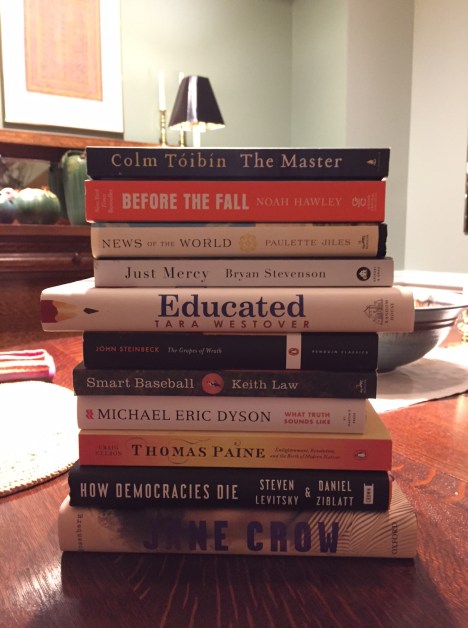
Today’s purchases at the Politics & Prose members sale – what a treasure trove!
The books from Educated to the top are Candice’s choices. Mine go down from there to the recent Pauli Murray biography Jane Crow. Our summer reading bags are full once again!
And Did I Mention That the Nationals Won — Once the Nats were finished with the pre-game celebrations with the Caps on Saturday, they turned around to beat the San Francisco Giants 7-5, holding on to first place in the National League East. Adam Eaton returned from the Disabled List and Bryce hit another home run. Go Nats!
Have a great weekend…wherever you live (but this weekend, it is hard to top D.C.)
More to come…
DJB
P.S. — Oh, and not everyone stayed in Washington this weekend…that’s not a bad thing.
Self-awareness is so important in facing life’s ups and downs. Despite experience shaping our model of the world (as I’ve written before), bias still prevents us from making experience-based decisions, especially if we lack self-awareness. A colleague recently sent me a note along with a 2018 Harvard Business Review article by Dr. Tasha Eurich which explored this theme.
Self-awareness
Eurich’s article spoke of two broad categories of self-awareness:
“The first, which we dubbed internal self-awareness, represents how clearly we see our own values, passions, aspirations, fit with our environment, reactions (including thoughts, feelings, behaviors, strengths, and weaknesses), and impact on others. We’ve found that internal self-awareness is associated with higher job and relationship satisfaction, personal and social control, and happiness; it is negatively related to anxiety, stress, and depression.
The second category, external self-awareness, means understanding how other people view us, in terms of those same factors listed above. Our research shows that people who know how others see them are more skilled at showing empathy and taking others’ perspectives. For leaders who see themselves as their employees do, their employees tend to have a better relationship with them, feel more satisfied with them, and see them as more effective in general.”
Self-awareness can help in confronting our biases. Common obstructionist biases in situations that should be informed by experience are the tendency to use confirmatory evidence, assumptions about causality, and disregarding negative information. My colleague’s question to me was, “Do we throw our hands up now?”
Not yet (she answered her own question). There are different ways to gain self-awareness outlined in the HBR article. Dr. Eurich found that “people who improved their external self-awareness did so by seeking out feedback from loving critics— that is, people who have their best interests in mind and are willing to tell them the truth. To ensure they don’t overreact or overcorrect based on one person’s opinion, they also gut-check difficult or surprising feedback with others.” Introspection, on the other hand, was a surprisingly poor way to gain self-awareness for many people because we often approach it in the wrong way. We begin our introspection with the question “why.” Eurich makes the point that “why” invites negativity and rationalization. Instead, she encourages the use of “what” questions in forward-focused introspection, because identifying patterns in situations and decision-making allows us to see what actions contributed toward our success or failure. Asking “what” questions will help people make experience-based decisions.
What we do should be informed by what we know. It’s hard. But asking “what” will help.
In recent weeks, a friend acquired a book by Rebecca Solnit, an author I admire. I immediately offered to read it at the same time, in order to discuss it together. Having read the book several years before, why return to this one when I had so many unread books in piles around the house?
The answer comes in understanding how we know what we know. That’s been on my mind recently as I’ve thought about topics as wide ranging as cultural norms, untold histories, political divisiveness, and generational perspectives. Just how do we—as humans—shape our personal world view?
Pondering the big questions
In rereading Solnit’s book, I came to the material at a very different time in my life and that of our country. I had vaguely remembered parts of the book from my first reading, but frankly there were whole sections that seemingly had escaped my notice or understanding the first time through. But I also realized how much more of the book aligned with my current “model” of how the world works. And I don’t think that’s by accident.
“Reading and experience train your model of the world,” writes Paul Graham. “And even if you forget the experience or what you read, its effect on your model of the world persists. Your mind is like a compiled program you’ve lost the source of. It works, but you don’t know why.” Henry David Thoreau said something similar when he wrote: “Every man…tracks himself through life, in all his hearing and reading and observation and traveling. His observations make a chain.” In Thoreau’s formulation, I “half knew” what I’d read earlier, and was ready to receive it on a second reading and have it connect more deeply with my model of the world. Graham, the computer programmer and investor, notes,
“…reading and experience are usually ‘compiled’ at the time they happen, using the state of your brain at that time. The same book would get compiled differently at different points in your life. Which means it is very much worth reading important books multiple times. I always used to feel some misgivings about rereading books. I unconsciously lumped reading together with work like carpentry, where having to do something again is a sign you did it wrong the first time. Whereas now the phrase ‘already read’ seems almost ill-formed.”
There’s much to be learned by going back to that which has formed us—consciously or unconsciously—to see how our current base of knowledge and experience reacts with this material today. In fact, it is critical to continued learning.
So take the time to reread the books that captured your imagination as a teenager, or in graduate school, or in mid-life. It is one way we know what we know.
I am in the middle of an impressive yet troubling book by Steve Almond entitled Bad Stories. This work about the American psyche in 2018, by the New York Times best-selling author and co-host of the Dear Sugarspodcast (with fellow writer Cheryl Strayed), looks at the many reasons we came to be where we are today as a nation.
Bad Stories: What the Hell Just Happened to Our Country by Steve Almond
There is much to consider in this work. But for now, I want to focus on stories — good and bad — and what they can mean personally and professionally for those of us who look to “tell the full American story.”
Almond writes, “I’ve placed my faith in stories because I believe them to be the basic unit of human consciousness. The stories we tell, and the ones we absorb, are what allow us to pluck meaning from the rush of experience.” He then quotes the Israeli historian Yuval Noah Harari, who insists that our species came to dominate the world in part because of “our unique cognitive ability to believe in the imagined, to tell stories that extend beyond our bonds beyond clan loyalties.” For a powerful example of storytelling, we don’t have to look much beyond last Saturday’s address at the royal wedding by Episcopal Bishop Michael Curry.
As a lover of history, I believe in the power of stories. Like each of you, I’ve heard them my entire life. As I wrote recently, people I love told stories that were wrong — bad stories — which perpetuated a false reality that was focused on keeping one race of people under the control of another and to “warp our fears into loathing.”
Almond says,
“Our larger systems of cooperation, whether spiritual, political, legal, or financial, require faith in a beautiful fiction known as the common good….For most of our history, humans relied upon folklore and religious parable to conceptualize the common good. But much of our progress as a species, Harari insists, is a function of cultures shifting from superstitious stories to verifiable ones, as happened during the Scientific Revolution of the 16th century. Our embrace of reason and empiricism has saved a lot of people from dying of illness and starvation. It has led to a standard of living within many precincts of the world that would have been unimaginable in previous epochs. It has not, however, changed the fact that we still choose the stories by which we construct reality (emphasis added).
What happens, then, when some of the stories we tell ourselves are bad, meaning fraudulent either by design or negligence? What happens when the stories we tell ourselves are frivolous? Or when we ignore stories that are too frightening to confront? What happens when we fall under the sway of stories intended to sow discord, to blunt our moral imaginations, to warp our fears into loathing and our mercy into vengeance? The principle argument of this book is that bad stories lead to bad outcomes (emphasis added).
…bad stories arise from an unwillingness to take reality seriously. If bad stories become pervasive enough they create a new and darker reality.”
We work at telling the full American story at the National Trust in part to correct bad stories, and in part to take reality seriously. I think that is work at the core of our lives together. It has also led me to think about the personal stories I tell myself and others. When I get a (minor) fact wrong I’m fond of saying, “this story may not be factually accurate, but it is true,” meaning that it points us in the right direction. Almond, in a response to a question from his seven-year-old son about the truth of a set of stories, says something similar when he notes that the truth of certain stories isn’t really the point. “A story didn’t have to be true (which I interpret as factual) to produce a good outcome, to help people behave a little more kindly.” Sometimes the intent of the storyteller to either build up or tear down is the determining factor of a story’s value.
If we can recognize the value of others as well as our role in listening to, understanding, and honoring their stories, I believe we’ll be on the right path to taking reality seriously. And we’ll be correcting bad stories.
At a recent staff retreat, I urged everyone to “work with their door open.”
It may have seemed like a strange request since we don’t have offices with doors in our headquarters at the National Trust, and many of our historic sites and field offices also utilize open plan design. But whatever the personal office situation of those in the room, I was making the request in a more figurative sense.
In an observation that isn’t original but aligns with my own, I have noticed that people who have the door to their office closed throughout the day may get more work done today and tomorrow, and may be more productive than most in the short term. However, several years later somehow they don’t quite know what problems are worth working on. All the hard work they do can be tangential in importance.
On the other hand, those who work with the door open get all kinds of interruptions. But they also occasionally get clues as to what is really going on in the world and what might be important. In my mind, those interruptions are more than worth the short-term drop in productivity.
Being open, being collaborative, being curious: those are the ways we learn. In our minds, in our personal interactions, and in our focus on others, we can work “with our doors open” and accomplish so much more together.
I’ll tell you all about the downsides of procrastination later. When I get around to it.
Seriously, indecisiveness can be bad. Indecisiveness can also lead to better choices and better results. To discern which it is, we must understand why we may be waiting to make a decision.
If you find yourself chronically putting off difficult tasks you know you should tackle, then you’ll find this path leads to the loss of time, the loss of respect of co-workers and family, and it can cost you in results. Perhaps when you are in a situation where you don’t enjoy or admire your work, you have to force yourself to push forward. When that happens, Paul Graham suggests, “the results are distinctly inferior.”
However, if you are doing work you enjoy and still worry that you are indecisive, Graham and others see us making better choices with more creative outcomes by waiting for a more deliberate answer. Screenwriter Aaron Sorkin says, “You call it procrastination, I call it thinking.”
“There are three variants of procrastination, depending on what you do instead of working on something: you could work on (a) nothing, (b) something less important, or (c) something more important. That last type, I’d argue, is good procrastination.
That’s the ‘absent-minded professor,’ who forgets to shave, or eat, or even perhaps look where he’s going while he’s thinking about some interesting question. His mind is absent from the everyday world because it’s hard at work in another.
That’s the sense in which the most impressive people I know are all procrastinators. They’re type-C procrastinators: they put off working on small stuff to work on big stuff.
What’s ‘small stuff?’ Roughly, work that has zero chance of being mentioned in your obituary. It’s hard to say at the time what will turn out to be your best work (will it be your magnum opus on Sumerian temple architecture, or the detective thriller you wrote under a pseudonym?), but there’s a whole class of tasks you can safely rule out…”
I sometimes find myself filling up a to-do list and checking off the boxes to convince myself I’m not procrastinating. (That’s Graham’s type-b procrastination listed above.) Or I rip through a project and finish it early. Again, I convince myself I’m not procrastinating. But as Wharton School professor Adam Grant notes, “Our first ideas, after all, are usually our most conventional.” He notes in an essay entitled Why I Taught Myself to Procrastinate, “My natural need to finish early was a way of shutting down complicating thoughts that sent me whirling in new directions. I was avoiding the pain of divergent thinking — but I was also missing out on its rewards.”
Right or left – Let’s think on that for a while…
Truth be told, I have had a first draft of this post in my box for over a month. In that time, as I read various articles on the topic and thought about what I wanted to say (i.e., procrastinated), one of the clearest thoughts I’ve found came from Richard Hamming, who asks the simple question: “What is the best thing you could be working on, and why aren’t you?” If we’re focused on that — even while daydreaming — there’s a better-than-average chance that we’re a “good procrastinator.”
We ask and answer questions every day. When a colleague or supervisor asks about the status of a project, that’s (usually) a straightforward question deserving of a straightforward answer.
That’s not the type of question that’s been on my mind in recent weeks.
There are much more difficult questions that are pointing toward important — even life changing —decisions. Should I move? Is it time for graduate studies? Where should we send our children to school? Am I spending my money wisely? Should I consider a job change? Is it time to reach out to a colleague or friend who is struggling? What is the right response to today’s political environment? When is the right time to retire? How should I deal with an aging parent?
“Many of us are busy and anxious. We are social animals: We listen for the culturally normative thing to do among our friends and, most often, follow it. This is what Aristotle, and later a lot of Internet evangelists, called the ‘wisdom of the crowd’ and what Hannah Arendt might have called the ‘banality of evil.’”
In listening for and following the culturally normative thing to do among our friends, we make decisions about where to live, the best schools for our children, how to spend our money, where we work, when to provide advice, how to vote, and on and on based on what others are telling us. I find myself doing this all the time.
But there are some questions that should force you to decide just whose values you are adopting. The writer Courtney E. Martin frames it as, “…there are certain decisions, I’m realizing, that should make my heart ache, if not break.” She notes that at least one friend of hers had a breakthrough when — while agonizing over a decision — someone asked her the simple question, “What is your work here?”
As you face the questions in your life that really matter, think about what your work should be in that context. And make sure you first understand just whose questions you are answering.
Earlier this month, I joined other members of the National Trust on a memorable trip from Memphis down to the Mississippi Delta. Dr. Bill Ferris, the former chairman of the National Endowment for the Humanities and one of the nation’s leading scholars on the American South, joined us and helped set the context for what we were seeing in places such as Oxford, Sumner, Indianola, and Dockery Farms. His remarks were a masters class in the connections of place with memory, history, food, drink, literature, race, and gender.
At one point, Bill noted that a relative of his liked to say that “he was raised on cornbread and recollections.” As someone who has eaten my fair share of cornbread, often quotes my grandmother, and tells stories passed down from my father, I understood completely.
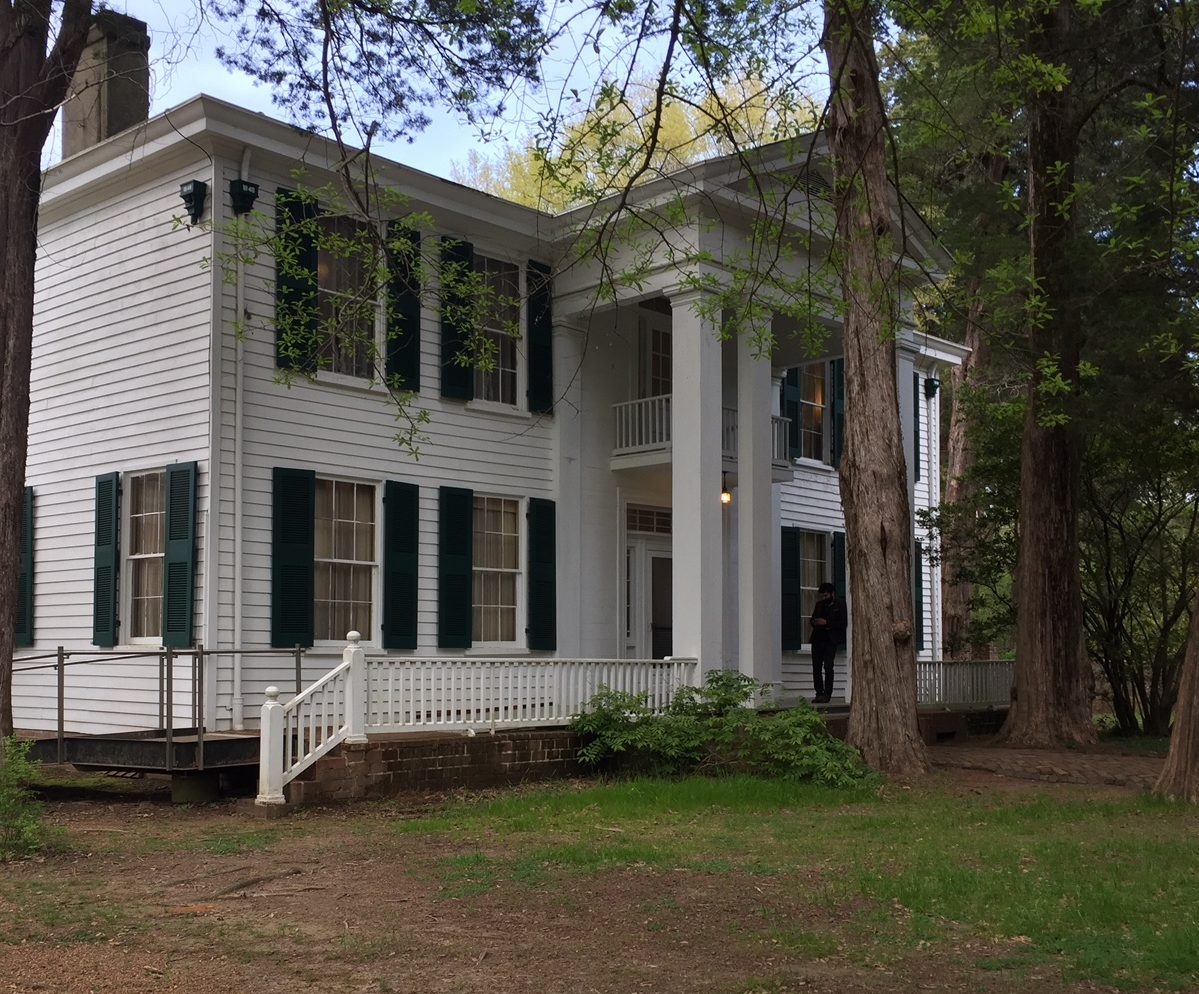
We launched our journey into the Delta from Rowan Oak, William Faulkner’s home in Oxford. Both the site and writer are reminders of the importance of recollections and history to life today.
Rowan Oak, Home of William Faulkner
Historic sites at their best are dynamic places where past, present, and future meet in a variety of ways. I often say that “the period of significance is now” with historic sites to point to those intersections. You cannot have been in the preservation field very long without hearing the famous William Faulkner quote from Requiem for a Nun, which goes, “The past is never dead. It’s not even past.” That’s very true at a place like Rowan Oak, where communities of people who write and love literature, admire architecture, and enjoy good liquor and good company all visit for remembrance and inspiration. (To that last point, Faulkner has another famous line which suggests that “pouring out liquor is like burning books.” He enjoyed his Four Roses.)
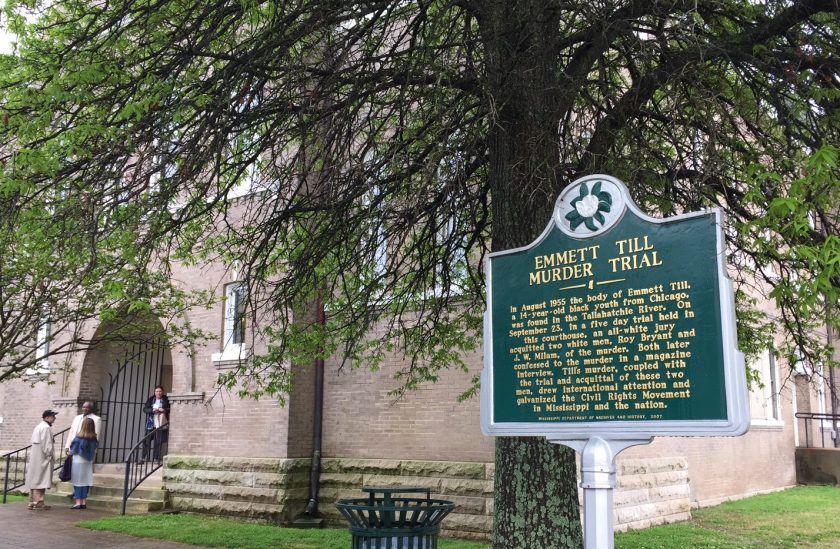
At its best, memory is a poet and not a historian. But not all recollections are correct, and some are purposefully misleading, including “Lost Cause” memories told by my beloved grandmother. Perhaps the most meaningful and moving part of the trip was the 90 minutes we spent at the courthouse in Sumner, Mississippi, where the murderers of young Emmett Till were tried and acquitted in 1955, setting off events that led to the modern Civil Rights movement. Visitors are invited to “engage in the story of Emmett Till, explore your own story, and create a new emerging story with us.”
It is important to bring this past into the present, where we are still grappling with the racism that led to Till’s murder and the murder through lynching of at least 4,000 African Americans from 1877 – 1950. In that restored courthouse, we read aloud an apology from citizens of Tallahatchie County to the family of Emmett Till. One of our National Trust Council members spontaneously used that venue to speak from the heart about his mother’s recollections as a young African American woman in the Delta who was only five years older than Till. This is a historic site that exists to tell the story of Emmett Till in order to move people forward.
Courthouse in Sumner, Mississippi
You don’t have to be a historian to play a role in the telling of the full American story. I happened to be with attorney Bryan Stevenson — the dynamic founder and head of the Equal Justice Initiative — last week, and was reminded of the work we all have to do when he said “injustice prevails where hopelessness persists.”
If we want to build communities and a nation full of hope, it is important that we set forth a new narrative about the injustices in our lives, past and present. Historic sites, monuments, and recollections are good places to begin.
Have a good week.
More to come…
DJB
Image: Site of the Emmett Till Murder Trial in Sumner, Mississippi by DJB
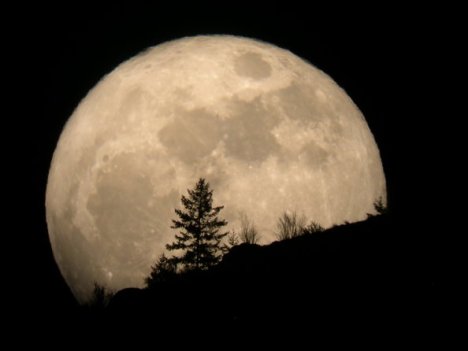
A couple of weeks ago, I came across this little gem of a film entitled Have You Ever Really Seen the Moon?The premise of this three-minute video is simple: a guy wheels his telescope out into the streets and neighborhoods of Los Angeles and invites people to look at the moon. The reactions restore faith in our ability to be awed.
“What is that, bro?” a guy on a bike asks.
“It’s a telescope,” says Overstreet. “Do you want to check out the moon?”
The offer is made over and over to a cross section of passersby in a cross section of places across greater L.A. And one by one, they put their eyes to the viewfinder and gaze upon what they’ve looked at a million times yet never seen.
Interestingly, Overstreet and Gorosh show us very little of the actual moon. No, what holds your eyes, and lifts your soul is the way these different people in different neighborhoods all respond in precisely the same way — with gasps and shouts and whispers of naked wonder at the sudden nearness of lunar soil.
. . .
“I’m looking at the moon,” says a young, cap-to-the-back white guy into his phone. “Hold on real quick.” Then he puts his eye to the viewfinder. “Oh, my God,” he says.
“Oh. My. God,” breathes a black man in a hoodie.
“Oh, my God,” says a little kid, laughing.
“Oh, my God,” says a guy with a mane of gray hair.
“Oh!” says a woman, as if startled. “Oh, my God.”
There is something quietly profound in their awe, something that stirs you somewhere deep within like a light breeze moving among tall grass.”
The Moon (credit space.com)
Miami Herald columnist Leonard Pitts, Jr. captured the essence of this work in a recent piece. In viewing the movie and reading this column, I was reminded of how — back in the pre-smartphone days — preservationists would tell their fellow citizens to “look up” at the buildings along Main Street to see beyond the (often altered) storefronts. Even then we would get so absorbed in our own tunnel vision that we’d forget to see what past generations had built and the possibilities those buildings had for today and tomorrow. That tunnel vision has increased exponentially with smartphones, where so many have all but stopped looking beyond that small screen as they walk through a downtown or in a beautiful natural setting. Have You Ever Really Seen the Moon should remind us of the wonder around us. Stop, look up, and take some of it in.