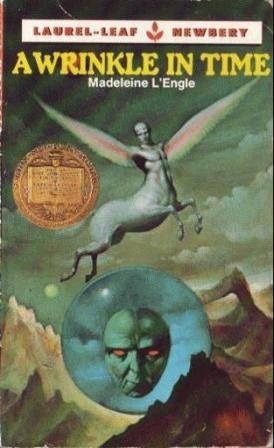
Madeleine L’Engle – the well-known author of A Wrinkle in Time and many other works of both fiction and nonfiction – is a writer I return to again-and-again when I’m looking for wisdom from a different perspective. As Candice and I took time off this past weekend to celebrate our anniversary, I found time to re-read L’Engle’s Two-Part Invention: The Story of a Marriage, which is the one book both of us included several years ago on a list of influential readings.
Reading that book made me think of L’Engle’s other writings, selections of which became the basis for a collection of daily readings entitled Glimpses of Grace.Over the weekend I looked at the reading for March 20th. It was titled “The Blessing of Silence” and while the references to transistors and records are dated, it is still worth a read.
“Why are we so afraid of silence? Teenagers cannot study without their records; they walk along the street with their transistors. Grownups are as bad if not worse; we turn on the TV or the radio the minute we come into the house or start the car. The pollution of noise in our cities is as destructive as the pollution of our air. We show our fear of silence in our conversation: I wonder if the orally minded Elizabethans used “um” and “er” the way we do? And increasingly prevalent is what my husband calls an articulated pause: “You know.” We interject “you know” meaninglessly into every sentence, in order that the flow of our speech should not be interrupted by such a terrifying thing as silence. If I look to myself, I find, as usual, contradiction….Yet when I went on my first retreat I slipped in silence as though into the cool waters of the sea. I felt totally, completely, easily at home in silence. With the people I love most I can sit in silence indefinitely.
We need both for our full development; the joy of the sense of sound; and the equally great joy of its absence.”
As we go through our work day (in our open office spaces), as well as our time with friends and family, silence can be a welcomed change in a world filled with noise. As L’Engle says, we need both for our full development.
Think about when and how silence can enhance your life, and have a good week.
Thirty-five years ago tomorrow – March 20th – Candice and I started our adventure together. I remember the first time I saw Candice. She was coming around the corner of an office cubicle at the Georgia State Historic Preservation Office — where we’d both just been hired — and I thought, “Wow!” (That’s a technical term meaning, “This could be interesting!”) As I got to know her over the months and years, my initial assessment was more than confirmed.
In her book Two-Part Invention: The Story of a Marriage, Madeleine L’Engle describes the evening that her husband Hugh proposed to her.
“We went to one of our favorite restaurants in the Village, and after dinner he came home with me. We talked. About this, about that. He suggested that we play records, and chose Tchaikovsky’s Swan Lake.
He picked up a book of poetry off the shelf and began leafing through it, and then read me Conrad Aiken’s beautiful words:
Music I heard with you was more than music, and bread I broke with you was more than bread.
And then he said, ‘Madeleine, will you marry me?'”
I love that sentiment of how two make something more than what we feel alone. That is so true with Candice. In honor of our anniversary, here are thirty-five reasons I’d do it all over again.
1. Thinks deeply about what type of wife, mother, sister, in-law, and friend she wants to be. Then she acts out of that conviction.
2. Will go to a restaurant, taste something we both love, and come home and duplicate it for us. How does she do that?
3. Treats children as people. They respond to her respect with love and respect of their own.
4. Is both romantic and pragmatic, and knows when each is the proper approach.
5. When we were first married, I brought a habit of buying things on credit to the marriage. Candice grew up waiting until she had cash before making a purchase. We talked through our attitudes toward money, and then we adopted her overall approach whenever possible. (House mortgages excepted.) When I look at our family’s financial situation thirty-five years later, I am so glad she had the patience to work with me on financial management. She’s also taught Andrew and Claire about the thoughtful use of money.
6. Even in light of the previous reason, when I took a shine to several very nice guitars, and had the wherewithal to buy them, she fully supported the scratching of my Guitar Acquisition Syndrome (G.A.S.) itch.
Playing one of my Running Dog guitars
7. Has consistently seen more in me than I see in myself. Over thirty-five years, that’s a great confidence builder.
8. Remembers everyone’s birthday, and sends cards, calls, and otherwise makes you feel very special…even if you don’t want to remember that you’re now 62!
9. There have been times of misunderstandings. All marriages have them. Yet when one of us outruns the other, Candice will wait for me to catch up (if she’s ahead) or ask me to wait for her to get comfortable with wherever I am.
10. We renovated two old homes early in our married life. On the first house, we found ourselves arguing over how well I did the detail work and how slow she was in moving through items that didn’t require a lot of thought. She had the good sense to point out that her focus made her the best person to take the paint off the baseboards, while my zeal for the big-picture meant that I should strip wallpaper to my heart’s content. We never again strayed into each other’s territory, and it probably saved our marriage.
11. Wears “jewelry” created by Andrew and Claire in kindergarten and pulls it off as if she’s wearing the latest designer creation. She always gets compliments when she brings them out.
12. Is incredibly patient. Will wait (and wait, and wait) for what she wants. I guess that was a good trait, in that she waited for me!
20th Anniversary Dinner at Prospect Hill
13. Is non-judgemental. She has said that when she sees a situation where she might get frustrated by someone’s action, she stops and thinks, “What don’t I understand about this situation?”
14. Loved both my parents and always treated them with respect and affection. Candice and my father had a special bond, driven, in part, by their shared love for theology. When my father died, Candice asked me to get as many of his theological books as I could from his library. Two or three boxes of books later, we had significantly added to our collection.
15. Knows how to snuggle.
16. Takes good care of me when I am sick – especially those times when I’m a terrible patient. I certainly would not put up with what I put her through when I don’t feel well. (Note: The times I am really sick, I’m actually a pretty good patient. But that’s not often.)
17. Is a wonderful mother to our children. I give her (and the twins) all the credit for how well they turned out as people. Plus, I think the twins have been helped by having a mother who is a teacher. She knows things from her training where I am clueless.
Claire and Candice in San Gimignano
Andrew and Candice in Stockholm
18. Loves to travel, and is a great traveling companion for all of us.
19. Does everything in her power to get me to eat a healthy diet. If you see me with an order of french fries, you can be assured that I made the choice (instead of being served them as part of one of her dinners.)
20. As the years of our marriage have passed, Candice has become much more comfortable with each of us separately focusing on things we enjoy. I might go to a ballgame with a friend, and she’s fine with that (and in fact, is supportive.) We can now spend the day together at home, and go for hours between checking in. Yet she’s also aware of when we might need to connect.
21. Loves good food and encouraged us to sit down and eat a civilized dinner with well-cooked food, thoughtful conversation, and no television. We’ve been doing that for thirty-five years, and I think all of us have benefited. As the children became older, we added candles (and later wine) to the mix. Andrew and Claire have always been able to carry on meaningful conversations with adults, and I credit their experience at the dining room table. We’ve also had some amazing conversations with them in recent years around topics that I never thought I’d consider – much less discuss. All because of the good food and drink, and the space and time to share.
22. Laughs at (most of) my jokes, even when she’s heard them dozens of times before.
23. Has never been afraid to try new things. In the course of our marriage, Candice’s jobs out of the house have included preservationist, teacher, tutor, shop keeper, caterer, teacher (again), innkeeper, and teacher (yet again). I may have missed one or two. Her curiosity, openness to new experiences, and desire to make a difference in the lives of others has taken her down many rewarding paths – for her and for our family.
Candice and Margaret – two thirds of the catering team at Table Grace – seen here preparing one of our Thanksgiving dinners with the Pearsons
24. Makes getting up early on Saturday to get to the Farmers’ Market fun, by tying it in with coffee and pastries at Tout de Sweet. Saturday mornings are our time to connect with each other, catch up, and look ahead. We both see it as our sacred time.
25. Her idea of a perfect evening is to have an intimate dinner and conversation for several hours with a small group of friends. As someone who doesn’t like large parties, I am forever grateful that this is her preference.
26. Can get me out on the dance floor.
Our 32nd anniversary – celebrated in Copenhagen in March 2014
27. Makes an effort to stay connected to family and friends. She calls her family faithfully, and visits often. When she hasn’t heard from someone in a while, she’ll often reach out with an email, Facebook post, text, or call to see how they are doing. Once she “retired” she took to scheduling regular tea time or lunches with friends new and old. My social life would be pretty limited without Candice’s instincts to connect with others.
28. Loves traditions, and makes great ones for our family. The twins – at age twenty-four – still look forward to getting their shoes filled with goodies on St. Nicholas Day.
29. When cancer, a concussion, and hip replacement entered her life (at different times), Candice tackled each recovery with a dedication that I’ve seldom seen. She is a great example of how patient, doctor, spiritual director, family, and friends work together to bring healing to one’s body.
30. Jazz is the only intersection between our musical tastes, but she has been to many more folk, bluegrass, and acoustic music concerts than I’ve been to concerts with acapella singing groups. She will put up with my music for a long time until she asks for a change (and Del McCoury is often involved in pushing her over the edge.)
31. Candice grew up Catholic. I was raised Southern Baptist, but by the time we met I had joined the Episcopal Church. We agreed that we both wanted to worship in the same church, so we each took classes in the other church as we were preparing to get married. (Note: You can tell the difference in the two when you hear the names. In the Episcopal Church, one attends the “Inquirers Class.” For the Catholics, one goes to the “Converts Class.”) I will always appreciate Candice’s willingness to move from her family’s church and towards the Episcopal church, where we’ve now been members for 35 years.
Celebrating our 34th wedding anniversary at Ditirambo in Rome
32. Neither one of us is perfect (surprise) and we often disagree. But as Alain de Botton said in Why You Will Marry the Wrong Person, “The person we are best suited to is not the person who shares our every tastes (he or she doesn’t exist), but the person who can negotiate differences in tastes intelligently – the person who is good at disagreement.” Candice is good at disagreement, in that she never makes that disagreement personal, hurtful, or permanent. To use de Botton’s phrase, “She can tolerate differences with generosity.”
33. Loves to cook and is very good at it! The first meal she made for the two of us had me hooked, and she hasn’t let up yet. Yes, I know how lucky I am.
34. For our 35th anniversary, was “all in” when I suggested a long weekend away at Mohonk Mountain House, for time to eat, read, meditate (yes, I went to a guided meditation class!), eat, get a massage, do yoga, eat, drink, and celebrate. We had a delightful time re-connecting with each other and with this wonderful place.
Celebrating our 35th Anniversary at a snowy Mohonk Mountain House in March 2017
35. Loves me unconditionally. Who could ask for more?
Thank you, my love. Let’s do thirty-five more!
Love, and with hopefully much more to come…
DJB
Image: The newlyweds – poor graduate students – on our honeymoon at Prospect Hill
At the National Trust, we begin each executive team meeting with an example of our values in action. Discussing how our colleagues have exemplified our values of integrity, collaboration, diversity, and innovation – all focused on making a difference – is often my favorite part of the meeting.
National Trust Trustee emeritus Ken Woodcock was a consistent proponent of the importance of organizational values, an approach that came from his years at the energy company AES. At Ken’s urging, I read Joy at Work by the highly unconventional AES co-founder and CEO Dennis Bakke, who spoke eloquently about the importance of values. In one especially telling example, Bakke quoted from the company’s public-offering memo, which read in part:
“An important element of AES is its commitment to four major “shared” values: to act with integrity, to be fair, to have fun, and to be socially responsible….AES believes that earning a fair profit is an important result of providing a quality product to its customers. However, if the Company perceives a conflict between these values and profits, the Company will try and adhere to its values – even though doing so might result in diminished profits or foregone opportunities. Moreover, the Company seeks to adhere to these values not as a means to achieve economic success, but because adherence is a worthwhile goal in and of itself. The Company intends to continue these policies after this offering.”
Staffers at the Securities and Exchange Commission suggested that this paragraph should go into the section of the document entitled “Special Risk Factors.” In other words, the SEC officials thought that values were a hazard! As Bakke noted, he could now say that the U.S. government thought it was very risky to attempt to operate a business with integrity, fairness, social responsibility, and a sense of fun. While AES certainly had its ups and downs though the years, the company is ongoing and these core values remain under the current leadership.
Bakke’s overall point about the importance of values is a good one: We should attempt to live according to a set of unchanging shared ethical principles not because doing so might result in economic success to the individual or organization, but because it is the right way to live.
It wasn’t until I was well into the second of two books I’ve devoured in the past few weeks that the timeliness of these very different works dawned on me. Nothing in either the biography or novel – both released in 2016 – would have suggested that they were important books for our time, much less that there would be common threads.
And as a bonus, both are terrific reads.
Timothy Egan has produced a page-turning biography that captures the incredible saga of Thomas Francis Meagher (pronounced Mar), one of the most famous Irish Americans of all time. Egan – one of my favorite writers (see the “Writers I Enjoy” list on the side of my blog page) – has previously written highly readable and well-researched histories on the Dust Bowl (The Worst Hard Time) and the founding of the U.S. Forest Service (The Big Burn). In The Immortal Irishman: The Irish Revolutionary Who Became an American Hero, Egan bring Francis Meagher’s time and story to life.
Meagher was born to comfort in Ireland, but left that life to lead a failed uprising against the British during the Great Hunger of the 1840s. In this part of the book, Egan’s description of the horrors of the potato famine and the English starvation of the Irish is visceral and hard-to-forget. For his part in the Young Ireland uprising, Meagher is “transported” to a Tasmanian exile on the other side of the world, yet escapes and comes to America where he is instantly hailed as the most famous Irish American in the land.
The 1850s in America have eerie parallels to today, with sectional divisions, strong partisan divides, and politicians who ignore the fundamental issues facing the country. In the decades before the Civil War, the Know-Nothing Party – one of the predecessors to Trump’s Republican Party today – brought a nasty, nativist strain to politics that blamed immigrants – and especially Irish immigrants – for all the nation’s ills. Irish-Americans were attacked in their homes, legislation blocked their arrival, and bigotry was both accepted and prevalent throughout the land.
Francis Meagher strode onto the stage and – through the power of his story and oratory – because a leader of Irish Americans in New York. When the South (including a large number of Irish immigrants) fired on Ft. Sumter, Meagher helped recruit Irish Americans to join the Union cause. In short order General Meagher was the head of the Irish Brigade, which was asked again and again to go into the worst situations in battles and save the day after the blunders of the Union’s incompetent generals. The worst example was the charge they were forced to endure up Mayre’s Heights into the teeth of the Confederate Army at Fredericksburg. The great Irish musician John Doyle captured that story in his terrific tune Clear the Way (with the music beginning after a short history lesson at about 2:48 in this video).
Disillusioned with the war, Meagher moves to Montana to become the territorial governor. Hoping to finally make his fortune and create a New Ireland in the frontier, Meagher instead finds himself fighting injustice in this lawless territory. The story ends with a mysterious death at age forty-three. Egan provides compelling new information to perhaps help put a coda on this amazing life.
The Immortal Irishman is a first-rate work. The relevance is that he reminds us that the nativist strain we face today has a long and sad history in the U.S.
Homegoing by Yaa Gyasi
I expected to enjoy Timothy Egan’s work. I had no idea what to expect when I bought a young writer’s first novel on a whim – literally because a woman was standing at the book table at the Politics and Prose members sale and said, “This is a great read.” We talked about other things she liked and her tastes seem to align with mine…so I took a flyer.
Am I glad I did.
Yaa Gyasi’s Homegoing is a very impressive debut novel. The story of two half sisters born in eighteenth century Ghana, and the families their different paths produced, is epic and emotional. Gyasi skips back and forth between the family that stays in Ghana and the other one – unbeknownst to the first – who is sold off into slavery in the U.S. She follows each, generation after generation, through wars in Africa and slavery and the Great Migration in the U.S.
The pace is brisk and there are multiple story lines to maintain. The reader is helped along by the family tree in the front of the book, and somewhere along the way I found myself drawn into the rhythm of the story being told on both sides of the Atlantic. Some reviewers have suggested that the African chapters are the stronger of the two strains of storytelling, but I found that to be a minor quibble. Certainly the chapters about the family members sold into slavery are more familiar, but that doesn’t make them any less compelling.
Homegoing is yet another epic reminder of how a country that proclaims freedom was built on conquest and slavery. So many times I came up from an extended period of reading this fascinating work, only to be faced with what seems like never-ending examples of bigotry and conquest coming from the evening news.
Two very different books. Two excellent writers. Two works that help us see that the national story is truly much more complex, layered, and difficult than we often realize.
Every day I get an email with the daily Ted Talk. I have to admit, I end up deleting the majority of them without opening the video. But every now and then, a title catches my eye, and I decide I want to indulge.
“What I Learned from 2,000 Obituaries” which showed up in last week’s email fell in the latter category. Here was the teaser:
“Lux Narayan starts his day with scrambled eggs and the question: ‘Who died today?’ Why? By analyzing 2,000 New York Times obituaries over a 20-month period, Narayan gleaned, in just a few words, what achievement looks like over a lifetime. Here he shares what those immortalized in print can teach us about a life well lived.”
Spoiler alert…I’m going to tell you the punch line in just a few sentences, so if you want to watch a very entertaining, short (for Ted Talks) and thoughtful piece, just click straight on the video (also inserted below).
The premise is easy to understand. Reading the New York Times obituaries with a purpose and several analytical tools gives you a chance to have an insight into accomplishment and perhaps what really matters in life. Narayan understands that many Times obituaries will be focused on people of fame. So he sets up his review to include an equal amount of obituaries of people who are not well known, yet drew the interest of the paper’s famous obituary writers.
His findings? (Okay, you’ve been warned about the spoiler that’s on the way.)
First it pays to be named “John.”
On a more serious note, the single word that jumped out of obituaries from both groups is “help.” The overwhelming number of people – both famous and unknown – who were chosen to be immortalized in the Times obituary section, were celebrated for “making a positive dent in the fabric of life. They helped.”
Narayan ends by suggesting that if more people lived their lives in order to be famous in death, the world we live in would be a better place today.
Celebrating my 60th birthday, along with my fractured shoulder and new sling
I was at work today when someone in a meeting reminded me that today was the second anniversary of my (in)famous encounter with a sliding ambulance.
What, you haven’t heard that story? Well, go here to be reminded. You don’t want me to tell you about it now, because the story becomes “better” with every retelling. I was reminded again that I was once “famous in cabs!”
After it came up today, I mentioned this anniversary to a guest in the meeting and he said, “You can’t say you were hit by an ambulance without telling the story,” so I’ve already had a chance to recount it once today.
When I ended he said, “That’s means you’ll be 62 tomorrow on your birthday?” I replied, “If I make it!” After my ambulance encounter at 59 years, 364 days, and 21 hours on March 3, 2015, I don’t take anything for granted.
Fingers crossed that this evening is uneventful. At least there is no ice in the forecast.
Since the first of the year I have been on a tear when it comes to reading. It is amazing what the winter blues can lead to, when you decide you want to change your habits!
While the books weren’t perfect by any stretch – and I was upset that a couple took up so much of my time – all had things worth highlighting and I can highly recommend two of those on my list.
I wrote about the best of the group earlier on More to Come…. Paul Kalanithi’s beautiful memoir, When Breath Becomes Air, remains with me today, an indication of a work’s ability to go deep into the psyche.
When I posted that review, I mentioned that there were two recent books where I would say, “You should read this.” So let’s take a look at the second.
Weapons of Math Destruction by Cathy O’Neil
Weapons of Math Destruction: How Big Data Increases Inequality and Threatens Democracy by Cathy O’Neil is the serious non-fiction work that manages to tackle an academic subject – math algorithms – in an enlightening and easy-to-understand fashion. In this 2016 work, O’Neil shows how our lives are being increasingly decided by mathematical models that substitute proxies – such as credit scores – for such hard-to-quantify factors as employee worth. O’Neil goes through the arc of a person’s life to show how these opaque and unregulated algorithms slot us into types, classes, and levels of potential that have little to do with reality. As O’Neil states in her introduction, “Profits end up serving as a stand-in, or proxy, for truth.”
Not all mathematical models are bad. O’Neil notes that baseball represents a healthy case study, in that in comparison to the toxic models seen throughout our lives, baseball models are fair, in part, because they are transparent.
Baseball also has statistical rigor. Its gurus have an immense data set at hand, almost all of it directly related to the performance of players in the game. Moreover, their data is highly relevant to the outcomes they are trying to predict. This may sound obvious, but as we’ll see throughout the book, the folks building WMDs routinely lack data for the behaviors they’re most interested in. So they substitute statistical stand-in data, or proxies. They draw statistical correlation between a person’s zip code or language patterns and her potential to pay back a loan or handle a job. These correlations are discriminatory, and some of them are illegal. Baseball models, for the most part, don’t use proxies because they use pertinent inputs like balls, strikes, and hits.
O’Neil cites three elements of a WMD: Opacity, Scale, and Damage. Mathematical models, while often cited as impartial, reflect goals and ideology. In the fields of finance and big data, part of the goal is wealth, and one outcome is that wealth becomes directly tied to self-worth. As she saw a growing inequality in the field of Big Data, O’Neil quit her job as a Wall Street quant and began to investigate the issue in earnest. She found algorithms that “would make sure that those deemed losers would remain that way. A lucky minority would gain ever more control over the data economy, raking in outrageous fortunes and convincing themselves all the while that they deserved it.”
That sounds very familiar in today’s world, with the privileged claiming that they “earned” that privilege, when – in many cases – they were simply born on third base.
Each chapter of this 200 page book looks at a different element of life today. Interested in going to college? Welcome to the WMDs that have totally changed our educational system. Wonder how those particular ads show up on your Facebook feed, and not sure why yours differ from others? Learn about online propaganda and predatory advertising.
In 2010, one effective ad featured a photo of President Obama and said: ‘Obama Asks Moms to Return to School: Finish Your Degree—Financial Aid Available to Those Who Qualify.” The ad suggested that the president had signed a new bill aimed at getting mothers back to school. This was a lie. But if it spurred people to click, it served its purpose.
Behind this misleading headline, an entire dirty industry was beavering away. When a consumer clicked on the ad, according to a ProPublica investigation, she was asked a few questions, including her age and phone number, and was immediately contacted by a for-profit school. These callers didn’t give her any more information about President Obama’s new bill, because it never existed. Instead they offered to help her borrow money for enrollment.
O’Neil also looks at justice in the age of Big Data, and how WMDs are working to criminalize poverty. Once you are in the criminal justice system, Big Data makes it very difficult to get a job. If you land a job, WMDs like scheduling software are designed to increase profits, not support workers. WMDs frame debt as a moral issue, although almost everyone (beyond the 1 percenters) goes through periods of debt. In the targeted world of WMDs, insurance companies no longer help society balance its risks but can charge for anticipated costs, hurting the poor most of all. O’Neil’s final chapter – The Targeted Citizen – is the scariest of all. If you are on Facebook (and I’m not) you should read this and then decide that you want to stay connected. If you want some insights into why Donald Trump is now president, read this chapter.
This is a book that everyone should read. The way out of this mess isn’t clear, but O’Neil offers some options:
We’ve seen time and again that mathematical models can sift through data to locate people who are likely to face great challenges, whether from crime, poverty, or education. It’s up to society whether to use that intelligence to reject and punish them – or to reach out to them with the resources they need. We can use the scale and efficiency that make WMDs so pernicious in order to help people. It all depends on the objectives we choose.
We are quickly moving from a civilized society to a winner take all, dog eat dog world. It all depends on our choice.
In his wonderful 1987 book Leadership is an Art, retired Herman Miller CEO Max DePree tells a story about diversity. He notes that one of the key people in the 1920 furniture business founded by his father was the millwright, who oversaw the steam engine that powered the enterprise. One day the millwright died.
DePree’s father went to visit the family, and after some awkward conversation the widow asked if it would be all right if she read aloud some poetry. DePree continues with his story.
“Naturally, he agreed. She went into another room, came back with a bound book, and for many minutes read selected pieces of beautiful poetry. When she finished, my father commented on how beautiful the poetry was and asked who wrote it. She replied that her husband, the millwright, was the poet. It is now sixty years since the millwright died, and my father and many of us at Herman Miller continue to wonder: Was he a poet who did millwright’s work, or was he a millwright who wrote poetry?”
DePree takes the lesson of this story as the need to endorse a concept of persons.
“This begins with an understanding of the diversity of people’s gifts and talents and skills….Understanding and accepting diversity enables us to see that each of us is needed. It also enables us to begin to think about being abandoned to the strengths of others, of admitting that we cannot know or do everything.”
Diversity can be a catchphrase and frequently – in all its richness – goes unrecognized. We are all better when – as we recognize what individuals bring to our lives – we “polish, liberate, and enable” those gifts.
Well, Candice and I were on a roll to get to all nine Best Picture nominees prior to Sunday night’s Academy Awards show. But then two sold-out theatres (when we tried to see Fences and Lion), trips to Tennessee (both of us) and Florida (Candice), a board meeting, and a very bad head cold (the last two are mine) intervened.
So the four I ranked on February 18th are the only ones we’ll see prior to the awards show. I’m sorry we did not see the other five nominees, and especially Fences and Arrival. This was an especially rich year for Best Picture nominees.
Of the four that we saw, the odds-on favorite to win the Oscar is La La Land. It is a delightful movie, but compared to the other three we saw, it is a lightweight. What most reviewers note is that the voters love nothing better than to award good films about making films.
In reflecting on the other three – Hidden Figures, Manchester by the Sea, and Moonlight – I think they all would be worthy Best Picture winners. Moonlight and Manchester are the better films from the standpoint of the craft of film-making. Hidden Figures is such a good story for our times. My heart is with Hidden Figures, but if I were voting, I would go in the following order:
When I was young, we did not celebrate the generic “Presidents Day.” Instead, we attached the names of real men — flawed but great, each in his own ways — in celebrating first Lincoln’s Birthday on February 12th, followed shortly by Washington’s Birthday on February 22nd. I am pretty sure — growing up in the South — that we were not given a day-off from school on the 12th, but we did generally receive the 22nd off…even if it was smack in the middle of the week.
There is an interesting history to this holiday, beginning with its name and including the story of how it was moved to the third Monday in February. According to the federal government, what we celebrate today is officially Washington’s Birthday. But states actually decide which federal holidays to celebrate, and they can also rename them. So in Maryland, where I live, we celebrate Presidents Day.
I’m a bit old-fashioned and like my holidays well defined and not simply an occasion to get an extra-long weekend and a great deal on a mattress. (Not that I mind the long weekend.) Arguably Washington and Lincoln are our two greatest presidents, and – of course – the National Trust has properties with ties to both (Woodlawn and President Lincoln’s Cottage). While I don’t subscribe to the great man theory of history, I do believe in the power of leaders to help shape narrative, both lead and follow popular will, and make decisions that can chart the course of nations. Both Washington and Lincoln understood and used the power of narrative.
Washington was a singular figure in the American revolution, the “indispensable man” as described by historian James Thomas Flexner. More than any other, he helped shape some of the norms of our national government. When he warned that we should “Guard against the impostures of pretended patriotism,” Washington’s words have relevance in almost every political climate experienced by this county. Yet they also speak to a need to understand our own motivations.
Lincoln Memorial
Lincoln, of course, was a quote machine. The best storyteller to ever occupy the presidency, his letters and speeches provide a rich context to some of the darkest days of our nation. As in all great leaders, Lincoln’s words resonate across different times, various political climates, and touch on our responsibilities as both individuals and as members of a larger community. One letter he wrote prior to his election as president spoke to me in today’s times. In that letter he said, “Understanding the spirit of our institutions to aim at the elevation of men, I am opposed to whatever tends to degrade them.”
The elevation of our fellow travelers on this journey of life is a noble aim – individually and as members of a global community.
Happy (belated) Lincoln’s Birthday. Happy (anticipatory) Washington’s Birthday. Have a great week.