Improved productivity has been on my mind recently. Thankfully, there are tips, articles, and entire books on the topic. A quick Google search will uncover…well, 97.9 million options. (I just checked it for you.)
In looking through several recent articles as well as notes I’ve made in the past, I was struck by the importance so many writers put on mornings…and evenings. This rings true, and let me tell you why.
An article in Forbes noted that highly productive people practice a consistent morning routine. “My single greatest surprise while interviewing over 200 highly successful people was how many of them wanted to share their morning ritual with me,” said writer Kevin Kruse. “While I heard about a wide variety of habits, most people I interviewed nurtured their body in the morning with water, a healthy breakfast and light exercise. They nurtured their mind with meditation or prayer, inspirational reading, and journaling.” And when they started to work in the morning…
“Ultra productive people know their Most Important Task (MIT) and work on it for one to two hours each morning, without interruptions. Tom Ziglar, CEO of Ziglar Inc., shared, ‘Invest the first part of your day working on your number one priority that will help build your business.’ What task will have the biggest impact on reaching your goal?”
As a morning person, I get this. Your first hours awake can be a time of great clarity and focus. So what were the suggestions that struck me about the evening? In the same article by Kevin Kruse, he noted that productive people “make it home for dinner.”
“There is always more to be done, more that should be done, always more than can be done. Highly successful people know what they value in life. Yes, work, but also what else they value. There is no right answer, but for many, values include: family time, exercise, giving back. They consciously allocate their 1,440 minutes a day to each area they value (i.e., they put it on their calendar) and then they stick to the schedule.”
Making it home for dinner with family and friends helps increase productivity!
A different article on bad habits to break if you want to increase productivity, focused first on how one spends time in the evening. Using your phone, tablet, or computer in bed is a sure-fire way to harm sleep and productivity. But…I bet you knew that already. You probably read it online at some point.
I was reading several essays by the Quaker educator, activist, and author Parker Palmer recently when I came across one that included a poem with the title, “The World Has Need of You.” He was drawn to this work by poet Ellen Bass in part because of her line “It’s a hard time to be human.”
Any time can be a hard time to be human, but we do find ourselves living in what can charitably be called interesting—perhaps historic—times. Palmer makes the point that each of our lives, words, and actions makes a difference, especially in times of stress and widespread anger. The world needs us to think and then act broadly and deeply, with integrity and charity, as part of a community.
Palmer links to another essay by the writer Courtney Martin that deals with first questions. First questions that stay with us for a lifetime, such as an eight-year-old Dorothy Day, witnessing the 1906 San Francisco earthquake, and shaping the rest of her life around the question of why we wait until times of stress to care for others without judgment instead of “Why can’t people always care for one another unconditionally?” First questions that drive us to understand that the world needs us.
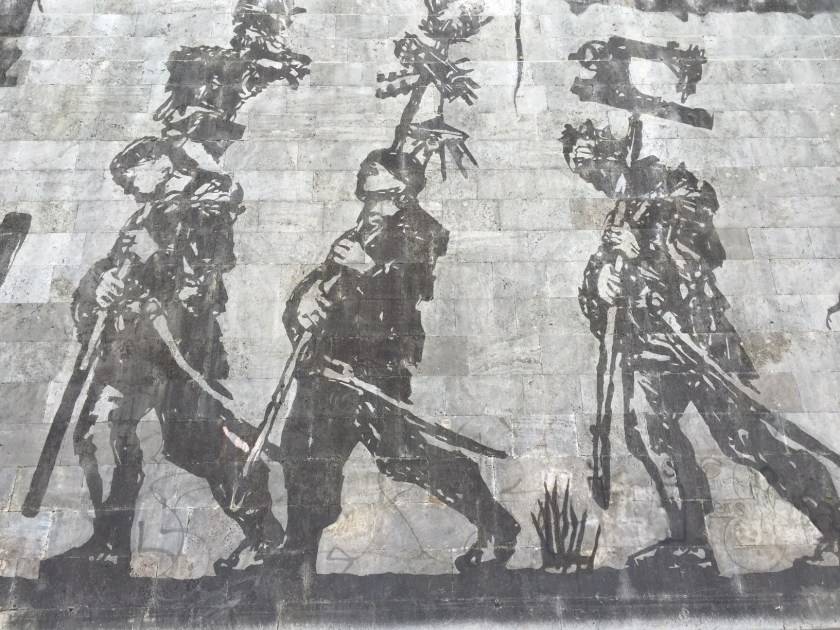
Detail from Triumphs and Laments by William Kentridge (Rome, 2016)
All of this has me thinking about my own first questions, and what actions the world—at home, work, in community, and globally—needs from me now.
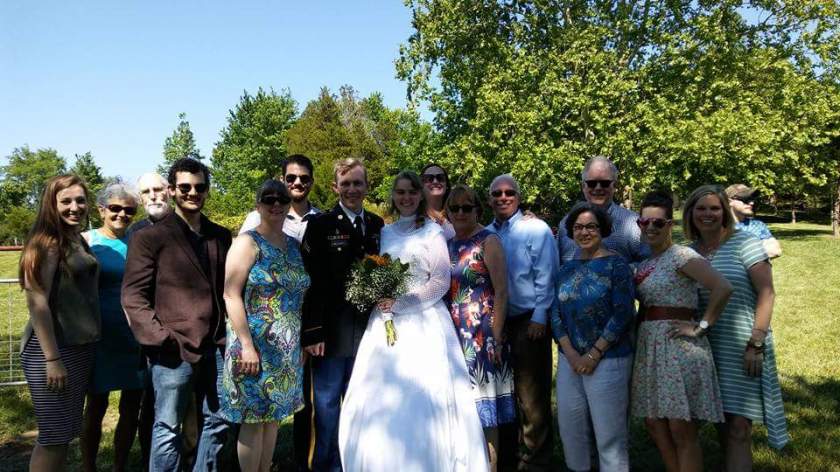
After three family funerals in the past eighteen months—two of which came much too early in the lives of those we lost—the Brown family was able to come together this weekend for a family celebration.
We gathered at my brother Joe’s beautiful Cripple Creek farm on a sunny and cloudless spring day to celebrate the wedding of our niece, Erin, and Jonathan Belcher.
The bride looked beautiful in the wedding gown she had made by hand (over 53 1/2 hours!). The bluegrass music for the reception covered the countryside. The children of our other nieces played games and ran through the fields and around the pond.
A good time was had by all.
It is nice to remember the cycle of life continues in a year when we’ve said goodbye too many times. So on this Mother’s Day, which falls on the one-year anniversary of my father’s passing, here’s to Erin and Jonathan and to the resiliency of family and love.
I had two meetings yesterday in Harlem. Fortunately, the second one was over lunch at the Red Rooster.
Oh my!
Deviled eggs to die for. Homemade lemonade. Cornbread that “came from heaven” according to our wonderful waitress (and her sense of direction was pretty good). My main dish (an appetizer) was described on the menu as:
Yep, Chicken & Waffles circa 1930
Smoked maple syrup, salsa poblana, b&b pickles
I pretty much licked the plate clean. And I had a side of Spring succotash to boot: asparagus, favas, peas, corn, crispy shallots. Man, nobody does lima beans like people whose culinary traditions come from the South.
Not familiar with the Red Rooster? Don’t worry. Neither was I. But my assistant (who gets bonus points for this find), knew of it and also knew it was steps away from where the first meeting took place. So that’s how Howard Zar—the director at Lyndhurst—and I ended up chowing down at the Red Rooster. Just your typical Jewish New Yorker and transplanted southerner hanging out together over great food.
Here’s the Red Rooster story:
Located in the heart of Harlem, Red Rooster serves comfort food celebrating the roots of American cuisine and the diverse culinary traditions of the neighborhood. Named in honor of the legendary Harlem speakeasy that attracted neighborhood folk, jazz greats, authors, politicians and some of the most noteworthy figures of the 20th century such as Adam Clayton Powell Jr., Nat King Cole and James Baldwin.
Co-Creators Andrew Chapman and Marcus Samuelsson have long wanted to open a restaurant that would have a positive impact on the neighborhood’s culinary landscape and its community at-large. At Red Rooster we want to share the story of Harlem with our guests, and offer a platform to celebrate local artists, musicians and culinary talents. We embrace today’s Harlem with a spirit of inclusiveness and community by hiring our family of staff from within the community; inspiring better eating through neighborhood cooking classes; and buying from local purveyors.
Harlem is a unique and historically rich neighborhood that we are honored to be a part of. We invite you to please join us uptown and share in the spirit of Harlem at Red Rooster, where Chef Marcus Samuelsson brings his passion for food to the neighborhood he calls home.
I wrote to Andrew, Claire, and Candice afterwards and said that I might need a cleanse after this meal. Claire said it is okay to indulge every now and then. (I love my daughter.) What she didn’t know is that we head to Tennessee today…where a healthy food cleanse is pretty near impossible with my family.
(Note: I made the following remarks at the funeral of Dr. James K. Huhta on Monday, May 8, 2017, in Murfreesboro, Tennessee. Jim was the founder of the Historic Preservation Program at Middle Tennessee State University, an early mentor in the field, and—along with his wife Mary who died 11 months earlier—a dear friend.)
I thought I would start my remarks with a history joke…but they’re all too old.
Feel free to groan, because I will keep on with the bad puns and jokes if you don’t. Just as Jim would have done.
In recent days, I have talked with people who knew Jim from all walks of life. We all acknowledge the deep pain of the past year to the family, friends, and this community. But like these friends and colleagues, I want to reflect today on his many accomplishments and his impact on others, before the inexplicable challenges of recent years became too much for him to bear.
Several people recounted how Jim’s optimism for the future set them on a path which they only now recognize as life-changing. His leadership positions in the preservation field were mentioned time and again. Some had personal stories of Jim, Mary, Becky and Suzanne.
But every single person I spoke with mentioned the puns.
It was the articulate humor “with which he approached all of life’s challenges,” as his Advisory Council colleague Tom King phrased it, that was the endearing feature that touched all.
Longtime U.S. Congressman Bart Gordon, who worked closely with Jim on what is now this city’s nationally regarded greenway system, told me that Jim’s most lasting accomplishment was “Holding the world’s record for most puns made as chairman of the Greenway Commission.”
I think Bart was only partially kidding.
Peabody award winning journalist Krista Tippett has written about the link between a sense of humor and wisdom in her book Becoming Wise. She says,
“I have yet to meet a wise person who doesn’t know how to find some joy even in the midst of what is hard, and to smile and laugh easily, including at oneself….There is a science helping us to see a sense of humor in the brain as an expression of creativity, making unlikely connections, and leaning into them with joy.”
The Jim Huhta I want to remember today had a wise sense of humor and a wisdom that made unlikely connections, which he leaned into with joy. His professional accomplishments were numerous. He was one of the pioneers of preservation education, a visionary working in a multi-disciplinary history program at a time when many of the other schools in this field were focused solely on preservation through an architecture and architectural history lens. Jim once told a reporter for the Nashville Tennessean that “historic preservation is history outside (the) classroom, and it seeks to use our cultural heritage in a variety of ways…for future generations.”
As a pioneer in the field, Jim was sought out for leadership positions here in Murfreesboro, in Tennessee, and across the nation. Locally, he chaired projects to restore the Rutherford County Courthouse as well as open the Stones River and the Lytle Creek Greenways. Jim and former Mayor Westbrooks were the driving forces behind the bicentennial project at Cannonsburgh.
At the state level, Jim authored the plan for a National Heritage Area on the Civil War in Tennessee. When opportunities arose at the national level, Jim was there as well. He was a founder and early chair of the National Council on Preservation Education, served as an Advisor to the National Trust for Historic Preservation and on the board of the National Center for Preservation Technology and Training, and was appointed by President Bill Clinton to two terms on the President’s Advisory Council on Historic Preservation.
Jim’s record of accomplishments runs to five single-spaced pages and is a testament to his vision, his indefatigable energy, his love of people, his sense of public service—and his wisdom.
But I want to focus on the intersections of Jim’s life. Just as thriving Main Streets or exemplary historic sites are dynamic places where past, present, and future meet in a variety of ways, Jim Huhta lived those intersections of past, present, and future in a very personal way.
Jim had a family heritage that he loved to showcase. It didn’t take long to figure out that Jim was the son of first-generation Finnish immigrants. Usually that information would come out after he told you not to fly on a Finnish airline, because he heard that they sometimes disappeared in Finnair.
I know of students who took pilgrimages to Ashtabula, Ohio, simply because they heard him talk incessantly about his hometown.
But Jim knew that not everyone had a way to connect to their personal past, so he worked hard to get people to look — and treasure — what was around them. In that same Tennessean interview from 1980, he noted that “Most of us have very little feeling for family, community, and local history. But if we would look at the history closest to us, we would have more pride in our communities.”
Jim wanted to know about your past, but more importantly, he wanted you to know about your past.
Understanding the past is important, but only if it connects and is relevant to the present and the future. How one lives right now in community was central to Jim’s understanding of preservation and public service. One colleague who worked with Jim spoke to the “broadmindedness and focus on community” that he brought to historic preservation.
I saw this personally, as Jim pushed this young undergraduate to tackle challenges out in the real world. While students who came into his classroom were often scared by the large pile of books and multi-page syllabus he displayed on day one, once he weeded out those who didn’t want to work, Jim quickly led those who were left out of the classroom and into the community. He had a very robust sense of public service, and Jim worked to instill that same value in those he taught.
But the past and present are still missing a key component if we do not see their connections to the future. I have been working with colleagues across the country on the occasion of the 50th anniversary of the National Historic Preservation Act to prepare a vision for preservation’s future. In reviewing this work, I’m pleased—but not surprised—to see how much of this vision comes from what I learned 40 years ago from Jim Huhta.
A preservation movement that puts people first is right in line with Jim’s insights that places from our past, reused today, have positive impact on our spiritual, social, and economic well-being in the future. Jim also believed—and lived it in his life and work—that a people-centered preservation movement hears, understands, and honors the full diversity of the American story.
As he talked about Becky and Suzanne, and later his granddaughters Olivia and Catherine, Jim made it clear that he was working at the intersection of the past and present for future generations — future generations where he had a strong and loving personal investment.
People were central to Jim’s life and work, as those of us who made frequent visits to see Jim and Mary at the yellow house can attest. He had a familiarity with people from the past—including those who had often been under-represented—that has resonance today.
As the writer Rebecca Solnit has suggested in writing about indigenous communities, “The people consigned to the past have emerged as our best hope for the future.” With his work to ensure that the lives and stories of those associated with places such as the segregation-era Bradley Academy were not lost, Jim clearly grasped and shared this concept.
My recollections of Jim always include the people he loved the most—Mary, Becky, and Suzanne—and a wide, generous view of family. Like many students after me, I spent hours talking not just with Jim, but with the family. Jim hired me to help with the landscaping at the yellow house while I was in school, and since he knew that my parents were Baptist teetotalers, he always offered up a beer after the job was finished. When I moved away from Murfreesboro, my mother—who worked at Linebaugh Library where Jim and Mary were among her most faithful clients—would all but encourage me to make a run over to the yellow house when I returned for a visit, so I could enjoy an adult beverage and get caught up on what Jim and Mary were doing. In later years, I would hear of how the Huhtas stopped by to chat politics with my father at his regular table at the City Café. For me and many others, Jim would write exemplary letters of recommendation that would make you blush, but after he sent them off he would bring it back down to earth by telling a bad joke or three. In his own way, Jim let you know that he understood you as a person with a past, present, and future that he embraced and celebrated.
This is a family to which I am clearly indebted, and to which I hold close as they struggle to make sense of that which cannot be understood on this side of life. I can only say that Jim’s life included a large measure of work to hold both people and place dear.
To paraphrase the writer Madeleine L’Engle, these are places filled with people living over centuries of time. Places where a richness of experience permeates the rooms and life is lived to the utmost. Where we experience birth and death. Joy and grief. Laughter and tears. And bad puns.
Jim’s life was meaningful, consequential, and full of wisdom for a better future. And now, the fullness of that life will be in this place and in all of us. May both Jim and Mary rest in peace.
In a recent email exchange with some colleagues, I made the mistake of relying on my memory for a budget number instead of first checking our documents. When the mistake was corrected by another on the email trail, I made the excuse that I was working from memory, and added that I should remember not to rely on my memory. A colleague with a very dry wit responded with the quip, “It’s hard to remember not to rely on your memory.”
He had me there.
I’ve written in the past that, “Memory is a poet, not a historian.” When you need things like budget numbers, we call upon the historian part of the brain, to make sure the figures are correct.
But in many instances memory—and especially the poetry of memory—is crucial. Max DePree writes of the times when memory and storytelling come together in powerful ways. He does so to differentiate between what he calls scientific management and tribal leadership. “Every family, every college, every corporation, every institution needs tribal storytellers. The penalty for failing to listen” to these storytellers, says DePree, “is to lose one’s history, one’s historical context, one’s binding values.”
I have heard several excellent examples of storytelling in recent weeks that helped me understand the historical context that was at the heart of the message. At last week’s Main Street Now conference, Bill Peduto—the mayor of Pittsburgh—spoke in easily understood language that told you about the city he leads and loves. When he says, “The city of Pittsburgh produced more steel in World War II than Japan and Germany combined,” one learns so much more than just the annual steel production numbers in western Pennsylvania. You learn about the character of the people.
Stuart Graff, the CEO of the Frank Lloyd Wright Foundation, was engaged in tribal storytelling at the celebration of the Painted Desert National Treasure two weeks ago when he said that Wright stressed that one should “Study nature, love nature, stay close to nature. It will never fail you.” Stuart—speaking primarily to a group of conservationists and preservationists—was making the counter-intuitive case for taking a different perspective when looking at modernist structures in natural settings, such as national parks. My National Trust colleague Tom Mayes, in his Why Do Old Places Matter?series, participates in a type of tribal storytelling to remind us of the values around the work we do. It’s not just about the buildings.
There are times when we will all be called upon to reflect on people, work, and values we hold dear. Remembering (if we can) to rely on the poetry of our memory helps us turn those reflections into storytelling, which then helps us connect to our history, our historical context, our binding values.
I’ve mentioned before how much I have learned from the book Leadership is an Art by Max DePree. Events in my life are leading me back to reference this work. I want to share some thoughts from this book, beginning with DePree’s writings on intimacy and work. The former CEO and Chairman of Herman Miller, Inc. begins his chapter on the subject by saying, “Intimacy is at the heart of competence. It has to do with understanding, with believing, and with practice. It has to do with the relationship to one’s work…intimacy with one’s work leads to solid competence.”
Intimacy—in DePree’s view—is the “experience of ownership.” One arrives at intimacy with one’s work out of “difficulty or questions or exasperation, or even survival.” And this intimacy “affects our accountability and results in personal authenticity in the work process. A key component of intimacy is passion.” Working through difficult situations to reach a sense of ownership of one’s work—and life—is something to which we can all relate.
“Superficiality in a special way is an enemy of intimacy. When one thinks carefully about why certain people who are competent, well educated, energetic, and well supported with good tools fail, it is often the red thread of superficiality that does them in. They never get seriously and accountably involved in their own work.”
DePree also focuses on ambiguity and change. He notes that “We find intimacy through a search for comfort with ambiguity. We do not grow by knowing all of the answers, but rather by living with the questions.” I love that idea of being comfortable with ambiguity and growing through our living with the questions. This is important because “Three of the key elements in the art of working together are how to deal with change, how to deal with conflict, and how to reach our potential.”
Let’s think about how we can ask the questions and search for the answers together. Have a good week.
It is the time of year when we are aligning budgets and strategic plans across our organization in anticipation of the new fiscal year. Some look at these times in an organization’s year and instinctively call for changes in practice, following the dictate that change is hard, and yet necessary.
In their work Great by Choice, authors Jim Collins (of Good to Great fame) and Morten T. Hansen tackle this question by looking at differences in how very successful (what they call 10X) companies and a list of comparison organizations change their basic operating practices over time. They found that the 10X companies had clear practices that allowed them – even in times of great disruption – to continue to “do the same thing that you are already doing well, and over and over again.” The authors explain further by saying,
“Conventional wisdom says that change is hard. But if change is so difficult, why do we see more evidence of radical change in the less successful comparison cases? Because change is not the most difficult part. Far more difficult than implementing change is figuring out what works, understanding why it works, grasping when to change, and knowing when not to.”
I’ve just spent a weekend with several colleagues at our National Trust Council weekend – a time when we gather with some of our most generous financial and programmatic supporters and talk about the work we undertake. In the course of the weekend, one long-time member – who has watched our work carefully since the early 2000s – told me that our laser-like focus in the last seven years on tackling important issues at national treasures, reimagining the role of historic sites, and deepening our research around the role played by older places in revitalizing cities – is both evident and refreshing. Too often she saw organizations shift priorities and programs from year-to-year, in search of the next new thing. She was saying, in essence, that we are figuring out what works, understanding that dynamic, and being very thoughtful about whether or not to change.
This is good advice both for organizations and individuals. How many of our friends and family members do we know who follow the nearest fad. Instead of going down that path, let’s strive to do the hard work: figure out what works, understand why it works, grasp when to change, and know when not to.
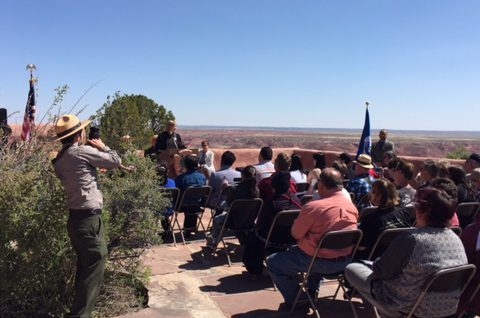
Judge Fine presides over the naturalization ceremony at the Painted Desert Inn
Sometimes you find yourself in the right place at the right time.
Last Wednesday I was in Arizona for work at the Petrified Forest National Park. But first, a colleague and I attended a naturalization ceremony that the park hosted at the National Historic Landmark Painted Desert Inn for nine new citizens and their families and friends.
It was Americana at its best. No, it was more than that. It was deeply moving as nine people made a life-changing decision to establish a new home in a new land.
A local girl scout troop – with a diversity that “looked like America” – acted as the color guard. The Honorable Deborah M. Fine, other federal officials, and Park Superintendent Brad Traver, made remarks that got to the heart of the privilege and responsibilities of citizenship. Several speakers noted that there was no better place to become a U.S. citizen than a national park – America’s “best idea.” A recording of America the Beautiful took your eyes to the desert and the spacious skies, bringing chills to the bone.
The beautiful Painted Desert
The view of the Painted Desert from the Inn
My colleague Brian turned to me and said, “Is there a better place to sing America the Beautiful?” Nope. I wish we would stop singing God Bless America at all these sporting events and sing America the Beautiful instead. It is so much more inspiring.
In this day and age when we often demonize immigrants, it was refreshing to be part of a celebration of immigration. Nine new citizens from eight countries, coming together as one.
A few weeks ago I wrote about the blessing of silence, meaning “quietude” as opposed to the “silencing of voices.” Rebecca Solnit, in her most recent collection of essays entitled The Mother of All Questions, notes that silence is crucially different from quietude. The latter speaks to the absence of noise – which is sought – while the former speaks to the absence of voice, which is too often imposed.
Little did I know that the Friday before my last post on this topic, the Harvard Business Review had published an article entitled, “The Busier You Are, the More You Need Quiet Time.” My colleague Barb Gibson sent along the HBR article which began with a quote from writer Ta-Nehisi Coates who argued that serious thinkers and writers should get off Twitter, in a call to “get beyond the noise.” It isn’t just writers who suggest that periods of silence are valuable. Medical researchers have found that “taking time for silence restores the nervous system, helps sustain energy, and conditions our mind to be more adaptive and responsive to the complex environments in which so many of us live, work, and lead.” Real sustained silence, the kind that “facilitates clear and creative thinking, quiets inner chatter as well as the outer.”
The HBR article provided some practical steps to facilitate silence, including using five minutes at the end of meetings for a period of silence, taking the occasional afternoon off for a silent walk in nature, and going on a media fast for several hours or a full day.
Cultivating silence can increase our chances of “encountering novel ideas” and discerning “weak signals” from the constant verbal agenda that goes on in our head. It isn’t easy, but cultivating silence in our lives can be done with some creativity and commitment.
Many celebrate this season as one of renewal, rebirth, and redemption. Quietude can be a great way to focus on those themes in meaningful ways.