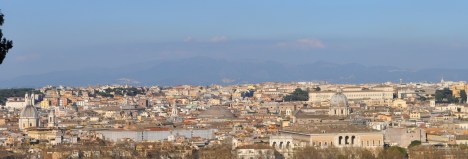
Last week I was fortunate to join the most remarkable retirement celebration I’ve ever attended. Paul Herman, the Head of the Lower School at St. Albans here in Washington (where my son is an alum), was celebrated for 44 years of service. There are many wonderful things I can share about Paul, but I’ll stick to one example. Each day he stands outside the school and greets every student by name, gives them a firm handshake, looks them in the eye, and offers up an encouraging word (or a reminder to tuck in a shirt tail). If he doesn’t remember a name after the first week, he pays the student a dollar. Suffice it to say he rarely has to pay. Candice and I hadn’t seen Mr. Herman in at least four years, but as we were next in the receiving line he looked up and said, “Great, here come the Browns” and gave us a warm greeting. He has an amazing gift to make people feel included and welcome.
The center nave of Washington National Cathedral was packed with those saluting Mr. Herman, and the service for thanksgiving was filled with exceptional readings and reflections. The one that struck me the most was the final reading, from “On Light and Worth: Lessons from Medicine,” by Bernadine Healy, M.D. It was given on May 29, 1994 as part of a commencement address at Vassar College, and I would like to share it with you.
“As a physician who has been deeply privileged to share the most profound moments of people’s lives, including their final moments, let me tell you a secret. People facing death don’t think about what degrees they have earned, what positions they have held, or how much wealth they have accumulated. At the end, what really matters is who you loved and who loved you. The circle of love is everything and is a good measure of a past life. It is the gift of greatest worth.”
At this time when we are too often reminded that life is short, look for a way to share your gifts, and have a good week.
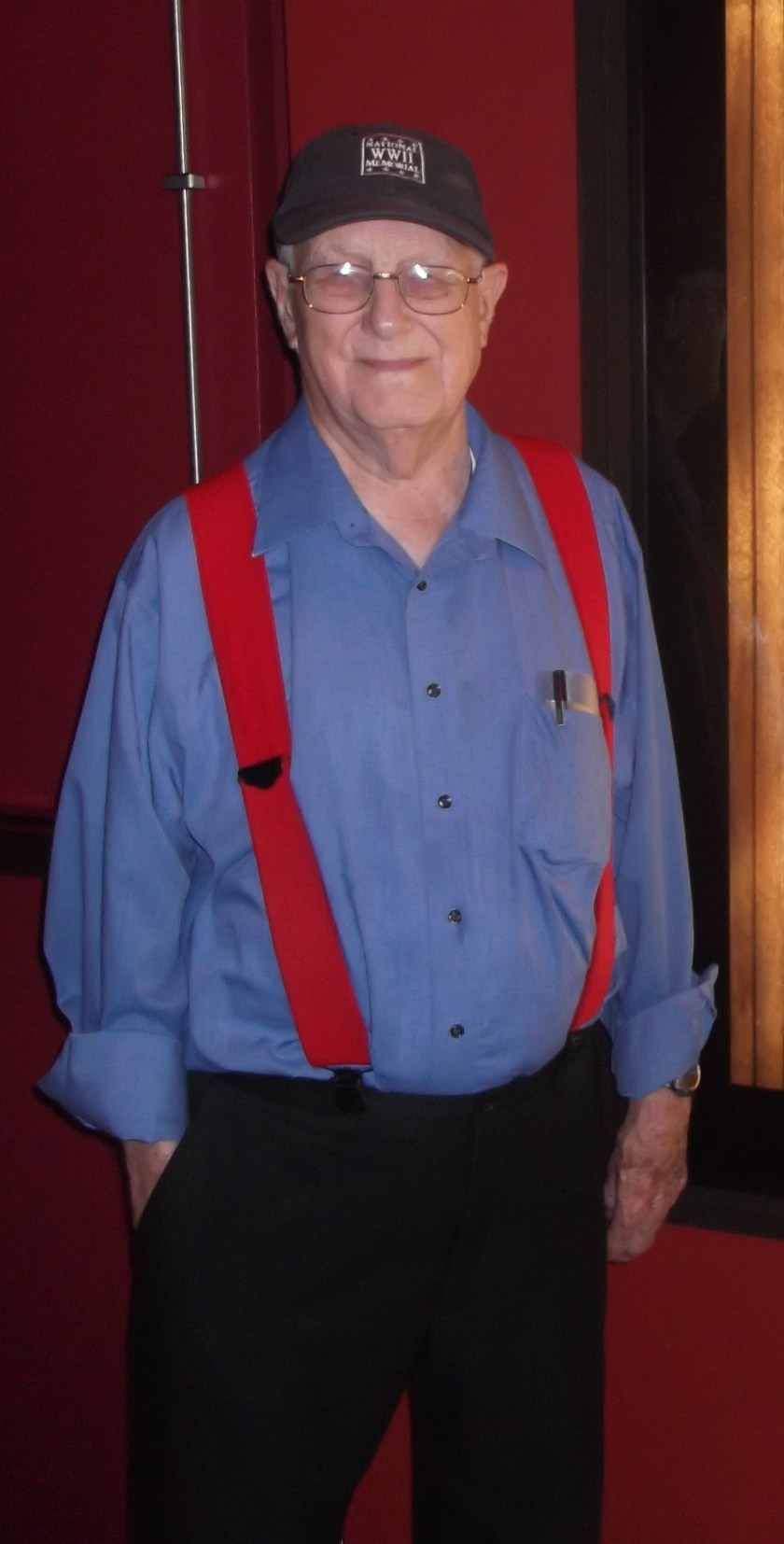
Thomas Bearden Brown, after 90-plus years of a life exceptionally well lived, passed away earlier this morning. We will miss the laughter, wisdom, care and love of our father, father-in-law, and granddaddy more than can be expressed.
Daddy learned from the best. His father was a gregarious, loving man who never met a stranger. His mother was gracious, thoughtful, hard-working, and fair. Daddy had the best of those traits and if I don’t always exhibit them, it wasn’t for his lack of service as an example.
Daddy believed in serving his country, and as a World War II veteran he’ll have a flag draped across his coffin next week. A life-long New Deal Democrat, he believed in treating everyone fairly – whether they looked like you, thought like you, or held the same values as you. He never de-humanized anyone, and when I last spoke with him less than two short weeks ago, he was lamenting the level of our political discourse. Daddy could disagree with you, but he never disparaged you. (Well, maybe he did disparage Donald Trump a bit, but that could be forgiven.)
I think that’s what I’ll remember about Daddy the most. He tried his best to teach each one of us that everyone was human and deserved respect. Daddy and Mom expected us to use Mr. and Mrs. when speaking with African-American men and women in the 1960s, even though most of our friends used first names, if that. He loved history, but he understood that heritage is just history without the difficult parts, and he knew the difficult parts were real. Daddy and Mom took in Asian immigrants who came to Murfreesboro and treated them as family. I remember him giving food and money to street people, just as his mother had done years earlier at her boarding house, to help them get back on their feet. He believed in paying his fair share of taxes because we lived in community, and not everyone had the same benefits that we did growing up white, middle class, and privileged in ways we could not even understand. And when our gay son and transgendered nephew told their grandfather — in his late 80s at the time — of their life journeys, he may not have always understood, but he always told them that he loved them as much as he did any of his other grandchildren.
I’ve already said much about my father that I wanted to say when I posted 90 things about the wonderful life of Tom Brown to honor his 90th birthday last July. Here are just a few that describe my father to the core:
Tom Brown with his children (clockwise from upper left) Joe, Steve, Debbie, David, and Carol on July 5, 2015 – his 90th birthday
Allowed all five of his children to grow into the people they are, instead of trying to force us into any preconceived molds. The consternation we each caused our parents in different ways and at different times (except for Debbie, who was always the perfect child) must have been hard to live through. But he stuck with his principles.
Keeps his mother’s memory alive by sharing stories and sayings that he remembers from his childhood. One of my favorites (which I remember Grandmother saying to me on occasion) was “Make yourself useful as well as ornamental.”
Has a very high respect for women and always treats them as equals. One of the things of which Daddy was most proud was the fact that Mom was the first female deacon in the history of First Baptist Church.
Lives with a wonderful understanding of grace. He told us at one point that his mother’s favorite Bible verse was “For by grace are ye saved through faith; and that is not of yourselves: it is the gift of God: Not of works, lest any man should boast.” Ephesians. 2:8-9. In the note to our family, he said that his mother often quoted it to him, and it had the most impact on his life.
My father always loved gospel music – and especially black gospel music. In his 80s he took a two-year sabbatical from his life-long Southern Baptist Church to attend the local black Baptist Church because it had a little spirit! And he would love Mavis Staples and Aretha Franklin’s take on Oh Happy Day, because he believed – in the depths of his soul – that Jesus “Taught me how to watch, fight and pray.” He did each of those through 90 wonderful years.
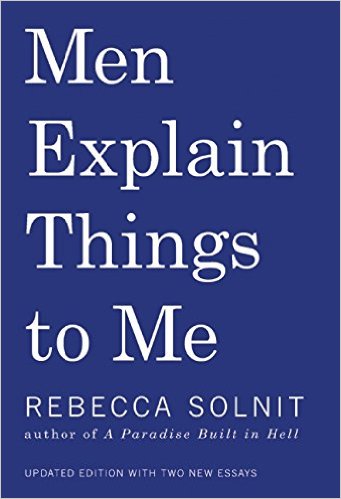
I just completed reading a thoughtful collection of essays by the writer Rebecca Solnit. Titled after the first in the collection and her best-known essay – Men Explain Things to Me – these nine pieces written between 2008 and 2014 explore multiple topics including the gender wars and male privilege, the use of violence as a way of silencing speech, abuse of power, a new twist on marriage equality, and more. Through them all, Solnit pushes the reader to consider perspectives that are likely to be outside their comfort zone.
A colleague forwarded the link to the Men Explain Things to Me essay several weeks ago after I referenced Solnit’s book Wanderlust: A History of Walking. (Also highly recommended.) The essay begins with the comic scene of a man explaining Solnit’s most recent book to her – even though he never read anything more than the New York Times book review of her work.
But as noted on Solnit’s website, she ends this essay “on a serious note— because the ultimate problem is the silencing of women who have something to say, including those saying things like, ‘He’s trying to kill me!'”
Each essay in this collection has something important to say and I strongly recommend them all. Solnit is a clear thinker and talented writer. For this post, I want to focus on two specific essays.
In Praise of the Threat: What Marriage Equality Really Means quickly had me thinking, “Of course, she’s right.”
“For a long time, the advocates of same-sex marriage have been saying that such unions pose no threat, contradicting the conservatives who say such unions are a threat to traditional marriage. Maybe the conservatives are right, and maybe we should celebrate that threat rather than denying it. The marriage of two men or two women doesn’t impact any man-and-woman marriage directly. But metaphysically it could.”
Solnit proceeds to examine traditional marriage. For much of its history the laws defining marriage – and the actual practice in much of the world – made the husband “essentially an owner and the wife a possession. Or the man a boss and the woman a servant or slave.”
Solnit ends this piece by writing,
“It’s time to slam the door shut on that era. And to open another door, through which we can welcome equality: between genders, among marital partners, for everyone in every circumstance. Marriage equality is a threat: to inequality. It’s a boon to everyone who values and benefits from equality. It’s for all of us.”
Solnit takes a look at the inexplicable in Woolf’s Darkness. I used this essay when asked to speak to our Professional Development Program participants at work last week. I wanted to make the point that while I am a planner by training (and disposition), some of my most successful experiences (professional and otherwise) came when I left the carefully planned path and identified opportunities outside my comfort zone where I could both contribute and grow.
In this essay, Solnit quotes a line from Virginia Woolf – “The future is dark, which is the best thing the future can be, I think” – as a starting point for a celebration of the unknown.
“As I began writing this essay, I picked up a book on wilderness survival by Laurence Gonzalez and found in it this telling sentence: ‘The plan, a memory of the future, tries on reality to see if it fits.’ His point is that when the two seem incompatible, we often hang onto the plan, ignore the warnings reality offers us, and so plunge into trouble. Afraid of the darkness of the unknown, the spaces in which we see only dimly, we often choose the darkness of closed eyes, of obliviousness.”
A few pages later, Solnit expands on this point:
“I once heard about a botanist in Hawaii with a knack for finding new species by getting lost in the jungle, by going beyond what he knew and how he knew, by letting experience be larger than his knowledge, by choosing reality rather than the plan.” (emphasis mine)
In the final essay in this collection, Solnit writes,
“When the first women’s rights convention was held in Seneca Falls, New York, in 1848, thirty-two of the one hundred signatories to its Declaration of Independence-echoing manifesto were men. Still, it was seen as a women’s problem. Like racism, misogyny can never be adequately addressed by its victims alone. The men who get it also understand that feminism is not a scheme to deprive men but a campaign to liberate us all.”
Amen.
I’ve made a resolution to return to read Men Explain Things to Me once or twice a year, just to keep that clear voice and perspective front of mind.
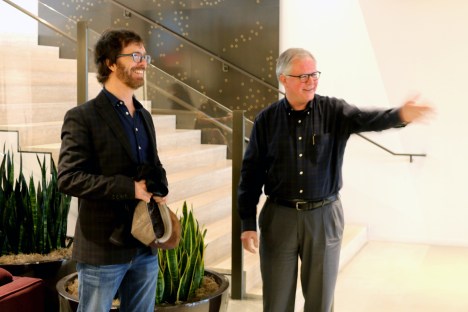
With Ben Folds at the Washington Offices of the National Trust
Even though I already have one of the best jobs in the world, some days at the office are simply better than others. Tuesday was one of those as musician Ben Folds made a stop by the headquarters of the National Trust for Historic Preservation before his concert next door at the Kennedy Center.
The Trust has worked with Ben Folds and others to help save historic Studio A and Music Row in Nashville. I had a chance to meet him first in January of 2015, when we announced Music Row as one of our National Treasures. Ben has been one of the heroes of the fight to save Studio A – telling the story of this place as persuasively as he tells stories in his music.
I had the chance to introduce him to our staff yesterday at our headquarters at the Watergate. I told them that Ben was the early and consistent voice for Studio A, shining a light on this special place when its future was darkest. He was the one who spoke out in the face of Nashville’s rush towards demolition and new development. His consistent voice led our own Tom Mayes to reach out following a concert at Wolf Trap and offer National Trust assistance. Ben saw that a wonderful purpose-built studio with incredible acoustics and a history of creativity that included Willie Nelson, Dolly Parton, Tony Bennett, and The Black Keys also had a future. Thanks to his efforts, that future includes the change of management to producer Dave Cobb and last year’s recording of Traveler by Chris Stapleton – a record that swept every major award and is simply one of the best country music albums, from one of the best country music singers and songwriters, in years.
Finally, I told the staff that Ben helped me realize a life-long dream of a mention in Billboard magazine.
It was great to hear Ben tell his story to our staff and to thank them for all they do for people who want to save special places.
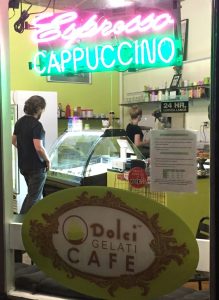
It turns out that the world continued while I was on sabbatical for six weeks. We returned on Monday afternoon and caught up with chores on Tuesday, while simultaneously trying to keep our Italian buzz alive. Pacci’s Pizzeria here in Silver Spring and Takoma Park’s Dolci Gelati Cafe certainly helped in that regard!
In checking the news here in the states, I also discovered a few things that caught my eye.
Baseball season has begun – When I left the country, spring training was underway. As we returned, our Washington Nationals were jumping off to a 12-4 start and are currently in first place in the National League East. I know, I know: it is early. I also know they have feasted on the Atlanta Braves and Philadelphia Phillies. But a win in April is as good as a win in September, and if they expect to do anything this year, the Nats will need to feast on the teams in their division who aren’t very good. I have tickets for Sunday afternoon’s game, and can’t wait.
On the plane ride home from Rome, I was also able to catch my own personal spring training viewing of the movie Bull Durham. Best Baseball Movie. Ever. I’ve watched it dozens of times, and the story of Crash, Nuke, and Annie never gets old. Yes, I did laugh out loud at the quotes, including one of my favorite lines that Annie uses in describing the talented but clueless Nuke (which has the added advantage of being true): “The world is made for people who aren’t cursed with self awareness.”
And this little piece is among my favorite scenes:
[Larry – the coach – jogs out to the mound to break up a players’ conference] Excuse me, but what the hell’s going on out here?
Crash Davis: Well, Nuke’s scared because his eyelids are jammed and his old man’s here. We need a live… is it a live rooster? [Jose nods]
Crash: We need a live rooster to take the curse off Jose’s glove and nobody seems to know what to get Millie or Jimmy for their wedding present. [to the players]
Crash: Is that about right? [the players nod]
Crash: We’re dealing with a lot of shit.
Larry: Okay, well, uh… candlesticks always make a nice gift, and uh, maybe you could find out where she’s registered and maybe a place-setting or maybe a silverware pattern. Okay, let’s get two! Go get ’em.
Priceless! Play ball!
My home state is in the running for the “What are These Guys Thinking?” award – Tennessee, which has NINE state songs, had a group of legislators pushing to name the Bible as the State book. Jeez. What, were they worried that Mississippi was going to run away with this year’s award? Before the Governor vetoed this bill, Gail Collins wrote a classic column:
Amid all the truly awful things state legislatures do, one of the rare bright spots has been the naming of official symbols. Who was ever made unhappy by the designation of a state rock?
Tennessee, alas, is screwing up the record. The governor is currently trying to decide whether to sign a piece of legislation that would put the Bible on the list of State Things, alongside the salamander (amphibian), milk (beverage), honeybee (agricultural insect), raccoon (wild animal), several variations on the theme of state tree and flower, and nine — nine! — official state songs. The last of which, adopted in 2011, was “Tennessee.”
The next question you’re probably asking is why it took nine tries for Tennessee to get a song named “Tennessee,” and the answer is that it actually has two. You have to admit that’s pretty inclusive. On the other hand, picking the Christian holy book as a state symbol seems simultaneously divisive and unnecessary. Not to mention sort of disrespectful to the Bible, which doesn’t usually get included on the same list as the salamander and the smallmouth bass.
My father’s work on earth is not yet done. He needs to fire off another of his classic letters to the editor to the local newspaper reminding his fellow citizens that Baptists (and they are all some type of Baptist in Tennessee) practically invented the separation of church and state (before they decided in the 1980s that they kind of liked bossing around other people who perhaps had different religious beliefs from them).
The endless Presidential campaign continues – No, the election didn’t magically end while we were gone. They are talking about the same things they were when we left. I could write a lot about the campaign, but I’ll just quote from one of my favorite websites: Margaret and Helen – Best Friends for 60 years and counting.
I saw an interview with a gay, black Republican congressman from Georgia who is supporting Rubio. I think that makes him a unicorn. But anyway… The reporter pointed out that Rubio doesn’t recognize the congressman’s relationship with his same-sex partner. The congressman responded by saying that was ok because neither did his mother. Now if that ain’t the dumbest thing I’ve ever heard. Well it was, at least until I watched that debate.
You can’t make this stuff up.
Roots music is alive and well, if a bit quirky – I really missed playing guitar when I was in Rome, but I was glad to at least see a couple of articles about roots music while I was there. Upon my return, the New York Times had a nice appreciation for singer/songrwriter John Prine that I recommend. Prine – who turns 70 this year – has an amazing facility for finding just the right words, on topics serious and not-so-serious. Such as “Jesus: The Missing Years.”
It was raining, it was cold, West Bethlehem was no place for a 12-year-old…”
The world is a strange place, and we depend on writers like Prine to help us through.
A sabbatical should be a time to reflect on the “why” and “how” of life. In trying to extend that reflection into my re-entry into the world of everyday work, I have continued to read outside my usual scope of interest.
In a book I was reading on the train this morning, Edward Abbey — who has been called the enfant terrible of American environmentalism — was quoted as having had some good things to say about walking.
“Walking takes longer, for example, than any other form of locomotion except crawling. Thus it stretches time and prolongs life. Life is already too short to waste on speed….Walking makes the world much bigger and therefore more interesting. You have time to observe the details.“
I love the line “Life is already too short to waste on speed.”
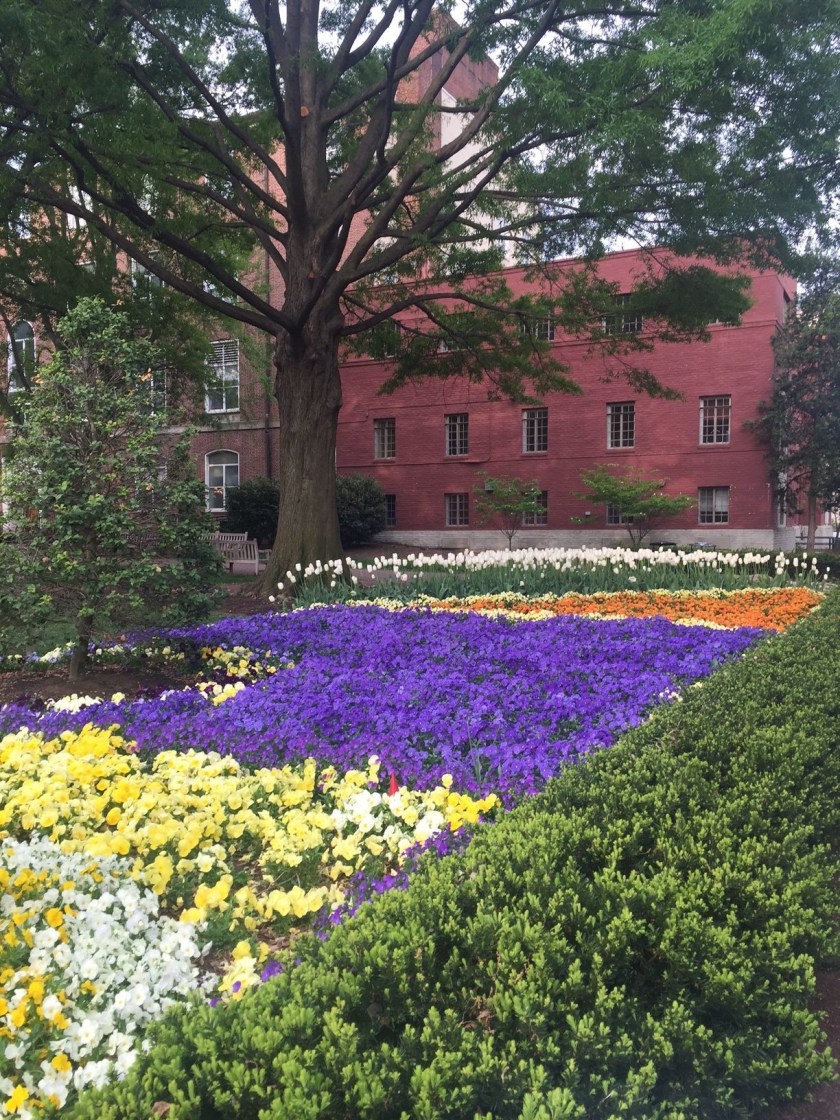
On this morning’s walk to work, I passed the flower beds in the University Yard at GW. It was a reminder to take the time to observe the details.
More to come…
DJB
IMAGE: Flower beds at George Washington University’s campus on H Street, NW by DJB
As we prepare to leave Rome and head home, I have pulled together a few final observations about things we have seen while in this most fascinating of countries. I’ll begin with the serious, and then move on to – shall we say – less serious thoughts that have popped into my head before returning to a final note of thanksgiving. As always, these Observations From… posts are quick and quirky. You’ve been warned!
Grave of Poet John Keats in the Non-Catholic Cemetery in Rome
The Non-Catholic Cemetery is a treasure – Several people told us to make sure we visited the “Non-Catholic Cemetery in Rome” (also known as the Protestant Cemetery), and we are so glad we did. On the day we visited Ostia Antica, we walked across the street from the train station upon our return and spent a good hour roaming through this beautiful space.
Here is a bit of the background, from the cemetery’s website:
The Non-Catholic Cemetery for Foreigners in Testaccio, Rome (to give it its full name) is also widely known as the Protestant Cemetery although it contains the graves of many Orthodox Christians, Jews, Muslims and other non-Christians. It is one of the oldest burial grounds in continuous use in Europe, having started to be used around 1716 (and thus celebrating its 300th anniversary in 2016)….
The Cemetery population is both exceptionally diverse and exceptionally rich in writers, painters, sculptors, historians, archaeologists, diplomats, scientists, architects and poets, many of international eminence….
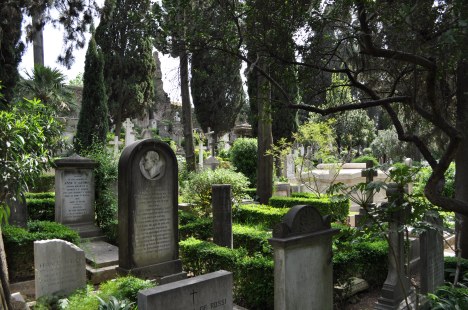
A view of the Non-Catholic Cemetery
Pyramid and Aurelian Wall as seen from the Non-Catholic Cemetery
This is a beautiful urban space, located next to the Pyramid of Cestius (dated between 18 and 12 B.C.) and adjacent to a section of Rome’s ancient Aurelian wall. Cypress trees hover over the site, while the graves themselves are often small garden spaces. The famous are buried here – John Keats and Percy Shelley, most notably – and it is something of a pilgrimage site for artists and writers.
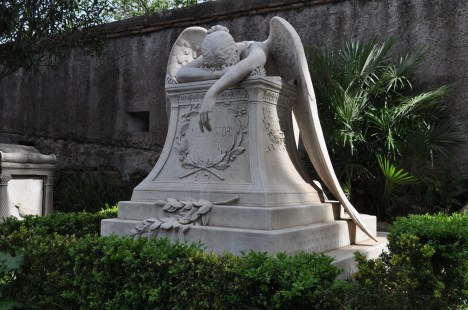
The entire cemetery was lovely, but Candice and I were both mesmerized by the arrestingly beautiful Angel of Griefsculpture by W. W. Story for the tomb of his wife.
Angel of Grief by W.W. Story
Side view of W.W. Story’s Angel of Grief
Story was the best-known American sculptor in Rome for a 40-year period, and this evocative piece was his last. He designed it for the tomb of his wife, who died early in 1895, and he followed her in death later that year. The lightness of this work, the unspeakable grief that is evident on every part of the angel’s body, and the sadness found in features such as the flowers which have dropped from her hand make this an incredible personal statement as well as a moving work of art.
This is a treasure not to be missed in a city full of treasures.
Beauty – When my colleague Tom Mayes was at the American Academy in Rome last year, he worked on a series of essays about why old places matter. They are all worth a read, but I’ve been struck by one in particular while on my sabbatical – Tom’s essay on beauty. He begins with a simple declarative statement.
“Old places are beautiful.”
But as Tom quickly notes, beauty is not a simple topic. Read the entire essay for his thoughtful take on the subject, but this one sentence captures key elements for me:
As I read and talk to people about beauty, a few words and phrases capture the experiences I’ve had—and that I believe other people also have—at beautiful old places: delight, exhilarating surprise, speechlessness, the language of timeless reality, echo of an ideal, sudden unexpected harmony of the body, mind and world.
Throughout our six weeks, I experienced many of these same feelings and emotions and was reminded again and again of the beauty of this old and historic city.
Blessed Ludovia Albertoni by Bernini at San Francesco a Ripa
We have eaten well in Rome – Very well. Perhaps too well. (I’ll know about that last point when I step on the scale at home.)
Spaghetti Verrigni with carbonara sauce and black truffle from Antico Arco
In a city full of good restaurants, we found a few, which I’ll pass along to you in case you are coming to the city.
We found the best pizza at Antico Forno Roscioli, “one of Rome’s best bakeries and among the city’s most historic institutions” according to food blogger Katie Parla. Candice got the recommendation to eat pizza there from Chris, the chef at the American Academy, and we weren’t disappointed.
I wrote earlier about our Easter Day feast at Antico Arco. What I haven’t mentioned is that we’ve returned four times since then, and each meal has been wonderful. They also have a strong wine list. Highly recommended.
Candice and I celebrated our 34th wedding anniversary at Dittirambo, and it was a great place to experience Rome’s passion for food. We also recommend Al Moro, if you want the old-style traditional Italian cooking complete with the atmosphere and waiters to make the experience complete!
We went out in style our last weekend here, taking two more of Katie Parla’s recommendations (get her app “Katie Parla’s Rome” and put it on your iPhone if you are coming to the city). Saturday night we went to Roscioliand we recommend the fried anchovies, among other items on the menu. Then our last dinner (for this trip) will be tonight at Cesare al Casaletto, described as the “best trattoria in Rome!”
Bonus recommendation: If you are in Murano and find yourself hungry, go to Trattoria Busa alla Torre. Outstanding!
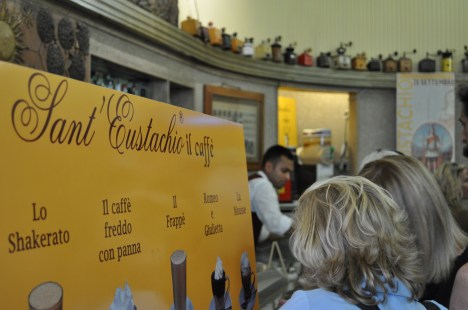
A busy day at Sant’ Estachio il Caffe in Rome
And finally, if it isn’t the best caffè shop in Rome, Sant’ Eustacio il Caffè is certainly the most historic and best known. All four of us made it there, at different times, to sample this Rome tradition.
The greatest American import – Every time I walk past a McDonalds or Burger King in Rome, I cringe, and I’ve just heard that Italy now has its first Starbucks – which is really like bringing coals to New Castle. These folks invented all the stuff Starbucks tries to pass off as coffee.
However, there is one American import that surprised me – and it wasn’t always an embarrassment. There is American music everywhere in Italy. The Italian guy playing electric guitar on the bridge over the Tiber is as likely to be playing Chuck Berry riffs as anything else. We were eating in a small neighborhood restaurant in Venice to the sounds of Ray Charles and obscure Motown artists. 95% of the cab drivers listened to American rock and roll. One told us it was how he learned to speak English!
I would have liked to have heard more local music, but “‘C’est la vie’, say the old folks, it goes to show you never can tell.”
Rome Overview
Grazie – The wonderfulness of this portion of my sabbatical would not have been possible without the help and support of some very nice people. First and foremost, the National Trust for Historic Preservation (which has a sabbatical policy) and my boss, Stephanie Meeks. Stephanie came to me about a year ago and suggested I think about taking a sabbatical. That set the wheels moving toward an Affiliated Fellowship at The American Academy in Rome. The academy’s wonderful staff could not have been more welcoming and helpful. In addition, this time off would not have been possible without the support of my team at the National Trust. They all said, “We’ll take care of things and will ask WWDJBD? if anything actually comes up.” I have had the freedom to focus on other things away from the day-to-day of work thanks to Barb, Tom, Susan, Katherine, Jim, Tricia and Kelly. Several friends and colleagues who have been to the academy in the past – especially Tom, Rod, Eduardo, and Tabitha – gave invaluable advice for getting around the city and country. Others who we know also came through with great suggestions, and we did as many as we could in six short weeks. Finally, Candice and I so appreciate Andrew’s willingness to hold down the fort at home while we were away. It was very comforting knowing that he was taking care of all the mundane chores.
We’ve had a wonderful six weeks. Thanks for reading. Ciao!
More to come…
DJB
Image: My home away from home – the Chiaraviglio Apartments at the American Academy in Rome photo by CCB.
Over the past two weeks, we have visited three distinctive churches that each took our breath away in different ways. The first is rarely seen. The second is seen by almost every tourist in Rome. And the last is one of those masterworks of architecture that really must be seen to be fully appreciated
Each Friday we were at the American Academy, I took part in the “Fellows Walk.” The last of those – for us – took place a week ago Friday and it was titled “The Presence of Absence: The Medieval Roman Forum.” I’ll turn to the AAR’s description of the walk to fill you in on the focus:
Rome brims with a seemingly endless number of sites that loom large in the popular imagination. But how does the imagined city compare to our actual, sensory experience of Rome? This final series of Walks will lead us through a selection of sites — forum, church, neighborhood, villa and garden — designed to provoke a set of distinct, physical experiences. Charting places of sensory input across time, these Walks will encourage us to become aware of the presence of absence, visual perspective, mathematical order, scale, materials, topography, labor, fragrance, temperature, color and much more beyond.
Today’s visit will focus on how we experience Medieval Rome through both the traces — and voids — of this stratum of the city’s history. We’ll concentrate on a series of sites in the Roman Forum, which witnessed some of the early transformation of Rome’s ancient, pagan monuments into places of Christian worship. We’ll begin our discussion on Via dei Fori Imperiali, a Fascist-era road that cut through the Forum and obliterated much of Medieval Rome in the process. From here, we’ll visit three churches that emerged between the 6th and 9th centuries: Ss. Cosimo e Damiano, S. Lorenzo in Mirandola, and S. Francesca Romana. These locations represent the varying degrees to which we can experience the history of Medieval Rome in sites that were once the center of Roman society and culture yet today are rarely open to the public and thus remain a mystery to contemporary residents and visitors alike.
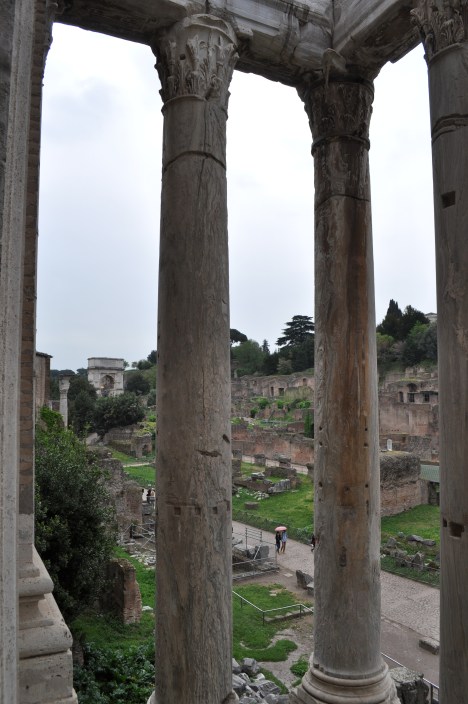
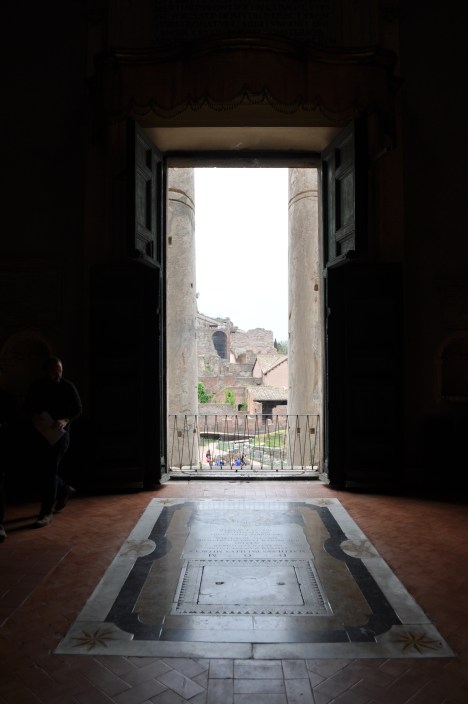
Many people know San Lorenzo as “the church in the temple” in the middle of the Roman Forum. Others know it as “the church where the entrance door hangs in mid-air on the second floor.” Those two things are connected.
Altar in San Lorenzo in Miranda
This is a 17th century Baroque church, but it was originally the Temple of Antoninus and Faustina, built around 141 CE. Over time through the Middle Ages, as the Forum filled in with silt and occupation debris, the floor of the church – and thus the entrance door from the Forum side – was raised to its present location. When archaeological excavations began in the 19th century, there was some pressure to demolish the church to leave only the Roman temple remains. That did not happen, however, and the current church provides one of the most interesting – and seldom seen – views of the Forum.
Forum view from San Lorenzo
The “entrance door” to the Forum from San Lorenzo
The conversation on the walk focused on how the Medieval Forum was lost — intentionally — to the archaeology of the 19th century (with its focus on Imperial Rome) as well as the 20th century fascists changes to the city (which also had a focus on returning Rome to its Imperial glory). Absence is often a very important part of the historical record, as we see here.
Yesterday, Candice and I visited a church that — unlike San Lorenzo — is on every tourist’s “Top 10” list of places to see. That would be the Basilica of Santa Maria del Popolo.
Raphael mosaics in the Chigi Chapel of Santa Maria del Popolo
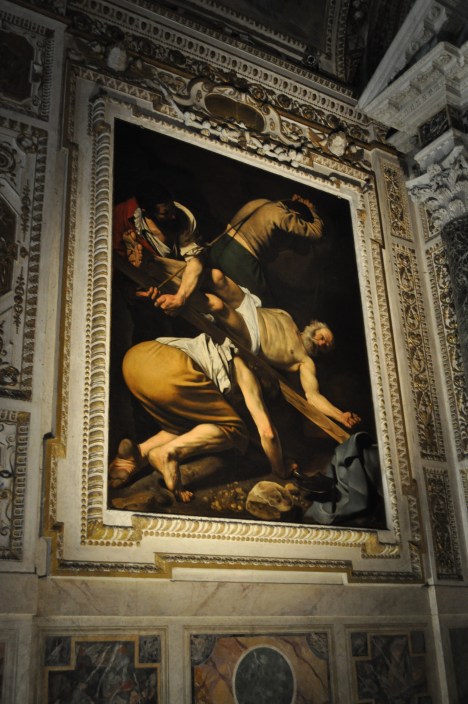
Santa Maria del Popolo is an art museum and a church. Raphael? Check. Caravaggio? Check. Bernini? Check. And that’s only the beginning.
Caravaggio’s “Conversion on the Road to Damascus”
Caravaggio’s “Crucifixion of St. Peter”
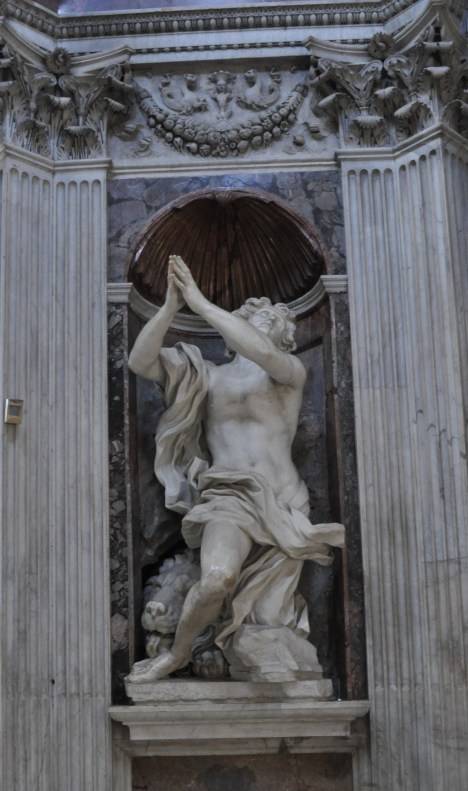
Bernini’s “Daniel and the Lion”
Santa Maria del Popolo
Santa Maria del Popolo — located on the beautiful Piazza del Popolo — is a well-loved church by people of all faiths and no faith. As found in the church’s brochure,
I have always considered Santa Maria del Popolo (Our Lady of the People) as an example, a perfect example of the specific nature of Italian cultural patrimony….
Well said.
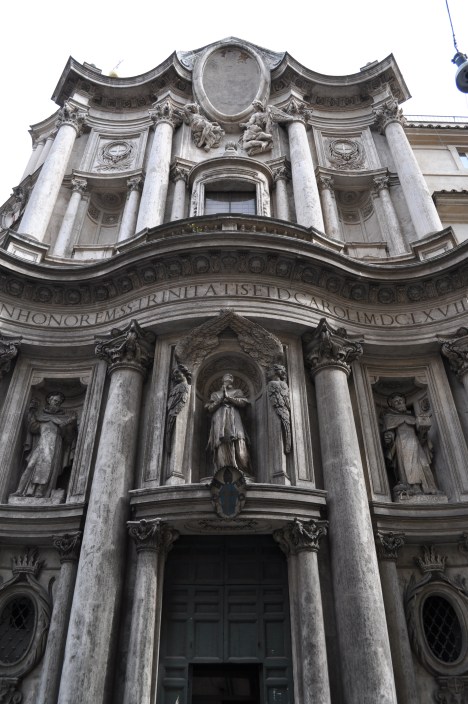
Exterior of San Carlo alle Quattro Fontane
Finally, I want to return to a church mentioned in an earlier post – San Carlo alle Quattro Fontane (Saint Charles at the Four Fountains). This design – a masterpiece of architect Francesco Borramini – is both “extraordinary and complex.” Working with a very difficult site and needing to include a number of elements to complete the architectural program, Borramini came up with a design that works and thrills at the same time.
Altar at San Carlo
San Carlo detail
It is the dome, with its exquisite geometric pattern, that caps this wonderful space and brings it all together.
Dome of San Carlo alle Quattro Fontane
There is more I could show, but my pictures do not do this building justice. So I am going to end this visit to Italian churches with a segment on San Carlo from Daniel Solomon’s Bedside Essays for Lovers (of Cities) – a favorite text.
Borromini was eclipsed for much of his career by the flashier and more charismatic Gian Lorenzo Bernini, and his oeuvre are mostly second-tier commissions – smallish buildings on undistinguished city sites. His greatness is built on surmounting the contradictory demands of these commissions – simultaneous city fabric and monument. Second-tier commissions produced some of the most complex and subtle works of the Western canon…
Never have the ordinary and the extraordinary been reconciled with more sublime elegance than at San Carlo alle Quattro Fontane. Its interior is nothing less than a three-dimensional cosmological map depicting in its intricate geometries and its filtration of light the relationship of heaven and earth. But the sanctuary of San Carlo sits on an unremarkable street corner on the consistent street frontage of via Quirinale, leading to the magnificence of Palazzo Quirinale and Piazza Quirinale a couple of blocks up the street. Mediating between the glories of the interior and the important but subservient role of the exterior is a subtly undulating wall, true to the demands of both inside and out. In this most complex of mediations, Borromini leaves the enduring lesson of how to be both a humble city builder and an architect of thundering power.
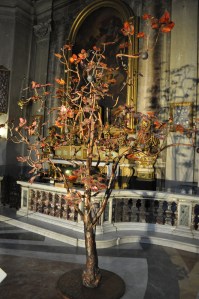
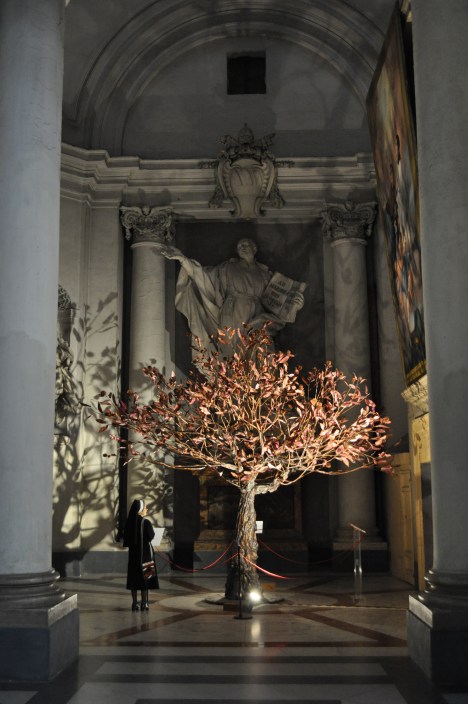
Fig Tree from the exhibit “Laudato si – To the Roots of Life”
I believe it was those sage philosophers Rodgers and Hammerstein* who said, “When the Lord closes a door, somewhere He opens a window.” That describes our Friday in Rome.
After seeing the stunning Santa Maria del Popolo in the morning (more on that later), we had planned to take in the Bernini statue The Ecstasy of St. Theresaat Santa Maria della Vittoria and then walk down the street to see Francesco Borromini’s fantastic San Carlo alle Quattro Fontane. Both were closed. Thankfully, I’ve seen San Carlo (and will try to get Candice there tomorrow). But we were disappointed, and the gelato we had after our picnic lunch only partially brought my spirits back.
However, as has been our practice, when we walk by a church or open historic building that we haven’t seen before, we’ll ask each other, “Do you want to go in?” More times than not, we’ll say “yes” and head in to find some new hidden gem.
We were walking back towards Trastevere when we passed Chiesa di Sant’ Ignazio (the Church of St. Ignatius). The two of us almost walked past it, but we decided to turn back and go inside to see why there was a pretty good crowd of visitors in the doorway.
We are so glad that we did!
As I wrote a little over a week ago, Rome is not only a place for incredible historic works of art, but the city continues to inspire contemporary artists. We stumbled in on a beautiful exhibit of copper, blowtorched and forged by fire, into a series of trees by the artist Settimo Tamanini.
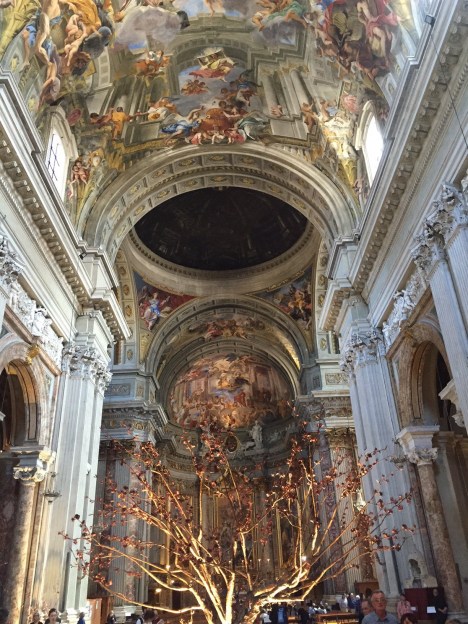
Central Nave with Frescoes in the vaulted ceiling and tree from the “To the Roots of Life” exhibit
When one enters Sant’ Ignazio, the eye is immediately drawn to the Andrea Pezzo frescoes in the vaulted ceiling. But today, that view includes shimmering copper trees, “blowtorched and forged by fire” from the exhibit To the Roots of Life.
This exhibit ties in with Pope Francis’ encyclical Laudato sì on the need to safeguard creation. Eight of the artist’s creations – almond, apple, fig, pomegranate, olive, and chestnut trees along with a burning bush and grape vine – are placed throughout the church, along with short engravings that bring forth commentary and scripture. This moving work softens the architectural space with all its marble and brass. As the exhibition’s curator notes, “…the sculptures of the trees…complete the visual pathway from the frescoes of the vault to the garden, embracing everything and providing an illusory perspective of matter unified and transfigured.”
“To the Roots of Life” in the Sacristy of Sant’ Ignazio
This exhibition is part of the call of an earlier pope to bring contemporary art to the life of today’s church. But these works – as is true with any good art – can be seen from a myriad of perspectives, with or without religious overtones. You can take this work on several levels.
I’ll end with an excerpt from the words of Settimo Tamanini in the exhibit catalog:
…Art, as a way towards Beauty, represents a great challenge and responsibility for contemporary artists: that of offering, through its universal language, a visible image of the fertile and silent activity of invisible Wisdom.
I have drawn inspiration from the tree, already present in the first pages of the Bible and in deep harmony with the Universe.
This is how the “Trees of Great Mothers” fruit trees from Palestine, have been born, powerful sculptures in pure copper wrought through blown flames and fire.
The Garden of Eden which is in us all.
So that, entrusting ourselves to our true Master, we can breathe joy and hope to be given to others.
More to come…
DJB
*(Note for careful readers: I actually realize that this quote is from The Sound of Musicbook by Howard Lindsay and Russel Crouse, but if I had said “Lindsay and Crouse, no one would know what I meant.)
Earlier this week Candice and I found time to visit two sites that have taken us at least as far back as the 4th century BCE and up through the 7th century CE. Both were fascinating while serving as good platforms for thinking about historic preservation past and future.
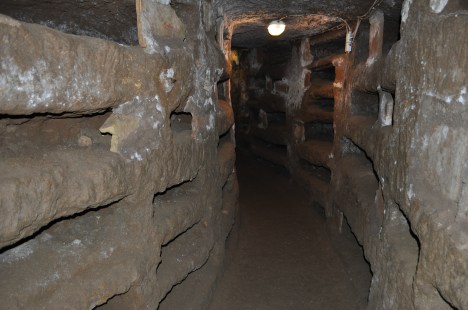
On Tuesday, we walked through our neighborhood to get to the Basilica of San Pancrazio, where we had attended Palm Sunday services three weeks ago. We heard a presentation the night before from one of the fellows at the academy on labor practices in the catacombs, and it stirred us to visit the catacombs under the basilica.
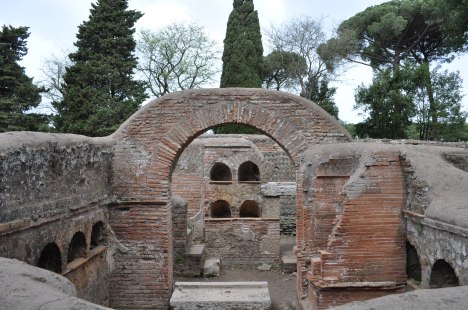
View of the tombs in the catacombs below the Basilica of San Pancrazio
San Pancrazio’s catacombs are one of the few in Rome that have been consistently visited through the ages. The fact that they were not lost over the centuries has been attributed to the fact that pilgrims from the cult of St. Pancras consistently visited the site throughout the Middle Ages.
(Pancras) came to Rome together with his uncle Dionysus after his parents’ death and was decapitated in 304 after refusing to sacrifice to the gods. His body was abandoned on the Via Aurelia and was picked up by a Christian matrona, Ottavilla, who buried him in the closest graveyard, that she probably owned. (Wikipedia)
Jenny – whose talk inspired us to visit this set of catacombs – mentioned that this particular site was small but had many of the features found in larger tombs. For a simple definition, catacombs are “human-made subterranean passageways for religious practice. Any chamber used as a burial place is a catacomb, although the word is most commonly associated with the Roman Empire.” Built by “fossors,” the catacombs predate the Christian era. The early Roman custom was cremation, with the ashes placed in a columbarium (of which there are early examples), but Christians tended to favor inhumation, due to the belief in the bodily resurrection at the Second Coming of Christ.
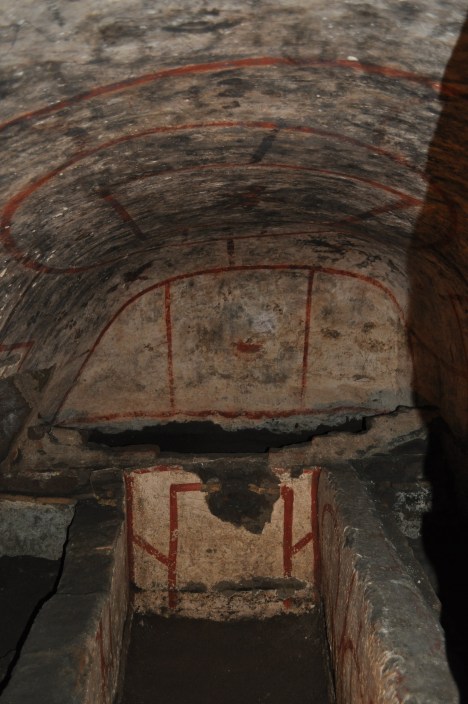
Detail from a chamber in the catacombs of San Pancrazio
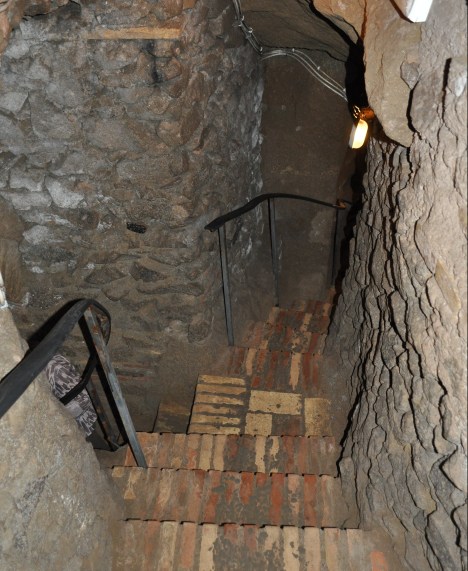
We met up with the volunteer guide inside the basilica. He spoke very little English and we spoke no Italian. However, he was so pleased to be showing the catacombs to visitors and we were so excited to have the opportunity, that we worked through the language barriers and had a very informative tour. Lesson #1 for historic sites: have a knowledgeable and enthusiastic guide and you can overcome communication barriers. The catacombs are entered by a door in the basilica floor, located between the nave and a side aisle. Very steep stairs took us down underneath the basilica to the remarkable remains of this early Roman burial site.
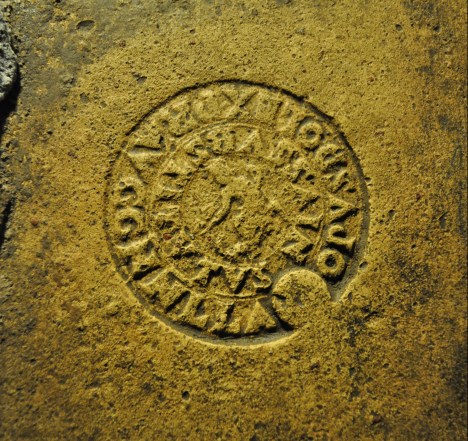
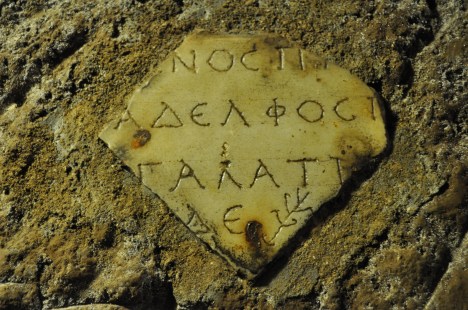
A marker found in the catacombs of San Pancrazio – which our guide identified as the sign of the fossor who dug the graves
Marker detail
We were able to call up information from the site’s Wikipedia page, and that material – along with Jenny’s talk the night before – helped us fill in the tour and ask intelligent questions of our guide. In this part of the catacombs, we visited:
the cubicle of Botrys, from the name of the decedent buried in it: the peculiarity of this grave is that, on his headstone, Botrys declares himself as a christianós, an unusual expression in the Christian graveyards;
the cubicle of Saint Felix, dating back to the end of the 3rd and the beginning of the 4th century, decorated with a linear red style and elements referring to the sea (ships and fishes);
the cubicle of Saint Sophia, housing a white-plastered arcosolium with four graves, that are believed to be the martyr Sophia and her three daughters’. (Wikipedia)
Catacomb tunnels
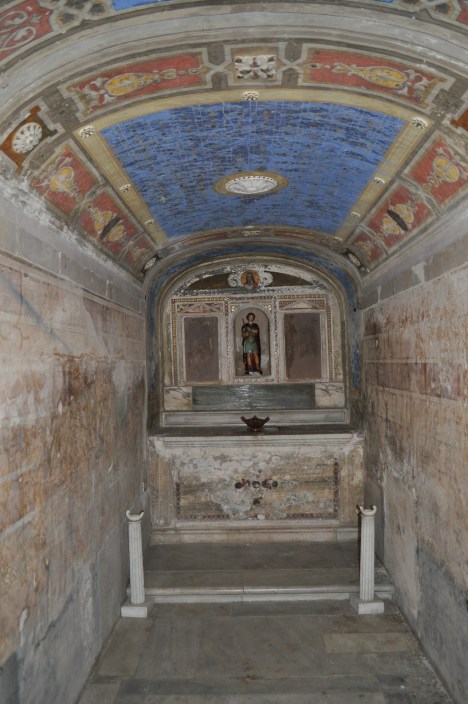
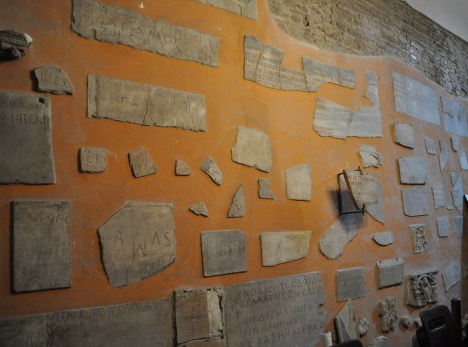
Following our tour, the guide asked if we wanted to see the crypt where the patron saint was buried (his remains having been moved there in the 7th century for easier access for the pilgrims). We quickly agreed, and he led us into a tunnel in the apse that led to the crypt, which is under the altar, followed by a visit to the sacristy which included a wall of ancient inscriptions and markers.
Crypt of St. Pancras
Wall of the Sacristy
Candice and I found this entire experience to be delightful. Befitting the setting, we were reverential yet inquisitive. Our guide could not have been more welcoming, wanting to ensure that we understood what we were seeing. He also encouraged photographs, so that we could capture this place for future memories. While not one of the major catacomb tours in Rome, it certainly captured and held our interest for the 90 minutes we spent at the basilica.
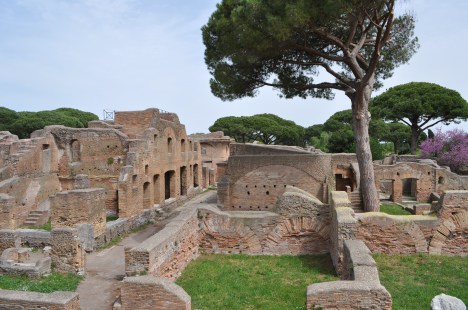
View of the excavations at Ostia Antica
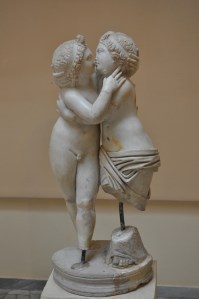
Amore e Psiche from the Ostia Antica archaeological museum
Yesterday, we took the Roma-Lido train (think Washington Metro with better service and more graffiti) for the 20-minute ride to the archaeological excavations of the ancient town of Ostia Antica. This was the harbor city for ancient Rome, located originally at the mouth of the River Tiber. (Due to silting, it is now three miles from the sea.)
We spent over three hours on-site and could have spent more if we’d had the time. As you’ll see in the photographs, this is an extensive excavation that uncovered a complex and highly-developed city dating back to at least the 4th century BCE.
Rather than write a great deal about its history, I’ll direct you to the link above, which also takes you to other sites, for more detailed information. Ostia is known for its mosaics, amphitheater, baths, and wide range of building types. The tour begins – appropriately given our visit the day before – in the necropolis just outside the city walls.
Tombs in the Necropolis at Ostia Antica
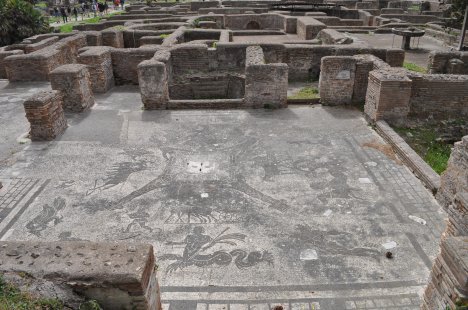
Mosaics in the Baths of the Cisiarii
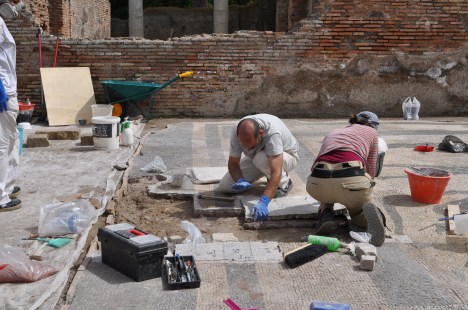
Work on the mosaic floor of the gymnasium in the Baths of Neptune
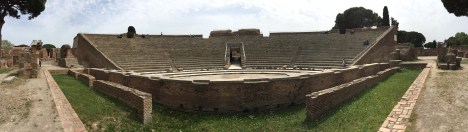
Panoramic View of the Theatre at Ostia Antica
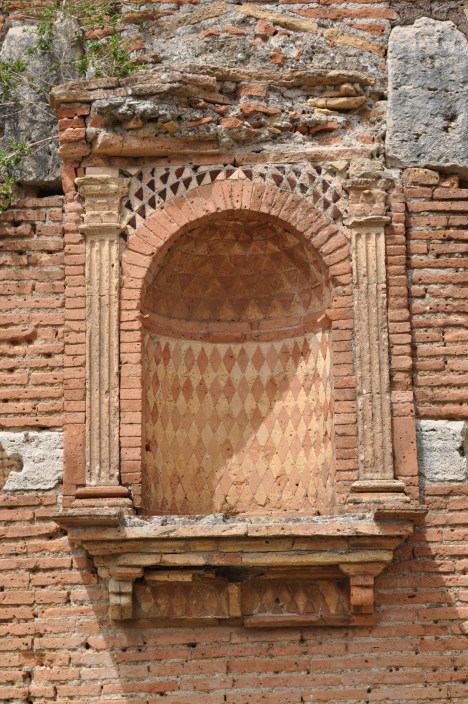
Niche for holding a statue of the household god in a series of merchants’ stores and houses
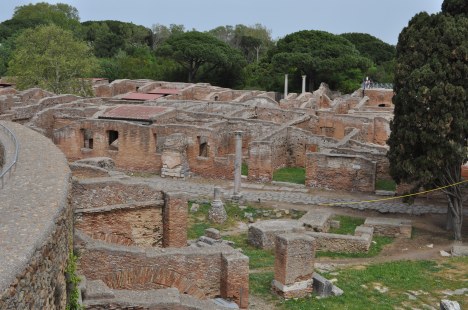
View of excavations in the center of Ostia Antica
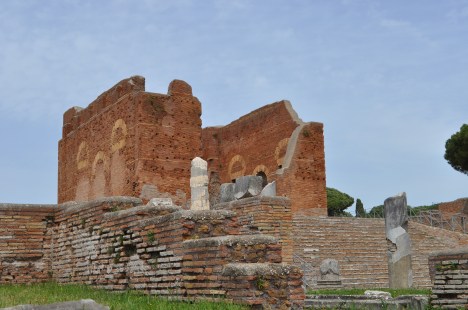
Capitolium and Sacellum of the Lares Augusti
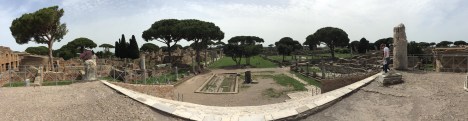
Panoramic view of the Forum from the Capitolium
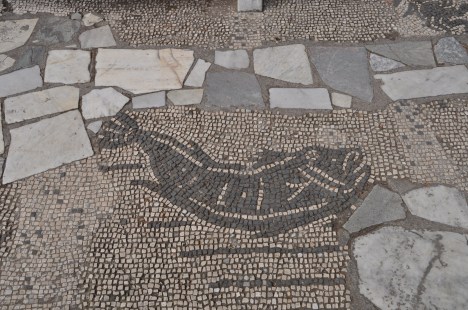
Mosaic detail in the Tabernae of the Fishmongers
I have about fifty more photographs I could post, but I hope you have the sense that this is a wonderful step into antiquity. I was also impressed with how the interpretation of the site addresses issues of the changing nature of archaeological and preservation practice. On several signs, the destructive actions of earlier generations are addressed respectfully yet directly, understanding that professional standards and practices change over time as better tools and deeper interpretation come into play. In particular, the treatment of mosaic panels in the gymnasium – which had always been exposed to the elements – are given detailed explanation. The common practices of the 1970s contributed to the deterioration, and so the preservationists and archaeologists who began a new conservation project in 2004 had to factor in this aspect of the site’s history. It was refreshing to see this openness in interpretation.
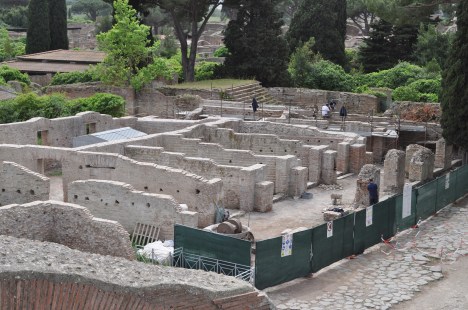
Ongoing preservation work at Ostia Antica
Candice and I also commented on the fact that except for two or three school groups, we had much of the site to ourselves. In talking with fellows and experts at the academy, I have heard how preservation and conservation funds are drying up in Italy. I do not know the particulars here, and while we saw evidence of ongoing work at Ostia Antica, it seemed as if the site was working to get by with less support – which includes marketing (a key aspect of historic site preservation).
I’m thankful that a colleague sent me a link to “Top Ten Day Trips from Rome” and Ostia Antica topped the list. We would agree. This is a site that is evocative, mysterious, and educational – calling us to reflect both backwards and forwards at the same time.
We need more places like this.
More to come…
DJB
Image: Excavated street and buildings at Ostia Antica