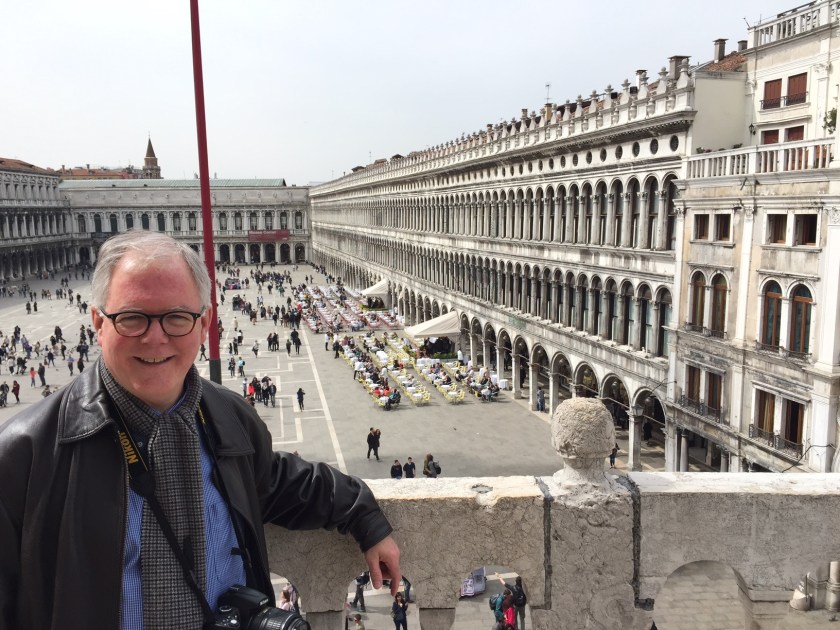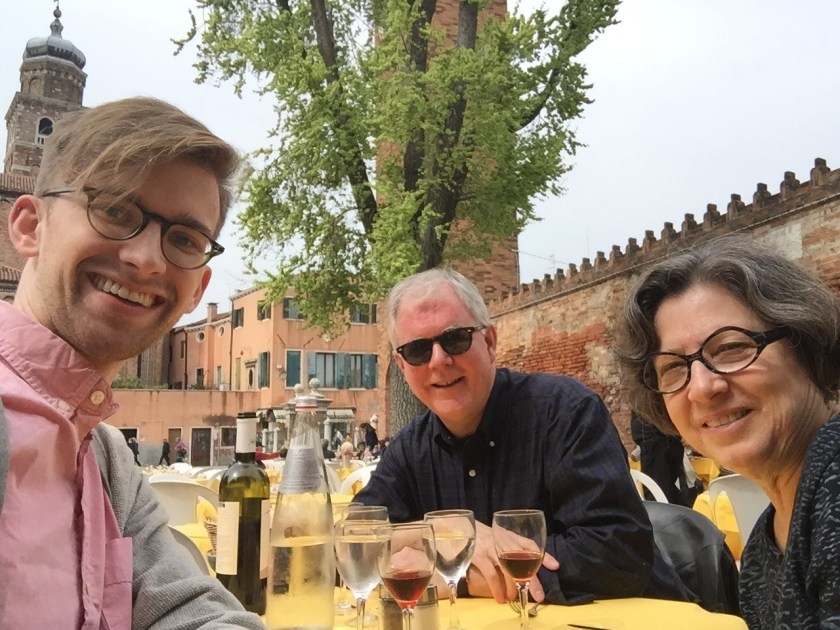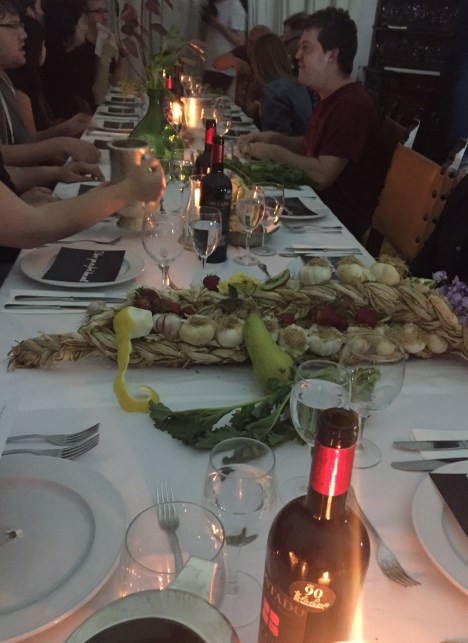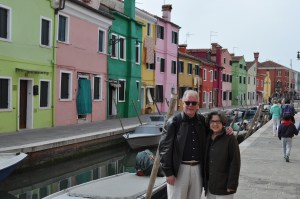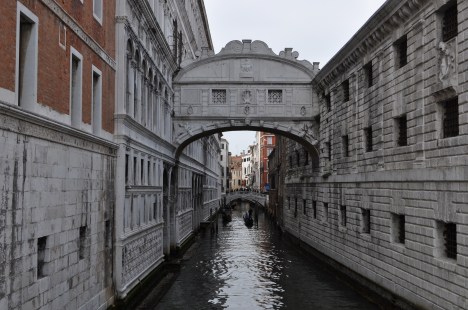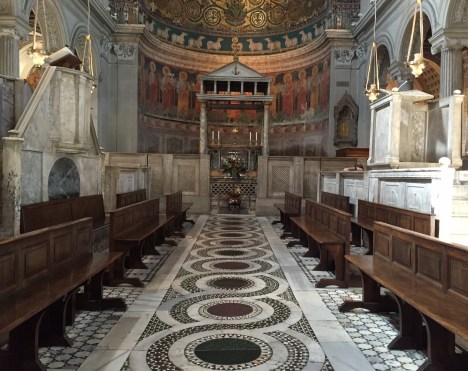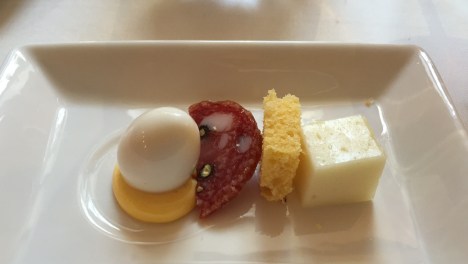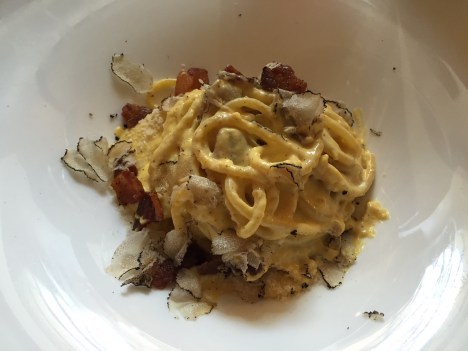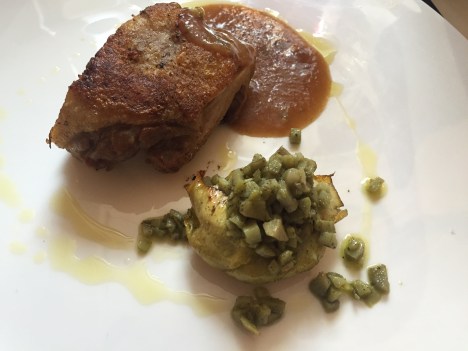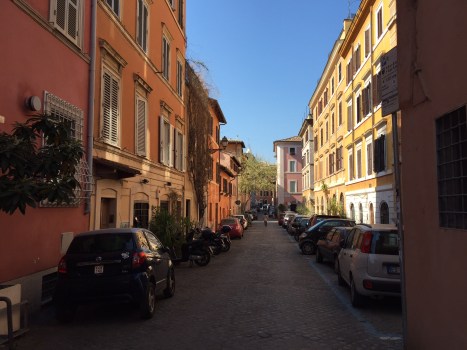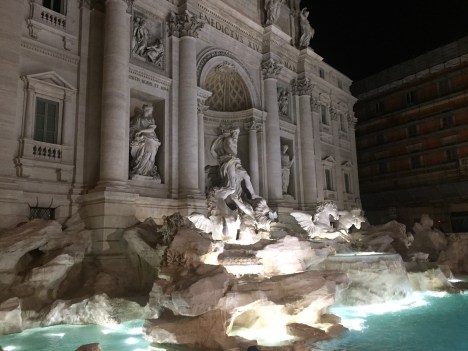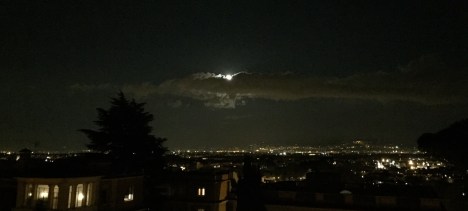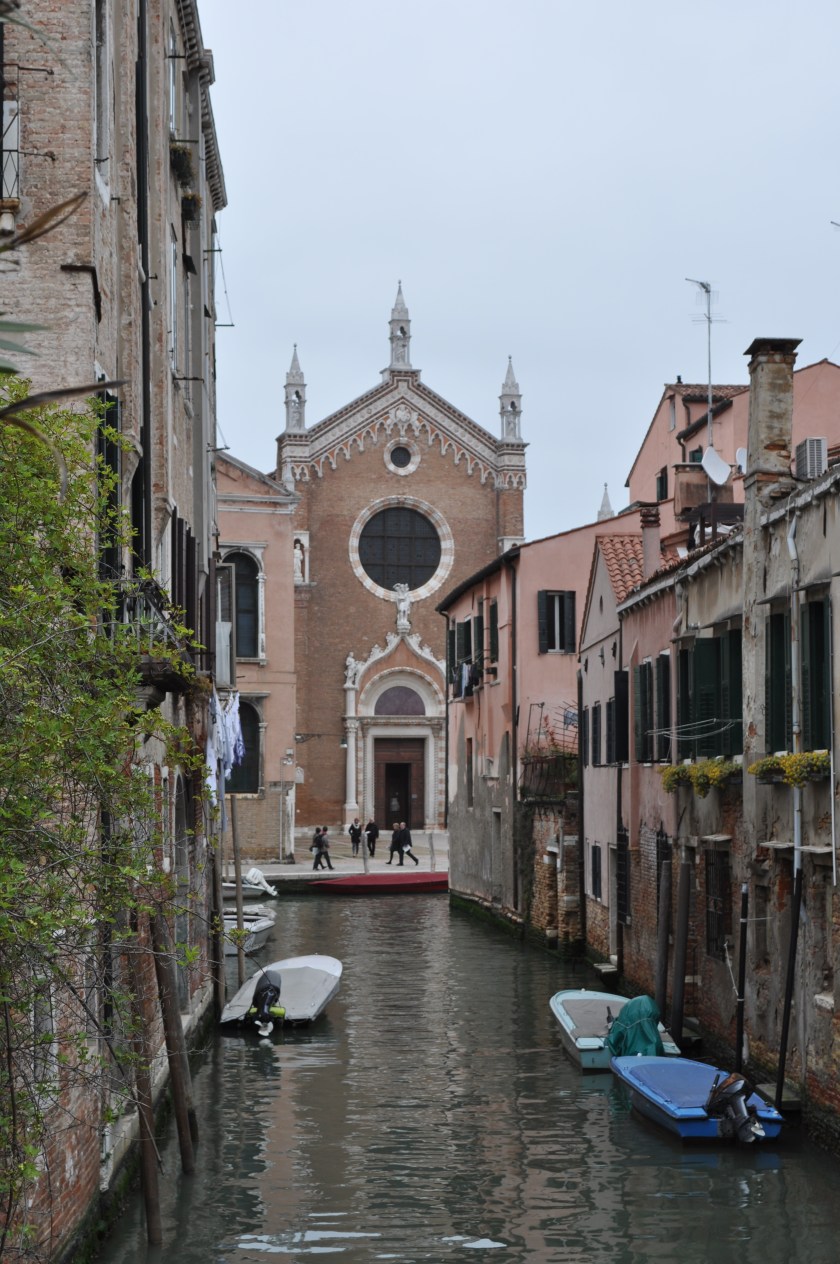
Today Candice and I celebrated our 34th wedding anniversary! I have to admit that Rome is a pretty wonderful place to celebrate anything, but it seems especially appropriate for an anniversary.
The newlyweds at Prospect Hill
When Candice and I were married in 1982, I was a poor graduate student in Atlanta who found time during my spring break to get married and take a honeymoon trip to Prospect Hill – a 1732 farmhouse bed & breakfast outside Charlottesville. Our first anniversary was actually celebrated back at Prospect Hill, as we were there while finding housing before our 1983 move to Staunton in the nearby Shenandoah Valley. For the first decade of our life together, we would return to the inn for “major” anniversaries – such as the 5th and 10th.
20th Anniversary Dinner at Prospect Hill
Anniversaries changed as the twins arrived, and when they were five we moved to Washington. During those years we were lucky to be able to find a baby sitter and go out for a dinner. We did return to Prospect Hill for our 20th, thanks to our good friends Margaret and Oakley Pearson, who watched Claire and Andrew for the weekend. For our 25th, we found an inn outside Washington for a dinner. We laugh at the picture from that time (which I haven’t included here!), as it is clear we had teenage twins! (No other explanation required, but you can use your imagination.)
Things started getting interesting with our 30th, which came about three weeks after hip replacement surgery. Needless to say, we didn’t do anything exceptional that year (except survive). Our first overseas anniversary was our 32nd – when we were in Copenhagen visiting Andrew during his semester abroad. And then last year, we shifted a planned 60th birthday dinner for me at Fiola restaurant (one of DC’s best) to an anniversary dinner after my run-in with the ambulance.
Our 32nd anniversary – celebrated in Copenhagen in March 2014
Perhaps the Italian food at Fiola got us in the mood, or perhaps we decided Copenhagen was such a great idea, why not do Rome?! So we find ourselves here in the Eternal City, celebrating 34 wonderful years together.
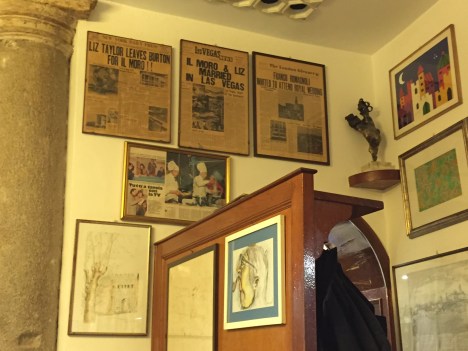
A colleague of mine, Tabitha Almquist, suggested Ditirambo as a great restaurant to try during our stay in Rome. We went this evening and had a terrific meal. We began with a bottle of Cabernet and the appetizer: Ditiramo’s tris (zucchini flower with ricotta cheese, Piemonte’s beef tartare with black truffle and Casteimagno cheese, and smoked duck breast with melon and toasted almonds). Oh my – what a start! For pasta, we split a fettuccine with mushrooms and quail, followed by a pork loin that fell off the bone. We wrapped it up with a “modern twist on the cannoli.” It was a memorable meal.
Can’t wait to see what next year will bring (in terms of our celebration, the meal, and – oh yes – life!)
Happy anniversary, my love.
More to come…
DJB
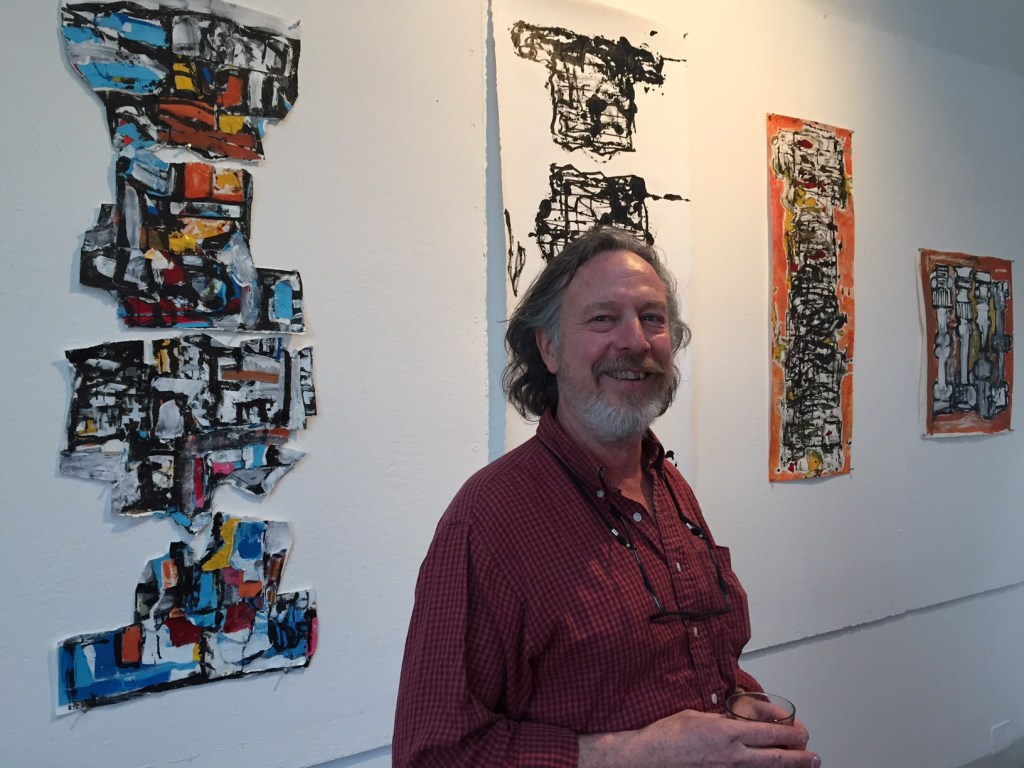
Image: Celebrating our 34th wedding anniversary at Ditirambo in Rome
Saturday was a picture perfect day in Rome. Not a cloud in the sky. Mid-60s temperature. Our windows were open all day to let in the fresh air and sunshine. It was a day that called us to go outside.
And we did just that, heading over to the largest landscaped public park in Rome, located nearby the Academy in Monteverde on the Janiculum. While we walked, talked, and enjoyed the sunshine, we primarily engaged in the age-old past-time of people watching. Thankfully, we were rewarded in this beehive of activity. Children playing football. Teenagers in love. Older couples holding hands, both to show affection and to steady their partner. Picnics on the grass.
Danish architect Jan Gehl has said that – in the past 50 years – architects, landscape architects and planners…
“…have gotten confused about scale. They constantly confuse car scale with people scale. Sometimes they make a mix, but most of the time they make car scale and say, look, there’s a sidewalk, people can walk here. What’s the problem? That is not at all exciting.”
The builders who created the Villa Doria Pamphili park understood people scale. While cars are relegated to the outsides of the park, the inside has so many wonderful spaces for people to do all the things people – as social animals – are inclined to do. Candice and I had a lovely three hours watching the interactions today, which we then capped off with a stroll over to the Garibaldi monument to take a few photos of the ancient city.
Since we’re in Rome, our people watching continued over dinner. We took the ten minute walk from our apartment to Vineria Litro, a small wine bar recommended by both the chef at the American Academy and the New York Times. Over glasses of wine, we sampled delicious food and watched the place fill up as the hours passed. Just before we left, two ladies walked in for an early evening glass of wine, trailed by their dogs who slipped down next to them at the bar. We knew we weren’t in Kansas anymore when no one batted an eye. And they didn’t even have to use the old joke about taking a dog into a bar, which goes like this:
Two women were out walking their dogs when they saw a bar and decided to stop in for a drink. However, there was a sign in the window that said, “No dogs.” The first said, “Don’t worry, follow my lead.” She then put on a pair of sunglasses and walked into the bar. The bartender says, “Hey lady, can’t you see the sign? No dogs allowed.” She replies, “He’s my seeing eye dog,” the bartender says “okay,” and he fixes her a drink.
Her companion then puts on her sunglasses and heads into the bar. The bartender says again, “Hey lady, you can’t bring that dog in here.” To which the woman replies, “He’s my seeing eye dog.” The bartender says, “That Chihuahua is a seeing eye dog?!?” And the woman replies, “They gave me a @(*%#(% Chihuahua?!”
Enjoy your day with your friends of all shapes and stripes.
Yesterday the Fellows Walk took us to the opposite side of Rome, where the city grew outside the walls in the 19th century. It was a different take, focused on unification, industrialization, and city planning.
The tour ended in the Quartiere Coppedè (the Coppedè Quarter) designed by architect Gino Coppedè. A small enclave of apartments and houses from the early 20th century, the buildings exhibit a riot of every Italian architectural influence imaginable. Wild historical eclecticism – one short-lived response to modernism of the early 20th century.
Following the end of the tour, Candice and I roamed the neighborhood with Jeff Cody from the Getty, taking photographs and finding new elements to view on every wall. Over a coffee, Jeff pulled out a small sketch book to show us some drawings he had made from earlier visits to Italy, and it was then that I regretted not having taken any sketching classes in my life.
Just look at these possibilities in the Quartiere Coppedè:
Arch leading to the Coppede Quarter
Coppede Quarter Detail
Building decorative arts in the Coppede Quarter
View of the fountain in the Coppede Quarter
A piece of Tuscany in the Coppede Quarter
It was the second time in two days I’d had that same feeling. The first was on Thursday, when we found an artists’ supply store near the Pantheon that was chock full of pencils, paints, colors, and everything needed to capture the city on paper. Claire and I turned the corner and saw the paints pictured at the top of this post at the same time…and we had the exact same reaction. Our cameras were at work instantly – trying to capture the vibrancy of the content of these jars on these simple wooden shelves.
I suppose it is never too late to take up sketching. Ah, to be an artist.
Claire on the stairs from Trastevere to the American Academy
Rome has steps. Everywhere. A lot of steps. (Yes, I can confirm for Mrs. Reeves, my sophomore English teacher, that I know a “lot” is a field and not “many” but I like the way “a lot of steps” sounds.)
So begins this edition of “Observations from the Road” (or “The Pedometer is Getting a Workout” edition). For those who may be new to More to Come…, the “Observations from…” series are short – often meaningless – comments that don’t deserve a full blog post (or perhaps even the light of day) but that hasn’t stopped me from posting them in the past. So here goes with the current edition.
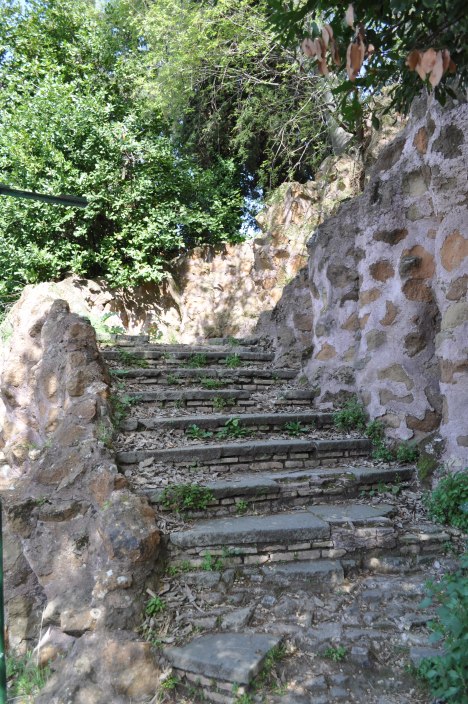
I’m going to break the pedometer – Everyone who has been to Rome told us that we’d walk a great deal…but I guess I didn’t really believe it until we arrived and started walking. And believe me, I love to walk. Rome is a wonderful city to see from the sidewalk (or the middle of the street, where a great deal of walking appears to take place). I can’t say the same for the few cab rides we’ve taken. In the course of our first ten days here, we have been on guided walks (more on that in a minute), purposeful walks (usually to find the next gelato stand, truth be told), a couple of exercise walks (although that seems to be unnecessary), and many others. Two quick observations. First, there isn’t a soft surface in the entire city (which is hard on 60-year-old knees). Second, there are more steps than pigeons. Today’s count – which wasn’t exceptionally extensive: 22 flights of stairs. And we still have 4-5 more to face, as we’re on a third-floor walk-up. The picture at the top of the post shows Claire about half-way up the main staircase from the neighborhood directly below the Academy to our apartment. Short of a cab ride, that’s the only way to get home.
Just another meal in Rome (photo credit: Claire Brown)
The only thing that will keep me from losing 10 pounds while I’m here is the food and drink – Yes, we walk a great deal. But I’ve also become very fond of the local vino and food. Perhaps I was meant to be Italian instead of a white Anglo-Saxon Southern protestant! In terms of wine, I tend to order “whatever you recommend to go with this meal” and I haven’t been disappointed yet.
Invite a family member to visit you if you want to check off the bucket list items in short order – We have found in Washington that when friends and relatives visit, we tend to take them to places that we would like to see “at some point” but have never actually made the visit. You know, like the Washington Monument. So when Claire came to Rome for a week, we found that the same dynamic was in action.
Ceiling in the Vatican Museums
Want to go to the Vatican Museums and Sistine Chapel? Check!
Michelangelo’s Pieta in St. Peter’s
St. Peter’s Basilica
Ensure that you’ve seen Michelangelo’s Pietà in St. Peter’s Basilica – not to mention the Basilica itself? Check and check!
Colosseum
Colosseum? Check, check, and check!
With Candice at the Trevi Fountain
And that combination of landmark and pop culture, Trevi Fountain? Check, check, check, and check! (Three checks are for the three coins and the fourth is for good luck, I suppose.)
The Pantheon
The Pantheon ceiling and light
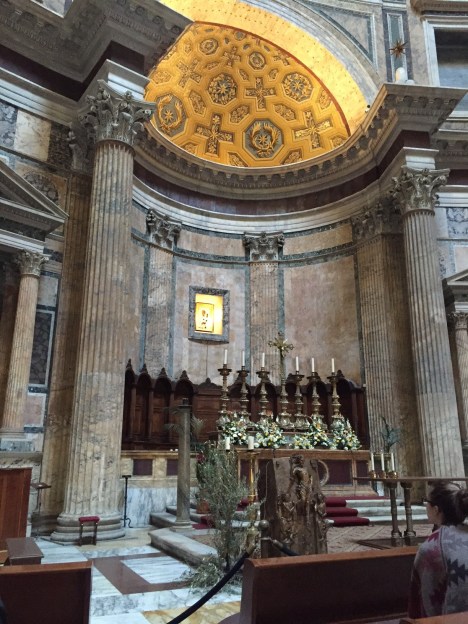
You cannot get enough of the Pantheon – This will, no doubt, come as no surprise to long-time readers, but I think the Pantheon is an incredible space. In the first ten days in Rome, I’ve visited the Pantheon twice…and expect to go back about once per week for the rest of the time we’re here. Now that I’ve seen this architectural icon twice in the sunshine, I want to go back on a rainy day and watch the light and rain interact inside the building. I want to see it in the morning. At noon day. In the early evening. Our friend Rod indicated that it could be addictive, and I suspect he is right.
Caravaggio’s St. Matthew in the French national church in Rome
It pays to walk with some very smart people – I’ll end where I began…with walking. Every Friday the American Academy has a guided walk for fellows and fellow travelers. We made the first one last Friday, focused on the national churches of Rome, we are signed up for tomorrow’s walk, and we intend to try to catch every one for the next five weeks. Tying in with the historical and current issues around immigration, our guides last Friday led us to nine different national churches in Rome. We saw terrific art – such as the oil paintings by Caravaggio dedicated to St. Matthew in San Luigi Dei Francesi (St. Louis of the French). Some of the architecture was excellent. I had a chance to view preservation in action in the city. And all of the conversation – including a continuing conversation over dinner that evening about whether national churches in the Catholic context even constituted immigration – was stimulating and thoughtful.
That’s it for now. In the meantime, I’ll keep you posted on the health of my pedometer.
48 hours barely counts as dipping your toes in the water that is Tuscany, but it is what we had for this first visit over last weekend. With Claire in the country for a limited time, we opted to experience a few sites and then return later for a longer drink of more that the region has to offer.
But first, let me detour to talk about trains.
At the suggestion of our friends Tom and Rod, we booked our trip on the Italo high-speed train from Rome to Florence. Ninety minutes after boarding – following the smoothest train ride I’ve ever experienced and going 260 km/hour (that’s about 160 mph for the metrically challenged) – we pulled into Florence and walked ten minutes to our cozy little historic hotel. For those who talk about American exceptionalism, I’d beg to differ. When it comes to train travel, we aren’t even on the same planet! On Monday, while we were coming back from Florence on the train, our DC Metro apparently had another fire in a tunnel that shut down three lines for the day. I often take that line. As I’ve written before, “Take the train whenever possible. It is civilized and, short of walking and riding a bike, it is the most environmentally friendly way to travel….Imagine how well our transportation system could run if people demanded, and politicians funded, train travel.”
End of rant.
We had a few key things we wanted to experience over the weekend: wine, food, architecture, art, the landscape…all the basics of life. True to our plan, we did touch on every one of our desired experiences and had a chance to understand why Tuscany is often described as the quintessential Italian experience.
Glimpse of the Duomo (Cathedral) dome from one of the streets in Florence
After checking into our small hotel about a block from the Piazza Del Duomo (the cathedral), we went in search of our first taste of food and wine. The restaurant Candice had identified online had – at most – ten tables and – not unexpectedly – was packed. (Candice has become very adept at reviewing an online menu and identifying great places to eat, but alas, she isn’t the only one who can pick out a great place for a meal.) However, we searched nearby and found a wonderful wine bar with excellent food that satisfied our cravings.
Florence Bridges
The Duke and Duchess of Urbino at the Uffizi in Florence
Suitably fortified, we made our way to the Uffizi, often called Italy’s greatest art gallery. In room after room we viewed the Medici art treasures – paintings we had seen online and in reproductions our entire lives.
Botticelli’s “The Birth of Venus” in the Uffizi
From Botticelli to Titian to Michelangelo, the Uffizi was a treasure trove of Renaissance art.
The Venus of Urbino by Titian, in the Uffizi
Having stumbled in our attempt at eating in our choice restaurant for lunch, we decided not to make the same mistake twice and made reservations at dei Frescobaldi, a restaurant and wine bar that rated a Michelin guide review. We were not disappointed. Almost three hours later we finished a wonderful meal combined with local wine – Claire said she would be satisfied if this was the best of the food she had all week – and found our way back to prepare for Sunday’s tour of the top sites in Tuscany.
I suppose that Pisa is one of those bucket list places to visit, but even an early morning visit – when the crowds were relatively thin – didn’t help get past the “tourist trap” feeling of the place. It is difficult to view the tower without walking around folks putting up their hands (or other body parts) in the obligatory “hold back the tower” photo. I was glad to get back on the bus and get the hell out of Pisa.
Claire and Candice in San Gimignano
Candice and DJB in San Gimignano
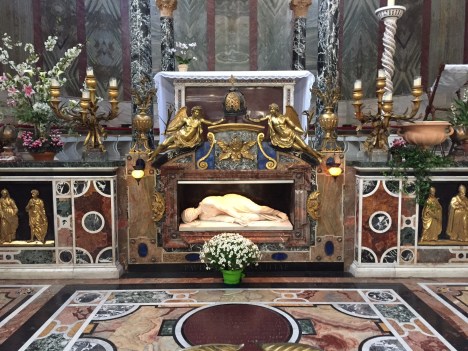
From the ridiculous to the sublime was the theme of our next stop, in lovely San Gimignano.
A World Heritage Site that was built by noble families in the 12th and 13th centuries, this beautiful medieval town features fabulous craftsmanship, stunning views of the Tuscan countryside, and surprises seemingly around every corner.
San Gimignano street view
San Gimignano’s Collegiata
After a meal paired with local Chianti Classico, we headed into Siena, a true treasure trove of medieval design and hidden treasures.
Siena’s Piazza del Campo (photo credit: Claire Brown)
There are two must-see things in Siena: the incredible medieval piazza and the Duomo. I could go on and on about the piazza here…but I’ll save that for another post. It is, however, one of the wonders of the world and is not to be missed.
Piazza del Campo detail
The Siena Duomo is also an incredible landmark for the community. Striped black and white marble sets off this unique cathedral in ways that are hard to describe.
Siena Duomo tower
Siena Duomo facade
We arrived back in Florence after 14 hours on the road: exhausted but satisfied. And we tumbled into bed to catch a few hours of sleep so that we could check out the Florence Duomo and museum before boarding our train home on Monday afternoon.
474 steps after we began, we stood on the top of the famed Brunelleschi dome on Monday morning and surveyed all of the historic core of Florence. What an incredible treat.
At the top of Florence: proof that we made it!
Frescoes at the Duomo dome
East Doors of the Duomo Baptistry in Florence
We ended up at the Museo dell’Opera del Duomo (the Cathedral Works Museum) where we could have spent all day. What an incredible collection from the Duomo and Baptistry. We ended with a view of Michelangelo’s Pietá – often called his most personal one – with the hooded Nicodemus widely believed to be a self-portrait.
Michelangelo’s Pieta in Florence
We returned to Rome full of wonder and a desire to see much more. And while there is so much to discuss…why, for instance, we could go an entire weekend without hearing one word from a guide as to how the rulers in Florence and Siena acquired such incredible wealth on the backs of conquered people and with resources extracted from other countries…that is for another time.
48 hours. It turns out to be just enough time to whet the appetite.
View of Rome from our window in the Chiaraviglio apartments
Candice and I arrived at the American Academy in Rome on Monday morning to begin my six-week sabbatical. We suffered through the usual jet lag (and a bit more…but that would be TMI) and quickly settled in to our cozy apartment. Over the course of the first few meals we were welcomed by dear friends of Tom (recent Rome Prize winner from the National Trust) and Rod’s (his husband); joined a talented graphic artist and his wife at the bar when we both realized we were there for our first night (and then later realized we had met a decade ago when he designed the branding for The Glass House); were connected to some new acquaintances through long-time colleagues in the U.S.; and simply met a host of welcoming fellows and “fellow travelers.”
Basilica di Santa Maria in Trastervere
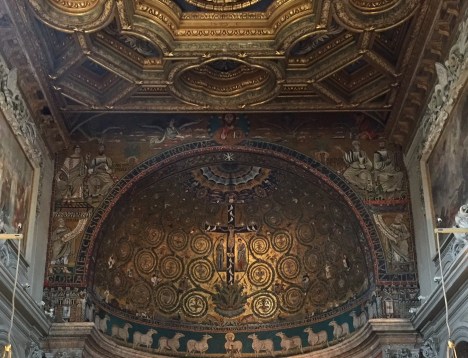
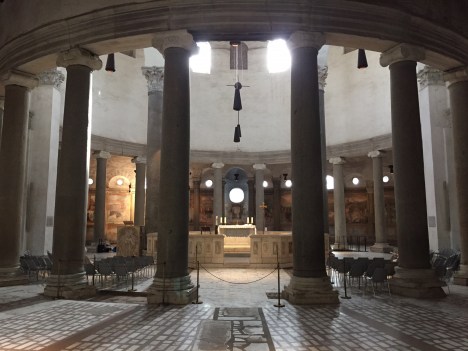
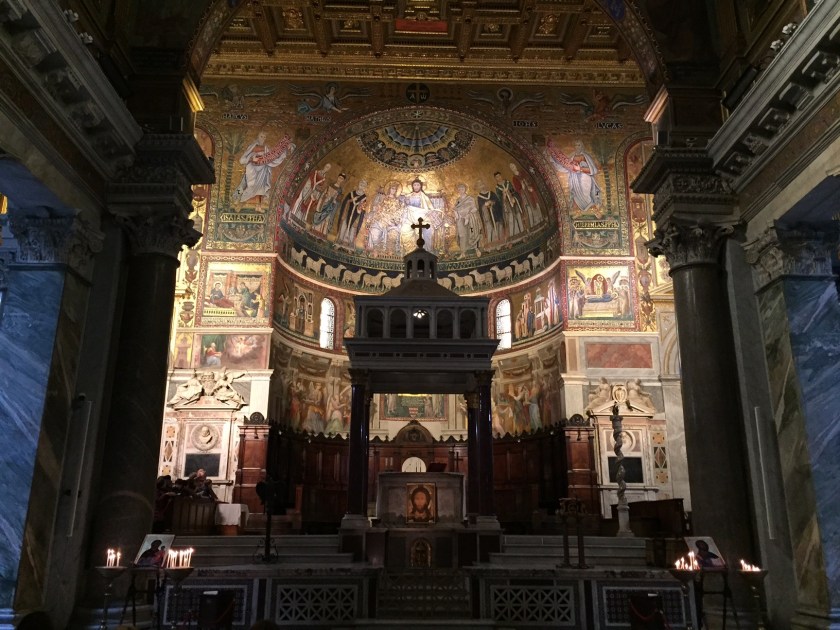
Once the jet lag wore off, we began to explore the neighborhood of Trastervere which lies at the foot of the hill from the Academy (down some 70 steep steps…but that’s another story.) Our focus was the Basilica di Santa Maria, where the basic floor plan and wall structure dates back to the 340s, and much of the existing structure to 1140-43. The interior features wonderful 13th century and 17th century mosaics in the apse. We also wandered through the streets, getting lost on more than one occasion but in the process discovering open air markets, cafes, and shops where we wanted to return when we had more time.
It was clear from our arrival that we would have many opportunities to look both back and forward. Bryony Roberts, the Booth Family Rome Prize Fellow in Historic Preservation and Conservation, gave a shop talk on Wednesday entitled “Projected Histories” which did just that. Bryony is an architectural designer and scholar who designs transformations to historic buildings. We had a chance to chat before her talk and share our experiences with connecting landmark buildings to new audiences.
In a fascinating overview of her work, Bryony discussed recent projects, the first of which was a preservation-based plan for the rebuilding of the modernist Oslo government center damaged in the 2011 terrorist bombing that also claimed the lives of 80 individuals at a youth summer camp. What I found fascinating from that presentation was that she and her students at the University of Oslo had presented a forward-looking alternative based on the historical context of the center in a way that respected the mid-century modernist structures, but also added appropriate new buildings that appeared – from the plans – to improve the urban feel of the city.
Much of her work focused on less permanent engagement with existing architecture through performance and art. We all experienced one small example as we entered the main AAR building each day, where the patterned floor was transformed with new shapes and colors that played off of the circles and diagonal patterns of the McKim, Mead & White original.
Byrony Roberts installation at the American Academy in Rome
Clearly the installation that captured the most attention from those in attendance was the “We Know How to Order” performance with the South Shore Drill Team during the most recent Chicago Architecture Biennial. This group of young African-Americans from Chicago’s South Side, many of whom had never been to the Loop, collaborated with Roberts in a performance that engaged – in totally new ways – the Mies van der Rohe precision of the Federal Center. Here is the project description:
The project ”We Know How to Order” for the inaugural Chicago Architecture Biennial magnifies systems of ordering bodies in contemporary Chicago. This site-specific performance brings together the Federal Center by Mies van der Rohe and the South Shore Drill Team, which performs high-energy drill routines infused with street choreography. Conceived by Bryony Roberts, and choreographed by Asher Waldron of the South Shore Drill Team, this collaborative project responds to a space of federal government and the architecture of Mies van der Rohe through dynamic physical movement.
This engagement works for me on so many levels, but especially on the political. As Bryony mentioned several times in her talk, it was the political nature of preservation that drew her to the field. She discussed the various dimensions of this political nature in the Q&A segment and in a follow-up private conversation. I’ve spoken a good deal recently about the political nature of preservation – how we have to get the public to support our work – as a factor that seems to be missing from the purely academic approach to the field. Here you have young people – whose lives have been impacted by the decisions made over many decades by the federal and local government to separate African-Americans in the South Side of one of America’s most segregated cities – responding through art to that government and the order it imposed. We also have good contemporary art that will help show a much broader audience the relevance of this space to their lives today.
At dinner, a new friend asked how the presentation would be viewed at the National Trust. Knowing of our work to engage new audiences through art at The Glass House, the Farnsworth House, Shadows-on-the-Teche, the New York State Pavilion, and so many other sites and treasures, I said I was pretty sure it would be very well received.
Enjoy the five-minute video of “We Know How to Order” for a look forward at one future of preservation.
Taking extended time away from work is a luxury for many Americans – not to mention for many citizens of the world. As the oligarchs have taken over large parts of our economy, the 90% are pressured to work ungodly hours and take time off at their peril. One of the most telling – and incredibly sad – segments of Michael Moore’s “act of guerrilla humanity” called Where to Invade Nextis his reporting about how other countries provide their workers so much more time off than U.S. companies AND realize more productivity. Imagine that.
All of this is to say that I feel very fortunate to work for an organization that has a sabbatical policy to encourage creative, restful, and restorative time off. Several of my colleagues have taken a sabbatical in recent years – some to travel, others to work for preservation groups in other countries, and still others to work on projects for their faith communities. In each case they came back with refreshed perspectives and energy for their work.
My last day in the office before heading off for the first three-quarters of a sabbatical at the American Academy in Rome was Friday. (I’ll take the last quarter in August.) After 40 years of work (I started my professional career immediately after graduation from college), I feel that I’m getting a bit of a gap year…even if it is only 8 weeks. And I know how precious this time is. My sister texted today to say my 90-year-old father was in the ER with shortness of breath. It turns out that it was not related to his heart, but it was just another reminder of the fragile nature of life.
Before heading off, my management team gathered earlier this week to review our plans for the time I’m away. Each team member arrived with a coffee cup which – when turned to face me – had my picture and the letters “WWDJBD?” plastered across the mug. “What Would DJB Do?” Oh my! They said that when they were faced with a tough decision, they would pick up their coffee cups and get – I don’t know – inspiration? We had a great laugh. As you can see, my assistant checked my pictures and they chose to go with the “relaxed DJB” – from a photo taken by Claire on a beach trip a few years ago. I wonder if they had as tough a choice as the postal service did when choosing between the “skinny Elvis” and the “fat Elvis” back in the day.
I am very grateful that Candice and I will have this opportunity together. Andrew will hold down the fort at home, yet both of the twins will find time to visit us while we’re away. I’ll post as many pictures as possible, and – hopefully – a few thoughtful reflections as well.
Andrew with Lady Gaga and other survivors of sexual assault on the stage of the Oscars (photo credit: Patrick T. Fallon for The New York Times)
These past two weeks have been emotional ones for our family.
It began when Andrew called us while on his way home from a singing gig about 10 days ago. He had been asked to be on stage at the Academy Awards in Los Angeles with Lady Gaga as she sang her Oscar-nominated song “‘Till It Happens to You” from the film The Hunting Ground.
A survivor of a sexual assault while a freshman in college, Andrew’s story was included in the film and in media such as the Huffington Post. Andrew has bravely stepped forward over the past few years to talk about his experience and to help others with similar experiences. And now, he had a chance to stand with other survivors on the national stage.
Fast forward to late last week. Andrew had flown to LA and spent the first night with a family friend before connecting with his sister Claire (who was back in her apartment after a multi-day retreat). We spoke with him on Friday evening and could tell by the tone of his voice that he and the other participants were part of an incredibly important healing experience. Andrew indicated that social media posts about the upcoming performance were forbidden by the producers, so when we mentioned Andrew’s journey discretely to a few friends, we always added the caveat that they couldn’t tell anyone until after Sunday evening. We heard from him again on Saturday, after the dress rehearsal. Our anticipation grew. And then Sunday evening we turned on the Oscars to wait for the performance.
As she entered on the red carpet, Lady Gaga mentioned that 1 in 5 young women would be sexually assaulted by the time they graduated from college. For young men, the number is 1 in 16. Those odds took our breath away. However, it turns out that when we’ve talked to friends and colleagues, the percentage that have been sexually assaulted or have a family member who has been assaulted is frighteningly high. It breaks your heart.
Shortly after 11 p.m. on the east coast, Vice President Joe Biden came onstage at the Dolby Theater. We had not heard that the VP was introducing Lady Gaga’s performance, but found out later that he was the author of the Violence Against Women Act in 1994, with a long history of advocacy on issues of sexual assault. He urged the audience to join in a crusade against sexual assault by joining the “It’s On Us” campaign.
Andrew with Vice President Joe Biden following the Oscars
Then Lady Gaga began “‘Til It Happens to You,” pouring her pain as a survivor into the emotional performance. Halfway through the song, Andrew and 50 other survivors emerged from the background and came to surround Gaga’s piano – each supporting the other. The survivors had phrases written on their arms – Andrew’s was the title of this post: “We Believe You.”
Andrew with Lady Gaga at the Oscars
Andrew and Candice’s Facebook pages quickly filled with comments. Almost 700 friends liked his photos and posts about the evening. To take it from here, I’m turning to Andrew’s own words. First, from Facebook:
Yesterday was the most important moment of my healing since September 5, 2011. I’m so humbled by the openness, resilience, and radical love we have shared over three days. Thank you to Lady Gaga for her beautiful soul and breathtaking performance (she gifted the song, as did Diane Warren!). An incredible thanks to Vice President Biden and all of the passionate, deeply empathetic work he has done through the decades on empowering survivors, most notably as the original author of the Violence Against Women Act. And thank you to our fifty-one survivors, my great friends in heart and soul. I could never have had the strength without all of you. We are love, we believe you, and you are not alone.
When he returned home, a classmate from St. Albans School arranged for Andrew to speak to AOL about his experience. He described how Lady Gaga gathered the survivors together for a heartfelt prayer before heading on stage, as recounted by the AOL reporter:
“She just sort of said: ‘To the creator — whoever whatever created the universe — thank you for bringing us here, for giving us this story to tell and this message to give.’ And then after the prayer she said, ‘Gonna go out there and sing the shit out of it!’ ” Andrew Brown, a survivor featured in the performance and in “The Hunting Ground,” told AOL.
But his perspective on the weekend has remained the same as when he was included in The Hunting Ground or featured in national media such as The Huffington Post:
A weekend with Lady Gaga. Hugs from Brie Larson and Kate Winslet. Handshake from Jason Segel. Conversation with Joe Biden. Well wishes from Jared Leto, Leo DiCaprio, Alicia Vikander, Whoopi Goldberg, and Chris Rock. Truly a blessing.
But I would still give it all back. That’s always been true.
Candice and I would give anything to have kept Andrew from having to go through all the hell that he has experienced as a result of the assault. But we don’t have that option. So we love him unconditionally (as we always have). We support him the best we know how. We are proud of how he has taken an awful experience and turned it to good for others. And we marvel at his personal love and resilience.
“We Believe You” means so much more to us than just we think your story is true. In every way possible, it means we love and support Andrew – and his wonderful sister who carried this news with Andrew well before his mother and I learned of the trauma.
Thank you, Andrew. Thank you, Lady Gaga. Thank you, Joe Biden. Thank you to the 50 other survivors on the stage. We need you more than ever.
There was one upside of being stuck in traffic – and then stuck in the car wash line – on a February day with 60+ degree weather. The Bluegrass Junction station on Sirius XM radio was featuring a live concert of The Steeldrivers – a band I highlighted in my Favorite Roots Music Albums of 2015post last December. (Oh yeah, it was also the winner of the “Best Bluegrass Album” in that other little year-end list – The Grammy’s.)
After playing “If it Hadn’t Been for Love” from their first project (the black album), fiddler Tammy Rogers mentioned that “some singer you might have heard of — named Adele” — had covered that song earlier this decade and featured it in her Live at the Royal Albert HallDVD. I knew Andrew would love this.
So I returned home and told Andrew the story. I mentioned that Chris Stapleton – who wrote and sang on the original SteelDrivers version – just won Country Album of the Year for both the CMA and Grammy’s, which gave me some faith in the ability of the country music industry to recognize real country when it bites them in the behind.
We listened to the Adele version, and laughed ourselves silly, over the introduction. But hey, Adele is a great vocalist and this is a top-notch cover.
Then I played Andrew a song by Chris Stapleton off of his Traveller album, so he could hear what a great country voice sounds like. Here’s the tune “Tennessee Whiskey” first made famous by David Allen Coe and especially George Jones.
I was saying something like, “Now that’s real country” when Andrew asked, “Have you heard the mash-up of six bro-country tunes that are all alike?” No? Really? (Yes, I find out I’m the 6 millionth person to view this…but I am a bit slow.)
Anyway, if you want to know what’s wrong with most of what comes out of country radio, listen to this mashup of “Six nearly identical hit country songs” that were “separated at birth.”
Thank God for Chris Stapleton, The Steeldrivers…and Adele!