A writer I follow on Substack posted an essay entitled What our books reveal about us. I was intrigued and — after reviewing the 65 books I read in 2023 — decided to answer that question for myself.
You’ll see the list of the 65 next Wednesday. In the meantime, here are eight totally subjective observations about what I discovered.
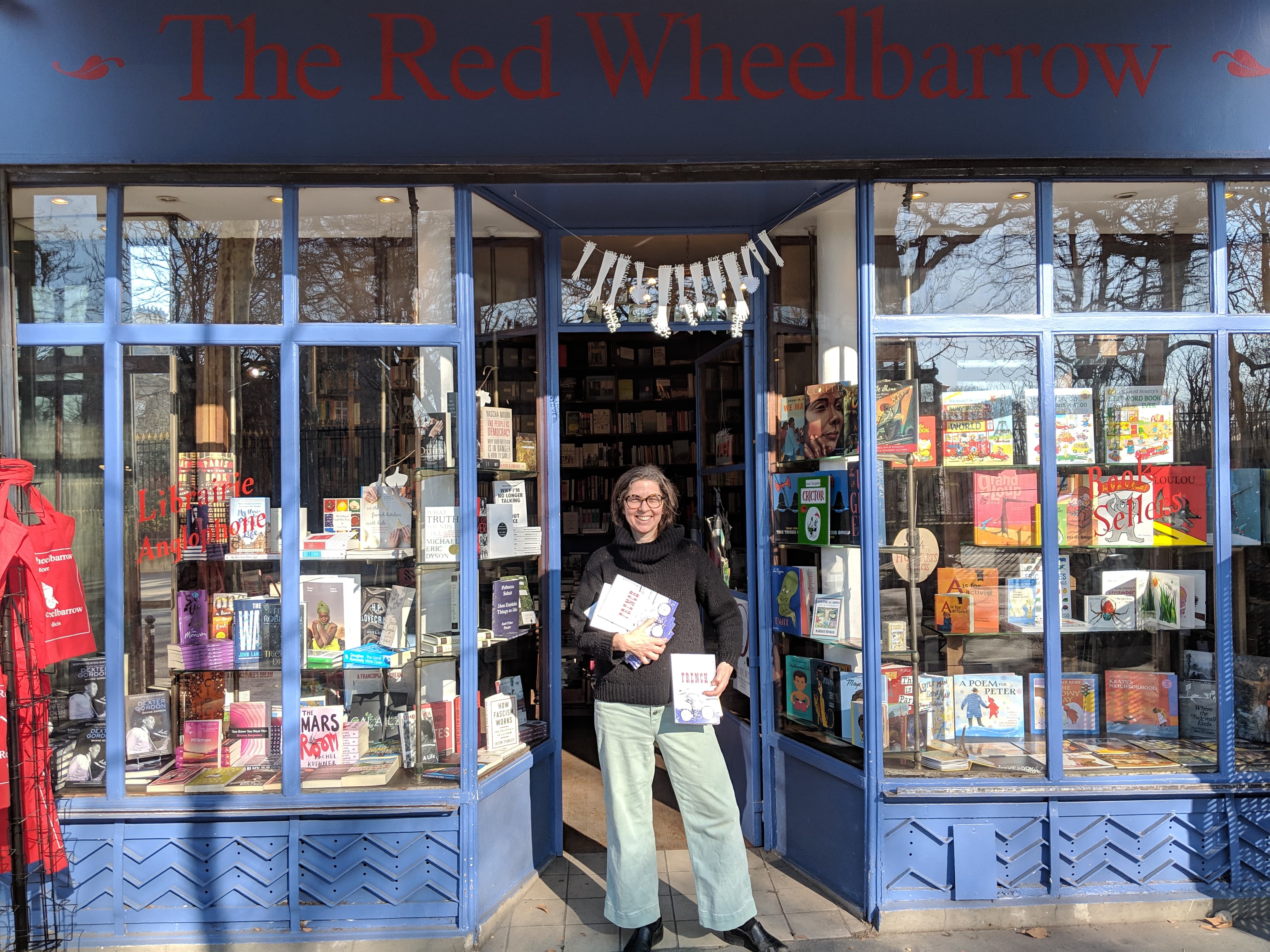
The Red Wheelbarrow bookstore in Paris (credit: Janet Hulstrand)
I may be a planner by training, but I don’t always follow the plan — I began the year with a six-month TBR list (and even had all the books in nice, neat stacks). However, more than one-third of the books I eventually read (24 of 65) were published in 2023 or late in 2022, meaning I bought them during the year at some wonderful independent bookstore.
I am open to suggestions — 32 of the 65 books — almost half — were recommended by friends and other readers. And many recommended by readers at the end of last year are still sitting in my TRB pile. I’ll get to them eventually!
I can disappear down rabbit holes — Late last year I read Kathryn Schulz’s beautiful memoir Lost & Found, setting me on a quest to think about wonder and awe. I’m well past ten books that touch on that topic and I know there’s more to come.
I am reading more spirituality and theology than I would have guessed — Perhaps it is because I’m now in my third stage in life, but I find myself drawn to writers who think about things bigger than each of us individually. I’m especially appreciative of those who consider the spiritual world from perspectives that differ from mine.
I am so proud of friends who publish books — Writing well is hard. Writing a good book is really hard. Publishing a book that others will read is even harder. At least seven people I know from different parts of my life published books in 2023. My Author Q&As were how I spread the word.
I believe that history can point the way forward — The late historian David McCullough was fond of saying that history “is an antidote to self-pity and self-importance…history is a lesson in proportions.” Abagail Adams wrote to her son — the future president John Quincy Adams — that “the habits of a vigorous mind are born in contending with difficulties.” In 2023, one-quarter of the books I read were histories, and almost all spoke to what the past can tell us about today’s sometimes trying and perplexing world.
Diversions were more fun than I suspected — By now anyone who reads this newsletter knows that I have been on a binge reading murder mysteries in 2023. I’ve enjoyed it much more than I feel is legal. You’ll have to figure out what that means.
I still need to broaden my perspective — I’ve made the intentional choice to read from a diverse group of authors writing about topics that may be outside my comfort zone. This past year, ten of the books I read came from ethnically diverse authors. That can improve, but I’m already seeing changes in my perspective.
Think about it: what do the books you’ve read reveal about you?
Our nation’s natural storytelling instincts crave simplicity and clarity. As a result, we often turn to uncomplicated national origin stories or discuss white supremacy and racism as a black/white binary. These issues, however, are more complex than what I learned in school.
Rather than beginning with the colonies declaring their independence in 1776 from the British throne or explaining our racism from the introduction of the first enslaved Africans on American shores in 1619, perhaps — to truly understand the origins of modern American — we need to go all the way back to 1452.
The Hidden Roots of White Supremacy and the Path to a Shared American Future (2023) by Robert P. Jones begins with several clear and powerful stories and ends with a question that, though difficult, must be answered if we are to illuminate the path forward. Jones has crafted a searing yet courageous look at contemporary issues around race set within the context of a 15th century church doctrine that haunts our lives, laws, and politics to this day.
On June 18, 1452, Pope Nicholas V issued the “Doctrine of Discovery” that “merged the interests of European imperialism, including the African slave trade, with Christian missionary zeal.” That particular papal doctrine granted the Portuguese king the following rights:
To invade, search out, capture, vanquish, and subdue all Saracens (Muslims) and pagans whatsoever, and other enemies of Christ wheresoever placed, and the kingdoms, dukedoms, principalities, dominions, possessions, and all movable and immovable goods whatsoever held and possessed by them and to reduce their persons to perpetual slavery.
When Columbus returns from his first voyage in 1493, Pope Alexander VI extends this papal bull to validate Spain’s ownership rights of “previously undiscovered” lands in the Americas. Once again, all non-Christians are “enemies” and thus not deserving of political or human rights, they can be placed in perpetual slavery, and their land and possessions can be taken over by Christian nations and rulers. It also establishes a process whereby the competing European nations could make claims and take treasure without undue bloodshed among themselves.
Jones shows how so much of our law, public policy, history, and present-day politics revolves around this 15th century license to pillage and loot land that was granted by the person western Christians considered “the Vicar of Christ on Earth.”
The Doctrine is expanded over time so that it is used by Europeans and Americans to stake claims on indigenous lands and to marginalize and/or enslave those who lived there. William Henry Powell’s dramatic painting of Hernando De Soto’s “discovery” of the Mississippi River and his “claiming” of this land for Spain was all based on the Doctrine of Discovery.
When President Thomas Jefferson agreed to the 1803 Louisiana Purchase for $15 million, the U.S. was not acquiring title to this land from France. “Rather, it codified a transfer from France to the United States,” based on the Doctrine of Discovery, “of the right to assert dominion over Native peoples in that area without interference or competition from other European powers.”
Think about how that differs from the history we were taught.
As recently as 2005 in Sherrill v. Oneida, Supreme Court Justice Ruth Bader Ginsburg’s first footnote in her 8-1 majority opinion declared, “Under the ‘doctrine of discovery’ . . . fee title to the lands occupied by Indians when the colonists arrived became vested in the sovereign — first the discovering European nation and later the original States and the United States.”
As Jones so eloquently asserts in this thoughtful and important work,
The spirit of the Doctrine of Discovery continues to haunt us today. We remain torn by two mutually incompatible visions of the country. Are we a pluralistic democracy where all, regardless of race or religion, are equal citizens? Or are we a divinely ordained promised land for European Christians?
After a powerful opening story juxtaposing emancipation from slavery with Dakota deportation, Jones has us visit three different communities with histories worth remembering.
Sumner, Mississippi
In the Mississippi Delta, the reader learns of the community’s work to address the history of the murder of Emmett Till in 1955. But Jones also reminds us of the eradication of native Americans in Southern states leading to the horrific Trail of Tears, all in order to create cotton plantations worked by enslaved Africans.
Painting by J. Thullen of the largest mass execution in U.S. history.
In Duluth, Jones recounts the actions of an enraged white mob of approximately ten thousand people lynching three black men in 1920. But he puts it in the context of the largest mass execution in U.S. history of 38 Dakota men in 1862 and the brutal deportation of the Dakota from land that was supposedly protected by treaty . . . until that became inconvenient.
Tulsa Race Massacre
And in Tulsa, Oklahoma, the Tulsa Race Massacre that killed hundreds and destroyed blocks of black-owned businesses in what was known as the “Black Wall Street” resulting in the destruction of generations of wealth was taking place at the same time that white Americans were conducting their “Reign of Terror” on the nearby Osage Indian nation to steal their oil and mineral rights.
Jones chose those communities for their entwined stories of white supremacy that go beyond the simple white/black binary, but also because each has taken steps to repair the damage and the relationships. That work becomes the basis for his final section on a path forward, searching for hope in history.
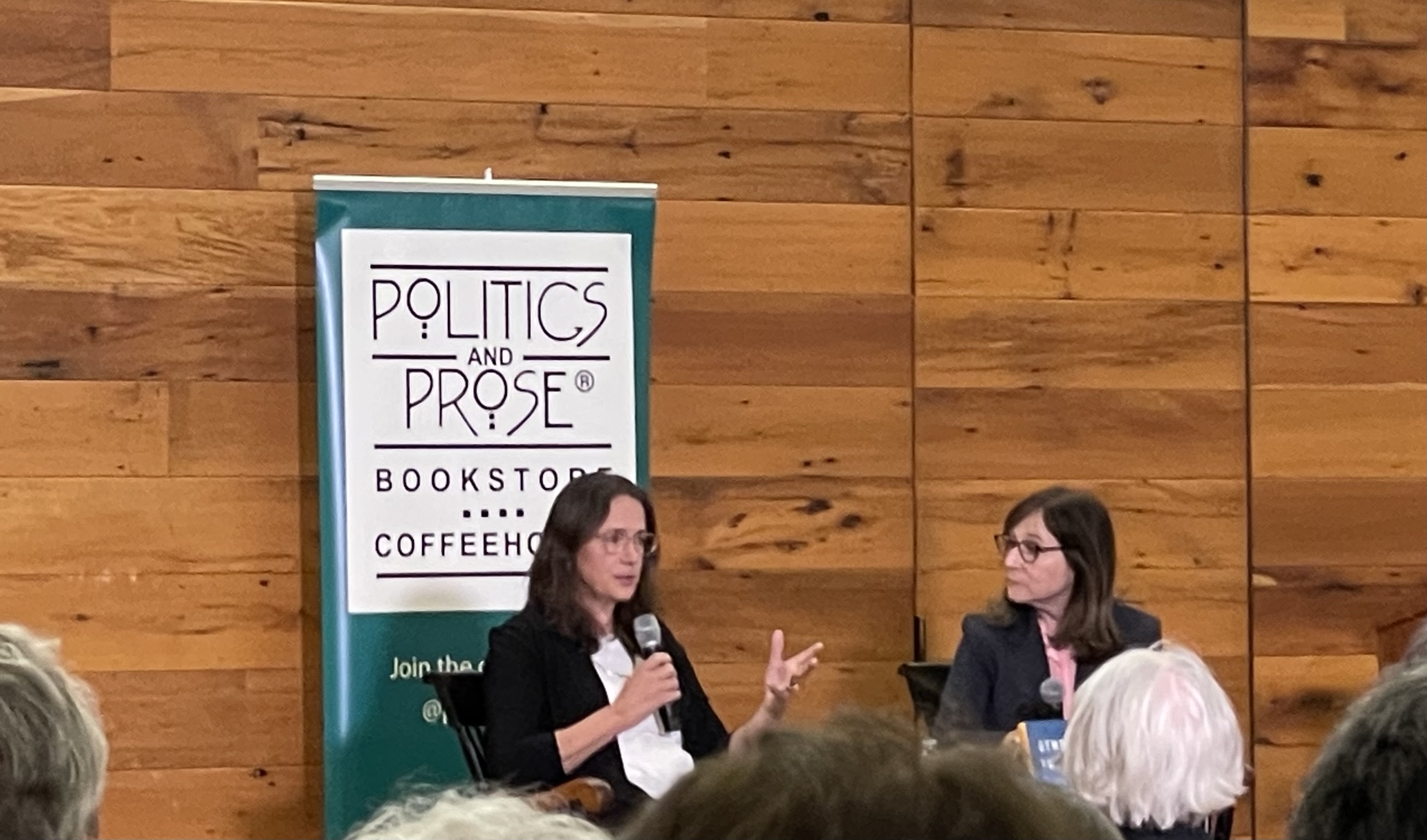
Robert P. Jones speaking at Takoma Park’s People’s Book
Jones, who was raised a Southern Baptist in Mississippi and holds a PhD in religion from Emory University and a MDiv from Southwestern Baptist Theological Seminary, writes with knowledge and empathy. Yet he also speaks bluntly about the question that must illuminate the path forward for us and for our children: How can we meaningfully respond to being beneficiaries of a crime so plain it cannot be denied and so large it can never be fully righted?
He doesn’t let his readers off the hook. “The paralysis that often cripples discussions of justice is a defense mechanism stemming from a lack of real motivation.”
While we are endlessly creative in fashioning novel ways to kill, disposses, and defraud others, we are hopelessly unimaginative in our efforts to balance the scales of justice. Greed spawns a million schemes, while repentance throws up its hands.
White Christians no longer represent the majority of Americans. But there are still more than enough to derail the future of democracy in America. In the authoritarianism of Donald Trump, we have seen which path millions have chosen. There is a better way forward.
I opine about all manner of things on MTC. In some instances, I even know what I’m talking about. An average of three postings per week is a great deal for anyone to follow. Some (he smiles) may have slipped through the cracks. So, in case you missed it* (or missed more than one), I’m here to help.
In a few days you will see a baker’s dozen of top 2023 posts as identified through reader views. What follows are twelve posts from the past year — one per month plus a bonus essay in place of a December entry — which did not make that list but that I especially enjoyed writing or that conveyed thoughts which I felt you, the readers, would appreciate. Personal favorites, if you will. I hope you enjoy them.
Winter
Image of Odesa’s Opera Theatre building taken by DJB in 2006
Protecting the pearl of the Black Sea (January 26) still resonates with me because of the personal connections made with Ukraine during a 2006 tour as well as the insightful commentary of historian Timothy Snyder on why the world needs a Ukranian victory. His analysis rings as true today as when he wrote it.
Things just take the time they take (February 15) begins with the simple fact that we won’t live forever. 4,000 weeks, to be exact, if we live to be 80 years old. We all know this intellectually, but we structure our lives and our priorities as if our time will stretch on indefinitely. The paradoxical reward for accepting reality’s constraints is that they no longer feel so constraining.
If your practice of gratitude is sporadic, Turning gratitude into thankfulness (March 13) has four tips to help you be “radically grateful.”
Spring
The William Strickland-designed Tennessee State Capitol in springtime
As with much of life, Tennessee is a paradox. The authoritarianism in my home state is not new. It builds on a past but is moving towards a new low. However, I write in A country that was built on a protest (April 10) of how resistance to authoritarianism, also a part of Tennessee’s rich heritage, is alive and well throughout the state today.
Somebody changed the locks (August 19) came amidst new (at the time) allegations of changed locks and deception at Mar-a-Lago. I know, you’re shocked. In a musical twist on the news I turn to Dr. John, who knew that when the locks are changed, “something is definitely going on wrong.”
As we hold the sunlight close during the change of seasons, views of wonder-filled sunrises and sunsets from my travels around the world filled At the break of day (September 7).
Fall
Rock Creek Park (credit: NPS)
In A brilliant love letter to baseball (October 2), I review Joe Posnanski’s loving look at 50 memories (and more) that explain why we love the game.
Moments of resonance (November 27) suggests that as humans we have learned how to fly but seem, in the process, to have lost the ability to dawdle. Hartmut Rosa writes that we should be focusing on “moments of resonance.” I love that phrase, because when things really touch us they resonate within us. Recognition of when we are happy is a first step. When things are going sweetly and peacefully, perhaps we should pause a moment, and then say out loud, “If this isn’t nice, what is?”
As I wrote in A love letter to readers (bonus read from January 3), anyone who writes — whether they do it for a living or just for the hell-of-it — appreciates those individuals who read their works. I’m always deeply touched by the positive feedback from friends and strangers alike who send comments or notes concerning something I’ve written. Plus this post has 35 recommendations for books to read, suggested by MTC readers. If this isn’t nice, what is?
I hope one or more of these posts catches your fancy today.
Saturday Soundtrack began as a diversion. Or perhaps pandemic therapy. But as I’ve written before, it has become a real labor of love.* 2023 was the fourth full year of my commitment to focus more on the music in my life and share those explorations with the readers of More to Come.
At this time of reflection and “best of” lists, we once again turn to see what you — the readers and listeners — enjoyed by highlighting the ten posts with the most views from this year’s Saturday Soundtrack series. I did not list them in countdown order, working instead off a thematic framework, but I did save the post with the most views for the last.
Thanks for reading and commenting on these posts throughout the year. Your choices are outstanding!
Rest in Peace
Three of this year’s top Soundtrack posts are remembrances of past musical lives that continue to grace our world.
An incredibly rare event is often described as coming along “once in a Blue Moon.” On August 30/31 we experienced the second full moon within the span of one month, which had me thinking about the late and beloved singer-songwriter Nanci Griffith and her song, Once in a very blue moon.
Gordon Lightfoot
Gordon Lightfoot, R.I.P. is my remembrance for the Canadian singer and songwriter, who passed away on May 1st. Lightfoot was a consistent voice in my world during my 20s and 30s.
George Winston
The self-described folk pianist George Winston, who sold millions of albums over a long career, passed away on June 4th after a 10-year battle with cancer. Like many, I came to Winston’s melodic, quiet, and thoughtful playing in the 1980s, and I celebrate his legacy in the remembrance George Winson, R.I.P.
Holy music
Two of the top-ten posts this year had connections to the spiritual and holy.
Music for Holy Week was a repeat of a 2020 post that was curated by my son, Andrew Bearden Brown (more on him later). The haunting music and exceptionally talented singers Andrew selected held up well, as readers once again made it a top Soundtrack post of the year.
The Delta Rhythm Boys rattle those dry bones is tied to one of the most evocative stories in the Old Testament: Ezekiel’s encounter with God in the valley of the dry bones. The Delta Rhythm Boys put down the definitive version of the classic song Dry Bones, which I highlight (along with their other work) in this post which became a reader favorite.
Folk and bluegrass
Four of our top posts came from artists in the folk, acoustic music, and bluegrass field.
Watchhouse Duo: Andrew Marlin and Emily Frantz (credit: Charlie Boss)
Watchhouse Duo goes back to the basics is a look at the most recent project by Andrew Marlin and Emily Frantz. They are back on the road as they began: two individuals “with profound chemistry, performing earnest yet masterfully crafted songs that encompass the unknowable mysteries, existential heartbreak, and communal joys of modern life.”
Alison Brown
Alison Brown doesn’t play the banjo; she plays music on the banjo. On banjo with Alison Brown shows the range of musical skill and interests of this progressive banjo player. In her newest album, a tour de force, Alison includes “forays into bluegrass, Brazilian choro music, classical and swing era jazz” with collaborators including musician, actor, and comedian Steve Martin; virtuoso mandolinist Sierra Hull; Israeli clarinetist Anat Cohen; multicultural chamber group Kronos Quartet; classical guitarist Sharon Isbin; and fiddle stalwart Stuart Duncan.
Molly Tuttle and Golden Highway
The Grammy-winning artist Molly Tuttle and her band Golden Highway released their new record City of Gold in July. I highlight this terrific new work that showcases the versatility of the band and the expansiveness of Tuttle’s musical interests.
Carrie Newcomer
Coming in at #2 on the annual Soundtrack top-ten list of reader views isA Great Wild Mercy, singer-songwriter Carrie Newcomer’s newest project. Newcomer has always explored “the intersection of the spiritual and the daily, the sacred and the ordinary,” and this album continues that search. Over the course of her career she has become a prominent voice for progressive spirituality, social justice and interfaith dialogue. Author Barbara Kingsolver has written of Newcomer, “She’s a poet, storyteller, snake-charmer, good neighbor, friend and lover, minister of the wide-eyed gospel of hope and grace.”
Soundtrack favorite
And #1 on the list of reader views is:
This year’s prize winners in the Handel Aria Competition were: Emily Donato, soprano, first prize; Andrew Bearden Brown (right) tenor, second prize; and Fran Daniel Laucerica, tenor, third prize.
Our son — the tenor Andrew Bearden Brown — was a finalist in the 10th annual Handel Aria Competition held at historic Grace Episcopal Church on the capitol square in Madison, Wisconsin. The Handel Aria Competition was established in 2013 and the finalists for this year’s competition were selected out of 125 auditions from around the world. Andrew took second prize, and in the #1 Saturday Soundtrack post for 2023 — A memorable evening of Handel — I post the videos of his two arias. All of the finalists sang beautifully in this wonderful historic setting. Needless to say, we are so proud of Andrew’s performance. I shared it with the readers of More to Come, who responded enthusiastically!
Enjoy!
More to come . . .
DJB
*I enjoy all types of music but realized in 2019 as More to Come passed the ten-year mark that I was seldom finding time to really listen to new music, much less highlight musicians I loved through the newsletter. Announcing a weekly commitment to showcase some of the work of those who caught my ear was a way to push me out of my typical posts. The reaction? Well, I have one family member who confesses to “never reading the music posts.” Others — friends, business colleagues, and family members — regularly comment or send emails with thoughts and suggestions only about the Soundtrack features. Suffice it to say that enough people read them that I’ll continue to feed my soul though these explorations and highlights.
When I began my year of reading dangerously™ I had no idea what would result from a mystery-novel-a-month habit, having never given the genre much attention. Now that I’ve worked my way through the twelfth such book this year, I can honestly say that the final installment may have been the biggest surprise of all.
Who knew there was such a thing as a light, witty, and — most surprising of all — big-hearted mystery novel? Well, I do now.
The Thursday Murder Club (2020) by Richard Osman is centered around Coopers Chase, a high-end peaceful British retirement village on the grounds of a former convent. We soon discover that Coopers Chase was built with drug money by the “loathsome” Ian Ventham and maintained by his dangerous associate, Tony Curran. Only the chapel and cemetery still suggest their original use, as the rest of the facility has been repurposed into living spaces, a restaurant, and meeting facilities, including the Jigsaw Room. There four residents turned septuagenarian sleuths meet weekly to discuss unsolved crimes in “a two-hour slot free between Art History and Conversational French. They book the room under the name ‘Japanese Opera: A Discussion’, which ensures they were always left in peace.” Together they call themselves the Thursday Murder Club.
The four club members could not be more different. The leader, Elizabeth Best, is secretive about her background as an ex-spy. Very no-nonsense, Elizabeth can always call-in favors from around the world when needed. Joyce Meadowcroft, the most recent member, is a widow who was a career nurse. She was asked to join the club after accurately estimating how long it would take someone to bleed to death from a particular type of stab wound. Ron Ritchie is the tattooed former union organizer who is not afraid to mix-it-up with anyone, and who doesn’t believe a single word anyone ever tells him. It is a surprisingly good skill to have when reading police reports. Ron’s son Jason is a well-known former boxer now resigned to working on celebrity ice-skating shows. Ibrahim Arif, an Egyptian-born semi-retired psychiatrist, is the fourth member, bringing very useful organizational and observational skills to the club.
The four are discussing old murder cases culled from the files of Elizabeth’s friend Penny Gray, a former police officer who’s now comatose in the village’s nursing home. But that routine’s about to be disrupted. First, we learn that Ventham has big plans for the future just as soon as he’s removed the nuns’ bodies from the cemetery. Ventham also fires the combustible Tony Curren and replaces him with Bogdan Jankowski, who is a willing but wary associate for Ventham.
When Curren turns up murdered in the kitchen of his nearby home with a strange photo that includes Jason Ritchie lying beside his head, the Thursday Murder Club suddenly has a very real murder mystery with real-life consequences on their hands.
About this time Elizabeth spots a new member of the local police force who, having just moved to the area from South London, meets the group after giving a home security talk that Ron and Elizabeth immediately disrupt. They all like the ambitious officer, who in turn recognizes their sharp mental and observational skills, so Elizabeth pulls strings to get PC Donna De Freitas placed on the local murder team. She is partnered with team leader Detective Chief Inspector Chris Hudson, and although they differ in age (she is 26 and he’s 51) and background, they hit it off and soon trust each other and — more importantly — see the value the Thursday Murder Club can bring to the case.
Soon more bodies begin to turn up, including Ventham who is poisoned while arguing with the residents as they try to save the cemetery. Not all the deaths are murders, and there are poignant moments as the retirees navigate aging and end-of-life decisions. Osman is a very good writer with clear affection for these retirees who maintain their spark for life. There are twists and turns throughout that are as surprising as the final outcome. The Thursday Murder Club is a book that will lead you to laugh, tear up, think, and ultimately compel you to turn page-after-page until you’ve reached the satisfying conclusion.
Recommended by my friend and former colleague, Barbara O’Reilly, The Thursday Murder Club was a very rewarding end to my year of reading mystery novels. I’m now hooked but won’t be so rigorous as to include one each month. However . . . I suspect we’ll be seeing many more in the coming months.
More to come . . .
DJB
The Weekly Reader links to the works of other writers I’ve enjoyed. I hope you find something that makes you laugh, think, or cry.
Over the course of 2023 I’ve been privileged to have seven different writers accept my invitation to discuss their recently published works. The readers of More to Come have been the beneficiary of their generosity. For this year-end roundup, I have pulled these conversations together in a salute to these thoughtful and perceptive authors.
As is appropriate for MTC, the subject matter is all over the map. Scan these short blurbs (the links take you to the full post and conversation) to find history, preservation, memoirs, spirituality, community revitalization, the uncovering of untold stories, career and life advice, and authorship. You’ll find all that below, listed alphabetically by author.
A Long Way from Iowa: From the Heartland to the Heart of France (2023) by Janet Hulstrand takes the reader from her grandmother’s hometown in Iowa to the author’s home in the French countryside. Janet’s adventures recounted in this delightful memoir include working as Caroline Kennedy’s editorial assistant and living in a gypsy caravan outside Paris. In the interview, we discover much about Janet’s journey, including the complicated relationship with the two women who fueled her love for learning, exploration, and writing.
Sleeping With the Ancestors: How I Followed the Footprints of Slavery (2023) by Joseph McGill, Jr. and Herb Frazier is a compelling work about a crusading effort to draw attention to the preservation of dwellings where enslaved people lived, worked, and raised their families. McGill — who founded and leads The Slave Dwelling Project — and his co-author Herb Frazier have compiled a captivating account of his years working to “change the narrative, one slave dwelling at a time.” In it, the authors recount the broadening of a modest regional effort into a national force. For this post, Joe — a former colleague at the National Trust — graciously agreed to chat with me about the book and his work.
Never Say Whatever: How Small Decisions Make a Big Difference (2023) by Dr. Richard A. Moran reveals how the W-word is a career — and life — killer. We have a chance to make a big impact in both, but to do so we have to make the numerous daily decisions that everyone faces. The choices we make, even the small ones, help us pivot toward the life and career we want. But that becomes much harder if we tend to rely on “whatever” as a substitute for decision-making. Rich shared insights he’s uncovered with readers of More to Come in this author interview.
Books and Our Town: The History of the Rutherford County Library System (2023) by Lisa R. Ramsay is a wonderful addition to the story of America’s love affair with public libraries. After a newspaper editorial encouraged the citizens of Murfreesboro, Tennessee, to create a public library, Henry T. Linebaugh answered the call. For its 75th anniversary, Ramsay has gathered a rich array of stories that tell how Linebaugh Library and its branches became essential parts of my hometown. I interview Lisa about civic engagement, strong female leadership, and more.
AMEN? Questions for a God I Hope Exists (2022) by Julia Rocchi is full of wisdom, vulnerability, and questions asked in an open and seeking spirit. Essays, quotations, poems, and prayers probe the mysteries that make up life in what one reviewer sees as, “a psalter for the post-modern, exhausted age.” Julia writes of a God who is imminently approachable and ready to answer our deepest questions. When we “ask questions of God, the Universe, whatever it is that we believe to be bigger than ourselves,” Julia notes, “we do so not to arrive at answers, but to inspire still more questions.” In this post she answers some of mine.
Playing Authors: An Anthology (2023) is a collection by 18 writers asked to consider the question of authorship. The creative act of writing in today’s world is at the heart of this newest release from Old Iron Press, a female-led, small independent press in Indianapolis. “Literary mashups, personal essays, alternative history, and other disobedient forms” are included in this work, which begins with the sad and insightful and laugh-out-loud funny “Hemingway Goes on Book Tour.” In this post, I chat with that story’s author, Robyn Ryle, about the inspiration for this piece, the challenges of modern publishing, the need for more diverse voices, and imagining other famous authors beyond Hemingway in the rat race of today’s world of the book tour.
Your City is Sick (2023) by Jeff Siegler takes a deep dive into how the various causes of community malaise — poor planning decisions, neglect, disregard for current residents, and more — have led to the dysfunction we see today. Like a blunt yet perceptive doctor, Siegler first helps us understand the disease and then — in straightforward, no-holds-barred language — he prescribes treatments to push his readers to transform their cities through relentless, incremental improvements. In this post, Jeff talks with me about one of the worst diseases a city can face — Silverbulletitis — and why it is important to focus on the community you have and those who live there.
Thanks to each of these perceptive and thoughtful authors for taking the time to grace the More to Come newsletter with their experiences and insights. It was truly a delight to highlight their creativity and these important works.
More to come . . .
DJB
Author photos clockwise from top left: Joseph McGill, Jr., Jeff Siegler, Robyn Ryle, Julia Rocchi, Lisa Ramsay, Janet Hulstrand, Richard Moran
When I don’t find a book especially illuminating or enjoyable, I recognize that the fault may well be with the reader and not the writer. I’m fully prepared to accept that as the case with a book I just finished reading with my Third Stage book group. My friends all found portions of this work meaningful and illuminating, and in our discussions they helped me uncover truths I had missed. However, I found it a slog to read, in part because it is such a piece “of its time.” I have recently written a positive review of another work by this writer, and I reference his quotes on occasion. But this particular work is one I don’t expect to pick up again.
The Four Loves (1960) by C.S. Lewis is sometimes described as a “classic” of the British writer, scholar, lay theologian, broadcaster, Christian apologist, and bestselling author. In this work, Lewis takes the reader through a description of four different types of love: “affection, the most basic form; friendship, the rarest and perhaps most insightful; Eros, passionate love; charity, the greatest and least selfish.” There was something of value in each, but for a short, 190-page work, it certainly seemed to take forever to read.
While it has very little to do with Christian or God-like love, I very much appreciated his perspective in the early chapter entitled “Likings and Loves for the Sub-Human.” Here Lewis considers things such as a “love of home” or a “love of country.” The latter brought forth for me some of his most direct and useful — in the context of today’s battles over history — observations.
The actual history of every country is full of shabby and even shameful doings. The heroic stories, if taken to be typical, give a false impression of it and are often themselves open to serious historical criticism.
“I think it is possible,” he writes, “to be strengthened by the image of the past without being either deceived or puffed up . . . The stories are best when they are handed on and accepted as stories.” And perhaps there is a relationship to the divine when he scolds those who have a firm belief that their own nation “has long been, and still is markedly superior to all others.” He relates a story about an old clergyman who. when told that all nations felt this way, responded with “Yes, but in England it’s true.” He isn’t a villain, Lewis asserts, only an “extremely lovable old ass.” But he warns that the lunatic fringe can take this approach to a radicalism “which Christianity and science equally forbid.” We are seeing that in today’s so-called “Christian nationalism.”
Lewis also notes that there needs to be “a full confession by Christendom of Christendom’s specific contribution to the sum of human cruelty and treachery.”
I am not going to delve into the four different loves. There are a multitude of reviews by writers who engage much more thoughtfully with this work — from both a positive and negative perspective — that are easily found online. But in the final chapter on “Charity,” Lewis reminds us that God is love, and that love is the divine energy. But because none of us has direct knowledge about the ultimate Being, we are forced to use analogies. “We cannot see light, though by light we see things.” So is it with love.
No one can describe with certainty that divine energy. It is similar to death, in that no one still alive has fully experienced it. No one can say what happens to the dead but, as Madeleine L’Engle notes in words that could just as easily apply to Charity, “The important thing is that we do not know. It is not in the realm of proof. It is in the realm of love.”
As I wrote when I first heard Ashbrook on Thanksgiving Day in 2008, Church of the Ascension is a small Gothic church that is acoustically alive, providing a nice setting for “the sparkling strings of hammered dulcimer, cittern, and harp guitar” blending with “rich harmonies and driving melodies on fiddle and accordion.” The program promises to include “toe-tapping dance tunes and haunting vocals of seasonal ballads and meditative airs from the shores of the many Celtic nations.”
Ashbrook “has been an international pioneer and advocate in the revival of the hammered dulcimer” for more than four decades. In addition, she plays the Irish wooden flute and pennywhistle and performs frequently as KA/PO with her husband Paul Oorts, a multi-instrumentalist from Belgium.
There are a number of videos of the duo playing Celtic music, if not necessarily holiday selections, on YouTube. I’ll showcase a few to whet the appetite, beginning with Fallen Heroes of Waterloo from their Celtic Cafe project.
Ashbrook plays the wonderfully titled Good Morning to Your Nightcap from the Hills of Erin album.
One of our favorite tunes is The Water is Wide, which Ashbrook performs on her Starry Starry album.
Oorts accompanies Karen on a Sedgwick harp guitar in concert at the 5th Annual Harp Guitar Gathering on October 28, 2007. They title this set The Belle & the Butler and it includes the tunes Sandy River Belle and the Butlers of Glen Avenue.
During the pandemic, KA/PO recorded a concert for the Washington Free Public Library in Western Maryland for the library’s “Noteworthy Sundays” series. It captures some the range of their musical interests.
Finally, the Kennedy Center recorded the duo’s Millennium Stage concert in May of 2013 as they represented Belgium at the European Union Showcase. This is another concert-length video you may find of interest.
In addition to the Silver Spring venue, the quartet will perform this show in Shepherdstown, WV on December 16th and in Burke, VA on the 17th.
Enjoy!
More to come . . .
DJB
Photo of Karen Ashbrook and Paul Oorts credit KarenAshbrook.com (copyright 2014 Michael G. Stewart)
The question of authorship has been around for centuries. Who gets to tell stories, and how, is certainly a fundamental — some would say existential — issue for our time.
Playing Authors: An Anthology (2023) is a collection by 18 writers asked to consider this question of authorship. The creative act of writing in today’s world is at the heart of this newest release from Old Iron Press, a female-led, small independent press in Indianapolis. The description of the project as “literary mashups, personal essays, alternative history, and other disobedient forms” shows the range and imagination of this work.
The historian in me connected with Amy Halloran‘s “The Author of Nature” about the erasing of the history of Jesse Hawley’s “authorship” of the Erie Canal by powerful politicians. I also loved the odd modern fable, as told by Mary Christine Delea, of the Ford Motor Company contacting Marianne Moore, wanting her help in naming their new car. They turned down Thundercrest, among others, and instead chose Edsel. We know how well that turned out. Marianne Moore, on the other hand, got to throw out the first ball at a Yankees game. Don’t mess with the poets.
The anthology’s opening story, “Hemingway Goes on Book Tour” is sad and insightful and laugh-out-loud funny. Here’s a small slice:
“Cranky old white dude is not a brand,” the marketing director said. “You’re no Bernie Sanders, Ernest.”
DJB: Robyn, what inspired you to think about the great Ernest Hemingway going on a book tour?
Robyn Ryle
RR: I’d been thinking a lot about what it means to be an author today. It doesn’t matter if you’re traditionally published or an indie author — you’re expected to be your own marketer and publicist. I’m not very good at that public face of writing and I suspect a lot of writers feel the same way. One day I found myself wondering, rather resentfully, “Did Hemingway have to do this? Did Hemingway go on book tour?”
The answer is, not really. I think the idea of authors as promoters of their own work not coincidentally became prominent at the same time more women became authors. Promoting yourself is, after all, emotional labor. I was contemplating an essay about these dynamics when I saw the call for pieces on the playing authors theme for Old Iron Press. I decided writing a story that imagines Hemingway on book tour was more fun than writing the essay. I was right.
When the marketing director pushes Hemingway to consider his “brand,” your story ― like others in the anthology ― grapples with the challenges of the modern publishing industry. What important voices are we missing today because of the commercial focus of that industry?
It’s interesting that this was a theme that developed in the anthology. I guess it’s something that’s very much on writers’ minds today.
As to what voices we’re missing, still and always the voices of people in marginalized groups. Even with publishing’s dedication to diversity in the wake of the Black Lives Matter movement, 66-75% of the books published in 2021 were by white authors. Statistics about books by LGBTQ+ authors or authors with disabilities or working class authors are harder to come by. I’ve heard some Black, indigenous and people of color already seeing signs that even that small window in publishing is closing again now.
Also in today’s publishing world, there’s less patience with allowing authors to develop their craft over time. If your first book doesn’t sell well, you’re less likely to get the opportunity to publish a second (sort of like pitchers not being allowed to go through the lineup more than two times in today’s MLB). There are a lot of classics that we’d be missing now if the authors had been dropped by their publisher after their first novel.
It reads as if you had a great deal of fun in writing this story. Did other “famous authors on book tours” come to mind, and if so, which ones would you like to imagine in a sequel?
What a great question! I’m a little obsessed with Hemingway. For better or worse, he’s the model against which a lot of American writers measure themselves. Plus, he really did create his own larger-than-life brand.
Even as it was fun imagining Hemingway on book tour, there’s a sadness there, too. Book tours make you question your whole existence as a writer and a person. When I think of other writers on book tour, the sadness wins out over the humor. Virginia Woolf? Book tours would have been a nightmare for her. I like to think she would have stolidly refused to do any such thing. Maybe today’s authors should do the same. Jane Austen’s interesting with her wry sense of humor. I could imagine her getting into it, having a YouTube channel, a podcast, and thousands of Instagram followers.
As someone who writes regularly on Substack, in books, and for magazines, could you highlight one or two pieces in the anthology that especially spoke to you?
I love Barbara Shoup’s essay, “Author, Author,” so much. Writers’ conferences and workshops are fraught places. She perfectly captures the energy there. The desperation. A lot of people are there to GET PUBLISHED at all costs. It’s hard to be in those spaces when you’ve seen how the sausage gets made, so to speak. It’s hard not to be the oracle of doom, telling people that publishing a book doesn’t really change much about your life for most writers. People don’t really want to hear that.
I also loved Corey Michael Dalton’s story, “Cinderella,” for the sheer fun and humor.
In a recent Substack newsletter, you wrote of your need to hear more diverse voices in the books you read. What recent books by diverse authors would you recommend to our readers?
So many to choose from as there are so many in so many different genres, but I’ll focus on the books with which I’ve been finishing up my reading year. These are also books I haven’t seen on a lot of the big end-of-year lists. Temple Folk by Aaliyah Bilal is a collection of short stories about the lives of Black Muslims in the U.S. I knew a lot about the Nation of Islam during the 1960s, but not about what’s happened to that community in the intervening years. If you like mysteries, A Disappearance in Fiji, by Nilima Rao is the beginning of a new series that features a Sikh police sergeant stationed in Fiji. The series explores the British empire in early 20th century. There have been so many novels that are retellings of Greek myths, so I was happy to see Every Rising Sun, by Jamila Ahmed, a retelling of the story of Shaherazade and the One Thousand and One Nights, which centers Shaherazade’s story.
Each month my goal is to read a minimum of five books on a variety of topics and from different genres. Here are the books I read in November 2023. If you click on the title, you’ll go to the longer post on More to Come. Enjoy.
Democracy Awakening: Notes on the State of America (2023) by Heather Cox Richardson is an accessible and engaging work that tells how America got to this difficult moment in time. The author of the Letters from an American newsletter, Richardson’s newest volume takes us back through our past to see precedents that led to our most recent authoritarian experiment in the ascendancy of Donald Trump. As Richardson shows, there has always been a small group of wealthy people who have made war on American ideals, using language and false history as their tools of choice as they fight against the liberal consensus. But we also have a history of those on the margins — women, people of color, immigrants — who have fought equally hard to push America to live up to its ideals. Their work shows us pathways out of the current moment.
Small Things Like These (2021) by Claire Keegan is a short yet deeply moving novel set in small-town Ireland during the Christmas season of 1985. Bill Furlong is a coal and timber merchant who, while delivering a load of coal to the local convent, makes a discovery that forces him to consider his past and the choices he must make. This little gem of a book brings us face-to-face, in a simple yet memorable story, with how we confront our past and with the evils of a community’s complicit, self-interested silence. It is also a deeply moving story of “hope, quiet heroism, and empathy.”
The Church of Baseball: The Making of Bull Durham (2022) by Ron Shelton is a delightful book on multiple levels. Full disclosure: I love the movie. Bull Durhamis not only the best baseball movie ever but also the best sports movie ever. It’s not even close. Shelton, a former minor league baseball player turned writer and director, has a passion for this multi-faceted story that still shines through 35 years after the film was released. And the tale of how Shelton — along with Kevin Costner and Susan Sarandon — pursued every angle to make this film in spite of great odds and with challenges arising around every corner, is worth knowing as well.
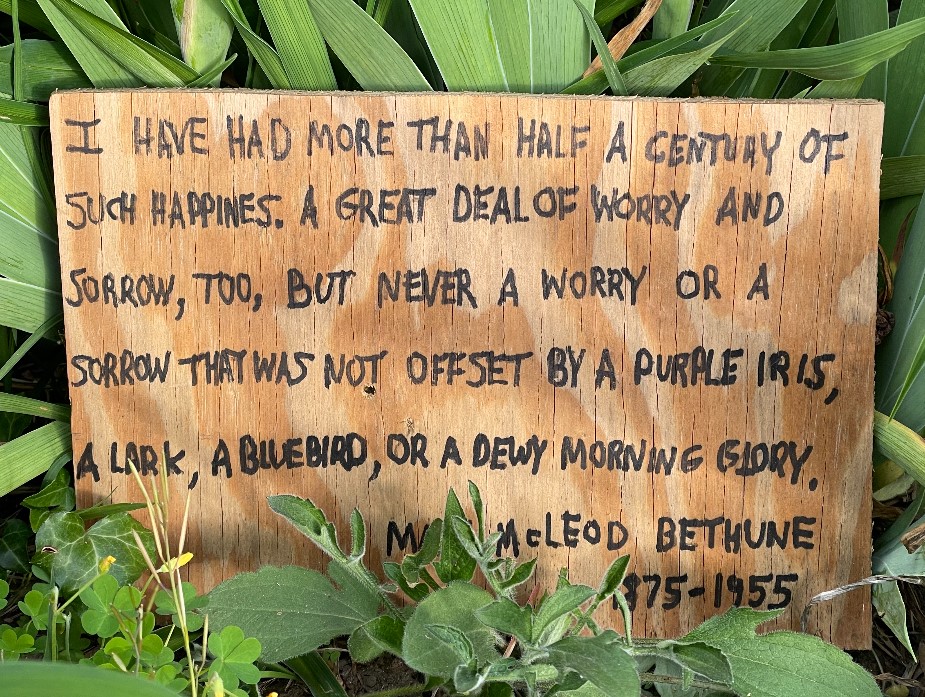
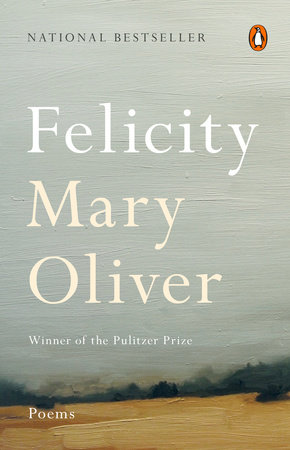
Blue Iris: Poems and Essays (2004) by Mary Oliver is a collection of ten new poems at the time of publication, two dozen of her poems written over the prior two decades, and two previously unpublished essays on the beauty and wonder of plants. Nature is full of mystery and miracle. Oliver believes our response, if we are paying attention, should be one of astonishment and gratitude. Understanding the true enchantment and mysterious spell of nature, she found ways to hear music in her world, even when there was nothing playing, and convey that to her readers.
The Book of Charlie: Wisdom from the Remarkable American Life of a 109-year-old Man (2023) by David Von Drehle is the story of Charlie White, a man born before radio who lived to use a smartphone. Upon moving to Kansas City, Von Drehle meets White — at the time his 102-year-old neighbor — and strikes up a friendship. Over seven years he learns that Charlie lost his father at an early age, the victim of a freak accident. But it was in his response to that tragedy that Charlie learned how to live. This parable of persistence and durability points the way toward a happy and useful life.
The Murder on the Links (1923) by Agatha Christie begins with the famous Belgian detective Hercule Poirot rushing to northern France after receiving an urgent request from a client, Paul Renauld, who fears his life may be in danger. Unfortunately, by the time Poirot arrives the local police have found Renauld stabbed to death, lying in a shallow grave on a golf course, wearing only an overcoat and his underwear. This curious turn of events is made even stranger when another well-dressed man is found on the estate murdered in an identical way. Poirot has a nagging suspicion that he’s seen this crime before. As is true with many of Christie’s novels, these characters are not always who they seem to be.
What’s on the nightstand for December (subject to change at the whims of the reader):