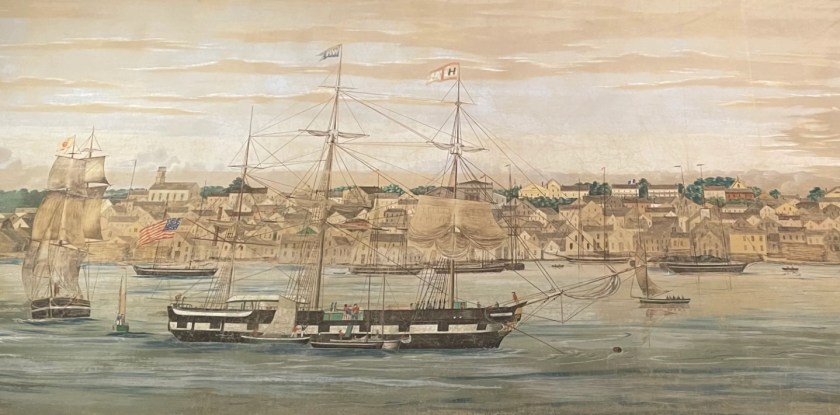
Historian Edward L. Ayers looks at the six critical decades leading to the Civil War to find contested visions, but also hope for our future.
It is tempting to look at a period of history—especially one with well tilled soil—and decide that the main stories and themes are settled. That we understand not only what happened, but why. I have certainly been guilty of wanting my history wrapped and tied up with a neat bow.
Fortunately or unfortunately, depending on your point of view, history is seldom so simple. It is complex, multi-layered, surprising. What happened has not changed, but what we know about what happened and the context into which we can place that new understanding always seems to be expanding. Pulitzer prize winner Viet Thanh Nguyen, made this important point in connection with the Vietnam War when he wrote, “All wars are fought twice, the first time on the battlefield, the second time in memory.”
As we learn more, the way we tell the stories of our history and the way we preserve the physical reminders of the past changes. History is under construction.
Through compelling storytelling mixed with solid scholarship, gifted historians have a way of opening our eyes to the “messy complexity of our past.” We may think that the United States was on an inevitable path of collision in the years prior to the Civil War. Perhaps. But many different Americans—probably more than we traditionally recognize—were involved in contesting the possibilities and promises of our young country in the the first half of the 19th century.
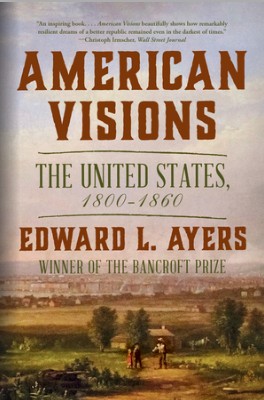
American Visions: The United States, 1800 – 1860 (2023) by Edward L. Ayers is an illuminating synthesis of the six decades leading to the Civil War. Ayers shows us how a broad cast of characters came together to shape the volatile new nation. There were famous writers and those who only won veneration after their deaths. People on the margins who ruptured history. Faith leaders and con men. Naturalists. Musicians, artists, and poets. Indigenous leaders, female activists, Black speakers, and abolitionists. “Individuals dismissed for their skin, sex, or peculiarity spoke for an America of freedom and connection, of possibility and responsibility. They did so from the traditions of the Declaration of Independence and the New Testament, from the individuality of art and literature, from traditions of African and Indigenous cultures, and from a recognition of the mutual dependence of the human and the natural world.” Their visions were articulated after confronting the moral failings of the nation.
They lived and worked in an era when the young United States “veered in unexpected directions.” A time when American slavery went from something seen as a backward and failing institution to the point where it “would spread over an area the size of continental Europe and lead the United States into a war against another republic.” Older historians have termed this period the “age of Jackson” or “the rise of the common man”; the era of “manifest destiny” or the “ante-bellum” years. Ayers wants us to think of this time as “the era of the new nation, the story of government, economy, culture, and identity invented on the spot, of progress and wrong weaving together in ways that defined America’s understanding of itself.”
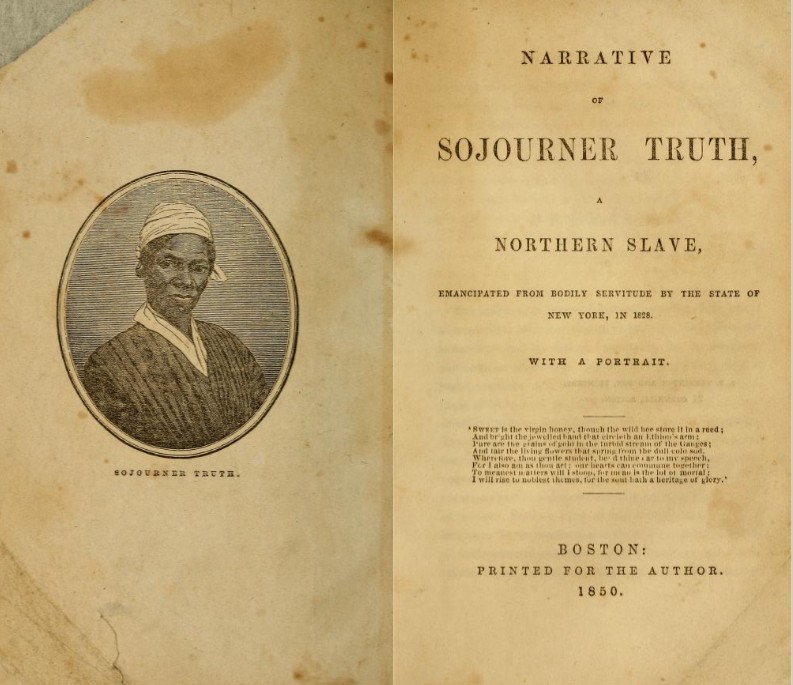
Ayers takes the reader through nine chapters and an epilogue full of unexpected twists, thoughtful explorations, and vivid, lively prose. As a helpful story map on the New American History website shows, we find voices we expect—Tecumseh, Frederick Douglass, Ralph Waldo Emerson, Joseph Smith, James Fenimore Cooper, William Lloyd Garrison, Elizabeth Cady Stanton, Sojourner Truth, John Brown—and many more we do not. Men and women such as Hiram Powers, whose marble statue of a white woman enslaved by Turkish captors seized the imagination of white Americans across the nation while some noted that millions of enslaved Black women found no sculptor. William Gilmore Simms who found a large and admiring audience with his stories of the South during the era of the American Revolution—and of enslaved people contented with their lot. Elias Boudinot, born of Cherokee and white parents, who used his education to defend the rights of Native people to their lands.
Because these are people setting out visions for the new country, we read more than one might expect about writers, artists, lecturers, poets, activists. “Walt Whitman published Leaves of Grass at his own expense and set some of the type. The poetry scandalized many readers at the time but later became recognized as the most important American poetry of the century.” Lilly Spencer, painting pictures from her own experience pushed beyond sentimental images of married life. Sarah Grimké wrote Letters on the Equality of the Sexes after abandoning her wealthy slaveowning family in South Carolina for a Quaker community in Philadelphia, where she became an abolitionist.
Ayers interests and scholarship are so wide—with subjects including “authors, reformers, pseudoscientists, mystics, showmen, and more”—that any listing of the people and voices found in this work will be inadequate. But one never loses the thread and readers are brought along by Ayers skill at weaving these many pieces into one fascinating, mind-expanding, and enlightening fabric.
These are complex visions of progress and possibility that are full of contradictions. The issues of this era remain important today. Historian and Harvard president emerita Drew Gilpin Faust said that Ayers is “a son of the South who knows how to honor the past by facing it squarely.” Ayers describes himself as “an optimistic person who has written and taught about the worst wrongs in American history,” doing so because he believes that “by addressing these evils we can perceive and counter their insidious legacies.” That can seem difficult in our present age, especially when nativists, racists, and those who politicize religious faith claim the sanction of history.
“But we can choose to remember a fuller American history, one that is more truly patriotic, one that evokes the nation’s highest ideals of equality and mutual respect in the face of the nation’s failings.”
As Ed Ayers shows in this sweeping synthesis of our period of growth as a nation, “bold men and women in the new United States spoke without permission and often in defiance of those who held power . . . Their visions remain powerful—and necessary—generations later.”
More to come . . .
DJB
A depiction of New Bedford in “The Grand Panorama of a Whaling Voyage ‘Round the World” by Benjamin Russell and Caleb B. Purrington (1848) as featured on the Medium newsletter of Edward Ayers.


Pingback: When history, myth, and memory clash | MORE TO COME...
Pingback: Observations from . . . June 2026 | MORE TO COME...
Pingback: From the bookshelf: June 2026 | MORE TO COME...
Pingback: Summer reading . . . check! | MORE TO COME...