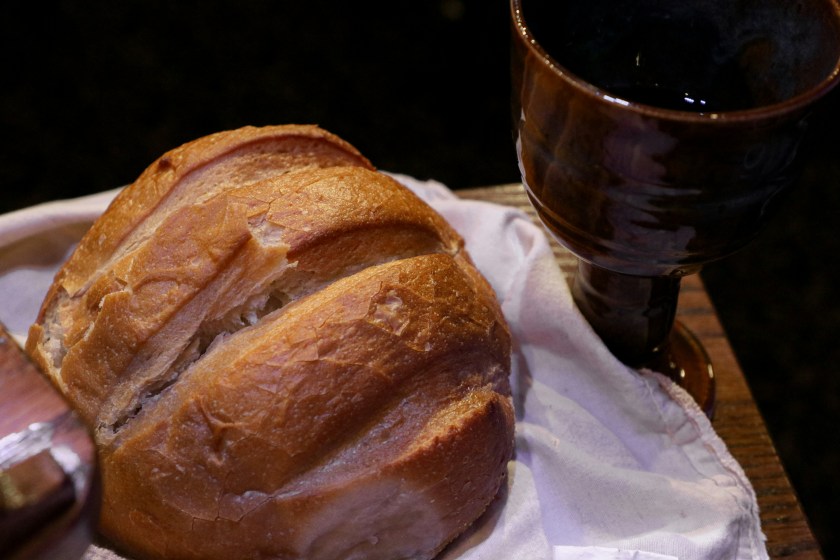
The former Archbishop of Canterbury looks at the essential elements of the Christian life. It is a useful reminder on the day we say goodbye to my mother-in-law.
Our family and the families of Candice’s two brothers have gathered today to say goodbye to my wife’s mother, my mother-in-law, and Andrew and Claire’s grandmother. Irene Ann Holsey Colando lived to be 93 years of age. When we bury her ashes in the columbarium at St. Patrick’s Catholic Church in Mt. Dora, Florida, her Christian faith will be the framework for all we do and say. A lifelong Catholic, Mrs. Colando loved the church and participated fully in every aspect of its ministry. I heard her say on more than one occasion, “God is taking care of me.” She fully accepted me into the family and often mentioned—especially after Candice joined me in the Episcopal Church—that her father had been an Episcopalian. I called her my favorite mother-in-law and she would respond that I was her favorite son-in-law. We will all miss her dearly.
“I wait for the Lord, my soul waits, and in his word I hope; my soul waits for the Lord more than watchmen for the morning, more than watchmen for the morning.”
Psalm 130: 5-6
A former Archbishop of Canterbury prepared a little book designed to help us think about the essential elements of the Christian life. It seems an appropriate topic to consider on this special day in the life of our family.
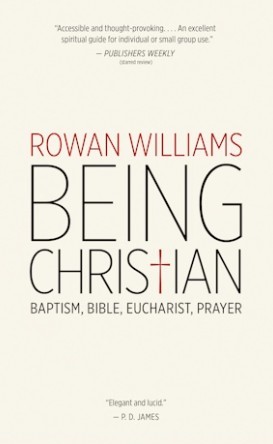
Being Christian: Baptism, Bible, Eucharist, Prayer (2014) by Rowan Williams is a clear, accessible, and thought-provoking work; simple to read and yet profound in its approach to what it means to be a Christian in today’s world. As the title suggests, Williams looks at four elements that cut across almost every part of Christendom, beginning with the act that brings us into full membership in the church. Christians read the Bible and gather to share bread and wine in memory of the death and resurrection of Jesus of Nazareth. Finally, Christians pray, with many incorporating the prayer passed along by Jesus into their worship service. Some traditions of the church have other elements that are important to them to varying degrees (e.g., speaking in tongues, healing, confession, celibacy for priests, foot-washing, worship on Saturdays), but Williams wants to focus on what brings us together, not what divides. As one reviewer notes, Williams entices us all to go deeper by reviewing the basics. “It takes a theologian of depth to write a simple book about complex concerns.”
Each chapter includes insights and perspectives that expand one’s understanding of the historic arc of Christianity and the role of each element in today’s church. Baptism, Williams writes, is a restoration of what it is to be truly human. The humanity that God first intended. What is that intention? It is, Williams suggests, a letting go of our personal identity. This new creation is “not a humanity that is always going to be successful and in control of things, but a humanity that can reach out its hand from the depths of chaos, to be touched by the hand of God.” That leads Williams to suggest that if one wants to know where we might expect to find the baptized, one answer is, “In the neighborhood of chaos.”
We are expected, as Christians, to not be afraid of looking with honesty at the chaos inside ourselves, “as well as being where humanity is at risk, outside.”
The chapter on reading the Bible was especially useful to me. Williams points out that Christian people characteristically have the Bible read to them. “Christian life is a listening life.” It is not an easy book to understand. “As soon as you think you know what the Bible is, you turn the page and it turns into something different.”
Williams makes the point, which resonated strongly with me, that God wants you to hear all parts of the Bible.
“He wants you to hear law and poetry and history. He wants you to hear the polemic and the visions. He wants you to listen to the letters and to think about the chronicles.”
The Bible can be contradictory and the stories confusing. So Williams suggests that an important question to ask yourself if why exactly is it important to God that you hear it. Know it.
Here and elsewhere, Williams wants us to see that we are still in the middle of the story. There is constant movement into an endless mystery. Jumping to conclusions while the story is still being told it not helpful. He encourages us to think about how some people responded, but recognize that this story isn’t always easy to hear.
Williams speaks of the Eucharist as exemplary of the life Jesus lived on earth. It confused those who were with him then.
“The indiscriminate generosity and the willingness to mix with unsuitable people were already, in the first Christian generation, just difficult enough for the Gospel writers to scratch their heads and cough just a little bit about it. But they could not deny it or suppress it. It was too vividly remembered. Jesus sought out company, and the effect of his presence was to create a celebration, to bind people together.”
The Roman Catholic priest James Allison summarizes much of the Gospel message as “Let’s party!” In Holy Communion, Williams asserts, Jesus tells us that he wants our company. Yes, there is remembrance of death and suffering in the Eucharist, but there is also very much a celebration.
Prayer is how we grow in Christian humanity. He quotes Gregory of Nyssa in suggesting that prayer “is in significant part about resolving conflict and rivalry. If people prayed seriously they would be reconciled.” God shows us how to forgive and then steps back and says, “now, show me” how you forgive others.
In reflecting on this book, Sister Wendy Beckett of the Carmelite Monastery, Quidenham, wrote:
“Christianity is both simple and profound. Rowan Williams understands these two levels, and how we come to the depth of what Jesus is by the simplicities of informed Christian practice. This is a handbook for Christian living.”
That sums it up pretty well.
In The Leaving by Jan Richardson
in the leaving,
in the letting go,
let there be this
to hold onto
at the last:
the enduring of love
the persisting of hope,
the remembering of joy,
the offering of gratitude,
the receiving of grace,
the blessing of peace.
Rest in peace, Irene Ann Holsey Colando.
More to come . . .
DJB
Photo by Morgan Winston on Unsplash


My sincere condolences.
She raised an outstanding daughter.
Thank you, Jane. You knew Mrs. Colando back in the day. And yes, she did raise an outstanding daughter.
Pingback: Observations from . . . June 2026 | MORE TO COME...
Pingback: From the bookshelf: June 2026 | MORE TO COME...