Latest Posts

Hail to the Reds*

When Joe Posnanski’s “bonus” Substack essay hit my in-box this morning, I could have guessed the subject without even reading the headline. Joe (“writer of sports and other nonsense”) has been telegraphing this one for a few days.

The first two sentences capture my feelings perfectly.

I am so in on the Cincinnati Reds right now that I can barely function as a human being. It’s truly unhinged.

Candice will attest to this fact. I’ve made her watch Elly De La Cruz highlight videos. I’m considering getting one of those cool Elly t-shirts from the Reds. (Tell me which one you like best!) I’m so excited that Candice and I are going to see Elly, Joey Votto, and the Reds on July 5th when they come to Nats Park (that was a fortunate pre-season choice in games). And if I can’t wait, I may make the drive to Camden Yards for the Reds’ three-game set with a real major league team that begins on Monday. And there’s a very good chance I’m going to Cincinnati in September to see the Reds and check off another MLB ballpark from my bucket list.

I’ve only known two Cincinnati Reds fans in my life. My best friend growing up, Ben Jamison, had lived in Louisville prior to moving to Tennessee in the mid 1960s. All these years later, Ben still follows the Reds. And Robyn Ryle, a wonderful writer I follow on Substack, lives in nearby Madison, Indiana, and occasionally writes about the Reds. Robyn and I have had a couple of baseball-related chats in the comment section of various blogs.

But last evening I was watching baseball (two very forgettable nights for the Nats and the O’s) and I kept seeing that insane Braves-Reds score. Atlanta jumped out 5-0 in the top of the first. Then the Reds come back. The two teams go back-and-forth. By the time the late innings rolled around in Cincinnati I was tuned in to the MLB network and yelling at the screen. MLB had the Reds-Braves game side-by-side with a meaningless (to me) Yankees-Rangers game (of course), and the announcers wouldn’t shut up talking about the Yankees and Aaron Judge (who wasn’t even playing). All while the most exciting team in baseball was clubbing the ball all over the yard, racing around the bases, and having FUN!

You should go read all of Joe’s post (it is free), but here are a couple of money quotes. First this:

I am, for the most part, a sensible man. I don’t believe in UFOs, conspiracy theories or that there are magical clutch hitters, but I firmly believe that when Elly De La Cruz arrived in Cincinnati, everything changed … not unlike when that doofus Knights’ manager Pop Fisher finally decided to play Roy Hobbs*.

*Even if it took an actual outfielder death to make it happen.

Then this one:

With De La Cruz, there’s something even bigger happening, though. He’s such an energizing presence. When you’re around him, I believe, you can’t help but feel like anything, and everything is possible. It’s like this:

Yesterday the job of being a Cincinnati Red was good but kind of uninteresting, the crowds were slight and somewhat indifferent, the results were monotonous, win three in a row, lose four in a row, win, lose, win, lose a couple, etc.

And today, the whole thing bursts into color like the post-tornado scene in “The Wizard of Oz” because Elly’s here, and you have NO IDEA what miracle that guy’s going to pull off. And suddenly, being a Red is like the best thing going.

What miracle did Elly and the Reds do last evening?

Then, on Friday night, big matchup against the titanic Atlanta Braves, sellout crowd at Great American Ball Park, and what do we get? Elly De La Cruz became the youngest player in more than a half-century to hit for the cycle, which included a double hit so hard (117-mph exit velocity) that it sounded like Lexington and Concord as it crashed into the wall.

And Joey Votto hit two majestic bombs, each high and deep and worthy of having its own theme song.

And the Reds won 11-10 for their 12th victory in a row.

Here is the wrap to Joe’s essay:

Why do we love baseball? Two weeks ago, the Reds meant nothing to me. Now they’re my everything. What a game this is.

Play ball, indeed! . . . with an emphasis on the play!

More to come…

DJB

*Washington-area readers may have thought I was going in another direction with that headline, but long-time readers know that 1) I despise the former name of the Washington Football Club and stopped using it well before the team finally changed names, 2) I really despise Dan Snyder (just approve the sale already NFL and get him out of our lives), and 3) I don’t really watch pro football anymore. I was going to make the title Hail to the Red Stockings but I thought that would also be confusing.


It’s not country, it’s just music

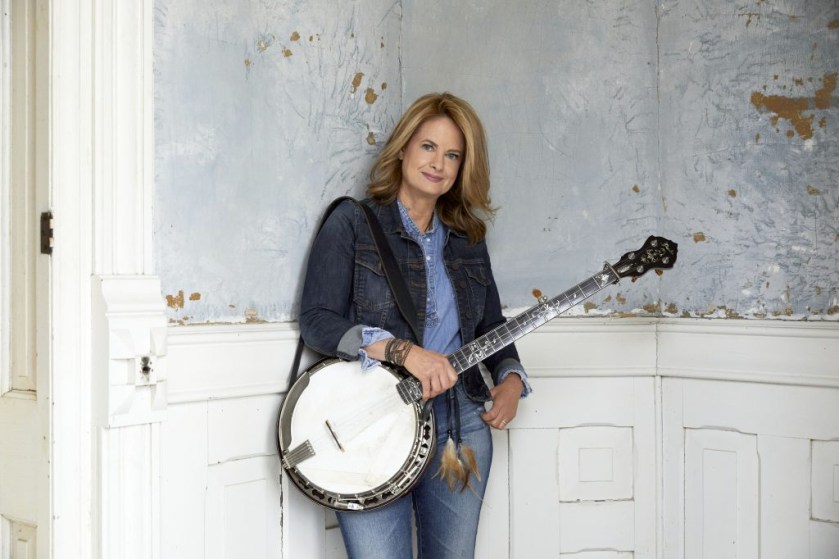
Singer and songwriter Brennen Leigh tells the story of growing up on the Minnesota—North Dakota border with two parents who raised her “on Willie Nelson and Emmylou Harris, traditional tunes like Wreck of the Old 97, and weekend airings of Austin City Limits.”

It wasn’t even called “country music” in her house, she says. “It was just music. I didn’t understand probably till I was 10 that there was other music besides country.”

“My dad would entertain my brother and me by playing guitar and singing,” she recalls. “I didn’t have a chance. I was totally indoctrinated from a very young age.”

The Bluegrass Situation also notes the influence of home in Leigh’s music, as demonstrated in the tune Don’t You Know I’m From Here.

On Prairie Love Letter, her full-length paean to her homeland on the Minnesota-North Dakota border, Brennen Leigh demonstrates a visceral, evocative grounding — just as (Dolly) Parton constantly speaks of her Tennessee mountain home: with a glint in her eye, and a sorrow in her heart for knowing she had no choice but to leave it. Leigh stakes her claim on both the wide, expansive plains and Nashville all at once, asking her audience “Don’t you know I’m from here?” As if to remind she’s as at home in bluegrass and country — and Music City — as Dolly herself.

Leigh has also had a long love affair with Western Swing, “a multilayered genre rich with history, dating back to the 1920s. Elements of jazz, blues, polka, and rural country music make up a sound that has had many lives” and is best known for its founder — Bob Wills — and his chief acolyte, Asleep at the Wheel’s Ray Benson.

Leigh lived in Austin for 15 years before moving to Nashville. During that time in Texas she got to know Benson and they discussed the possibility of recording together. However, it wasn’t until 2021, after she was living in Nashville, that Leigh wrote the tunes and all the stars aligned for the album Obsessed With the West, a collaboration with Asleep at the Wheel. I love In Texas With a Band, which came off that album, as well as the odd little ditty If Tommy Duncan‘s Voice Was Booze (I’d stay drunk all the time), performed solo in the live version below.

Brennen Leigh has been singing and writing songs for a long time, often in recent years in collaboration with Noel McKay. Puttin’ Up A Front is classic country, while Only Other Person in the Room is a beautiful duet from their Before the World Was Made album.

Leigh’s classic country voice comes through in much of her music, but nowhere is it better than in her haunting Outside the Jurisdiction of Man from Prairie Love Letter.

Lying in the wagon bottom looking out over the side 
At that great wide open Western land
Not another soul in sight for miles and miles around 
We’re outside the jurisdiction of man 

So let my remaining time all pass
On a blanket of swaying prairie grass
And then won’t you bury me ‘neath the work of God’s own hand 
Outside the jurisdiction of man

Lovely, just lovely. As Marty Stuart likes to say, country has broad shoulders.

More to come…

DJB


UPDATE: Apologies for misspelling Brennen Leigh’s first name in a couple of instances in the original post. I’d blame it on the spellcheck, but that would be too easy and inaccurate as well.


Photo of Brennen Leigh courtesy of BrennenLeigh.net.

The dark underworld of the soul

The femme fatale is a classic of literature and art, the “mysterious, beautiful, and seductive woman whose charms ensnare her lovers, often leading them into compromising, deadly traps.” The character goes back to ancient times and is so familiar that a writer who calls upon the archetype employs her at their peril.

But when a modern, sexy, complex version shows up in a novel, it can result in an excellent path to exploring the dark underworld of the soul.

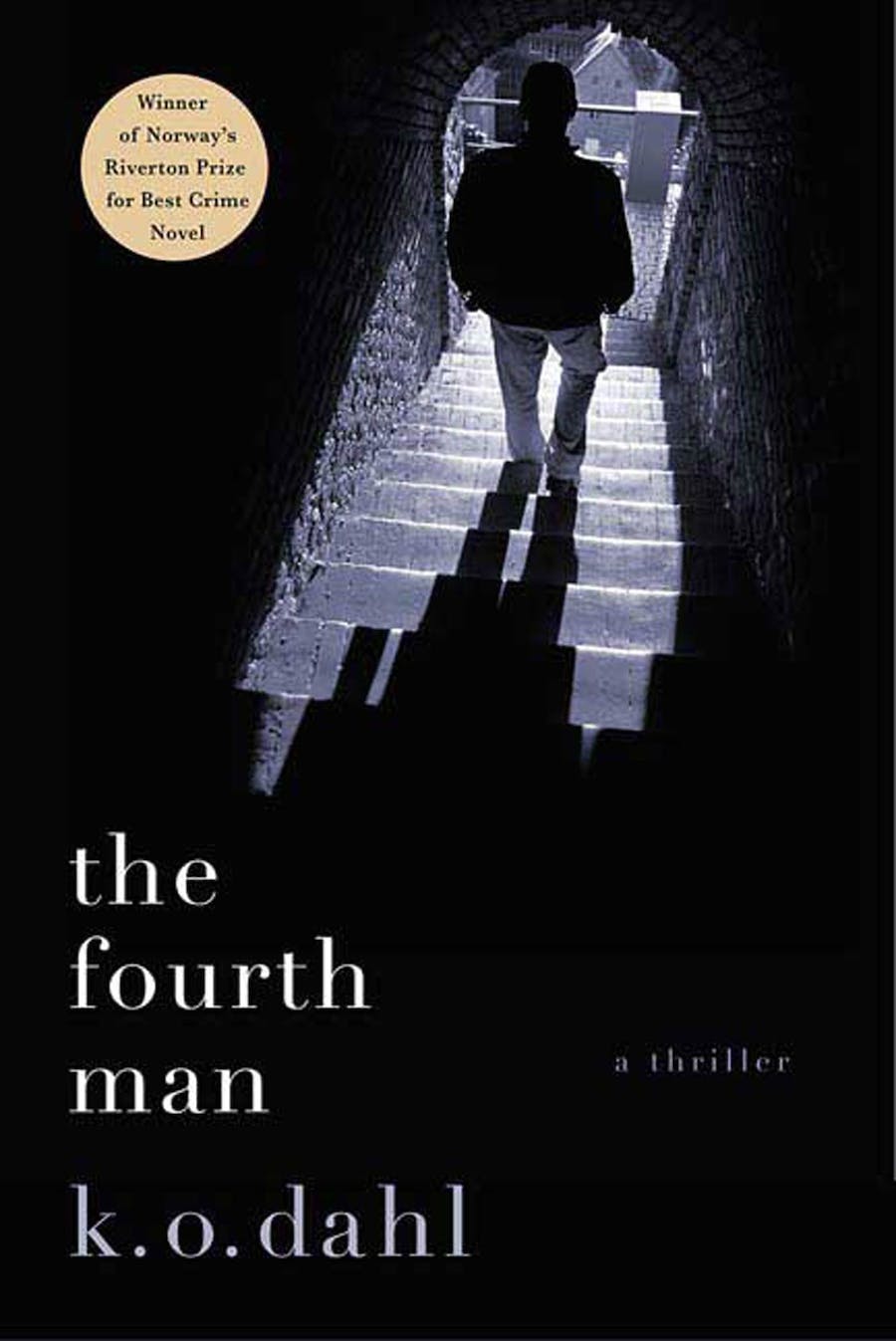
The Fourth Man (2005 with translation in 2007) by the Norwegian writer K.O. Dahl is a smart, dark, complex, and ultimately very satisfying crime novel which served as Dahl’s U.S. debut. We meet Detective Inspector Frank Frølich of the Oslo Police in the third sentence, as he is participating in a stakeout. An unexpected woman inadvertently enters the scene, endangering both the police raid and her own life. As bullets begin to fly, Frølich throws her to the ground and lays on top of her. The inspector and Elisabeth Faremo, the dark-haired beauty with mysterious eyes and a unique tattoo, meet by chance a few weeks later and their affair begins. It is only after Frølich is hopelessly in love that he learns that Faremo is the sister of a hardened and wanted member of a local crime gang. And his wary colleagues suspect that their original meeting was no accident.

Through a fast-paced, compelling, and very believable story, Dahl has Frølich explore the seamier sides of Norwegian life and his very conflicting emotions about Elisabeth. The inspector’s fortunes takes an unforgettable turn in the middle of the night when he’s awakened by a call to come and investigate the murder of a shipyard guard. He rolls over to find that Elisabeth is no longer beside him in bed. We are then introduced to stolen art, wealthy investors who are not all that their public personas suggest, another of Elisabeth’s lovers, icy Norwegian waterfalls that make excellent places to push unsuspecting victims to their deaths, and isolated ski chalets that can be torched to cover up other murders. Frølich has to seek the truth — and his true feelings for Elisabeth — while suspended from the police force. His gruff, firm, yet sympathetic colleague with his own challenges in love helps do the tough police work that gets us to the unexpected ending that is as complex, emotional, and smart as the rest of the book.

The Fourth Man — my sixth murder mystery this year — was another recommendation from the good booksellers at Brookline Booksmith. It was a satisfying discovery in this year of reading dangerously.

More to come…

DJB


To see reviews of the other books in my year of reading mystery novels, click here for JanuaryFebruaryMarch, April, and May.


The Weekly Reader links to written works I’ve enjoyed. I hope you find something that makes you laugh, think, or cry. 


Image by Chris from Pixabay

Father’s Day, baseball, and dad jokes

It may be time to crawl under the blanket.

Because Claire was in the air for about 12+ hours on Sunday flying home to California from Switzerland, we decided to postpone a celebration of Father’s Day until Sunday, June 25th.

Claire in Thun, Switzerland (photo by Sylvie Abookire)
View of Zurich streetscape by CHB

I did take time during the day to send along a dad joke or two to Andrew and Claire, as I wouldn’t want them to feel neglected. For instance:

What’s the best thing about Switzerland? I don’t know, but the flag is a big plus.

And I even passed along the Second Gentleman’s Dad Jokes…which I (naturally) thought were pretty funny.

But when I saw an article on Monday morning in The Athletic on MLB’s power rankings and dad jokes, I couldn’t restrain myself. Seriously, with baseball, Father’s Day, and dad jokes, what could go wrong?

There are 31 dad jokes (!) in the article (one for each team plus one to introduce the article. I’ll limit myself to five (you’re welcome) and encourage you to go read the rest (plus see where your favorite baseball team stacks up against the rest of the league. Spoiler alert: the Nats aren’t at the bottom, but they aren’t far away!)

So here we go!


Dad joke #1:

I have a joke about chemistry, but I don’t think it will get a reaction.

This one was the lead-in to the story about the amazing Baltimore Orioles and their team chemistry. “Want to know a secret?” Brittany Ghiroli asks. “The Orioles clubhouse is really close.”

Like make-up-handshakes-in-the-bullpen kinda close. (You think the Homer Hose happens otherwise?) A group of young guys who have played together for years now, and seen a lot of losses, have morphed into one of the most fun teams in the league . . . If not for Tampa Bay’s ridiculous record, we’d be talking about the O’s a lot more this season. As it stands, we will be talking about Adley Rutschman and Gunnar Henderson for quite a long time. 

Actually, I prefer the team sprinkler to the Homer Hose…but perhaps that’s just me.


Dad joke #2:

I once had a dream I was floating in an ocean of orange soda. It was more of a fanta sea.

Some are wondering if this Arizona Diamondbacks season is a fantasy. They have “the sport’s fifth-highest slugging percentage, two of its most dynamic starters, a speedy outfielder who’s running away with National League Rookie of the Year honors” and they still sit atop the NL West.


Dad joke #3:

I hate those people who knock on your door and say you need to get “saved” or else you will “burn.” Stupid firemen.

Houston isn’t burning yet, “but Ryan Pressly’s June swoon” has to alarm the Astros, even with baseball’s best pitching staff.


Dad joke #4:

I visited my friend at his house. He told me to make myself at home, so I threw him out. I hate visitors.

The Philadelphia Phillies (.633 home winning percentage), have been the NL’s best team at home. This week they will host the first-place Braves and Mets. “Buckle up. Philly is cooking.” And as every Nats fan (sadly) knows, if it is June then Kyle Schwarber is hitting homers every other day this month. Sigh.


Dad joke #5:

Have you heard about the new corduroy pillows? They’re making headlines!

My, my, my…what’s become of the Cincinnati Reds?

Who can stop the Reds? No one . . . Jokes aside, Cincinnati has won eight in a row and 11 of their last 13 and are two games over .500 in an incredibly winnable NL Central. It’s not just Elly De La Cruz, though he is appointment viewing.

That’s enough. Enjoy some baseball . . . and call me if you want to hear some more dad jokes. (That’s a call my children will never make.)

More to come…

DJB

Photo by Alexandra Gorn on Unsplash

Acknowledging the difficulties

Life is wonderful. Life is also difficult. Understanding, acknowledging, and wrestling with that paradox is a key to our growth into mature human beings. When we face difficult questions or problematic sayings, especially in matters that cut to the core of what we believe, we cannot simply ignore them if we hope to expand our minds and our worldview. That is especially true when a belief or pronouncement is not only difficult but continues to cause harm.

For instance, as we celebrate Juneteenth, do people of faith today spend much time grappling with the implications of being a slave (as mentioned multiple times in the Bible) especially given our own history of owning enslaved individuals in the U.S.?

Acknowledging the difficulties is what the most recent book taken from my TBR pile is all about.

The Difficult Words of Jesus: A Beginner’s Guide to His Most Perplexing Teachings (2021) by Amy-Jill Levine is full of challenging questions and problematic sayings. Perplexing is just the right word, for I often found myself asking, “Jesus said that?”

How difficult could they be? Well, right off the bat she has Jesus looking at the rich young ruler in Mark 10:21 and saying, “You lack one thing; go, sell what you own, and give the money to the poor, and you will have treasure in heaven.”

Not exactly the message of today’s prosperity gospel preachers.

How many professing Christians have emptied their bank account and joined ranks with Mother Theresa? None that I know. Or how many “hate father and mother” (Luke 14:26-27) or believe in slavery (Mark 10:44)?

What, exactly, are we to do with such sayings? Fortunately, there are questions we can ask that help. Questions such as: What’s the historical context in first century Palestine? What did the writers have in mind? Who made up their audience? How might the various ways of translating words have impacted meaning? What’s our historical context coming after centuries of bad interpretation and hateful sermons? And perhaps most importantly, what moral question is Jesus asking us to consider with these provocative sayings?

Levine is well suited to tackle these issues. She is the first Jew to teach New Testament at Rome’s Pontifical Biblical Institute. In 2021 she was elected to the American Academy of Arts and Sciences. Levine describes herself as “an unorthodox member of an Orthodox synagogue and a Yankee Jewish feminist who until 2021 taught New Testament in a Christian divinity school in the buckle of the Bible Belt.”

No difficult word or perplexing statement is going to push her away from this challenge.

I admire Levine’s ability to hold to her own faith tradition yet take other traditions seriously and with good intent. Because she admires the man and his teachings, the one thing she does consistently is take Jesus seriously. That’s more that can often be said for those who profess belief in the Christian gospel.

In each of the six chapters of this short but fascinating work, Levine dives into the historical context around Jesus’s audience at the time: first century Jews. That usually means she goes back deep into Jewish tradition, in which she is well versed. She also is a well-trained linguist who looks at how different words came to be used, especially as the Bible was translated through the centuries. What she doesn’t do is take the easy way out and suggest that not all these sayings came from the mouth of Jesus. She accepts the difficulty and wrestles with its deeper meaning.

In the Afterword, Levine notes that “if we look at the Bible as a book that helps us ask the right questions rather than an answer sheet, we honor both the Bible and the traditions that hold it sacred.” And so she works through each perplexing statement looking at the questions that we should be asking ourselves today. How much do we think about “economics, the sources of our resources, the way we use them, their hold on us”? Values and personal identity in relationship to family, others, and ourselves are additional topics that these difficult questions press us to consider. How do we address passages that seem to indicate that the all-knowing and all-loving God is just a bully?

As is true for many Americans, I have lived my entire life among cultures that see the Bible as an answer sheet. And it is not surprising to find the number of times those answers align with personal biases and have a tone that exudes righteousness. In this context I have worked to change my mind-set to asking the right questions, moving from certainty to mystery.

Levine is a delightful and playful writer who helps me in this journey. As she notes after stringing together a series of puns, sometimes a little levity can help us deal with the heaviness of the implications of what these sayings push us to consider. She can admit that she’s among the 78 percent of American Jews who do not believe in hell, although she confesses that especially in her less gracious moments “I do like the idea.” The belief in the existence of hell is something that has changed a great deal through the centuries, so when she ends the chapter on “Outer Darkness” with the sub-title, “To Hell with Hell” you know where she’s headed.

AJ (as she’s known to friends) notes here — as well as in her highly praised work on the short stories of Jesus — that parables are not “videotapes of life; they are stories designed to challenge us, to provoke us, to get us to think, and to motivate us to act morally.” In tackling these perplexing questions, Levine has challenged, provoked, and hopefully motivated the modern reader. It’s up to us as to whether — and how — we deal with them. But they are not going away.

More to come…

DJB

Image by Frantisek Krejci from Pixabay.

On Banjo with Alison Brown

Alison Brown has never been one to back down from a challenge. The progressive banjo player only came at music professionally after completing her undergraduate studies at Harvard, receiving a MBA from UCLA, and pursuing a career in investment banking. “But she missed the bluegrass music she’d grown up playing in Southern California so much that when Alison Krauss called looking for a banjo player, she made the decision to give up her Wall Street career to pursue music.” She formed her own group, The Alison Brown Quartet, in 1993.

As I’ve written before on More to Come, Alison is also the co-founder and CEO of the Compass Records Group, an internationally recognized roots music label which Billboard Magazine has called “one of the greatest independent labels of the last decade.” Compass Records Group oversees a catalog of nearly 1,000 releases across multiple label imprints, including Red House Records, Green Linnet and Mulligan Records.”

Alison’s new album On Banjo shows the range of her musical skill and interests. In this new work she includes “forays into bluegrass, Brazilian choro music, classical and swing era jazz with collaborators including musician/actor/author Steve Martin, virtuoso mandolinist Sierra Hull, Israeli clarinetist Anat Cohen, multicultural chamber group Kronos Quartet, classical guitarist Sharon Isbin, and fiddle stalwart Stuart Duncan.”

Foggy Morning Breaking is one of the more traditional tunes on the new album, with Brown and Steve Martin sharing banjo duties, along with support by Nashville session fiddler extraordinaire Stuart Duncan, mandolin phenom Sierra Hull, Punch Brothers guitarist Chris Eldridge, and long-time acoustic bass master Todd Phillips. If you go to the end of the video, Brown and Martin talk about how they shared co-writing duties for this piece, which she also discusses in a recent interview with The Bluegrass Situation:

The way “Foggy Mountain Breaking,” came about is I wrote the A section. It was during the pandemic. I asked Steve, “Do you wanna write a B part?” He sent me a perfect B section 24 hours later. We figured out a bridge together. It’s named after a lyric in a John Hartford song and is obviously a riff on “Foggy Mountain Breakdown.”

People who follow bluegrass and Americana music know of Martin’s long-time interest in, and musical ability on, the five-string banjo. Others may be surprised to learn that he’s the originator of the Steve Martin Banjo Prize and highly respected among professional musicians. As Brown says in that BGS interview:

Steve’s a great banjo player with a really beautiful touch and a delicate, sweet tone. He loves playing in double C tuning. Banjo players usually tune to a G, but you can drop the fourth string to a C and tune the second [string] up to a C. It’s an old tuning that clawhammer guys use a lot.

Sierra Hull — who has been featured multiple times in More to Come — also joins Brown’s On Banjo project in a duet setting. After noting that Hull’s fingers “dance over the fingerboards,” Brown talks about the tune Sweet Sixteenths:

It required her to play every fret on the first string of the mandolin and she did it flawlessly. She said she’d never had a chance to work on such complicated music with another woman. So it’s a really special thing. It’s always a delight to play with Sierra, but to do a duet with her was like chocolate and more chocolate.

(UPDATE: And now featuring the official video instead of just the audio. Check out the marvelous little run that begins around the 2:25 mark.)

And while it isn’t on the On Banjo album, I just love The First Ladies of Bluegrass rendition of Brown’s piece Girl’s Breakdown. The superband quintet includes in addition to Brown — the first woman to win the International Bluegrass Music Association (IBMA) Banjo Player of the Year award — Hull, the first and only woman to ever win the IBMA Mandolin Player of the Year award; Missy Raines, the first and only female musician to win the IBMA Bass Player of the Year award; Becky Buller, the first and only woman to ever win the IBMA Fiddler of the Year prize; and Molly Tuttle, the first and only female to ever take home the IBMA Guitar Player of the Year honor.

Brown is out to reclaim the history of the banjo and to recognize and support the disenfranchised people who once played the instrument. As she notes, the banjo was first found on Southern plantations. “Then white people appropriated that music in minstrel shows, performing in blackface.” As Brown notes, “It’s deep in terms of what it says about our history and America’s original sin.”

It went from being a Black instrument to being a white lady’s instrument. The Black voice of the instrument and the female voice of the instrument were both disenfranchised. There are gorgeous old photos of women in the 1890s holding banjos, and there were female banjo orchestras. I’m excited to see that re-emerging.

As you can hear on the tune Porches, Brown isn’t afraid to take the music in new directions. Here she performs on low banjo with the Kronos Quartet: David Harrington (violin), John Sherba (violin), Hank Dutt (viola), and Sunny Yang (cello). The string arrangement is by Chris Walters.

It is said that “Alison Brown doesn’t play the banjo. Alison Brown plays music on the banjo.

Enjoy!

More to come…

DJB

Photos of Alison Brown (credit: AlisonBrown.com and Compass Records)

Continue to celebrate the good news!

As I wrote a few weeks ago, thanks to the Biden/Harris administration and Democrats all across the country, we are in the midst of an astonishing economic run in the U.S.


Jobs are rising, inflation is falling

When the June BLS jobs report came out we saw that it was another good one — 339,000 net new jobs, 432,000 with upward revisions from previous months. With this new data the monthly jobs tracker at the Hopium Chronicles now looks like this:

  • 33.8m jobs – 16 years of Clinton, Obama
  • 13.1m jobs – 28 months of Biden
  • 1.9m jobs – 16 years of Bush, Bush and Trump

Biden’s 13.1 million jobs is almost 7 times as many jobs as were created in the 16 years of the last 3 Republican Presidencies, combined.  

Let that sink in for a moment.

Joe Biden is the third consecutive Democratic President who has brought strong growth, lower deficits and American progress. The last three Republican Presidents all brought recession, higher deficits, American decline.

With Democrats Things Get Better

Inflation continues to fall and Larry Summers was wrong, the U.S. did not have to throw millions of Americans out of work to meet that goal.


Here’s a narrative you can start to use

If you want a narrative that points to the good news all around us, you can do much worse than this:

The American recovery from COVID has been the best of any advanced nation; economic growth remains robust; in recent months the unemployment, uninsured and poverty rates have hit record lows; the deficit has come way down; the President’s ambitious agenda to build things here at home has begun to have a very positive impact on the economy; real wages and incomes are in positive territory again, and inflation appears to have returned to a pre-pandemic, pre-Russian invasion of Ukraine and more sustainable place.

Through their grit, resilience, and hard work the American people have gotten through this rough patch in our history, and have once again made the American economy the envy of the world. . . .

But let’s be very clear — far more is going right today in America than wrong. It is time for those who spend so much time talking down this great country to join us in acknowledging the progress we’ve made, for this progress isn’t just the progress of Democrats or Joe Biden, it is American progress to be celebrated by all.

More Good News on Inflation

Not that you’d ever know any of this from listening to the mainstream media.

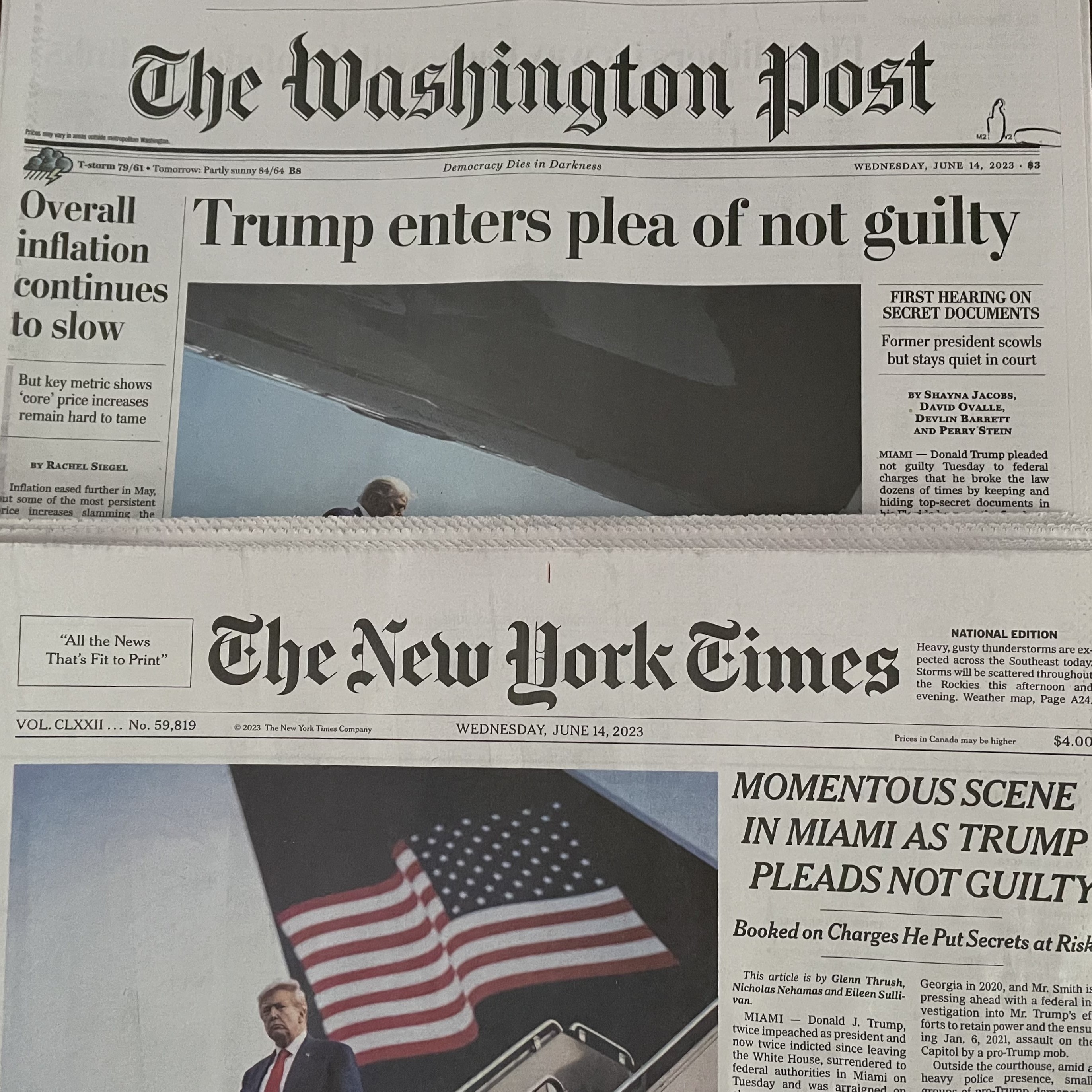
These are the headlines on The Washington Post and The New York Times on June 14th. I put the Post at the top because it is the least egregious of the two. For the first ever arraignment of a former U.S. president, it sticks with the basic — if unsurprising — facts. Trump pleaded not guilty. Whoopee do. Not exactly news, but truthful. In the left-hand column the Post also acknowledges that inflation is falling, yet they can’t leave well enough alone so the sub-heading has to being with “But…” How about after saying that overall inflation continues to drop, add “And this is the plan that President Biden designed … and its working!”

But that Times headline … oh my goodness. Is the real news here that there was a “momentous scene” at the arraignment, when there clearly wasn’t such a scene at all? Do you have to include a picture of Trump coming off his private jet with an American flag painted on the tail piece as if it is Air Force One? Sinclair Lewis never said the famous quote attributed to him — “When Fascism comes to America, it will be wrapped in the flag and carrying a cross” — but it is nonetheless a pretty good description of today’s wannabe authoritarians.

Here’s what’s missing from all the coverage: “Trump’s lawbreaking was so blatant, so inexcusable, so dangerous, that DOJ had no choice but to indict.” He stole our nuclear secrets, for crying out loud.

As rock-solid conservative Judge J. Michael Luttig wrote yesterday,

There is not an Attorney General of either party who would not have brought today’s charges against the former president.

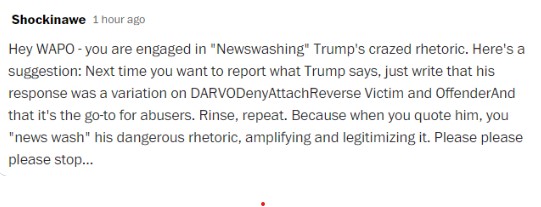
No, the mainstream media would rather be engaged with “newswashing” as one astute Post reader noted:

Noting that Trump’s rhetoric follows the pattern of abusers everywhere (DARVO: deny, attack, and reverse victim and offender) is a pretty handy way to take care of just about 100% of everything he says.

And oh, my goodness, Fox News Corporation, which “has been hemorrhaging viewers since it fired Tucker Carlson” seems okay with paying out more than three-quarters of a billion dollars for lying, and then turning around and lying some more. The threat to the bottom line might have been behind its chyron attacking Biden by claiming “WANNABE DICTATOR SPEAKS AT THE WHITE HOUSE AFTER HAVING HIS POLITICAL RIVAL ARRESTED.”

But Fox News is not news. Stop treating them as if they were.

Heather Cox Richardson reminds us of the history behind NOT holding the powerful accountable to the rule of law.

The willingness of government officials to ignore the rule of law in order to buy peace gave us enduring reverence for the principles of the Confederacy, along with countless dead Unionists, mostly Black people, killed as former Confederates reclaimed supremacy in the South. It also gave us the idea that presidents cannot be held accountable for crimes, a belief that likely made some of the presidents who followed Nixon less careful about following the law than they might have been if they had seen Nixon indicted.

Holding a former president accountable for an alleged profound attack on the United States is indeed unprecedented, as his supporters insist. But far from being a bad thing to stand firm on the rule of law at the upper levels of government, it seems to fall into the category of “high time.”


It is easy to get frustrated but it is up to us to continue to say, “We’re here to celebrate all the good that Joe Biden, Kamala Harris, the Democrats, and the American people are doing.”

More to come…

DJB

Image by Jean Martinelle from Pixabay

Family, myth, and identity

Remembrance has a powerful pull on our psyches. We all want to leave a legacy and something to show that we existed, for a short while, on this planet. We may do that in many ways, but the task is more difficult — and perhaps more urgent — when a key part of your identity is being erased before your eyes.

When extinction is happening in real time.

Thinning Blood: A Memoir of Family, Myth, and Identity (2023) by Leah Myers is one young Native American’s powerful push against that feeling of extinction. This is a fierce piece of personal history by Myers, who may be the last member of the Jamestown S’Klallam Tribe in her family line due to her tribe’s strict blood quantum laws. She is searching for ways to ensure that her identity, her family’s story, and the tribe’s history in the Pacific Northwest’s Olympic Peninsula is not lost forever.

While I am not drawn to memoirs by writers of such a young age as a matter of course, there was a compelling nature to this meditation by the not-yet-30-years-old Myers that called to me. Hers is a young Native American voice from a child of the 21st century raised between Native and white worlds, fearful that her culture is being “bleached out.” She is searching for a personal as well as a tribal identity. Myers speaks honestly about how some Native Americans lump her family among those who “are only Indians when they have their hands out for something.” And how many of her white friends just assumed she was white, given the lightness of her skin. She never grew up on a reservation and had been removed from her culture. She often felt she didn’t belong. Yet she is writing to stake her claim as “Native enough” to tell these stories and take her place alongside the ancestors.

In Thinning Blood, Myers brings together family remembrances, folk tales, tribal history, Native mythology, and her individual story to craft a narrative both personal and communal. She draws on the character of the women in her line — her great-grandmother’s strength, her grandmother’s determination, her mother’s compassion — to shape her voice and story. Noting that totem poles are used to represent stories or places, the totem pole she crafts in her mind and that provides the shape for this memoir represents her family. And the symbols each family member takes — bear, salmon, hummingbird — corresponds to their character and what they’ve passed along to her — the raven — who is given voice and has a story to tell.

There are several powerful sections that deserve special attention: Myers rewatching her favorite childhood movie, Pocahontas, to focus on the hurtful stereotypes that permeate Disney’s storytelling; her struggling with the Klallam language as a young adult; and, most disturbingly, the brutal violence against her body by a teenage white “friend” that almost killed her. The chapter An Annotated Guide to Anti-Native Slurs could stand alone as a useful and educational read for all non-Natives.

Myers also addresses a very current issue in her memoir: genocide and Native adoptions. Genocide is defined as the deliberate and systematic destruction of a racial, political, or cultural group. The United States government has a long, dark, and still largely unacknowledged history of attempted genocide against Native Americans. In recent years, Myers notes, what was once an effort of blunt force became more subtle as the government “carved apart families and the women who could create them.”

After a brutal past of stealing children from their mother’s arms to send them to boarding schools to “kill the Indian and save the man,” The Indian Child Welfare Act of 1978 sought to keep Native children in tribal communities. The New York Times had a thoughtful story in May about this brutal history, its impacts on those who were taken from their communities, and how our radical Supreme Court — intent on returning America to some fictionalized version of the past — may overturn it. *

Thinning Blood closes with Myers writing a letter to her seventh-generation descendent — someone she never expects to exist due to her decision not to have children — and with a sobering explanation of what will happen to her homeland, the Olympic Peninsula, when the “really big one” comes and the earth is swallowed up by the sea. In this moving and honest outreach to a child who will never be and her clear-eyed assessment of the fragility of life, Myers brings her journey through her family’s history and her search for identity to a fitting close.

More to come…

DJB


*UPDATE: Late on Tuesday evening, June 14th, the Supreme Court by a 7-2 vote, upheld the 1978 Indian Child Welfare Act, which gives preference in the foster care and adoption of Native American children by their relatives and tribes. This is a big win for Native Americans.


The Weekly Reader links to the works of other writers I’ve enjoyed. I hope you find something that makes you laugh, think, or cry. 


Photo by Benjaminrobyn Jespersen on Unsplash

When fear and resentment take power

Millions of white Americans in the 1920s were scared that the way of life of their fathers was soon to be a thing of the past. What frightened them was the emboldened nature of newly enfranchised women; the excitement of young people testing their freedom in the jazz age; waves of immigrants coming to seek a better life; and African Americans, restive after their service in the Great War.

Into this caldron of fear and resentment stepped a fast-talking con man, David C. (D.C.) Stephenson, who promised a safe haven for their hatred and a way to punish their enemies. A secret society gave them a feeling of comradery with like-minded citizens. Clergy were bribed to provide “moral cover.” Members rose to their feet and cheered speakers who called Jews “un-American parasites.” Catholic priests and nuns were harassed. These white Americans believed in the absolute superiority of one race and one religion and the inferiority of all the others.

KKK initiation in Muncie (Library of Congresss)

The society took over the party of Abraham Lincoln and many newspapers ran regular columns written by Stephenson (who preferred to be called Steve) and his cronies. Terrorist gangs of armed vigilantes were sent out to intimidate and kill those who were perceived as less than human. Although liquor had been outlawed with prohibition, the “law” didn’t apply to Steve and his friends in power. He threw wild parties at his mansion where the booze and sex flowed freely. Paid-for policemen and judges protected the powerful and punished the outsiders.

Sound familiar?

There’s a reason we need to study the “warts and all” version of history. Understanding the full scope of our past helps us combat those who are banning books today as they weaponize an interpretation of history that supports their agenda. Pushing a return to the politics of fear, resentment, and hatred is all part of the fascist strongman playbook that we’ve seen before in America.

A Fever in the Heartland: The Ku Klux Klan’s Plot to Take Over America, and the Woman Who Stopped Them (2023) by Timothy Egan is a page-turning true-life historical thriller of the rise and fall of the powerful Indiana chapter of Ku Klux Klan and the charismatic, ethically unmoored con man at its helm. This is not the KKK of the post-Civil War South. Instead, it is a retooled all-purpose hate and special interest group seeking to take over American democracy. As Egan’s deep detective work uncovers, they did succeed in taking over much of the state and local governments in Indiana, Colorado, and Oregon. They came close to infiltrating the nation’s government in Washington.

The predatory and murderous D.C. Stephenson, a salesman who could “talk a dog off a meat wagon,” had his sights set on the presidency. To bring him down, it took a small but determined band of newspaper editors and reporters, James Weldon Johnson and other members of the NAACP, aging Civil War veterans who remembered why the war was fought, a boyish looking yet fearless prosecutor, and a courageous young woman whose dying declaration led to the “trial of the century.”

Stephenson had failed many times in life and left behind a string a unpaid bills and broken marriages. He had no education beyond high school, was an ardent fan of Mussolini, and at various times claimed to be a lawyer, psychologist, and businessman. Yet he understood people’s fears and their need to blame others for their failures. At this venture he was wildly successful. The Klan reached millions of white Americans in the 1920s and the Indiana chapter was the largest.

The book turns on Steve’s kidnapping, beating, drugging, brutal rape, and murder of Madge Oberholtzer, a twenty-eight-year-old unmarried educator who was living with her parents. Stephenson was, to put it simply, a monster. After Egan’s compelling description of the trial, where Steve clearly figured he would walk free, the monster is found guilty of second-degree murder and goes to jail.

Yet he is never repentant. As Egan writes, Stephenson broke parole and was re-imprisoned but he ultimately died a natural death, in 1966, at age 74. His pattern of cheating, leaving his wives, and sexually assaulting women never ended.

Egan’s work helps us understand the madness of our time.

The call to make America great again has a long history. Many in the 1920s were thoroughly taken in by nationalist rhetoric and “circus-like spectacle.” Today, millions of our fellow citizens are caught up in the same fever of rhetoric and spectacle. The villainy and hypocrisy of those who preach law and order and freedom and justice the loudest is the 21st century version of a deep-seated American sin. Followers of men like Stephenson will forgive any Big Lie, because they believe what they want to believe. D.C. Stephenson called his trial “a hoax and a witch hunt,” predating our former president’s use of those exact same words by a century.

Egan is a gifted writer who for a number of years was the sole Western voice on the New York Times op-ed page. His National Book Award winning account of the Dust Bowl, The Worst Hard Time remains to my mind the best work on the country’s largest environmental disaster. In A Fever in the Heartland he looks at a disaster of another kind — a huge failure of human empathy and compassion — that is repeating itself in the early 21st century.

Egan summarizes the message of Stephenson’s story in a way that fits our challenges today.

Democracy was a fragile thing, stable and steady until it was broken and trampled. A man who didn’t care about shattering every convention, and then found new ways to vandalize the contract that allowed free people to govern themselves, could do unthinkable damage.

The fight for democracy has been part of American history since its founding. It never, ever ends, which is why we have to study our history and keep on fighting in this generation.

Timothy Egan has reminded us yet again of the scope and depth of that challenge. Given the shocking revelations in last week’s news about boxes of stolen national security secrets, it is also very timely.

More to come…

DJB


Image: Main Street in Indiana

George Winston, R.I.P.

George Winston, the self-described folk pianist who sold millions of albums over a long career, passed away on June 4th after a 10-year battle with cancer. Like many, I came to Winston’s melodic, quiet, and thoughtful playing in the 1980s. During that era he had three records, Autumn, Winter Into Spring, and December, all of which were certified platinum in the United States. He won a Grammy for best New Age album for 1994’s Forest.

Thanksgiving, inspired by friends and places of Miles City, Montana, was the first piece on the December album.

Rolling Stone’s obituary spoke of how Winston wanted to be remembered as a musician.

His music seemed to incorporate elements of classical, jazz, folk, ambient, and New Age music, but as Winston put it in a Q&A for his website, he always called his “melodic style” of play “Folk Piano” or “Rural Folk Piano.”

“It is melodic and not complicated in its approach, like folk guitar picking and folk songs, and has a rural sensibility,” he said, adding: “Any other labels, including anything having to do with anything philosophical, or spiritual, or any beliefs, are also not accurate, as I have no interest in those subjects. I just play the songs the best I can, inspired by the seasons and the topographies and regions, and, occasionally, by sociological elements, and try to improve as a player over time.”

The first album of Winston’s interpretation of Vince Guaraldi’s music, Linus and Lucy, was on my playlist for years. This live medley of the title tune plus You’re in Love Charlie Brown brings back lots of memories.

As critic Walter Tunis notes,

George Winston was a quiet army of one — a musical impressionist whose devotion to myriad but specific influences — The Doors, Henry Butler and especially Vince Guaraldi — along with a scenic-oriented sense of artistic expression, combined to make solo piano music unlike anything heard before his arrival. Yet from the instant more mainstream artists wandered within earshot of his musicianship, Winston became one of the most imitated instrumentalists of the past five decades.

The notes with the video for Cast Your Fate to the Wind, Winston’s interpretation of another Guaraldi composition, tell us that the song “first appeared on Vince’s 1962 album Jazz Impression of Black Orpheus, a collection based on his interpretations of Antonio Carlos Jobim and Luiz Bonfa songs from the classic 1959 film.

Cast Your Fate to the Wind was originally the B side of the 45 RPM single from the album, with the A-side being Samba De Orpheus . . . but disc jockey Tony Bigg and program director Buck Herring, at radio station KROY in Sacramento, California turned it over and played Cast Your Fate to the Wind instead, and played it every hour, which led to it becoming a national hit.

Dozens of artists besides Winston have recorded it through the years. At the end of the song, Winston’s piano is muted by damping the strings with the left hand, while playing the keys with the right hand.

As Rolling Stone notes, Winston pushed the boundaries of his playing, releasing “a full album tribute to the Doors, Night Divides the Day, in 2002. His 2004 album, Montana: A Love Story, included interpretations of songs by Frank Zappa and Sam Cooke; 2019’s Restless Wind featured takes on George Gershwin and Stephen Stills tunes.”

At Midnight came from Winston’s last album, Night, released in 2022.

This lovely Paste Studio concert from this time last year shows that Winston was still performing and composing beautiful music even in the last years of life. Beverly opens both his Night album and this mini-concert. Blues for Ukraine, the second tune, is debuted in this recording. He ends with an energetic take on the James Booker tune Pixie. Winston also speaks with his host about how the album came together, about his compositional style, and why he writes on his hands.

Winston clearly was influenced by a range of musicians over his lifetime, absorbing their music but always making it his own. As he told Tunis in a 2010 interview, “You have your identity, and then you have the things you received from your mentors. It’s a different combination for everybody. We’ve all got our own unique way of how we end up showing what they gave to us.”

George Winston gifted us, over more than five decades in the public eye, his own unique musical legacy. Because it seems so appropriate, let’s end with Winston’s interpretation, from Night, of Leonard Cohen’s iconic Hallelujah.

Rest in peace.

More to come…

DJB

Photo of George Winston (Credit: Todd V. Wolfson from GeorgeWinston.com)