(NOTE: Charles Ray wrote a blog post about Congressman Jamie Raskin’s father that led me to repost the life lessons here on More to Come. I encourage you to read Ray’s post, as well as Jamie Raskin’s eulogy for his father, Marcus Raskin, which is the source for these lessons.)
We generally see our Congressman, Jamie Raskin, each year at the Takoma Park July 4th parade. We love that parade as one of the best expressions of American values one can find in a region where too many in power have forgotten what the country stands for. Somewhere during the parade, Raskin and a crowd of young supporters will show up, and it is like a windstorm sweeps through the street. Raskin works the crowd like no one else can, shaking every hand he can reach and waving to the ones he cannot touch. In my post about 2019’s parade, I likened him to James Brown when I used the “hardest working man in politics” sobriquet.
Raskin is in the news these days because of his stellar work to speak truth to power in the second impeachment trial of Donald Trump. Many people wonder why he was quoting his father in the opening remarks. If you are like me and didn’t know very much about the life and work of Marcus Raskin, I encourage you to read his son’s eulogy, given at Sixth and I Synagogue in Washington when his father passed away at age 83 in 2017.
The eulogy is entitled Lessons I Learned from My Father, and I’ll quote those lessons in the hope that you’ll read the entire eulogy and understand a little bit more about father and son, and the remarkable moral compass that is at the heart of their work.
Lesson One: My father taught us that, when a situation seems hopeless, then you are the hope. When everything looks dark, you must be the light.
Lesson Two: Spoil children with love and wisdom, not with things.
Lesson Three: Whatever the background noise, follow the music in your head and the dreams in your heart.
Lesson Four: Go to school to teach as well as to learn and never let your schooling interfere with your education.
Lesson Five: Bring your full intelligence and ethics to work every day and if you can’t, you may need to find a new job.
Lesson Six: Hate war and work as citizens for peace and justice.
Lesson Seven: Act pragmatically, not in the degraded sense of doing what powerful people want you to do, but in the Deweyean sense of promoting experiments to advance the ideals of freedom and the common good.
Lesson Eight: Never give up on anyone, never hate anyone, and act with love whenever you can.
Lesson Nine: No good act in life is ever wasted.
Wonderful lessons for living a meaningful and purpose-filled life.
Presidents Day is a good time to reflect on the office of the presidency and our expectations for the people who have been elected to lead our nation. There is much to consider on this day, coming as it does less than 48 hours after a strong bipartisan majority in the Senate voted to convict Donald Trump during his second impeachment trial but fell ten votes short of the required two-thirds threshold.
Taking the long view, more than 1,000 historians and constitutional scholars had urged conviction so that “No future president should be tempted by the example of his defiance going unpunished.” In considering the flawed individuals who will always hold this position, presidential historian Lindsay Chervinsky writes this weekend on the “incredible power we entrust to imperfect hands.”
From a preservation viewpoint, I have thought about the places that shaped our presidents. Places that, as presidential historian Michael Beschloss has said, give us the opportunity to “walk through autobiography.” * What do they suggest about the characteristics needed to faithfully execute the Office of President, and to preserve, protect and defend the Constitution of the United States?
My visits to presidential homes began as a young child on family vacations. It was one of those trips — a car ride through the heartland, working our way north from Tennessee to Chicago — that made the longest-lasting impression.
I saw things on that trip I’d never seen before. Lush, impenetrable fields of corn planted right up to the roadside of those pre-interstate highways convinced me that we were caught in a maze where I had to count on my parents’ map-reading skills to escape. Two places from that trip shaped me forever: Wrigley Field, where I saw my first major league baseball game and became a fan for life; and the Lincoln Home in Springfield, a historic site that intrigued my young nine-year-old mind in ways I didn’t fully understand for years.
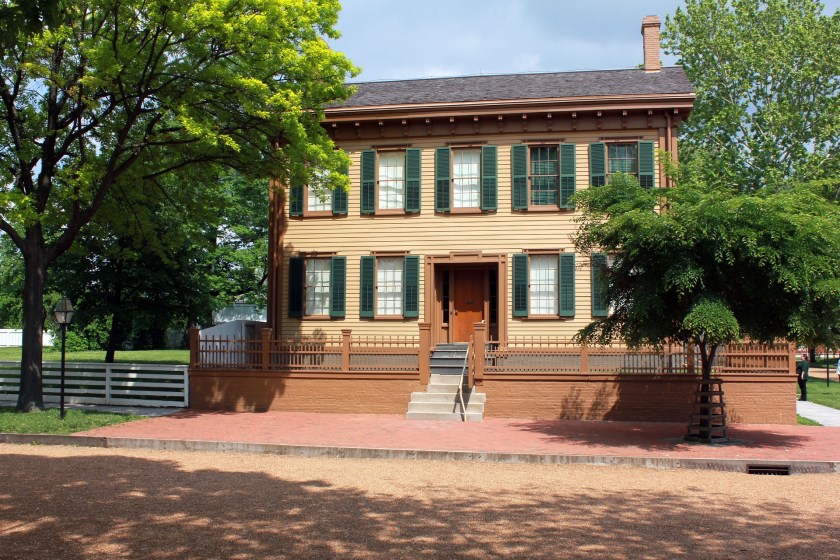
Abraham Lincoln’s home — the only one he ever owned — was a place of autobiography. What I remember most about that house was how very ordinary it was.
Oh, it was well decorated for the period, exuding a prosperous, middle-class aura. The National Park Service operation spoke to its importance in shaping the president who would save the nation. But I had seen much grander homes when visiting my grandparents in Franklin and Nashville. Two-story Greek Revival-style townhomes were a dime a dozen in communities throughout the mid-South in the 1960s.
We were there during the centennial celebration of the Civil War and the place was packed. More than fifty years later it remains a site that attracts visitors who very much go out of their way to see how such an extraordinary individual arose from such ordinary surroundings. Springfield is where we see Lincoln as a man of the West, who came up through self-education and hard work to rise to the pinnacle of power at a time of extraordinary crisis. And it was something from this place — for Lincoln was definitely of Springfield — that gave him the strength and character to lead a nation.
It took another president from Illinois to drive home the point about the connections between ordinary places and extraordinary people.
President Barack Obama was speaking in Chicago at the dedication of Pullman as a National Monument. After some background on the site’s role in helping build an African American middle class, President Obama spoke to the large number of students in attendance about why this place in the heart of their community was being designated a national monument:
“It’s also understanding that places that look ordinary are nothing but extraordinary. The places where you live are extraordinary, which means you can be extraordinary.”
Speaking directly to the school children, the president continued.
“You can make something happen, the same way these workers here at Pullman made something happen….no matter who you are, you stand on the shoulders of giants. You stand on the site of great historic movements. And that means you can initiate great historic movements by your own actions.”
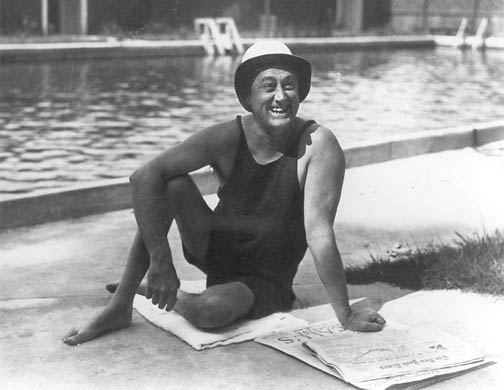
Not all our great presidents came from humble surroundings, but all were shaped by place. Of the three who consistently rank at the top of historians’ lists of greatest U.S. presidents, Franklin Roosevelt quickly comes to mind as a scion of wealth who was profoundly shaped during his time of treatment for polio at Warm Springs, Georgia.
George Washington’s family had land and held slaves, but were not necessarily wealthy by 18th century standards. Yet as historian Andrea Wulf has shown, at Mount Vernon Washington connected to that land and developed a garden that spoke to the vibrancy of the American landscape and experiment in self-government.
Gardens at Mount Vernon (Image by Nayuta from Pixabay)
Lincoln, in sharp contrast to those two, was born into poverty and was raised in very ordinary circumstances, but he was shaped by communities in Kentucky, Indiana, and then in Illinois, first in New Salem and ultimately in Springfield.
Washington’s place in the firmament of American presidents will always be secure. A singular figure in the American revolution, he was the “indispensable man” as described by historian James Thomas Flexner. More than any other, he helped shape some of the norms of our national government.
Following the winning of independence, Lincoln and Roosevelt faced the two greatest crises in our nation’s history. They came from very different worlds, but they shared the trait of empathythat grew out of place; a trait that put them in touch with the needs of the ordinary people and gave them the extraordinary strength and courage to address whatever life threw at them. Roosevelt, after being stricken with polio, came to understand hardship in a visceral way. Lincoln’s empathy is well documented, as in his response to an issue that contrasts starkly with the Republican response to the recent insurrection:
“Must I shoot a simple-minded soldier boy who deserts, while I must not touch a hair of a wily agitator who induces him to desert? I think in such a case to silence the agitator and save the boy is not only constitutional, but withal, a great mercy.”
President Joe Biden comes from ordinary places — Scranton and Wilmington — and grew up around ordinary people. He did not attend elite colleges. While in the Senate, he rode an Amtrak train home each night from Washington to Delaware to be able to see his children. He suffered horrible personal losses when his first wife and 13-month-old daughter were killed in a tragic car wreck in 1972, and again much later when his son died at the age of 46 of brain cancer. A stutterer when he was young, Biden learned how to deal with bullies and how to be empathetic to others who struggled.
Now as president, Biden faces cascading crises the likes of which we haven’t seen since FDR’s time: a badly managed national response to a worldwide pandemic, the resulting economic fallout, the rise of home-grown white supremacist terrorism, economic and racial inequality, the hollowing out of government for private gain, and an opposing political party that has just demonstrated that a majority of its national leaders are willing to sacrifice our democracy for personal power. Any one of these crises would test the mettle of normal presidents.
We don’t know how Biden will respond, but there are early indications that we have a chance, once again, to see what extraordinary things can come from ordinary places and ordinary people. Joe Biden and Kamala Harris — the daughter of immigrants and the first woman and first person of color to serve as Vice President — cannot do this alone. But as history has shown again and again, we have the chance to count on ordinary citizens in all walks of life — not just our leaders — to step forward to do the extraordinary work necessary to build a more perfect union.
* I did a quick count, and I have visited the homes of 16 of the nation’s 46 presidents, and the number goes over 25 when you toss in other sites related to our nation’s chief executives. Not exactly a bucket list item (like my MLB stadiums quest) but a decent number for an American citizen.
Born into slavery with his actual birth date unknown, Frederick Douglass chose to commemorate his birthday on February 14th. A blogger with the name of Chitown Kev gathers the insights of political pundits, and he began today’s post with a thoughtful commentary on how Frederick Douglass may just be the greatest pundit of all time.
“Political violence, voter disenfranchisement, treason,” Kev notes, “Mr. Frederick Douglass wrote variations of this very same subject material in the 19th century.” Yes, “today’s pundits are writing about…contemporary events but I am not sure that they have any better or more eloquent of a grasp of the raw news material in front of them than Mr. Frederick Douglass did in his own day.”
As an example, Kev provides the following excerpt from an 1865 impromptu speech delivered to the Massachusetts Anti-Slavery Society:
“I believe that when the tall heads of this Rebellion shall have been swept down, as they will be swept down, when the Davises and Toombses and Stephenses… there will be this rank undergrowth of treason…You will see those traitors, handing down, from sire to son, the same malignant spirit which they have manifested, and which they are now exhibiting, with malicious hearts, broad blades, and bloody hands in the field, against our sons and brothers. That spirit will still remain; and whoever sees the Federal Government extended over those Southern States will see that Government in a strange land, and not only in a strange land, but in an enemy’s land.“
Frederick Douglass from “What the Black Man Wants” (1865)
Coming out of this weekend, I wish that Douglass was not so prophetic.
If you want to know more about this man, I strongly recommend historian David W. Blight’s biography Frederick Douglass: Prophet of Freedom. It would be a great way to celebrate the birthday of this towering figure who speaks truth to us still.
We all face decisions. When we have to make quick decisions, we rely on our fast, highly intuitive, emotional thinking, following the instincts we’ve honed over time. It is the big, important life decisions that emotion and intuition cannot adequately address.
For most of us, our life-changing, moral-clarity-moment decisions don’t play out on a national stage. But if we think about these decisions in our lives, we see that even when the right path is clear those choices are not always easy. One reason, as explained in Thinking, Fast and Slow, is that our brain finds it more important to have a coherent story in order to ease cognitive processing rather than to look at a range of alternatives that may challenge our basic assumptions. We don’t look for or absorb things that challenge our comfort level.
Which brings me to complicity.
When we are complicit in some action, when we personally benefit or find comfort in taking a certain route, even the moral clarity of a different choice may not be enough to force our hand. I know from personal experience how it acts out in our lives, as we come up with what we believe is a coherent story to avoid challenging our basic assumptions. Often, it is only when we are called to account that we realize that complicity has blinded us to the objective viewpoint and the moral choice that was in front of us all along.
Which brings me to the decisions made today in the second impeachment trial of Donald Trump.
Many commentators have rightly suggested that this was not so much a trial of the former president as it was of the Republican Party. The evidence against Trump was open-and-shut. The House Impeachment Managers, virtually everyone agreed, took a chaotic and horrific day and put the events of January 6th together into a coherent, emotionally searing, and highly believable case. They won praise for handling a difficult task well. As my Congressman and Lead Manager Jamie Raskin described the overwhelming evidence, “If you don’t find this a high crime and misdemeanor today, you have set a new terrible standard for presidential misconduct in the United States of America.”
Senator Richard Blumenthal, a Democrat from Connecticut, put it clearly when he said, “Donald Trump will be convicted by history, even if he isn’t convicted by the United States Senate.”
But making the right decision is difficult if you are complicit. Minority Leader Mitch McConnell and dozens of other Republican Senators proved that point this afternoon.
Sarah Longwell, writing on the conservative website The Bulwark, noted that finding 17 Republican senators to vote for conviction is a “Herculean” task. She was right. Why? Because — contrary to what Mitch McConnell said after the vote — many of them joined the former president in feeding the lie that led to January 6th. Members of the jury are “not just not impartial” but, she notes, “are both witnesses and accomplices to the crime.”
“There is something deeply, cosmically unfair about a group of elites force-feeding voters a lie about a stolen election, bilking them out of their money, demanding with the most overheated rhetoric that they “fight” to save the country — and then avoiding all responsibility while those people are hauled off to jail for doing what they’d been asked to do.…
But, as always, there are different rules for different people and in this case, the law that governs QAnon Shaman Guy has suddenly transmogrified when it comes to Trump. Why? Because of the sheer volume and depth of Republican mendacity. Republicans can’t hold Trump accountable precisely because they were complicit. They actively promoted his lies. And so convicting Trump would be an indictment of their own actions.“
Accountability may have helped some make the correct decision in real time, but others put off that moral reckoning. Yet history — as it generally does for all of us — holds those accountable who knew the right choice yet took a path that they see as more personally convenient or beneficial.
Of course the Minority Leader spun a different and truly disingenuous tale once Trump was found guilty by a bi-partisan majority of 57 senators, only to fall 10 votes short of the required two-thirds threshold for conviction.
In a statement that was clearly more for the donors he needs to return to support what has become a party of seditionists than it was to show moral courage, McConnell — mere moments after voting for acquittal — laid the blame for January 6th squarely at the feet of Donald Trump while hiding behind a false constitutional fig leaf that impeachment was not the right remedy to deal with the crimes of a former president. All the while it was hisactions as the Majority Leader at the time that delayed the process and thwarted any possibility of holding the trial while Trump was still president. As with all things McConnell, it was a cold, political calculation that had no basis in constitutional fact or love of the institution of the Senate.
Civil rights historian Diane McWhorter made the point before the vote was taken that history will judge those who choose to vote for acquittal harshly. “As a student of an act of domestic terrorism that shocked the nation nearly 60 years ago, I can give you an idea how things will go for the Republican Party if senators decide to sweep January 6 under the rug and vote to acquit former president Donald Trump.” She writes of Birmingham’s reputation after a church bombing by white vigilantes killed four black girls at Sunday School, “(W)hen the church bombers went unpunished, the stain of their crime on the city became indelible and defining….there’s a sense that it never overcame its fate as the “City of Churches” where children were murdered at worship.”
I don’t pretend to know what may happen as a result of today’s acquittal vote in the Senate. But I do know that it is difficult and takes great moral courage to be objective if you are complicit. That moral courage was missing today from 43 members of the U.S. Senate.
February is always the longest month of the year. As we round out a year of loss and lockdown, however, these 28 days just seems extra cruel. Yes, there’s optimism that hasn’t been present since the pandemic struck. Yes, many of us are fortunate to live with family members, roommates, partners, and caregivers, and we depend on the human touch they provide. Yes, some of us even live with our valentines!
Yet the sense of being alone is top of mind for far too many people. We still remain separated in ways that, as social beings, are not healthy for our souls or spirits. We’re lonesome. As the word comes out of our mouths, the sound makes it clear that we’re just tired of being alone.
What a timely topic for a Saturday Soundtrack. And a song. Thankfully, there are hundreds of songs to choose from.
Which brings me to the great Al Green. Best known for recording a series of soul hit singles in the early 1970s, including Take Me to the River, I’m Still in Love with You, and his signature Let’s Stay Together, the Reverend Al Green has a smooth voice offset by a rocky personal history. Tired of Being Alone was among his major hits of the 1970s, and seems to fit the tenor of our times.
Green’s hit has also been covered by a number of musicians, including, in this simple acoustic arrangement, the talented singer Morgan James. Having recently released a new album of Memphis-based soul music, James knows what to do with Green’s tune.
Norah Jones is one of my favorite singers, moving easily between styles and musical genres. She has a new pop-flavored song, Hurts to Be Alone, out from her newest album, but I want to go back a few years to showcase her tribute to the classic Elvis tune Are You Lonesome Tonight?
While we’re into tributes, Johnny Cash turns in his version of the Hank Williams’ hit I’m So Lonesome I Could Cry. This is Cash near the end of his life, so the voice isn’t as strong as it once was, but it aches and fits the tune perfectly, as only he can.
The late John Prine said that “songwriters just go from one breakup to another.” In writing The Speed of the Sound of Loneliness he said in an introduction to a live version that he recalled a Life magazine story years ago of an astronaut breaking the land speed record on the Bonneville Salt Flats, and they had a picture of the G-forces pulling at his face. “I felt like that in this song, that’s what was happening to this guy’s heart. All these G-forces were pulling at it.”
Then he adds, “If that makes any sense to you. If not, the song will be over before you know it.” Pure Prine.
Sometimes lonesome doesn’t get any better than Steve Earle, with Del McCoury singing tenor as no one else can.
And then there are the times when loneliness isn’t the worst alternative. Jack White, joined here by country singer Margo Price channeling Dolly Parton, sings the White Stripes song I’m Lonely (But I Ain’t That Lonely Yet).
“I can’t seem to focus And you don’t seem to notice I’m not here I’m just a mirror You check your complexion To find your reflection’s all alone I had to go
Can’t you hear me? I’m not comin’ home Do you understand? I’ve changed my plans
‘Cause I, I’m in love With my future Can’t wait to meet her And I, I’m in love But not with anybody else Just wanna get to know myself“
Enjoy! I hope you get to spend Valentine’s Day with the one(s) you love. And stay safe when you do connect with others in your future.
This Weekly Reader features links to articles that grabbed my interest or tickled my fancy. I hope you find something that makes you laugh, think, or cry.
There’s a lot going on this week, so I’ve pulled in a baker’s dozen of articles and videos — everything from impeachment to people who coronasplain to a beautiful duet by two musicians featured in recent Saturday Soundtracks. I’ve tried to limit descriptions and quotes to just enough to entice you to dive deeper without getting too discouraged by the length. So let’s jump in!
We’ll begin with four impeachment and insurrection-related articles. First up, historian Lindsay Chervinsky, writing in Governing magazine, looks backward in As Trump’s Trial Nears, Here’s a History of Unusual Impeachments. Each of the cases she cites offers valuable insight and demonstrates that there is no such thing as a typical impeachment.
“Even the wifi password was a signal. Attendees at President Donald Trump’s rally in Dalton, Georgia, on January 4 who wanted to log in to the Make America Great network had to enter the phrase into their devices: ‘SeeYouJan6!’ Trump was in town that night ostensibly to boost two Republican Senate candidates, but he spent much of his speech railing about the ‘stolen’ 2020 election—and inciting supporters to descend on the nation’s capital two days later. ‘They’re not taking this White House,’ he declared, Marine One spotlighted behind him. The crowd roared. ‘We’re going to fight like hell.’”
This is a long and important piece worth your time.
“The video begins with Trump’s eyes in the shadow, and its second frame focuses the audience on the Capitol building – America’s Reichstag, where the decisions being denounced by the rally’s organizers were being made that day. The third frame of the video is the Hollywood sign in Los Angeles. This image immediately directs the attention of an audience attuned to an American fascist ideology to the supposedly elite class of Jews who, according to this ideology, control Hollywood. The appearance of the Hollywood sign makes no other sense in the context of a short video about an election. The next two images, of the UN General Assembly and the EU Parliament floor, connect supposed Jewish control of Hollywood to the goal of world government. As we have seen, according to Nazi ideology, Jews seek to use their control of the press and the entertainment industry to destroy individual nations. The beginning of the video focuses our attention on this supposedly ‘globalist,’ but really Jewish, threat.“
“However horrifying I find the spectacle of white Christians storming the Capitol in hopes of keeping Donald Trump in power, I do not find it at all surprising, because I grew up in the Christian nationalist movement. Growing up I came to understand firsthand that many Christian nationalists view people who don’t practice their form of Christianity as illegitimate. I also came to understand how racism is ingrained in the teachings of the white evangelical church.“
David Leonhardt, writing in the New York Times, answers the question that should be asked more often in Why Are Republican Presidents So Bad for the Economy? It goes against Republican talking points about their economic prowess, but historians could have told you this if you’d asked!
Since 1933, the economy has grown at an annual average rate of 4.6 percent under Democratic presidents and 2.4 percent under Republicans, according to a Times analysis. In more concrete terms: The average income of Americans would be more than double its current level if the economy had somehow grown at the Democratic rate for all of the past nine decades.…
“…Democrats have been more willing to heed economic and historical lessons about what policies actually strengthen the economy, while Republicans have often clung to theories that they want to believe — like the supposedly magical power of tax cuts and deregulation. Democrats, in short, have been more pragmatic.“
Speaking of false talking points. It is time to stop the “Unity” charade, and a good place to start is by taking the GOP talking points away from the beltway press. Eric Boehlert, writing in Press Run about Biden, the press, and the “unity” charade makes the case that it is time for the press to grow up.
Three days into Biden’s presidency and the press was demanding to know when he’d start placating the GOP by pushing “Republican priorities.” (Answer: That’s not how elections work.) That same day, CNN interviewed Trump supporters in Texas who wanted Biden to be ‘less divisive.‘…
Here’s the press’ skewed perspective: When Trump lost the popular vote in 2016 by three million votes, it wasn’t seen as a sign of weakness when he couldn’t find common ground with other side. When Biden wins the popular by seven million votes, he gets dinged for not being bipartisan.
As Boehlert notes, let’s stop the “unity” charade and see it for what it is.
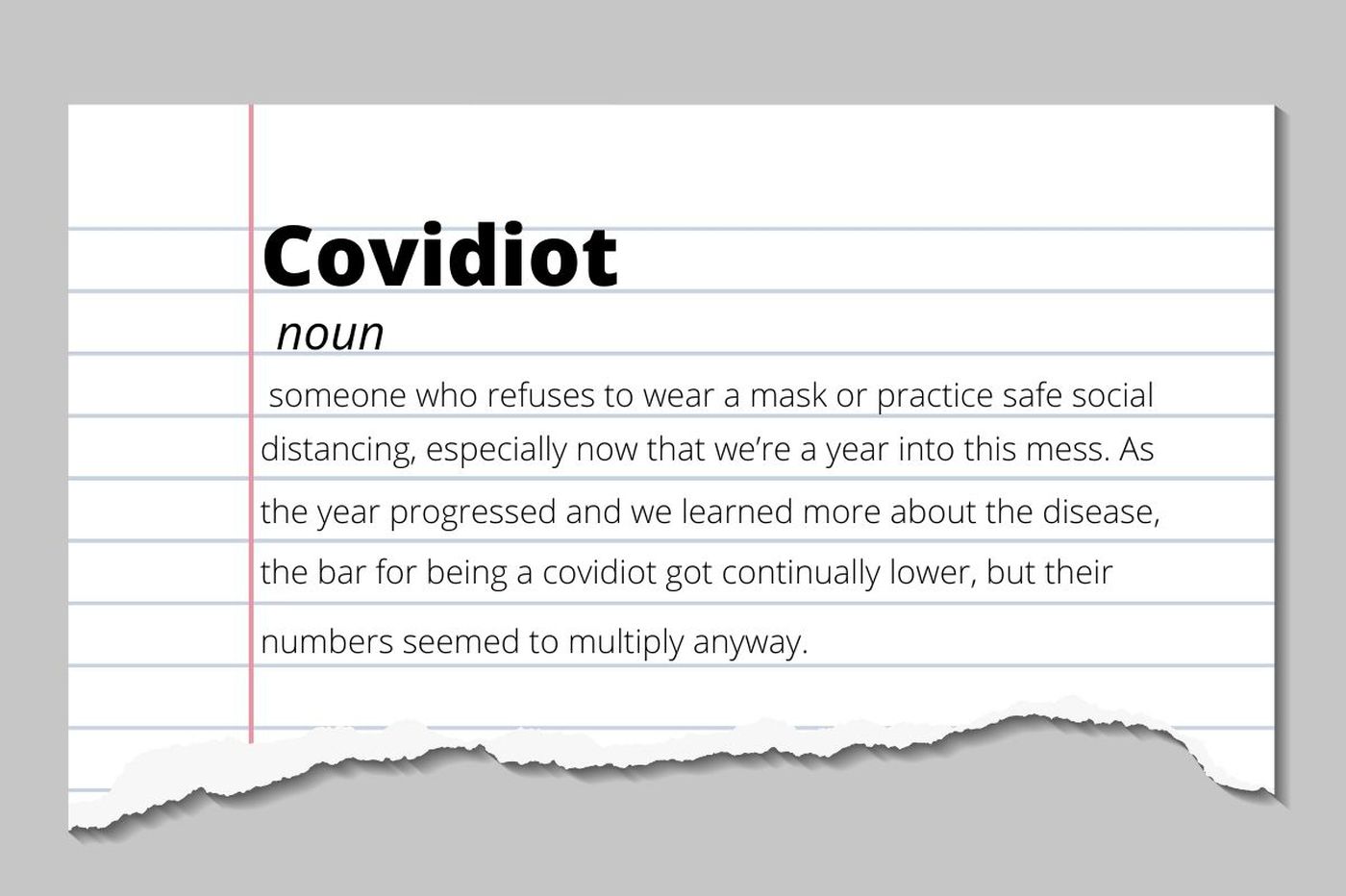
I’ll just say it right up front: I love to read The Philadelphia Inquirer’sAngry Grammarian. And this one from late January updating the pandemic dictionary was a classic. Are you a covidiot who coronasplains? he asks. And what is a covidiot you may ask?
Definition of covidiot. Credit: Philadelphia Inquirer.
After reading that, you can probably figure out that coronasplaining is something done by a covidiot.
Let’s finish with three pieces that have nothing to do with impeachment, insurrection, fascism, pandemics, or conspiracy theories. In other words, normal stuff that we are now beginning to see again after four years of lunacy.
“Lindstrom has discovered a link between empathy and common sense: the better we understand each other, the more problems we can solve through common sense. We treat others the way they want to be treated.
Unfortunately, studies have shown our ability to empathize has declined visibly, driven by social media, technology use and even the prevalence of Botox, which makes it harder to read people’s expressions.
Perhaps this is why common sense seems to be in such short supply today. As we lose our ability to understand each other, we struggle to find solutions that are both logical and widely accepted, based on a shared understanding of each other’s needs.“
Muriel Vega, writing for Preservation magazine, the publication of The National Trust for Historic Preservation (my old employer) has a short piece about The Meticulous Restoration of NASA’s Mission Control at Houston’s Johnson Space Center. For those of us who remember watching all those space flights in the 1960s, with pictures from Mission Control, this brings back a lot of memories.
Finally, we’ll end this Baker’s Dozen with an absolutely lovely piece by two musicians who have been featured in More to Come’sSaturday Soundtrack: John Smith and Sarah Jarosz. Eye To Eye is a beautiful tune for our time of separation.
I cry out, but I feel like you can’t hear me I need it, and I wish that you were near me
Eye to eye Remember when you looked me in the eye Eye to eye No, I don’t wanna have to wait in line Can we stand Eye to eye?
“And ye shall know the truth, and the truth shall make you free.“
John 8:32 (KJV)
If only knowing the truth were as easy as the gospel writer, quoting Jesus, makes it sound. Spiritual truths are not my specialty. But in the worlds I do know, such as history, my experience is that seeking the truth is hard enough. Many of us spend a great deal of energy avoiding the truth, or — once we’ve found it — we try and conveniently forget what we’ve discovered.
I’ve been thinking about the seeking of truth since watching the film Traces of the Trade: A Story from the Deep North. Katrina Browne produced and directed Traces of the Trade, a documentary about her slave-trading ancestors from Rhode Island, the hidden history of New England’s complicity in slavery and her family’s reckoning with questions of privilege and repair.
Katrina Browne at Cape Coast Castle, Ghana, in a room where slave ship captains, including her ancestors, negotiated to purchase Africans. (Credit: Elly Hale)
Discovering the truth about her ancestors — the largest slave trading family in America — brought on questions, doubts, and new perspectives. Browne had approached her journey believing the old American myth that the South was singularly responsible for slavery. What she discovered when her grandmother made a short reference to their Bristol, Rhode Island, slave-trading ancestors in a family history was the large and complex web of people in every state of the Union whose livelihood and privilege benefited from slavery. She discovered, in her own way, what historian Edward Baptist meant when he spoke of how slavery made American capitalism in The Half Has Never Been Told, his influential and troubling work about the continental cotton empire.
We all cling to myths as if they were truth because they are comforting and help us avoid facts we would rather not consider. The battle of myth over truth was most recently seen in the now disbanded 1776 Commission. Historian Michael Kazin writes of the way that the commission — cobbled together to fashion a manifesto for “patriotic” education without a professional historian in their ranks — pines for a “simple, quasi-theological way of understanding the past.” There is nothing wrong, Kazin notes, “with venerating allegedly timeless values, but that is a task for preachers and ceremonial orators — not historians.”
“…one reason historians argue fruitfully, if endlessly, about such topics is that they appreciate that how one defines those “values” helps determine the way one interprets what occurred. In the 1960s, the Americans who staged peaceful demonstrations to integrate bus stations, restaurants and workplaces and those who sent the police to beat them up both claimed they were upholding the causes of liberty and justice. But between George Wallace’s idea that freedom meant the right to exclude Black people from one’s property and Martin Luther King Jr.’s view that it meant giving equal access to everyone, there could be no compromise.“
Instead of clinging to myth, Traces of the Trade is the type of truth-seeking that has led individuals and institutions to consider much more deeply their role in human trafficking. Browne’s work contributed to the Episcopal Church’s 2006 decision to apologize and atone for its role in slavery.
Many of our challenges today comes from those, like the participants in the 1776 Commission, who proclaim to “know” the truth when what they know are their myths. They dismiss those who disagree with their worldview. They won’t do the hard work to find out the truths that may shake up their myths. They decry those who don’t hold their views of freedom and values even if those views and values mean they have the right to exclude Black people from their property or to deny them the right to vote. As Anand Giridharadas writes in Mayflower Mouth, these are the people who think they know the truth about what and who is American and what and who isn’t. They believe they have the right to make that choice for everyone else even when they are in a minority.
As Giridharadas writes, these gatekeepers of the American myth also suggest that Andy would be a good choice for an Americanization of his strange-to-their-ears first name.
But I don’t think I would make a good Andy. I even dare to think that Anand is as American as any other name. I know deep in my bones that I don’t live as a guest in (now ex-Senator David) Perdue’s country.* He lives as my fellow citizen in the country we share. Either mouths like his will learn to twist and blow and yawn and trill and roll in at-first unfamiliar ways, or, in the times that are coming, they will marginalize themselves. It is already a country of many names and many sounds; it is becoming all the more so by the day. This election is a referendum on whether America is a John-Bob republic or a country for us all. The John-Bobbers aren’t winning.
What is the personal myth that I hold dear? I believe that the idea of America is a beautiful thing. That we are a nation founded on ideals and not on a common ethnicity, language, religion, or culture. The idea of the United States is that anybody — anybody — can be an American if you agree to respect the principles of representative democracy. My myth is that our ideals say we don’t care about your skin color, your religion, your accent, your beliefs, or where you’re from.
But I know that the truth of how our past has played out into our present is much different than my idea of America or our common ideals. So yes, my myth is about values that I hold dear, but it also recognizes that America is a project, a work-in-progress. My myth is based on a vision and values, but the simple fact that I believe that vision to be true doesn’t make it so. Katrina Browne’s brave journey into her personal past makes that so very clear.
Real leaders know that you are at your best when you question what you know, realize there is much you don’t know, and try not to fall into the trap of “knowing what just ain’t so” to quote the great Satchel Paige. As a country, we need to continue to seek the truth about the struggles to form a more perfect union. There is work to be done every single day to make those values and that vision a reality. We are what we do, much more than what we have.
As in so many things in life, the journey of seeking is much more important than the destination of knowing.
Jake Blount is an award-winning banjoist, fiddler, singer and ethnomusicologist based in Providence, Rhode Island. A solo artist and half of the duo Tui, he was a 2020 Strathmore Artist in Residence here in the DC area until the coronavirus hit. Blount serves as a board member of Bluegrass Pride and he is a 2020 recipient of the Steve Martin Banjo Prize, which is where I first came across his work.
Oh, and he happened to spend years playing metal and funk guitar. Yes, people do take very different routes to get to a love of old-time music. This week on Saturday Soundtrack, there’s more on his path below.
Blount specializes in the music of Black communities in the southeastern United States, and in the regional style of the Finger Lakes. A versatile performer, Blount interpolates blues, bluegrass and spirituals into the old-time string band tradition he belongs to. He foregrounds the experiences of queer people and people of color in his work. His teachers include Rhiannon Giddens, Bruce Molsky and Judy Hyman.
“One of the most persistent myths surrounding country music is that the genre is “white people music.” The erasure of the Black artists who shaped country music and the industry’s continual exclusion of people of color stands in contrast to genre’s longstanding mantra: “three chords and the truth.” And the truth is, country music would not exist without Black artists.
In 2020, Blount’s first full-length solo album, Spider Tales, was released on Free Dirt Records & Service Co. The album debuted at #2 on the Billboard Bluegrass Chart. Rolling Stone wrote of one of the songs on the album:
A queer and black performer working in Appalachian music, Blount gives an eerie, gender-flipped rendition of Leadbelly’s “Where Did You Sleep Last Night” — famously covered by Nirvana — that’s heavy on mournful fiddle and every bit as unsettling as the original.
Goodbye, Honey, You Call That Gone opens Spider Tales. “The tune comes from Lucius Smith, a Black banjo player from Sardis, Mississippi, who often performed in a band with Sid Hemphill.” The video notes also tell us that Alan Lomax recorded Smith first in 1942, then in 1978. In this video, Blount is playing the banjo while Nic Gareiss performs with his feet.
Roustabout features Blount and Tatiana Hargreaves, another frequent musical partner. According to the notes on the video, this tune is from Dink Roberts, who lived in Haw River, North Carolina, and was an accomplished guitarist as well as banjoist.
In the Wide Open Country interview, Blount describes when he became immersed in Black old-time music.
“I sort of had this gradual, gravitational pull toward more traditional stuff and finding my way to it that really came to a head when the grand jury made the choice not to indict George Zimmerman for the killing of Trayvon Martin,” Blount says. “I felt the need to go back to the songs my ancestors had sung, initially in the form of spirituals, and then eventually in the form of banjo and fiddle music to sort of understand how they had seen the world because songs are the only direct record they left us. So many of them couldn’t read or write and could not read or write the truth — even if they were able to put it to paper — for fear of persecution. I went looking for something that I needed to adapt to the world in front of me and wound up involved in this awesome jam scene and getting really into source recordings and learning old music. It just took on a life of its own.”
As people around the world protest racial injustice and police brutality following the killing of George Floyd, Breonna Taylor, Ahmaud Arbery and so many others, Blount says traditional old-time and folk songs, many of which are featured on Spider Tales, provide a soundtrack to the current Black Lives Matter movement.
We’ll end with Boll Weevil, which features Blount’s fiddling and vocals and was recorded live at the 2019 International Bluegrass Music Association World of Bluegrass gathering in Raleigh.
This Weekly Reader features links to articles that grabbed my interest or tickled my fancy as January turned into February. I hope you find something that makes you laugh, think, or cry.
Statistics tell us that January and February are the months in the U.S. with the highest death rates per 1,000 people. The pandemic has brought death and loss to the forefront of American life in ways reminiscent of other times of national trauma. In the American Civil War, more than 600,000 soldiers lost their lives. We are not at that scale yet, as an equivalent proportion of today’s population would be six million. However, in This Republic of Suffering, Drew Gilpin Faust reveals the ways that death on such a scale, usually occurring without relatives nearby to help with the nursing and grieving and often happening anonymously in those days before those killed could be easily identified, changed not only individual lives but the life of the nation. I suspect the scale and often the loneliness of loss through the pandemic will result in more changes in all our lives.
The pace of loss has been on my mind as I have been reflecting on the number of people who have passed away in recent weeks. This week’s Weekly Reader includes stories and remembrances of several individuals who touched the lives of others in ways known and unknown. All were well known in their fields. So many who died of COVID in the same time period are known only to their families and friends. But so many of those individuals also left remarkable legacies. I wrap it all up with an article that summarizes ten ideas that one person has used to help make a life well lived.
Hank Aaron (credit: Baseball Hall of Fame)
The great baseball columnist of The Washington Post, Thomas Boswell, wrote a heartfelt appreciation for the man who just may have been the greatest baseball player to ever play the game, Henry Aaron. Hank Aaron’s greatness and grace were underappreciated and unmatched makes a strong case for that assessment, and that’s saying something coming from this Willie Mays fan.
“The 1957 and 1958 World Series hooked me on Aaron, who died on Friday at 86, and (Warren) Spahn. Their Milwaukee Braves battled the New York Yankees, whom I already had learned to hold in equal parts awe and hate, on dead-even terms, winning in seven games in their first Series meeting before New York got revenge in seven games in ’58. Aaron hit .364 and slugged .600 in those two World Series.…
There was no conspiracy of silence about Aaron, no plot to keep him underappreciated — which he still is to this day. He was, simply, the greatest attention-deflecting machine the game ever produced. He played with understated grace, swift efficiency and a lizard-tongue wrist-snap of a swing. He tried to hit the ball 400 feet, not 450. That restraint, in an era that adored tape-measure homers, allowed him to blend contact with power; Aaron hit over .320 eight times yet routinely had years with around 40 homers but only 60 strikeouts.…
He had a quiet, utterly composed, almost Buddha-like presence. It was like talking to a bronze statue that suddenly began speaking, slowly and thoughtfully, the least-rushed man alive.“
I had the chance to see Aaron live once in my life, in 1966, the first year the Braves moved to Atlanta. On the last day of the season, our Little League coach told us all to gather around, and then he announced that the coaches and parents were taking us to Atlanta the next Sunday to see an Atlanta Braves game. This 11-year-old was over the top excited! I can’t remember the score, or who they played, but I will always remember seeing graceful Hank Aaron — the real home run champion — play baseball that sunny summer day.
“I came to Philadelphia in 1995, just a farm boy with a fancy diploma. Within a year of my arrival, I met both Michael Jordan and John Chaney.
“On paper,” writes Hayes, “the coach was far less impressive than the player. In person, it wasn’t even close.”
“Jordan was a brand. Chaney was an institution.
But Chaney wasn’t just an institution. Along with a handful of other Black coaches, Chaney helped change an institution — the insular, powerful world of college basketball coaching. It was a world dominated by Bobby Knights and Dean Smiths; the stately legend of John Wooden; the hoary ghost of Adolph Rupp. It was a world made accessible to people like me by the late John Thompson at Georgetown; by Nolan Richardson at Tulsa and Arkansas; and, in gritty North Philadelphia, by John Chaney, who died Friday. He was 89.
You’ve heard this before, but for Coach Chaney this is true: Like Thompson and Richardson, Chaney will live forever through the lives he so deeply touched; and through lives he never knew he touched.“
I first met the late Barbara Erickson, President and CEO of the Trustees of Reservations who passed away much too early on January 15th, when she visited the National Trust for Historic Preservation. She came soon after taking on her role with the Trustees, the Massachusetts organization that was a precursor to the National Trust in the U.K. It was clear that Barbara was an impressive leader as well as an individual who was generous in spirit. We got to know each other a bit more when she came to the 2015 International National Trust Organisation (INTO) Cambridge conference when I served as an INTO Trustee and we were both speakers. Catherine Leonard, the Secretary-General of INTO, has written Barbara J Erickson, President and CEO of the Trustees of Reservations as an appreciation for Barbara and her work on the international stage. It includes a link to a blog I wrote after Cambridge.
Barbara was a force for preservation and conservation, and she will be missed.
Three generation of Brown men loved the Mel Brooks film Young Frankenstein. To be truthful, Daddy, Andrew, and I could quote multiple lines from several Mel Brooks movies, and when we watched them together the laughter was loud and long. Sadly, most of the main actors from that 1974 mini-masterpiece of a film have now passed away, including last week, the wonderfully talented Cloris Leachman.
“It was ‘Young Frankenstein,; however, that delivered her enduring place in film history. The movie was bursting with brilliant visual and verbal gags that paid irreverent tribute to Universal Studios horror films such as “Frankenstein” with Boris Karloff and “Dracula” with Bela Lugosi….
To play Frau Blücher, Ms. Leachman tied her hair in a tight bun, affixed a chin mole and gave her skin a sickly pallor with makeup — she was made to resemble Judith Anderson’s severe housekeeper Mrs. Danvers from “Rebecca” (1940). But the pièce de résistance was her German accent and her fearsome glare. Horses whinny in horror at the mention of her name.
Ms. Leachman made the deadpan most of her deliciously cockeyed lines. ‘Stay close to zee candles,’ she says, holding an oversized candelabra with unlit candlesticks as she climbs a shadowy staircase. She overdoes her offer of a nightcap to an increasingly angry Frankenstein, first proffering brandy, then ‘varm milk . . . perhaps?‘ and, finally, the chocolate malted kid’s drink Ovaltine. Later, she confesses to a dark secret: “Yes! Yes!” she shouts of Victor Frankenstein. ‘He voss my boyfriend!’”
“A wonder of poise and punch, the actress dared to declare herself a moral progenitor, taking on roles that reflected the dignity of Black women.“
“Tyson was a peculiar kind of famous. I was never told of her importance. I just knew. Everybody knew. This woman was somebody. She looked sainted, venerated — at 29, 36, 49 and 60. Even in anguish. It’s possible that happens once you’ve played a 110-year-old formerly enslaved woman in ‘The Autobiography of Miss Jane Pittman’ and after you’ve played Kunta Kinte’s mother. Or maybe those roles happen because you radiate venerability.“
“Ideas are powerful. Arriving at the right time, they can alter the entire direction of your life.
But ideas also hide in the background, acting as assumptions. Quietly influencing your decisions, whether they’re true or false.“
Number 6 — Fear is overcome through exposure — rings true for me. And Number 10 — Happiness is in the pursuit, not the possession — is always a good reminder.
Rest in peace, Hammering Hank, Coach Chaney, Barbara, Frau Blücher, and Cicely Tyson. Like Marcus Haynes said, you will live forever through the lives you so deeply touched; and through lives you never knew you touched.
More to come…
DJB
Image: Cloris Leachman in her legendary role as Frau Blücher in the Mel Brooks film Young Frankenstein.
The stories we tell, and the ones we absorb, notes writer Steve Almond, “are what allow us to pluck meaning from the rush of experience.” It is why I believe in the power of stories. But power works for good and evil, and every story has a perspective. Not every story is told with the best of intentions.
“We do not tell stories as they are, we tell stories as we are. “
Anaïs Nin
The truth in this quote about stories attributed to French-Cuban American diarist, essayist, novelist and writer Anaïs Nin made me stop and think. We see through our own personal lenses as we tell stories, and there are other stories — sometimes hidden — that are part of the telling. Stories that may be good or bad, true or false.
We all decide if our stories will include a larger sense of humanity as we consider our relationship to others. I saw the quote about stories in a recent enewsletter, and an earlier post from the same organization with the subject matter title of Reclaiming our sense of humanity came to mind as I thought about the telling and absorbing of stories.
Reclaiming our sense of humanity strikes me as a necessary project in these turbulent times. In that work, the stories we tell ourselves and others are key to our growth personally and as a nation.
It is easy to look at the chaotic and never-ending news cycle and lose faith in the future, to question our ability to see each other as humans, worthy of care and love. People tell stories from the horrific and sick to the fantastical and sometime comical. (Jewish lasers in space, anyone?) These are often based on conspiracy theorists repeating baseless claims designed to spread disinformation and distrust. Or sometimes these stories come as part of a worldview from groups who believe that people who don’t practice their form of religion are illegitimate. Those stories tell us who they are. They also make it easy to turn to cynicism and despair.
There are different ways to approach life, to tell our stories, and to reclaim our sense of humanity. We can refuse to be drawn into the false stories and lies that are told to drive us apart. And we can do the work that is before us to remake our relationship to others.
“When you recognize that pain and response to pain is a universal thing, it helps explain so many things about others, just as it explains so much about yourself … It essentially tells you what everybody needs. You know what everybody needs? You want to put it in a single word? Everybody needs to be understood. And out of that comes every form of love.”
Journalist and broadcaster Krista Tippett shared her thoughts on the reclaiming of our sense of humanity and the need to move beyond all the coverage of the worst of human nature, in an interview with the Poetry Society of America. When asked “If you were to choose one poem or text to inscribe in a public place right now, what would that be?” she responds:
“The last line of a poem called “Vocation,” by William Stafford: “Your job is to find what the world is trying to be.” The language of vocation — calling — is important to me, in civilizational as well as personal terms. Through all of the extraordinary disorientation and tumult of our world right now, I think we are also glimpsing the world that wants to be born — a world in which we center what is essential in human terms — and reimagine and remake our relationship to others and to the natural world.”
Tippet notes that the worst of human nature and action gets all the coverage in our chaotic news cycle, “but it is not the whole story of our time.” I like the idea that our calling in this moment is to look, hear, and work to “center what is essential in human terms” as we reimagine and remake our relationship to others. In short, it is to reclaim our humanity.