All posts filed under: Historic Preservation

Saving the past has a past

It is surprising that a field that has focused so much on the preservation of history has an unfortunate blind spot to its own history. Historic preservation is one of the longest-lasting examples of community development, land use reform, and public history in the United States. The stories of the past efforts of our fellow citizens to ensure that parts of our history are with us today and tomorrow are varied and fascinating. Yet many, both inside and outside preservation, tell themselves a simplistic and usually inaccurate story of how we came to value parts of our past in a country that too often only values the new and what’s over the horizon. The recently released second edition of Giving Preservation a History, edited by Randall Mason and Max Page, is a strong attempt to reverse our trend at historical amnesia in the preservation field. Through seven essays retained from the first edition, six new essays prepared for the 2020 book, and two concluding chapters to wrap both works together, the editors have endeavored to put forward …

Searching for Utopia

Americans have a long history of living with an eye on the horizon, seeking something shiny and new. The first religious communities of New England, founded to escape the tyranny of the established churches in Europe, led to Roger Williams and others leaving those new settlements for Rhode Island to escape the tyranny of the Puritans. The Jeffersonian search for freedom in land led to grid-and-garden patterns of development across much of the Midwest and West and, eventually, the push out of the city into the “land” of the suburb. Communitarian journeys to places like New Harmony, the Shaker villages, and (a personal favorite) the 19th century English town of Rugby, Tennessee are part of the story. Henry Ford noted that, “We shall solve the problem of the city by leaving the city,” so Ford, George Pullman and other industrialists, up to and including today’s Silicon Valley elites, have constructed company towns and “E-topias” to build something new in the land of opportunity. All of these examples and many more are part of Alex Krieger’s …

Uplifting Preservation

There are times when the personal takes on global implications. Last week was one of those times. It began when I discovered that a former National Trust colleague, Raina Regan, has begun a fascinating self-help project for preservationists. Here is Raina’s description of this work: “One of my goals for 2019 was to be more intentional with my free time, which resulted in a rekindled love of reading. I was really drawn to self-help books, and according to my count, I’ve read two dozen of them in 2019. As I read each one, I considered how they would apply to me and my work in historic preservation. At some point, I decided I wanted to take what I’ve learned and share it more broadly with the world—and Uplifting Preservation was born.“ Uplifting Preservation is a once-a-month newsletter on the Tiny Letter platform where Raina shares her perspective on a specific book, such as Brené Brown’s Daring Greatly: How the Courage to Be Vulnerable Transforms the Way We Live, Love, Parent, and Lead, and its relevant concepts …

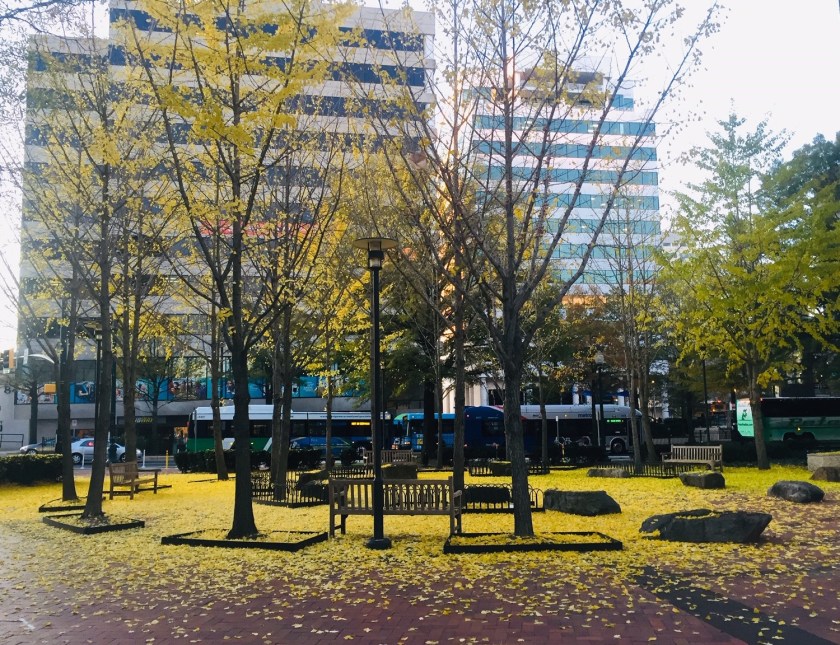
Fall in downtown Silver Spring

Beauty and design

Former Charleston, South Carolina, mayor Joe Riley has spoken eloquently about beauty and civic design. In an Architect magazine article on the occasion of the mayor’s retirement after 40 years in office, author Wayne Curtis quoted Riley as saying,  “Often architecture is thought elitist, that you’ve got to be schooled or have a special interest. But not long after I was elected, I’d see visitors in town. They looked like they were retired blue-collar workers, and you’d see them admiring buildings.” Riley ends with one of his core beliefs. “Beauty has no economic litmus test. It’s a basic human need and instinct.” I’ve been thinking of Joe Riley’s belief in the ability of beauty and good civic design to uplift our communities* as I have walked through our downtown in recent weeks. There is a great deal of construction activity underway in Silver Spring, but I am hard-pressed to find too many examples of fine urban design. One challenge is that much of the future of downtown Silver Spring was turned over to a development …

Governor's Commission presentation

R.I.P. Virginia Governor Gerald L. Baliles, Advocate for preservation

(Note: Slightly revised versions of this appreciation ran in the National Trust’s Forum newsletter, on LinkedIn, and on social media pages for Preservation Virginia and other preservation organization.) Former Virginia Governor Gerald L. Baliles, who passed away on October 29th at age 79, has been appropriately recognized as a quiet but effective leader. His “boldly cautious” style was credited for gains in increasing the number of women and minorities in statewide leadership positions, as well as for increased support for transportation and the environment. But the Jerry Baliles I remember was also one of the most effective advocates for historic preservation at a time when development pressures in Virginia were pushing forward at the expense of its past. His leadership led to much needed changes at the state level that played an important role in all that has happened to save the best of Virginia’s past in the almost three decades since the end of his term as governor in 1990. During his campaign for governor, Jerry met with representatives of the state’s preservation community. …