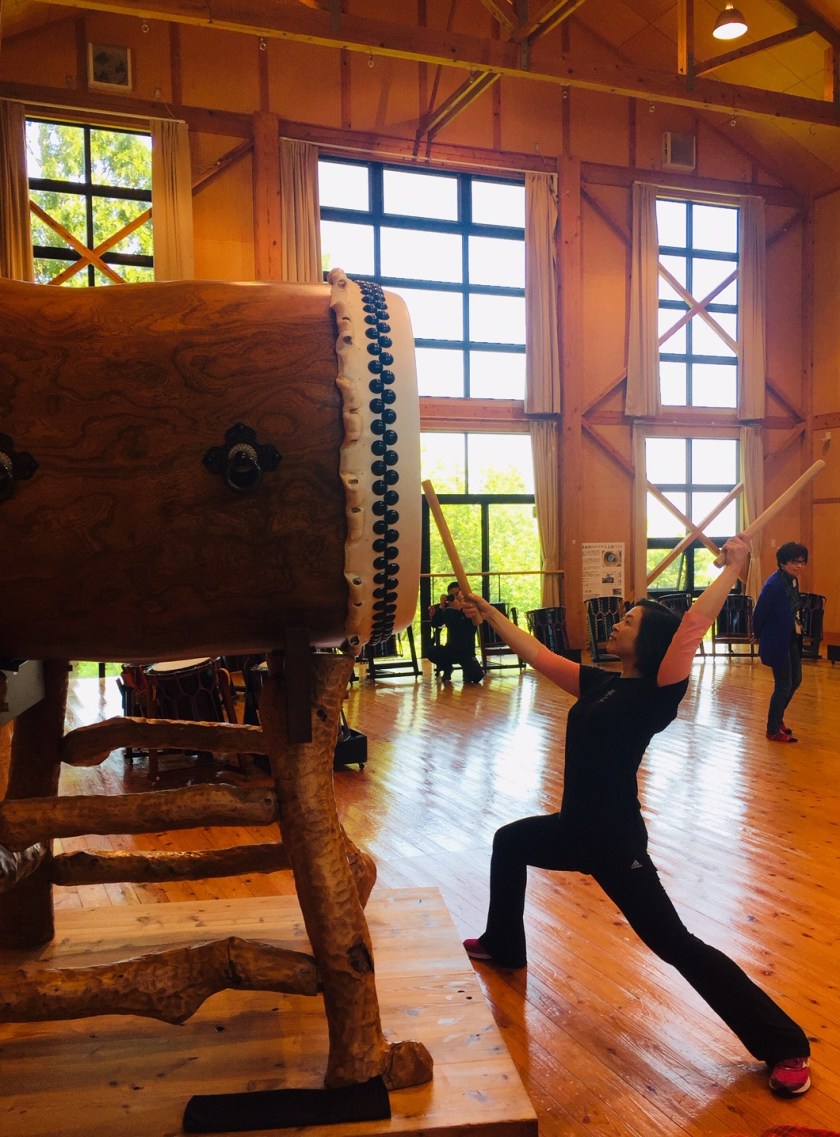
Children of the drum
We need to remember the basic things that make us human, helping us work together in community. We need to get to the heartbeat.
We need to remember the basic things that make us human, helping us work together in community. We need to get to the heartbeat.

Linking the passions of America’s founding fathers with those of the ruling classes of Asia wasn’t on my agenda when I left for a two-week National Trust Tour of Japan and South Korea earlier this month. Sometimes serendipity just strikes. It was pure chance that I began reading Andrea Wulf’s Founding Gardeners: The Revolutionary Generation, Nature, and the Shaping of the American Nation as I was leaving for my first trip to Asia. I was absorbed in her illuminating study of the passion for gardening, agriculture, and botany of Washington, Adams, Jefferson, and Madison—America’s best-known founding fathers—as I was entering a world where exquisite gardens were the obsession of Japan’s ruling class. The juxtaposition was fascinating and delightful. I became acquainted with Wulf through one of my favorite books, her 2015 work The Invention of Nature, with its description of how Alexander von Humboldt radically reshaped the way we thought of our relationship to the natural world. Founding Gardeners, written in 2011, isn’t as consistently strong, but is an enlightening read in its own right. …

Pearl Harbor. Normandy Beach. Hiroshima. Names, places, memories, and lessons we should never forget. Last week I was moved beyond words by time spent at the Hiroshima Peace Memorial Garden and Museum in Japan. In fundamental ways the experience mirrored my reactions during visits in recent years to Pearl Harbor and Normandy Beach. The world at the time of those earlier visits seemed more stable than it does in 2019. Just a few years ago we didn’t have out-of-control individuals in positions of immense power in the United States; individuals threatening to use nuclear weapons against other nations and people just because the capability exists. Instead, we had leaders who sought, at least at some fundamental levels, to try and unite us as a people and as a world. There seemed to be adults in charge who had the memories to understand the horror to humankind of nuclear war. As John Hersey, the author of the landmark 1946 piece on Hiroshima in The New Yorker, once wrote: What has kept the world safe from the …

Who knew that Pope Francis was an urbanist? I’m not a Catholic and only occasionally follow news out of the Vatican, but I was taken by reports that Pope Francis had commented on driving habits during his most recent New Year’s Eve homily. As reported in the press, Francis — who is also the Bishop of Rome — included the following in his remarks: “’I feel gratitude in my soul, thinking about the people who live with open hearts in the city,’ Francis said. As examples of that spirit, the pope began with a for-instance that will echo the frustrations of many a Roman resident – ‘those people,’ he said, ‘who move in traffic with good sense and prudence.’ By consensus, the poor state of maintenance on Rome’s roads, the lack of accessible public parking, and the city’s paralyzing traffic, are among the top complaints from locals…. The pope then went on to cite other examples of heroism from the silent majority. He praised ‘those who respect public places, and report things that aren’t right; …
NOTE: This post first appeared on the Preservation Leadership Forum blog. It is adapted from remarks I made at the February 23, 2019, National Trust for Historic Preservation Board of Trustees meeting, my last Board meeting after more than two decades with the National Trust. Over the past 22 years, I made it a practice to regularly reflect on both the legacy and the promise of the National Trust for Historic Preservation. We were founded by Congressional Charter after America’s leaders had seen the destruction that war could inflict not only on people but also on a nation’s culture and heritage. Our founding chairman, David Finley, was one of the famous Monuments Men who risked their lives to save the cultural patrimony of Europe during World War II. Bill Murtagh, an early predecessor of mine in senior management, went on to a distinguished career in preservation as the first Keeper of the National Register of Historic Places, establishing the tool to tell America’s story. Clearly, we stand on the shoulders of giants. The National Trust …

Welcome! Learn how DJB’s newsletter has evolved from random thoughts to… more organized random thoughts.

A farewell message I wrote to my colleagues after 22 years at the National Trust.

Last Friday, my colleagues at work hosted a wonderful send-off party. There was a “B” theme to evening, as we had barbecue (Rocklands, my local favorite); bourbon (with gifts of several very nice bottles of whiskey over the course of the week); and bluegrass (the latter supplied live by the By-and-By Band). The band was even kind enough to let me sit in with them on a spirited rendition of Sitting On Top of the World! Friends, former and current colleagues, and partners came in from as far away as Los Angeles to celebrate. I used the occasion to say a few words (no surprise there), beginning with the observation that I was finding that almost anything that was said in the office brought to mind something that happened 10, 20, or 30 years ago—what I’ve dubbed the Old War Stories part of my transition. I knew everyone would be thankful if I kept it short, so I brought notes. On the occasion of my 60th birthday, I composed a post entitled 60 Lessons From …
March is one of my favorite times of the year. The longest month—February—is past. Winter is nearing an end here in DC. Baseball players have reported to spring training camps. Hope springs eternal. Speaking of baseball, I have my own spring training ritual every year. Up first is a viewing of Bull Durham—the best baseball movie ever—followed by reading a new baseball book. Together the two get me in the mood for the season. I can report checking off both of those training regimens this year well before Opening Day. I actually read two baseball books recently, although one may not count because it is entitled The Is Not Baseball Book. You have to love a book which begins with a first chapter of “Sports Is Not a Metaphor. It’s a Symbol.” Afterwards it jumps into all matter of things, including pataphysical management systems leading to “self-learning” teams. That’s for another time. It is the second book, Smart Baseball: The Story Behind the Old Stats that are Ruining the Game, The New Ones that are …

We all fail. Even those who go to great lengths to demonstrate that they are always right, never are. Rather than fear failure, what if we accepted failure’s inevitability yet used the outcomes to our advantage? Marcel Schwantes, Founder and Chief Human Officer at Leadership From the Core, wrote the following to encourage the “practice of failing forward”: “If you’re the type of person who gives up too soon after failing and you just can’t bounce back from a setback, you’re missing one of the greatest lessons of every successful person: Failing is part of the journey that will lead to success. Accept this fact early on so that when failure comes knocking and tries to scare you away, you stare it down with confidence and embrace it, learn from your mistakes, and try again a different way.” Schwantes’ comment struck me in two ways. First, I believe he’s right about learning from setbacks. It isn’t that we should try to fail, but rather that we should recognize — and build upon — the inevitable. More importantly, this …
 MORE TO COME...