
The power of words
A word after a word after a word is power.
Posts about places that matter
A word after a word after a word is power.

For several years I’ve regularly traveled for work to Monterey, California, a small coastal city some two hours south of San Francisco. So when we went looking for a west coast destination for this year’s family vacation, I suggested we check out the Monterey Peninsula. Now that we’ve wrapped up a week-long visit to Pacific Grove—next-door neighbor to the city of Monterey—we’re just coming to realize how much we’ve seen and explored in this new (to us) part of the world. Let’s begin with the coastline, the attraction to visitors for thousands of years. I awoke every day shortly after 6 a.m. and went for walks of as much as two hours along the well-used (and well-loved) Monterey Bay Coastal Trail. Pacific Grove’s portion of this 18-mile trail, which follows the path of the old Southern Pacific Railroad train tracks, hews close to the water and rock-strewn coastline, while Monterey’s comes inland a bit to incorporate Cannery Row, the Monterey Bay Aquarium, and Fisherman’s Wharf. My walk often began before sunrise and was shrouded in …

I recently asked my colleague Priya Chhaya to open a retreat with a reflection on changing perspectives. We were discussing a familiar theme, the future of the American city, in an unexpected place—in this particular case, under the night sky in the American west. For one of the readings, she chose the Sylvia Plath poem Stars Over Dordogne, calling out the second verse in particular: “Where I am at home, only the sparsest stars Arrive at twilight, and then after some effort. And they are wan, dulled by much travelling. The smaller and more timid never arrive at all But stay, sitting far out, in their own dust. They are orphans. I cannot see them. They are lost. But tonight they have discovered this river with no trouble, They are scrubbed and self-assured as the great planets.” Priya noted that when in a city, which is home for many of us, you often only see what is right in front of you: the buildings, the roads, the cars, the noise, the obvious density. But a …

You’ll never know that one of your guitar heroes is sitting in the seat next to you if you don’t take your head out of your phone or computer.

I am in the middle of an impressive yet troubling book by Steve Almond entitled Bad Stories. This work about the American psyche in 2018, by the New York Times best-selling author and co-host of the Dear Sugars podcast (with fellow writer Cheryl Strayed), looks at the many reasons we came to be where we are today as a nation. There is much to consider in this work. But for now, I want to focus on stories — good and bad — and what they can mean personally and professionally for those of us who look to “tell the full American story.” Almond writes, “I’ve placed my faith in stories because I believe them to be the basic unit of human consciousness. The stories we tell, and the ones we absorb, are what allow us to pluck meaning from the rush of experience.” He then quotes the Israeli historian Yuval Noah Harari, who insists that our species came to dominate the world in part because of “our unique cognitive ability to believe in the imagined, …
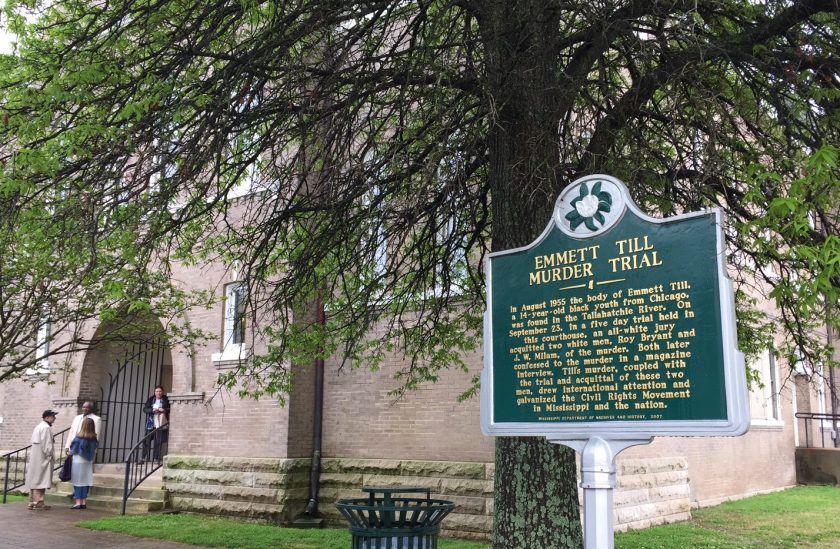
A trip through Mississippi, where Bill Ferris quoted a relative who said “he was raised on cornbread and recollections.”

How often do we give advice when simply presence and acknowledgement is required?
Our recent national conversations too often seem soaked in anger. I don’t know anyone who hasn’t become angry. It is a trait we all seem to share. What differs is how we respond to anger: our own and others. Over the winter holiday, our family visited the National Museum of African American History and Culture. Last Friday, our divisional management team toured the Mere Distinction of Colour exhibit at the National Trust Historic Site Montpelier. Both cultural institutions showcased the many ways a people oppressed have responded to anger held against them by others as well as that held inside themselves. While at Montpelier, I picked up Michael Eric Dyson’s book Tears We Cannot Stop, a powerful call for recognition and redemption which brims with this Baptist preacher’s righteous anger. In her collection of essays No Time to Spare: Thinking About What Matters, Ursula K. Le Guin has a two-part piece on anger. The first half looks at public anger, while the second focuses on our private anger. I thought of the first in the …

On Tuesday I spent a good part of the day at the Tenement Museum, on New York’s Lower East Side. I was there to meet with the museum’s new president, Kevin Jennings, and to tour their new Under One Roof exhibit with Annie Polland, the EVP for Programs and Interpretation. An affiliate historic site of the National Trust, the Tenement Museum tells the full American story about how many have come together to make our nation today. Which brings me to the so-called War on Christmas. The day I arrived, Kevin had just published an op-ed in Newsweek entitled “A War on Christmas? What Christmas Are You Talking About?” Early in the piece he asks the key question: “In recent years, a new holiday tradition seems to have emerged in America. From pundits to Presidents, the airwaves fill each December with people decrying the so-called “War on Christmas.” As a historian and museum President, I find myself wanting to ask “War on whose Christmas?” Those bemoaning the “War on Christmas” harken back to a mythical …

Kurt Vonnegut has called him America’s greatest satirist, while others suggest he was born of Mark Twain and H.L. Mencken. Lewis Lapham—editor emeritus of Harper’s Magazine, founding editor of Lapham’s Quarterly, and the object of those accolades—is a writer of great eloquence and “lethal wit.” I was delighted to see that some of the best of Lapham’s essays from the past twenty-five years have now been collected into a new work, Age of Folly: America Abandons Its Democracy. This is both a wonderful and important book. Lapham surveys the past twenty-five years to make the case that America’s imperial impulses have shaken our democratic principles. You can agree or disagree with his premise, but his arguments are lucid, thoughtful, and often challenging. In the very first essay, from 1990, Lapham states his case succinctly and directly. “If the American system of government at present seems so patently at odds with its constitutional hopes and purposes, it is not because the practice of democracy no longer serves the interests of the presiding oligarchy (which it never …

