All posts filed under: Random DJB Thoughts

This is where I put anything that is not easily categorized…

Singing at Christmas Day Dinner

Merry Christmas 2016

Several years ago we first volunteered to help serve Christmas dinner at our parish.  This is a wonderful tradition that we had just discovered.  Several hundred people – some homeless, some single, some elderly without family nearby, some simply wanting someone else to cook for them – come together for several hours of turkey, stuffing, pies, caroling, and conversation. That first year, as we were leaving, one of the children said, “Can we make this a regular part of our Christmas Day tradition?”  We’ve been there ever since. Because Andrew and Claire were born five days before Christmas, we have always waited to jump into the season until after we celebrate their birthdays.  Plus, Candice and I have always wanted to focus on Advent, and then celebrate the 12 Days of Christmas through until Epiphany on January 6th. But this year we’ve actually scaled back some of the past over-the-top holiday celebrations.  Our decorations are simpler. We are content to be together as a family around a dinner table.  (No cell phones, please.) And just …
No WiFi

Be civil, be urban

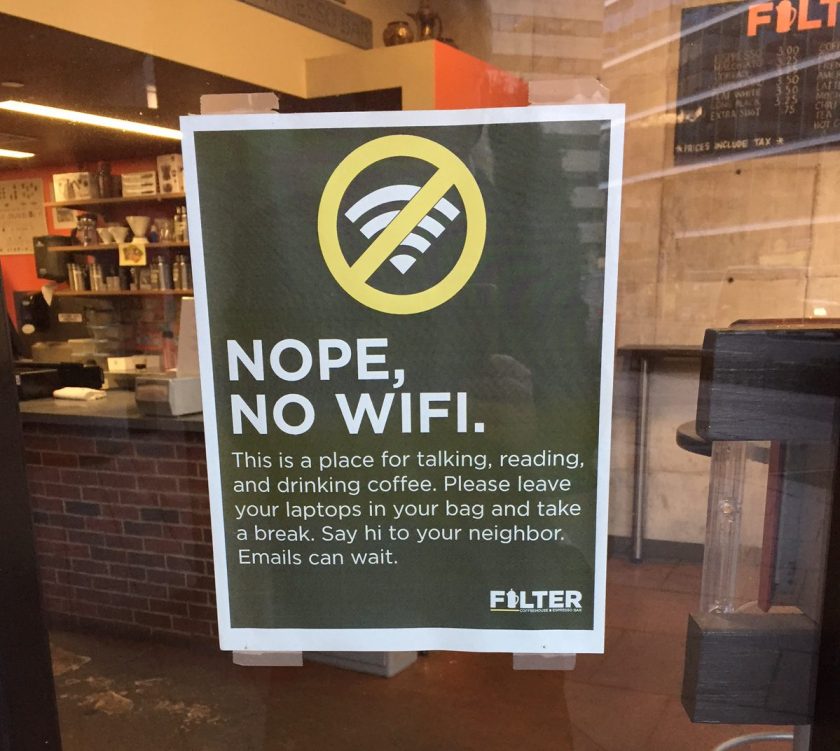
Each morning on my walk to our offices at the Watergate, I stop off at Filter coffeehouse for a coffee to begin the work day.  What first drew me to this particular coffee shop on I Street, NW between 19th and 20th (as opposed to the 15 others I pass in my 25 minute walk) is the sign on the door.  It reads, simply, “Be Civil, Be Urban.” I was intrigued.  My interest was really piqued when I stepped inside and found urban planning books and architectural models on the bookshelf, a prominent “Nope, No WiFi” sign, and a quote on the wall from architectural historian Spiro Kostof that reads, “Civilization, in this strict sense, is the art of living in towns.” Living and working in groups – in towns, cities, and organizations – led us to move toward a civilized society.  But civilization is not guaranteed. How we live and work together is a key to productivity, learning, growth, and happiness.  Civility is — unfortunately — in short supply in much of our national …

Relevance

Nina Simon, the Executive Director of the Santa Cruz Museum of Art and History, gave a powerful TrustLive talk at the recent Houston PastForward conference on place and relevance.  She defines relevance as a key that unlocks meaning, opening doors to experiences that matter to us, surprise us, and bring value into our lives. In her book The Art of Relevance, Nina applies two criteria to all the stories she tells about relevance.  First, how likely new information is to stimulate a positive cognitive effect – to yield new conclusions that matter to you.  Second, how much effort is required to obtain and absorb that new information.  The lower the effort, the higher the relevance.  As those of us who heard her speak know, she frames this work in terms of doors and keys that help different groups access rooms of information.  To understand individuals different from us, we have to go outside our rooms and look – with empathy – at the views of the community outside the door.  We have to learn from …

You Can’t Stop the Revolution

Since moving to Pasadena earlier this year, Claire has been attending All Saints Episcopal Church.  Today, she sent us a text that said, “The sermon at All Saints got a standing ovation this morning…It was a feminist re-telling of the character of the Virgin Mary and how the patriarchal church has belittled her from a strong woman of color into a submissive white woman who embodies the impossible ideal of being a virgin mother.” Well, I certainly wanted to hear that! Luckily, All Saints posts their sermons on YouTube, and so I just finished listening to Mike Kinman’s sermon – the one Claire referenced – entitled You Can’t Stop the Revolution.  “Mary was the Mother of the Revolution of Love and the Magnificat is her protest chant – a protest chant the church has spent 2000 years mansplaining in an effort to silence the radical power of her proclamation.” More than once Kinman says, “God’s revolution of love will be led by fierce, nasty women.”  This is a powerful message.  Give it a listen. More …

Pearl Harbor Day

A couple of years ago I wrote a post called Why We Memorialize and Remember Sacred Places on the reasoning behind my decision to cite December 7, 1941, as my top candidate deserving of the descriptor “The day the world changed forever.” I thought it would be a good post to share again – here on Pearl Harbor Day.  Memorials are about memory, which is “an essential part of consciousness” as quoted in my colleague Tom Mayes’ series of essays on Why Do Old Places Matter? In this day and age, we glorify the individual and forget that it is the collective – the community – that holds us together.  Places such as the U.S.S. Arizona memorial – and I would argue the Waikiki Natatorium War Memorial – are indeed “places where moments in personal history become part of the flow of collective history.”  History that transcends individual experiences and lifetimes. It is important to remember that we are judged not just by what we build, but by what we choose to save and remember …

Duffle bag

The real voyage of discovery

I was in college before I took my first airplane ride – a trip from Nashville to Philadelphia for (no surprise here) the 1976 National Trust Preservation Conference.  It was probably another ten-to-fifteen years after that before I traveled outside the U.S. Growing up in a large, middle-class family in Tennessee in the 1950s and 1960s, we didn’t just jump on an airplane when we felt the urge. My children find this difficult to comprehend, since they took their first flight at 6 months of age, and by the time they were in college the number of countries they had visited required both hands to count.  When I tell them that my grandparents probably stayed in Tennessee their entire lifetimes, they begin to recognize the dramatic changes that take place from one generation to the next. I’ve been working to make up for lost time when it comes to travel.  Both personally and professionally, I have the opportunity and privilege to travel to many places both in the U.S. and around the world.  I was thinking …

Macon musical history

Not my average radio interview

Folks in Macon, Georgia, take their musical roots seriously.  (Think Otis Redding, the Allman Brothers, Little Richard.)  So on Friday morning when I was booked for an interview on WNEX, The Creek — a new Macon radio station featuring Southern roots music and local issues — I assumed it would be different from the local NPR stations where I normally find myself talking about preservation. I was right.  And (with the possible exception of my time on the Honolulu public radio station), it turned out to be much more fun than my average NPR radio interview! We were in town to launch our National Treasures campaign for the Ocmulgee National Monument.  Lands affiliated with the Ocmulgee National Monument have been home to Native Americans for more than 17,000 years.  However, over recent decades the places with ties to the site have been threatened by urban sprawl, the subdivision of forested tracts, and ownership fragmentation. The National Trust and our partners are seeking to re-designate the monument as a historical park, expand the current boundaries, and …

Ants Don’t Get Stuck in Traffic Jams

The Next City website had a recent post by a physicist, Laurie Winkless, entitled 7 Things I Learned While Trying to Figure Out How Cities Work.  Number 3 jumped out at me, and I’ll quote it here: “We’ve all been caught up in phantom traffic jams, where for no discernible reason, traffic builds up and then eases. These traffic shockwaves are officially known as “jamitons,” and they can arise even if everyone is driving perfectly. But ants don’t have the same issue: Even when their highways are packed, they don’t get gridlocked. It seems that it’s because ants self-organize into lanes, and give each other a lot of headway, which buys them more time to react to any incidents up ahead … maybe a lesson in there for us all.” Maybe a lesson indeed!  I looked up from my book on a recent commute on the Metro, when I felt several people rush by my seat.  What was the hurry?  It turns out that they had entered at Gallery Place and were all pushing to …