All posts filed under: Recommended Readings

Books (along with a smattering of movies and plays) that I have found of interest and want to share

No WiFi

Be civil, be urban

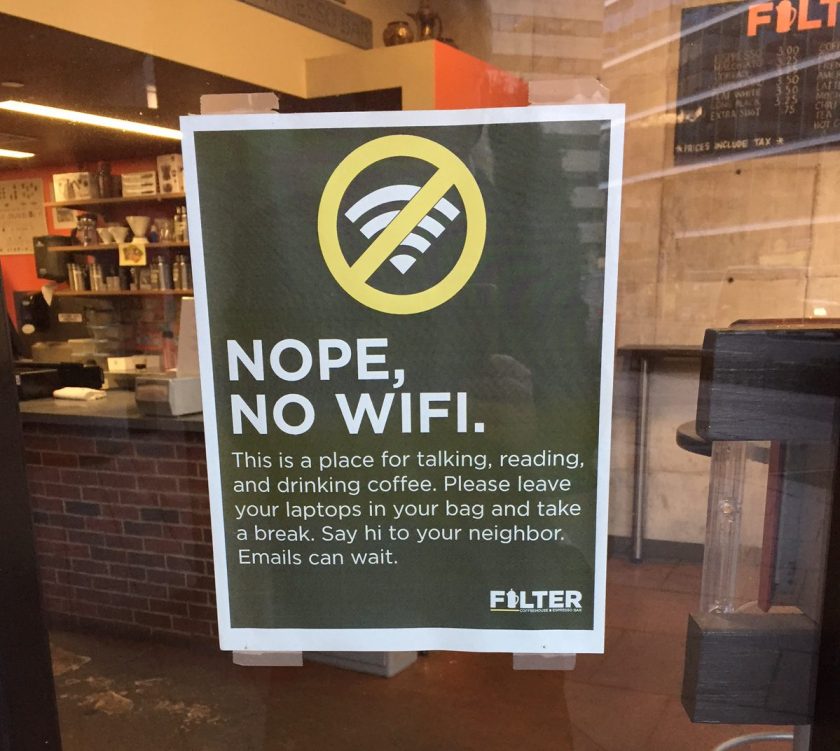
Each morning on my walk to our offices at the Watergate, I stop off at Filter coffeehouse for a coffee to begin the work day.  What first drew me to this particular coffee shop on I Street, NW between 19th and 20th (as opposed to the 15 others I pass in my 25 minute walk) is the sign on the door.  It reads, simply, “Be Civil, Be Urban.” I was intrigued.  My interest was really piqued when I stepped inside and found urban planning books and architectural models on the bookshelf, a prominent “Nope, No WiFi” sign, and a quote on the wall from architectural historian Spiro Kostof that reads, “Civilization, in this strict sense, is the art of living in towns.” Living and working in groups – in towns, cities, and organizations – led us to move toward a civilized society.  But civilization is not guaranteed. How we live and work together is a key to productivity, learning, growth, and happiness.  Civility is — unfortunately — in short supply in much of our national …

Relevance

Nina Simon, the Executive Director of the Santa Cruz Museum of Art and History, gave a powerful TrustLive talk at the recent Houston PastForward conference on place and relevance.  She defines relevance as a key that unlocks meaning, opening doors to experiences that matter to us, surprise us, and bring value into our lives. In her book The Art of Relevance, Nina applies two criteria to all the stories she tells about relevance.  First, how likely new information is to stimulate a positive cognitive effect – to yield new conclusions that matter to you.  Second, how much effort is required to obtain and absorb that new information.  The lower the effort, the higher the relevance.  As those of us who heard her speak know, she frames this work in terms of doors and keys that help different groups access rooms of information.  To understand individuals different from us, we have to go outside our rooms and look – with empathy – at the views of the community outside the door.  We have to learn from …

View of Florence

The Well-Tempered City

Jonathan F.P. Rose is a man of many interests and talents.  A developer, Rose builds affordable housing and mixed-income community centers.  He is a jazz aficionado and — as suggested by the title of his newest book — a classical music devotee.  Rose is also an interdisciplinary scholar and writer.  In The Well-Tempered City:  What Modern Science, Ancient Civilizations, and Human Nature Teach Us About the Future of Urban Life, Rose brings those talents and interests together in a wide-ranging and thoughtful look at the past – and future – of the places where 80% of the world’s population will live by 2080. (Full disclosure:  My employer — the National Trust for Historic Preservation — has recognized Jonathan’s work with a Preservation Honor Award, and I have worked with him through his role as an advisor to a couple of our projects.) The Well-Tempered City is a book that reflects a lifetime of work and thought about how cities best serve people.  Early in the book, Rose notes that, “Since the founding of the very …

For the Son of a Librarian, the Apple Doesn’t Fall Far from the Tree

I love seeing lists of books recommended by people from all walks of life.  As the son of a children’s librarian and the husband of a children’s reading specialist, books have always been a part of my life. This enthusiasm was brought home to me again when I recently saw a list of recommended readings from President Obama (or, as Inc.com called him, the “Bookworm-in-Chief.”)  It seemed appropriate – the day before the election – to recall all the good things President Obama has brought our way, including an intellectual curiosity about the world. Writer Rebecca Solnit has said, “I disappeared into books when I was very young, disappeared into them like someone running into the woods.”  I know that feeling.  A couple of years ago, in thinking about a lifetime (so far) of reading, I put together my own list of twelve books (plus some bonus reads) that had influenced me. If you click through, you’ll see that the initial one on my list is the first I remember from my childhood. I suspect …

Cultivating a (wise) sense of humor

We are made by what would break us.  In every life, inexplicable things happen. It is difficult to respond to these challenges, but I’ve noted before that we learn to walk by falling down. The beginning of wisdom often results from “the dramatic and more ordinary moments where what has gone wrong becomes an opening to more of yourself and part of your gift to the world.” Those words were written by Krista Tippett, the Peabody Award-winning broadcaster of On Being and a 2014 recipient of the National Humanities Medal from President Obama.  She has published a new work based in part on her years of conversation with poets, scientists, philosophers, theologians, and activists.  Becoming Wise:  An Inquiry into the Mystery and Art of Living, is a thoughtful book, full of insight. Tippett indicates she wrote about wisdom because “one of its qualities…is about joining inner life with our outer presence in the world. The litmus test of wisdom is the imprint it makes on the world around it…” In this new work, Tippett writes …

Conservation as a Creative Act

A 2011 terrorist bombing in the national government quarter of Oslo damaged two central modernist buildings and set the Norwegian government on a path of demolition and replacement that raised questions of national remembrance, security, preservation, and democratic consensus. That incident provides the context for a new and expansive work about preservation, urbanism, and architecture edited by architectural designer and scholar Bryony Roberts, the 2016 Rome Prize winner in Historic Preservation. Tabula Plena: Forms of Urban Preservation takes its title from a contrast to the familiar architectural and planning term, tabula rasa, the clean slate—a site that is cleared and thus provides the freedom for design without constraints. Preservationists in the United States know this situation all too well, from the urban renewal battles of the 1950s and 60s to today’s call for clearing urban blocks to allow new high-rise buildings that will provide more “density” in our rapidly growing cities. Roberts and students from the Oslo School of Architecture and Design (AHO), working in collaboration with a team of students from the Columbia University …

Sunset in Maine

Dawdling

E.B. White once wrote, “The curse of flight is speed.  Or, rather, the curse of flight is that no opportunity exists for dawdling.” I’ve been reading White as we’ve dawdled the past few days near his long-time Brooklin home in Maine, our feet very much on the ground (and water).  The first dictionary definition of dawdle is “to waste time,” but then options such as “moving slowly and idly” are put forth, as is “languid” and “saunter.”  I prefer the latter choices, as we’ve been dawdling, but definitely not wasting time. Monday we sat outside the Pilgrim’s Inn, at water’s edge, and read for a couple of hours in the morning, enjoying a picture perfect Maine summer day.  Then we sauntered (if you can do so by car) over for a late lunch at the Brooklin Inn.  Our friends Tim Boggs and James Schwartz had invited us to their area home for an afternoon sail and dinner. As we were walking out of the Inn, James and Tim drove by, stopped, and encouraged us to …