
“An urgent book about the ways music can affirm an individual’s sense of humanity in dehumanizing circumstances . . . [It] writes the history of prisons into American music—a story as important as it is overlooked.”
Installment #22 in my series on the region’s independent bookshops.
Reston Town Center, while well beyond my regular haunts, was not an unknown entity when I began my visit to the DC region’s independent bookshops. It was during my time as a student in the 1970s and early 1980s—especially as I was obtaining a masters in Urban Planning—when I first learned about the New Town development begun in a Virginia cow pasture in 1964.

But when I took the Metro toward the Reston stop in suburban Virginia, it had been a long time since I’d seen what Robert E. Simon—Reston’s founder—had created. My walk from the Metro station took me past tall, modern office buildings, across six-lane highways, over a pedestrian bridge crossing the Washington & Old Dominion (W&OD) Railroad Regional Park trail, and through a town square bustling with a noonday event.

I was traveling to visit Scrawl Books, which—although located in the heart of the Virginia suburbs—is not your average cookie-cutter bookstore. Owner Rachel Wood is a former children’s librarian and Reston resident with more than 30 years experience connecting books with people. It shows in the book selection. Scrawl has created “a welcoming space where people can browse, gather, and explore new ideas.”



The staff was friendly and welcoming, pointing me towards the local authors stack and other features on display. It was also heartening, in the midst of the sameness of suburbia, to find a shop that strives not only to reflect but also to contribute to the diversity of Reston and Herndon and the surrounding area. Which is how I came to find and purchase a new work that writes the history of prisons into American music, a book recommended to me just days before by my friend and Brilliant Reader Bob Stevenson.
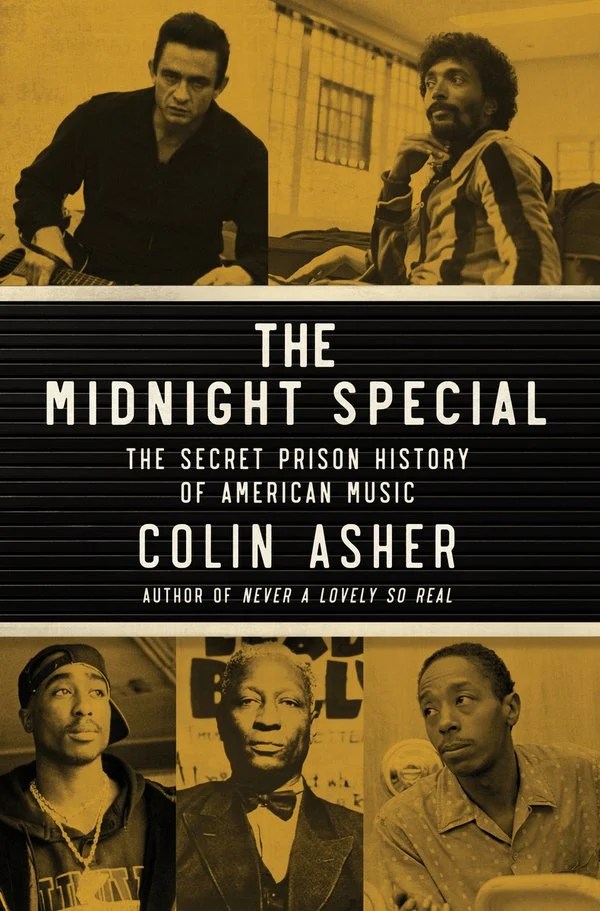
The Midnight Special: The Secret Prison History of American Music (2026) by Colin Asher examines how the police, courts and penitentiaries have shaped the nation’s musical culture through profiles of five artists: Lead Belly, Elmo Hope, Johnny Cash, Ike White and Tupac Shakur. Asher’s work is as unconventional as it is unexpected. In a thoughtful New York Times review, critic Dwight Garner writes that Asher’s “fog-piercing down-bound train of a book,” is “better than it had to be.” That last description comes from the depths Asher explores in each of the profiles. Had they been simply recitations of the facts of each artist’s involvement with the criminal justice system, it still would have been a useful book. But Garner explains the special appeal of this story.
“If these profiles had been straightforward, that might’ve been enough. But Asher is a calm and sophisticated storyteller who picks you up and sets you back down in places you didn’t anticipate. Like a good film director, he knows how to stagger his material. Minor characters rise, become major ones, then fall back.”
The author isn’t trying to write a definitive history of American prison music but instead focuses on five albums and the lives of the musicians who made them. Asher asserts that each has something distinct to say about the ways that policing and incarceration have shaped our musical culture. This book also tells the story of a criminal justice system “that has grown exponentially in size and cultural impact over the last century.” An uncharitable view could be that it is a criminal justice system run amok.
“But it’s also a revisionist history [writes Asher] that asks readers to reflect on the fact that genius exists within society, not in isolation—to recognize that their favorite folk song, or blues, may exist only because people sang it to one another on Southern prison farms decades ago; that the hands laying down a piano solo on a majestic bebop track were, likely, once bound by cuffs; that the singers strutting about on our grandest stages may only be enjoying success because someone in a uniform once gave them a pass; and that the forbidding prison walls rising beside our highways and within our cities are entrapping people who gather, when they can, to perform with as much talent, love, and passion as any group on the outside.”
We see the strength of Asher’s storytelling abilities right away with his in-depth study of the blues legend Huddie “Lead Belly” Ledbetter‘s life and album “The Midnight Special” and Other Southern Prison Songs. Ledbetter’s arrests, incarcerations, and escapes over gun charges defined almost two decades of his life and the way his music has been viewed for almost a century.
Criminality became shorthand for Black authenticity in part because of the work of musicologist John Lomax, “who first recorded Ledbetter, shaped his ‘primitive’ image and made him perform in prison garb.” Lomax also reflected the widespread racism of his day and often treated Ledbetter shabbily. As Garner notes, the elder Lomax “employed the musician as his valet, took an outsize chunk of his earnings and confiscated his tips. He was controlling. He wouldn’t allow Ledbetter to sing the songs he longed to sing, ones that had no connection to prison.” It was only after Alan Lomax took over the work of his father that Ledbetter received some measure of respect and broader appreciation.
The life and career of bebop pioneer Elmo Hope (1923-67) was a revelation to me. It was also, as Garner writes, heartbreaking. No less a talent than Thelonious Monk called Hope “the greatest pianist on the planet.” Hope had spent his formative years woodshedding with Monk and Earl “Bud” Powell—two of jazz’s finest musicians.
Hope was a prodigy and had been training as a pianist since he was seven. Thanks to his mother his head was full of Bach and Chopin, but as a teenager his soul was lifted by new ideas about jazz. Over the course of a decade Elmo and Powell were part of jam sessions and performances that involved some of the greats of the jazz world—Charlie Christian, Dizzy Gillespie, Coleman Hawkins, Max Roach, Kenny Clarke, Charlie Parker, Miles Davis, and Monk—and that reshaped our understanding of the music.
But Hope was shot by police in Harlem, part of a long pattern of law enforcement violence against Blacks in the city, and although he was released after the police could not get their story straight his troubles with the criminal justice system were just beginning. Garner explains:
“Hope was put away on Rikers Island after a string of arrests stemming from his heroin habit. He was allowed to join the jail’s band, a virtual who’s who of New York jazz greats, and played alongside Sonny Rollins, who was sent to Rikers after a foiled robbery. This book lingers on how Hope and so many other musicians, including Billie Holiday and Charlie Parker, were denied cabaret licenses because of their convictions, deforming their careers by rendering them unable to perform in New York City clubs that served alcohol.”
Asher ends this chapter with a review of Hope’s classic 1963 album Sounds From Rikers Island.
Johnny Cash is the third profile in Asher’s book and the only white man among the subjects. Cash was treated differently by the criminal justice system and was perceived more sympathetically by audiences than was the case with the four Black musicians. Although he had numerous run-ins with the law, he spent only one night in jail.
“The outlaw has a venerable place in country and folk music [notes Asher]. He—and it’s almost always he—is a free spirit. A moonshiner, a gambler, a bank robber, or maybe a jilted lover. He shoots people and hurts women, but he isn’t the sort of subhuman the press made Huddie Ledbetter out to be. The country outlaw is white, so his violent urges read as an expression of his prideful masculinity, not wickedness or debasement.”
Asher speaks of Cash’s work on prison reform, especially early in his career, and how he recognized the humanity of all incarcerated individuals. He considers what Black artists might have achieved if granted the level of compassion and forgiveness Cash received. “The obverse is worth considering, too—the great cultural loss the world would have suffered if Johnny had been treated the way his Black peers were.”
Some of Cash’s most successful records were recorded in prisons, including the iconic At San Quentin (1969).
Ike White (1945-2014) was another revelation for me. A soul and funk prodigy, White was sent to prison at 19 for the killing of a convenience store owner during a botched holdup. A warden at San Quinton encouraged White and other musicians to turn to their creative sides to help get through their periods of incarceration. As Garner notes in his Times review:
“White was discovered after he backed Eric Burdon, then with the band War, and the soul shouter Jimmy Witherspoon, during their appearance at San Quentin. White’s guitar work on the blues standard “Goin’ Down Slow” was so psychedelic and soulful that Burdon and Witherspoon, who recorded the show, included the live version on their 1971 album “Guilty!” (That album has been rereleased as “Black and White Blues.”)”
White recorded his own album in San Quentin, Changing Times. No less than Stevie Wonder wrote the album notes. But by the time White was able to release it, the psychedelic sound seemed dated and it received few reviews and fewer sales.
I knew the name and a bit of the music of rapper Tupac Shakur (1971-96), but Asher’s profile greatly expanded my horizons and appreciation for his journey. The story begins with his mother, Afeni Shakur, a political activist and Black Panther who spent two years in prison before her acquittal as part of the Panther 21. While locked up, she was pregnant with Tupac.
Afeni was a brilliant woman, someone who became a paralegal on the basis of her self-defense in the Panther 21 trial. She loved Tupac but feared that the state would come after him as they had her. Her attention to her child could be sporadic, but his education was unique. His musical tastes were idiosyncratic, ranging from folk records to Don McLean’s “Vincent” to the musical Les Misérables. When Tupac acted up, Afeni made him read that day’s New York Times aloud from the first word to the last.
Asher questions how much of Tupac’s “Thug life” persona was real. As Garner explains in his review:
“Asher links the themes in Shakur’s songs to those in Lead Belly’s and notes that, unlike Lead Belly’s characters, Shakur’s fought back.
Here, too, Asher cites the perceived connection between criminality and authentic Black expression. He suggests that Shakur, who served time for a sexual-assault conviction, wanted to escape his gangsta-rap image before Suge Knight, the head of Death Row Records, forced him back into it.”
A man who could transcribe Robert Frost’s “Nothing Gold Can Stay” from memory and record the song Dear Mama doesn’t easily fit into stereotypes. While in a car with Knight following a prize fight in Las Vegas, Shakur was killed by gunfire from a passing automobile. He was twenty-five years old.
Tupac once said, “I was cultivated in prison, my embryo was in prison.” That statement of fact is an appropriate endpoint—and perhaps a reminder that we can all do better—for this groundbreaking work.
More to come . . .
DJB
Photo of Alcatraz prison by Emiliano Bar on Unsplash

