All posts tagged: Bluegrass Music

A conversation with Fleck (not Flatt) and Scruggs

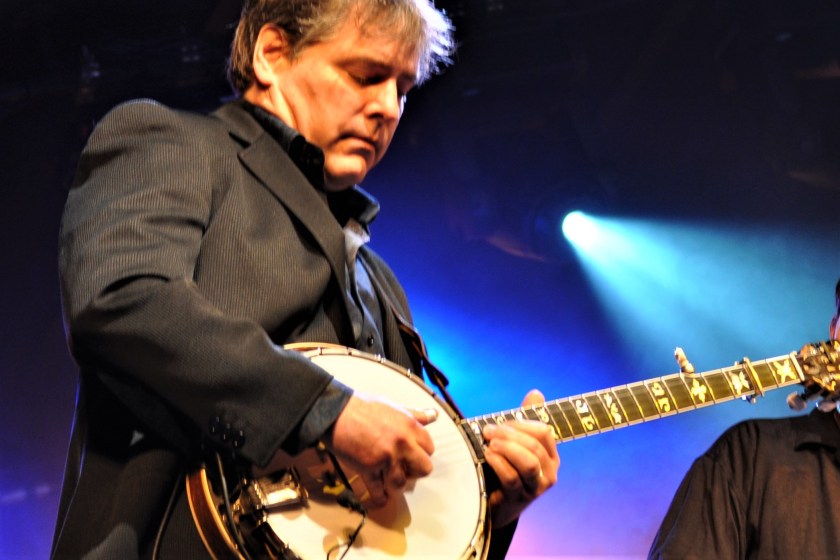
Thanks to the wonderful Bluegrass Blog for highlighting a recent online interview between banjo masters Earl Scruggs and Bela Fleck.  Scruggs (photo below) was the inventor of the three-fingered picking style that is integral to the bluegrass sound, and Fleck (photo top) is the banjo innovator who has won 11 Grammy awards and – with his 27 nominations – has the distinction of being nominated in more Grammy categories than any other musician. The interview took place on BMI.com and covers — in just a few short questions — a variety of topics.  Here’s an exchange on their first meeting: BF: Do you remember when John Hartford introduced us by any chance? I’m not expecting you to, but you came over to his place, and he invited me over…I played rhythm guitar, and then at the very end of the session, John said, “Oh, Béla plays a little bit of banjo,” and you said, “Oh, well get it out,” and then I played something for you. I remember, because I thought it was so sweet of …

On the trail of Uncle Dave Macon

Andrew, Claire, and I spent much of today in Readyville, Tennessee, with my brother Joe, sister-in-law Kerry, and their family (more on our visit in a later post).  Joe is an ornamental blacksmith and fellow lover of bluegrass and old-time music.  So it seemed fitting – after a day of playing Old Joe Clark and other tunes with Joe and his son Joseph – that I take Andrew & Claire on an educational trip by hallowed ground:  the burial place of Uncle Dave Macon. Affectionately known as the “Dixie Dew Drop,” Uncle Dave was a vaudeville performer and one of the first stars of the Grand Ole Opry.  He came out of a 19th century performing sensibility, but also was one of the first country musicians to take advantage of the new technology of radio. After his death in 1952, Macon was buried between Murfreesboro and Readyville in the Coleman Cemetery.  A new road to Cannon County now bypasses the cemetery, but I turned off the four lane and went over to the Old Woodbury …

Aereo-Plain

Taking the Steam Powered Aereo Plane to that desert island

The last album in my review of top five albums to take to a desert island may be my all-time favorite.  I’ve long loved John Hartford’s quirky, hippy-bluegrass Aereo-Plain album.   So it was only fitting that last night, as I was returning from a dinner in Nashville with a long-time friend, I turned on Del McCoury’s Hand Picked show on XM Radio’s Bluegrass Junction and what was coming out of the speakers but Steam Powered Aereo Plane.  Damn, Del has great taste in music!  I was reminded all over again of why this album is on my list. What do I love about this album?  Let’s start with the cover. My mother hated this cover when I was a teenager and my wife hates it still.  I loved it so much that I had the father of a high-school friend who was a commercial artist do a charcoal drawing of Hartford with his shaggy beard and aviator glasses.  (My friend Judy’s father had a side business of doing spot-on drawings of photographs from 1970s record albums.)  …

Five albums for a desert island: The Circle Album

I still remember coming home sometime in 1972 — I was a junior or senior in high school — and putting Will the Circle be Unbroken on my stereo. I had started focusing on acoustic music (such as James Taylor) a year or two before, but I was soon exploring more of the roots of folk, which led me to the record bin on that fateful day when I found this record with the funny looking cover by the Nitty Gritty Dirt Band — a country-rock ensemble I had recently seen in concert. There was a little patter to start the record, which was unusual in and of itself in that era of over-produced rock albums, with Jimmy Martin commenting on John McEuen’s banjo kick-off by saying, “Earl never did do that….”  But then Martin, the Dirt Band, and their musical guests were off with a rollicking version of The Grand Ole Opry Song. Decades before O Brother Where Art Thou?, there was Will the Circle Be Unbroken when some long-haired hippies and rockers took country, bluegrass, and mountain …

Five albums for a desert island

Facebook is full of lists – 25 Random Things About Me just being the best known of a recent flurry.  When I was on Facebook tonight, I saw a friend’s posting of Five Favorite Albums and thought, “Now that’s a list I could enjoy compiling. It took me less than 3 minutes to come up with five albums that I’d want on my iPod if I were stuck on a desert island.  But the Facebook application doesn’t let you say much about the choices.  So I’ll turn to More to Come… and over the next few nights will tell you about: The David Grisman Quintet Will the Circle Be Unbroken Time Out Sgt. Peppers Aereo-Plain The David Grisman Quintet’s self-titled debut album blew me away the first time I put needle to vinyl back in the mid-70s and I still love to listen to the amazing musicianship of Grisman, Tony Rice, Darol Anger, Todd Phillips, and Bill Amatneek.  The cover of the album (see above) told you this record was all about the instruments and their players.  …

Clarence and Roland White featured in spring Fretboard Journal

My favorite magazine showed up in the mail earlier this week, and I was delighted to see a cover story on flatpicking pioneer – and former Byrd – Clarence White.  The Fretboard Journal is coffee table quality but with writers who have musical smarts.  The Spring 2009 cover article on Clarence White and his mandolin-playing brother Roland is a terrific example.  There are great pictures of White’s Telecaster and superb writing about the unique syncopation that Clarence employed.  (You can hear it in the video below.)  White was one of the most influential guitarists of all time (#41 on the Rolling Stone list of 100 Greatest Guitarists) and The Fretboard Journal connects all the dots of his impact. Clarence White is that unique musician who had influence in multiple musical genres.  As a teenager he introduced the guitar as a lead instrument in bluegrass.  Then he moved to the Byrds where he played a key role in defining the sound of country-rock.  And much too soon – at age 29 – he was hit by a drunk …

Missy Raines Brings New Hip to IMT

My colleague John and I were among a small but appreciative audience to hear Missy Raines and The New Hip at the weekly Monday night concert of the Institute of Musical Traditions.   The band features Raines’ energetic bass lines as the foundation for jazzgrass and acoustic music, capped with some terrific solo work by a group of young Nashville-based musicians. Instrumentals are the core of this band’s work, and they played most of the selections from Inside Out, their new CD on Alison Brown’s Compass Records.  The title track, Duke of Paducah, and a reworked Angeline the Baker entitled simply Angeline are among the highlights.   All the musicians were top notch, but Michael Witcher on dobro stood out throughout the evening.  Multi-instrumentalist Ethan Ballinger looks to be all of 16, but played beyond his years.  The band also broke in a new guitarist (on his second gig and so new he’s not listed on the web site) who carefully studied the chord charts but didn’t miss a beat.  At the end of a satisfying night …

Watching the Grammy’s

Andrew and I have been watching the Grammy Awards show together…a little father/son bonding.  He’s helping me understand the genius of Radiohead and I’m helping him understand why Paul McCartney was such a seminal bassist in pop/rock music.  Seems like a fair trade to me. Of course, the categories I care about never get face time in prime time.  Wouldn’t you have loved to see Dr. John sing from his Grammy award winning City That Care Forgot album?  I know that they had to bring out Lil Wayne for the masses as part of their New Orleans tribute, and it was good to see Allen Toussaint, so I’ll take what I can.  Thank God some people still care about New Orleans.  In the Bluegrass category, Ricky Skaggs won for the terrific Honoring the Fathers of Bluegrass, while banjo player Bela Fleck won best pop instrumental album.  (Isn’t this the category that would have included Walk Don’t Run and other pop instrumental classics?  That’ll teach all those folks who make banjo jokes!) In the folk category, …

Live at McCabe’s

I am in Santa Monica, California, for a set of meetings.  For most people, when they think of Santa Monica they think of the beautiful beach and the restored Santa Monica Pier, with its historic carousel and the great Ferris wheel that lights up the night sky.  Those things are all pretty wonderful, but when flatpickers come to Santa Monica they think of Live at McCabe’s. Back in the 1970s, Norman Blake was making his first west coast appearance and he recorded an album at McCabe’s Guitar Shop, which is located on Pico Boulevard here in Santa Monica.  It is a wonderful album for several reasons, but most of all because it showcases Blake’s incredible guitar flatpicking skills.  For those who’ve only heard Blake on O Brother Where Art Thou or on his later albums, there’s always a wonder – as others have noted – at how Blake came to be mentioned among the first guitar greats in the same breath with Doc Watson, Dan Crary, and Clarence White.  When you listen to Live at …

O’Connor, Fleck to Play Inauguration Event

Thanks to the Bluegrass Blog for passing along the news that Mark O’Connor and Bela Fleck will be playing next Monday at the Kennedy Center’s Eisenhower’s Theatre as part of the Let Freedom Swing concert.  The evening’s program of jazz music is in honor of the life of Dr. Martin Luther King, Jr. and in anticipation of the inauguration the next day of President-elect Barack Obama.  While O’Connor and Fleck made their name in bluegrass, they routinely cross musical genres and have the musical chops to join host Wynton Marsalis. While tickets are by invitation only, the event is to be televised, so be on the lookout for this mix of terrific musicians. More to come… DJB