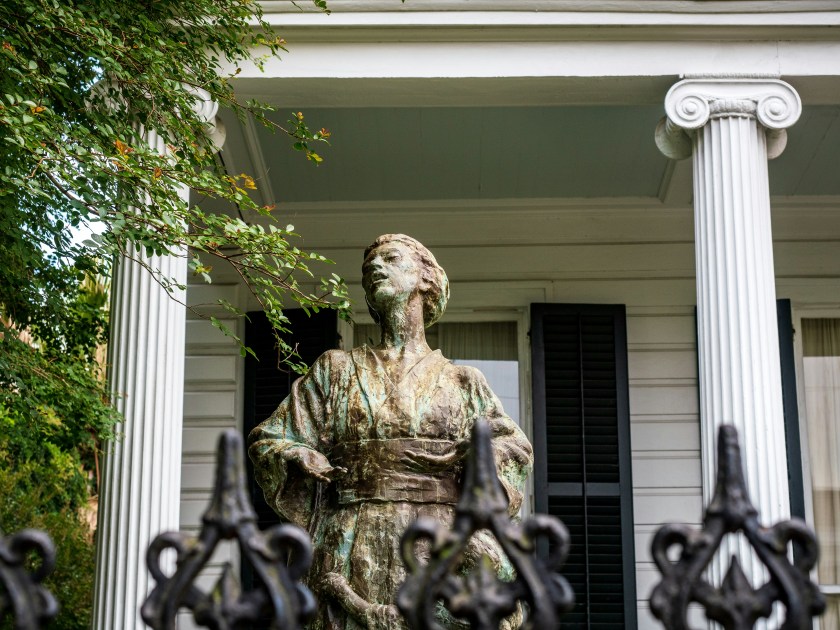
Nancy Lemann’s debut novel from 1985 is, to quote Walker Percy, “hilarious, haunting, poignant.” I laughed ’til I cried.
Installment #21 in my series on the region’s independent bookshops.
My long-time friend, former colleague, and Brilliant Reader Tom was introducing me to Solid State Books, his favorite DC-area bookstore. As we were perusing the staff recommendations we both saw the following:
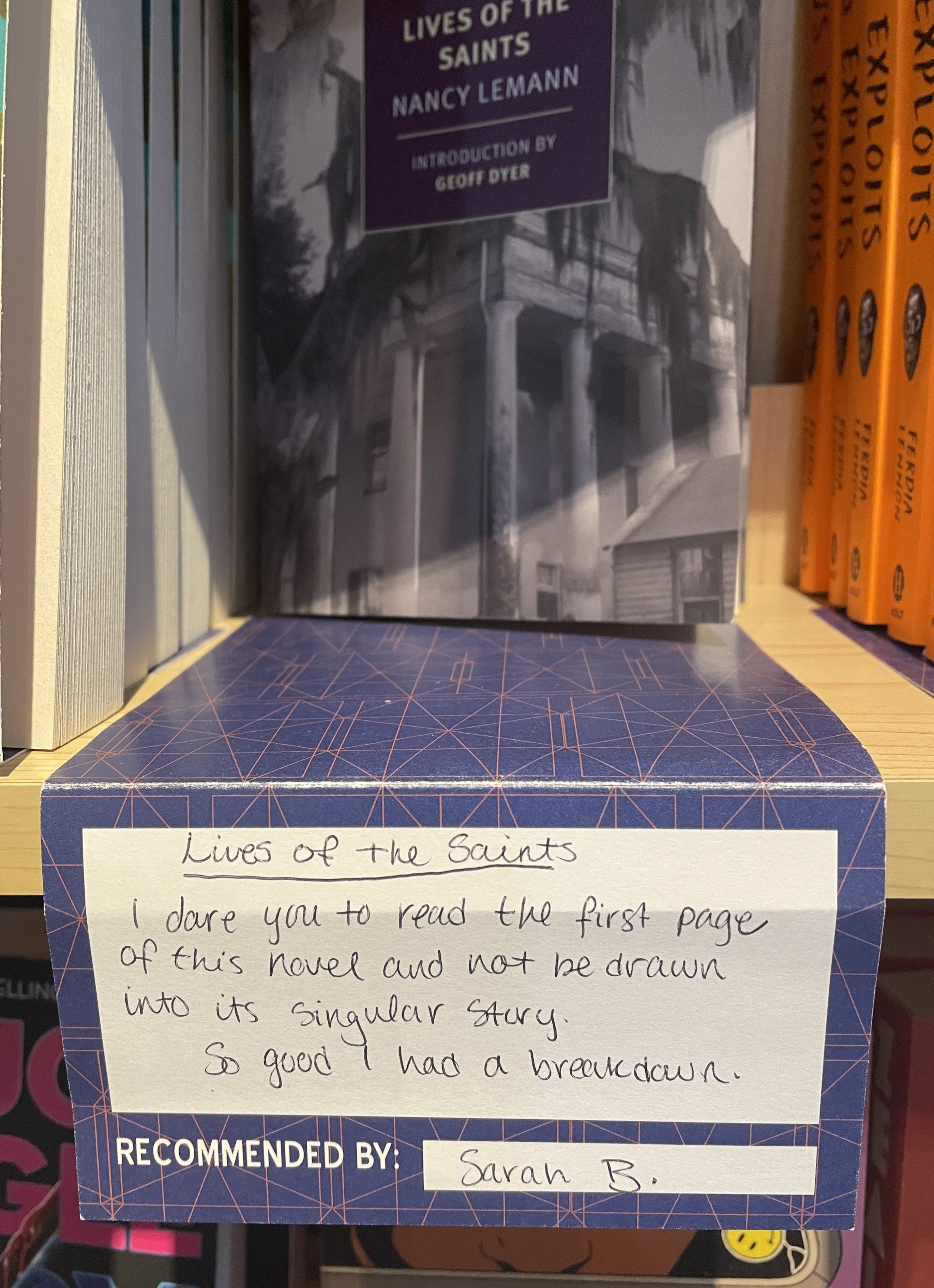
“Lives of the Saints: I dare you to read the first page of this novel and not be drawn into its singular story. So good I had a breakdown.”
Sarah B.
We both immediately hooted out loud (you have to know Tom to understand how easily that sound came out of our mouths). Turning to the nearby staff member, we could only point at the small sign because it was so uniquely absurd. It turns out we were talking with the infamous Sarah B. She promised us we’d love the novel. I bought it. And I did.

Solid State (we visited the 14th and S Streets location) is now one of my favorite new finds from this year of visiting the 30 independent bookstores in the DC region. I’ve returned again to spend more time in the shop where a warm, welcoming feeling exudes from the shelves and the staff. A full-service, Black-owned general interest bookstore, Solid State Books has a wide selection of fiction and non-fiction titles, a generous children’s area, great gifts, and more. Tom and I both spoke of the thoughtfulness of the curation. Plus, it is smack in the middle of the wonderful 14th Street neighborhood, with great restaurants, stores, and local icons (Ben’s Chili Bowl, anyone) just a few steps away.
And with killer staff recommendations that grab you by the collar until you have a breakdown, what’s not to love.
Here are the first two paragraphs from that recommended first page:
“All in all, Henry Laines’ wedding was one of the worst events in my experience, tragic in society. Everyone that I have ever known was there, plus a party of out-of-towners whose broad Memphis and Charleston accents shocked me, although we were the same, Americans far from that hub of the universe along the East Coast.
Everyone had breakdowns at this wedding. Including the bridge and groom. Especially the bride and groom. Crowded parties like at the Stewarts’ often can be known to Bring on Breakdowns. Especially if the Stewarts are the hosts.”
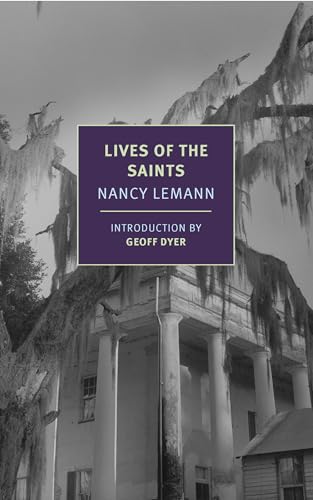
Lives of the Saints (1985; republished in 2026 by the New York Review of Books) by Nancy Lemann is unique in its voice; in its digressions; in its look at life in New Orleans, the deep South, and America. Louise Brown—the narrator who stands in for the author and an “exquisitely rendered basket case”—has just returned from four years in a New England college and finds herself immersed once again in “New Orleans society’s ‘wastrel-youth contingent.'” Her focus is on Claude Collier, a son of one of the city’s old families who is deep into his personal period of wasted youth. His father—a prominent attorney who loves classical Greek, opera, and his son “to a degree approaching beatitude”—simply says that “Claude is not using his abilities.” Yet Louise tells us that he makes the world seem kind. “He had the indiscriminate kindness that is the meaning of generosity. But he was also wild.”
As the story begins at that infamous wedding between Henry Laines and Mary Grace Stewart, Louise fills us in on both members of the wedding party. Laines, who is thirty-five and looks older than his years, was to her “the perfect bachelor.” The bride’s mother and grandmother are “probably recalling the famous pink kid evening bag [the elder Mrs. Stewart] used to carry in 1915.” The bride, notes one of her several former flames at the wedding, is “probably in the bamboo grove having sex.”
“The bamboo grove?
Well, you know, that’s the type of person she is. She’s the type of person who would just go out to the bamboo grove during the middle of a party or during her own wedding and have sex.
She is? What? But—but—why the bamboo grove, though?
It’s racy out there, Louise. It’s sexy. Out in the bamboo grove.
‘God,’ I said, stunned, wishing I were that type of person.”
Mary Grace Stewart “had the spark of divine fire, which you find in a face not quite pretty enough.”
Twenty pages in and readers have met the main characters in this “tale of Violent Love, Breakdowns, Moods, and Felonious Drunkenness that floats from one lush, green, sweltering New Orleans evening to another.” They have also been introduced to Lemann’s writing style: “unabashedly digressive, weirdly and wonderfully confiding, as witty as it is melancholy.” A style with the random, quirky use of Capital Letters when you don’t expect them: “Mrs. Collier’s attitude toward Claude was that he was in a Huge Crisis that could only be resolved by law school.”
As Geoff Dyer writes in a loving and thoughtful introduction to this reissuing of a long lost classic, Lemann is also “the type of writer who is forever introducing a character as ‘the type of person who . . .’ followed by specifics reducing that to a category with a maximum occupancy of one. ‘Earl was the kind of person who, when you were with him in a restaurant, would start drawing his family tree on a napkin.’ That’s a brief example.” Mary Grace Stewart is the type of person “who would just go out to the bamboo grove during the middle of a party or during her own wedding and have sex” is another.
Claude and Louise are the focus of this tale, two people who—as Mrs. Collier describes them—“are always yearning after vague things. You cherish illusions.” For Claude, Louise is his steadying focus; for Louise, Claude is the only man who can cause her heart to “break into a million pieces on the floor.”
There are parties, a death and funeral, and endless days and nights of saxophones. Of gin and tonics. Claude and Louise go to the bamboo grove. They go to the broom closet. Claude decides he must leave and travels to New York City. Louise deteriorates and returns to the Lafayette Hotel to pay her debt to society. A place whose moment of glory had long since faded from the world. Where the decor “was red plush and cobweb.”
“Nuts made life worth living,” Louise asserts in Lives of the Saints. This lovely, nutty book (Walker Percy again) is proof of that maxim.
The insightful Sarah B. had the perfect description: So good you’ll have a breakdown.
More to come . . .
DJB
NOTE: Nancy Lemann is having a renaissance some 40 years after her debut. You’ll hear more from me about Lemann (pronounced like the cocktail garnish) in the coming months, as I have recently purchased the 40th anniversary edition of The Ritz of the Bayou as well as her latest novel, The Oyster Diaries.
Photo by Mary Hammel on Unsplash


Earlier this year The Atlantic had a wonderful profile of Lemann’s work and her renaissance. Here’s a gift link to the article.
Pingback: Observations from . . . September 2026 | MORE TO COME...
Pingback: Books are to be treasured, not banned | MORE TO COME...
Pingback: Of manners and mystery | MORE TO COME...
Pingback: From the bookshelf: September 2026 | MORE TO COME...