
A summary of the January posts from the MORE TO COME newsletter.
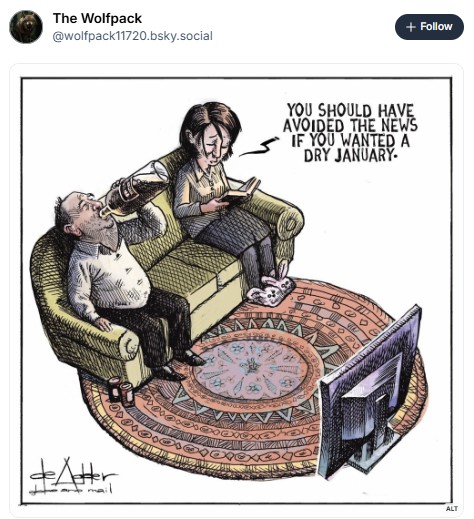
It can appear that the world—or at least our country—has lost its mind. The brilliant Canadian cartoonist Michael de Adder* recently posted a new work that spoke volumes. As a man clearly three-sheets-to-the-wind downs a liter of booze, his wife observes: “You should have avoided the news if you wanted a Dry January.”
The classicist Elizabeth Bobrick loves to tell her readers the old stories and invite them to think about what these classics can tell us today. “Hubris was a legal term in 5th century Athens,” Elizabeth recently wrote on her wonderfully titled Substack This Won’t End Well: On Loving Greek Tragedy. “Crimes of hubris included intimidation, assault and battery, rape, and public humiliation of enemies just for fun. Remind you of anyone?”
Like my friend Elizabeth, I’m a great believer in the power of stories and myth to help us make sense of our world. In January I used the turning of the year, language from a civil rights hero, and stories—including two brilliant works of fiction—to contemplate our path forward as individuals, community, and a nation.
In thinking and writing about what the past has to tell today’s world, I found myself agreeing with the writer John Sarvay, leaning into his assertion that meaning survives at the human scale. In a world increasingly dominated by the voices of social media and AI, we need to find ways to build and protect the smaller narratives, local and human-scaled, that might still hold meaning across political divides. “In rooms you can stand in, voices you can hear, systems you can touch.”
People are good for you. Connecting with other people and learning their stories—instead of listening to a news system dominated by angry voices or imbibing in a bottle of whiskey, no matter how smooth—has always been the way forward.
Let’s jump in and see how those thoughts played out on MORE TO COME this month.
READER FAVORITES

A thoughtful and intimate novel—reviewed in my post The stuff of life—topped the list of reader views on MTC in January. The Correspondent by Virginia Evans packs a subtle yet powerful message: we can grow and change even when change seems impossible. Consisting of letters written and received by Sybil Van Antwerp—a mother, grandmother, wife, divorcee, distinguished lawyer, retiree—it is also a testament to the power of the written word. In capturing one woman’s life—the joys, sorrows, births, deaths, pain experienced, pain hidden, pain finally explored—Evans has produced a vibrant work that envelops and moves the reader.
Another reader favorite was my annual New Year’s Day post: The beginning of awe is wonder. The beginning of wisdom is awe. In that essay I consider eight life learnings that guide me as opposed to a reliance on constantly changing resolutions. The language I used in 2013 in crafting these rules for the road of life tends to focus on actions: walking, eating, spending, committing, laughing, caring. We can’t simply think our way into being the person we are meant to be, we have to act out of our commitments. These guidelines have helped me take steps forward in my quest to be open to love and wonder.
LOOKING AT AMERICA’S STORIES
- A moment like this is my reflection after watching the public swearing-in of New York City Mayor Zohran Mamdani. There have been other moments in our history when the time was ripe for change, when a political base changed sides, when the country faced vital decisions that could become part of Dr. King’s long arc of the moral universe that bends toward justice. Mamdani—in a powerful speech that spoke to our moment—looked back while also looking forward.
- Two of my posts revolved around the Martin Luther King, Jr. holiday. The Times They Are A-Changin’ examines some of the music that was an especially powerful part of the push for civil rights in the 1950s and 60s. America remains a work-in-progress is my reflection about the work before us today. Abraham Lincoln called to the better angels of our nature from one of the darkest periods in our history. Dr. King showed us what that can look like in Selma, Birmingham, Atlanta, and Memphis. The fight for democracy never ends. And our legacy—what we do in this moment—lives on past our time on this earth.
- All good stories ask us to consider past and present. Eden and Birmingham and Minneapolis. Our beliefs are meant to be held up to scrutiny, not covered up with lies as I write in Stories and myths. We should all seek to understand when different perspectives and stories are being used for enlightenment and, conversely, when an alternative narrative is being used to hide the truth.
- Times that try men’s souls reminds us that we can do hard things. The beginnings of the anti-slavery movement were actually “puny.” Female abolitionists sold crafts at fairs to make enough money to bring men like Frederick Douglas to speak at events. “Who the hell thinks they are going to sell pin cushions to bring down a powerful institution?” asks writer and activist Rebecca Solnit. “Except they did.” People think they are only one person. What can they do? Historian Heather Cox Richardson responds: “Make a damn pin cushion.” Those of us who don’t know what to do in the face of tyranny can ask a simple question. What is my pin cushion?
BOOK REVIEWS

In addition to my review of the new novel by Virginia Evans, I also highlighted four other books in this month’s newsletter.
- What binds us together is my take on Clear by Carys Davies, a historical novel that brings a great deal of power, intelligence, and empathy into a few short pages. It was recommended by Brilliant Reader Sara, who says that it is “one of the rare books that I care about keeping in my library no matter how many times I have to cull out for moving or just for extra room.” Amen.
- The first Elizabeth George novel A Great Deliverance was the treasure I uncovered on a recent visit to The Lantern Bookshop, the first stop in my 2026 quest to visit all 25 independent bookshops in the DMV. I write about both in A jewel of a novel.
- The second installment in my independent bookshop pilgrimage—Read when you’re happy, when you’re anxious, and in the moments in between—featured my visit to Takoma Park’s People’s Book and the new work Every Day I Read: 53 Ways to Get Closer to Books.
- Last year we followed the advice of the great travel director Dr. Seuss and took off—with brains in our head and feet in our shoes—to explore great places. And the wonderfully wise children’s classic was a perfect place to kick off this exploration of the “places we saw” in 2025, as I write in Oh, the places we’ve seen!
- From the bookshelf: December 2025 is my regular summary of the book reviews from the previous month.
COMMENTS I LOVED

In response to the post on Zohran Mamdani’s speech as mayor of New York City, Brilliant Reader Jane wrote:
“I can’t imagine the conversations around the dinner table at your house, not to mention breakfast and lunch.
Thank you for this uplifting piece.
I hope we don’t squander this opportunity. The consequences are dire.”
I wrote back that those conversations are probably not as riveting as she might imagine, but sometimes we do get in pretty deep. Dinner table conversations, especially with multiple generations involved, sometimes lead to magic.
DON’T POSTPONE JOY
Thanks, as always, for reading. Your friendship, support and feedback mean more than I can ever express.
As you travel life’s highways be open to love; thirst for wonder; undertake some mindful, transformative walking every day. Recognize the incredible privilege that most of us have and think about how to put that privilege to use for good. Women, people of color, LGBTQ+ individuals, immigrants, public servants, and others can feel especially vulnerable . . . because they are. Work hard for justice and democracy as the fight never ends.
But also keep some room in your heart for the unimaginable. Take time to dawdle and dream. Leave enough empty space to feel and experience life. Those gaps are where the magic begins. When times get rough, let your memories wander back to some wonderful place with remembrances of family and friends. But don’t be too hard on yourself if a few of the facts slip. Just get the poetry right.
Remember that “we are here to keep watch, not to keep.” Pay attention. Be astonished. Tell about it. And bash into some joy along the way.
Life is finite . . . love is not.
Try to be nice. Always be kind.
More to come . . .
DJB
*A winner of the 2020 Herblock award
For the December 2025 summary, click here.
You can subscribe to MORE TO COME by going to the small “Follow” box that is on the right-hand column of the site (on the desktop version) or at the bottom right on your mobile device. It is great to hear from readers, and if you like them feel free to share these posts on your own social media platforms.
Photo of winter by Adam Chang on Unsplash.
 MORE TO COME...
“IF WE CANNOT FIND WORDS, MAY WE FIND THE WILL; IF WE EVER LOSE HOPE, MAY WE NEVER LOSE OUR
HUMANITY.”
Amanda Gorman, 2026 / Shalem
Thanks for these words of wisdom, Bob.
Pingback: Observations from . . . February 2026 | MORE TO COME...