
In the latest installment in my Author Q&A series, I talk with Biblical scholar Amy-Jill (AJ) Levine about her newest book, the value of different interpretations, the lack of female perspectives in Genesis, the importance of asking questions, and more.
Few stories cut across time like those found in the Biblical book of Genesis: Adam and Eve (and the snake!) in the Garden of Eden. The world’s first brotherly argument (and murder) between Cain and Abel. Noah’s ark. Jacob’s dream and the stairway to heaven (Led Zeppelin was correct). These are the stories that generations have been taught to help make sense of creation, God, human nature, the world, and our place in it. Yet because they are so much a part of the cultural air we breathe, they are often remembered at a very rudimentary level. Our interpretations of these stories are too often stuck in our minds from our third-grade Sunday School class (to use my Baptist-to-Episcopalian Christian spiritual tradition as a marker).
A new work released in August offers interpretations of these seminal stories that concern history, literature, and theology. The book invites readers to share their own interpretations and enter conversations that not only go back centuries but also are as fresh as today’s news.
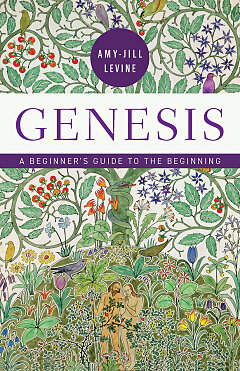
Genesis: A Beginner’s Guide to the Beginning (2026) by Amy-Jill Levine is the tenth in her series of “Beginner’s Guides” that examine Biblical stories, liturgical seasons, miracles, and specific books of the Bible. With her typical deep theological insight, broad cultural knowledge, curiosity about the multiple meanings texts invite, and accessible writing, Levine (known as AJ to friends) leads readers on an exploration of stories we all think we know. She finds herself in conversation with God “from the affirmative ‘love the creation, with everything very good’ to the questions: Why put temptation in the garden? Why not accept Cain’s offering? Why flood the world?” Her conversations lead to more questions, both hers and ours. This short work is easy to digest but its good taste and satisfying feeling linger long after the meal is complete.
A Jewish biblical scholar who is University Professor of New Testament and Jewish Studies Emerita at Vanderbilt University and the Rabbi Stanley M. Kessler Distinguished Professor of New Testament and Jewish Studies at Hartford International University for Religion and Peace, AJ asks us to take the stories in Genesis, and what they tell us about our relationship to God and to our fellow humans, seriously. To do so will guide many readers beyond a childhood level of understanding that long-ago either shut down the brain or depended upon agreement with someone else’s interpretation.
And it is an important time to take these stories seriously. We are in a period of culture wars, authoritarian grabs for power, and attacks on a broad and inclusive interpretation of religion by right-wing agitators and Christian nationalists that use simplistic interpretations and demands for obedience to advance their agenda. At the same time, we face left-wing pressures to make everything conform to particular agendas and so impose interpretations rather than invite conversation. AJ’s appointment in August 2026 as the first Jewish president of the Catholic Biblical Association has brought online antisemitic backlash, a significant portion of which is coordinated—and even monetized—to advance several narratives, including anti-Israel sentiment amid the Israel-Hamas war. OSV News, a Catholic news and information service, recently reported on these attacks.
Christopher Hale has been reporting on similar right-wing backlash against Pope Leo XIV, as happened recently when a new document quoted the Vatican as saying that interfaith dialogue is critical to the Catholic faith. So many on the right, in their attempts to dominate the conversation about religion, have lost the trees for the forest. Love your neighbor as yourself is a summary of the law. But no summary replaces what it summarizes: “The details are commentary; go and learn them.”
In this era of culture wars, hubris, and attacks, I was delighted when AJ agreed to chat with me about her newest work—our third conversation together in my Author Q&A series—and delve into a few of the details of Genesis.
DJB: AJ, in the Introduction you state that “one of the glorious aspects of studying biblical stories is that mutually exclusive interpretations of the same text can both be right.” Some religious traditions (or traditionalists) would disagree. Why is it important to consider different interpretations, and what are some of the key examples from Genesis which are ripe for multiple interpretations?

AJ: I have met numerous Christians who think the only purpose of the Old Testament (to use Christian terminology) is to point to Jesus. This approach misses not only the richness of the text; it also misreads how Jesus himself understands the text and how the New Testament writers use it. When 2 Timothy 3.16 states that “all scripture is inspired by God [lit. ‘God-breathed’] and is useful for teaching, for reproof, for correction, and for training in righteousness,” the term “scripture” means the Old Testament. Indeed, if a scriptural text only means one thing, then we can stop listening to sermons, writing Bible studies, doing personal devotion, because the text has nothing more to say and the Holy Spirit has been put out of business.
Christians may well find Jesus on every page of the Old Testament — there is nothing wrong with this reading. But there is no good reason to limit those pages to a “find Jesus” moment. The text poses questions to us, and the answers will differ depending on the perspectives and experiences, and sometimes religious affiliations, of the readers. Here are just a few questions that have yielded multiple, and sometimes contradictory answers: Is the story of Adam and Eve about original sin or is it about the importance of repentance? Is Eve the hero or the villain? Is God at fault for provoking and for not preventing Abel’s murder? Is Noah a hero, or is “most righteous in his generation” at best a back-handed complement? God decides to test Abraham by commanding him to kill his son — did Abraham pass the test? Is Potiphar’s wife a sympathetic figure? Is Joseph…. ?
In the creation stories, you write about Adam and Eve’s movement from innocence to maturity and even suggest that one interpretation of the existence of both the forbidden fruit and the snake in the garden is that God wants humans to make that move. What insights come from looking at the story of the Garden of Eden not as a “fall” and sinful―exile if you will―but as God’s way of emancipating humans, moving us from the realm of nature to the realm of culture?
Adam and Eve, naked and unashamed, are like toddlers with no sense of modesty. They have no sense of the world, or of their potential for creativity; they do not know what it is like to work for a living, whether it be the struggle to make ends meet or the satisfaction of a job well done. Expelled from the garden, they can begin to fulfill the first commandment: “Be fruitful and multiply and fill the earth.” At the same time, they can better appreciate the love they have for each other. If they stand in front of each other, naked and not ashamed, then they are, for a while, back in Eden.
You note that in so much of Genesis we miss out on the female’s point of view, from Eve to Mrs. Noah to Sarah to Leah and Rachel and more. What questions should those of us who want to explore life and meaning beyond the patriarchal text be asking of these stories?
We can always expand the text, since good stories can beget more stories. We can speculate what Mrs. Noah thought as her husband was building a boat and collecting animals (my friend Sandy Eisenberg Sasso wrote a children’s book about how Mrs. Noah saved all the seeds while Noah was busy collecting the animals). We also might query what the animals were thinking and feeling. Nor do we know what God or the angels were thinking during the days and nights of the flood. More, we can wonder, as did the early rabbis, what Sarah was thinking when Abraham took her precious Isaac away from home, and then when, apparently, Abraham returns without Isaac. Jewish interpretation fills in these gaps by giving voice to the women, but it never says, “these are the only readings.” It invites us to add our own interpretations.
Why is it important to stop and consider the geographical markers mentioned by the narrator in Genesis―places such as Beer-sheba―when we read the text? In a similar vein, what do we miss when Christian writers about the Old Testament refer to those in the stories as “God’s people” as opposed to Hebrews, Israelites, or Jews?
Location names give us a sense of both place — these are stories set in the real world, our world — and they also give us a sense of history: what happened here before may repeat, or rhyme, or contradict. We can build on history, or correct it, or seek to replace it. We can query how place names came about, which names were replaced, or erased. After whom or what was a place named?
A few years ago, I wrote an article on story Bibles containing both Testaments: for most, Christian readers would have no idea of any connection between Hebrews/Israelites/Jews and the stories in the “Old Testament” (to use Christian terminology). Nor would they have any idea that Jesus, Peter, Paul, etc., were also Jews. For these Bibles, the Jews are the ones who kill Jesus and persecute his followers. For children exposed to these Bibles, Jew-hatred starts early, whether by omission (neglecting the connections of the Old Testament to Jews; omitting the connection of Jesus to Jewish identity) or commission (setting up “the Jews” as Jesus’s opponents). For a good children’s Bible, I recommend Elizabeth F. Caldwell and Carol A. Wehrheim (eds.), Growing in God’s Love: A Story Bible.
The people in Genesis have a lot to answer for, from Adam and Eve shirking the blame for what they did all the way to Joseph with his multiple tricks and deceptions. What lessons can we learn today from reading about these very imperfect people?
The Bible is less an answer book (as if it were the ‘magic 8-ball’) and more a book that helps us to ask the right questions. In seeking answers, we realize that our judgments are conditioned by our own experience (people who have committed murder, or friends and family of the victims; people who survive disasters and people who have never been endangered; people who have mystical experiences and people who find mysticism too woo woo; people who have seen their children sacrificed whether in war or at the hands of terrorists or by protesting injustice; people who have been sexually harassed or assaulted, and the people who harass or assault). The stories in Genesis, although ancient, are also our stories. Human imperfection continues, but so do perseverance, resilience, and faith.
Thank you, AJ.
Thank you, again, for taking the time to ask such good questions.
More to come . . .
DJB
For earlier conversations with AJ, see:
- Nativity stories that provoke, encourage, and perhaps even inspire (Nativity)
- The transformational power of stories (Holy Friday)
And for my reviews of other books by AJ:
- The Difficult Words of Jesus: A Beginner’s Guide to His Most Perplexing Teachings
- Short Stories by Jesus: The enigmatic parables of a controversial rabbi
Image by Iris,Helen,silvy from Pixabay


Pingback: Observations from . . . September 2026 | MORE TO COME...