Latest Posts

Singing at Christmas Day Dinner

Merry Christmas 2016

Several years ago we first volunteered to help serve Christmas dinner at our parish.  This is a wonderful tradition that we had just discovered.  Several hundred people – some homeless, some single, some elderly without family nearby, some simply wanting someone else to cook for them – come together for several hours of turkey, stuffing, pies, caroling, and conversation.

That first year, as we were leaving, one of the children said, “Can we make this a regular part of our Christmas Day tradition?”  We’ve been there ever since.

Because Andrew and Claire were born five days before Christmas, we have always waited to jump into the season until after we celebrate their birthdays.  Plus, Candice and I have always wanted to focus on Advent, and then celebrate the 12 Days of Christmas through until Epiphany on January 6th. But this year we’ve actually scaled back some of the past over-the-top holiday celebrations.  Our decorations are simpler. We are content to be together as a family around a dinner table.  (No cell phones, please.)

And just as the twins helped bring the Christmas dinner into our family celebration, they now help us choose one event for each of the 12 Days of Christmas.  This year’s list includes a night of making pasta together.  Two evenings at the theatre. Brunches and dinners with dear friends. Dim sum.  A family hike.  And a belated 24th birthday celebration, since Claire didn’t arrive home until Christmas Eve.

If you celebrate the season, dear readers, I hope you have a wonderful time filled with family and friends you love along with outreach to those who need our love.

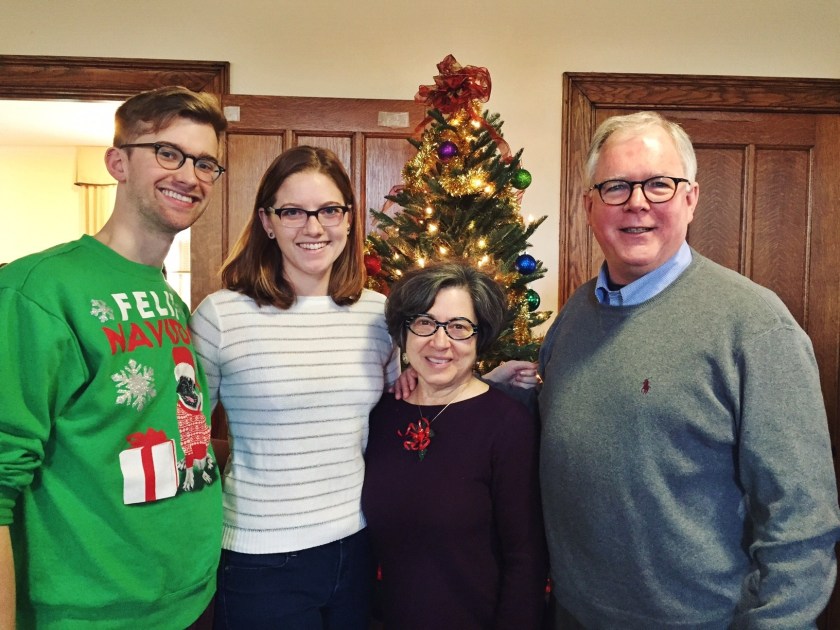
Browns at the Christmas Day Dinner
The Browns at the St. Alban’s Parish Christmas Day Dinner 2016 (photo credit: Suzy Mink)

Merry Christmas!

More to come…

DJB

Image: Singing carols at the St. Alban’s Parish Christmas Day Dinner by Candice Brown

The New Jim Crow

Nothing can be changed until it is faced: The new Jim Crow

Several weeks ago I finished reading a book which won’t leave my mind.  The New Jim Crow:  Mass Incarceration in the Age of Colorblindness by Michelle Alexander is an important and disturbing book which ultimately leads to much soul-searching on the part of the reader. It first came out in 2010 and has been on my bookshelf for a while, but I only picked it up at the tail end of the presidential election campaign.  That was timely.

Alexander – a civil rights lawyer, advocate, and legal scholar – has written a well-researched and devastating work.  In The New Jim Crow, Alexander shows we have not moved into a colorblind society, but have – in fact – simply replaced one racial caste system (Jim Crow) for another (mass incarceration).  The book is thorough in its analysis and gut-wrenching in its conclusions.

Alexander writes in the introduction,

“What has changed since the collapse of Jim Crow has less to do with the basic structure of our society than with the language we use to justify it.  In the era of colorblindness, it is not longer socially permissible to use race, explicitly, as a justification for discrimination, exclusion, and social contempt. So we don’t. Rather than rely on race, we use our criminal justice system to label people of color “criminals” and then engage in all the practices we supposedly left behind…We have not ended racial caste in America; we have merely redesigned it.”

As Cornel West alludes to in the foreword, Alexander’s work harkens back to the work and beliefs of Dr. Martin Luther King, Jr.  King, as quoted by West,

“Called for us to be lovestruck with each other, not colorblind toward each other. To be lovestruck is to care, to have deep compassion, and to be concerned for each and every individual, including the poor and vulnerable.”

In six thoughtful chapters full of stories, statistics, and urgency, Alexander makes a strong case that the huge racial disparity of punishment in America is designed, not merely chance. What passes for “rite of passage” antics in the privileged white community will land young men of color in a criminal justice system that strips away their rights and marginalizes them for the rest of their lives.  No politician or class of citizens is free from Alexander’s gaze.  The “War of Drugs” and mass incarceration began in the 1970s and grew to new heights in Ronald Reagan’s America, but Bill Clinton and Barack Obama – and their justice departments – have doubled down and strengthened this system as a way of being “tough on crime.”  Approximately a half-million people are in prison or jail for a drug offense today, according to Alexander, compared to an estimated 41,100 in 1980 – an increase of 1,100 percent.  Alexander makes the strong case that the War on Drugs is not pointed toward the drug kingpins, but the people of color who posses small amounts and have no history of violence or significant dealing.

And once a person of color (usually young males) enter the prison system, they are labeled, discriminated against, and marginalized for life.  Just look at all the ways one of our political parties in the U.S. is working to block voting rights and understand that felony convictions are one of the easiest ways to keep people of color from voting to have some control over their lives.

For those who would push back and say that criminals should not have rights, I urge you to first read Alexander’s book and reflect upon your own experiences of how people of color are treated differently in the U.S. from whites and those of privilege.

“Today, no less than fifty years ago, a flawed public consensus lies at the core of the prevailing caste system.  When people think about crime, especially drug crime, they do not think about suburban housewives violating laws regulating prescription drugs or white frat boys using ecstasy.  Drug crime in this country is understood to be black and brown, and it is because drug crime is racially defined in the public consciousness that the electorate has not cared much what happens to drug criminals – at least not the way they would have cared if the criminals were understood to be white.  It is this failure to care, really care across color lines, that lies at the core of this system of control and every racial caste system that has existed in the United States or anywhere else in the world.” (Underlined emphasis in the original; bold emphasis mine)

Alexander’s powerful last chapter is inspired by the writing of James Baldwin.  And coincidentally, the Washington Post just featured an article about a new lynching memorial – from the first era of Jim Crow – that includes these powerful lines from an unfinished book by James Baldwin:

“You cannot lynch me and keep me in ghettos without becoming something monstrous yourselves. And, furthermore, you give me a terrifying advantage. You never had to look at me. I had to look at you. I know more about you than you know about me. Not everything that is faced can be changed, but nothing can be changed until it is faced.” (Emphasis mine)

Alexander hits the nail on the head of how we must address the new era of Jim Crow – by treating the problem of mass incarceration as a racial caste system and not as a system of crime control.

“Seeing race is not the problem.  Refusing to care for the people we see is the problem.  The fact that the meaning of race may evolve over time or lose much of its significance is hardly a reason to be struck blind.  We should hope not for a colorblind society but instead for a world in which we can see each other fully, learn from each other, and do what we can to respond to each other with love.  That was King’s dream – a society that is capable of seeing each of us, as we are, with love.  That is a goal worth fighting for.” (Emphasis mine)

Read this very important book, if you haven’t already.  I suspect you will begin – as I have – working through how to address this new system of Jim Crow in your own life.

More to come…
DJB

Image: Cover of The New Jim Crow: Mass Incarceration in the Age of Colorblindness by Michelle Alexander

No WiFi

Be civil, be urban

Each morning on my walk to our offices at the Watergate, I stop off at Filter coffeehouse for a coffee to begin the work day.  What first drew me to this particular coffee shop on I Street, NW between 19th and 20th (as opposed to the 15 others I pass in my 25 minute walk) is the sign on the door.  It reads, simply, “Be Civil, Be Urban.”

I was intrigued.  My interest was really piqued when I stepped inside and found urban planning books and architectural models on the bookshelf, a prominent “Nope, No WiFi” sign, and a quote on the wall from architectural historian Spiro Kostof that reads, “Civilization, in this strict sense, is the art of living in towns.”

Civility
Civility by Stephen L. Carter

Living and working in groups – in towns, cities, and organizations – led us to move toward a civilized society.  But civilization is not guaranteed. How we live and work together is a key to productivity, learning, growth, and happiness.  Civility is — unfortunately — in short supply in much of our national and international discourse today.  The author and social critic Stephen Carter, in his book Civility: Manners, Morals, and the Etiquette of Democracy, blames this on an over-reliance on markets, a forgetfulness of the obligations we owe each other, and a lack of a moral compass in decision-making.  He says,

“…the language of the marketplace, the language of wanting, of winning, of simply taking – the language of self – is supplanting the language of community, of sharing, of fairness, of riding politely alongside our fellow citizens…”

That quote from Carter has stuck with me through the years, and it fits in with the “Be Urban, Be Civil” mantra at the coffee shop. That “Nope, No Wifi” sign states that Filter “is a place for talking, reading, and drinking coffee.”  Patrons are asked to “Please leave your laptops in your bag and take a break.  Say hi to your neighbor.  Emails can wait.”

I find that my daily 3-5 minutes in the shop helps me stop and think about ways I can be civil as I ride alongside my fellow citizens.  I think about it as I walk through the George Washington University campus, and look and speak to the staff and students who are out and about at that hour. On good days, it remains on my mind in the office, in meetings, and as I return home to family. When I’m reminded each morning that to live together well requires civility, I try and carry that mindset as far into the day as I can.

I don’t always succeed, so I’m happy to have a place to get my daily reminder of civility along with my cup of coffee. None of us got to where we are today on our own, and our lives are intertwined and enriched by all those who surround us.  If I forget to recognize that when I see you, please remind me that it may be time for a refill of my cup of civility coffee.  I’ll know exactly what you mean.

Have a great week and a wonderful holiday season.

More to come…

DJB

Relevance

Art of Relevance

The Art of Relevance by Nina Simon

Nina Simon, the Executive Director of the Santa Cruz Museum of Art and History, gave a powerful TrustLive talk at the recent Houston PastForward conference on place and relevance.  She defines relevance as a key that unlocks meaning, opening doors to experiences that matter to us, surprise us, and bring value into our lives.

In her book The Art of Relevance, Nina applies two criteria to all the stories she tells about relevance.  First, how likely new information is to stimulate a positive cognitive effect – to yield new conclusions that matter to you.  Second, how much effort is required to obtain and absorb that new information.  The lower the effort, the higher the relevance.  As those of us who heard her speak know, she frames this work in terms of doors and keys that help different groups access rooms of information.  To understand individuals different from us, we have to go outside our rooms and look – with empathy – at the views of the community outside the door.  We have to learn from other rooms and people outside of our comfort zone.

As we think about relevance in all we do, we need to recognize that it is a process and – Simon asserts – a moving target.

“Your content (or work, or information) can be relevant to different people at different times for different reasons – or not.  Even at institutions that have undergone radical reinvention, change doesn’t stop.  As Will Rogers said, ‘Even if you’re on the right track, you’ll get run over if you just sit there.’”

We can approach the shifting tides of relevance in three ways: by embracing them, fighting them, or equivocating over them.  You can imagine which response Nina Simon suggests.

Have a good week.

More to come…

DJB

You Can’t Stop the Revolution

All Saints

All Saints Church (photo credit: All Saints Church, Pasadena)

Since moving to Pasadena earlier this year, Claire has been attending All Saints Episcopal Church.  Today, she sent us a text that said, “The sermon at All Saints got a standing ovation this morning…It was a feminist re-telling of the character of the Virgin Mary and how the patriarchal church has belittled her from a strong woman of color into a submissive white woman who embodies the impossible ideal of being a virgin mother.”

Well, I certainly wanted to hear that!

Luckily, All Saints posts their sermons on YouTube, and so I just finished listening to Mike Kinman’s sermon – the one Claire referenced – entitled You Can’t Stop the Revolution. 

“Mary was the Mother of the Revolution of Love and the Magnificat is her protest chant – a protest chant the church has spent 2000 years mansplaining in an effort to silence the radical power of her proclamation.”

More than once Kinman says, “God’s revolution of love will be led by fierce, nasty women.”  This is a powerful message.  Give it a listen.

More to come…

DJB

View of Florence

The Well-Tempered City

Jonathan F.P. Rose is a man of many interests and talents.  A developer, Rose builds affordable housing and mixed-income community centers.  He is a jazz aficionado and — as suggested by the title of his newest book — a classical music devotee.  Rose is also an interdisciplinary scholar and writer.  In The Well-Tempered City:  What Modern Science, Ancient Civilizations, and Human Nature Teach Us About the Future of Urban Life, Rose brings those talents and interests together in a wide-ranging and thoughtful look at the past – and future – of the places where 80% of the world’s population will live by 2080.

(Full disclosure:  My employer — the National Trust for Historic Preservation — has recognized Jonathan’s work with a Preservation Honor Award, and I have worked with him through his role as an advisor to a couple of our projects.)

The Well-Tempered City is a book that reflects a lifetime of work and thought about how cities best serve people.  Early in the book, Rose notes that,

“Since the founding of the very first cities, governance and culture have been use to balance ‘me’ and ‘we.’  Governance provides the protection, structure, regulations, roles, and responsibilities necessary to allocate resources and maintain coherence among a large and often diverse population.  Culture provides society with an operating system informed by the collective memory of its most effective strategies, guided by a morality that speaks for the whole.  Healthy cities must have both strong, adaptable governance and a culture of collective responsibility and compassion.”

The Well-Tempered City
The Well-Tempered City by Jonathan F.P. Rose

Balance and systems are a key to Rose’s view of cities.  As a framework, Rose calls upon Johann Sebastian Bach’s The Well-Tempered Clavier, a groundbreaking work that sought to prove a new system of music which — as Rose explains — “demonstrates both the perfection of the whole and the role of the individual within it.”  In urban areas, Rose’s goal  seeks to knit the threads of “technical and social potential and the generative power of nature back together, toward a higher purpose for cities.”

There are five qualities that, in Rose’s view, make up the well-tempered city:  coherence, circularity, resilience, community, and compassion.  He moves through these five qualities in detail, calling on many different disciplines and experiences to weave together his call for cities that balance prosperity with equity and efficiency.

There is much to absorb and like in this work, and I highly recommend it.  There are also a couple of times when I wanted to question the assumptions.  In Rose’s segments on the environment and resilience, he barely mentions reuse of older buildings and promotes — somewhat inadvertently — the “we can build our way to sustainability” argument.  In fact, while he speaks extensively about the need for beauty in our cities, the role of the existing built environment in providing that beauty is rarely raised.  Finally, this work has a strong bias towards New Urbanism, where I take a grain of salt approach to some tenants of New Urbanist thought.

But those are quibbles in what is a fine addition to the bookshelf on the current state and future of urbanism.  Near the end of this work, Rose writes,

“Technology has produced cities that would have been unimaginable in Bach’s time, advancing in waves from the tower of Jericho to the megacities of today. But the essence of humans and nature has not changed.  We still feel a great sense of peace and joy when our minds are bounded by the synchrony of music, beauty, truth, dignity, love, and compassion.  Our cities today contain many of the technical achievements that Frederick the Great would have been so pleased by, but little of the harmony that Bach and the original makers of cities sought.

The purpose of our cities must be to integrate the science sought by the Enlightenment with the harmony of Bach, to compose the conditions of fitness of their people, their neighborhoods, and nature.”

Enjoy a bit of The Well-Tempered Clavier as you contemplate the Well-Tempered City.

More to come…

DJB

Image: Florence, Italy by DJB

Pearl Harbor Day

U.S.S. Arizona in Pearl Harbor on Memorial Day Weekend

U.S.S. Arizona Memorial

A couple of years ago I wrote a post called Why We Memorialize and Remember Sacred Places on the reasoning behind my decision to cite December 7, 1941, as my top candidate deserving of the descriptor “The day the world changed forever.”

I thought it would be a good post to share again – here on Pearl Harbor Day.  Memorials are about memory, which is “an essential part of consciousness” as quoted in my colleague Tom Mayes’ series of essays on Why Do Old Places Matter?

In this day and age, we glorify the individual and forget that it is the collective – the community – that holds us together.  Places such as the U.S.S. Arizona memorial – and I would argue the Waikiki Natatorium War Memorial – are indeed “places where moments in personal history become part of the flow of collective history.”  History that transcends individual experiences and lifetimes. It is important to remember that we are judged not just by what we build, but by what we choose to save and remember from the past.

More to come…

DJB

Duffle bag

The real voyage of discovery

I was in college before I took my first airplane ride – a trip from Nashville to Philadelphia for (no surprise here) the 1976 National Trust Preservation Conference.  It was probably another ten-to-fifteen years after that before I traveled outside the U.S.

Growing up in a large, middle-class family in Tennessee in the 1950s and 1960s, we didn’t just jump on an airplane when we felt the urge. My children find this difficult to comprehend, since they took their first flight at 6 months of age, and by the time they were in college the number of countries they had visited required both hands to count.  When I tell them that my grandparents probably stayed in Tennessee their entire lifetimes, they begin to recognize the dramatic changes that take place from one generation to the next.

I’ve been working to make up for lost time when it comes to travel.  Both personally and professionally, I have the opportunity and privilege to travel to many places both in the U.S. and around the world.  I was thinking about this recently while listening to the writer Pico Iyer talk about travel and change.  Like me, his grandparents “almost had their home in their community and their tribe and their religion handed to them at birth, whereas I felt that I could, in some ways, create my own.”  In describing what to take from the opportunity to see so many wonderful places, Iyer writes,

“…anybody who travels knows that you’re not really doing so in order to move around – you’re traveling in order to be moved.  And really what you’re seeing is not just the Grand Canyon or the Great Wall but some moods or intimations or places inside yourself that you never ordinarily see when you’re sleepwalking through your daily life….there’s this great undiscovered terrain that Henry David Thoreau and Thomas Merton and Emily Dickinson fearlessly investigated, and I want to follow in their footsteps.”

We really do sleepwalk through many phases of our life.  The trick is not to require travel to open up our inner places, but to live more of our lives as we do when we “travel to be moved.”  Or, as Marcel Proust once said, “The real voyage of discovery consists not in seeking new landscapes, but in having new eyes.”

Have a great week.

More to come…

DJB

Macon musical history

Not my average radio interview

Folks in Macon, Georgia, take their musical roots seriously.  (Think Otis Redding, the Allman Brothers, Little Richard.)  So on Friday morning when I was booked for an interview on WNEX, The Creek — a new Macon radio station featuring Southern roots music and local issues — I assumed it would be different from the local NPR stations where I normally find myself talking about preservation.

I was right.  And (with the possible exception of my time on the Honolulu public radio station), it turned out to be much more fun than my average NPR radio interview!

We were in town to launch our National Treasures campaign for the Ocmulgee National Monument.  Lands affiliated with the Ocmulgee National Monument have been home to Native Americans for more than 17,000 years.  However, over recent decades the places with ties to the site have been threatened by urban sprawl, the subdivision of forested tracts, and ownership fragmentation. The National Trust and our partners are seeking to re-designate the monument as a historical park, expand the current boundaries, and study ways to protect related areas in the river corridor.

So I showed up at The Creek’s studio (which looked something like a well-loved fraternity house) on Friday morning with a colleague and the president of the Ocmulgee National Park & Preserve Initiative.  We met Brad Evans, one of the owners, who asked a couple of questions to prep before we went on the air and indicated that they would play a tune halfway through the interview.  It came out that I was a John Prine fan, and Brad said, “What would you like to hear?”  I responded that I thought Paradise was a good cautionary tale for those who don’t take preservation seriously.  So we go into the interview, have a great conversation about why this place matters, and then Brad queues up the song by asking if Paradise was a good tune?  “Absolutely” I replied, and that familiar voice came across the speakers.

“When I was a child my family would travel, down to western Kentucky where my parents were born…”

While the song was playing, Brad asked what else we might discuss when we came back, and I suggested that we spend a bit of time talking about other National Treasure campaigns. I mentioned that I thought listeners to The Creek might enjoy our work on Nashville’s Studio A and Music Row.

Chris Stapleton - Traveller
Chris Stapleton – Traveller

So as John Prine wrapped up singing of Paradise being “five miles away from wherever I am,” we began to talk about the Music Row campaign on the air.  I noted that Studio A was not only the place where hundreds of country music classics had been recorded, but that Chris Stapleton’s Grammy award-winning album Traveller was made there after the studio was saved.  I suggested that had it been recorded anywhere else, this classic country album would have sounded different.  When it comes to recording studios – as with much else in life – place matters.

Brad wrapped up the interview and then told his audience that he had some Chris Stapleton lined up next.  I responded, “Man, you are good!” and he replied “I’m a pro – if you don’t believe me, just ask me.”  We laughed, and then away went Chris Stapleton with “Nobody to Blame.”

Oh man…if I ever get to do a preservation interview again when I can call on John Prine and Chris Stapleton for help, then you’ll know for certain I’ve died and gone to heaven.

More to come…

DJB

Sligo Creek

The importance of roots

As the late fall weather arrives in Washington and the leaves cover the ground, my thoughts have turned to one of the best natural history/science books I’ve read in years.

The Forest Unseen
The Forest Unseen

The Forest Unseen: A Year’s Watch in Nature by David George Haskell is both very modern and very old fashioned in its outlook.  Haskell’s work is a meditation of a year’s worth of observation on a small patch of old growth forest — which he refers to as his mandala — near Sewanee, Tennessee.

Every few days Haskell visits this patch of land and captures his observations.  The chapter for December 3rd is entitled “Litter,” as the forest floor is covered with leaves and other dying plants, similar to what we see along the C&O Canal, Rock Creek, or Sligo Creek here in Washington.  The first half of the chapter is an explanation of the leaves, mushrooms, bugs, seeds, fungal strands, and the unseen microbial community in the soil of his mandala.  But after noting that ecological science has yet to fully digest the discovery of the belowground network – as we still think of the forest as being ruled by relentless competition for light and nutrients – Haskell closes with a series of paragraphs that speak to the importance of cooperative action and roots.

“We need a new metaphor for the forest, one that helps us visualize plants both sharing and competing.  Perhaps the world of human ideas is the closest parallel:  thinkers are engaged in a personal struggle for wisdom, and sometimes fame, but they do so by feeding from a pool of shared resources that they enrich by their own work…Our minds are like trees — they are stunted if grown without the nourishing fungus of culture.”

Haskell speaks to the fact that “evolution’s engine is fired by genetic self-interest, but this manifests itself in cooperative action as well as solo selfishness.”  And he wonders if his new ways of thinking about evolution and ecology are so new after all.

“Perhaps soil scientists are rediscovering and extending what our culture already knows and has embedded into our language.  The more we learn about the life of the soil, the more apt our language’s symbols become:  ‘roots,’ ‘groundedness.’ These words reflect not only a physical connection to place, but reciprocity with the environment, mutual dependence with other members of the community, and the positive effects of roots on the rest of their home.  All these relationships are embedded in a history so deep that individuality has started to dissolve and uprootedness is impossible.”

Haskell’s work over his year in the forest is an attempt to “put down scientific tools and to listen: to come to nature without a hypothesis, without a scheme for data extraction, with a lesson plan to convey answers to students, without machines and probes.”  Listening moves us all past what we know and into the deeper knowledge to be found when we tap into the roots of nature and humanity.

Have a great week.

More to come…

DJB

Image of Sligo Creek Bridge by DJB