Latest Posts

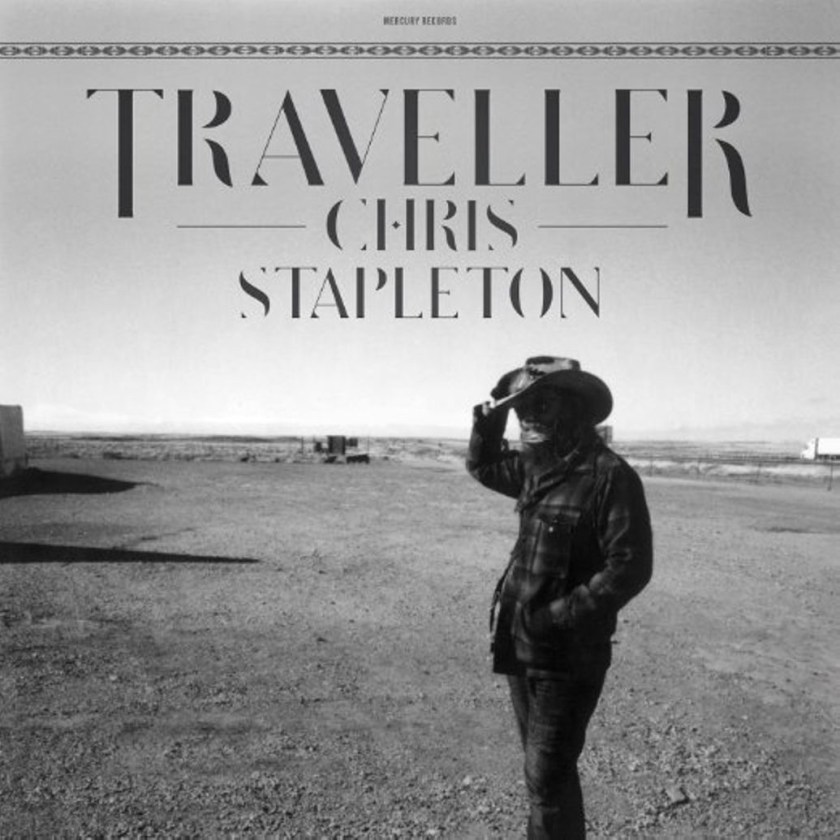
Chris Stapleton - Traveller

Real country

There was one upside of being stuck in traffic – and then stuck in the car wash line – on a February day with 60+ degree weather. The Bluegrass Junction station on Sirius XM radio was featuring a live concert of The Steeldrivers – a band I highlighted in my Favorite Roots Music Albums of 2015 post last December.  (Oh yeah, it was also the winner of the “Best Bluegrass Album” in that other little year-end list – The Grammy’s.)

After playing “If it Hadn’t Been for Love” from their first project (the black album), fiddler Tammy Rogers mentioned that “some singer you might have heard of — named Adele” — had covered that song earlier this decade and featured it in her Live at the Royal Albert Hall DVD.  I knew Andrew would love this.

So I returned home and told Andrew the story.  I mentioned that Chris Stapleton – who wrote and sang on the original SteelDrivers version – just won Country Album of the Year for both the CMA and Grammy’s, which gave me some faith in the ability of the country music industry to recognize real country when it bites them in the behind.

We listened to the Adele version, and laughed ourselves silly, over the introduction.  But hey, Adele is a great vocalist and this is a top-notch cover.

Then I played Andrew a song by Chris Stapleton off of his Traveller album, so he could hear what a great country voice sounds like.  Here’s the tune “Tennessee Whiskey” first made famous by David Allen Coe and especially George Jones.

I was saying something like, “Now that’s real country” when Andrew asked, “Have you heard the mash-up of six bro-country tunes that are all alike?”  No?  Really?  (Yes, I find out I’m the 6 millionth person to view this…but I am a bit slow.)

Anyway, if you want to know what’s wrong with most of what comes out of country radio, listen to this mashup of “Six nearly identical hit country songs” that were “separated at birth.”

Thank God for Chris Stapleton, The Steeldrivers…and Adele!

More to come…

DJB

My Own Personal Spring Training

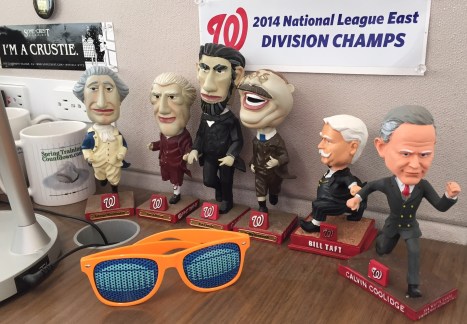
Racing Presidents

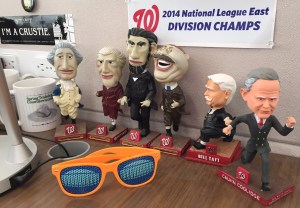
The “Racing Presidents” with a “Spring Training Countdown” mug by their side

As I post this, the clock on Spring Training Countdown (motto:  Winter Bad. Baseball Good.) reads:  4 days, 7 hours, 37 minutes, 7 seconds.  It is clear I don’t have much time to get in shape for the season!

My own personal spring training generally consists of reading a new baseball book and re-watching Bull Durham (best baseball movie ever).  However, our tape/CD player is broken (I know, we’re old school), and so I had to improvise and instead read two baseball books.  It is tough duty, but sometimes you’ve got to do what you’ve got to do to get into shape.

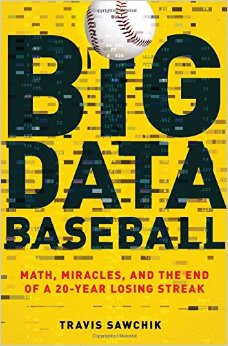
I began with 2015’s Big Data Baseball: Math, Miracles, and the End of a 20-year Losing Streak by Pittsburgh writer Travis Sawchik.

Big Data Baseball

Big Data Baseball

This is a terrific book about how the 2013 Pittsburgh Pirates, stumbling along in a 20-year losing streak (remember Sid Bream and Barry Bonds and Skip Carey’s classic 1992 “They may have to hospitalize Sid Bream” call) turned around their fortune as a baseball club.  The Pirates did it using big-data strategies, undervalued players, a leadership team willing to try new things, and an organization-wide commitment to integration of old-style and new-style insights to make the playoffs.

This book will most often be compared to Moneyball – which is a terrific book and a good baseball movie.  But it is different in a number of ways and well worth the read.

Sawchik happened to take on the Pirates beat for the Pittsburgh Tribune-Review in 2013, and so he doesn’t have the tone of a long-time homer.  He says that he didn’t get the idea for the book until late in the season, so while he was on the beat every day, he went back and had to research the real reasons for the ballclub’s turnaround.  He includes a nice epilogue about the 2014 season, when the Pirates returned to the playoffs.  And while Moneyball focuses on Oakland A’s General Manager Billy Beane, the real story of Big Data Baseball and the turnaround in Pittsburgh is the way that the GM and data analysts were welcomed by old-style manager Clint Hurdle and completely integrated into the overall organization.

PNC Park

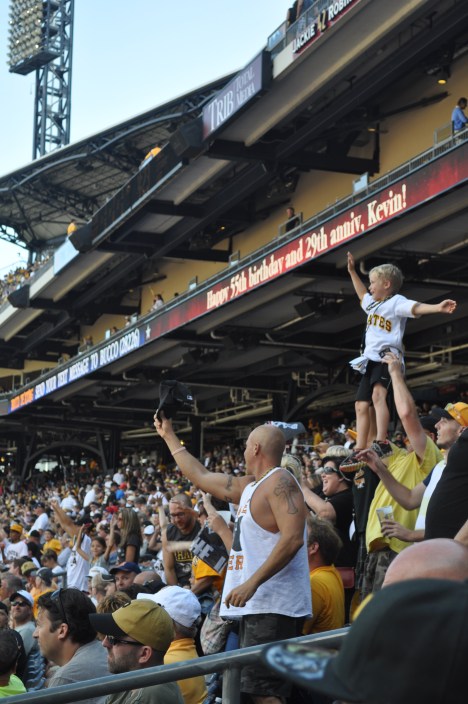
Pirates fans celebrate the turn in their team’s fortunes in 2013

We happened to attend a Pirates game in 2013 in the middle of the pennant race, and it was a magical day of baseball.  Big Data Baseball brought back those memories.

PNC in 2013

Packed PNC Park in 2013

There are so many parts of this book to recognize.  The pressure on Hurdle as the season began.  The ability of the data gurus to turn their analysis into understandable and visual graphics that helped sell their findings to the old-school guys.  Wonderful sections on pitch-framing and the undervalued skill of catcher Russell Martin.  The use of big data to develop secretive preventive medical practices that resulted in the fewest days lost to injuries in 2014.  (Are you paying attention, Washington Nationals?)  But I’ll focus on two.

The “Magic Act” chapter has a great section on the 2013 Wild Card play-in game.  Here’s where Sawchik’s baseball writing skills are clearly evident.

In the bottom of the 2nd inning, Cueto made the first mistake of the game.  He left a pitch out over the plate that late-season acquisition Marlon Byrd belted for a home run.  The crowd noise picked up in ferocity as the ball was swallowed by the crowd and Byrd began his trot around the bases.  A new chant originated at some ground zero somewhere in PNC Park and grew in volume to a tidal wave.  In a taunting, haunting crescendo, forty thousand chanted, “Kwaaaaayyyy-toe…Kwaaaayyyy-toe,” toward the center of the diamond.  Under this avalanche of noise, with the misfortune of having a two-syllable perfect-for-chanting surname, Cueto was thrown a new game ball by the home-plate umpire.  Cueto literally dropped the ball.  Seeing this, the crowd went into a frenzy, believing the dropped ball signaled that they had got inside the head of the Reds starting pitcher.  On the very next pitch, Cueto allowed a fastball to leak out over the plate.  Waiting for it was Martin, who smashed the ball into the left-field bleachers for another homer.  The crowd was euphoric.  Twenty years of pent-up misery was released that night, manifesting itself in a sound that felt like being at the bottom of a waterfall.

In “A Perfect Circle” Sawchik recaps the 2014 season, which again saw the Pirates make the playoffs.  And here, he focuses on a key insight:  the “continued focus on marrying their new-school and old-school personnel….The Pirates always wanted to have an (data) analyst in the clubhouse to counsel, making them the first known major league team to have a quantitative analyst among its traveling party.”

On that celebratory night in Atlanta, as the party wound down and the champagne was exhausted, Pirates second baseman Neil Walker found Mike Fitzgerald standing quietly in the corner of the clubhouse away from the epicenter of the celebration, where the players and coaches were massed.  Walker took a Budweiser from an ice-filled bin and walked toward Fitzgerald, dousing the analyst with beer.  Fitzgerald, the math genius who had never played professionally, and Walker, drafted out of high school and having spent years in the minors before emerging as an everyday major league player, laughed and celebrated together.  The dichotomy between them and yet their acceptance of each other was a snapshot of how far the Pirates had come in creating a culture of respect, a culture that would allow important data to be embraced.

This book will delight baseball fans (of all teams) as well as those looking to understand how important corporate culture, communication, and values are to success.  Highly recommended!

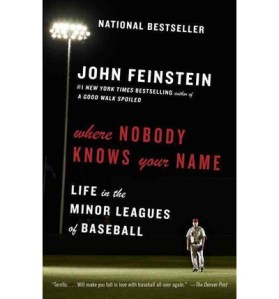
Life in the Minor Leagues

Where Nobody Knows Your Name

The second book – by a better known writer – is interesting,  but to my mind not as appealing to a broad audience.  Where Nobody Knows Your Name:  Life in the Minor Leagues of Baseball by John Feinstein is an account of the 2012 International League season – one of baseball’s two AAA minor leagues.

Feinstein is a good storyteller, and this book is full of good stories.  By focusing on seven players, an umpire, and a manager, Feinstein shows that being at a level just below the majors can have a variety of effects on different people. Some seem to know they are just going to be called up for a cup of coffee in the show, while others have tasted big league glory (Nate McLouth) only to lose it and then find it again.  Feinstein talks about the Durham Bulls of Bull Durham movie fame, and the current team – which was managed in 2012 by Charlie Montoyo playing in a state-of-the-art minor league stadium that didn’t bear any resemblance to the ramshackle yet lovable field of the 1980s.  He also sprinkles in cameos by players on the way up (Bryce Harper) and players on the way down (Mark Prior).

“Skip wants to see you,” can be the best words a AAA minor-leaguer hears, or the worst…depending on whether a player is being called up or released.  This book is full of “Skip wants to see you” moments.

Here’s how the book ends.

“I know I’m going to walk into the clubhouse and there will be a locker with my name on it and a uniform,” Elarton said just before heading south and east once again.  “I’m still a baseball player.  Honestly, I can’t think of anything much better than that.”…Before they take off their uniforms for the final time, they find out a truth that was eloquently captured in the words of longtime pitcher Jim Bouton in the closing words of his seminal book, Ball Four.

“You see,” Bouton wrote, “you spend a good piece of your life gripping a baseball and in the end it turns out that it was the other way around all the time.”

Truer words were never written.

Let’s play ball!

More to come…

DJB


Andrew in 2005

Still singing

(Editor’s Note:  Candice posted the following on her Facebook page earlier today.  I’m putting it here on More to Come… as she wrote it.)

In 2001 at the age of 8, Andrew began singing at the Washington National Cathedral as a novice boy chorister. In 5th grade, he joined the boy choristers and went on to become head chorister in 2007. Pictured here is Andrew in 2005 with Leonard Slatkin of the National Symphony Orchestra when Andrew was the treble soloist for the Chichester Psalms. Those were exciting years.

Today, Andrew sang for the first time as one of the men of the Cathedral Choir of Men and Boys. The second picture shows Andrew this morning as the choir was ready to process into the service. It’s been a great ride, Andrew, and we are excited to see where life, your talent, and your dedication takes you next.

Andrew at the Cathedral
Andrew sings with the Cathedral Choir of Men and Boys earlier today

More to come…

DJB

Image: Andrew with Leonard Slatkin in November 2005 after singing the treble solo in the Chichester Psalms

Walking as an act of citizenship

I love the fact that smart phones now have built-in pedometers. Knowing I can count my steps has encouraged me to find opportunities to walk around the places I live and work each day. In the process I’ve become much more familiar with the Foggy Bottom Historic District (near the Watergate where I work) and Silver Spring (near my home).  In snowy weather, as we’ve seen this weekend on the east coast, walking is sometimes our only reliable means of transportation.

Oxfords
A nice pair of oxfords for walking

Fred Kent, the founder of the Project for Public Spaces, has noted that “If you plan cities for cars and traffic, you get cars and traffic. If you plan for people and places, you get people and places.”

Walking doesn’t have to be for any great purpose.  The BBC News Magazine had a recent article that highlighted the “just to walk” stroll – titled appropriately The Slow Death of Purposeless Walking.

“But the same study found that a mere 17% of trips were “just to walk”. And that included dog-walking.

It is that ‘just to walk’ category that is so beloved of creative thinkers.

‘There is something about the pace of walking and the pace of thinking that goes together. Walking requires a certain amount of attention but it leaves great parts of the time open to thinking. I do believe once you get the blood flowing through the brain it does start working more creatively,’ says Geoff Nicholson, author of The Lost Art of Walking.

‘Your senses are sharpened. As a writer, I also use it as a form of problem solving. I’m far more likely to find a solution by going for a walk than sitting at my desk and ‘thinking’.”

A few years ago I read a wonderful book by Rebecca Solnit entitled Wanderlust: A History of Walking. In it, Solnit wrote:

“Walking is only the beginning of citizenship, but through it the citizen knows his or her city and fellow citizens and truly inhabits the city rather than a small privatized part thereof. Walking the streets is what links up reading the map with living one’s life, the personal microcosm with the public macrocosm; it makes sense of the maze all around….Walking maintains the publicness and viability of public space.”

Wherever you are going, enjoy your stroll today.

More to come…

DJB

Image by Free-Photos from Pixabay

Observations from the Road: The “There are Worse Places to Spend a Blizzard (Day 2)” Edition

Central Park

Central Park after the Blizzard of 2016

After 27 inches of snow fell in Central Park over Friday evening and Saturday, Sunday dawned bright, clear…and cold!  So after being fortified by breakfast, I decided to wander out to see how New York City was faring as a follow-up to yesterday’s There are Worse Places to Spend a Blizzard. 

First, a check of 5th Avenue at 54th Street.  When I was at that intersection last evening, it looked like this:

5th Avenue in NYC during the blizzard 01 23 16

5th Avenue at 54th Street shortly after 8 p.m. on Saturday, January 23rd

While the hustle and bustle in the roadways hasn’t picked up, there are many more people out walking through this part of the city by mid-day on Sunday.

5th Avenue

5th Avenue at 54th Street after the blizzard on Sunday morning

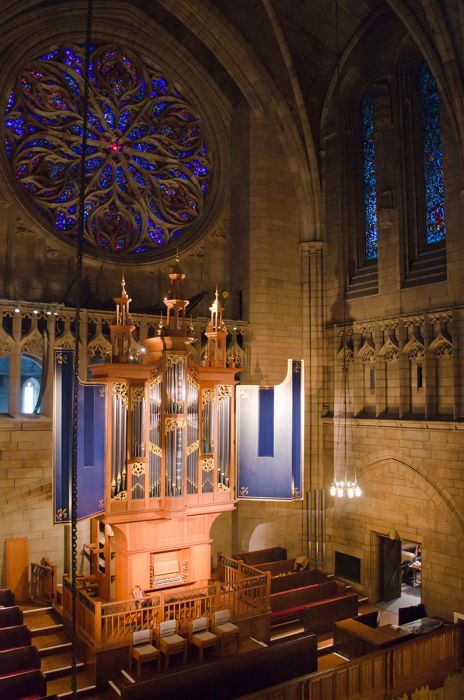
It was great to be out with the “crowds” (using that term loosely).  I saw dog walkers…and (small) dogs wearing booties.  I saw people gawking at the Trump Tower.  I saw men (mostly) doing the hard work of shoveling snow (with the main culprit in bad sidewalk maintenance being the luxury store Bergdorf Goodman.) I stopped by and saw the handiwork of old friends George Taylor and John Boody – Opus 27 – built by Taylor and Boody Organbuilders in Staunton, Virginia, for St. Thomas 5th Avenue in 1996.

Opus 27 Taylor & Boody Organbuilders

Taylor and Boody Organbuilders Opus 27 at St. Thomas Episcopal Church, 5th Avenue (photo credit: Taylor & Boody Organbuilders)

I also worked my way up to Central Park to see those 27 inches.  New Yorkers – being New Yorkers – were out in force.  The bicycle tours were doing a brisk business. Snow angels were being made. Selfies were the preferred photo of the day. And there was an outbreak of manners, as people waited turns to walk through small breaks in the snow and help older walkers navigate icy patches.  It was a great day to be out.

Plaza Hotel

The Plaza Hotel on Central Park South

Central Park looking east

Central Park looking east

Central Park looking west

Central Park looking west

Tomorrow I’ll have to navigate getting back to Washington.  Today, it is time to enjoy the snow.

More to come…

DJB

Observations from the Road: The “There are Worse Places to Spend a Blizzard” Edition

5th Avenue in NYC during the blizzard 01 23 16

5th Avenue at 54th Street in New York City at 8:30 on a Saturday evening

I came to New York City this weekend knowing full well that some of the meetings I had scheduled could be changed or cancelled due to the snow.  But the predictions were off significantly, and the blizzard that blanketed Washington came right up the eastern seaboard to New York.

However, our team made the best of it, and we were fortunate to have two of our members here from New Orleans.  So they just did what they always do in the face of natural disasters, and we ended up having a great “hurricane party” in their apartment about a block from our hotel.

What a wonderful way to spend a blizzard in New York City.

More to come…

DJB


The world, explained in ten maps

I’ve been sick much of the past week, with rest the best prescription.  As I’ve rested, I’ve read.  And read.  And read some more.

I should get sick more often.

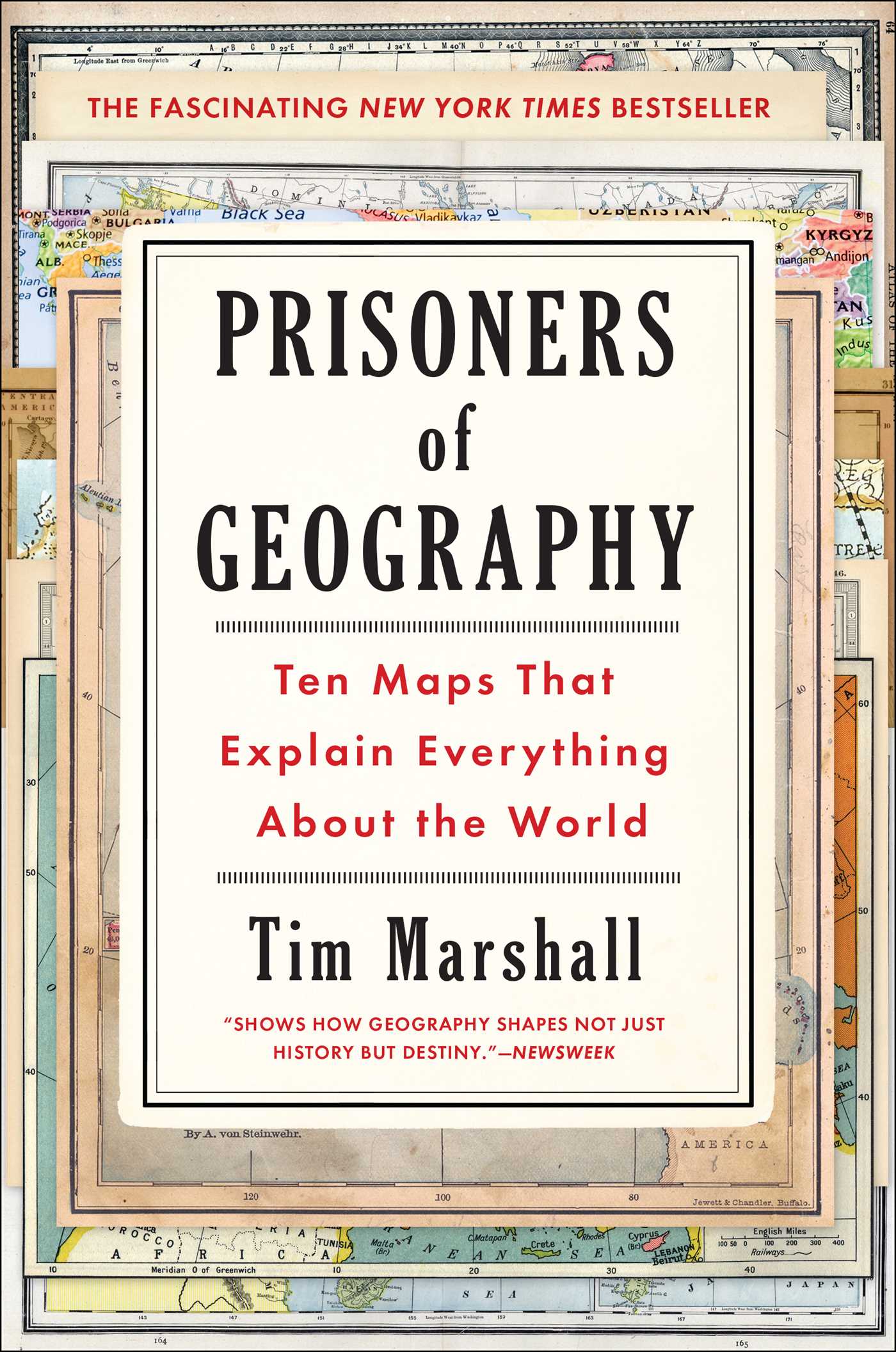
Prisoners of Geography by Tim Marshall

Prisoners of Geography: Ten Maps that Explain Everything About the World is a book I bought for my father for Christmas.  But in leafing through it at Politics & Prose, it piqued my interest, so I picked up a second copy for myself.  I’m glad I did.

Author Tim Marshall is a long-time British foreign affairs journalist.  In this easy-to-read yet thought-provoking book, Marshall writes “The landscape imprisons their leaders (of all nations, big and small), giving them fewer choices and less room to maneuver than you might think.”

This is a geopolitical book, which looks at the ways in which international affairs can be understood through geographical factors.  For my friends in the Foreign Service or at the World Bank, this is no doubt old hat.  But I don’t read much in either geopolitical theory or international affairs, and so I found this a useful introduction to the field.

Marshall’s chapters look at ten different regions.  Each examines the geopolitics of the past (how the nations were formed), current issues, and potential future conflicts.  It is a fascinating book – part travelogue, part history, part current events (up to mid-summer of 2015), and all engaging.

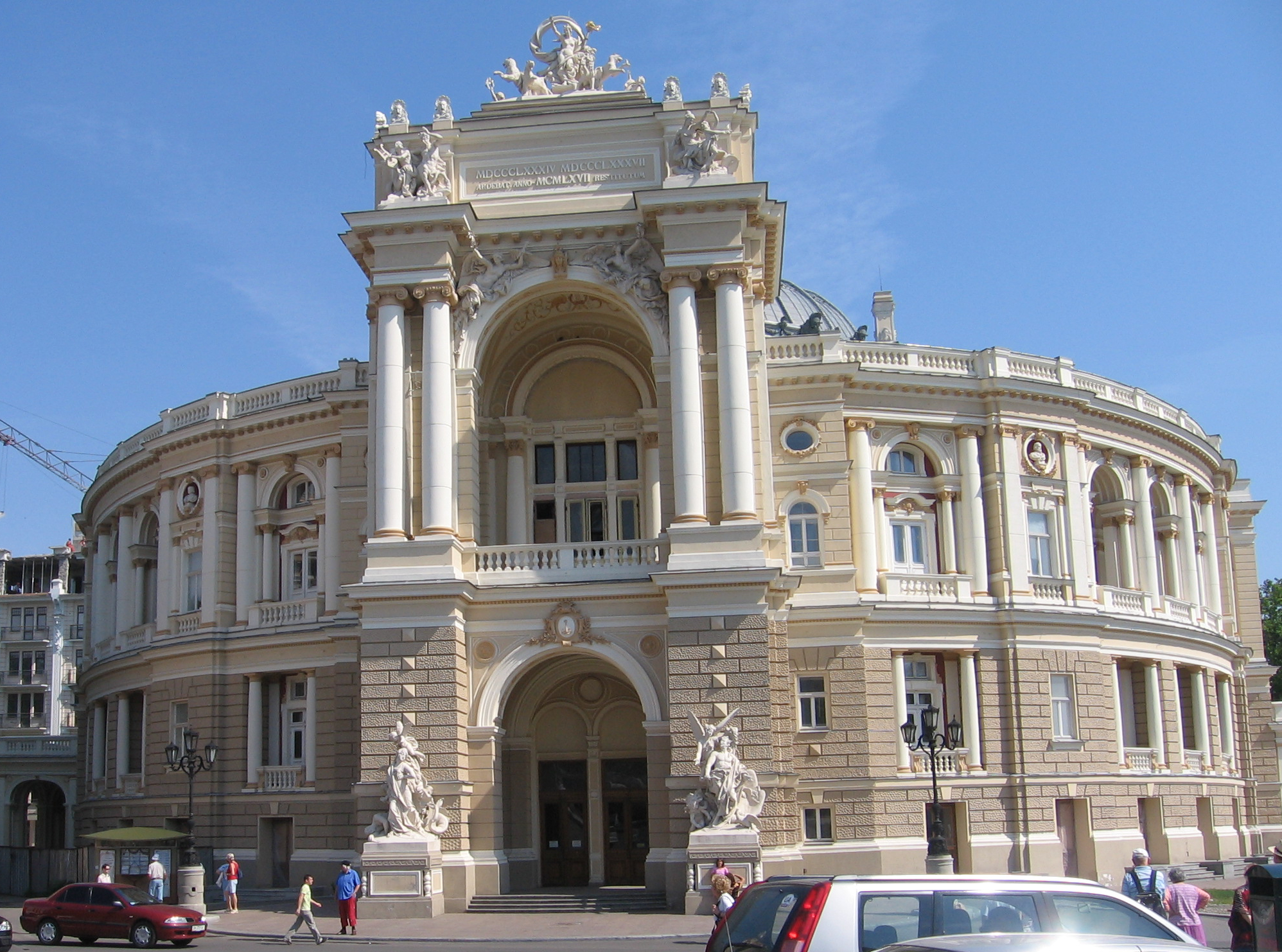
Odessa, Ukraine

Marshall begins with Russia, followed by chapters on China and the United States.  He is breezy, but to the point.  (As in, Putin “may well go to bed each night, say his prayers, and ask God:  ‘Why didn’t you put some mountains in Ukraine.'”)  I’ve traveled a bit around the Black Sea, and so have visited many of the places that give Putin – and thus the rest of the world as well – heartache.  Marshall explains why China is so bent on becoming a major naval power.  And with the United States, Marshall notes that we have

Location, location, location.  If you won the lottery, and were looking to buy a country to live in, the first one the real estate agent would show you would be the United States of America….

It’s in a wonderful neighborhood, the views are marvelous, and there are some terrific water features, the transport links are excellent, and the neighbors?  The neighbors are great, no trouble at all.

I was obviously on firm ground (no pun intended) in this chapter, but less well versed when reading about Africa – beginning with the third or fourth paragraph where Marshall notes that “the world’s idea of African geography is flawed.  Few people realize just how big it is. This is because most of us use the standard Mercator world map.  This, as other maps, depicts a sphere on a flat surface and thus distorts shape.”  One attempt to show the correct land mass is the Gall-Peters projection:

Mercator Projection (Old) and Gall-Peters Projection (New) of the World (from FriendlyAtheist.patheos.com)

Suffice it to say that Africa is large!

The chapter on the Middle East filled in some holes in my understanding, although I’ve read a good bit about the region in the past decade.  One of the most fascinating chapters was the last, on the Arctic.

This was a terrific book, from start to finish.  The only disappointment – surprisingly – was the maps.  (Imagine that!)  They are not terribly clear or illuminating, and I could have used more of the zoomed-in versions that cropped up occasionally in a discussion of a particular portion of the region.  I could imagine this book would be great in an interactive e-book format.  In any event, it is highly recommended.

Now my wish is that every Republican presidential candidate would have to read this book and be given a test before we let them back on a debate stage.

There I go again…must be the sickness returning.

More to come…

DJB

The power of identity

I’ve been reading two important books in recent weeks. Both have challenged some of my deeply held assumptions.  Both books and their authors have received extensive coverage in the media. And while I didn’t originally plan for this post to come out on the Rev. Martin Luther King, Jr. weekend, perhaps it is only fitting that I spend this time on America’s racial history as we honor one whose life work was spent on correcting injustice.

One book was not written with a white audience in mind, while the other is clearly intended to open the eyes of the those who see the civil rights movement as a three-day event:  “On Day 1, Rosa Parks didn’t give up her seat on the bus. On Day 2, [the Rev. Martin Luther King Jr.] led a march on Washington. And on the third day, we signed all of these laws.”  Both books – in their own ways – have affirmed for me that the work I can do to help build a more complete American identify can be a small but important step in helping to heal the racial divide that tears at our country.

The topic of racism and our response in this country is one I’ve been wrestling with in this blog almost since it began. Last year was especially difficult in this regard, given the shootings of nine innocent parishioners at Mother Emanuel in Charleston, and the response.  I came to these two books from a rather progressive (especially for the South) family background, where I had always tried to follow the rules of respect and trust.  I’m not sure that’s enough.

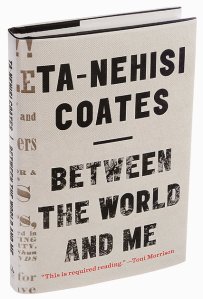
Between the World and Me
Between the World and Me by Ta-Nehisi Coates

Ta-Nehisi Coates’ Between the World and Me is rightfully being hailed as a worthy successor to the intellectual legacy of James Baldwin.  Written as a letter to his adolescent son, Between the World and Me grapples – in straightforward, stark, and beautifully written prose – with what it means to be black in a country that built its history and power in part on the difference between being white and black.

While Coates has been quoted as saying this is not a book written for white audiences, I think it speaks in a special way to those of us who did not grow up as people of color.  Journalist and lawyer Sally Kohn has suggested the following reason it is important for white audiences:

“That Between the World and Me was explicitly not written for white people (like me) is exactly why we should read it. Because part of the ideology of white supremacy and racial hierarchy is the idea that everything white is better, and that people of color should learn from how white people dress and work and raise their kids and write. Want to subvert that subtle, implicit bias? Tweeting #BlackLivesMatter is good, but expanding your intellectual as well as actual interpersonal relationships is even better. And especially if you live in a very white part of America, a book is a great place to start.“

I don’t live in a “very white” part of America (our block has multiple families of color who share life together in our urban neighborhood), but this spoke to me.  Much of Coates story is difficult to absorb in one reading, which is why I’ll probably return to it.  But this is an important voice, and I’m glad my children pushed me to read this book.

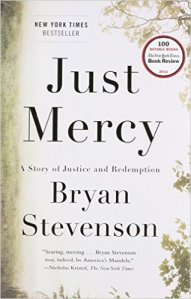
Just Mercy
Just Mercy by Bryan Stevenson

Bryan Stevenson’s work is easier to understand, if not easier to accept.  I was privileged to hear a recent talk by  Stevenson at the National Trust for Historic Preservation’s 2015 PastForward conference which helped me put both these works in a context, as he framed this struggle as the “power of identity.”

Stevenson is the founder of the Equal Justice Initiative, a nonprofit that provides legal representation to indigent defendants and prisoners who have been denied fair and just treatment in the legal system.  EJI…

“…litigates on behalf of condemned prisoners, juvenile offenders, people wrongly convicted or charged with violent crimes, poor people denied effective representation, and others whose trials are marked by racial bias or prosecutorial misconduct. EJI works with communities that have been marginalized by poverty and discouraged by unequal treatment.“

Just Mercy is Stevenson’s 2014 book that tells of this work, framed around the wrongful conviction of death-row inmate Walter McMillan, and the years-long effort to get the criminal justice system to right an obvious wrong.  It is a harrowing story, and not all of the people represented by EJI make it off of death row alive.  Stevenson’s struggle has been compared to Paul Farmer’s work in Haiti.  Tracy Kidder, who wrote the magnificent Mountains Upon Mountains about Farmer’s efforts to cure infectious diseases in the most poverty-stricken reaches of the planet, has this to say about Stevenson:

“Our American criminal justice system has become an instrument of evil.  Bryan Stevenson has labored long and hard, and with great skill and temperate passion, to set things right.  Words such as important and compelling may have lost their force through overuse, but reading this book will restore their meaning, along with one’s hopes for humanity.“

When Stevenson spoke last fall at the PastForward conference, he tied EJI’s work to that we do as preservationists.  He framed his talk as the power of identity, and called on us to speak to a more complete American identity.  Speaking truthfully about who we are as a people, “requires engagement that we have not yet made”  because there is a narrative of racial difference that we have not confronted.

Besides the power of identity, he spoke of power in memorialization, noting that “we preserve the things that matter.”  If we are to have a more complete American identity, we need a new way of thinking about what we preserve and what we tell.  Stevenson and EJI just released a report entitled Lynching in America: Confronting the Legacy of Racial Terror in which the Institute documents 3959 racial terror lynchings of African-Americans in Alabama, Arkansas, Florida, Georgia, Kentucky, Louisiana, Mississippi, North Carolina, South Carolina, Tennessee, Texas, and Virginia between 1877 and 1950.  The reports summary (linked above) should be read by all who care about truth and reconciliation in an area where we need to talk about race and racial justice.

This work is necessary, asserts Stevenson, not to punish, but to get to a “better freedom.”

Stevenson ended his talk at the PastForward conference with a call to change the landscape of American iconography, as it tells a false story.  He also ended with three points (two of which he makes in every one of his speeches).  Stevenson said that he believes,

  • We are more than the worst thing we’ve ever done.
  • That the opposite of poverty is not wealth, but justice.
  • And that we cannot judge how we are doing with landmark preservation if we just look at the sites of the wealthy, privileged and powerful.  You judge the character of a society by the places that it saves – especially the places that tell the story of the poor, the formerly enslaved, and the condemned.

There are important steps being taken at a time that this country is working through (not always successfully) its history of racial discrimination.  Martin Luther King, Jr. weekend is as good a time as any to take their work seriously.

More to come…

DJB

Image by Gerd Altmann from Pixabay

Observations from Home (The It Is Still the Christmas Season Edition)

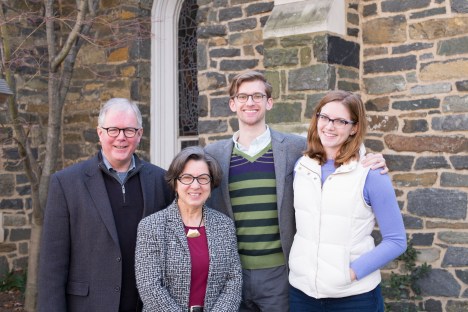
Brown Family Photo by John Thorne 12 20 15

The Browns on December 20th – Andrew and Claire’s 23rd birthday (photo by John Thorne)

If it is the Christmas season, it means that the Browns are likely to have a new family photo taken by our friend John Thorne.

(Blog interruption:  For those who may be wondering about the use of Christmas language after New Year’s Day, just think of the 12 Days of Christmas.  That’s how we celebrate at the Brown home.)

I’ve written before about the fact that we wouldn’t have family photos if not for John.  Thankfully, he showed up at church on December 20th and asked if we would like a family picture.  All four of us were there, and it was also Andrew and Claire’s 23rd birthday.  A perfect day to capture the family for 2015!

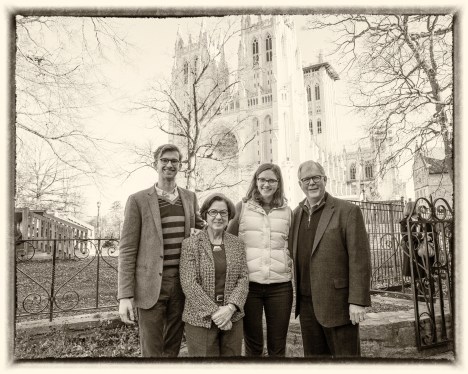
John used two settings, with two different cameras.  At the top you see us in the church yard, while the photo below shows the Washington National Cathedral in the background.

Browns at the Cathedral

Andrew, Candice, Claire and DJB on December 20, 2015 (Photo by John Thorne)

What a wonderful gift for the Christmas season.  Thank you John!

Speaking of getting the family together:  I’ve been hinting over the past couple of months that I’d like to round out my “family” of Racing Presidents’ bobbleheads…and my wonderful wife heard me.  Bill Taft was under the tree this year, and today he took his position on my desk with the “Mount Rushmore 4” and Calvin Coolidge.

Racing Presidents

George, Tom, Abe, Teddy, Bill, and Cal…your Washington Nationals “Racing Presidents”

I’ll have to admit that collecting racing president bobbleheads is a great deal less expensive than G.A.S. (aka Guitar Acquisition Syndrome).

Now, if you don’t know what the racing presidents do, here’s a little sample…from the last race of 2015.

And remember…only 44 days until pitchers and catchers report!  (Thank you Spring Training Countdown!)

Here’s hoping you found what you wanted under your tree this holiday season!

Happy New Year!

More to come…

DJB
 

Farewell 2015, Hello 2016

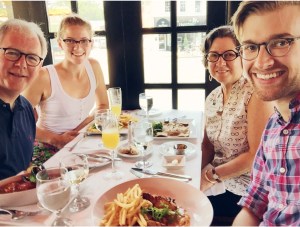
Sunday Brunch

A family celebration at Le Chat Noir’s Sunday Brunch before Claire heads to LA

Once again, the New Year puts me in a reflective and optimistic mood.

As in the past, I’m taking to More to Come… to reflect on the year just past, account for my resolutions, and look ahead to 2016.

2015 was the year that both our children graduated from college, my father turned 90-years-old, and Candice and I had blessings too numerous to count.

While our family has been blessed on many fronts, the same isn’t true for so many of our fellow citizens of the world.  The news we hear on a daily basis seems overwhelming in the nature and scope of the issues we face as a planet.  As an example, my recent reading (the subject of an upcoming post) has focused on our country’s seeming inability to come to grips with our terrible history of racial divide and hatred. But I could just as easily be reading on  income inequality, climate change, fake news, our increasingly broken political system, increases in poverty, or other similar challenges we face in this country and across the world.

Of course, if I really wanted to go negative, I could always take the Dave Barry approach.  And I haven’t even mentioned the elephant in the Republican primary…

On the other hand, there is much to be thankful for this year.  More Americans have health insurance – as of this writing nearly 90 percent – which is about as close to universal coverage as we have seen in a long while.  And thanks to a supreme court ruling in June – where “Ideology came face to face with reality, and reality prevailed” – they can keep that coverage.  We have had years of slow but solid job growth after facing down the Great Recession.  As I wrote at the end of June, now both my children can marry the person they want, no matter where they live in America, thanks to the supreme court ruling on marriage equality.  And it seems – although it occurs in fits and starts – that we are beginning to have the conversation on race that we should have been having for the past four centuries.

But I try to focus on more personal and family items in this year-end review, so I’ll step aside from all those major issues and look in the mirror.  In my 2013 year-end post, I outlined seven rules for the next third of my life. For two years now I’ve looked at them on my computer wallpaper as I’ve logged on in the morning. Colleagues have seen them and made comments. The family has been supportive. So…how did I do this year?  Let’s reflect:

1.  Exercise six days a week for the rest of your life. 2015 has seen improvement on this front. Since early October I’ve exercised essentially every day of the week.  Just as importantly, I’ve been getting more sleep on a regular basis. I still have a way to go, but I’m feeling as if I have begun to settle into the pattern I hoped for when I set this rule.  Year-end report:  Last year I was 10 pounds heavier at year-end than at the beginning of the year.  As 2015 ends, I weigh ten pounds less than my heaviest weight of the year.  Progress!

2.  Listen more than you talk.  In feedback from the person who would know best, I’ve regressed some in this area. It is always a challenge when I find myself in a place of some authority (either at work or home) not to grab the bully pulpit.  Year-end report:  Check myself regularly to ensure that I’m truly listening before trying to put forward my perspective. 

3.  Spend less than you make.  Well, I didn’t buy any new guitars this year!  Seriously, this is an area where I do okay, but I feel the need – as my retirement years loom on the horizon – to adjust some of my expectations in order to live with much less regular income in the not-too-distant future.  Year-end report:  Okay, but I can improve…and would probably benefit from a longer-term plan.

4.  Quit eating crap!  Eat less of everything else.  Thanks to the support of Candice, Andrew, and Claire, I continue to make progress here.  I still eat the occasional serving of french fries at lunch, but I generally make the wise choice. I just had my year-end physical, and while I need to work to ensure that I maintain a normal blood sugar level, I had a pretty-good check-up, all things considered.  Year-end report:  Doing well, but should focus on learning more about the details of a healthy diet.

5.  Play music.  As seems to be the case recently, this rule comes and goes.  When we were in Staunton over Thanksgiving with our friends the Pearsons, Oakley brought together some friends and local musicians for a night of excellent music-making.  The next morning my fingers hurt, but it was a good kind of hurt.  I’ve now played a great deal over the holidays.  When this happens, the world just seems a better place.  Year-end report:  I just need to remember that I can never play too much music.

6.  Connect and commit.  We made real progress in gathering people together this year on a regular basis – be it in our Foyers group at St. Albans, brunch with friends, or meals around our dining room table to get to know couples in a deeper way.  Just as with rule #3, this is important to think about in the years to come.  Year-end report:  Keep up the good work…and do more good work.

7.  Don’t be a Grumpy Old Man.  Enjoy life! I think I had some issues here in 2015.  Turning 60 had a more profound effect on me that I liked to admit. Things started aching that had never ached before (and not just from the ambulance encounter).  Like every baby boomer, I think I’m about 7-10 years younger than my actual age.  My issues with rule #2 seem to come into play here.  When I hear comments about 1975, my first reaction is always “Well, that’s not so far in the past,” before I quickly do the math and realize that it was 40 years ago.  I have a pretty wonderful life, all things considered, and I want to enjoy it.  Year-end report:  Slipped on this one, but ready to shake it off.

2016 holds a great deal of promise, as I’ll have my first sabbatical in a 38-year career. Candice and I are looking forward to six weeks away (with two more later in the year) without a focus on the day-to-day of work and home. Andrew is now singing professionally every weekend, and is thinking through his next steps in terms of work and education.  Claire feels that her year of service through the Episcopal Service Corps was a great choice to help her determine her next steps.

I’ll end this with the same paragraph I used last year:

…feel free to call me when I come up short.  Also, feel free to take one or more of these goals for your own and modify them as you wish. I’ll keep you posted…but let’s hope you start seeing more pictures of a smiling, slimmer DJB playing more music! Better yet, let’s hope you are with me, enjoying the food, music, wine, and company.

Happy New Year!

More to come…

DJB