Latest Posts

Train Travel, 78 RPMs, Chiggers, and Other Memories of Cleaning Out a House

Tom Brown transition

My father in the midst of transition

I took a day off from work today to be with family in Tennessee.  My father – who earlier this year celebrated his 90 birthday – is transitioning from living in his home of the past 26 years to living in an independent living facility. (The home he is leaving is not to be confused with “The Old Home Place” aka 407 E. Main Street, where I spent my formative years from junior high through college.)

My two sisters and a brother who live nearby have handled most of the details of the move, and Daddy now spends much of his time with my sister Debbie and her husband Mark as he waits for his new apartment to become available.

However, before I was able to focus on family I had work to do along Music Row in Nashville, and I found myself at one of our Historic Hotels of America, the Union Station Hotel on Broadway.

Union Station Hotel

Ceiling at the restored Union Station Hotel in Nashville

I’ve told the story before, but it is so good it bears repeating again.

My parents were part of the post-war (WWII) marriage boom that begat the well-documented baby boom.  Both were from the small town of Franklin, located about 20 miles from Nashville.  My father had just graduated from Vanderbilt and he and my mom were married in the First Baptist Church in Franklin.  Before beginning his life-long career with the Tennessee Valley Authority, my father and his new bride had a honeymoon to take.

Luckily, they had relatives (my father’s sister) in Chicago, so they came to Union Station – like so many honeymooners, soldiers, businessmen (in those days), and families before them – and boarded a train bound for Chicago.  I’ve heard stories my entire life about the plays they saw in the city, visiting Wrigley Field to see the Cubs (that must have been how I got those baseball genes), and so much more.  But the stories always begin with that train ride from Union Station.

Today at lunch (at Murfreesboro’s City Cafe, naturally), my father started talking about that train ride again, and he told me that he and mom left at midnight on “The Georgian.”  When my father was last in Union Station he took a picture of the train schedule that still sits on the wall above the check-in desk.  Sure enough, plain as day, you can see that the Georgian leaves Nashville at 11:59 p.m. on its way to Chicago.

Train Schedule

Historic Train Schedule from Nashville’s Union Station

Daddy’s house these days is a beehive of activity, and I joined in the task of going through family furniture, photos, books, and memorabilia earlier this morning with my father and sister.

Wagner family bed

Wagner Family bed

Much of the house looked like this – pieces of furniture, piled high with things such as quilts to be sorted for family members, friends, or “the yard sale.” This particular bed is coming to our house, since it was a part of a suite from my great-uncle David Jefferson Wagner’s family.  (Alert readers will have figured out that I was named for my father’s Uncle Dave, as well as for my mother’s father, Thomas Jefferson Roberts.)

Here is Uncle Dave in his earlier days (looking quite the dandy)…

Uncle Dave Wagner

Uncle Dave Wagner

…and then in a picture with my father as a young boy.  Daddy told me that he was very close to Uncle Dave, who was like a surrogate grandfather.

Tom Brown with Uncle Dave

Tom Brown with Uncle Dave Wagner

When working through 90 years of life – as seen in the things my parents acquired and kept – I’m not very interested in adding lots of new possessions.  I am interested in having a few family things of meaning to pass along to my children that will become part of our stories.  So today I sat aside a set of glasses that my mother used when she was entertaining. I pulled out a selection of Teddy Wilson 78 rpm records because my father loved Teddy Wilson’s music (look it up if you don’t know about 78s and/or records).  I picked up at least five Molly Ivins books, because she made us both laugh as she wrote about the absurdity of political life in Texas.  Candice now has two crates of theological books to add to her collection.  I found a small butter press that I sat aside…not because I plan to do anything with it, but just because I remember it as something my mother loved to have in her kitchen.

Paper Pile Up

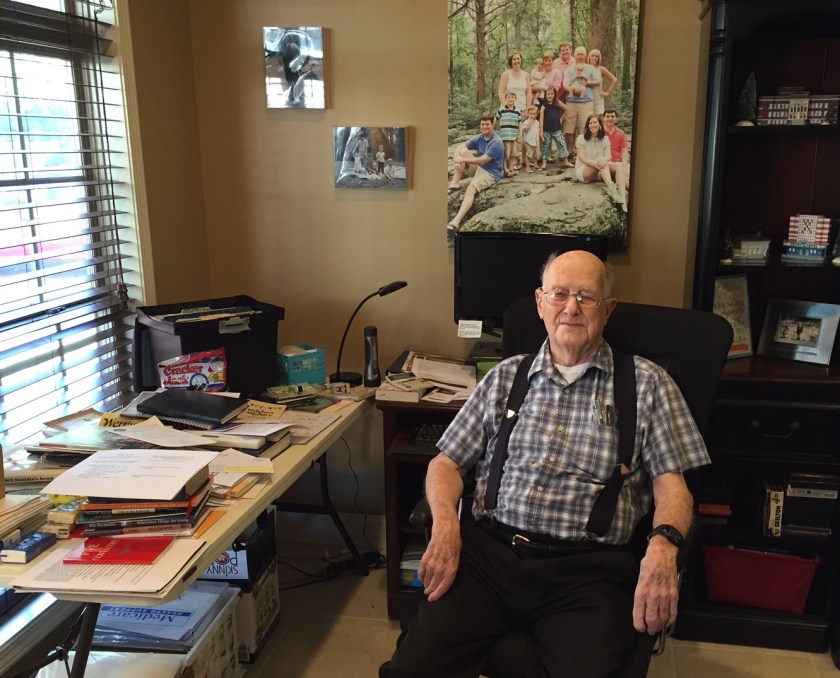
“Conquering the Paper Pile Up” – found underneath a pile of papers (naturally) in my father’s home office

My sister and I laughed when she pulled out the book Conquering the Paper Pile Up from underneath a pile of papers.  My father is known for his piles and piles of books, newspapers, and magazines.  I also set aside the poster from the re-lighting of the marquee at the restored Franklin Theatre, where my father worked as a teenager.

And then there was this:

Chiggers

Chiggers (photo by Don Williams)

My parents use to camp with a group of friends from Cookeville, Tennessee.  One of them – Don Williams – took this photo of my father and submitted it to an art show with the title of “Chiggers.”  We laugh every time we see this photo, and Debbie told Daddy today that “We’re going to put this up at your funeral, so people will see the real Tom Brown.”  He loved it and heartily agreed.

How can you not love a man who is so comfortable in his own skin (even when it is itching!).

Off to catch a plane home, but loved the day of family memories.  Try to clean out your parents home before they leave you. If you’re lucky, you’ll have your own “Chiggers” moment.

More to come…

DJB

Mr. Emerson has thought about everything

Tim Emerson
Tim Emerson

(Editor’s Note: Teachers are such an important part of our lives.  Our twins were blessed to have many wonderful teachers, and a few real mentors from that group. Last evening, Candice and I went to a celebration of the teaching career of Tim Emerson, the retired head of the Upper School at Maret, and one of the teachers who changed our Claire’s life. 

During the evening we heard tributes to Tim — loving, personal, and funny — that indicated he had changed many lives for the better over his 36 years at Maret.  As one former student said to Tim while surrounded by about 400 friends and family, “Just look at the people here tonight.  This is your report card.”

The lesson that we should never underestimate the impact one person can have on the world fits as well with Tim as it did in my last post written for one of Andrew’s teachers.  The following is our thank you to Tim on the occasion of his retirement, and we wanted to share it with our family and friends.)

Tim, you are a star in our book! Your gentle spirit, kindness, insightfulness, and wisdom are your gifts our family so appreciates. Our Claire loved your creative writing class, where you brought out her writing potential. Again and again, Claire would mention something you said or a perspective you had as she turned it over in her mind. You made her think deeply. One time she commented, “I think Mr. Emerson has thought about everything.”

Tim, for all you are and all you have given our family — thank you!

Candice and David

Maret Graduation
Claire and Tim Emerson at Claire’s Maret graduation

More to come…

DJB

UPDATE:  Tim Emerson passed away on May 9, 2018

Never underestimate the impact one person can have on the world

Ben Hutto
Ben Hutto

(Editor’s Note:  My son, Andrew Brown, lost a very dear teacher, mentor, and friend yesterday when Ben Hutto passed away. This is the same Ben Hutto who was recently given a shout out by Stephen Colbert on one of his first Late Night shows, and the same person who was included — unbeknownst to us before we heard his name read out loud — in the Prayers of the People when we visited St. Martin-in-the-Fields in London a couple of weeks ago. Ben not only touched our family, he touched tens of thousands of people all across the globe. Ben had a love for music and life that reached so many people on so many different levels. I noted in my 60 Lessons from 60 Years (#54) that one should never underestimate the impact one person can have on the world. Ben Hutto was one of those people who touched many lives. Andrew wrote the following for Facebook, and as of this afternoon, his post was nearing 400 likes. It was just one of hundreds of posts and comments on Ben’s Facebook page. Andrew’s is heartfelt and beautiful, and I wanted to share it with you.)

William Benjamin Hutto III (October 4, 1947 – September 29, 2015)

I have something to ask of you, friends. Please keep my dear teacher, friend, and mentor, Ben Hutto, in your thoughts and prayers as he enters his eternal life.

The first time I sang with Mr. Hutto was in 2004 as a treble. Thinking back to that performance of “Chichester Psalms,” I don’t think I could have comprehended exactly how profound an impact Ben would have on me half a lifetime later. His ardent spirit and closeness to God led him to touch the lives of thousands of students, teaching the values of choral music and its role in the Episcopal faith. Between three choral groups and four musicals, he was the teacher at St. Albans I spent the most time with by far, learning about the idiosyncrasies of Herbert Howells and laughing at the characteristically Southern idioms he would use to describe the music he loved. When I was still a senior in high school, Ben was the first person to hire me as a professional musician at his church, St. John’s Lafayette Square. Since then he has become not only a teacher and mentor but also a friend. I am only one of the countless young musicians he mentored, and I feel so blessed to have spent time with him making music, socializing over gin, and just being. The outpouring of prayers, love, and support over the past months from the St. Albans, St. John’s, and Episcopal musician communities demonstrates the wonderful role he held in so many people’s lives.

Requiescat in pace, my teacher, my mentor, my friend. You will always be with me in my music and in my life. I love you.

Andrew Brown

More to come…

DJB

Stick a Fork in This Season

Nationals LogoSaturday was the final home game included in my season ticket package for the Washington Nationals 2015 season. I was much more ambivalent about the end of this season than I am for most.

Although the Nats finally won in the 12th inning yesterday, the Mets also won earlier in the evening and clinched the National League East Division title.  Time to stick a fork in this stinker of a season.

I’m not going into all the problems with the 2015 Nats (although I’ve touched on several recently). They are almost too many to contemplate.

If you want to read why Matt Williams should be fired, you could do worse than this one from Nationals Baseball at the end of the disastrous 3-game sweep by the Mets earlier in September.

If you want to read why the trade for Jonathan Papelbon was the worst trade of the season (something I supported at the time, but now see how wrong I was), read Joe Posnanski. That trade, plus the pre-season dealing of Tyler Clippard (which I did not support at the time), calls into doubt the wisdom of our general manager.

If you want to read why the team should go all-in with a lifer contract for Bryce Harper, read Tom Boswell.

I will say that I am ready for Ian Desmond to leave.  After watching his wretched season all summed up last evening  with a strikeout with the bases loaded and no outs in the 4th – as he swung for the fences – my thoughts turned to the fact that this is a talented player who needs a new direction.  When he has the same number of errors as all the other players who have played infield and catcher for the Nationals this season combined, it is time to look elsewhere.

10th anniversary ball

10th Anniversary Ball from Saturday’s batting practice at Nationals Park

But let’s put all that behind us.  Yesterday was still a day at the ballpark, which beats many other pursuits hands down. The game began on a positive note.  My friend Dolores and I (we split my allotment of season tickets) decided to take in an afternoon of batting practice on a nice fall afternoon before a 4 p.m. start.  I actually caught (corralled might be a better term) a BP home run ball off the bat of some anonymous Philadelphia player. Believe it or not, in 50+ years of attending MLB games, this was the first ball – BP or otherwise – I had ever caught at a stadium. But there was a little guy – about 9 or 10 years old – in the row in front of me who had brought his glove but hadn’t caught a ball all afternoon.  Dolores said, “Why don’t you give it to the kid?”  And I did.  His eyes lit up, which made it all worthwhile.

A lady in her late 40s – glove in hand – was also sitting in that row and saw it all.  A couple of minutes later, she snagged a BP home run. She said it was her second of the day.  After the Phillies cleared the field and the kid left, we stayed to talk and enjoy the cool fall breeze. When she heard I gave away the first ball I’d caught, she said, “I caught two, why don’t you take one?”  Then she asked if I was a season ticket holder, and when she heard I was she said, “Why don’t you take the one with the ten-year anniversary stamp on it.”  And she gave me the ball in the picture above. Angels come in all varieties.

On to the game, where Stephen Strasburg showed the dominance he’s demonstrated since coming off the disabled list, firing eight innings of 3-hit, 1-run baseball while striking out 13.  Yes, I know it is the last-place Phillies, but he’s been consistently tough over the stretch at the end of the year.  Unfortunately, as has been the case all too often this year, there was no offensive support.  Once again, Bryce Harper was the only Nat who showed up consistently at the plate, going 3-5, raising his league-leading batting average to .339, and driving in the winning run in the 12th.  The Nats had plenty of opportunities to put this game away early – especially in the 4th when Harper, Werth, and Robinson loaded the bases with no outs.  The key at-bat was Desmond’s.  With no outs and the bags full, you have to put the ball in play.  But this is the guy who has been striking out constantly, and he did so again in a big moment.

When the Nats were recently swept by the Orioles – to effectively kill whatever slim chance they had to make the playoffs – Boswell questioned their fight…and effectively their heart.

The Nats’ recent galling defeats, just at the moment the Mets finally showed vulnerability (a 3-6 homestand), brings up another touchy issue.

How much “flight” does a major league team need to have? How much is too little, like going through the motions, even being pushed around and swept in your own ballpark by supposed key rivals like the Mets and now the O’s?

Right now, the Orioles, even though their odds of making the playoffs are almost nil, seem to have the proper amount of pluck under Showalter.

The Nats? Well, if they’re trying to get Williams fired, they’re doing a fine job. They often looked like kid brothers getting slapped around by bigger boys against Baltimore. Fielding and fundamentals, base-running judgment and, at times, just running the bases at total full speed — all poor. Ian Desmond couldn’t get down a crucial eighth-inning sacrifice bunt. And he looked so bad doing it that you wondered: Why ask him to do that at all?

Nobody ever looks good being beaten, but the Nats frequently seem resigned, like they are living out some kind of blighted year before an offseason in which at least a quarter of the team will depart — as free agents or in trades.

As was noted last year after the crushing playoff loss to a team they should have beaten, only a few of these Nationals look as if they are ready for the tough situations that invariably come with September and October baseball.

Well, it will be an interesting off-season.  All I can say is the proverbial, “Wait ’til next year.”

More to come…

DJB

I Haven’t Laughed This Much in Years

Destiny of Desire

Cast from Arena Stage’s Destiny of Desire (photo by Tony Powell)

Last evening Candice and I kicked off the 2015/2016 season at Arena Stage with the hilarious Destiny of Desire, a new play by Helen Hayes Award-winning playwright Karen Zacarías.

I haven’t laughed this much in years.

This modern comedy is based on a Latino telenovela, and Zacarías and the cast are pitch perfect in capturing the wild plot twists, overplayed drama, and shirt-ripping passion required by the genre.  The play begins on a dark and stormy night in Mexico, when two newborns are switched in a hospital, and the play gallops along from there for two hours to the entirely predictable, but nonetheless enjoyable, ending.

The all-Latino cast is strong, and the Arena crowd – which is generally stingy with its praise – gave a swift and heartfelt standing ovation.  Candice and I attend 6-8 plays a year at Arena, and I’ve never seen a crowd leave in such good spirits.

This is a rollicking good time.  Even if you’ve never tuned in to a telenovela on Spanish-language television, you’ll quickly pick up the vibe and have a great time.

Recommended!

More to come…

DJB

Edgartown

Walking through autobiography

Friday evening I was at the Grey Barn and Farm on Martha’s Vineyard listening to Presidential historian Michael Beschloss. I was there in my role at the National Trust for Historic Preservation with a group from the National Trust Council and special guests from the region. Beschloss – in speaking to the importance of preserving the places where history happened – made two points that spoke directly to our last four days of touring, learning, and generally soaking in as many new experiences as possible.

First he noted that in seeing places where people lived in the past, “You are walking through their autobiography.”

Beschloss added – as a good historian should – that is was important to try with all your might to “get the interpretation – the story – right.”

On my first visit to Martha’s Vineyard, I hoped to gain an understanding of the many layers of history where the autobiographies are derived from its past as Native American settlement, a working whaling port, Victorian resort, a vacation refuge for African-American professional elite and intelligentsia, and part untouched landscape. Four days was just barely enough time to scratch the surface, yet we did our best to understand how these pieces make Martha’s Vineyard what it is today.

Old Whaling Church
Old Whaling Church in Edgartown

My explorations began with an insider’s tour of the Old Whaling Church. Whaling was an important early industry, setting the commercial tone that helped shape the buildings and homes in small communities such as Edgartown.  The Old Whaling Church – with its impressive trompe l’oeil painting on the interior – was a key civic institution in a region where religion played an outsized role in early life.

trompe-l'oeil
Old Whaling Church Trompe-l’oeil
DJB at Old Whaling Church
DJB shows the optical illusion of the Trompe-l’oeil at the Old Whaling Church

Later that evening the passage – generation-by-generation – of buildings and history as part of the island’s past was very evident in a visit to an authentic 1890s wooden boathouse on the Edgartown Harbor – the oldest on the island.

Vose Boathouse
Wooden 1890s boathouse on the Edgartown Harbor

During the weekend, we spoke with local preservationists from the Martha’s Vineyard Preservation Trust and the Martha’s Vineyard Museum to learn of their past work and future plans to expand ways in which they can tell the island’s full story.

Union Chapel
Union Chapel in Oak Bluffs
Dome at Union Chapel
The dome at Union Chapel
Panorama of Union Chapel
Panorama of Union Chapel, built in 1870 as a non-sectarian worship space on Oak Bluffs

Saturday morning, my colleague Beverly Morgan-Welch, Executive Director of the Museum of African-American History in Boston & Nantucket, helped us with Beschloss’ admonition to “get the story right.”  Speaking of the rich history of African-Americans in Oak Bluffs, Beverly noted that many communities – including many generations of African-Americans – passed their stories down orally as opposed to in the written word.  She spoke of how African-Americans knew how to connect, knew how to “do” community, almost from the beginning of their time in America, as they fought for survival in a hostile world. The networking that later took place among African-American elites at Oak Bluffs is an extension of that ability to connect and build community.

We spent a delightful day in Oak Bluffs on a picture perfect Saturday, viewing the multi-hued Victorian gingerbread cottages and the Martha’s Vineyard Campgrounds. Again, these places spoke volumes about the values and lives of the builders as well as today’s residents.

Oak Bluffs
Oak Bluffs
Wesleyan Grove
Wesleyan Grove
Campground
Panorama of the Tabernacle at the heart of the Campground
Wesleyan Grove Core
Homes at the heart of Wesleyan Grove

Today, preservation is helping keep Martha’s Vineyard history alive and relevant for the 15,000+ year-round residents and the hundreds of thousands who visit the island each year. I was privileged to see a handful of these special places and hear of the stories that help flesh out the autobiographies of the men and women who made – and continue to make – this island a place that matters.

More to come…

DJB

Image: Edgartown in Martha’s Vineyard by DJB

Sunflowers by van Gogh

Connecting…across a distance

After a very busy week of conference activities in Cambridge – going from early morning until late in the evening – Candice and I came to London for two days to rest and reconnect with each other and with our souls.

The Water Lily Pond
Candice connects with an old friend – Claude Monet’s “The Water-Lily Pond” at the National Gallery in London

Knowing that we were likely to need a break from seven days of nonstop travel, meetings, tours, discussions, and connections, we chose to see where the spirit would lead.  Little did we know that although we were quite a distance from home, we would connect to friends old and new in ways wonderful and unexpected.

The train from Cambridge deposited us at King’s Cross Station on platform 9, and that was the first reconnection.  My mind immediately went to those summers of reading Harry Potter books to Andrew and Claire at the river house.  And I thought…hmmm, I bet Platform 9 3/4 is around here somewhere. Sure enough, there was a queue of twenty-somethings waiting to take their picture at Harry’s famous point of departure for Hogwarts.  We laughed, and reminded ourselves that our Claire stood in this very spot about 18 months ago to get her picture taken as she pushed her school cart through the wall.

On Friday afternoon we explored the Belgravia neighborhood around our hotel, and then found a wonderful Italian restaurant nearby for dinner.  Il Convivio was a treat, as we took our time and enjoyed the wine, good food, and incredibly friendly staff.

Saturday was a leisurely day for rambling around the city…seeing streets, shops, and more.  If we found a cafe that intrigued us, we’d drop in for an iced coffee, scone, or tea.  If we wanted to sit for a while, we’d find a pocket park and put up our legs and rest. It helped that the London weather was picture perfect.

FoodFilosophy
Candice at a small London cafe during a day spent rambling, exploring, and connecting

The second reconnection came through the wonders of social media.  Candice had been checking her Facebook account and discovered that dear long-time friends from our days together in the Shenandoah Valley were in London for a four-month stay.  Tom and Sarah O’Connor lived across the street from us in Staunton, Virginia, and their twin girls – Rachel and Charity – were born 10 days after Claire and Andrew.  These four grew up together for the first few years of their lives and we’ve all stayed friends even after both families moved from Staunton.  Candice and Sarah made the plans, and we came together – again at Il Convivio – for a delightful evening. Even though it had been several years since seeing Tom and Sarah, our conversation picked up right where we last left it, as we caught up on life.  What a wonderful treat.

London Panorama
London Panorama

Sunday’s morning’s wrap up to cycling’s Tour of England closed many streets, but we still made it in time for services at St. Martin-in-the-Fields, an active, diverse, and engaging congregation in the heart of London. Internationally known for its music program, St. Martin’s came to be known to us today for so many other elements of its life together.

Yes the music was wonderful, and I was reconnected with an old friend – Palestrina’s Kyrie from Missa Brevis. But we also heard a passionate and challenging sermon from the Rev. Richard Carter on the Syrian refugee crisis gripping Europe at the moment. I’ve seldom heard such strong political language – put in a Christian context – in a church in the U.S. but we were connected with powerful preaching that reminded us of some of the best we’ve heard through the years at St. Alban’s Parish in DC.  We saw – in the ministries, the outreach, the words shared – how this parish “draws inspiration from our patron saint St. Martin who, by cutting his cloak in two, demands that we look both at the resource that we create and possess, and the way that it is shared.”

We also saw connections between parishes.  When the prayers of the people included Ben Hutto – a name we recognized – we both wondered if it could be the Ben Hutto we knew.  Yes, it turns out, it could. The vicar told us that he had exchanged pulpits with St. John’s Lafayette Square in Washington, where Ben is the choir master and Andrew has sung over the past several summers.  It was a connection we never expected, but we were glad to add our prayers for Ben to those of our new friends in London.

At the end of the service, the young lady with the beautiful singing voice sitting next to me reached out her hand and asked if we were visiting.  Over the course of the next half hour, Helen had told us about the homeless ministry at St. Martin’s (the Church of the Ever Open Door), invited us down to the beautiful new gathering space for coffee and tea, introduced us to some 8-10 parishioners, learned about Candice’s work with our healing ministry, and generally ensured that we were welcomed and connected. It was the most meaningful welcome I’ve ever seen…and I’ve been to a great many churches in my 60 years of life!

After a lovely lunch in the St. Martin’s crypt, we wandered across the street to the National Gallery to see a number of Impressionists works by some of our favorite painters.  Candice was especially delighted to see the Monet Water-Lily Pond, as we’ve had a poster of this painting in our house for years.

I’ll end these stories of connection by quoting from this morning’s parish newsletter from St. Martin-in-the-Fields.  In a piece entitled From a Distance written by their Vicar, Sam Wells connects so many thoughts that have been swirling in my head in this summer of Syrian refugees in Europe, immigrant-bashing in the U.S., and a loss of concern for fellow human beings who do not share our ideological beliefs and are perceived as outside our tribe.

From a Distance

In Ernest Hemingway’s novel “For Whom the Bell Tolls,” set during the Spanish Civil War, a republican guerilla spots a nationalist cavalryman from a distance and kills him.  He raids the man’s purse, and inside finds a photograph of the soldier’s wife, intimate letters, and items of intense personal faith. Suddenly the cold act of war is revealed for what it was, and a feeling of revulsion creeps over the reader.  This is no longer an ideological struggle; it is the ghastly abrupt shattering of a beautiful set of relationships and loves.

I’m writing this on 11 September: a momentous day.  Rowan Williams described a suicide bomber as someone who can only see from a distance.  All violence requires distance; it depends on not seeing, not hearing, not sensing certain things.

Christianity tells us that God never sees at a distance, never sees things only in general. There are no lives that are superfluous.  11 September starkly contrasts the cold calculation of terror, the calculation of distance, that cannot see, cannot hear, cannot feel, lest it be revolted and turn from its murderous purpose, with the counter-narrative of intimate complexity, those anguished cell phone messages, those desperate acknowledgements of what most mattered in lives about to end, those extraordinary sacrifices of firefighters and strangers and honest bystanders.

The life of St. Martin’s is textured by precise detail, by careful evaluation and by discernment over minor differences.  It is life close up, and in that sense it imitates the life of God, close up and giving full attention to the world’s intimate detail.  Let us, as a community, renew our commitment in loving attention to details that matter.  And so let us defy those who harden their hearts to bring about savage destruction through seeing merely from a distance.

More to come…

DJB

Image: “Sunflowers” by Vincent van Gogh taken by DJB at the National Gallery in London

Ickworth

A brilliant week of English charms and global lessons

In Cambridge – a lovely town with an international reputation for education – it was appropriate that the delegates to the 16th International Conference of National Trusts (ICNT) took in the charms of the East of England while also gathering so many valuable lessons from instructors both local and global.

All in all – to use the British equivalent of great – it has been a brilliant week!

The opening day’s remarks set the stage for discussions throughout the week.  Dame Helen Ghosh – Director General of the National Trust for England, Wales & Northern Ireland – began by reminding the delegates of the need to be open to change as we seek to conserve our heritage.  Jonathon Porritt challenged many of the assumptions the delegates brought to Cambridge, in a speech on our environmental challenges that was referenced throughout the week.

Tuesday took Candice and me along with half of the delegates to Wimpole Estate, for conversations around cultural identities.  This emphasis arose from the 15th ICNT in Entebee, Uganda, in 2013, which raised the need to recognize intangible heritage to new levels within the National Trust community.  The National Trust of England, Wales & Northern Ireland has placed renewed emphasis on the Spirit of Place principle, and we had good conversations around how our work reveals and shares the significance of place and ensures that their special qualities are “protected, enhanced, understood, and enjoyed by present and future generations.”  Our focus at NTHP on how the “period of significance is now” was raised by others who heard my comments on the topic on Monday.

Theatre Royal Ceiling
Beautifully restored ceiling and trim at Theatre Royal in Bury St. Edmunds

Wednesday the entire conference delegation headed to Bury St. Edmunds and the restored Theatre Royal.  A working theatre and National Trust site, Theatre Royal was the setting for a presentation by my friend and partnership colleague Tim McClimon from the American Express Foundation, as well as Kate Mavor, the recently named Chief Executive of English Heritage Trust. (I’ve worked a bit with Kate previously when she was CEO of the National Trust for Scotland.)  Both were eloquent in speaking of the ways to increase participation in preservation.

Tim McClimon
Tim McClimon of the American Express Foundation speaking at the 16th ICNT in the Theatre Royal

Our time at Theatre Royal was followed by an afternoon and evening at the magnificent National Trust property Ickworth.  There we mixed long tours with more sessions around growing the movement.  Candice and I especially enjoyed the hike down to the Ickworth Church and the walled gardens.

Ickworth facade
Ickworth’s impressive rotunda
Ickworth Church
Ickworth Church
Ickworth Walled Garden
Ickworth Church and Rotunda, as seen from beyond the walled garden
Entrance Hall at Ickworth

Thursday’s sessions for our discussion groups began at Anglesey Abbey and then moved to Wicken Fen for conversations around land, landscape and nature, before we returned to Wimpole Estate for dinner and a barn dance.

Anglesey Abbey 09 10 15
Anglesey Abbey on September 10, 2015
Candice in the rose gardens
Candice in the gardens at Anglesey Abbey
Birch orchard
DJB in the Himalayan Birch orchard at Anglesey Abbey

At Wicken Fen – a nature preserve – our conversations and tours focused on landscape and urban scale conservation.  An ambitious project with a 100-year time frame, Wicken Fen and the beautiful wetlands proved to be a delightful place for these discussions.  The National Trust’s Stuart Warrington was an especially effective speaker and moderator on this topic.

Wicken Fen
A wind-powered pump at Wicken Fen landscape and nature preserve

Friday came much too soon, as we gathered back in Cambridge for the final sessions and farewell.  Barbara Erickson of the Trustees of Reservations started the morning with an impressive overview of the work of this Massachusetts-based organization that was a precursor – and inspiration – for the National Trust in England, Wales & Northern Ireland more than 100 years ago.  Barbara is leading the Trustees to move more toward its original mission for both land and heritage conservation – once again proving that sometimes we must go “back to the future” as we change our work in the 21st century.  I feel our work in the U.S. has become too segmented and hope to speak and write about the need for whole place preservation in the months ahead.

INTO Ex Comm
The newly elected INTO Executive Committee gathers in Cambridge with the members of the INTO Secretariat and with Dame Fiona Reynolds, the new Chairman of INTO (second row, third from right)

Ben Cowell, our host from the East of England, and Catherine Reynolds, the Secretary-General of INTO, provided reflections on the conference before Dame Fiona Reynolds – the newly elected Chairman of INTO – wrapped up the conference.  Fiona focused on the family nature of INTO and the National Trust movement, noting that families are best when they include all members great and small; the need to celebrate our successes across the organization; and finally the urgency of expanding our voice for heritage on the global stage.  A handoff to the Indonesian Heritage Trust – which will host the 17th ICNT in 2017 in Bali – wrapped up the week.

Many thanks to the staff and volunteers of the National Trust for England, Wales & Northern Ireland for a wonderful week full of charms and lessons.  It was simply brilliant!

More to come…

DJB
Image: Ickworth by DJB

Wimpole Hall Interior

Sheep and chandeliers

“Sheep and chandeliers” is the title the National Trust of England, Wales & Northern Ireland has given to its brochure for Wimpole Hall and Wimpole Farm, where we joined a group of participants in the 16th International Conference of National Trusts for a day of in-depth discussions and tours on Tuesday.

Over the course of the day, we gathered in small groups throughout the estate with National Trust staff and volunteers to discuss topics such as the spirit of place, ways to use the past to engage with contemporary issues, and cultural identities in a homogenizing world. All were fascinating, made even more so by the extraordinary setting of this estate and working farm.

Wimpole Hall
Wimpole Hall

We learned of the site’s role in World War II, where it hosted American and British bombers on the large expanse of lawn in the front of Wimpole Hall, as well as some of the challenges of interpretation for a site with layered histories and traditional expectations of how an estate would be presented to the public.

Lawn at Wimpole
The lawn at Wimpole, which was used by Allied bombers in WWII

The discussion sessions were mixed with tours of the house and farm, and it was especially interesting to hear about the organic farming work – and challenges – of the National Trust.  Mark – the head stock farmer at Wimpole – was especially eloquent and entertaining, beginning with his description of how the construction of the Great Barn worked so well for the Trust’s current farming efforts.

Great Barn
Mark in the Great Barn at Wimpole
Great Barn Framing
The Framing in the Great Barn

But Mark’s presentation really hit its stride as he spoke of how the National Trust maintains rare breeds and works to improve the quality of food for the British population.  We began in the cattle yard, where he explained how the meat from these breeds is especially tasty, with “fat to help add to the taste, which I personally test to ensure quality control” all said while patting his mid-section.

British Longhorn
A British Longhorn at Wimpole Farm
Mark at Wimpole Farm
Mark describes the economies of organic farming at Wimpole Farm

We next moved into the piggery, where one sow had just delivered a litter of nine piglets.

Piglets
Newly born piglets at Wimpole

That was nice to see, but the real treat was right at 2 p.m. – one of the feeding times for the pigs – when they made such a ruckus with their squeals calling for their food that you could barely hear your conversations.  As Mark’s assistant farmer Kate noted, they don’t need an alarm clock at Wimpole.  The pigs will let you know when it is time for their feeding…365 days a year.

Piggery
In the Piggery

An all-round fascinating day seeing the conservation, interpretation, and the spirit of Wimpole in action.

More to come…

DJB

Image: The centerpiece of the Yellow Drawing Room in Wimpole Hall

King's College Courtyard

Opening views from the 16th International Conference of National Trusts

Cambridge, England, has proven to be a delightful host for the 16th International Conference of National Trusts, co-sponsored by the National Trust of England, Wales and Northern Ireland and the International National Trusts Organisation (INTO).  More than 250 delegates and guests have arrived for the preliminary INTO meetings and the five days of conference sessions, tours, and discussions.

Anglesey Abbey
Anglesey Abbey

Candice and I arrived mid-day on Saturday for the INTO meetings, which began the next morning at Anglesey Abbey, a wonderful National Trust property near Cambridge. While most of the day was spent in meetings, we were given a delightful tour of the house, gardens, and mill by National Trust staffer Justin Scully and his team.  It was enough to whet our appetite for a return visit with the full conference later in the week.

White Birch Grove at Anglesey Abbey

Each day we’ve taken our meals in the Great Hall at King’s College – a splendid space in which to enjoy good conversation with fellow delegates from around the world.

Great Hall of King's College
Great Hall of King’s College
Great Hall Windows
Windows in the Great Hall

And on Monday evening, it was also the setting for our opening gala reception, with baroque music from Eboracum Baroque.

Eboracum Baroque
Eboracum Baroque at King’s College

Now it is time to head out the door for a day of touring and discussions at National Trust properties.

More to come…

DJB

Image: King’s College Courtyard, Cambridge by DJB