Latest Posts

For anybody who could use a break

It has probably been years since I last read science fiction. But when a friend, former colleague, and voracious reader added a comment on my year-end-reading post, I quickly jumped on her suggestion. She was noting how much she loved that Small Things Like These was on my list and agreed that it was a remarkable book. Then she added, “For something equally well written and ‘short’ though perhaps not your usual genre might I recommend Becky Chambers A Psalm for the Wild-Built?”

Takoma Park’s People’s Book, had a copy so I bought it and jumped right in. The dedication page is “For anybody who could use a break.”

Yes, my friend Priya had recommended this work at the perfect time.

A Psalm for the Wild-Built (2021) by Becky Chambers is an optimistic, charming, and contemplative novella. It takes place on a small moon called Panga, centuries after the Awakening at the end of the Factory Age, when the robots “employed” by humans decided they wanted to depart for the wilderness to observe “that which has no design.” They had long ago faded into myth and legend until Sibling Dex takes a turn off the paved road, heads into the wilderness, and meets Mosscap, a 7-foot tall, metal-plated, boxy-headed, wild-built robot—part of the fifth generation since the Awakening. They meet because Chambers has written a lovely story that reminds us of the necessity of taking a break, of not getting so bogged down in routine that you don’t “set aside time to care for yourself before getting up again to continue caring for others.”

Dex is a tea monk who travels between the human settlements on Panga to provide tea, a sympathetic ear, and quiet moments to any person who needs it. Even in the idyllic setting, where no one manufactures or uses nonrenewable resources or materials, “It was hard to find a Pangan who hadn’t, at least once, spent a very necessary hour or two in the company of a tea monk.”

After two years of service and constant travel, in which time they become the best tea monk in Panga and have a genuine belief in what they do, Dex decides to step away and plunge into the wilderness to visit the ruins of an old hermitage. His encounter with Mosscap—who is on his own mission to reconnect with humans to “find out what they need”—-and the subsequent challenges and truths they find along the way makes for an optimistic and hopeful vision.

We can all use a break.

More to come . . .

DJB

Photo from Pixabay.

Fiction as a pathway to the truth

In a world of false facts and disinformation, the truth can be very hard to uncover. When a new work of what we in the South use to call “regional fiction” came across my desk—a mystery novel set in part on an old wooden boat among the San Juan Islands—I wasn’t expecting that the compelling story would be a pathway to considering several fundamental truths. But in the hands of a skilled storyteller that’s exactly what I discovered.

Troubled Waters: A Sea Story (2024) by Syd Stapleton is a tale about an environmental disaster and cover-up wrapped in a whodunit. Our hero, Frank Tomasini, is a 47-year-old marine surveyor who lives comfortably on the Molly B, a 1937 salmon troller, which has been lovingly refurbished by its former owner who also happens to be Frank’s best friend. Near the first of 280 pages filled with crisp and clever writing, Frank is asked to unofficially survey the damage to an abandoned and adrift boat that belongs to Arthur Middleton, a “rich and holier-than-thou environmental warrior.” Middelton’s current crusade had centered on a polluting salmon fish farm located on remote Baker Island, near to where his boat is found. It turns out very few people, including Arthur’s brother, a high-powered Seattle business shark, seem too eager for Frank to find out what happened.

Frank’s telling of the story can slip into an irascible and cantankerous tone on occasion, but his dogged determination to find answers to this mystery make it work. He brings friends old and new along on his discovery, including Arthur’s somewhat eccentric but endearing aunt Agnes and Frank’s longtime friend turned lover, Carol. Much of the story takes place on the boat, which Frank keeps stocked with food and Laphroaig.

Troubled Waters is an engrossing read. If you want a full review I recommend this one from LineTime.org and this one from Against the Current. Stapleton—who studied at Berkeley in the 1960s and became a leader of the Free Speech Movement; debated William Colby, former Director of the CIA; ran for Congress as a socialist in 1970 (and lost); and has been a former ferry captain, landing craft relief skipper, and tugboat worker, graciously agreed to answer my questions about his new book.


DJB: Syd, “Troubled Waters” is a work of fiction about something we see all too often: environmental disasters and the subsequent coverup by those most responsible. Why choose fiction―and specifically the mystery genre―to tell this story?

Syd Stapleton

SS: One of the big problems with coverups is that it’s hard to get the facts. We all know that more than a few humans, including officials, can be heavily influenced by money, power and pressure, and that can weave a very tangled web. I wanted to make the point clearly, and I’m afraid that in today’s world, fiction is sometimes one of the few ways to make the truth clear.

For those of us with limited knowledge of the San Juan Islands, its gritty maritime and fishing history comes as something of a revelation. When you set the story here, were there specific aspects of the region’s past, present, and future you were hoping to weave into this tale?

I do think it’s important to remember that the impact of “modern life” has come in a very short time, when you look at things a little more broadly. Maybe it’s because I’m getting a little older, but I think the rate of change in the world is important to remember. Every generation has someone who lives to be a hundred years old. So, two lifetimes ago, the San Juan Islands were very, very far from being a vacation spot! Even just a hundred years ago, Native Americans were still a big presence, fishing and farming (well, and smuggling booze) were the main activities there, and life was not always easy.

That gap in time also lets us see a little more clearly the impact of “business” on the natural environment. Making money, as the principle moral value of our social organization, is a pretty scary thing when you look at the way it has affected many things, from Orca whales to housing prices to the pace of life, to the environment in general.

Your narrator, Frank Tomasini, has a bit of the lovable yet tenacious curmudgeon in his spirit. Your personal story has chapters that would seem to have required a similar outlook on life. Does Frank’s character come from someone specific, is he more of a composite of people you’ve met in the past, or is he a total creation from your mind?

Well, I’m not half Italian! I really put together the Frank character as someone whose voice I thought it would be easy for me to make consistent and believable. But he is a composite of people I’ve known and liked over the years. Some of the other characters are drawn straight from people I know and have worked with, with names changed to protect the innocent (or guilty). Particularly Frank’s history as a Berkeley radical in the ‘old days’ is something I know about and identify with.

I was interested in showing that even people without advanced degrees, or lots of money, can think clearly. They may not have a lot of power in the modern world, but they can still recognize a problem, and sometimes take steps to solve it.

Wooden Salmon Troller taken in 1955 from NOAA Historic Fishers Collection (via Wikimedia)

Your descriptions of Frank’s boat, the Molly B, reflect a real love for this refurbished 1937 salmon troller. Knowing that many of your readers (including this one) wouldn’t know their port from their aft, what went through your mind as you began to think about including nautical terms in this story?

As you know, there are a lot of “sea stories,” from Moby Dick through Joseph Conrad, B. Traven, Steinbeck and even some more modern writers. It can be an intense and intriguing world—a whole world of knowledge that allows for the consideration of different kinds of rules and priorities. The isolation of a small group under intense circumstances can lead to interesting interactions.

In the days before the dominance of plastic boats (excuse me, “fiberglass”), the building of wooden boats and ships, and their maintenance, was an art, an incredibly complex skill, with some positive features that are hard to find today. It’s not really an exercise in nostalgia, so much as it’s another appeal to look at the impact of “efficiency” and “low labor costs” on the world.

In finding out the “who,” but not seeing a satisfactory resolution of justice for those who perpetrated the disaster, I saw reflections of mystery writers such as Donna Leon. In her books she returns again and again to the theme that the truth can be very hard to discover in this life and justice isn’t always simple and easy. What books are you reading these days, and are there any mystery writers among that group?

I grew up an only child on a small farm, miles from the nearest town, let alone city, and my parents told me it was too far out to have television. So, unlike most of the kids my age, books were my companions and entertainment. It turns out my parents hadn’t been completely honest with me, but I forgive them! I’ve read intensely my entire life—history, politics, biographies, but mostly fiction over the last thirty years or so—good stuff, like Alice Munro, Henry Roth, Philip Roth, Henry Miller, Joseph Heller and on and on. And also a lot of “mysteries.”

I like Donna Leon! But among some favorites are (not in order of preference): K.C. Constantine, Qui Xiaolong, Caimh McDonnell, Percival Everett, Martin Walker, John Banville, Elizabeth George, Andrea Camilleri, Walter Mosely, James Lee Burke, Martha Grimes, Sara Paretsky, Laurie R. King, S. A. Cosby, Craig Johnson, Carl Hiaasen, Jonathan Lethem, Jo Dereske, T. C. Boyle, Cormac McCarthy, Dennis Lehane, Mauricio de Giovanni, Tony and Anne Hillerman, and more…

Thank you, Syd.

I really appreciate it.


More to come . . .

DJB

Aerial view of forested San Juan Islands in the Salish Sea with snowy Mount Baker on the horizon by Chris Linnett on Unsplash

You can do this hard thing

“Don’t let him get in your head” has been my mantra for Trump 2.0. I have generally followed the suggestions of Cal Newport and others and have stepped away from the exhausting digital chatter. Ryan Holiday, the author of Trust Me, I’m Lying, a book about media manipulation, wrote recently that “we’ve fooled ourselves into thinking that endless news consumption is how you stay ‘informed.’” However, Holiday argues . . .

“If you want to make a positive difference in the world—or simply maintain your sanity—you need to step back. You need to learn how to be more philosophical—which means being more discerning about what you let into your mind and learning how to see the big picture, calmly and with perspective.”

Rather than letting Trump and his minions get in our head, I believe progressives need to follow the advice of Jason Linkins in The New Republic and make him own every bad outcome that occurs on his watch. There will, unfortunately, be many.


Bringing water to our desert

It was a woman, naturally, who showed us how to speak truth to power, bringing—as one commentator has noted—water to our desert.

As an Episcopalian in the Diocese of Washington, Bishop Mariann Budde is my bishop. I haven’t always agreed with her, but I was so very proud of the way she spoke, in her firm, quiet voice, and asked Trump “to have mercy” on those who were scared and powerless. As the New York Times put it:

“For everyone watching, the vastness of Washington National Cathedral compressed, in one stunning moment, into a sudden intimacy. And with it, all the existential fights not simply of politics, but of morality itself. In a flash, the war over spiritual authority in America burst into a rare public showdown.”

The Canterbury Pulpit confronted the bully pulpit on the greatest possible stage.”

Bishop Mariann didn’t go into histrionics or make wild accusations. But she stated the truth of the situation plainly, placed the burden on his shoulders, and clearly—given the middle-of-the-night response on social media—got into his head.

She showed us how to do the hard thing.

One of the best summations of the national prayer service came not from the billionaire media but from a Lutheran pastor who wrote Herod goes to the National Cathedral and is disappointed. It is long but worth the time. He begins by noting that this was “A Service of Prayer for the Nation.”

“Not for ‘the citizens of’ the nation.
Not for ‘the taxpayers of’ the nation.
Not for ‘the leaders of the nation.
This was a service for the nation – the ‘whole’ nation.”

After reviewing all that preceded the sermon, Pastor Peterr then writes,

“What Budde did, in all humility and in all power, was to name Trump for what he is: one of us, with specific powers and abilities to directly shape life for all the people of the country, and indirectly for the world. Note, though, that what she pleaded for from Trump was of a piece with all the music and prayers, calling on every one of us to use our own far smaller powers and abilities to shape life for all the people in our orbit for the better, as small as our powers may be compared with the powers wielded by Trump.”

Have mercy. *


We can do hard things

Photo by Jess Zoerb on Unsplash

Shortly after the election, Carrie Newcomer placed this message on her A Gathering of Spirits Substack: You can do this hard thing.

Newcomer’s music “has always explored the intersection of the spiritual and the daily, the sacred and the ordinary.” She is a prominent voice for progressive spirituality, social justice and interfaith dialogue.

The title for the Substack post came from a song on Newcomer’s 2016 the beautiful not yet album. In the notes, Newcomer provides some background to this work.

“Barbara Kingsolver has written about a phrase she uses to encourage her children, ‘You can do hard things.’ I loved this idea behind this phrase. It absolutely acknowledges the difficulty of the task at hand, and yet, at the same time it completely affirms that the child has everything they need to move forward, and that they have support. I began to think about all the times in my own life that someone has given me that kind of sound advice and encouragement.”

The official version has the lyrics, and a lovely video interpretation.

“Late at night I called, and you answered the phone | The worst it had happened, and I did not want to be alone | You quietly listened, you said, “we’ll see this through” | You can do this hard thing, you can do this hard thing | It’s not easy I know, but I believe that it’s so | You can do this hard thing”

In 2022, Newcomer sang the song live at the annual International Women’s Day Performance, and it includes a wonderful introduction.

The bridge is so moving in the images it conjures. Then it ends with the hopeful: “Impossible just takes more time.”

“Here we stand breathless and pressed in hard times | Hearts hung like laundry on backyard clothes lines | Impossible just takes a little more time.”

Toward the end of Pastor Peterr’s post on the National Prayer Service, he references James Taylor’s Home by Another Way.

“Like the wise men of old, Bishop Budde knows another way, as do all those who planned this most powerful service . . . In JT’s words, in the face of Trump’s blizzard of executive orders which are designed to take and take and take some more from the most vulnerable among us, Budde didn’t give an inch. Instead, she stood in the path of our American Herod along with a host of others, naming that other way home . . . And that’s what each of us can do, wherever we are: name Trump’s way as the path of division, destruction, and death, and point to another way.”

The chorus is powerful.

“Yes they went home by another way | Home by another way | Maybe me and you can be wise guys too | And go home by another way | We can make it another way | Safe home as they used to say | Keep a weather eye to the chart on high | And go home another way”

Don’t let him in your head. We can speak the truth every way we can. We can point to another way.

We can all do this hard thing.

More to come . . .

DJB


*The nation’s comics have had a field day with Bishop Mariann’s speaking truth to power, and Trump’s response.

And keeping with the “God vs. ‘Divinely Inspired’ Trump” theme, there was more.


Photo by Clem Onojeghuo on Unsplash

Put your best cup forward

This story begins with an email on our neighborhood thread from my friend (and fellow morning walker) Ed Read. Early in January he posted the following:

“Hi neighbors,

I’m unabashedly putting in a plug here for this new coffee shop/ ‘micro-roaster’ just a few steps away from us.

I’m a coffee snob. I LOVE good coffee, especially fresh coffee, where the roast date is within several days. There IS a difference. There really is!

NO more buying coffee that is good ‘if used by 9 mo’s (or more!) from now’. I can now walk by, drop in, place an order for some freshly roasted beans and have them after a short wait or return the next day and literally have beans freshly roasted. He sources from small independent coffee farms all over. He has a great set-up, super equipment, and I’m just totally stoked that I can get such good coffee! 

Like a dream come true for me. 

So, please help out Doug as he launches his new business and start buying your fresh beans here.” 

Within days I had stopped by Celtic Cup Coffee, the brainchild of Doug Ilg, and tried it out for myself. Doug gave me a flight of coffee (light, medium, and dark roast) to try and we talked about his business and how he came to launch this new endeavor. The story can be found on his website, but the short version is that Doug, the founder and roast master, is a computer scientist who had a 30+ year career, including working with NASA and other agencies to devise ways of computing, organizing, storing, and distributing science data imagery from various Earth observing environmental satellite systems. We laughed about our shared experience of finding ourselves, as we aged, being a bit too much of the curmudgeon at work and deciding that it was time for the younger generation to have their shot. Doug’s decision was to follow his passion for coffee—one that began when he was just a boy—and help his community by broadening their home coffee brewing horizons.

After tasting the offerings, I made my choices and Doug roasted them while I waited. It took about 20 minutes, during which time a couple of other folks from the community stopped by, indicated they had seen Ed’s note (and the robust follow-up conversation), and wanted to give Celtic Cup a try. Since then, I’ve been making my coffee at home and loving it . . . which leads to the other part of the story.

The coffee roasters where Doug produces his micro-roasts on demand.

One of my rules for the road of life (#4 to be exact) is “spend less than you make.” These rules are really personal guidelines; not quite a principle but rather a reminder of how I want to live over time.

However, I had convinced myself that it was okay to stop in a local coffee shop and buy a fresh cup of coffee each morning (cost of $3-$5 a day plus a tip) to take with me on my morning walks (see rule #2). This was a habit I began during the pandemic and had continued for the next three years.

Candice would ask why I did it, given that I had a very nice coffee maker sitting on the counter at home. Now $5 each day wasn’t going to break our budget, but it didn’t really follow the spirit of that rule, as I was spending money unnecessarily. I told myself it was to support a local business (I’m a Main Street kind-of-guy) plus I liked getting to know the young people who were working early in the morning. But it still bugged me, and I know it bothered Candice although she was too kind to bring it up.

Celtic Cup helped me set a new path in life, for which I’m grateful. I still support a wonderful local merchant, the coffee is superb (better than what I was getting in most, if not all, of the shops I frequented), my coffee maker is back in business on a daily basis, and since Celtic Cup Coffee isn’t going to feature “all those fancy coffees” you’ll find at a place like Starbucks, I can still stop by Kefa Cafe, or Takoma Bev Co for the occasional latte. Win-win-win!

(Celtic Cup storefront. Credit: Source of the Spring)

If you live in the neighborhood, stop by and give Celtic Cup Coffee a try. And if you don’t, email Doug and he’ll chat with you about shipping a pound of freshly roasted coffee direct to your house.

I’m sure that if you do, you’ll get that “Top of the morning” feeling to start your day!

More to come . . .

DJB

UPDATE: Here’s the photo that goes along with the comment I posted below:

The original of the micro-roaster, co-invented by MTC reader Syd Stapleton

UPDATE NUMBER 2: Here are photos from the April 26, 2025 grand opening of Celtic Cup Coffee:

The strength to live in the present with dignity, creativity, and love

“Power at its best is love implementing the demands of justice, and justice at its best is power correcting everything that stands against love.” 

The Rev. Dr. Martin Luther King, Jr.

My book group is currently reading a work by one of the twentieth century’s most influential preachers, educators, prophets, poets, and mystics. I first read what has been cited as “a timeless testimony” that demonstrates “how to thrive and flourish in a world that attempts to destroy one’s humanity from the inside out” several years ago. But our current turmoil—stirred up by those focused on hatred and division—provides an updated context. The juxtaposition of the MLK holiday and the inauguration of this new president makes it an especially auspicious moment to look back while looking forward.

Jesus and the Disinherited (1949) by Howard Thurman is the work that inspired The Rev. Dr. Martin Luther King, Jr. and countless other advocates for peace and justice. Rev. Otis Moss, III highlighted the uniqueness of Thurman’s book when he wrote, “No other publication in the twentieth century has upended antiquated theological notions, truncated political ideas, and socially constructed racial fallacies like Jesus and the Disinherited. Thurman’s work keeps showing up on the desk of anti-apartheid activists, South American human rights workers, civil rights champions, and now Black Lives Matter advocates.” Vincent Harding called the book the centerpiece of Thurman’s “lifelong attempt to bring the harrowing beauty of the African-American experience into deep engagement with what he called ‘the religion of Jesus.'”

At the beginning of this slim but deep work, Thurman notes that there is a striking similarity “between the social position of Jesus in Palestine and that of the vast majority of American Negroes” (using the term that was popular in his day), an observation that “is obvious to anyone who tarries long over the facts.” He “begins with the simple historical fact that Jesus was a Jew.” As such, Jesus was a member “of a minority group in the midst of a larger dominant and controlling group.” Thurman argues that it would be “utterly fantastic to assume that Jesus grew to manhood untouched by the surging currents of the common life that made up the climate of Palestine.” He, like almost all Jews of his day, was disinherited.

“There is one overmastering problem that the socially and politically disinherited always face: Under what terms is survival possible?”

But while he grew up in the same society, we have to recognize that he was Jesus, and the other Jews in Palestine at the time were not. Thurman stresses that Jesus, in the midst of a very difficult psychological climate for Jews, focused on “the urgency of radical change in the inner attitude of the people.”

“(Jesus) recognized fully that out of the heart are the issues of life and that no external force, however great and overwhelming, can at long last destroy a people if it does not first win that victory of the spirit against them.”

It is the “inward center” which is the critical arena. The attempt to kill the soul is everywhere. As a mentor of mine phrases it, one way evil affects us is by isolating the mind and killing the heart.

In chapters on fear, deception, hate, and love, Thurman “demonstrates how the gospel may be read as a manual of resistance for the poor and disenfranchised.” He suggests that the position of the disinherited in every age is to determine “(w)hat must be the attitude toward the rulers, the controllers of political, social, and economic life?” Jesus, Thurman notes, rejected hatred.

“It was not because he lacked the vitality or the strength. It was not because he lacked the incentive. Jesus rejected hatred because he saw that hatred meant death to the mind, death to the spirit, death to communion with his Father. He affirmed life; and hatred was the great denial.”

The hatred for “the others” has existed for centuries. Hatred often begins in situations where there is “contact without fellowship.” There are no overtures of warmth and genuineness. It is easy, Thurman asserts, “to have fellowship on your own terms.” It is unsympathetic understanding breeding ill will. Hatred becomes a source of validation for us and for our personalities.

Thurman’s words ring as clear today as they did when he wrote them almost 80 years ago.

“The basic fact is that Christianity as it was born in the mind of this Jewish teacher and thinker appears as a technique of survival for the oppressed. That it became, through the intervening years, a religion of the powerful and the dominant, used sometimes as an instrument of oppression, must not tempt us into believing that it was thus in the mind and life of Jesus.”


On January 20th, writer Carrie Newcomer notes, there will be two stories presented. This is our national holiday celebrating the birthday of Dr. Martin Luther King Jr. We “honor stories that are real and lasting, stories of hope and faithfulness, of courage and deeply ethical living.”

“I think it is important to say clearly that our celebration of Dr. Martin Luther King Jr.’s life is not a story that ended after his tragic assassination in 1968 . . . We honor the work that has come before, we take humble and grateful insight from those who have faced enormous challenges and suffering and did not quit—even in the face of grievous cost . . . [and we] decide the kind of power we choose to believe in, and the power we hope to build upon each in our own way, through our own daily actions.”

And there will be another, very different type of story presented today.

“To be sure, this is the beginning of a new and dangerous regime, but it is an old story that is essentially unoriginal and without the kind of true power Dr. King described. In the story of this new regime, there is no room for anything that is truly expansive, no room for our highest values, no room for the good we can imagine and then create, there is no room for spiritual growth, only spiritual decay.”

We each choose fear, deception, hatred . . . or love. It is the “inward center”—our soul—which is the critical arena.

More to come . . .

DJB

Photo: Matt Collamer on Unsplash

Music of perseverance. Music of hope. Music for the MLK Weekend.

The annual King Holiday Observance is a time that we celebrate, commemorate and honor the life, legacy and impact of Dr. Martin Luther King, Jr. The King Center’s theme for this year is “Mission Possible: Protecting Freedom, Justice, and Democracy in the Spirit of Nonviolence365”. Focusing on nonviolence every day of the year—and not just on this weekend which includes the presidential inauguration that many fear will lead to increased violence—is a lofty goal.

I’ve told the story before of being in a meeting following the 2016 election. Several white participants were close to apoplectic in their concern over what the country had just done. But two older, very accomplished African-American friends had a less emotional reaction. Yes, they were concerned about what was to come but they were not surprised at the white community’s backlash against the nation’s first Black president. * They reminded us that their families—their mothers, fathers, grandmothers, and grandfathers—had always dealt with adversity in this land of opportunity. It went along with being Black in America. They persevered and they never gave up hope. Their unspoken message to us was if they did it in the midst of the oppression they faced, then persevering was the least we could do from our positions of privilege.

I remember their example and courage today and whenever I’m feeling hopeless. And this weekend, I turn to the music of hope and perseverance to help focus on the work ahead.

In his farewell address to the nation, President Biden noted the “short distance between peril and possibility” but promised that “what I believe is the America of our dreams is always closer than we think. It’s up to us to make our dreams come true.”

If we want to make our dreams come true and save our democracy, it is well past time for white Americans to join with all people of good intentions; dig into our deep history of racism fueled by greed; and fully commit to the hard, antiracist work to repudiate white supremacy and the corresponding minority rule that is a feature of that vile belief system. 


THE BLACK NATIONAL ANTHEM

There’s no better place to start this look at peril and possibility than with the Black National Anthem. With words by James Weldon Johnson and music by his brother John, Lift Every Voice and Sing was written at the turn of the 20th century, a time when Jim Crow laws were beginning to take hold across the South and Blacks were looking for an identity. In a way that was both gloriously uplifting and starkly realistic, it spoke to the history of the dark journey of African Americans.

Lift ev’ry voice and sing

‘Til earth and heaven ring

Ring with the harmonies of Liberty

Let our rejoicing rise

High as the list’ning skies

Let it resound loud as the rolling sea

Sing a song full of the faith that the dark past has taught us

Sing a song full of the hope that the present has brought us

Facing the rising sun of our new day begun

Let us march on ’til victory is won

“It allows us to acknowledge all of the brutalities and inhumanities and dispossession that came with enslavement, that came with Jim Crow, that comes still today with disenfranchisement, police brutality, dispossession of education and resources,” Shana Redmond — author of Anthem: Social Movements and the Sound of Solidarity in the African Diaspora — says. “It continues to announce that we see this brighter future, that we believe that something will change.”

Stony the road we trod

Bitter the chastening rod

Felt in the days when hope unborn had died

Yet with a steady beat

Have not our weary feet

Come to the place for which our fathers sighed?

We have come over a way that with tears has been watered

We have come, treading our path through the blood of the slaughtered

Out from the gloomy past

‘Til now we stand at last

Where the white gleam of our bright star is cast

While there are many versions by great artists, the one I learned is the one sung by choirs and congregations in church. Here is that version from late November 2016—another auspicious time—at Abyssinian Baptist Church.

God of our weary years

God of our silent tears

Thou who has brought us thus far on the way

Thou who has by Thy might

Led us into the light

Keep us forever in the path, we pray

Lest our feet stray from the places, our God, where we met Thee

Lest, our hearts drunk with the wine of the world, we forget Thee

Shadowed beneath Thy hand

May we forever stand

True to our God

True to our native land


RUTHIE FOSTER

Ruthie Foster

The Grammy-nominated 2020 album Ruthie Foster’s Big Band Live at the Parmount includes Woke Up This Morning, a freedom song created in 1961 from the old gospel favorite I woke up this morning with my mind stayed on Jesus. The song was written by The Rev. Robert Wesby of Aurora, Illinois, who sang it in the Hinds County, Mississippi, jail after his arrest and incarceration during the Freedom Rides. Foster takes us to church and to the streets with her powerful version.

We need to walk and talk with our mind “stayed on freedom.” For everyone, not just the wealthy.


ARETHA AND MAVIS

So much of the music of the Civil Rights era was built off of gospel music. O Happy Day with Mavis Staples and Aretha Franklin brings together two of the greatest and most powerful Soul and Rhythm & Blues voices not just of their generation, but of all time. (Check out the interplay at about the 1:50 segment and then again at 4:00. Good gawd!)


RHIANNON GIDDENS

Rhiannon Giddens

Rhiannon Giddens has, in her own way and on her own path, become a true musical treasure. In the powerful I’m On My Way, she sings “I don’t know where I’m going, but I know what to do.”

I don’t know the hour that finds me in this room

Dust around my feet and still no sugar in my spoon

But I’ve only got the taste for something sweet as time

Not bottled on the table but still hanging on the vine

I don’t know where I’m going But I’m on my way

Lord if you love me Keep me I pray

A little bird is stretching out to the shimmering, shaking blue

Don’t know where I’m going But I know what to do

Don’t know where I’m going But I know what to do

Several years ago Giddens updated the old Civil Rights anthem Freedom Highway, which has the great line, “made up my mind that I’m not turning around,” something we all need to do in this day and age.

The Giddens version of Wayfaring Stranger captures the tune’s haunting, yet ultimately hopeful message. We’re all strangers in a strange land, yet we still must persevere.

In a more modern tune, Giddens sings Keep On Keepin’ On with the Silkroad Ensemble, where she’s the artistic director.

One foot in front of the other. Day after day. Its what we have to do.

More to come . . .

DJB


*This past election cycle we could note that the backlash was against a woman of color who was running for the nation’s highest honor.


Image of MLK Memorial by Michael Wilson from Pixabay

Rest in Peace, Mr. Baseball

Bob Uecker, the Hall of Fame announcer known by so many as “Mr. Baseball”, died yesterday at the age of 90. Born to Swiss immigrant parents in 1934, he served in the Army before signing with the Milwaukee Braves. His telling of that moment, like so many others in his life, came with a self-deprecating joke.

“’You know, I signed with the Milwaukee Braves for $3,000,’ Uecker once said. ‘That bothered my dad at the time because he didn’t have that kind of dough to pay out. But eventually, he scraped it up.’”

Uecker had, to put it mildly, a modest big league career. But it got him into baseball and provided a treasure trove of stories. He talked about those modest accomplishments, among the biggest being his three home runs off of three Hall of Fame pitchers—Gaylord Perry, Ferguson Jenkins, and Sandy Koufax—as was being intentionally walked by Koufax.

When it came to that intentional walk, he joked, “I was pretty proud of that until I heard that the commissioner wrote Koufax a letter telling him the next time something like that happened, he’d be fined for damaging the image of the game.”

“I hit a homer off Sandy Koufax,” Uecker said in an interview with his NBC broadcast partner Bob Costas. “Each time I see him, I apologize. I was worried that it’d keep him out of the Hall of Fame.”

In addition to his five decades as one of baseball’s best and most unique announcers, Uecker was well known in pop culture. He was the humorous broadcaster from the movie “Major League” . . .

an iconic pitchman for Miller Lite commercials . . .

(NOTE: The first one below was filmed at Dodger Stadium, where Uecker is told by an usher that he is in the wrong seat. “I must be in the front rowwww,” Uecker cooed. But the next scene shows Uecker sitting in the last row of the upper deck. Decades later, the Brewers installed a statue of Uecker in the last row of the upper deck at American Family Field amid what the club calls the “Uecker seats.” It’s one of two Uecker statues on the stadium grounds today.) The second is a classic where Ueck stars with Rodney Dangerfield and a host of other big-name stars.)

and a frequent guest on Johnny Carson’s “Tonight Show.”

Uecker could make anything funny. He was traded in 1964 to the St. Louis Cardinals, and as he points out in his Hall of Fame acceptance speech, when he won the Ford Frick Award for Announcers, the Cards immediately won the World Series.

Those Cardinals did come from 11 games back to win the pennant, but Ueck did not play in the World Series.

“’I was on the disabled list,’ he told Bob Costas and Joe Morgan in the booth during Game 6 of the 1995 World Series.

Costas: Fouled to the screen. Why were you on the disabled list?

Uecker: I got hepatitis.

Costas: Swing and a miss. How did you get hepatitis?

Uecker: The trainer injected me with it.”

That Hall of Fame speech is 18 minutes of unscripted joy. Seeing Willie Mays, Reggie Jackson, and so many baseball greats wiping their eyes as Uecker deadpanned his way through the talk is priceless. Of course, he did have one quibble about his induction.

“You know, of all of the things that I’ve done, this has always been number one: Baseball. The commercials, the films, the television series, I could never wait for everything to get over to get back to baseball. I still, and this is not sour grapes by any means, still think I should have gone in as a player.”

Bob Uecker, Hall of Fame Induction Speech (line begins at around the 10:45 mark)

Here’s how Joe Posnanski described that moment yesterday in a loving tribute.

“Bob Uecker followed up that line, that incredible line, the funniest line ever uttered in any Hall of Fame speech—which, by the way, he ad-libbed along with the rest of the speech—with eight seconds of deadpan silence and let the laughter build all around him. That’s how it was his whole life. Laughter always built around him.”

Go read Posnanski’s farewell to Mr. Baseball. He includes some classic moments, such as the famous team photograph the Cardinals took in ’64, which they had to discard because Ueck and Bob Gibson are holding hands and smiling as if they’re a couple.

Will Sammon also has a terrific appreciation in The Athletic, and Adam McCalvy touches on a number of Uecker highlights for MLB. Go to YouTube, type in Uecker’s name, and go down a rabbit hole.

I’ll end with one of my favorite Ueck stories, which was his famous advice about catching the knuckleball. He told this after he’d allowed a record 25 passed balls and 31 wild pitches in just 48 starts, most of them with Phil Niekro on the mound.

“The best way,” he said, “is to wait for it to stop rolling and then pick it up.”

Thanks for the love and laughter, Mr. Baseball. Rest in peace.

More to come . . .

DJB

Photo credit: MLB.com

Honestly people . . . read a history book!

The slow death of the California dream, an article in the Spectator, showed up in my morning LinkedIn feed. A former colleague in the preservation field had posted it with this short, and to-the-point rejoinder:

“‘The Romans built aqueducts stretching hundreds of miles in less time than it takes to permit an outbuilding in California—and their aqueducts actually held water.’ I can’t believe someone actually wrote this line. Sure we have bureaucracy, but you know what the Romans had that we didn’t? Slaves. That’s right! Slavery. Don’t have to pay your workers . . . no unions . . . etc. Yes, the Romans were brilliant engineers and brought us amazing civil works . . . but up to 30% of the population were slaves. Yep, things sure move quicker when there aren’t 8 billion people on the planet using all the same resources and your government is based on an Emperor. Honestly people . . . read a history book.”

My comment to Allyson’s* post was succinct. I simply said, “Read history, indeed! Preach it, Allyson!!”

For something more thoughtful than “why can’t we build aqueducts like the Romans use to do?” I recommend my friend Charles R. Wolfe’s Place Shock in Los Angeles. In his essay anticipating the rebuilding of Los Angeles, Chuck “evokes a range of regulatory approaches, the writing of the late Mike Davis, and the realities of political expediency to explore what place restoration will mean,” ending with these two paragraphs:

“Los Angeles’s challenge is efficiently rebuilding homes and infrastructure while acknowledging how actual rebuilding transcends the physical. It’s about encouraging the intangible, honoring memories, and cultivating a sense of belonging.

Paradise is fragile, says climate change and its progeny of storms, melts, heat, and drought. In this case, it’s a matter of purposely reflecting on how resilience and beauty coexist amid political compromises and Davis’s ecology of fear.”

More to come . . .

DJB

*Dr. Allyson Brooks is the State Historic Preservation Officer (SHPO) for the State of Washington. For those not in the field, the SHPO—appointed by the governor—is the public servant responsible for managing the government’s response to cultural heritage in each state. Allyson—who is one of the most effective SHPOs in the country—has served in this position for 26 years. She was appointed by Governor Jay Inslee and two previous governors, serving as the chief executive’s primary adviser and policy expert on all issues related to the state’s cultural resources. As SHPO she “represents the Governor and the agency to state legislators, the Congressional delegation, government agencies, developers, community stakeholders, the general public, and tribal representatives.”


Photo by chris robert on Unsplash

Systemic change only occurs after acknowledging a systemic problem

Technology’s take-over of our lives, our privacy, our norms, and our government has grown exponentially in recent years. In the past decade under the cover of “innovation” . . .

“. . . technology companies have successfully resisted regulation and have even begun to seize power from governments themselves. Facial recognition firms track citizens for police surveillance. Cryptocurrency has wiped out the personal savings of millions and threatens the stability of the global financial system. Spyware companies sell digital intelligence tools to anyone who can afford them. This new reality—where unregulated technology has become a forceful instrument for autocrats around the world—is terrible news for democracies and citizens.”

Like the author of a new book that provides evidence-based and instructional stories—sobering as they are—of these atrocities, “I do not want to live in a world dictated by technology companies and their executives.” Tech leaders, it can be shown, “do not have the mandate or, frankly, the ethics necessary to govern so much of our societies.”

The Tech Coup: How to Save Democracy from Silicon Valley (2024) by Marietje Schaake is an extraordinarily frightening and important new work on how the tech giants of Silicon Valley have become “too big to fail and thus too big to regulate, causing harm to all of us.” With a subject that is large and technically complex, Schaake has written a book that is both engaging and readable, even for the non-expert. Which is a good thing, because what she describes affects each one of us. The ultimate result of this coup is “the fundamental erosion of personal freedom and democratic norms” all for the benefit of American oligarchs.

We think of oligarchs as Gilded Age tycoons or current-day Russians who built their fortunes on mineral extraction and transportation monopolies. As Mother Jones senior reporter Tim Murphy describes it, however, American oligarchs offer “a twist on the pilfering of the commons that produced Russia’s. It is built on a different kind of resource, not nickel or potash, but you—your data, your attention, your money, your public square.”

Jeff Bezos has famously used all of those things—our data, attention, and money—to enrich himself and destroy local economies, entire industries, and now the public square that was the free press. The resignation of Pulitzer Prize-winning Washington Post cartoonist Ann Telnaes after one of her cartoons was killed by the editorial board led me to finally pull the plug on our decades-long Post subscription.

“The cartoon that was killed criticizes the billionaire tech and media chief executives who have been doing their best to curry favor with incoming President-elect Trump. There have been multiple articles recently about these men with lucrative government contracts and an interest in eliminating regulations making their way to Mar-a-lago. The group in the cartoon included Mark Zuckerberg/Facebook & Meta founder and CEO, Sam Altman/AI CEO, Patrick Soon-Shiong/LA Times publisher, the Walt Disney Company/ABC News, and Jeff Bezos/Washington Post owner.”

Other principled and contrarian voices have also left the Washington Post in protest in recent days.

Bezos, Mark Zuckerburg, and Elon Musk are just the most visible of the tech billionaires who do not have allegiance to our country or to democracy. And frankly, we’ve no one to blame for their takeover of our lives and our government but ourselves. The “great outsourcing of our government,” writes Schaake, “is fundamentally rewriting the social contract between the democratic state and its citizens.”

A single very wealthy man (Musk) largely controls United States space capabilities. “And that happened because the U.S. pretty much just … handed it over to him.”

“He has no loyalty to any particular government, and often acts directly against the interests of his own. He single-handedly sabotaged a Ukrainian naval attack on invading Russian forces, despite the United States’ firm support for Ukraine, and was later revealed to be in “regular contact” with murderous Russian strongman Vladimir Putin while making such decisions.

He controls a major means of public communication, which he uses primarily as propaganda machine for misleading the public and boosting destabilizing—and often violent—anti-government voices.”

Hunter Lazzaro, Uncharted Blue

In her book, Schaake provides detail—in straightforward language without the hyperbole found on the internet—about why she wants governments to proactively prevent companies from harming citizens. Such a notion is seen by many of our tech oligarchs as quaint and old-fashioned, but Schaake describes why this is critical for democracy’s survival. Her chapter on cryptocurrency alone should be required reading for all thinking citizens of the world.

To provide another example she turns to Palantir, an analytics company that gets data directly from law enforcement and other government agencies and then analysis it with little transparency before repackaging it to sell to governments into “actionable insights.” This business model means that the company . . .

“profits handsomely—sometimes tens of millions of dollars per contract—on processes that cannot be scrutinized or interrogated by citizens. Why, exactly, should democracies put up with that?”

Schaake provides a road map for how governments and their citizens, can survive. As Mike O’Sullivan wrote in Forbes, “These are sensible proposals, but likely the very opposite of what Donald Trump might instigate as a set of policies.” And therein lies our newest challenge.

Brian Gardiner writes in a review of the book in the MIT Technology Review that the group of men (and they are almost all men) who are pilfering our public square are “seemingly incapable of serious self-reflection—men who believe unequivocally in their own greatness and who are comfortable making decisions on behalf of hundreds of millions of people who did not elect them, and who do not necessarily share their values.” How do you deal with them? “You regulate them, of course. Or at least you regulate the companies they run and fund.”

That may seem like a hopeless task in today’s world, but fortunately, history shows that there are ways we can stand up for our rights.

Both the UN’s Universal Declaration of Human Rights and the Declaration of Independence affirm that “legitimacy presumes consent—that the consent of the governed as at the heart of the notion of a social contract between citizens and their governments, which sees citizens give up some of their freedoms in favor of shared rules of the commons.” Democratic governments “must extend norms and rules to ensure safety in the digital world.”

It is up to us. Our democracy depends upon it.

More to come . . .

DJB


NOTE: I’ve been highlighting worries about technology’s over-reach for twelve years. Here’s a sampling of MORE TO COME essays on the topic.


Image by Gerd Altmann from Pixabay.

From the bookshelf: December 2024

Each month my goal is to read a minimum of five books on a variety of topics from different genres. Here are the books I read in December 2024. If you click on the title, you’ll go to the longer post on MORE TO COME. Enjoy.


Vermeer’s Hat: The Seventeenth Century and the Dawn of the Global World (2008) by Timothy Brook is a work of history that opens up the world for the reader. Using the paintings of Johannes Vermeer, he encourages us to view certain objects as doors which we can “step through into the teeming social, economic and political context which lies beyond.” Those doors include a beaver hat, Chinese porcelain, a geographer’s map, and more. Once we step into these worlds, Brook then deftly explains how the early years of the seventeenth century took mankind from isolated communities to interconnected worlds. It is, as one reviewer noted, an exhilarating piece of history.


Age of Folly: America Abandons Its Democracy (2016) by Lewis H. Lapham surveys the period from 1990 to 2015 to make the strong case that America’s imperial impulses have shaken our democratic principles. Drawn from monthly commentaries produced as the editor of Harper’s Magazine and essays written as backstory to various issues of Lapham’s Quarterly, Lapham makes the case for history as folly’s antidote. Lapham wants to teach us that “we have less reason to fear what might happen tomorrow than to beware what happened yesterday.” A nation denied knowledge of its past, he asserts, “cannot make sense of its present or imagine its future.”


Don’t think of an elephant: Know your values and frame the debate (2004) by George Lakoff is about framing messages. “Framing is about ideas—ideas that come before policy, ideas that make sense of facts, ideas that are proactive not reactive, positive not negative, ideas that need to be communicated out loud every day in public.” Don’t use the language that the right-wing wants you to use, Lakoff asserts, because their language picks out a frame—and it won’t be the frame we want. Framing is about getting language that fits your worldview—your values. And yet it goes beyond language. Ideas are core. Language simply “carries those ideas, evokes those ideas.”


How to Fight (2017) by Thich Nhat Hanh with illustrations by Jason DeAntonis begins by reminding us that how we respond to unkindness by others is a practiced habit, resulting from well-worn pathways in our brains. We feel slighted and we generally retaliate immediately. However, we can change our minds and develop new habits, new ways of approaching life’s challenges. In these short meditations, Thich Nhat Hanh “instructs us exactly how to transform our craving and confusion.” Paradoxically, we have to learn to take good care of our suffering in order to help others do the same.



Avant-Garde in the Cornfields: Architecture, Landscape, and Preservation in New Harmony (2019) edited by Ben Nicholson and Michelangelo Sabatino is a scholarly exploration of an iconic small town in Indiana that provides insights and new perspective into architecture, landscape, preservation, spirituality, and philanthropy.  Avant-Garde in the Cornfields traces how nineteenth century utopian aspirations based on the renewal of society through faith and later science became the touchstone for a transformation through preservation and reinvention of New Harmony’s traditions. An expansive vision of the third “utopian” chapter in New Harmony’s history which the editors have brought together in one eclectic, in-depth, and ultimately satisfying volume, this story of how the extraordinary past and present of New Harmony continue to thrive today is worthy of consideration in our own troubled times.


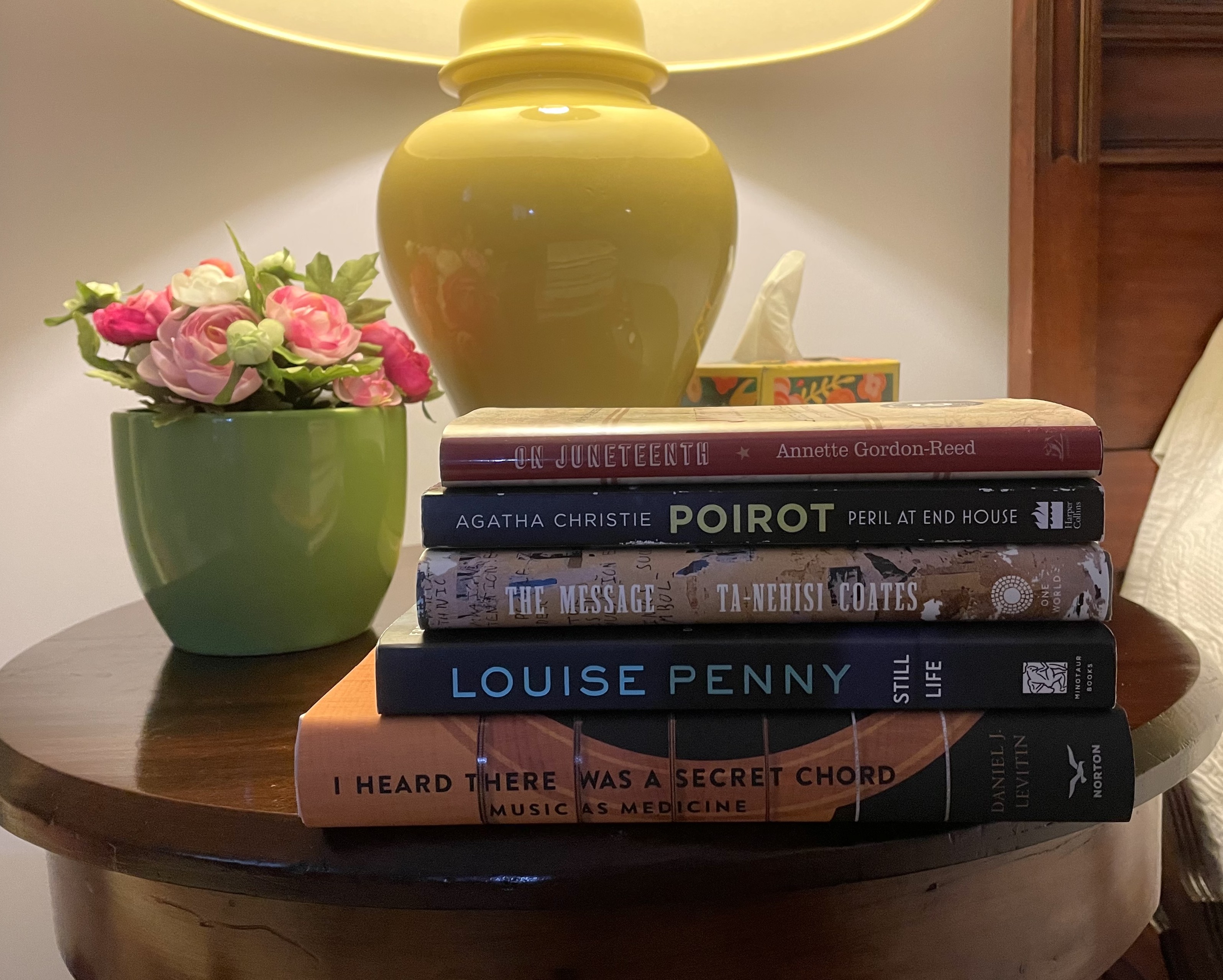
What’s on the nightstand for January (subject to change at the whims of the reader)

Keep reading!

More to come…

DJB


NOTE: Click to see the books I read in November of 2024 and to see the books I read in 2024. Also check out Ten tips for reading five books a month.


Man reading in park from Pixabay