Latest Posts

Our stories tell what we choose to believe

Elizabeth Alexander was raised among monuments. Growing up in Washington, D.C., she was surrounded by them. 

When she was a toddler, her parents took her to the March on Washington in 1963, where hundreds of thousands of protesters brought ebullient life to the steps of the temple-like Lincoln Memorial. When she was a girl, someone told her that the obelisk-shaped Washington Monument was actually “God’s pencil.” As a student, she took field trips to the various memorials whose designs were inspired by Classical architecture. Of these structures, she says she grew to understand “something about their scale and awe.”

She also came to realize everything monuments could distort and elide. . . In the capital, where the breadth of the nation’s history is presumably honored, in a city that in the early 1970s was largely populated by Black people, any depiction of them was exceedingly rare. 

Los Angeles Times, March 14, 2024

Yes, the Emancipation Memorial in D.C.’s Lincoln Park, unveiled in 1876, showed a slave kneeling at the foot of Abraham Lincoln. But that memorial has been rightly criticized for whitewashing the role of Black activists such as Frederick Douglass in ending slavery and for showing emancipated slaves as “kneeling supplicants to a great white savior.” It wasn’t until 1974 that the situation was addressed. That year the “National Council of Negro Women installed a sculpture in honor of educator and civil rights leader Mary McLeod Bethune across the plaza from Lincoln (which was rotated to face her). It was the first monument to honor an African American and a woman on public land in D.C.”

As head of the Mellon Foundation since 2018, Alexander has taken a leading role in helping the country rethink its monuments. The foundation has committed $500 million to study, preserve and recontextualize monuments—as well as remove them when their communities no longer deem them appropriate. 

The foundation website notes that monuments are just as much about the present and future as they are about the past.

Monuments and memorials—the statues, plaques, markers, and place names that commemorate people and events—are how a country tells and teaches its story. What story does the commemorative landscape of the United States tell? Who are we instructed to honor and uplift, and who do we not see in these potent symbols? Does the civic landscape show an accurate picture of our nation, or propagate a woefully incomplete story? 

Alexander says “monuments are a critical part of the civic landscape. For one, they are public—their forms and their messages absorbed by anyone who happens across them. ‘You’re saying this is a focal point,’ she says. ‘This is where we meditate, where we worship, where we are.'” And as a 2021 national audit showed, our monuments do not reflect our diversity as a country nor the diversity of our history.

Monuments to war outnumber those to other causes. Celebrations of white men outnumber everyone else. Confederate leaders Robert E. Lee, Stonewall Jackson and Nathan Bedford Forrest are on that list, as is Junípero Serra, the controversial Franciscan friar who established the mission system in California.

Mermaid statue in San Angelo, TX (photo by Courtney Rose on Unsplash)

Monument Lab’s researchers found that there were more recorded monuments to mermaids (22) than to U.S. congresswomen (2). “The story of the United States as told by our current monuments misrepresents our history,” concluded the report.

Los Angeles Times

Alexander, was a finalist for the Pulitzer Prize in poetry in 2006 for her collection American Sublime, where monuments “materialized in her verses.” And her work on monuments—both as a poet and a major philanthropic leader—has come together in the removal and replacement of the Lee-Jackson windows at the Washington National Cathedral.

Monuments have long been on my mind both professionally and personally, especially monuments around the “Lost Cause” of the Confederacy. As I wrote in 2020, the history portrayed by those monuments of the Southern restoration period tell a false story. The erased history isn’t what is happening today with the removal of the monuments; instead, the erased history is what happened more than 150 years ago, beginning shortly after Robert E. Lee’s surrender at Appomattox.

The whole Lost Cause narrative was to change the story from the South’s defense of slavery—of owning other human beings and treating them as property—to one that puts forward the Southern cause as noble, in defense of states rights, and with leadership that stood as exemplars of old-fashioned chivalry. Defenders of keeping the Confederate monuments today often add that they are about “heritage, not hate.”

But that easy slogan is just not true. 

Now and Forever: Windows by Kerry James Marshall at Washington National Cathedral with Original Poem by Elizabeth Alexander (2023) by Washington National Cathedral tells the story of the decision in 2017 to permanently remove windows that honored Confederate Generals Robert E. Lee and Thomas “Stonewall” Jackson and replace them with two new windows at the nation’s best-known house of worship. This short and informative guide to the process includes essays from the cathedral leadership and the artists, histories of how the old windows came to be gifted in 1953, helpful guides to the artists and fabrication process, and more. Richly illustrated and easily accessible, it helps the reader—and ultimately those who view the new windows by acclaimed American artist Kerry James Marshall and accompanying poem by Elizabeth Alexander—put those works in context.

Cathedral Dean Randy Hollerith and artist Kerry James Marshall in the workshop

In a short but moving forward, Harvard historian Henry Louis Gates, Jr. writes, “Stained glass windows have been a feature of churches since the Middle Ages. But this was a different kind of stain, and it would take another 70 years to cleanse it. We celebrate that cleansing and renewal with this publication.”

Dean Hollerith noted that the Cathedral has worked “to model what it means to be repairers of the breach, both in our own lives and in our life as a nation.” One way forward is to fully understand the power of monuments. Our monuments tell stories. Our stories tell what we believe.

More to come . . .

DJB


UPDATE: In the comments, my friend Sandy Kolb tells a wonderful story about the building of the All American Indian Days memorial in Sheridan, Wyoming. It is a terrific piece of family, community, and regional history and I’m so glad she shared it. Here’s a photo pulled from a local website that shows the memorial and here’s a post with more background and photographs. Many thanks to Sandy! DJB


Photos of Now and Forever windows from Washington National Cathedral.

Looking for solutions

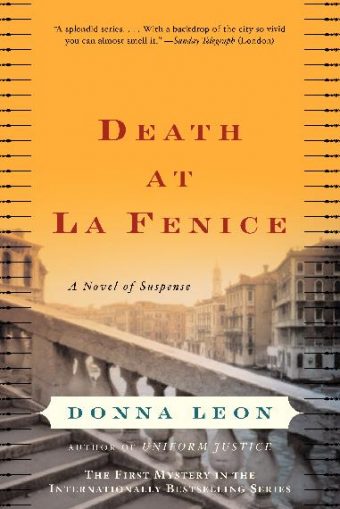
Regular readers know that I began binging on murder mysteries at an advanced age. Age 67, to be exact. After Andrew was gifted a box of Agatha Christie novels one Thanksgiving by our friend Oakley Pearson, I dove in and decided to read at least one murder mystery a month, my self-proclaimed year of reading dangerously.

It seemed appropriate, given the national discussions of 2023.

While I haven’t committed to keeping that same pace in 2024, I have already returned twice to see what else these clever writers have up their sleeves. There’s an inexplicable draw to murder mysteries that some may find difficult to comprehend.

A recent column by Amanda Taub in the New York Times described the appeal perfectly. She, like me, had turned to whodunit fiction—in her case as “a respite from the accumulated exhaustion of a long year, and the more recent stresses of writing about the horrors of the war in Israel and Gaza.” 

But why, if that was my purpose, would I find solace in such an inherently violent genre?

I now realize that what I really craved, and found in abundance in these novels, was solutions. The heart of this genre is not the murders that precipitate the plot, but the process by which they are solved—and, above all, the promise that they will be.

And what makes mysteries comforting even when the events they depict are horrifying?

Unlike the horrors of the real world, or even less formulaic forms of crime fiction like thrillers, the mystery genre promises readers an ending in which their questions are answered and some form of justice is done.

So here I was again, back at the source.

The Mysterious Affair at Styles (1920) by Agatha Christie was her first novel, the result of a dare from her sister Madge who challenged her to write a story. As the Christie website notes, the story begins when Arthur Hastings is sent back to England from the First World War due to injury. He “is invited to spend his sick leave at the beautiful Styles Court by his old friend John Cavendish.”

Here, Hastings meets John’s stepmother, Mrs. Inglethorp, and her new husband, Alfred. “Despite the tranquil surroundings Hastings begins to realize that all is not right. When Mrs. Inglethorp is found poisoned, suspicion falls on the family, and another old friend, Hercule Poirot, is invited to investigate.”

The book has some of the hallmarks of a first novel. There are, for instance, some overwritten passages and it certainly wasn’t my favorite among those I’ve read to date. Hastings can be an annoying narrator at times, so much so that Christie decides to marry him off in a later book and send him halfway around the world. That’s a good choice from my perspective.

Yet the book picks up steam as one moves into the murder itself and then the inquest. Finally, Poirot discovers the missing link when some small detail comes to mind, and he quickly sees that the crime is solved to everyone’s satisfaction. (Well, not to the murderer.)

At the end of the day, The Mysterious Affair at Styles provides a solution, which Poirot is all too ready to explain to Hastings in the final chapter of this period piece by a master of the genre. Like all of Christie’s books, it is a gift that keeps on giving.

More to come . . .

DJB

Image by Arek Socha from Pixabay.

Music for Holy Week – 2024

During Holy Week 2023 I reposted a selection of music that had been curated during the pandemic by our son, Andrew Bearden Brown. Together we featured some of the world’s best vocal ensembles. Church of the Advent in Boston, where Andrew is currently a member of the professional choir, has an outstanding music program, so for 2024 their programming is a good place from which to highlight a piece of music for each of the major days of the week.

I’ll include a listing of the entire program of musical selections for each particular service and then highlight one piece from those selections. The videos showcase some of my favorite vocal groups from around the world.

Church of the Advent, Boston

24 March – The Sunday of the Passion (“Palm Sunday”)

To remember the day of Jesus’ entrance in Jerusalem that begins Holy Week, the musical selections for the 11 a.m. service at Advent are:

Josquin Desprez: Missa “Pange lingua”
Frei Manuel Cardoso: Turbæ quæ præcedebant
Antonio Lotti: Crucifixus à 8
Paul Nicholson: Velum templi scissum est

The chosen selection is Antonio Lotti’s Crucifixus à 8 by Ensemble Altera (where Andrew is also a member).

I have also added a video of Ah, holy Jesus, sung by the congregation to a diminishing accompaniment, at the end of the Church of the Advent’s 2019 Palm Sunday liturgy.


27 March – Tenebræ

Tenebræ is a religious service of Western Christianity held in the evening during Holy Week. One of its most notable visible characteristics is the gradual extinguishing of candles. For this Wednesday service at Advent, the choir will sing:

Gregorian chant
Tomás Luis de Victoria: Versa est in luctum
Paul Nicholson: Velum templi scissum est
Tomás Luis de Victoria: O Domine, Jesu Christe

The featured video is of The Tallis Scholars singing Victoria’s Versa est in luctum.


28 March – Maundy Thursday

The Last Supper
Leonardo da Vinci’s painting “The Last Supper” in Milan, Italy (by DJB)

The fifth day of Holy Week commemorates the Washing of the Feet and Last Supper of Jesus with the Apostles, as described in the canonical gospels. “Maundy” comes from the Latin word mandatum, or commandment, reflecting Jesus’ words “I give you a new commandment.”

The selections to be sung by the choir at Church of the Advent are:

Josquin Desprez: Missa “Pange lingua”
Giovanni Pierluigi da Palestrina: Fratres ego enim accepi
Healey Willan: Ave verum corpus
Thomas Tallis: O salutaris hostia

Once again, I’ll call on The Tallis Scholars for their performance of O salutaris hostia.


29 March – Good Friday

Tomás Luis de Victoria: Reproaches
Giovanni Maria Nanino: Adoramus te, Christe
Thomas Wingham: Vexilla regis prodeunt

The Reproaches have been “sung for many centuries during the Adoration of the Cross at the Celebration of the Lord’s Passion on Good Friday. The structure of the text, alternating between refrains sung by the choir and couplets sung by one or more cantors, allows the length of the music to be adjusted easily to fit the ceremonial.”

A video from nine years ago features the choir at Church of the Advent singing these beautiful Reproaches.


30 March – The Great Vigil of Easter and 31 March – Easter Day

Giovanni Pierluigi da Palestrina: Missa “Papæ Marcelli”
Giovanni Pierluigi da Palestrina: Angelus Domini descendit
Giovanni Pierluigi da Palestrina: Et introeuntes in monumentum
Francisco Guerrero: Sicut cervus desiderat
(for Vigil)

arr Andrew Reid: Victimæ paschali laudes (for Easter Day)

I had difficulty finding a good video of these selections, but VOCES8 has a beautiful performance of the Sicut cervus desiderat by Palestrina that I have chosen to share with MTC readers.

As the hart panteth after the water brooks | so panteth my soul after thee, O God.


Whatever your religious tradition or beliefs, Andrew and I hope you can enjoy the beautiful choral music of Holy Week.

More to come…

DJB

Photo of water lily by Couleur on Pixabay.

Predatory plutocrats

In his acceptance speech at the 1948 Democratic National Convention in Philadelphia, President Harry S. Truman—who was running for re-election and badly trailing in the polls—used the opportunity to call Congress back into an emergency session. Historian Kevin Kruse notes that at their own convention “the Republicans had just passed a platform promising that they would act on rising prices and a serious housing crisis if they won. Truman basically said, why wait? If you believe in those things, do it now.”

President Harry S. Truman giving his acceptance speech at the 1948 Democratic Convention (credit: Truman Library)

After the special session of Congress got nowhere, Truman hit the road in an unusually energetic campaign. He trashed congressional Republicans as “Wall Street reactionaries,” “bloodsuckers,” and “gluttons of privilege.”  The Republican leaders in Congress, he said, were “tools of the most reactionary elements” who would “skim the cream from our natural resources to satisfy their own greed.”  Making the election about more than him or his opponent, he told audiences “If you send another Republican Congress to Washington, you’re a bigger bunch of suckers than they think you are.”

We all know how that turned out.

In this Nov. 4, 1948, photo, President Harry S. Truman at St. Louis’ Union Station holds up an election day edition of the Chicago Daily Tribune, which—based on early results—mistakenly announced “Dewey Defeats Truman.” (AP Photo/Byron Rollins; now in public domain)

That was the election where Truman earned his famous “Give ’em Hell, Harry” nickname. When a supporter yelled that phrase at a campaign stop, he replied, “I don’t give ’em hell. I just tell the truth and they think its hell!”

While they lost the 1948 election, those “Wall Street reactionaries” never went away. And in the subsequent 75 years, the oligarchs and their enablers have built new ways of taking public goods from the people for their own private gain. Now that we have a billionaire (allegedly) on the ballot again for president and we’ve seen how today’s Republican Party has shifted dramatically to support oligarchs and authoritarians worldwide, the issue is once again front and center.

American Oligarchy (2024) by the editors of Mother Jones provides a single-issue focus on the rise and ramifications of the American Oligarchy, pulling back the curtains that have been hiding their rampant pilfering of our country’s wealth. More than two dozen journalists contributed 17 stories to Mother Jones’ 50-page special magazine—the second time in its 48-year history it committed an entire issue to one topic.

We think of oligarchs as Gilded Age tycoons or current-day Russians who built their fortunes on mineral extraction and transportation monopolies. As senior reporter Tim Murphy describes it, “This American oligarchy offers a twist on the pilfering of the commons that produced Russia’s. It is built on a different kind of resource, not nickel or potash, but you—your data, your attention, your money, your public square.”

This is an eye-opening read, as we learn how it’s not only about the spoils but also about “what everyone else is losing in the process.” Our tax policy—which focuses on labor but not wealth—“starves state coffers to fill personal ones.” At its most basic, a small number of people have enormous power and wealth, “and they create a system which is designed to protect their interest.”

We may think of the United States as a first-world democracy that wouldn’t abide oligarchy, yet the fact is that the U.S. stashes the world’s shady cash. The writers dig up information on anonymous shell companies in the middle of nowhere South Dakota, secret trusts, and money-laundering enablers.

And have you wondered why bank ATMs have all of a sudden started featuring $100 bills. No normal person wants them as they are too difficult to break into smaller denominations. But these are the bills preferred by criminals. The rising criminal economy is pushing the growing demand, so the U.S. Treasury is printing more than normal Americans need as we fuel international crime and corruption.

The entire magazine is full of well-sourced information and very much worth your while.

In his recent State of the Union speech, President Biden spoke about taking on monopolies. If the Gilded Age taught us anything, extreme economic concentration yields gross inequality and material suffering. That feeds nationalism and extremist leadership. Biden’s predecessor wants to return to that period and create even more extremes of wealth in America. The President’s vision is different, as he spoke about “a powerful nation, a remarkably good and resilient people, desperate to move beyond this dangerous moment and to find a better path forward here and around the world.”

Historian Heather Cox Richardson notes the echoes of another president in Biden’s defense of the middle class as the engine of economic growth.

Biden sounds much like Democratic president Franklin Delano Roosevelt did when he ushered in the New Deal in the 1930s. In that era, Roosevelt and his Democratic allies replaced a government that worked for men of property with one that worked for ordinary Americans.

There are other echoes of the FDR administration today, she notes, “as Trump’s undermining of aid to Ukraine has become clear. Ukraine stands between an aggressive Russian dictator [and oligarch] and a democratic Europe.” 

In the 1930s and 1940s, the U.S. had to decide whether to turn away from those standing against dictators like Hitler, or to stand behind them. 

What became known as the Lend-Lease Act was central to the ability of the Allied Powers to fight off Hitler, Mussolini, and Hirohito, who were trying to take over the globe in the 1940s. Many in the business community originally opposed it, but as Roosevelt stated so eloquently,

 “And so our country is going to be what our people have proclaimed it must be—the arsenal of democracy…. Never, in all our history, have Americans faced a job so well worth while.”

We’ve defeated American oligarchy before and we can do it again. The first important step is to understand the challenge. Mother Jones has done us all a favor in laying that out so clearly.

More to come . . .

DJB

Yachts in Monoco by Melody Temple on Unsplash.

Onions, celery, and bell peppers

Every state has its claim to uniqueness, but none of them is so “out there” as Louisiana. It has what can truly be called a human gumbo of European, African, Native American, and Caribbean cultures, to name just a few, all mixed together. The northern part of the state is predominantly Protestant while the South is distinctly Catholic. The broad Mississippi River goes along the eastern border of the state before bisecting the southern portion, winding some 337 miles before it empties into the Gulf of Mexico. The state’s laws are based on the Napoleonic Code rather than English Common Law. The Holy Trinity in Louisiana also refers to onions, celery, and bell peppers.

Why Louisiana Ain’t Mississippi . . . or Any Place Else! (2022) by Jay Dardenne with photography by Carol M. Highsmith is a companion book to a Louisiana Public Broadcasting documentary and a beautifully illustrated guide to a fascinating piece of America. Dardenne is a long-time politico who provides an updated look at Louisiana’s demographics, history, economy, and politics in a short but insightful introduction. He writes that Louisianans innately recognize that we’re different. The title of the book “isn’t a knock on our neighbor. It’s just a recognition that our unique blend of religious zeal and joie de vivre exists nowhere else in America.”

The bulk of the book is composed of Highsmith’s wonderful photographs taken throughout the state, capturing the flavor of this place which calls us back again and again.

Carol Highsmith is a photographer who has taken the time to notice and share the wonder. In a remarkable 43-year project, Carol has visited all 50 states and photographed the people and places of this incredible country. Tens of thousands of those images now reside with the Library of Congress. Hundreds of thousands will eventually be donated copyright free to the American people.

Carol was gracious enough to answer a few of my questions about Why Louisiana Ain’t Mississippi and—most importantly—share some of her pictures with the readers of More To Come.


DJB: Carol, how did you become interested in photography and what subjects first drew you in as you were establishing your career?

CMH: In the 70s I traveled to Russia and came home with some amazing images because it was so remote—this is one:

When I arrived home from Russia, I noticed all of downtown Washington, D.C. was under renovation.  I decided to document it . . . starting with the Willard Hotel—this is the first image I took in a broken mirror. And it went from there.

A soon-to-be released book on Carol Highsmith’s work

Louisiana is an incredibly diverse state. Were there particular regions or communities that intrigued you or called out to you to linger as you captured their unique essence in your work?

I worked closely with the staff at Louisiana Public Broadcasting (PBS) and Jay Dardenne who was the Lieutenant Governor of Louisiana and the narrator of the 4-hour documentary on the state of Louisiana that was tied to the book. I’m a Louisiana fan so I love all of it, but they told me what they wanted, and I caught it. The book has done very, very well.

Louisiana ‘Steamboat House,’ New Orleans
Infrared view of a streetcar on St. Charles Avenue in New Orleans. The St. Charles Avenue Streetcar line is the oldest continuously operating street railway system in the world.
Slave quarters at Oak Alley in Vacherie, Louisiana, one of the historic former plantations along the River Road that winds along the Mississippi River. Although it was a sugar plantation, Oak Alley became world famous in the mid-1800s when a slave named Antoine perfected the practice of grafting pecan trees, including those with paper-thin, easily cracked shells.
Flowers sprout in a tiny island within a meandering bayou that flows through Tallulah, a small city in northeastern Louisiana, just across the Mississippi River from the State of Mississippi.
Shadows-on-the-Teche, a National Trust Historic Site in New Iberia, Louisiana

Your photograph of Gayle Benson, the owner of the NFL’s New Orleans Saints and the NBA’s New Orleans Pelicans, was taken in St. Louis Cathedral, where she is a regular lay reader. How did you choose that particular spot in which to capture this influential and powerful woman?

She is very tied to the St. Louis Cathedral so we decided it would mean a great deal to her to have her photograph taken there.  

Gayle Benson at the St. Louis Cathedral, where she is a lay reader
St. Louis Cathedral on Jackson Square in New Orleans.
St. Louis Cathedral Interior in New Orleans

There are so many intriguing, unique, and even wacky characters in Louisiana. Which particular photographs and subjects provided the most fun for you, as a photographer?

Here’s a sampling from the book.

A street musician from New Orleans

Do you have other books in print that capture specific states?

These are all available. You can click on the links to order the books (shipping included) for Arizona . . .

. . . Colorado, and . . .

. . . Wyoming.

Many thanks, Carol.

You’re welcome!

More to come . . .

DJB


The Weekly Reader links to the works of other writers I’ve enjoyed. I hope you find something that makes you laugh, think, or cry. 


NOTE: All pictures by Carol M. Highsmith. Some are from the book and others are from the Louisiana section of the Highsmith Collection in the Library of Congress.

Seeing the world with new eyes

Viewpoint is just a view from a single point. Given that caveat, I’m here to say that from where I stand, cataract surgery is weird.

Wonderful, yes, but weird.

To begin with, once you start telling friends your eyesight is cloudy and you are having cataract surgery, you find out that everyone has had, or is having, cataract surgery. Your next-door neighbor, your best friend, your brother-in-law, your lunchtime companion, your book-club acquaintance. I fully expect someone to tell me that their cat just had this procedure, somewhere between lives number 6 and 7. I’m worried that cataract surgery is just a precursor to hip replacement, another much-discussed procedure in what we third-stage folks call our “organ recitals.”

So yes, I just had a cataract removed in my right eye, the first in a two-step process of receiving new eyes. My doctor (who has done literally thousands of these procedures) and my wife (who went through it a year ago) told me everyone reacts differently and that, in fact, each eye is different. As of this writing—and it is guaranteed to change tomorrow—I have 20/20 vision in my right eye and I can barely read the big “E” on the eye chart out of my left.

My brain is confused.

So that actual “seeing” thing is weird at the moment. In the course of writing this post, I began without any glasses on, then I switched to my “regular” multifocal glasses seeking more clarity. Later I put on my multifocal reading/computer glasses in hopes of a better view, only to give up and take them off entirely.

And then there’s the procedure itself. Here’s my imperfect understanding of the way it works. First, while you are still awake, they use a laser to break the cataract into pieces. You never want to hear the words, “you will feel something pressing against your eye” if you can help it. Then the anesthesiologist gives you her cocktail of drugs (she refused to just go with a bourbon on the rocks) and while you are under they cut a slit (or something) in your eye to take out those pieces and install a new lens. You wake up and voilà—you can see things you couldn’t see before until your brain kicks into gear and tries to adjust to seeing through new eyes.

But this isn’t the weirdest part. That comes when your self-image gets all screwed up along with your eyesight.

You see, I’ve always worn glasses. Always.

Yes, there was a time in life when I didn’t wear glasses, but I was this big:

DJB at Easter in 1958. Hey, I had good-looking legs even then!

Apparently, I kept running into things because somewhere along the way my parents figured out that I needed glasses.

In first grade I was cute but couldn’t see a thing!

I was in the third grade when my mom and dad bought me glasses. The story is that they were appalled at how long they had waited because I was exclaiming over being able to see things like tree limbs for the first time. But they also knew I was an active little guy who would have quickly lost a pair of expensive glasses if they weren’t fastened to my face (figuratively), so they bought an extra-dorky pair (that’s a technical term) that curved around the ear to ensure they stayed on my face.

Here’s a not-so-cute and not-so-happy DJB in 1965 with my new, dorky glasses. I look like I’m ready to go to the office . . . in the 1950s.

My self-image immediately changed. I went from being a hellraising, fun-loving, active kid to a dork whose friends called him four-eyes. (Kids can be very mean.) I still played every sport imaginable, but I had to be careful not to break my glasses. And when I took them off to play football I couldn’t see past my nose, so the coach stuck me in as a lineman. I stopped playing football soon afterwards.

I once went to the doctor to see about getting contacts, but my eyeballs apparently weren’t made for contacts. Which was fine by me, since that whole “touching your eyes” thing is a problem I’ve had my entire life.

I’ll spare you the tedium (and me the embarrassment) of posting my various class pictures through high school. Suffice it to say, my glasses did not become any more fashionable. My parents were all-in on the dorky look. Maybe they got a discount. It was probably because my father was an engineer, where dorky equals cool. Who knows.

When I was able to assert more control over my glasses I tried to go with something that was fashionable for the era, as seen in the family photo from 1974, where Steve and I—in our wire rims—look as if we’ve just taken a break from a country-rock band.

Tom Brown Family
Debbie, Joe, Carol, Daddy, Mom, Steve, and DJB around 1974…the country-rock band era

Again, glasses were very much a part of my self-image throughout adulthood. I wore glasses. Period. Sometimes that look came off better than at others. I rather liked the pair I ended up with in my 60s.

But now my doctor tells me that I probably won’t have to wear glasses for driving and normal activity, but I will need a pair of reading glasses. So, when Candice and I were recently photographed we decided to try both the glasses look . . .

and the naked look (or so it seems to me).

I’m learning about letting go in life. And excessive worry over self-image—which, let’s face it, is all vanity—may be a good thing to jettison. I get it. But who is this guy?

So many of us sleepwalk through the phases of life secure in the comfortable nest of our self-image. Yet we can grow when we open up our inner places and question some of those core assumptions. Perhaps we should take a different viewpoint more frequently. As Marcel Proust once said, “The real voyage of discovery consists not in seeking new landscapes, but in having new eyes.”

Here’s to new eyes, both figurative and literal.

More to come . . .

DJB

Photo: Anne Nygård on Unsplash

A choral focus on epic narratives

A chamber choir of “seamless ensemble perfection” (The Boston Musical Intelligencer), Ensemble Altera is led by internationally celebrated countertenor Christopher Lowrey. Known for “thoughtful programming, passionate performances, and tireless advocacy for the importance of ensemble singing in the broader music culture,” the group has quickly established itself among the finest choral ensembles in North America.

Our son, the tenor Andrew Bearden Brown, is a member of Ensemble Altera, and I recently featured works from their program A Christmas Present, described as “a sumptuous collection of seasonal music written in the new millennium.”

Today I want to celebrate the release of Altera’s first commercial album.

The Lamb’s Journey: A Choral Narrative from Gibbons to Barber, releases in full on March 22nd on Alpha Classics. It is available on CD and on all streaming platforms.

Two of the selections have been pre-released in video version to whet the appetite. O salutaris Hostia by the Latvian composer Ēriks Ešenvalds features the beautiful voices of soprano soloists Eleonore Cockerham and Elijah McCormack.

The second preview track from the debut album is Antonio Lotti‘s Crucifixus, a work for which the 17th century Italian composer is most famous.

Here’s how the Alpha Classics website describes this album:

Altera has devised this musical tour through sacred territories which focuses on epic narratives from various periods, from Renaissance music to the present day. The program includes timeless works by Gibbons, Lotti, Scheidt and Bruckner, as well as twentieth-century compositions by Poulenc, Messiaen and others. Barber’s celebrated Adagio sits alongside the moving Salvator Mundi, taken from Herbert Howells’s Requiem. Not forgetting three world premiere recordings of works written or arranged for Altera by composers Joanna Marsh, Zuzanna Koziej, and Michael Garrepy, who has arranged Were You There?

Upcoming projects for the group “include A New Song: Psalms for the Soul, charting a survey of the Psalms of the Hebrew Bible, in all their dizzying variety, and Feminine Voices, featuring works by female composers for treble voices arrayed around Britten’s Ceremony of Carols.” Additionally, Altera will be making their debut at Carnegie Hall in Brahms’ Requiem, on May 9th with the Orchestra of St. Luke’s.

We’ll be there!

More to come . . .

DJB

Photo credit: Ensemble Altera

From the bookshelf: February 2024

Each month my goal is to read a minimum of five books on a variety of topics from different genres. Here are the books I read in February 2024. If you click on the title, you’ll go to the longer post on More to Come. Enjoy.


Witness at the Cross: A Beginner’s Guide to Holy Friday (2021) by Amy-Jill Levine examines the stories, texts, social contexts, religious background, and perspective of those who watched Jesus die: Mary his mother; the Beloved Disciple from the Gospel of John; Mary Magdalene and the other women from Galilee; the two men, usually identified as thieves, crucified with Jesus; the centurion and the soldiers; Joseph of Arimathea and Nicodemus. Dr. Levine, known as AJ to friends, brings her deep understanding of scripture, insightful commentary, broadness of perspective, and engaging wit to help us consider this climatic moment in the Christian story. AJ also graciously agreed to answer my questions about this work in the latest of the More to Come author interviews.


When We Cease to Understand the World (2021) by Benjamin Labatut (translated from the Spanish by Adrian Nathan West) is a troubling and haunting book that I could not put down “about the complicated links between scientific and mathematical discovery, madness, and destruction.” By taking the real-life discoveries of scientists and adding rich fictional detail to link their compelling stories with real-life consequences, Labatut makes the reader face uncomfortable truths. Labatut “has written a dystopian nonfiction novel set not in the future but in the present.”


Never Forget Our People Were Always Free: A Parable of American Healing (2023) by Ben Jealous is a work of pragmatic and enduring optimism in a sea of national malaise. President of People for the American Way, former president of the NAACP, civil rights leader, scholar, and former journalist, Jealous writes from a lifetime of reaching out to others and listening to what they have to say. In this engaging memoir, Jealous uses a series of more than 20 stories from his life — modern-day parables — to make the point that we must truthfully and fully address the tensions that have been building up throughout this century if we are to survive. And yet he remains optimistic, recalling the words of his grandmother that “pessimists are right more often but optimists win more often.”


The Word in the Wilderness (2014) by Malcolm Guite features a poem for each day of Lent. The season in which we traditionally reorient ourselves, slow down, and recover from distractions is also a good time to change the very way we read. Guite, in this thoughtful forty-day journey, suggests poetry is a good tool to achieve that change. “Poetry asks us to be savoured, it requires us to slow down, it carries echoes, hints at music, summons energies that we will miss if we are simply scanning. In this way poetry brings us back to older ways of reading and understanding both the Word and the World.” In the hands of writers such as the great Irishman Seamus Heaney, poetry — much like prayer — can be “banquet, music, journey, and conversation.”


The Costa Rica Reader: History, Culture, Politics (2004) edited by Steven Palmer and Iván Molina expands the perspectives around this intriguing Latin American nation by bringing new voices to the conversation. “Exceptionalism” is a term often used to describe Costa Rica, which is seen as “different from other Latin America countries.” It has never been consumed by civil strife or race-based oppression, the story goes, and it is the only country to have enjoyed uninterrupted political democracy for three-quarters of a century. Yet as Palmer and Molina write, some observers suggest that exceptionalism is at the center of a dubious mythology. This work is composed of short pieces that give a much fuller understanding of Costa Rica, showing it “as a place of alternatives and possibilities that undermine stereotypes about the region’s history and call into question the idea that current dilemmas facing Latin America are inevitable or insoluble.”


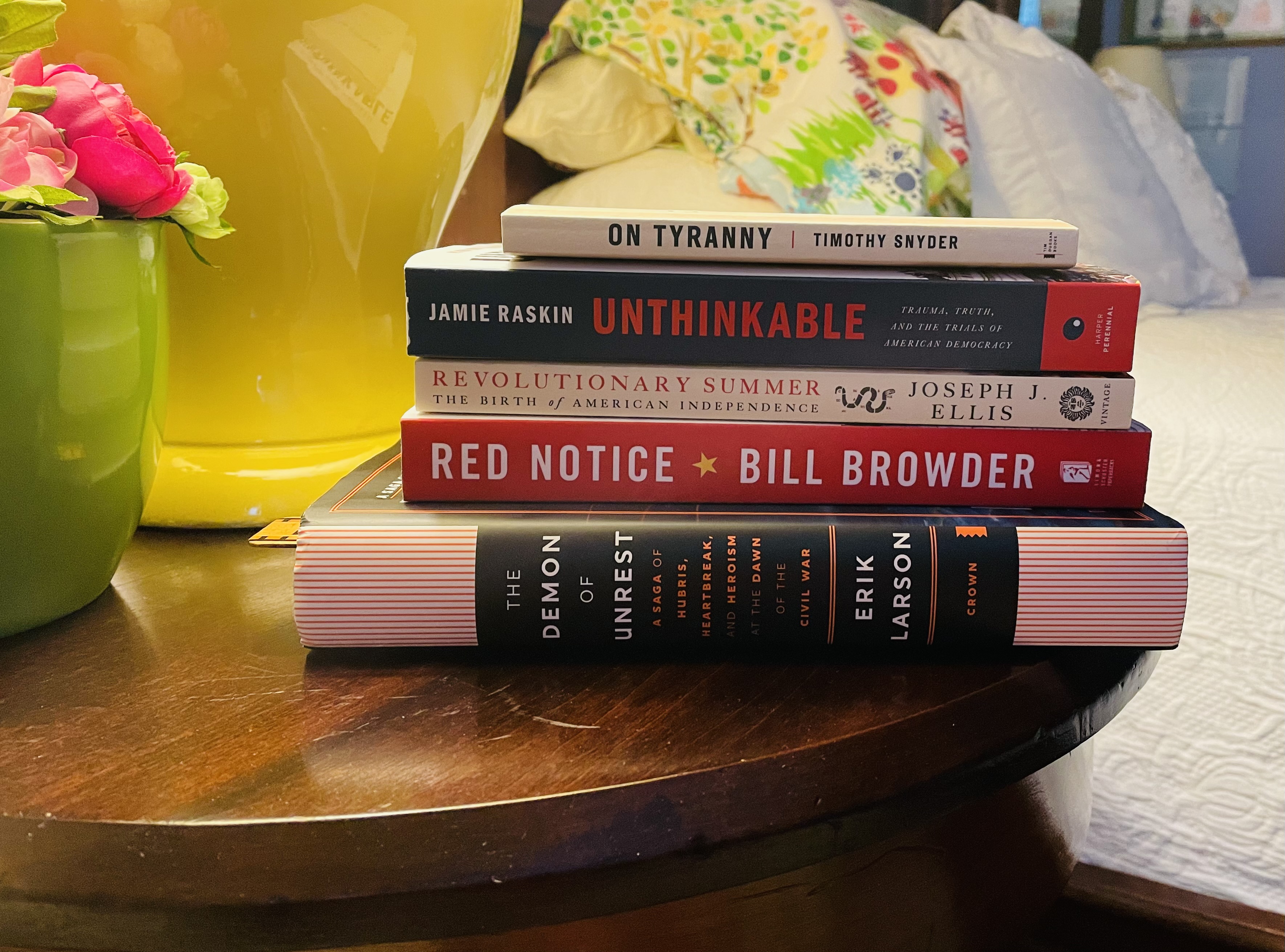
What’s on the nightstand for March (subject to change at the whims of the reader):

Keep reading!

More to come…

DJB


NOTE: Click to see the books I read in January of 2024 and to see the books I read in 2023. Also check out Ten tips for reading five books a month.


The Weekly Reader links to the works of other writers I’ve enjoyed. I hope you find something that makes you laugh, think, or cry. 


Image by Jay Mantri from Pixabay.

When the lines are never clear

We all face profound questions of existence. The way in which we grapple with this existential inquiry has consequences, but for many and perhaps most of us those choices do not change the world. However, some individuals possessing brilliant, far-reaching intellect determine that their discoveries are so important that the impact to their fellow humans is of little consequence in the grand scheme of life. They make choices and follow explorations that literally blow up the world around them.

When they make these choices, the lines between good and evil are too often blurred so that they may pursue their singular study.

When We Cease to Understand the World (2021) by Benjamin Labatut (translated from the Spanish by Adrian Nathan West) is a troubling and haunting book “about the complicated links between scientific and mathematical discovery, madness, and destruction.” By taking the real-life discoveries of scientists and adding rich fictional detail to link their compelling stories with real-life consequences, Labatut makes the reader face uncomfortable truths. Labatut, notes one reviewer, “has written a dystopian nonfiction novel set not in the future but in the present.”

When We Cease to Understand the World is not a work to be taken lightly. The first chapter is a fast-paced trip through the discoveries that alternately saved hundreds of millions of lives and — in the hands of the war machines of the first and second world wars — killed millions of people. Most of what he writes at this point is based on historical fact. It isn’t long before we are “introduced to a blur of real-life characters,”

. . . including the drug-raddled Hermann Göring, who crushed a cyanide capsule in his mouth to avoid the hangman’s rope; the father of computing, Alan Turing, who is reputed to have killed himself by biting into an apple he had injected with the same poison; Johann Jacob Diesbach, the inventor of Prussian blue, the first modern synthetic pigment and the basis of cyanide; and the alchemist Johann Dippel, who may have been the model for Mary Shelley’s Frankenstein.

The real villain here, however, is the chemist Fritz Haber (who died in 1934), who directed the program of poison gas attacks that killed tens of thousands of soldiers in the first world war, an accomplishment that drove his disapproving wife to suicide. Haber also discovered how to harvest nitrogen and make the fertiliser that saved the hundreds of millions of people who would have died in worldwide famines at the beginning of the 20th century. All the same, in the end he was overwhelmed by guilt, “not,” Labatut writes, “for the part he had played . . . in the death of untold human beings . . . but because his method of extracting nitrogen from the air had so altered the natural equilibrium of the planet that he feared the world’s future belonged not to mankind but to plants”.

Haber, Alexander Grothendieck, Werner Heisenberg, Erwin Schrödinger and others are among the luminaries “into whose troubled lives Benjamín Labatut thrusts the reader,” showing us how they grappled with the most profound questions of existence.” Along the way their discoveries and strokes of genius begin to alienate friends and lovers as these individuals of impressive intellect descend into isolation and insanity.

Some of their discoveries reshape human life for the better; others pave the way to chaos and unimaginable suffering. The lines are never clear.

Included on Barack Obama’s Summer 2021 Reading List, this was a troubling book that I could not put down. As the work progresses into the explorations of quantum mechanics, Labatut weaves webs of association across scientists, fields of study, and decades of time. The annihilation of nuclear holocaust is always nearby. He spins more and more fiction into the lives of these individuals, having us imagine what they dreamed, considered, and did as they chased their illusive answers to questions that may not have answers.

There is another part of the book that is troubling, as a perceptive New Yorker reviewer notes.

There is liberation in the vision of fiction’s capabilities that emerges here—the sheer cunning with which Labatut embellishes and augments reality, as well as the profound pathos he finds in the stories of these men. But there is also something questionable, even nightmarish, about it. If fiction and fact are indistinguishable in any meaningful way, how are we to find language for those things we know to be true? In the era of fake news, more and more people feel entitled to “make our own reality,” as Karl Rove put it. In the current American political climate, even scientific fact—the very material with which Labatut spins his web—is subject to grossly counter-rational denial. Is it responsible for a fiction writer, or a writer of history, to pay so little attention to the line between the two?

At the end of this book, Labatut introduces us to “the night gardener” who tends his plants when they’re asleep and won’t be distressed by his interfering with them.

It is to this mysterious figure that the narrator—or Labatut, since the two seem synonymous—gives the last, alarming, word. For the gardener, sums are the root of all contemporary evil: “It was mathematics—not nuclear weapons, computers, biological warfare or our climate Armageddon—which was changing our world to the point where, in a couple of decades at most, we would simply not be able to grasp what being human really meant.”

Some things are, to my mind, mysteries that will not be discovered in this life. Scientific inquiry can help explain the “how” but not necessarily the “why” just as spiritual works and the teachings of the mystics can lead us along the path to the “why” of being human without necessarily being too terribly factual on the “how.” The ToE, or Theory of Everything that the “scientific heirs” of this generation search for may be illusive for a reason.

More to come . . .

DJB

Photo by Jeremy Thomas on Unsplash

A kind of alchemy

America needs more communal singing.

Singing for many of us is something we do because we can. Singing together is something we should do because it helps break down the isolation that tears at too many souls, bringing us together into a supportive community and sustaining us during good times and bad.

An increase in communal singing would be another small step towards healing the estrangements in our civic life. The makers of Jim Beam bourbon certainly understand the value of singing together in an ad appropriately titled People Are Good for You.

I grew up singing at home with my brothers and sisters while mom played the piano. The Fireside Book of Favorite American Songs* and the sad tale of Springfield Mountain are a big part of my memory bank. My sister Carol still has that songbook, cracked spine and all, and she pulls it out occasionally to bring back memories.

I’ve often felt sorry for people who did not have places where they could sing in public. Even when my faith has been clouded by doubt or in moments of darkest despair, I’ve always found solace in the music at church. There I can sing robustly and without self-consciousness and feel unity with the world and release from the world at the same time. Many’s the time during the recessional at funerals I’ve sung the wonderful O God Our Help in Ages Past—with its incredible tenor line—while tears streamed down my face.

A quote widely, but probably incorrectly, attributed to St. Augustine says it best: “He who sings, prays twice.”

In her book Wintering, the author Katherine May speaks to the importance of robins during our coldest months. First, they seem to be around when other birds disappear. “Only in the far north do they migrate, and their bright plumage and friendly habits make them more visible than other birds.”

And they sing through the darkest months.

Other birds “call in the winter” but they are warding off predators, Robins, on the other hand, “engage in full, complex song during the coldest months when its far too early to consider breeding.” The well-fed robin will sing well in advance “of the time that he expects females to act on his display.”

In evolutionary biology, this is known as costly signaling, a gesture that advertises superior strength and vitality, yet by its very nature is potentially dangerous to the creature. A robin sings in winter because he can, and he wants the world—or at least the female robins—to know it. But he is also in practice for happier times (emphasis added).

May then describes what singing means to her, in a way that resonated deep in my soul.

One of the greatest blows was that I could no longer sing [when I lost my voice]. It’s tempting to glibly write, “Not that singing played a huge part in my life,” but that wouldn’t be true. Singing might not be my profession or my ambition, but it has sustained me for as long as I can remember, from attempting harmonies in the car with my mother to warbling along to the radio while I cook. I sang in choirs at school and at university, my low alto knitting with the other voices. Singing with others is a kind of alchemy, an act of expansive magic in which you lose yourself and become part of a whole. I have long been reliant on the stress release of booming out half-remembered choir parts when I’m driving alone in my car.

In twenty-first-century Britain and America, we’ve linked singing with talent. As the father of a professional tenor, I’m all for having professionals perform so we can enjoy their amazing gifts. I think we should even pay them handsomely for their work.

Andrew Bearden Brown, accompanied by Richard Rivale on piano, at Carnegie Hall in January where they performed composer Jake Heggie’s art songs “Friendly Persuasions: Homage to Poulenc” (photo courtesy of Boston University). 

But as May writes, we’ve got it fundamentally wrong if all singing has to be by talented and gifted professionals. And since Andrew recently served as the tenor soloist in the Reston Chorale’s Messiah Sing-Along, I know he would agree.

The right to sing is an absolute, regardless of how it sounds to the outside world. We sing because we must. We sing because it fills our lungs with nourishing air, and lets our hearts soar with the notes we let out. We sing because it allows us to speak of love and loss, delight and desire, all encoded in lyrics that let us pretend that those feelings are not quite ours. In song, we have permission to rehearse all our heartbreaks, all our lusts. In song, we can console our children while they are still too young to judge our rusty voices, and we can find shortcuts to ecstasy while performing the mundane duty of a daily shower or scrubbing down the kitchen after yet another meal.

Like the robin, we sometimes sing to show how strong we are, and we sometimes sing in hope of better times. We sing either way.

Pete Seeger was one of the great artists of the folk revival, in part because he knew—even at age 94—that music was made to be sung together.

Of course, we’re now so used to hearing such amazing versions of Lift Every Voice and Sing—the Black National Anthem—that we forget how wonderful it sounds when sung in community.

And the first link in this post refers to that great anachronistic American tradition of singing Take Me Out to the Ballgame. While it isn’t a “community” version, let’s begin with the Kansas City Symphony and Chorus having some fun with the tune while the Royals were on a World Series run.

And then, how it is traditionally—and best—heard.

Go find a place to sing in community. It’s good for you . . . just as people are good for you.

More to come . . .

DJB


UPDATE:

The British musician Brian Eno was once asked in an interview what he thought about music education in Britain’s school system. He said, “I believe in singing to such an extent that, if I were asked to redesign the British educational system, I would start by insisting that group singing becomes a central part of the daily routine. Group singing builds character and, more than anything else, encourages a taste for cooperation with others.”

In true community, we learn to sing not only with one another but with our world.

Philip Gulley

*1952 edition by Simon and Schuster, dedicated to the memory of Carl Van Doren, author, critic, and authority on Americana.


Photo by Carol Brown Ghattas