Latest Posts

Observations from . . . September 2023

A summary of posts included on MORE TO COME in September 2023.

This year I began to feature Q&As with authors of new books in the MORE TO COME newsletter. It has been a big hit with readers, and I’ve enjoyed connecting with both long-time and new friends who have put their thoughts into words and shared those with the reading public.

Two of those authors have had recent accolades that deserve special mention.

First, my former National Trust colleague Joseph McGill, Jr. had his book Sleeping With the Ancestors mentioned in the New York Times. You can read my July Q&A with Joe here. And then just last week, long-time friend and author Janet Hulstrand was featured in a Politics & Prose book talk around her memoir A Long Way From Iowa. You can read my February Q&A with Janet here. Congratulations to both Joe and Janet!

Look for the sixth of my author Q&As next month. But for now let’s jump in and see what was on my mind in September.


BACKUP CATCHERS AND SERVANT LEADERSHIP

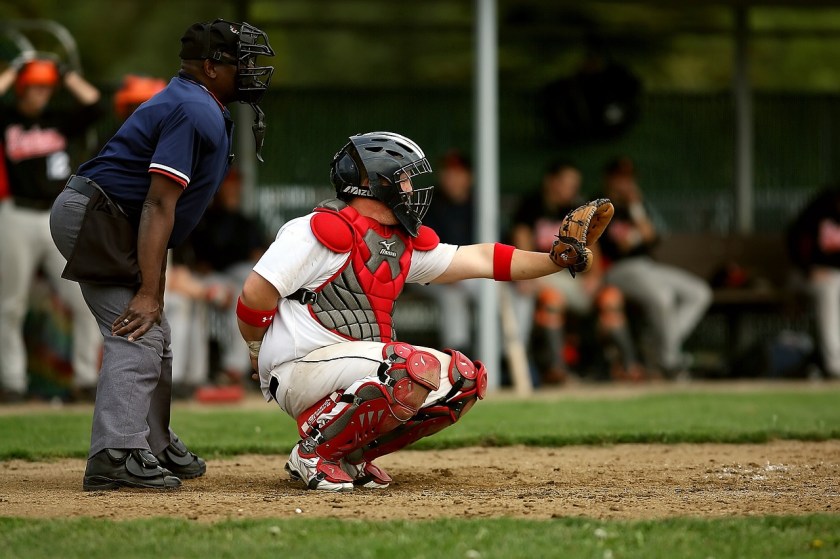
The post with the most views in September is one where I actually missed the lede. Go figure. In Ode to the backup catcher, I tied thoughts on retirement (Stephen Strasburg’s and others) together with a review of The Tao of the Backup Catcher: Playing Baseball for the Love of the Game. This little gem of a book starts slow but becomes a powerful take on servant leadership. That may not be abundantly clear from my review, but the post is still worth reading.


OTHER WORKS FROM THE BOOKSHELF

In addition to backup catchers, I read about exuberant aging, bathtub murders, flatboat expeditions, and biodiversity. Just another typical month.

  • Living exuberantly is my look at the latest from Margareta Magnusson. Her take on aging exuberantly gave me the opportunity to opine about Bach cantatas and beautiful fall gardens (on a visit to the Duke chapel to hear Andrew sing), ballparks full of pyrotechnics and cities with flying pigs (on a recent trip to Cincinnati), and the bending of the elbow with former colleagues and good friends. 
  • In my year of reading dangerously™, I turned to Dorothy Sayers and her book Whose Body?, which is reviewed in A classic of detective fiction turns 100. This is where you’ll find the bathtub murder.
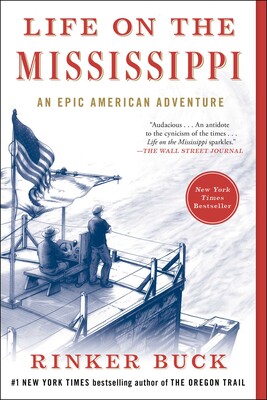
  • Luxuriating in the stream of time is my review of the fascinating and informative account of writer Rinker Buck (who names these guys?!) and his trip down the Ohio and Mississippi rivers from Pittsburgh to New Orleans on a wooden flatboat.

WE LIVE IN INTERESTING TIMES

Interesting doesn’t always equate with normal or easy. But these are the times we have, so here are my takes from September.

  • When U.S. District Judge Tanya Chutkan set the start date for former president Trump’s trial on four criminal counts for his efforts to overturn the results of the 2020 presidential election, multiple bells went off in my brain, resulting in A date with history. March 4th, until 1936, was when presidential inaugurations were held. Lawmakers chose that date because it was the one on which, in 1789, the Constitution went into effect. Priceless. It is also the only date that is a command. Oh, and it is my birthday.
  • Being alert to media framing ― as I discuss in Bad and broken frames ― helps us understand the challenges we face to shift our national conversations toward support for democracy.

IF YOU DON’T LIKE MY MUSIC CHOICE THIS SATURDAY, JUST WAIT A WEEK

My Saturday Soundtrack pieces in September covered an even broader range than is normally the case. Thus the meaning behind the title. I don’t expect everyone to like each featured artist or genre, but chances are I’ll get around to your favorites in a few weeks. In the meantime, check out:

  • A terrific new album by Rhiannon Giddens as featured in You’re the One. Giddens, the two-time GRAMMY Award and Pulitzer Prize-winning singer and instrumentalist, is more than willing to explore the past and future together.
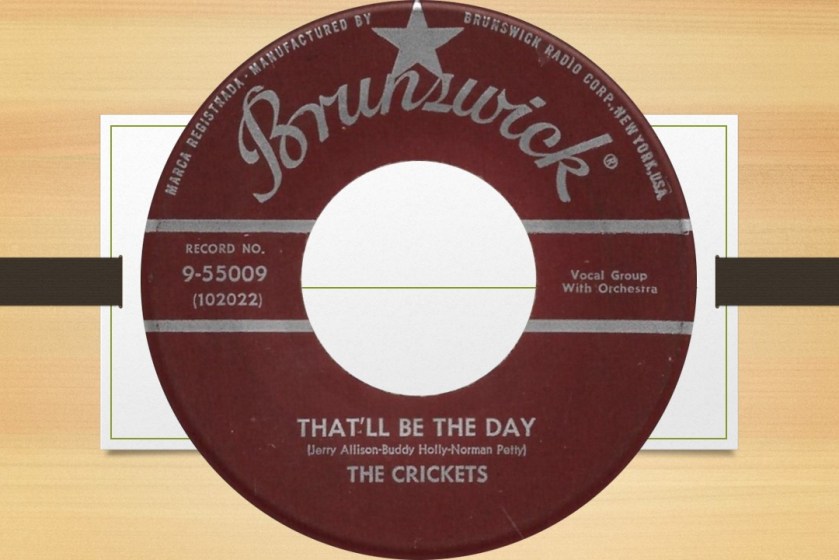
  • And then take a stroll down Rock & Roll memory lane with That’ll Be the Day and find out why it had worldwide impact . . . in unexpected ways.

WHATEVER ELSE TICKLED MY FANCY

  • At the break of day is a reminder of the beauty of sunrises and sunsets I’ve seen ― from Alaska to Asheville, Cambodia to DC, Dublin to the Dutch Caribbean, the Grand Canyon to Mohonk, and more.
  • I’ve never liked the sound of the word “blog.” It just grates on my ear. Searching for the right word is a short piece where I banish it from MORE TO COME. One of my editors thinks I can still find a better word. *

CONCLUSION

Thanks, as always, for reading. Your support and feedback mean more than I can ever express.

As you travel life’s highways be open to love, thirst for wonder, undertake some mindful walking every day, recognize the incredible privilege that most of us have, and think about how to put that privilege to use for good. Women, people of color, LGBTQ+ individuals, immigrants, and others can feel especially vulnerable . . . because they are. Work hard for justice and democracy as the fight never ends.

Bash into some joy along the way.

And finally, try to be nice. Always be kind.

More to come . . .

DJB


For the August 2023 summary, click here.


*What . . . this thing has “editors”?!?


You can follow MORE TO COME by going to the small “Follow” box that is on the right-hand column of the site (on the desktop version) or at the bottom right on your mobile device. It is great to hear from readers, and if you like them feel free to share these posts on your own social media platforms.


Photo of creek by Pexels from Pixabay

The earth is our home

In considering why anyone should give a second thought about a plant moving toward extinction with the name of the hairy beardtongue, one author — writing in the 1990s — asks us to first consider periwinkles. There are six species of periwinkles growing on the island of Madagascar, he notes. Halfway around the world, they might seem just as inconsequential as our hairy beardtongue. Yet one of those species, the rosy periwinkle (Catharanthus roseus) . . .

. . . is the source of alkaloid chemicals vinblastine and vincristine, used to cure two of the most deadly forms of cancer: Hodgkin’s disease, especially dangerous to young adults, and acute lymphocytic leukemia, which, before the periwinkle alkaloids, was a virtual death sentence for young children . . . Ironically, the other five periwinkle species remain largely unexamined for their medical potential. One of them is near extinction due to the destruction of its habitat.

On a global scale, one out of ten plant species has been found to contain “anti-cancer substances of some degree of potency.” And we simply don’t know what we’re losing.

The Hairy Beardtongue

What we do know is that we lose them at our peril.

Biological Diversity: The Oldest Human Heritage (1999) by Edward O. Wilson is a short introductory book designed to make the case that no species should be allowed to go extinct, if possible. Originally written after a keynote address at the first New York Natural History Conference in 1990, Wilson — by that time a highly decorated and somewhat controversial natural scientist who had already won one Pulitzer Prize for his book On Human Nature and was soon to receive a second for The Ants — wrote this work to educate young people about the importance of biodiversity, the threats to it, and our response.

With original natural history illustrations by Patricia Kernan the book was designed to not only be helpful to high school biology students but to anyone “interested in preserving the integrity of earth’s delicate ecosystems through awareness and education.” I happened to find the pamphlet tucked away in our bookcase at home (speaking of habitats with many undiscovered elements), and despite its occasionally dated text and data the basic premise still strikes me as inordinately valuable in today’s world.

We don’t have much time to waste if we want to reverse the trends of loss in biodiversity. Human-induced changes to the habitat come with “such a velocity that it is too great for life to handle.” We are inducing change at such a rapid pace — merely a tick in geological time — that species do not have time to adjust.

Wilson makes the pronouncement early in the book that “Simple prudence dictates that no species, however humble, should ever be allowed to go extinct if it is within the power of humanity to save it.” Later the book provides an example of a species that we saw on our recent trip to Alaska, the musk oxen, that was near extinction.

Small populations of Musk Oxen live in Arctic regions, in some areas due to reintroduction. They huddle together when threatened, an effective defense against predators such as wolves, but one that allowed easy slaughter of whole herds by humans in the 18th and 19th centuries.

The Musk Ox

I’m not a scientist and have never had much of a bent toward the natural sciences. But I’m working hard to catch up on some of the basics. In travels around the world as well as in our hometown, I can see how habitats are being destroyed, to the detriment of the planet and life.

In the preservation and planning field we talk about the gobbling up of land that was once in a more natural state. A colleague recently wrote that by the year 2020, Peoria, Illinois — that town known in our culture as representative of middle-America — had more than doubled in size geographically since 1920 yet the population had stayed relatively the same. Now the same number of people are taking up twice the space as was true 100 years ago, for no real reason other than bad planning decisions and greed. You can repeat this scenario of open-space loss in town-after-town across America. I suspect that no matter our personal lenses, we can all see the problem easily enough if we try.

I am a fan of the printing of lectures and other short presentations by museums, nonprofits, and other educational institutions as an easy-to-access introduction. This one gave more context to some of the recent works I’ve been reading, and enourages me to explore more.

Science is just one of many tools we use to understand the world. But curiosity and wonder help expand our knowledge. Reading widely about topics in which we are not expert helps us accept change more readily as we broaden our worldview. This is another small step along my path.

More to come . . .

DJB


Related posts on MORE TO COME:


The Weekly Reader links to the works of other writers I’ve enjoyed. I hope you find something that makes you laugh, think, or cry. 


Image by Adina Voicu from Pixabay

Thank you, Sean Doolittle

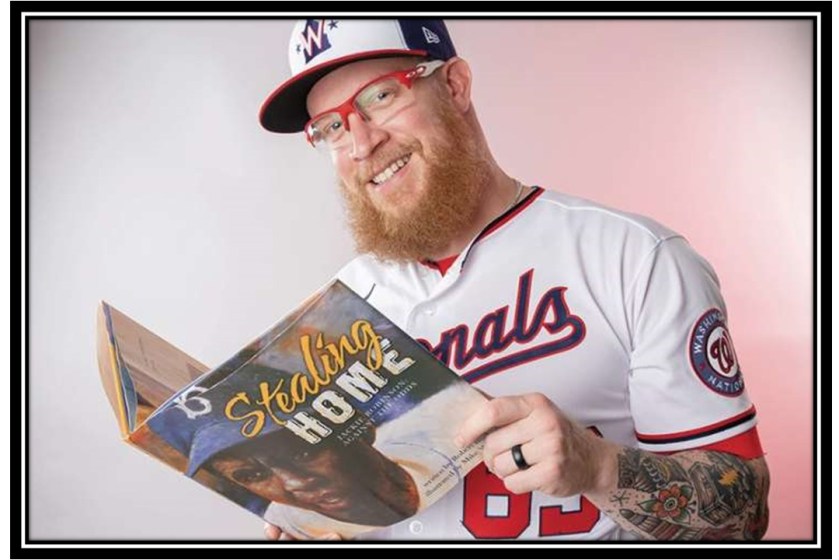
This will be short. I just wanted to say how much I love Sean Doolittle, who retired on Friday after 11 years in the majors, six of them with the Washington Nationals. As he wrote in his farewell message, he was retiring “with gratitude and a full heart.”

Many Nats fans have the exact same feelings.

No Nationals player between the amazing 2012-2019 run of success for the club was more a Washington-type person than Sean Doolittle. Not Bryce Harper who couldn’t wait to get out of town for the bigger money in Philly. Not Tony “Two-Bags” Rendon who really didn’t feel at home here even though he was indispensable during the 2019 championship run but then decided to accept a big offer from the Angels, the team where dreams go to die. Not even those players who really didn’t want to be traded and loved it here, the Max Scherzers, Trea Turners, and — the deepest cut of all, Juan Soto. Not even Ryan “Employee 11” Zimmerman who always felt more like a Northern Virginia-type to me than a District guy.

Doolittle and his wife Eireann Dolan, who is beloved by Washingtonians in her own right, made this city their “forever home.” As Chelsea Janes wrote in a beautiful piece for the Washington Post, Doolittle “felt like someone (Nationals fans) knew, the guy down the street who worked for the environmental nonprofit and sat in independent bookstores wearing Birkenstocks in his free time.”

For Doolittle, his appreciation for the opportunity to be a major league pitcher is real. He thanked the A’s, the team that originally drafted him. He thanked the Cincinnati Reds and Seattle Mariners for hosting him for a “gap year” in 2021, before he could return to the Nats. He thanked the union, which provided the working conditions and labor contracts where he could work through his numerous injuries and still be able to close out the wild and wacky Game 6 of the 2019 World Series, and which expanded to include minor leaguers under their bargaining umbrella. He said that 2019 was the highlight of his career, just as the year was the highlight of a lifetime of watching baseball for so many of us in Washington.

As Joe Posnanski posted today, Doolittle’s wife Eireann “wrote the most beautiful of summations of Sean’s wonderful and unlikely career.”

“Watching Sean’s career for the past decade,” she wrote, “has always felt a bit like seeing a Subaru Forester in the Daytona 500. Part of you is like, ‘Who the hell let that thing in there?’ And the other part kind of just wants to see how far it can go. Turns out farther than you’d think.”

Cleats Sean Doolittle decorated in 2019 for trans and gay rights during Pride Month. (Photo by Sean Doolittle via the Washington Blade)

Doolittle and Dolan used his platform to speak out for marginalized communities including LGBTQ citizens, and to promote causes such as literacy. He had an “ability to earn respect as the nerdiest guy in almost every classically macho clubhouse he entered,” Janes wrote. And Washington just loves nerds, especially those who are thoughtful, grateful, and somehow still relatable. It doesn’t hurt to be able to throw high heat past hitters.

So, I guess this was a little longer than I expected. But that’s okay. Sean Doolittle deserves it.

I can’t wait to see what he and Eireann do next in DC.

More to come . . .

DJB


Image of Sean Doolittle set to host a Storytime event in 2022 at Central Library in Arlington (via Arlington Public Library)

Living exuberantly

You have to love a book where the first chapter is an exhortation to have a gin and tonic with a friend, followed by another encouraging the reader to eat chocolate daily. These seemingly glib indulgences led me to think about Bach, ballparks, and the bending of the old elbow. Stick with me here, it’s a fun ride.

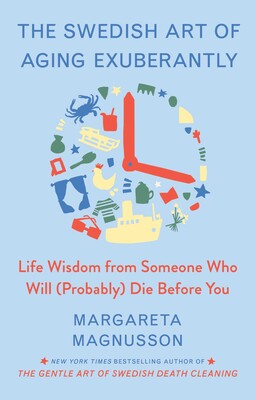
The Swedish Art of Aging Exuberantly (2022) by Margareta Magnusson is a witty look at how to live and age gracefully well into your final third of life. Magnusson was introduced to the world through her bestseller The Gentle Art of Swedish Death Cleaning (or the clearing out of your unnecessary belongings so others don’t have to do it for you). This follow-up work — which is a short 140 pages because “old people don’t want to read 400 pages” — is a humorous yet useful look at how to approach life when more of it is behind you than ahead. It is simple and pragmatic advice.

Part memoir and part acquired wisdom from more than eight decades on earth, Magnusson encourages us not to fear death but to focus on what’s important now: beauty, friends and loved ones, those less fortunate, leaving a better place for your children and grandchildren. Along the way her advice includes admonitions to wear stripes (she likes them), live within your means, don’t resist new technology, let go of what doesn’t matter, keep an open mind, spend more time with young people, and have that gin and tonic with a friend on a regular basis. As one reviewer noted, these suggestions allow Magnusson to “philosophize on life’s greater meanings.”

The chocolate she recommends is a thumb in the nose of diet culture. The gin, instead of encouraging alcoholism, is a reminder to stop and smell the juniper berries while catching up with those who have known you the longest.


I finished reading this book between two weekend trips that were my own little effort to live exuberantly. The first was a trip to Durham to hear our son, Andrew Bearden Brown, perform as the tenor soloist in Cantatas BWV 60 and 95 as part of the Bach Cantata Series of the Duke Chapel music series. Andrew was superb, singing before a close-to-full house of appreciative patrons and his delighted parents. The weekend gave us the opportunity to live exuberantly in the midst of the beauty of the music, the extraordinary architecture of the chapel, and the glory of nature’s offerings in the Sarah P. Duke Gardens.

Morning sun on the Duke Chapel
Duke Gardens on a picture-perfect day

Then, for something completely different in the exuberance department, I flew to Cincinnati this past weekend to meet up with a former colleague and watch a Reds game. Yes, per Magnusson’s suggestion, adult beverages were consumed along the way.

This has been a great year for meeting friends over a baseball game.

With my dear friend Ed Quattlebaum for a chilly April game at historic Fenway Park in Boston
Catching up with long-time friend and former colleague John Hildreth at Nats Park in July
Taking in my annual game at Nats Park with “Two-Dollar Tom” Cassidy in August … over an adult beverage*
With my former colleague Lisa Thompson last Friday at Cincinnati’s Great American Ballpark

As readers and friends know, I am on a bucket-list quest to visit all 30 Major League ballparks.** Because the Reds are so much fun this year, I made the decision to take advantage of frequent flyer miles and check another park off the list.

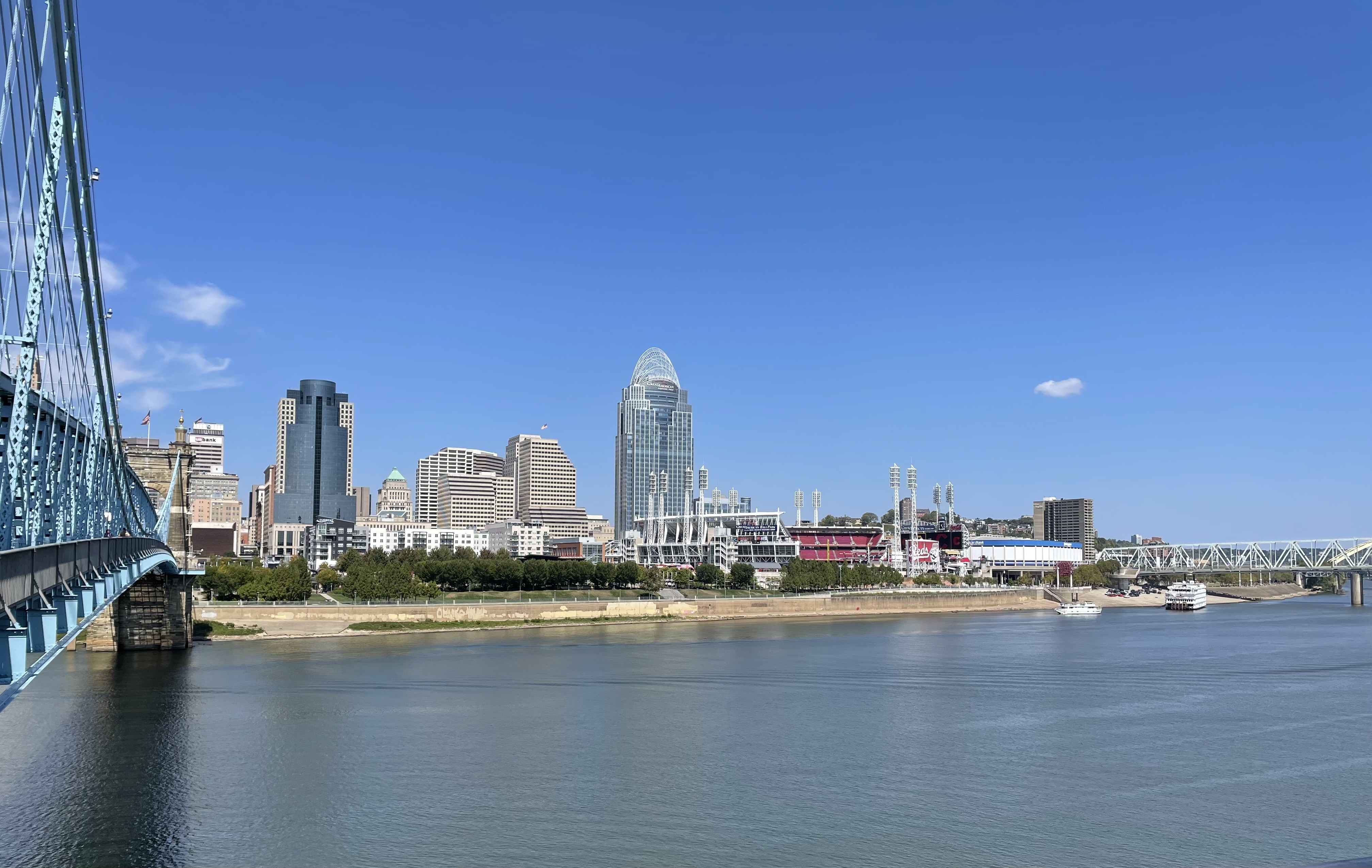
Ballpark as seen from across the Ohio River
On the streetcar to the game

Cincinnati was once the nation’s predominant port processing site, earning it the nickname “Porkopolis.” Today that’s celebrated in art.

Outside the ballpark with one of the city’s many pigs. No comments about the similarity in profiles.

Inside the ballpark: homage to the nation’s first professional baseball team, the Cincinnati Red Stockings, and a view of the field.

The fans love the park’s pyrotechnics — fireworks for a homerun and flames of fire for striking out an opposing player.

Alas, the Reds — in the midst of a race to secure a playoff spot — saw their bullpen implode in a 7-5 loss to the Pirates. As Joe Posnanski wrote, relievers with the “alien-made-up-name” of Buck Farmer and “Irish Poet” Ian Gibaut each had blown saves.***

I took advantage of the trip to see other delights of the city before flying home on Saturday afternoon.

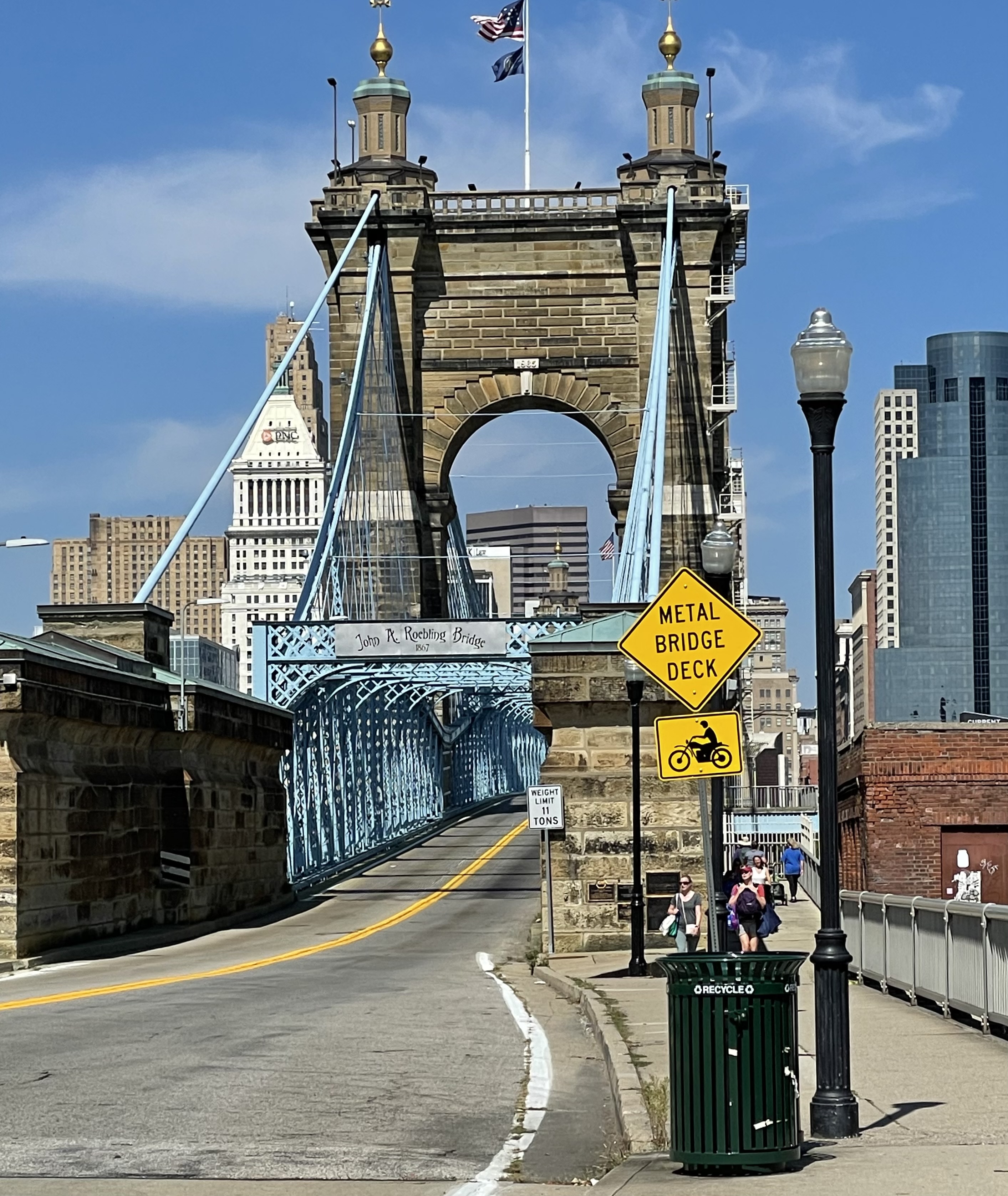
Walking across the Ohio on the historic John Roebling bridge (same engineer as the Brooklyn Bridge)
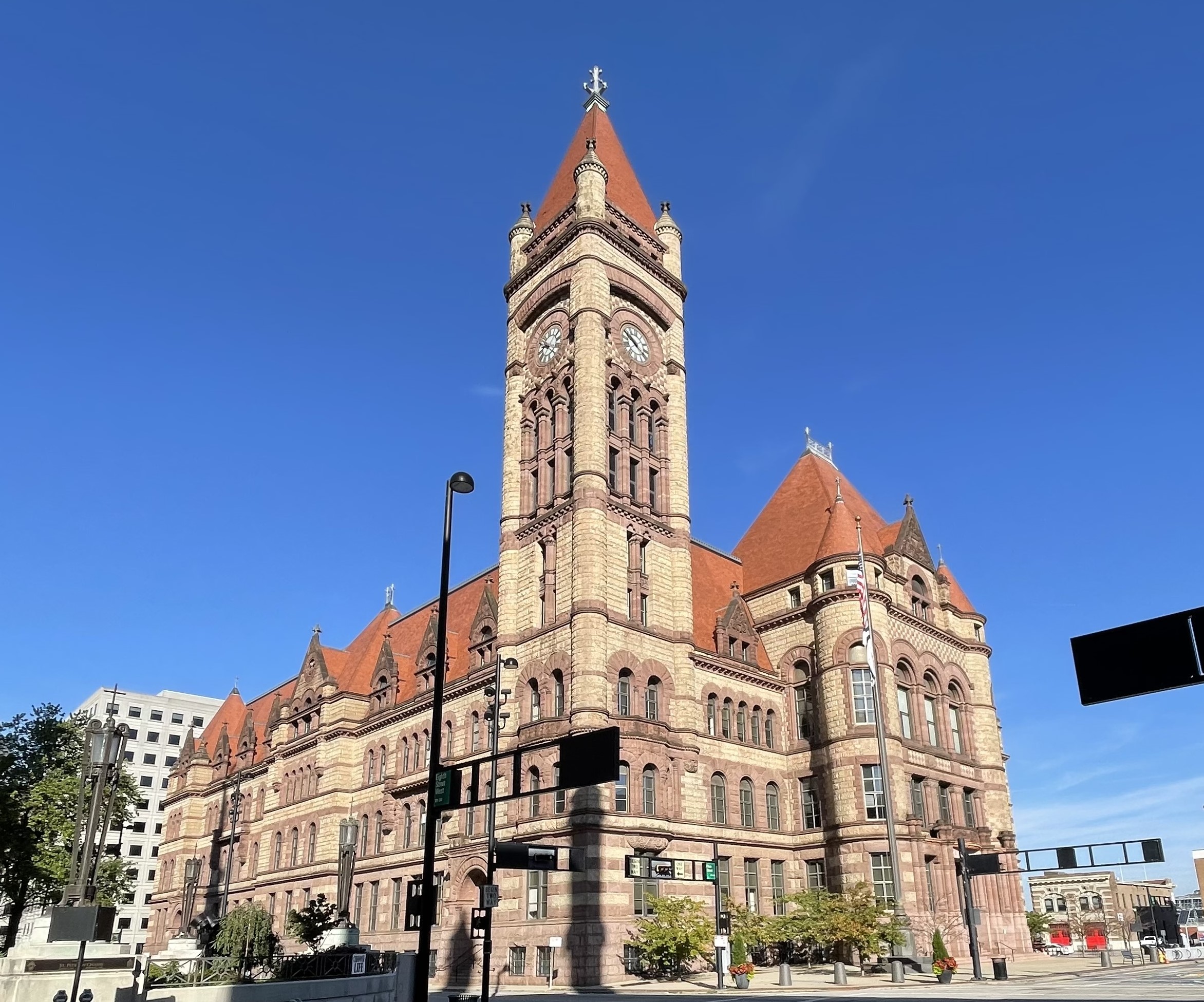
The Samuel Hannaford-designed City Hall
President Garfield statue
The James Keys Wilson-designed Wise Temple
Downtown architectural details
The Netherland Hotel — my home for the trip and home to the Palm Court bar, where I enjoyed a good Kentucky bourbon . . . just across the river in Ohio.

Here’s to living life large and exuberantly, no matter the age!

More to come …

DJB


*Tom gives two-dollar bills as tips to the staff at the beer stand. They’ve given him the nickname “Two-Dollar Tom.”


**I do have some rules for this quest. First, drive-by viewings don’t count. I have to actually see a game. I use to buy a hat of the local team to prove I’d been there, but it was suggested that I have enough caps — so that’s no longer necessary.

Finally, demolitions have wreaked havoc with these plans. I decided — in a totally arbitrary way since I am the commissioner and umpire for this game — that if I’ve seen a team in their home ballpark that has since been demolished, then it counts against my list.


***It got worse the next day as the Reds blew a 9-0 lead to lose 13-12.


Here is the list of teams/ballparks still to be visited. Let me know if you’d like to join me in seeing one or more of these ballparks.

  • Arizona Diamondbacks – Chase Field
  • Detroit Tigers – Comerica Park 
  • Los Angeles Dodgers – Dodger Stadium 
  • Miami Marlins – Marlins Park 
  • New York Yankees – Yankee Stadium (I know—how can I not have made it to Yankee stadium yet?! Just goes to show I’ve never been a big Yankees fan.)
  • Texas Rangers – Texas Stadium 
  • Toronto Blue Jays – Rogers Centre

Image by Ernest Roy from Pixabay

That’ll Be the Day

Buddy Holly has a special place in the history of Rock & Roll music. A central and pioneering figure of the mid-1950s, Holly was born in Lubbock, Texas, during the Great Depression. A member of a musical family, he learned to play guitar and sing alongside his siblings. Holly’s music was influenced by gospel, country and R&B.

Here’s how his Rock & Roll Hall of Fame essay begins:

Rock & roll as we know it wouldn’t exist without Buddy Holly.

The bespectacled ’50s teen idol roughed up familiar musical influences — rhythm & blues, rockabilly, country & western — with upbeat tempos, a jittery vocal approach, and youthful lyrics filled with edgy declarations of love, lust and heartbreak.

On September 23, 1957 — exactly 66 years ago today — That’ll Be the Day by Buddy Holly and the Crickets reached #1 on the charts in the US.

Despite Buddy Holly’s untimely death at age 22, his influence was felt around the world.

Glasses Sign near the Clear Lake Crash Site by Dsapery at English Wikipedia

Daniel Immerwahr, in his brilliant How to Hide An Empire, describes one of the perhaps unexpected ways Holly had influence on other musicians.

Liverpool England in the 1950s was near one of the largest U.S. bases in the world, Burtonwood, which was the gateway to Europe. The American influence on the area was enormous in all sorts of ways. One we may not immediately identify is entertainment. U.S. soldiers at Burtonwood looked for music that sounded like home (among other pleasures). Four musicians from the city were more than happy to oblige. While the rest of England was stuck in the vaudeville era, Liverpudlians had a special advantage with access to American records — especially from African American artists — and a big financial incentive to master that music. The first song that the Beatles recorded was a Buddy Holly cover. “They cut it in 1958, the same year the antinuclear marchers moved on Aldermaston” (a nearby nuclear facility in England) so that the Beatles and the peace symbol debuted within months of each other and were both side effects of the U.S. system of placing military bases around the globe.

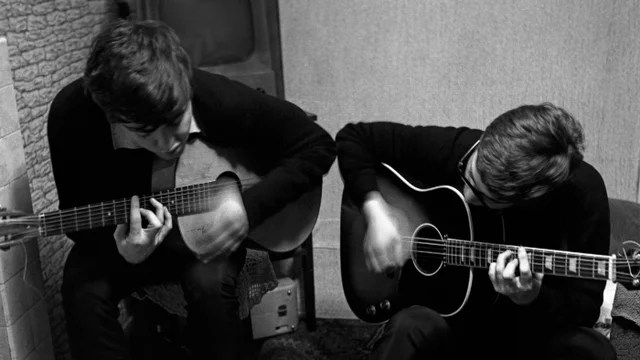
Paul McCartney (left) and John Lennon (right) practicing in the living room of McCartney’s boyhood home (credit Michael McCartney via the British National Trust)

The song they recorded — when they were still known as The Quarrymen — was That’ll Be the Day.

My favorite version of That’ll Be the Day was by Linda Ronstadt. Here’s the Wikipedia entry with just the facts:

Linda Ronstadt recorded “That’ll Be the Day” for her 1976 Grammy Award-winning platinum album Hasten Down the Wind, produced by Peter Asher and issued by Asylum Records. Her version reached number 11 on both the U.S. Billboard Hot 100 and the Cash Box Top 100 and number 27 on the Billboard Country Singles chart . . . This recording is included on the album Linda Ronstadt’s Greatest Hits (1976) and on the 2011 tribute album Listen to Me: Buddy Holly.

But That’ll Be the Day is important for so much more than the facts. It is a look into the heartbeat of 1950s music and the seismic changes that were underway, and Ronstadt nails that vibe in her interpretation. I heard Linda and her knockout band live twice in the 1970s, and this song was always a highlight. Guitarists Waddy Wachtel and Andrew Gold are smoking in this version from a live German concert, and Rondstadt’s powerful voice is unparalleled among rock singers.

Enjoy this special ride down the Rock & Roll memory lane!

More to come …

DJB


Also on MORE TO COME:


A classic of detective fiction turns 100

While standing in the mystery section of the Silver Spring Public Library on a recent summer day, I did a quick Google search on the best crime novelists of all time. Up popped the name of Dorothy L. Sayers, a pioneer in the genre, with the suggestion that I try the first of Sayers’ books to star the amateur detective Lord Peter Wimsey. Thankfully, my library had a copy!

It was only when I returned home that I discovered that this classic of detective fiction tuned 100 years old in 2023, making it the perfect next addition in my “year of reading dangerously.”

Whose Body? (1923) by Dorothy L. Sayers is a delightful period puzzle that turns deadly serious for Lord Peter as he works to find the answer to two mysteries. As the book opens he receives a call from his mother, the Dowager Duchess of Denver, asking for his assistance in helping clear her architect of suspicion of murder. It seems that overnight a body, clad only with a pair of fashionable pince-nez, has appeared in his bathtub. At the same time, a famous London financier vanishes from his bedroom across town, leaving no trace. The body in the bathtub is not that of the financier, so whose body is it? The police do not suspect that the two cases are connected, but Lord Peter has his doubts.

Lord Peter Wimsey is the first in a long line of British gentlemen amateur sleuths to appear in crime novels over the next 100 years. Independently wealthy he is nonetheless without the responsibilities of peerage which passed to his older brother, the Duke. Lord Peter (the title is a courtesy one only as he is not a peer and has no right to sit in the House of Lords) is intelligent and athletic, graduating from Oxford with a first-class degree in history and a reputation as an outstanding cricket player. From a 21st century perspective, it is fair to say that his Wikipedia entry is very impressive for a fictional character in a series of crime novels!

Whose Body? is definitely a period piece, and because the dialogue seeks to be faithful to the backgrounds of the various characters, not always as easy a read as an Agatha Christie novel of roughly the same vintage. However, Sayers constructs a delightful tale with memorable heroes and villains. Thanks to the help and insights of his valet, Bunter, a skilled amateur photographer, Lord Peter becomes convinced that the two cases are linked. He proceeds on that assumption despite the skepticism of the police, including Detective Parker of Scotland Yard who works with him to untangle the two cases.

What begins as something of a simple assignment for Lord Peter turns very serious as he experiences trauma from his service in World War I just before he has to confront the man he is convinced is the murderer. Sayers does us the favor of having the murderer write a rather lengthy confession to Lord Peter, just to make sure we have connected all the various dots.

As Sarah Weinman, who writes the monthly Crime & Mystery column for the New York Times Book Review said in an appreciation of Whose Body?, “the novel is pure pleasure to read, fulfilling a desire for escape — something readers want as much now as they did 100 years ago.” This was also Sayers’ first crime novel, and “(w)hat elevated Sayers’s debut to the upper ranks of the genre was the quality of her prose and the sense that her sleuth had more emotional heft than he displayed.”

At the time, Sayers was one of relatively few women writing detective fiction. Agatha Christie’s “The Mysterious Affair at Styles,” which introduced Hercule Poirot, had appeared three years earlier. While Margery Allingham would go on to publish her debut, “Black’erchief Dick,” not long after “Whose Body?,” she wouldn’t create her own gentleman sleuth, Albert Campion, until 1929 — the same year that Josephine Tey’s first mystery, “The Man in the Queue,” came out. Ngaio Marsh didn’t publish her first novel, “A Man Lay Dead,” until 1934.

Whose Body? takes the reader back, in more ways than one, to so many of the elements of the crime novel that generations of readers have come to enjoy. If you’ve never read it, or if it has been a number of years, now may be a good time to be introduced, or reintroduced, to this classic.

More to come …

DJB


To see reviews of the other books in my year of reading dangerously (i.e., mystery novels), click here for JanuaryFebruaryMarchApril, May, June, July, and August.


Photo by Aleks Marinkovic on Unsplash

Luxuriating in the stream of time

A good story can be a “titillating and very dangerous thing.”

Personal adventures — especially of the monumental variety — can lead to bad history. One well-known example comes from Norwegian ethnologist Thor Heyerdahl, whose 1947 Kon Tiki raft expedition captured the world’s attention and advanced his belief that “long before Columbus, early ocean travelers — tall, fair-skinned, redheaded Vikings much like himself — spread human culture to the most remote corners of the earth by drifting with the currents. Academics scoffed, and the 1976 voyage of the Hōkūleʻa resolved the debate. Micronesian navigator Pius “Mau” Piailug “demonstrated his profound skill for reading the night sky and the ocean swells and safely guided the massive ocean-going canoe from Hawaii to Tahiti.”

With that cautionary tale in mind, I approached the story of a more recent expedition with some apprehension.

Life on the Mississippi: An Epic American Adventure (2022) by Rinker Buck tells of the author’s 2016 quest to take a flatboat from Pittsburgh to New Orleans, recreating the approximate route traveled by a young Abraham Lincoln and millions of other Americans of that day. Buck undertakes this adventure to set the history straight, but in the process, he learned a great deal about himself, our country, and human nature.

When Americans think of pioneers, settlers in wagon trains heading west usually come to mind. Yet the role of the flatboat in our country’s evolution is far more significant than most realize. “Between 1800 and 1840, millions of farmers, merchants, and teenage adventurers embarked from states like Pennsylvania and Virginia on flatboats headed beyond the Appalachians to Kentucky, Mississippi, and Louisiana.” In this case, Buck gets the history right, using the vessel he built to illuminate that story for the many who have only a cursory sense of how our country grew.

The trans-Mississippi flatboat experience that began right after the Revolutionary War led to the expansive and complex American economy. It was built by farmers and others who didn’t have much in the way of book skills, but they nonetheless found the wherewithal to complete their task within themselves. Once they arrived at their destinations,

… settler families repurposed the wood from their boats to build their first cabins in the wilderness; cargo boats were broken apart and sold to build the boomtowns along the water route … In the present day, America’s inland rivers are a superhighway dominated by leviathan barges — carrying $80 billion of cargo annually — all descended from flatboats like Buck’s ramshackle Patience.

When describing the building of Patience, Buck goes into a discourse about the importance of jury-rigging — or what he calls shit-rigging — to life. He grew up on a dairy farm in New Jersey where his father would fix any problem by shit-rigging the solution. Front door-knob broken? No problem. Replace it with vice-grip pliers. It was a skill that Buck would learn and master. “Shit-rigging is life’s golden diploma.”

And when he looked at his completed flatboat, she was “a shit-rigging masterpiece, my hillbilly Pequod, my floating jalopy, my personal Kon-Tiki, a gorgeous code violation that would carry me south to New Orleans.”

Rinker Buck’s flatboat, christened “Patience”

Life on the Mississippi is the tale of the trip by Buck and his misfit crew — another piece of serendipity in that the flatboat captains of the early-to-mid 1800s usually pulled together a crew from whoever was available. As the author states early in the book, “the flatboat was indeed an ideal school for acquiring a knowledge of human nature.”

Besides an enjoyable travelogue, Buck also educates the reader about past histories and present-day challenges. Often they overlap. He has a moving and thoughtful chapter on the “burden of the 19th-century, trans-Mississippi frontier. Our thriving as a people depended on our destruction of the people who were already here and were now considered in America’s way.” Later he examines the forced migration of millions of enslaved Blacks from the Mid-Atlantic states to the deep South, to help expand King Cotton’s grip on our economy and nation. Both are extremely sad chapters in the country’s past. Yet how we remember history, Buck asserts, “is as important as history itself. Authenticity matters.”

The current life and death struggle of river valleys dealing with the transition from coal to other forms of cheaper and more environmentally friendly sources of power also comes in for examination. The topography of the Ohio River valley hides much of this from the American public and many of the locals he meets blame Washington but conveniently miss the point that the coal industry brought much of this downfall upon itself. Buck is a patient educator, who recognizes the different perspectives but focuses on the facts. When viewing the vegetation taking over abandoned docks and rusting plants, he notes: “Along the landscape of the inland rivers, the persistence of man was dramatically yielding to the persistence of nature.”

Buck, a progressive “Yankee” working his way through the deep red South, identifies misinformation at every turn. He was constantly told he was going to die, usually by people who never went on the river. “Misinformation is as American as apple pie,” he notes in another of his apt metaphors for life today.

An easy-to-read companion, Buck references histories written by those who first traveled the Ohio and Mississippi rivers and their tributaries such as the Cumberland and Wabash. These accounts are written by plain folk of the early frontier, giving their voices authenticity. One of the most colorful was the traveling minister and diarist Timothy Flint, who wrote: “Almost every boat, while it lies in the harbor, has one or more fiddles scraping continually aboard, to which you often see the old boatmen dancing.”

“A violin medley that started out as a Scotch-Irish reel from Ulster might be passed on along the river to a German fiddler from Mannheim, or a Bohemian Jew, or even a wayward Brahmin from Boston.” notes Paul Schneider. The inland river country …

… had become quintessentially American — slapdash, colorful, ethnically mixed.

Cumberland Gap is a tune no doubt heard on the river. This version by Notorious Folk includes some nice dancing.

Take a pause — to use a phrase that Buck employs — to luxuriate in the stream of time.

More to come …

DJB

A voice made for heartbreak

Bella White has a voice that Rolling Stone calls “sublime Appalachian heartbreak.” The Bluegrass Situation says “Bella White may be the next Queen of Country and Bluegrass Heartache.” Her bio gives us a hint of why that may be the case.

Although she hails from the Canadian city of Calgary, the 22-year-old singer/multi-instrumentalist grew up on the classic country and old-time music she first discovered thanks to her father, a Virginia native who played in bluegrass bands all throughout her childhood.

The first album for this Victoria, BC-based singer/songwriter — Just Like Leaving — “balances her old-soul musicality with a lyrical perspective that’s entirely of-the-moment, embracing an intense self-awareness as she documents her coming-of-age in real-time.” You can hear both in this live version of the title track, with its beautiful, evocative chorus.

And I’ve been grieving since I left old Carolina | The bars on my window didn’t leave me safe at night | Now I’ve chased your love cause I thought it might feel woolen | Like a dram on a damn cold winters night.

Her new album, released in April on Rounder Records, is Among Other Things. In the video of her debut on the Grand Ole Opry, White gives us a bit of her bio and why she’s producing the music the way she does. As she says, her songs tend to go between “storytelling” and “feelings-telling.” Break My Heart, the original tune she sings on the Opry, is a “break-up song” that falls in the latter category.

There’s a heartbreak of the young in the songs on this new album, as White is exploring themes common yet important to those coming-of-age such as “searching for purpose, the resilience of the human heart, and the deep-rooted tension between restlessness and inertia.” You get that sense in the title track, with its aching vocals and spare instrumentation.

Well, I can’t believe what’s become of me, was it just yesterday that I felt so free? Now all I feel is a pain so deep, but it’s for another, it’s not for me. It’s for another and it’s not for me.

The stripped-down live version of Numbers from a performance at Carter Vintage Guitars, gives the listener a chance to focus on that special voice and the story of the song, which she describes on her website.

“I wrote that song the day that my first record came out, which ended up happening in the middle of the pandemic,” she recalls. “I started writing about the confusion of nothing as going as planned, and realizing that maybe that’s just the way life is. The way the lyrics came to me was much more stream-of-consciousness than anything I’d done before—there was no pressure to appeal to a certain genre, and that felt like a real turning point. I just felt this incredible vastness.” In a testament to her innate eloquence as a lyricist, “Numbers” encompasses many of the elements that make White’s songwriting so spellbinding, comprising everything from clear-eyed observation (“The flowers my mama bought me/They only keep for two weeks/And then they just become another reminder/That he’s never gonna write to me”) to sharply poignant wit (“You would think that I should feel happy/But the truth is I feel spent/And the numbers they’ve been climbing/Just not enough to pay my rent”) to the kind of plucky self-awareness meant for free-spirited singing-along (“I’m still no good in lovin’/And lovin’ only leaves me losin’ anyhow”).

“When I was writing (Flowers on My Bedside),” White says, she “had this odd sensation of feeling really broken and sad about a breakup but also really excited about what I was creating.”

It felt like I was building my own little world within the song and growing as I wrote it. I found so much healing in that experience, I ended up coming up with seven other verses that didn’t make it onto the album.

This voice is meant to sing heartbreak. Let’s end up with just that voice and a guitar singing Now She Knows What It Feels Like, with a spurned lover singing to the one who took her lover, only to find that he also traded her in for someone new. Classic country.

For Washington area readers, Bella White will be performing at The Filmore in Silver Spring on October 9th. Enjoy.

More to come …

DJB

Photo of Bella White by Morgan Mason from Rounder Records

Ode to the backup catcher

UPDATE: Sometimes you just screw up. When I was writing this post, I really wanted to talk about Strasburg’s retirement and tie it into recent thoughts I’d had on the subject. But I’d also just finished reading The Tao of the Backup Catcher, and since it was about baseball (in a way) I thought I’d just tie the two together. Bad decision. In doing so, I missed the lede on this gem of a book and gave it short shrift. It is really a remarkable tale of servant leadership, a topic I’ve covered before, most fully here. So if you choose to read the book (and I hope you do) remember that it is much more about servant leadership than handling retirement gracefully. As they say, sometimes you win, sometimes you lose, and sometimes it rains. This post as originally written was somewhere in those latter two categories.


The announcement of Stephen Strasburg‘s retirement from baseball was delayed, a fiasco only the Washington Nationals could pull off. Nonetheless, the news has me thinking about the timing, difficulty, joy, and fragility of retirement. All of it.


Strasburg, who spent his entire career with the Nationals and won a World Series MVP award in 2019, was “perhaps the most thrilling pitching prospect in baseball history.” His 2010 debut was electric, a “seminal moment in the arc of baseball in Washington.”

The last-place Nats sold out Nationals Park for what was billed as “Strasmas.” A Tuesday night against the lowly Pittsburgh Pirates became a marquee event, with MLB Network broadcasting the game nationally.

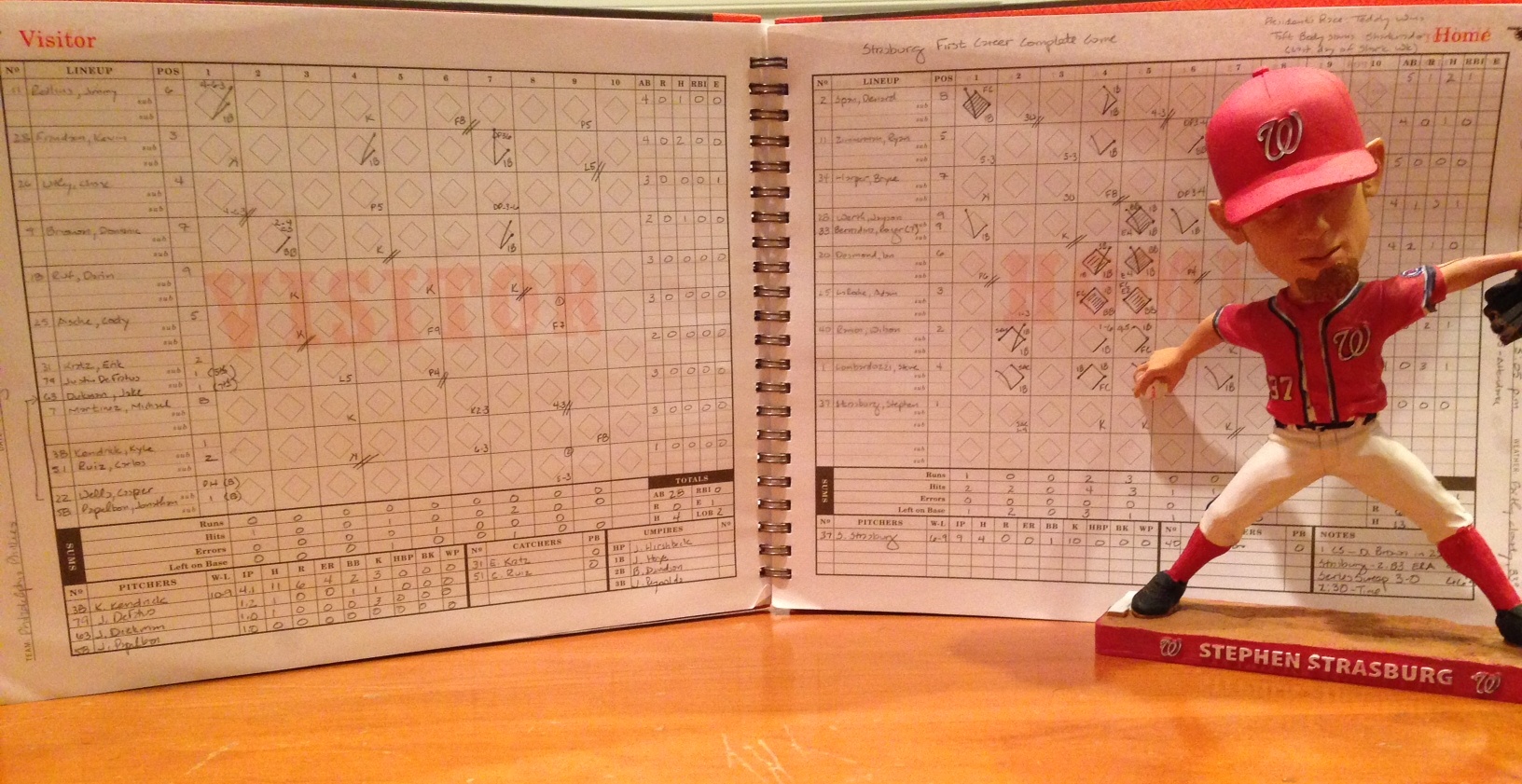
Strasburg delivered. Before that night, no pitcher had struck out as many as 14 hitters without walking any in his big league debut. That’s what Strasburg did against Pittsburgh in a 5-2 victory for the Nationals.

My Strasburg bobblehead and scorebook

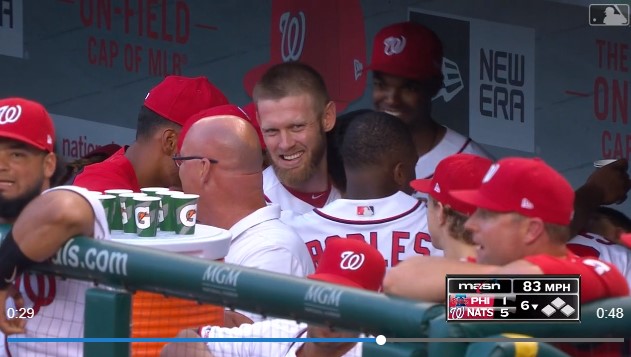
During a stellar yet injury-prone career, Strasburg was a three-time All-Star with a 113-62 record. He became the fastest pitcher by innings to strike out 1,500 when he reached the mark in 2019. The stoic Strasburg even started to smile that year.

Group hug: 2019

My hope is that this famously earnest athlete can now find the time and head space to bash into even more joy in the years ahead.

Expressing joy wasn’t a problem for Willie Mays. As I’ve written earlier, the only thing Mays couldn’t do on a baseball field was stay young forever. And therein lies the nub of our human condition. We’re all mortal.

Just as Mays discovered his mortality the hard way, Strasburg retired at age 35 because, “even after removing a rib and two neck muscles,” Joe Posnanski writes, “the doctors couldn’t quite put his body back together this time (as they had so many times before).”

Strasburg and Mays were elite athletes who, when healthy, were at the top of their profession. In other words, very different from 99% of us. And even very different from other teammates. Like the backup catcher.


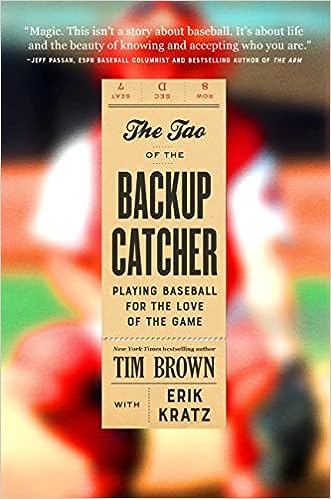
The Tao of the Backup Catcher: Playing Baseball for the Love of the Game (2023) by Tim Brown and Erik Kratz is “a story about a part of the game that hasn’t drifted into a math contest.” A catcher at Eastern Mennonite University who holds the Division III record for doubles, Kratz is discovered by a scout who sees something that suggests he has what it takes to get to the majors. Perhaps not to be a star, but to be the guy who is always there when the star catcher needs a day off from bending down behind home plate, catching 100-mph missiles, and taking foul balls off the left kneecap.

Backup catchers hang on, even if they must play for a variety of teams. When they are really good at what they do they can make a baseball career out of it. They watch and listen and ponder.

There’s a reason why, among other virtues, they caught twenty-three of the sixty-nine no-hitters thrown in the twenty-first century, and before that, why they’d caught six of Nolan Ryan’s seven no-hitters.

The values and competencies of backup catchers are often undefined. They ask: What can I do to help? Perhaps the answer “comes less from an understanding of how the game works and more from a deep familiarity with — and appreciation for — how oneself works.”

It’s not about letting go of your dream “but letting go of the ego.”

Brown begins this gem of a book at Kratz’s retirement. Unlike many backup catchers who are simply let go, Kratz leaves on his own terms.
He wouldn’t again be overlooked, optioned out, sent down, released, traded, waived, designated for assignment, nontendered, benched, ignored, hidden on a disabled list, lied to, pinch-hit for, or promised better.

That step, minus the baseball jargon, is more in tune with how so many leave their professions and move into retirement. No tribute videos before adoring crowds, no future Hall of Fame speeches. If we’re fortunate, the locker room attendants or the IT staff have nice things to say about the way we’ve worked to uphold our part of the team, treated others with kindness, and moved the organization forward.

And it is very hard to know when to let go. A friend told me the story of a colleague who said,

One should retire 1) while you are still enjoying the job and believe you are working at full capacity, 2) before people start wondering why you persist in hanging on, and 3) so that a younger person can have their turn.

I generally agree; however, those suggestions don’t always work. Being in the group of the formerly young, I recognize and appreciate the value of experience. The inequities in our safety net mean some have not had the opportunity to build for a comfortable retirement. My former colleague Nick Kalogeresis wrote an insightful piece about the decline of his beloved Greektown in Chicago due, in part, to retiring business owners who never found a son, daughter, or relative willing to take on running a new restaurant.

As in the rest of life, there is no one-size-fits-all answer.

But we often know instinctively when someone should retire. Several people in my circle of life stayed in their jobs too long because ego got in the way. Who they were was literally wrapped up in their job. The more we can set aside our ego, the more we can live life as it is meant to be lived.

I wanted to nourish my soul in retirement while I was still, as Mirabai Starr says, “thirsty for wonder.” To learn how I might live even more in peace with life’s uncontrollability. “We won’t last forever,” Natalie Goldberg writes. “Wake up. Don’t waste your life.”

Letting go can involve disappearance along with a sense of transience and fragility. Disappearance, Kathryn Schulz suggests, reminds us to notice, transience to cherish, fragility to defend. “We are here to keep watch, not to keep.”

With eternity always at your door, live all your life — whether star or backup catcher — in full bloom with a thirst for wonder.

More to come …

DJB


Image: Keith Johnston / Pixabay

Bad and broken frames

Frames help us see and navigate the world. When we tell stories, we often structure or “frame” them in a way to signal what matters. The Frameworks Institute suggests this framing can be positive, negative, or benign.


Basic questions

Much of what we see today in the world of politics, news, and journalism is negative and divisive. To shift our national and individual conversations toward forward-looking views of what is positive and good, informed citizens need to be aware of the frames we are encountering.

Media critic Dan Froomkin suggests journalists ask themselves: “Whose terms are you using? What requires explanation and what doesn’t? What is normal and what is not?” Those aren’t bad questions for us to ask of our news sources as well.


Examples of framing meant to divide rather than unite

James Fallows writes that most media platforms are not transparent about how they choose frames or why they exist.

The simple reality is this: how a story is presented can matter much more than what the story says.

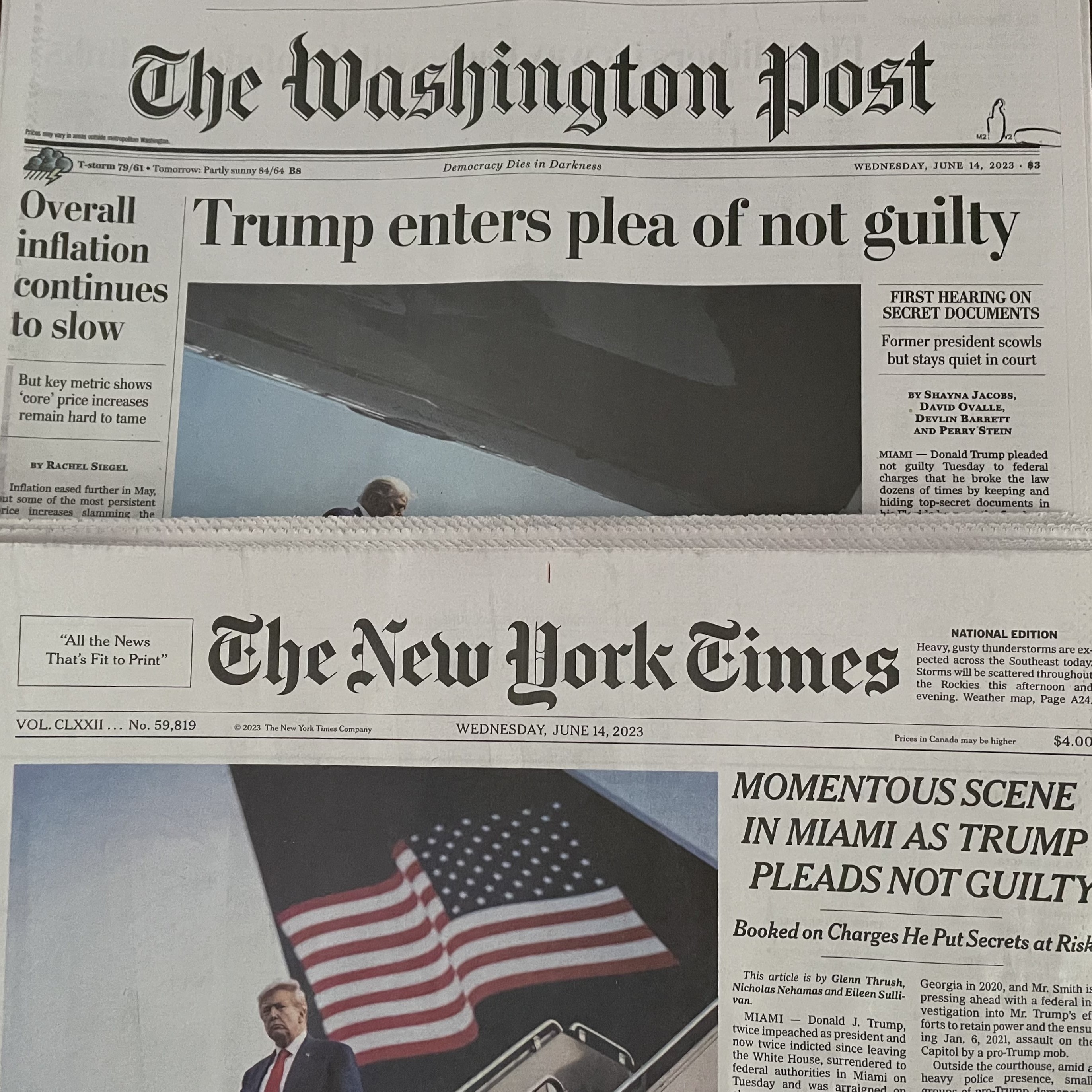
Fallows makes his point using an instance I happened to highlight several weeks ago. It involved the headline and picture in the Times on the day Donald Trump was first arraigned in federal court.

The Times headline was egregious. For those who watched, there clearly wasn’t a “momentous scene” at the arraignment, so why use that term? Did the Times have to include a picture of Trump coming off his private jet with an American flag painted on the tail piece as if it is Air Force One? 

“To put it crudely, would Donald Trump himself have chosen any other layout for that front page?” was Fallows’ summation of the headlines and photos of that day.

Fallows focuses on the Times simply because it is the most influential news organization in the country, driving a great deal of other media reporting. He also focuses there because the paper’s use of frames is so relentless that it has spawned parody sites.


You may want to think about your frame if commentators can have this much fun at your expense

There’s a famous Tweet stream from Doug Balloon (an alias) known as the NYT Pitchbot. Balloon tweets out fake but realistic sounding headlines and Twitter posts built on the standing jokes of

  • the New York Times tendency to play the framing game of bothsiderism (i.e., both parties do this and they’re all bad); and
  • the Times tendency to report that anything that happens can be framed as bad news for Joe Biden and, conversely, good news for Donald Trump.

Here are a few examples:

As the Cascadia Advocate noted,

Doug’s satirical tweets poking at the Times have taken on particular importance during the Biden presidency, owing in part to the Times’ indefensible fixation with relentlessly promoting the Republican Party’s electoral prospects and schemes for taking power. Though the Republican Party has morphed into a political entity that is incompatible with democracy, the Times has inexplicably chosen to regard the party as a legitimate political force and continually award it friendly coverage.


Why can’t the Times say that the economy is strong?

Even though the economy is doing very well, “the downbeat framing continues” at the Times. Fallows provides a few recent examples:

There’s a positive — and I suggest more accurate — way to frame our economic stories. On August 4th, the Washington Post editorial board wrote The economy is in the midst of something wonderful (and unexpected). That something wonderful was a “workforce boom.”

That isn’t so hard.


When politicians try to frame an issue but won’t provide a straight answer, be VERY suspect

Former Maryland Gov. Larry Hogan was on Face the Nation recently and spent a great deal of time talking about the potential Third Party group No Labels. Hogan kept pushing the idea that President Biden and his policies were terrible. That’s a misleading frame, because President Biden’s policies are popular with a growing majority of Americans. Their framing also ignores the fact that the polling shows that President Biden is very popular among Democrats, with an 83% favorable, 10% unfavorable rating. But the media has forgotten that Democratic voters matter. As Heather Cox Richardson writes,

We are still getting endless stories about the Republican voter. But who are the Democratic voters? What do they want? They are, after all, a majority.

Also, Hogan refused to say who was funding the No Labels group. That lack of transparency should be a big red flag to journalists and the public. As progressive journalist Markos Moulitsas pointed out on a similar segment on Meet the Press, No Labels is “creating this idea that there’s a mythical unicorn creature that will agree with these people who want something” besides Biden/Trump. It’s a frame we shouldn’t accept.


It isn’t just the headline writers and editors who use bad frames

Reporters also play a key role in this effort. Dan Froomkin was incredulous at the lede by the Chief White House Correspondent at the Times after Donald Trump’s fourth indictment. Peter Baker began with: “Another grand jury, another indictment,” followed closely by, “The novelty of a former leader of the United States being called a felon has somehow worn off.”

Peter Baker is bored. The chief White House correspondent for the most influential news organization in the world is wearily unimpressed with all these charges against the presidentTo anyone who cares one whit about accountability, or democracy, there is nothing remotely routine about what’s happening, and not a damn thing has worn off.

In fact, Trump’s (first) impeachment bored him, too!This man needs a new job.

What’s missing from the bad framing and much of the coverage about the former president is this: “Trump’s lawbreaking was so blatant, so inexcusable, so dangerous, that DOJ had no choice but to indict.” He incited a riot to overturn our election and then to top it off stole our nuclear secrets.

This shouldn’t be so difficult.


Frame the choices in a realistic way

Social Security and Medicare are beloved by many Americans, yet Republicans (most recently Chris Christie) regularly tell us that both programs will soon be bankrupt. That’s absurd in many respects.

What gets left out of the framing by the right is that our federal budget is made up of choices. And the politicians have decided that cutting the ever-growing levels of funding for the military-industrial complex should never be on the table. That’s a choice that affects every other priority.


How can we frame things in a way that unites rather than divides?

Fallows lets us see how the Times framed a recent NATO summit and then offers an alternative:

As someone noted on Twitter, suppose this headline had been reversed: “Despite Divisions, Successes at NATO Summit.” That would convey a quite different message — and, as it happens, would be more in keeping with the story itself.

We have the power to set the story in a way that unites and to reject false frames that divide. Richardson wrote in a recent newsletter, “It would be a shame if the growing legal troubles of the Trump conspirators overshadow the work of the Biden administration on the global stage this week as it seeks to counter the power and influence of China.” She then proceeded to devote the vast majority of her daily newsletter to the background history for the daily news, the work of the administration to reset American prestige abroad, and the implications of President Biden and Vice President Harris’s actions on Americans and the world.

Democracy counts on citizens knowing the facts … not just a false frame.

More to come …

DJB


Images by bluemoonjools, Kerttu and Marcelo from Pixabay


UPDATE: Peter Baker of the NYT continues to demonstrate how much he doesn’t get what’s at stake in this moment. Here’s an update from progressive journalist Laura Clawson:

House Republicans are engaging in a completely partisan, evidence-free impeachment inquiry—but Peter Baker of The New York Times wants to talk about how the White House is treating this as a political issue. And just to get this out of the way right off the bat, the paragraph count before Baker acknowledges that Republicans have no evidence against Biden is seven.

In paragraph eight, he gets around to, “The Republican investigation so far has not produced concrete evidence of a crime by the president, as even some Republicans have conceded.” Even there, the implication is that the Republican investigation has produced some evidence, and they just need to make it concrete. In reality, the Republican investigation has produced no evidence that the president has engaged in any misconduct, let alone a crime.