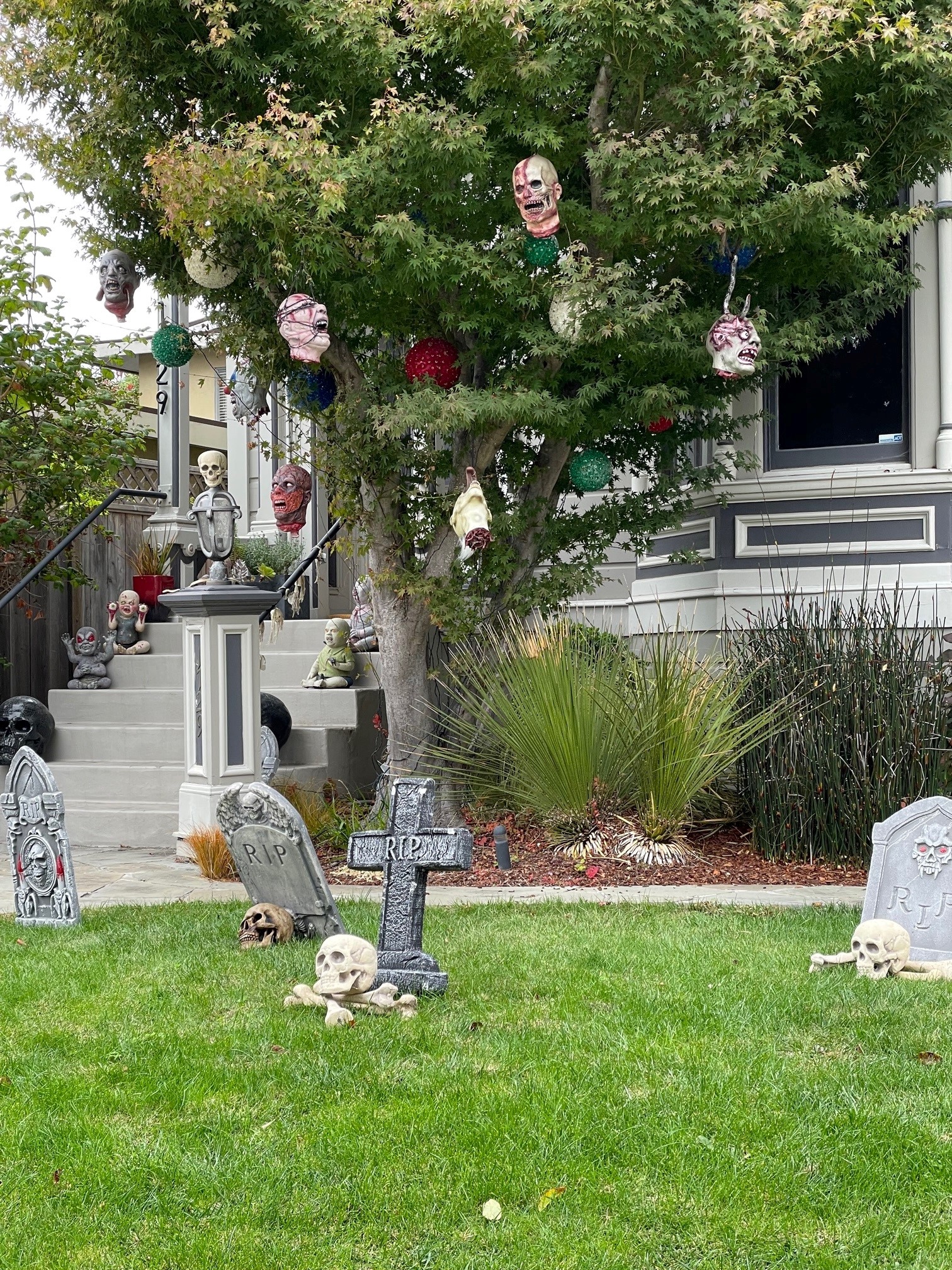
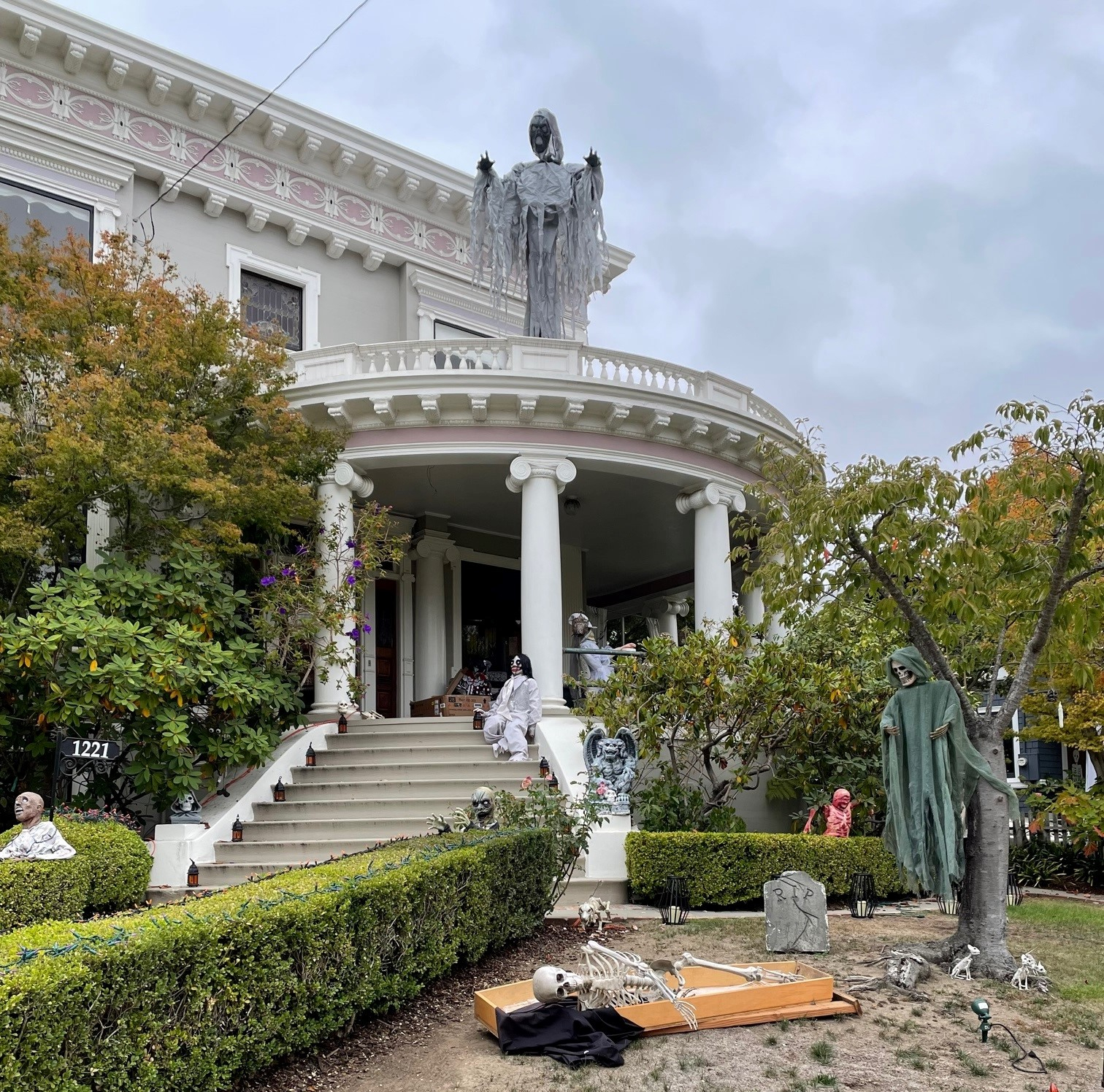
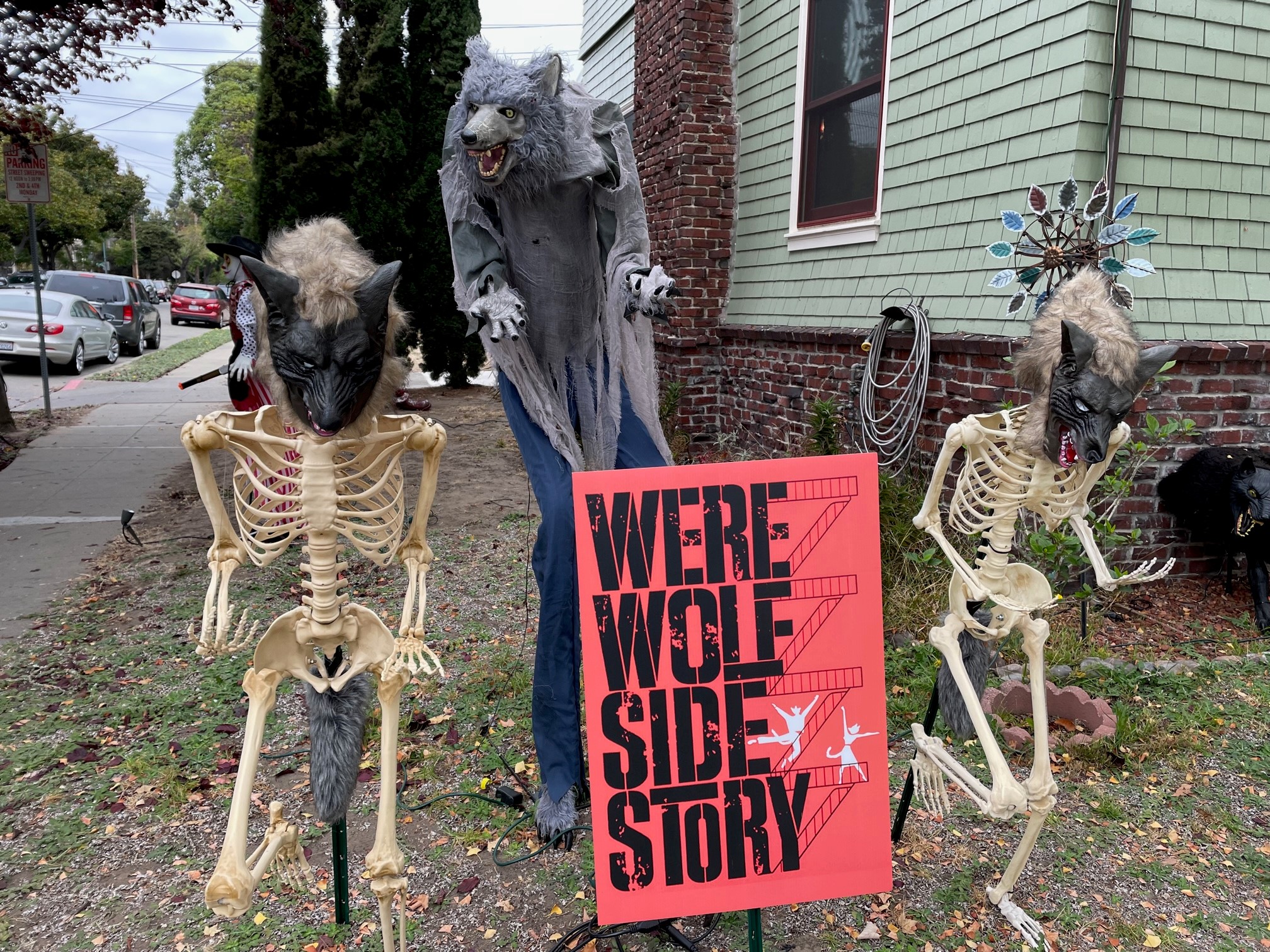
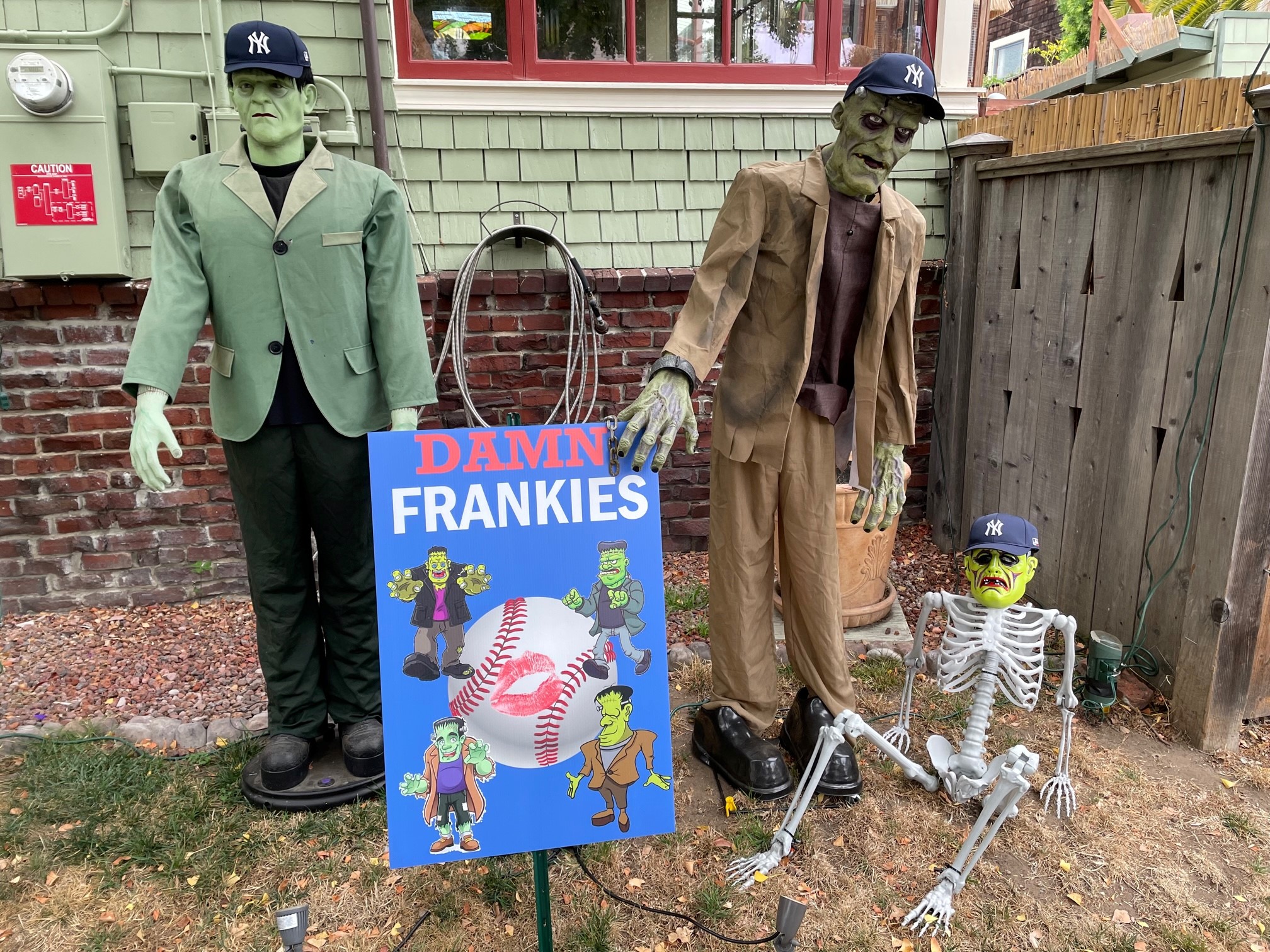
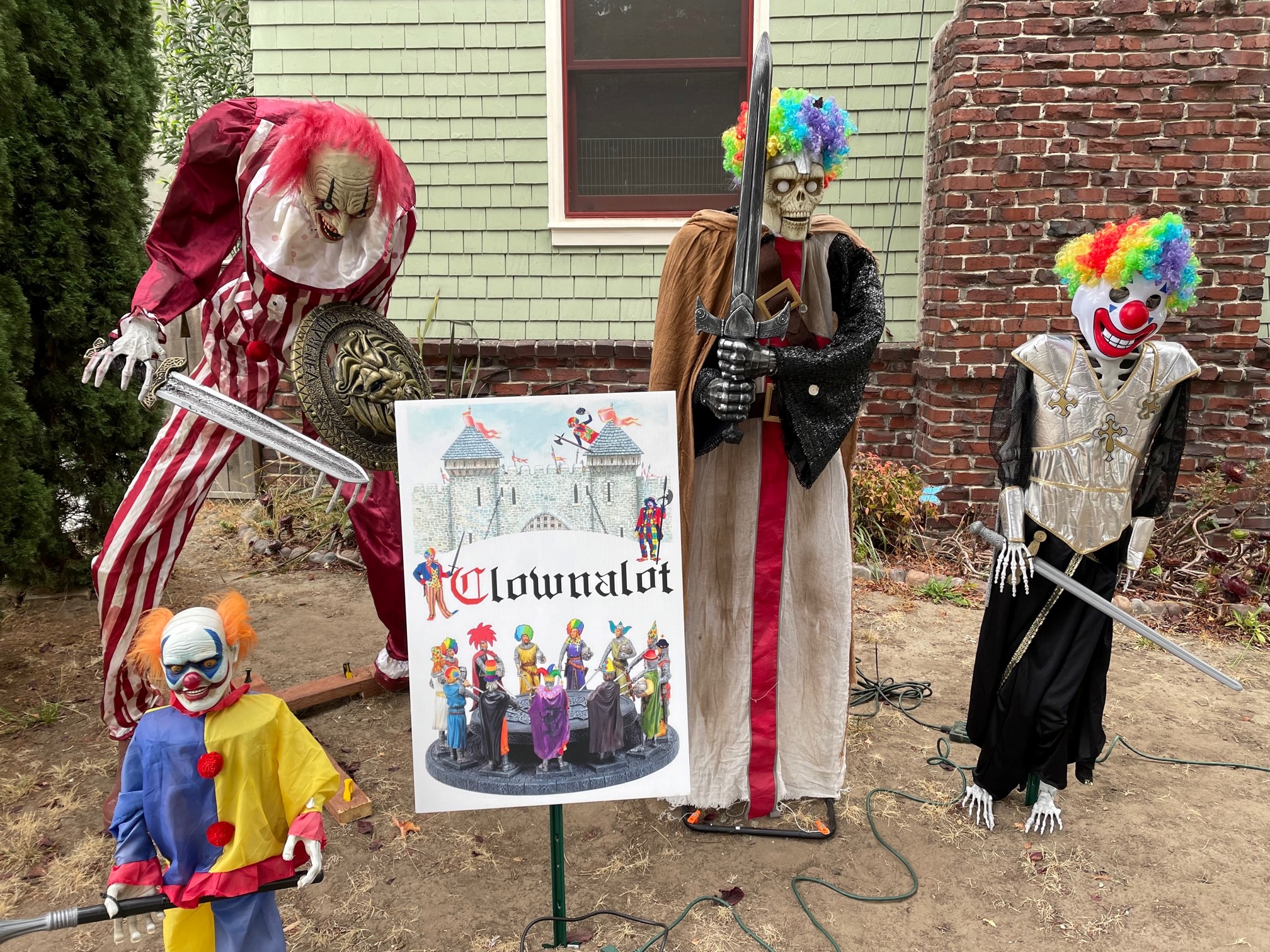
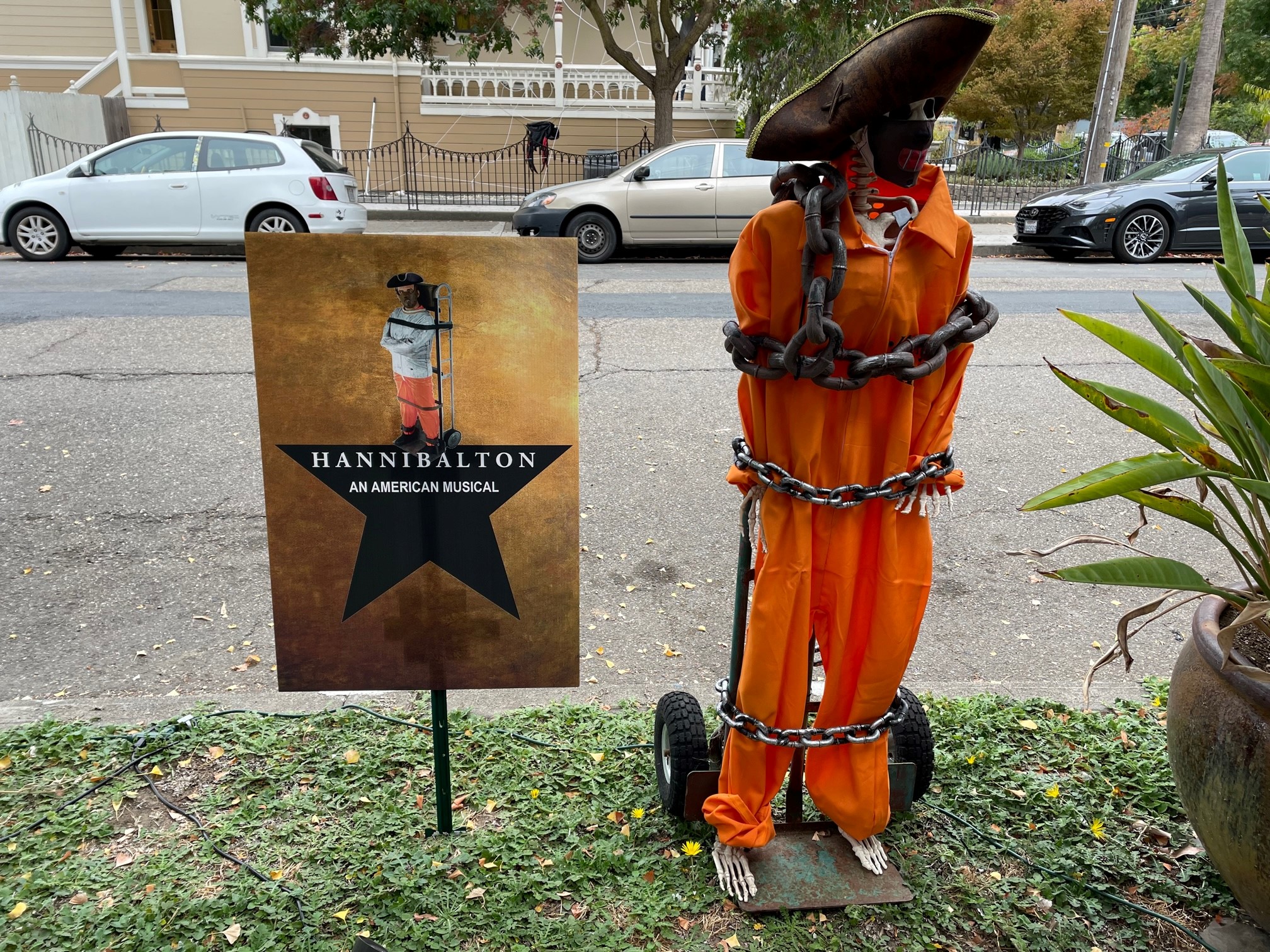
Over the last two years, first in 2020 and then again in 2021, the SaturdaySoundtrack before Halloween has featured roots music to celebrate the season. This year I’m traveling out of the country, but I have visited one town which goes all in for seasonal decorations: Alameda, California.
So, I’m going to post pictures from the creative folks in Alameda and intersperse them with a few of my favorite roots music songs for ghost, goblins, and other things that go bump in the night!
Hanging around in Alameda
I love this Alameda creation, with the skeleton doing the cannonball dive into the pool
The blues and jazz cats have a great number of songs for the season. Nina Simone does her usual masterful job with the Screamin’ Jay Hawkins hit I Put a Spell on You. That is followed by Elise LeGrow breaking the Bo Diddley classic Who Do You Love “down to a new set of bare bones. Watch her rasping howl bring ‘a tombstone hand and a graveyard mind’ to life.”
An ABBA-themed Halloween home in Alameda
These Alameda homeowners went all-in to welcome trick-or-treaters
Next, let’s turn to Rhiannon Giddens with a version of O Death from her recent album, They’re Calling Me Home. Giddens, with partner Francesco Turrisi, base this version on singing by Bessie Jones of the Georgia Sea Island Singers. As the Bluegrass Situation (BGS) site notes, it is a good reminder of “just how much of American music and culture are entirely thanks to the contributions of Black folks.”
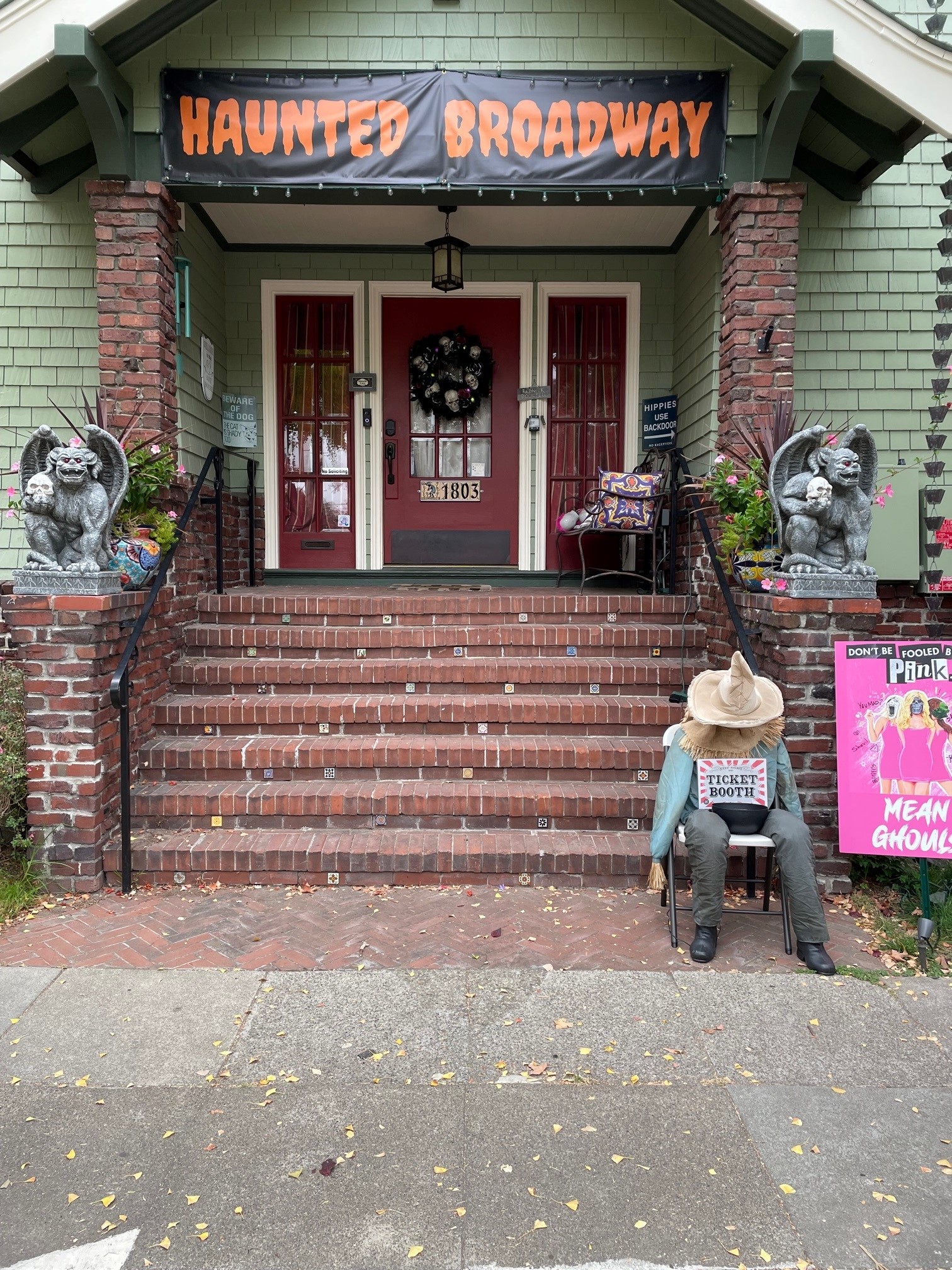
There was one house in Alameda that went all in with a Haunted Broadway theme. Here are a number of their creations.
A sidewalk view, capturing perhaps one-third to one-half of the creations by this Alameda family. Well done!
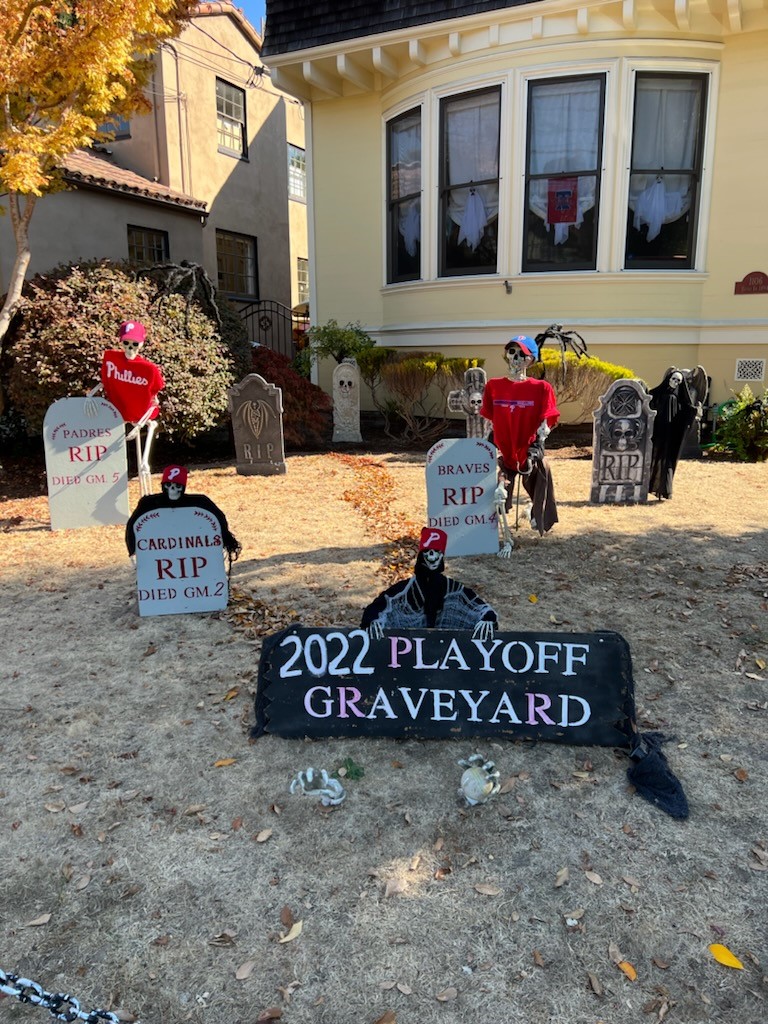
Although I’m not a Phillies fan, I thought this clever take on the 2022 baseball playoffs was too good to pass up!
A Phillies fan in Alameda having fun with this year’s baseball playoffs (photo by Claire Holsey Brown)
Since I’ve been posting a lot of cartoons this season, it seemed appropriate to include one for Halloween.
The song that originally took me down this spooky path is the Del McCoury Band’s title track from the album It’s Just the Night, with backing vocals by the classic gospel group Fairfield Four.
Happy Hallowe’en, everyone!
More to come…
DJB
Image of werewolf from Pixabay. Playoffs graveyard by Claire Holsey Brown. All other images by DJB.
National Trust Tours can take you to places that are on everyone’s bucket list…even the “educational experts.” Take, for example, my experience on the Mekong River Cruise tour where I’m currently serving as one of the study tour leaders.
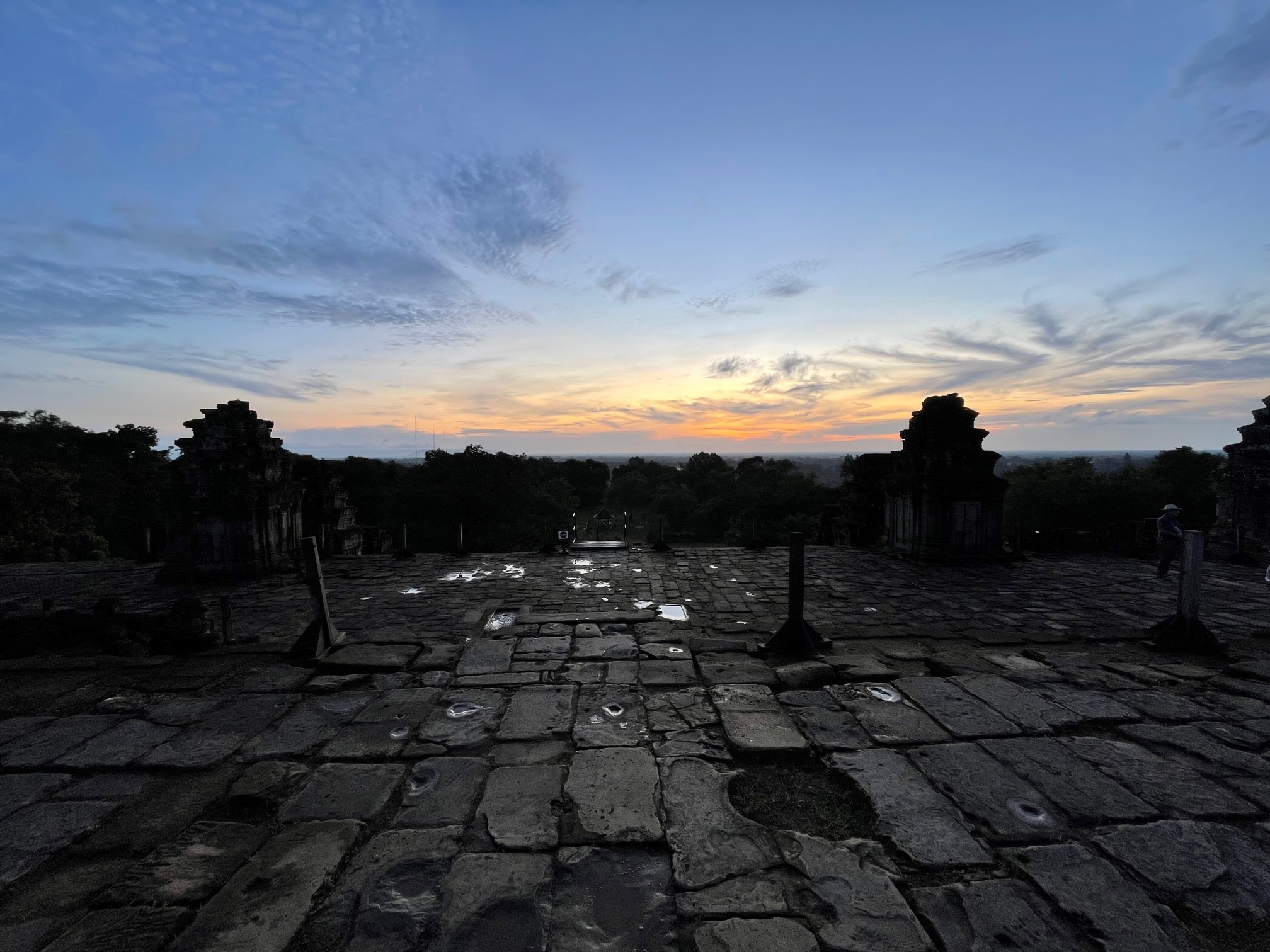
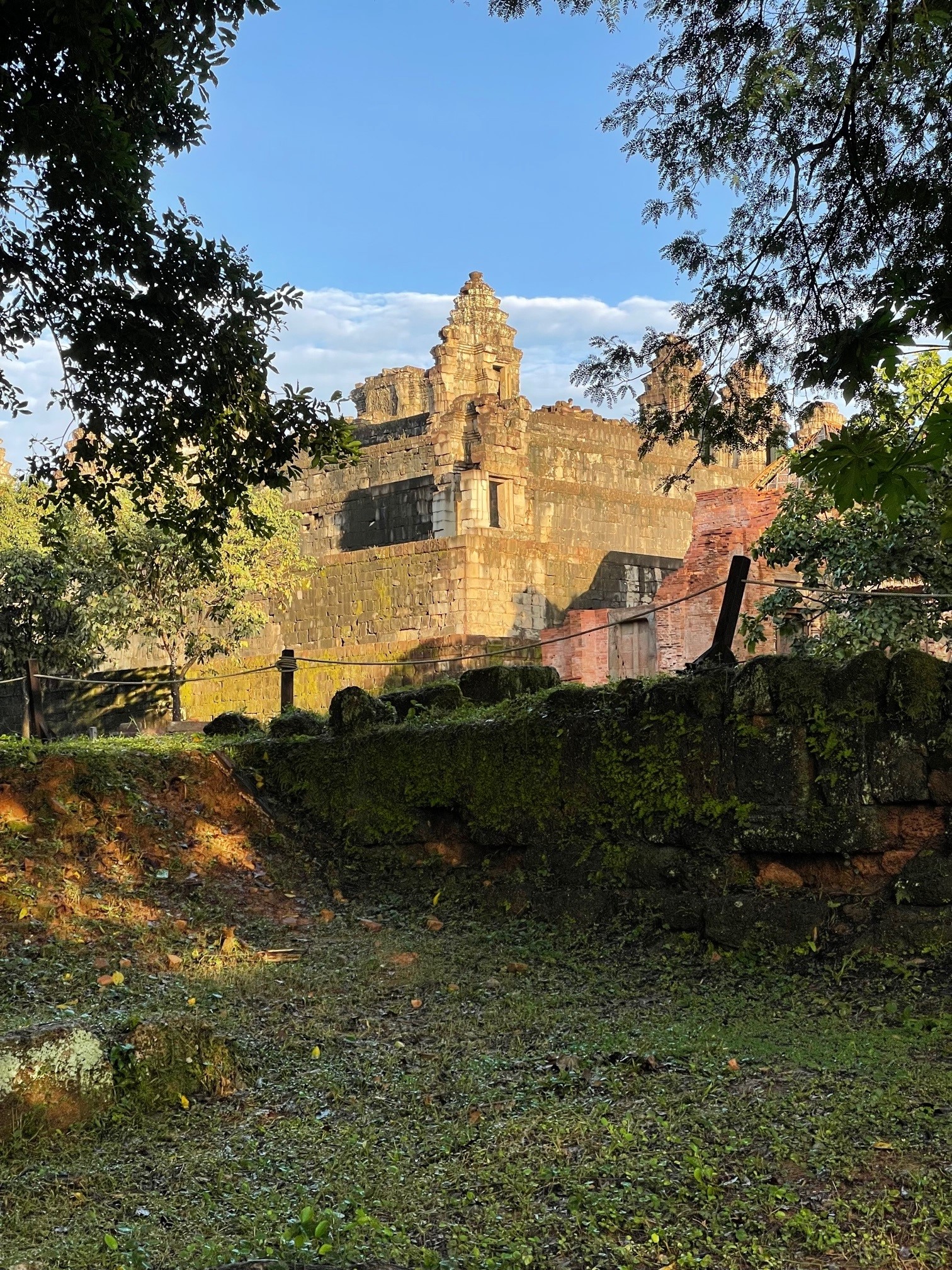
We rose at 4 a.m. this morning in Siem Reap. Our goal was simple: to view the sunrise over greater Angkor on a picture-perfect Cambodian day.
One of our first views from the top of the temple in the first light of morning
Mission accomplished!
Taking a 20-minute Tuk-Tuk ride to the point where we could begin hiking in the dark to reach the high temple mount of the late 9th century Phnom Bakheng Temple was an experience in itself. It was also inspiring to see places where long-time colleagues at American Express and the World Monuments Fund (WMF) have had such a profound impact on the stabilization, preservation, and restoration of these World Heritage Sites. While there I couldn’t help but think of the times I’d discussed global heritage conservation with my good friend Tim McClimon, the former president of the American Express Foundation, as well as the opportunities I’d had through the years to talk with Bonnie Burnam, the long-time CEO of WMF, about their work in this part of the world. Both have been colleagues I’ve long admired. Both remain an inspiration to me and many others.
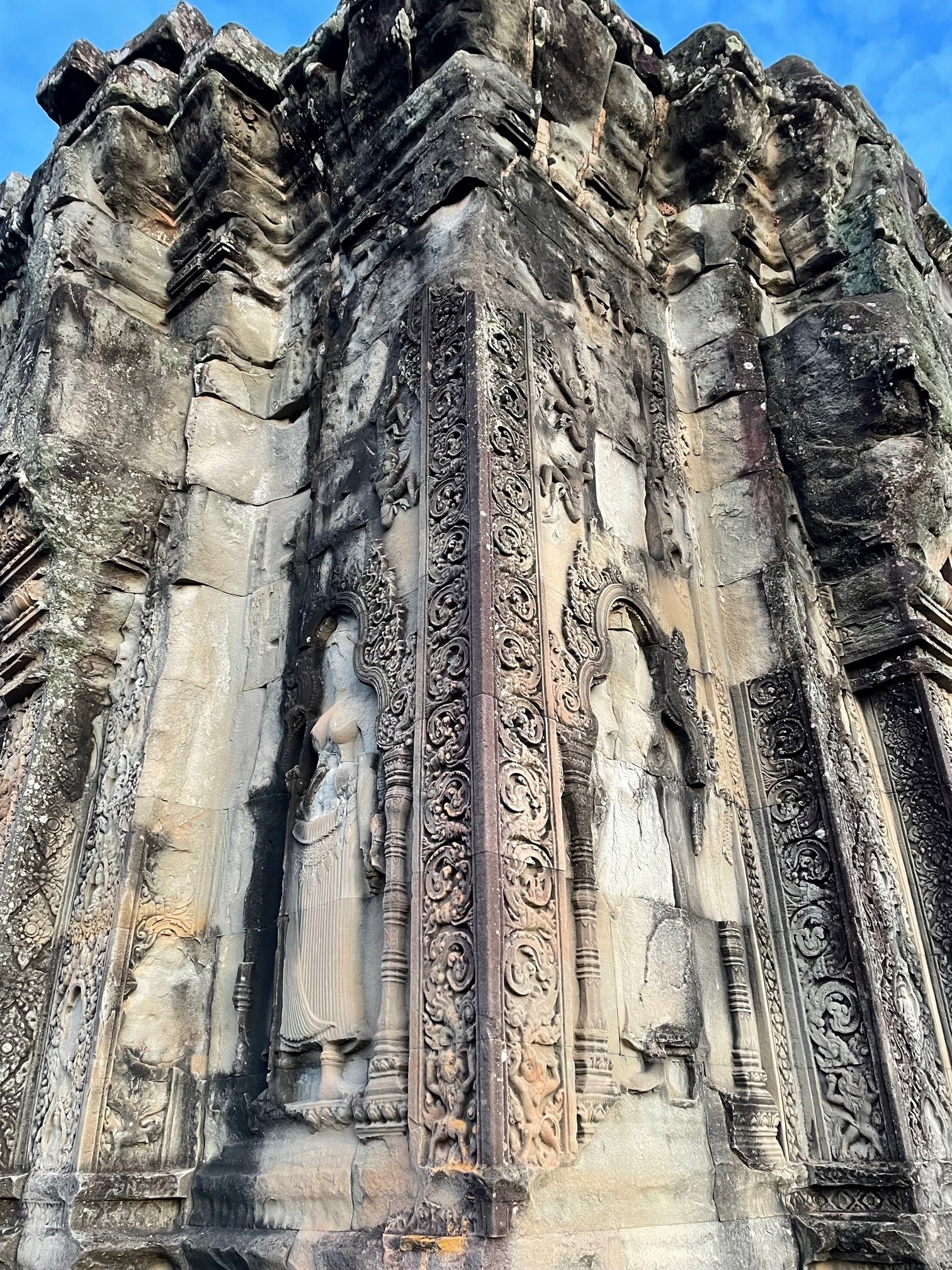
Some things are better seen than explained, however, so I’ll stop writing and begin posting photographs taken today from Phnom Bakheng Temple. Enjoy!
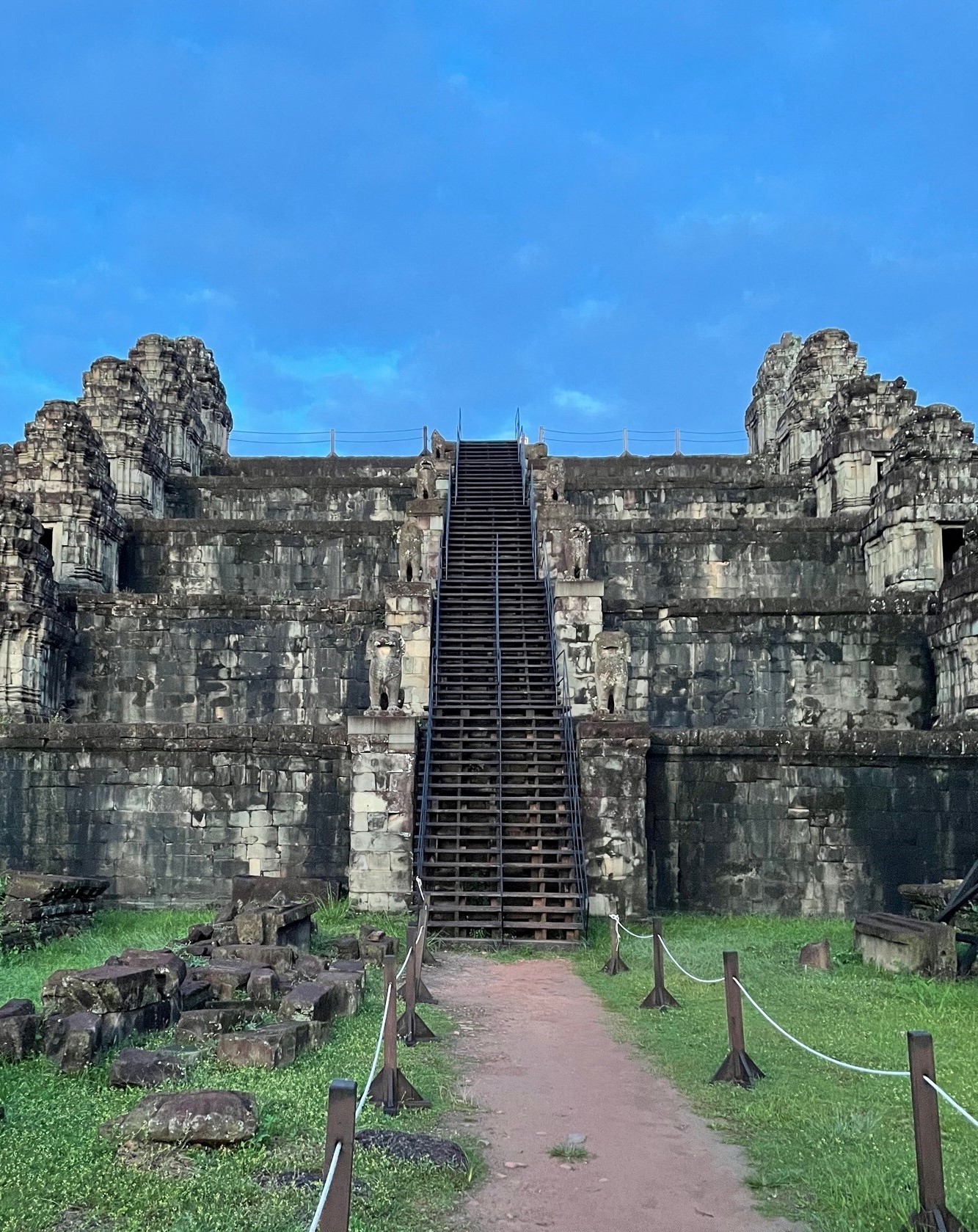
After hiking up the mountain, we still had these stairs to climb before reaching the top of the temple
One of our first views of the temple, as the light began shining from the east
Early morning view looking back towards Angkor Wat
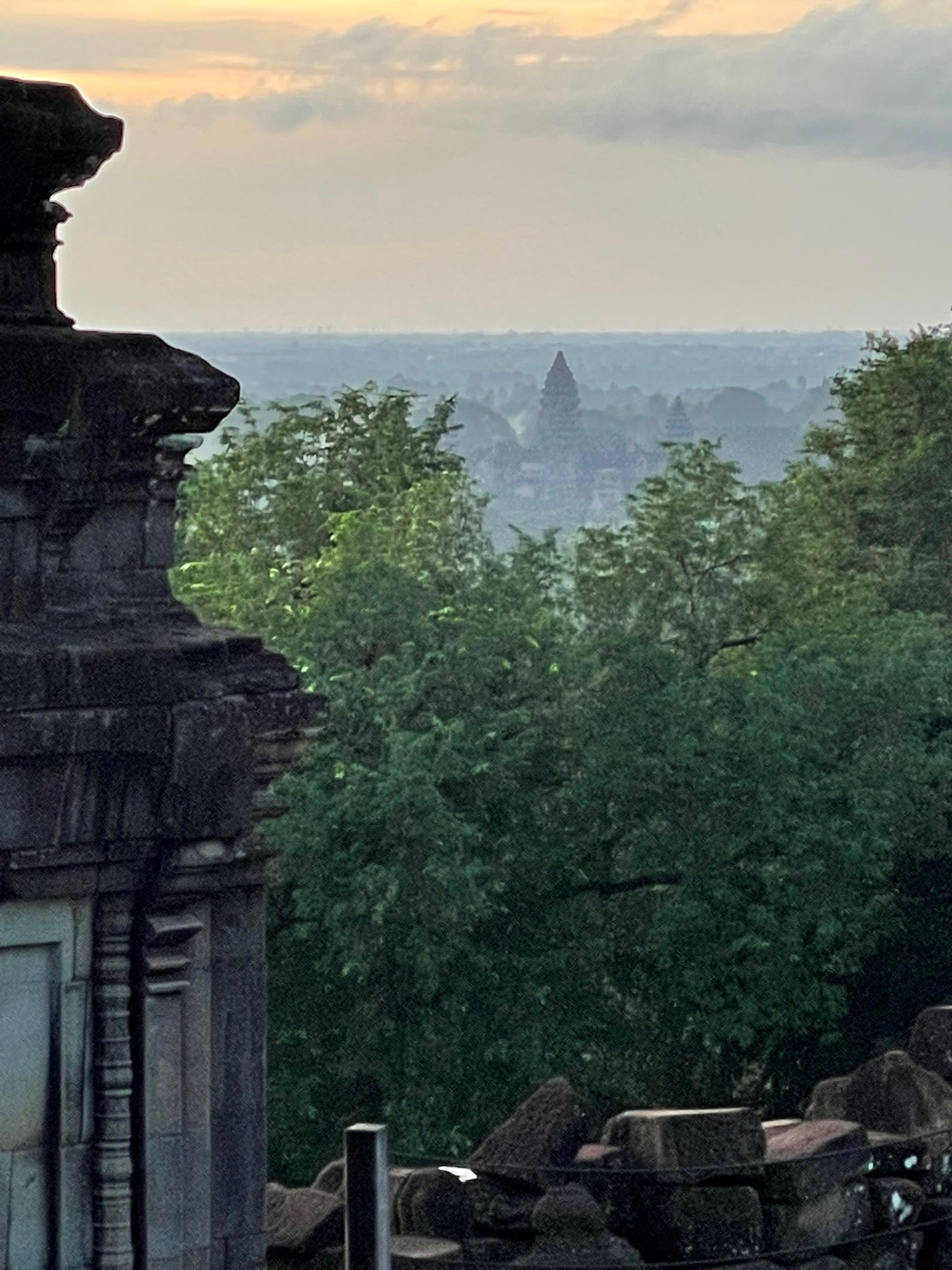
Angkor Wat in the morning mist
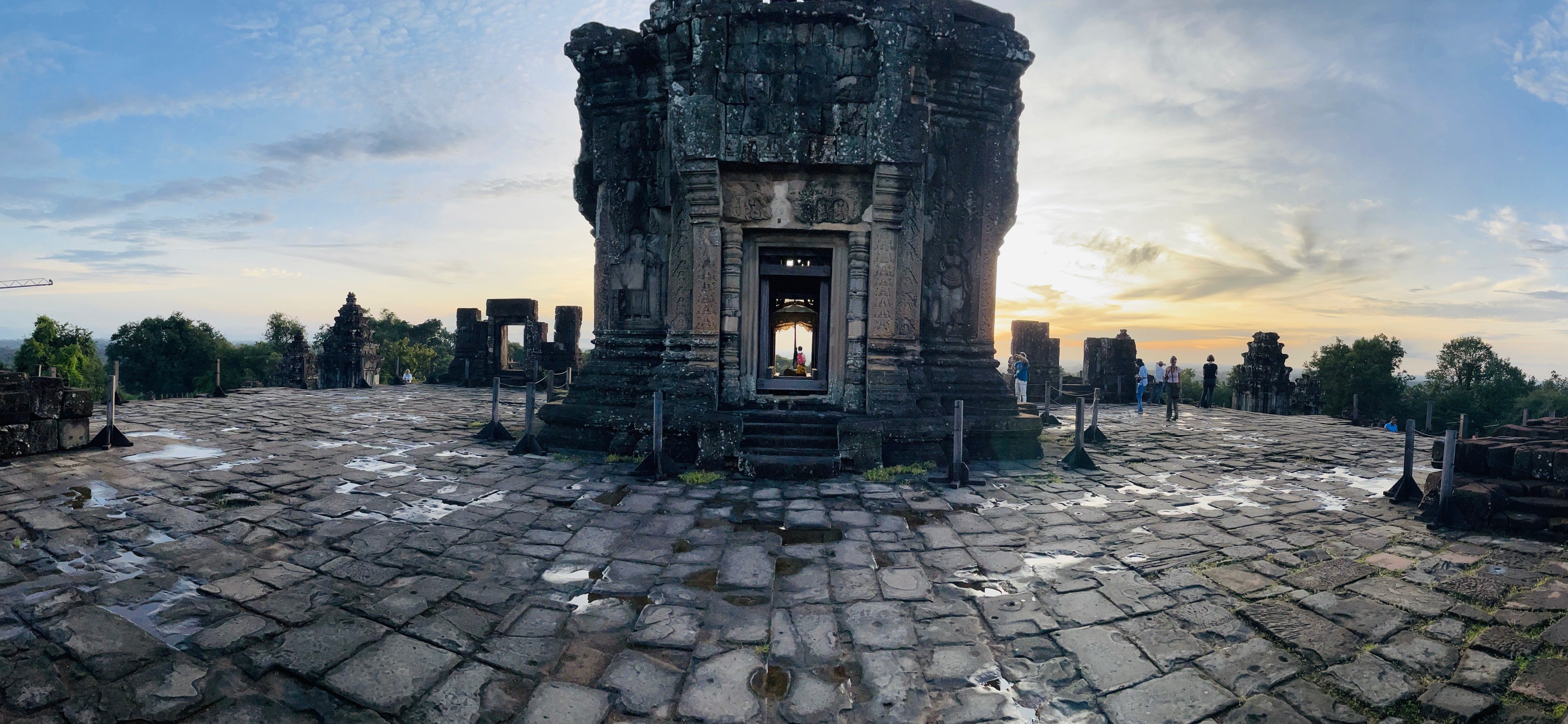
Panorama from Phnom Bakheng Temple
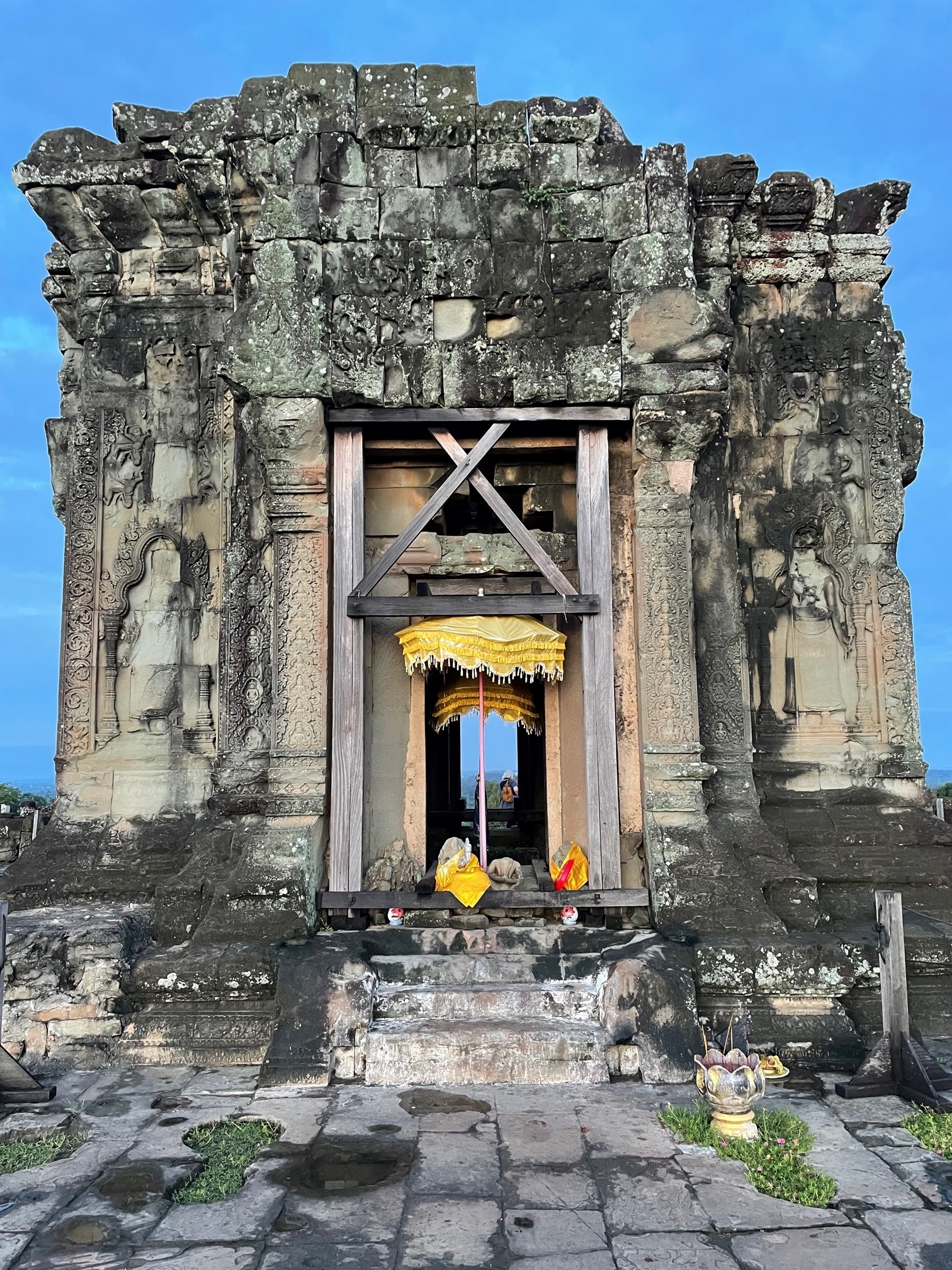
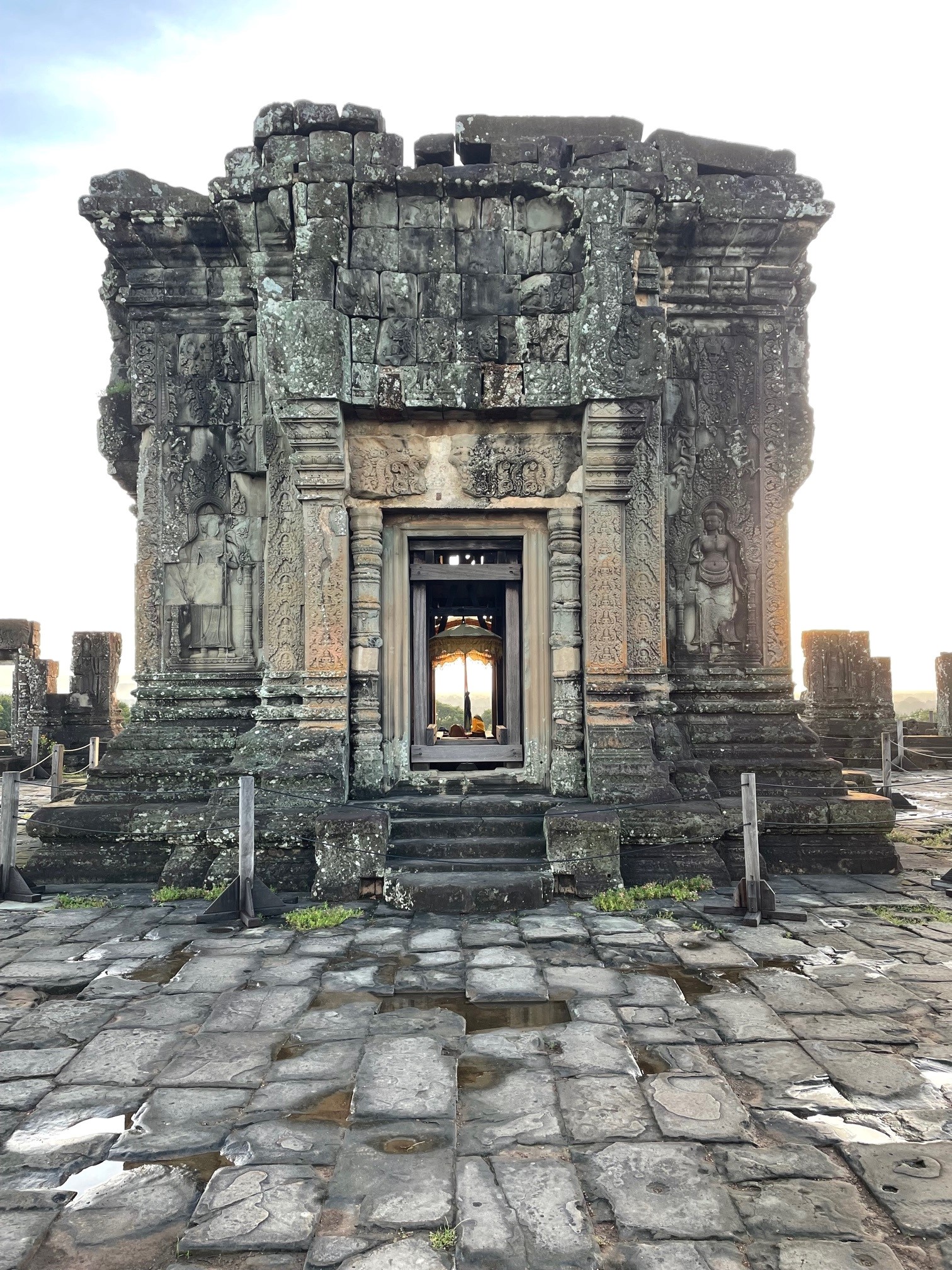
Views through the temple
I feel the need to tell you a bit more about what you’re seeing in these photographs, so here’s a great description from the WMF project page:
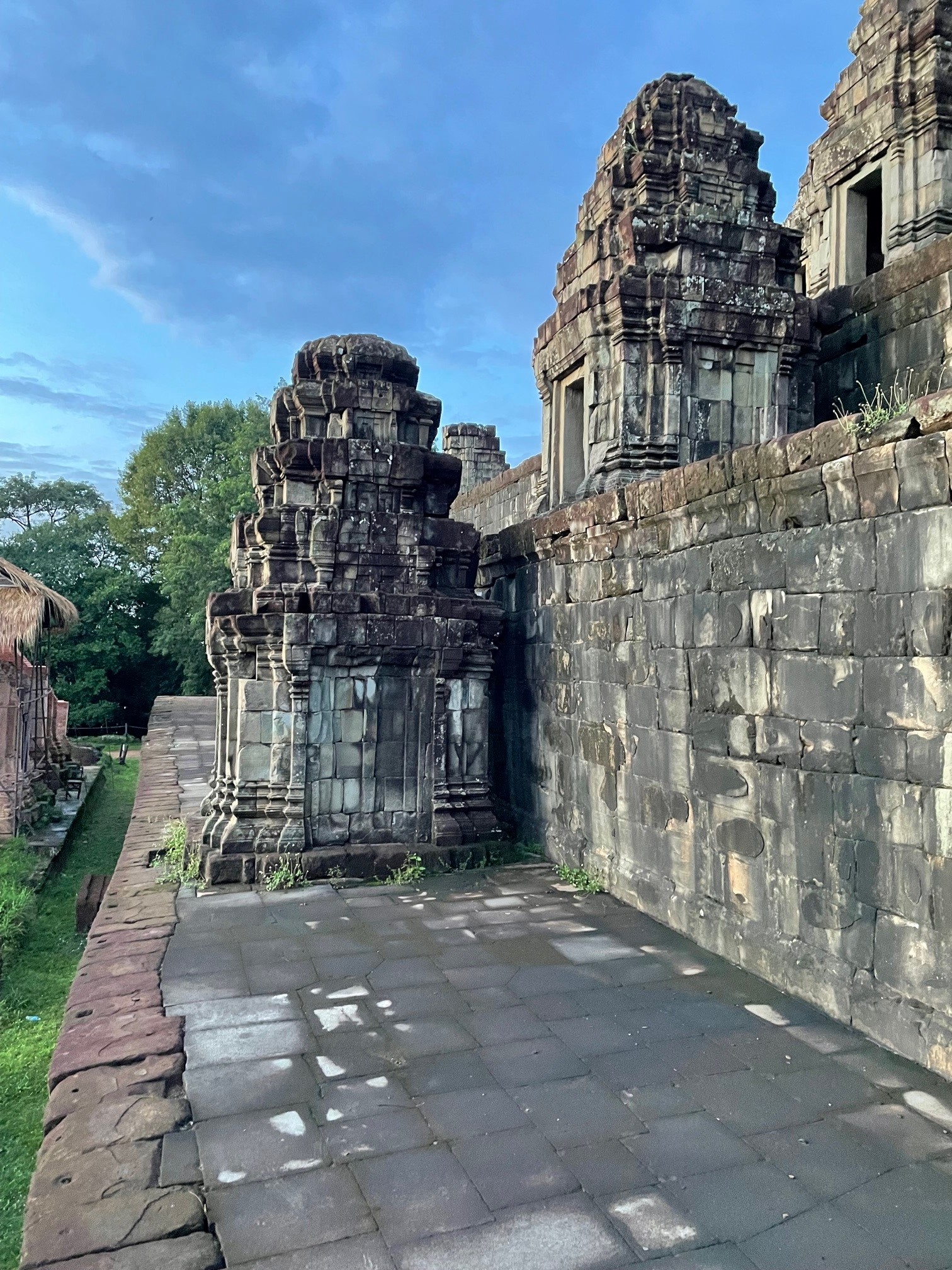
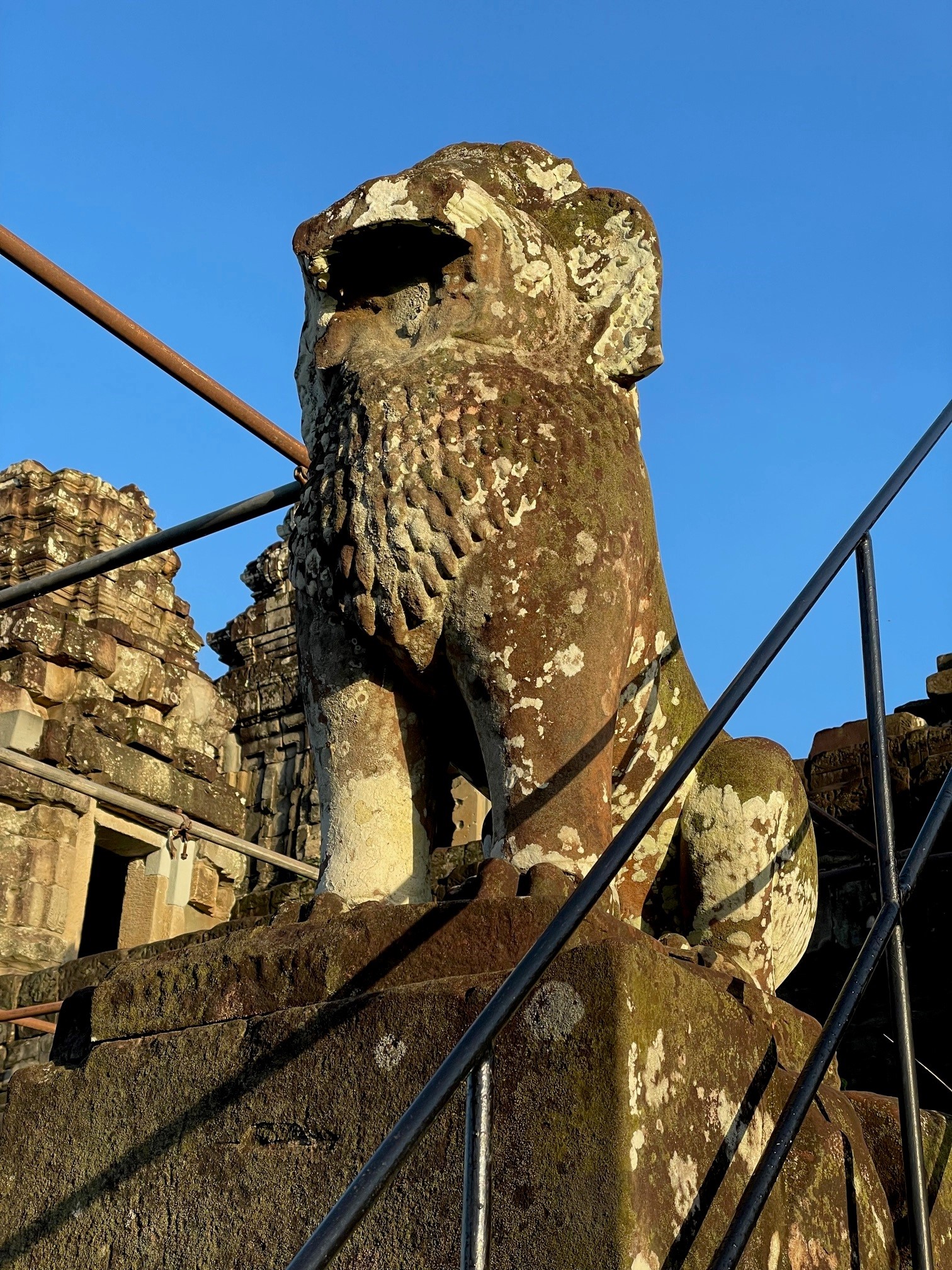
Phnom Bakheng, the state temple of the first Khmer capital in the Angkor region, survives as one of the world’s greatest architectural treasures. The Temple of Phnom Bakheng was constructed between the late ninth and the early tenth century by Yasovarman I as the centerpiece of his new capital, known as Yasodharapura. It was abandoned only a few decades after its construction, but its privileged hilltop location makes it unique among the temples of Angkor. Its stepped pyramid construction is a built representation of Mount Meru, the center of the physical and metaphysical universes in dharmic religions. Shrines and guardian lions adorn the seven levels of terraces that make up the pyramid; decreasing in size towards the top of the temple, these enhance the impression of the temple’s height. Five shrines on the top platform, arranged in a quincunx formation, represent the five peaks of Mount Meru. In the sixteenth century, an attempt was made to construct a large seated Buddha around the central shrine, which has since been dismantled. The central temple was surrounded by multiple brick towers, which only survive as ruins. Today, Phnom Bakheng is a popular spot for panoramic views of the Angkorean landscape, often enjoyed by visitors at sunset.
Views from atop the temple
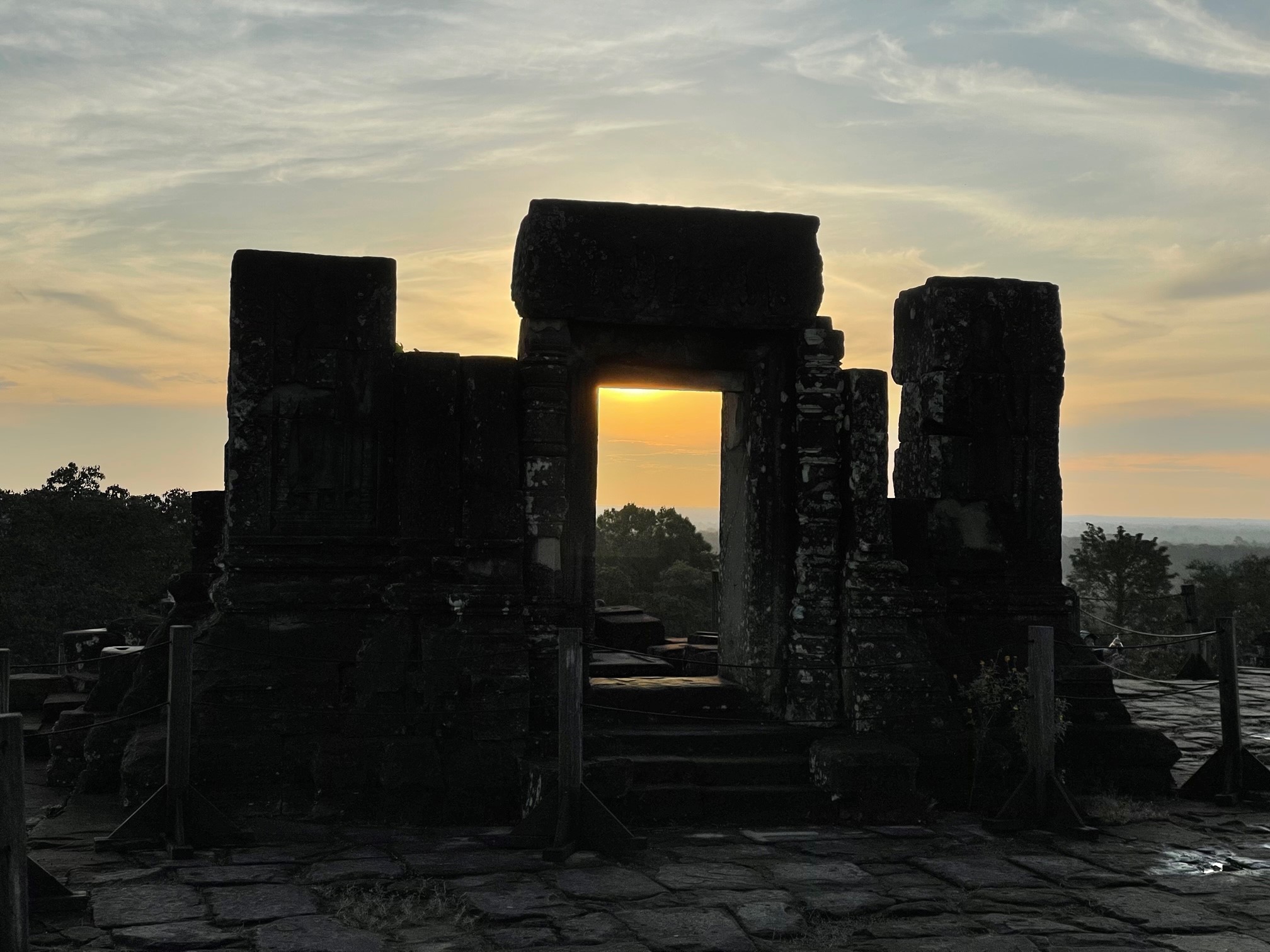
View through temple looking east
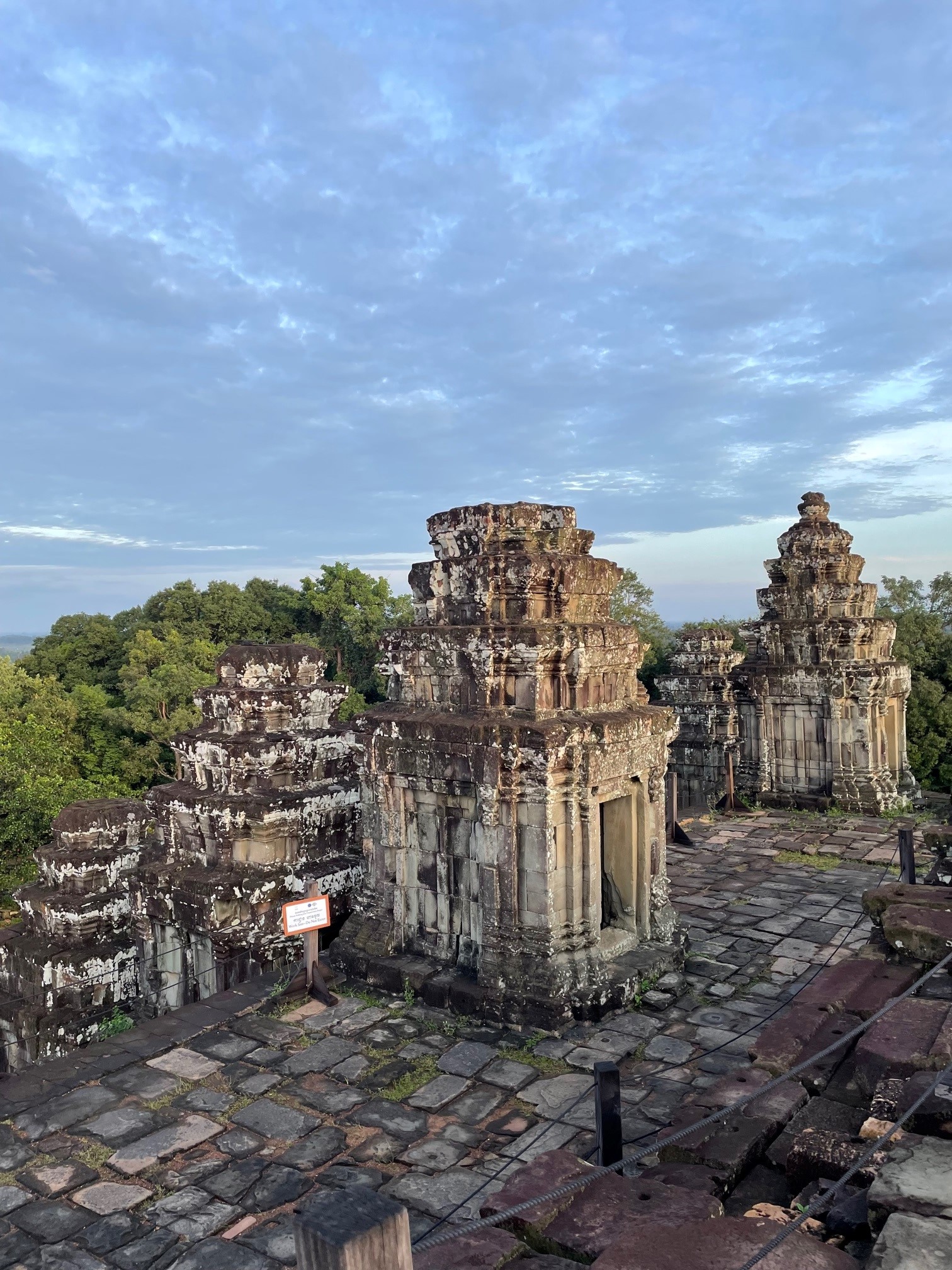
Towers
Temple detail
Detail, looking through the central temple
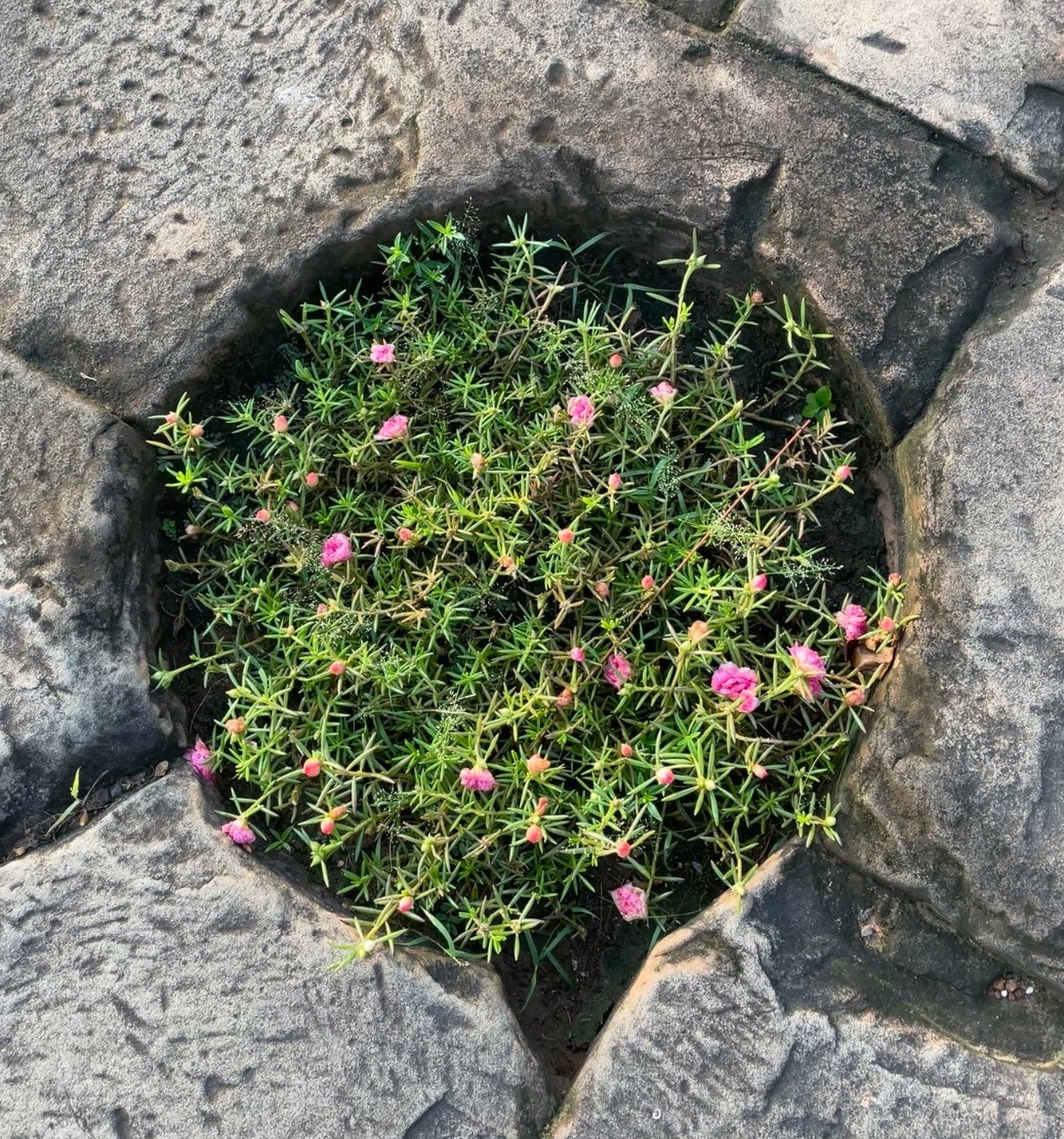
Small plots of flowers on the temple floor
Towers along the edges of the temple
Looking west from the temple
Guardians of the temple
Candice and DJB at Phnom Bakheng Temple
Our final view of the temple before our hike back down the mountain
We spent the rest of the day exploring Angkor Thom and Angkor Wat…which I’ll cover in a later post. In the meantime, check another one off the bucket list!
More to come…
DJB
All images by DJB except for the one of flowers which is by Candice and the one of Candice and DJB, which was taken by Tek, our local guide.
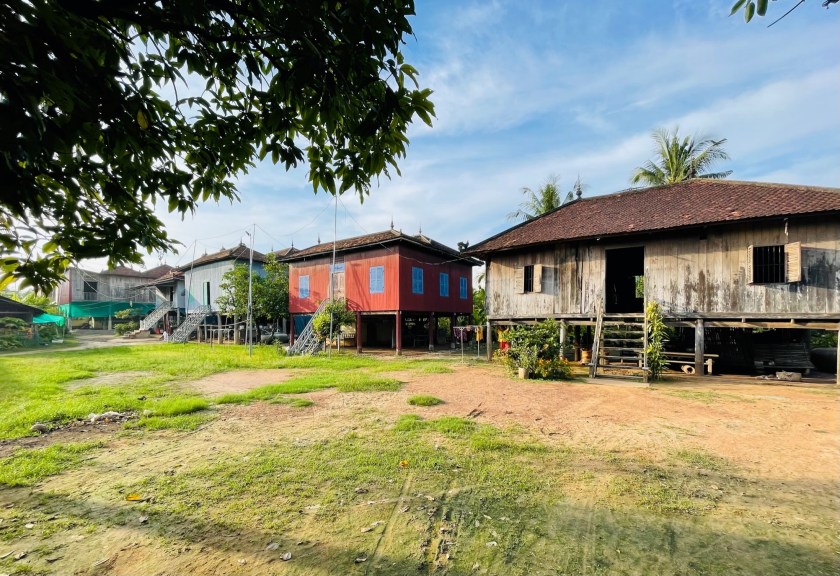
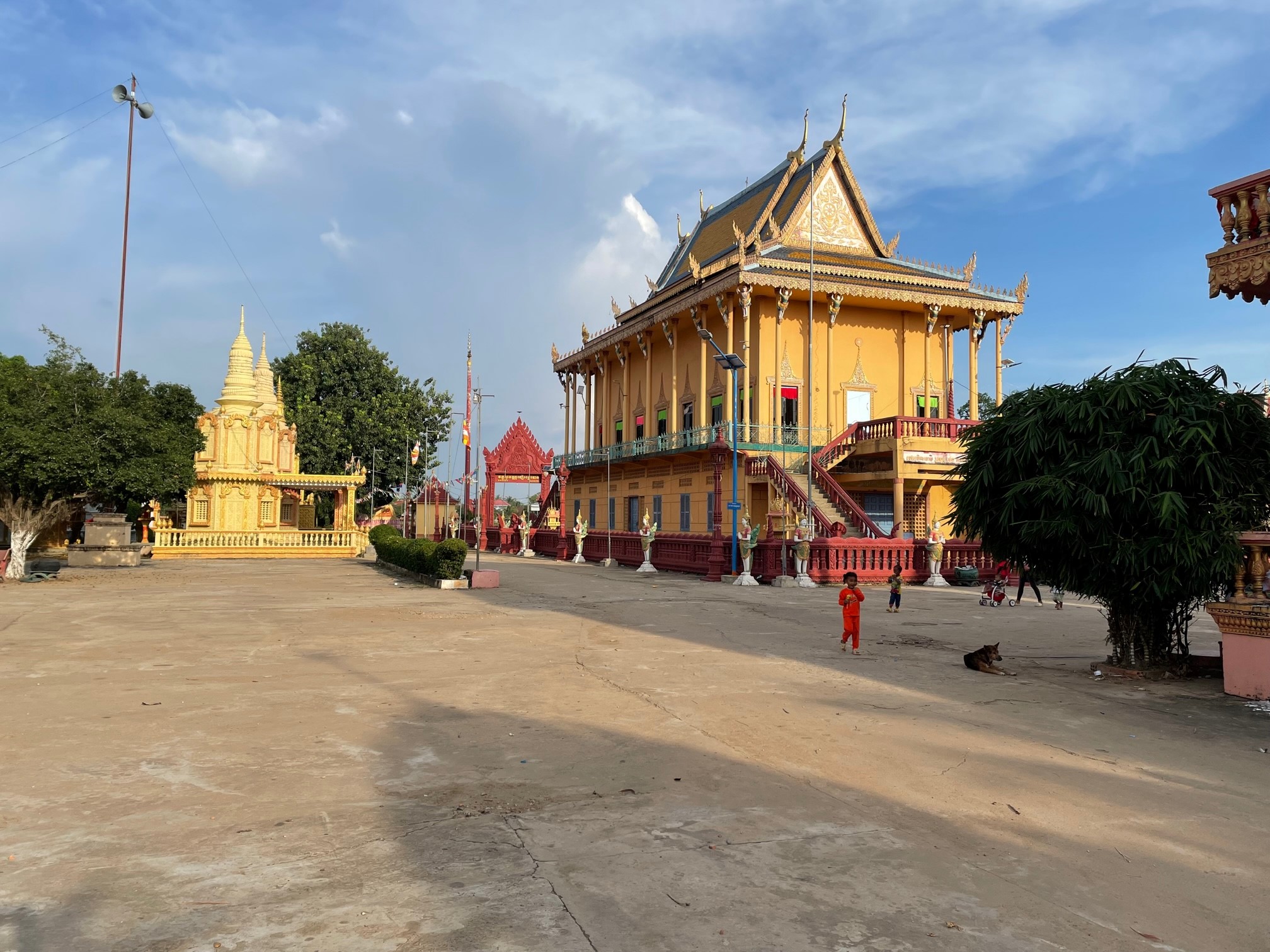
On our last day cruising the Mekong River before heading off to Siem Reap for two days of exploration at Angkor Wat, our National Trust Tours group visited the remarkably intact traditional Khmer village of Angkor Ban. Because the Khmer Rouge used the houses in this community for residential and storage purposes, it is one of the few villages that survived destruction under the regime. The remoteness of the area helped the villagers maintain more traditional ways while their friendliness to those of us visiting made it one of the favorite stops on the tour.
Temple in the monastery at Angkor Ban in Cambodia
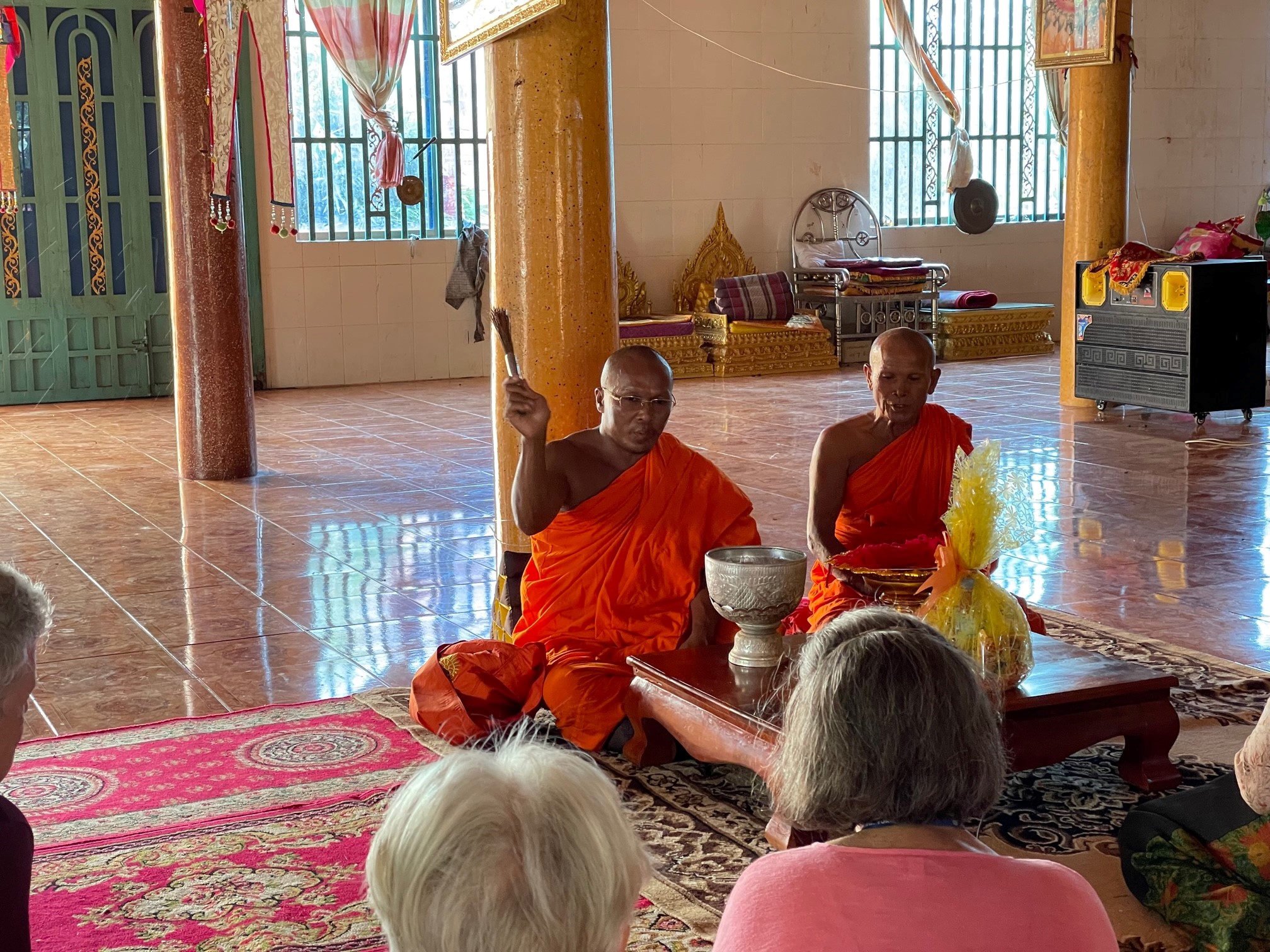
Our group heads to the water blessing at Angkor
Traditional water blessing
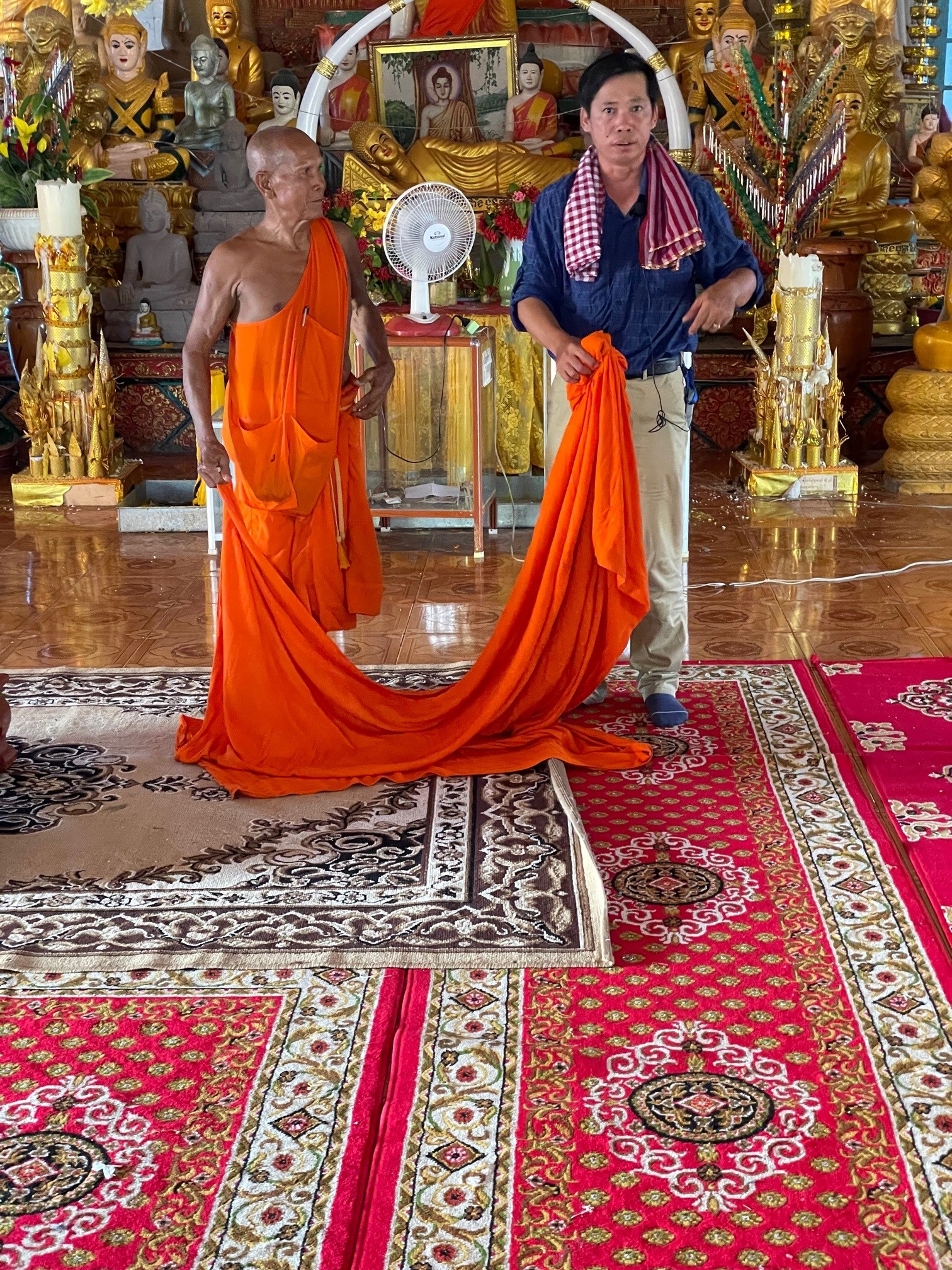
Our local guide Tek helps one of the monks show how to put on the traditional robes
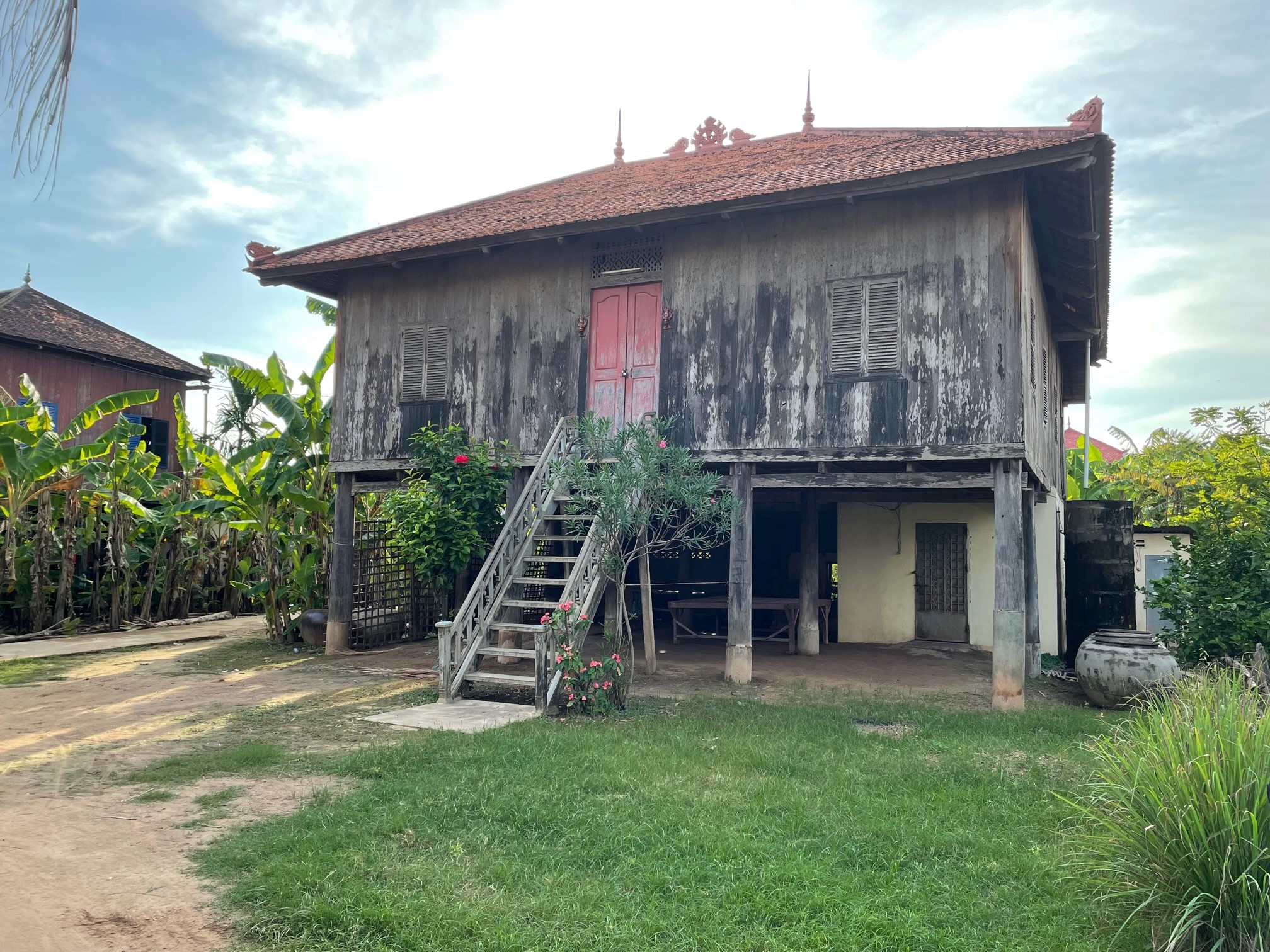
During the three-hour tour, we stopped by the local monastery for a water blessing by the monks before we visited with local families and farms to see how the locals live. One generous homeowner gave us a tour of her traditional home, set up high on stilts to avoid the floods of the river. Inside we walked on the traditional bamboo floor and explored the family and private spaces.
A traditional-style home in Angkor Ban
Walking on bamboo floors through the family space in a traditional Angkor Ban home
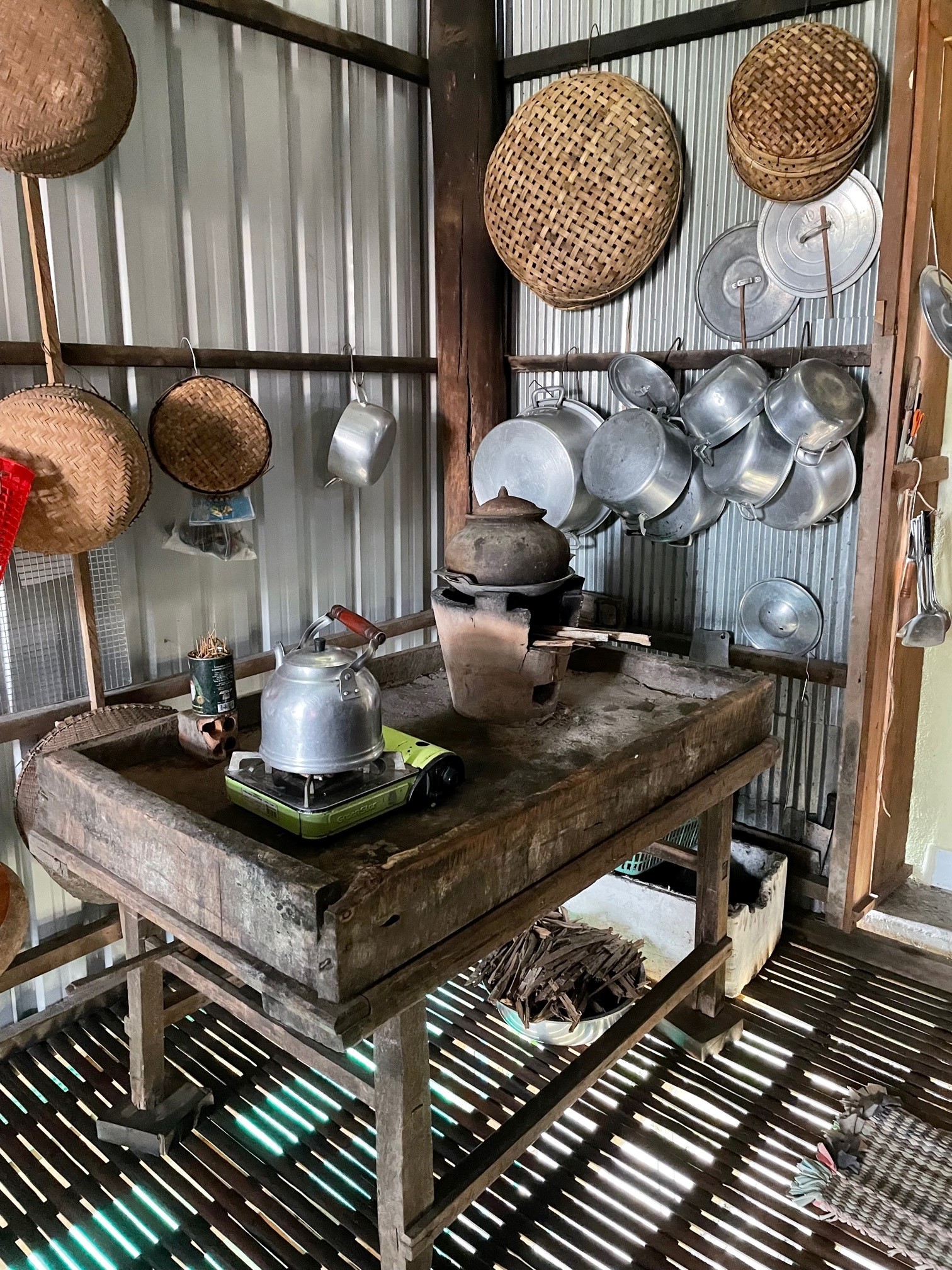
The kitchen area in this Angkor Ban home
A bed and sitting area in this traditional Angkor Ban home
Another of the traditional Angkor Ban houses
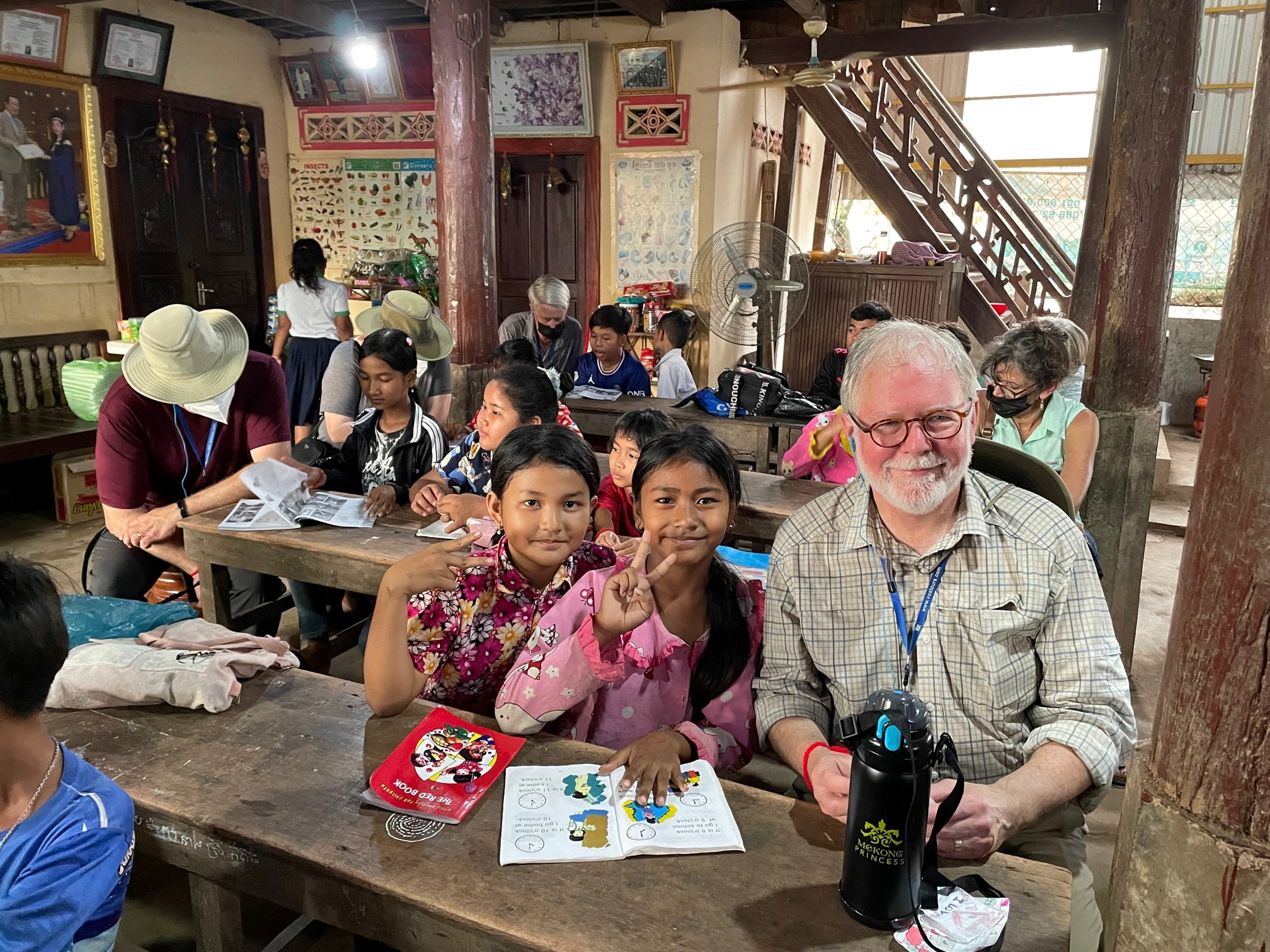
Afterwards, we continued to an English language primary school, where we met the children, helped them in reading English, and learned about a typical school day.
Candice listens to a young student at the English language academy read from her book
DJB with two of the students at the English language academy, after they have been reading from their lesson books
It was a magical way to end our time on the Mekong Princess, our home for the past seven days.
Enjoy the images from this portion of our visit.
The Mekong Princess at sunset alongside Angkor Ban
More to come…
DJB
Image of a row of traditional houses in Angkor Ban by DJB
History is always under construction. The facts that we know now may be accurate, but incomplete. As we learn more, the way we tell the stories of our history and the way we preserve the physical reminders of the past changes. Our memories are shaped by forces outside ourselves which are often not acknowledged.
Haunting pictures from the War Remnant Museum in Ho Chi Minh City
That is especially true in a place like Southeast Asia, where America’s recent history is confusing, contradictory, evolving, and always ― it seems ― up for interpretation. MacArthur fellowship recipient and Pulitzer Prize-winning author Viet Thanh Nguyen, who was born in Vietnam and raised in America, speaks to this tension in his book Nothing Ever Dies: Vietnam and the Memory of War.
Nguyen notes that he counts himself among those Americans “who often do not know what to make of Vietnam and want to know what to make of it.” Confusing the country of Vietnam with the war, he suggests, adds to our uncertainty; in his own case about “what it means to be a man with two countries, as well as the inheritor of two revolutions.” Nguyen calls on us to work toward the creation of just and ethical memories by remembering others as well as our own people.
The issues facing the preservation of historic places and how we maintain and share collective memories from our past have constantly changed in what is rapidly approaching 50 years for me in the field of historic preservation. In a talk on our National Trust Tour of the Mekong River and in visits to several sites where we confronted very difficult history, I asked our fellow travelers to join me in considering how those changing perceptions affect the work to preserve our history in the U.S., and how these issues play out in places like Vietnam and Cambodia.
Tour of the Cu Chi tunnels, where Viet Cong soldiers lived underground to escape detection by the South Vietnamese and their American allies
When there are disputes about history, we often find that it occurs at places where the meaning and memories bring forward powerful emotions. Places where the underlying causes are either unclear or not recognized by some groups because to do so requires deeper introspection and changes in perspective than they are willing to undertake. Disputed or difficult histories can be tied to places of destruction, enslavement, exploitation, death, and remembrance even when that’s not the prevailing narrative being told or interpreted at those places in this moment.
Confronting difficult histories pushes us to think beyond simple frames and established timelines. Viet Thanh Nguyen confronts one challenge of naming the war in Southeast Asia by suggesting that it encourages selective memory as we remember the violence that spread beyond Vietnam’s borders; a violence which was administered not only by the Americans and their allies but also by the Vietnamese people against each other and to Cambodia and Laos, and which led to the atrocities of the Khmer Rouge regime in Cambodia from 1975-1979 after the “Vietnam War” was “officially” over.
We saw several places on this tour where the history is difficult and can sometimes be in dispute.
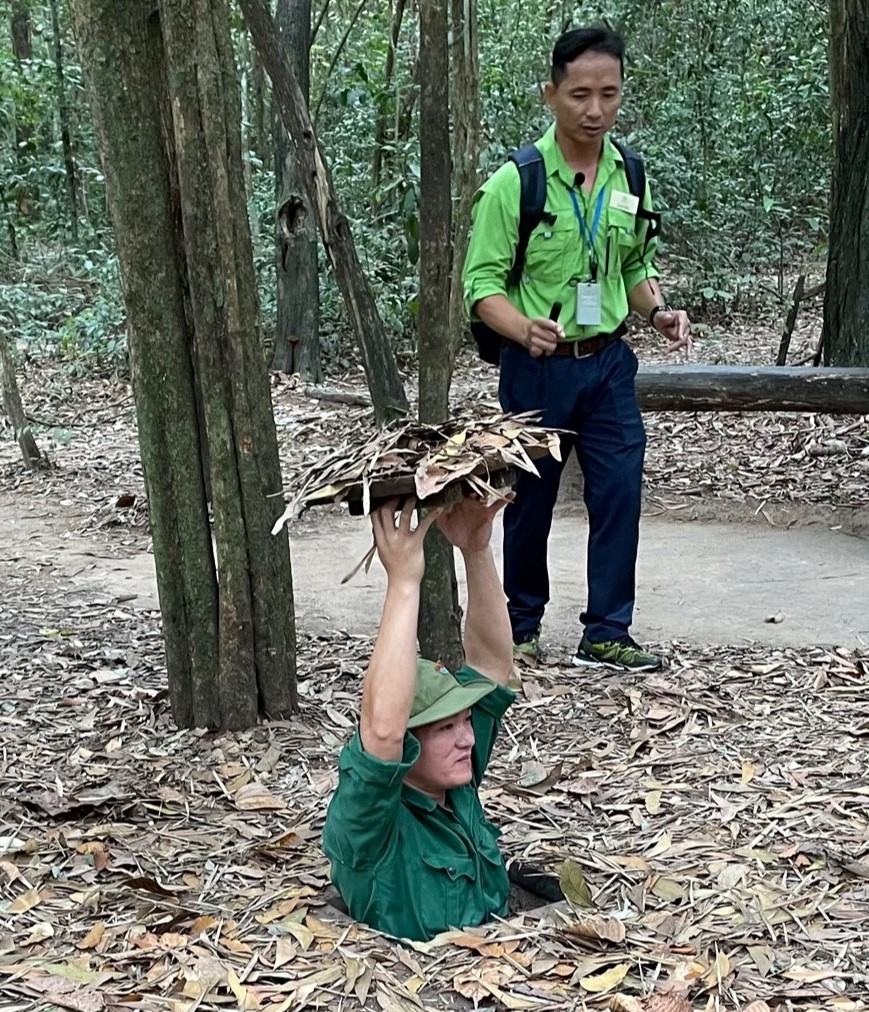
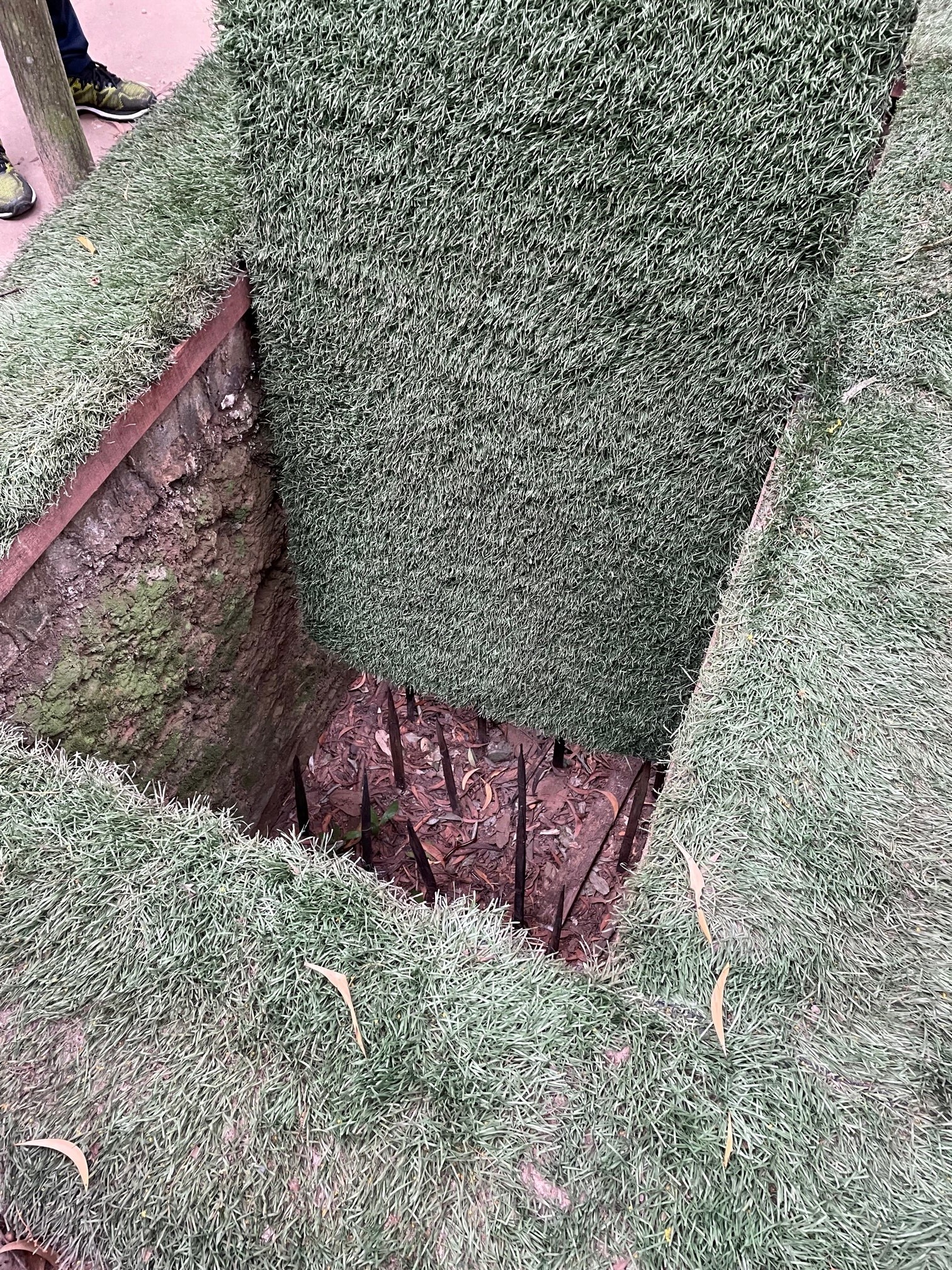
It was a challenge for some to visit the Cu Chi tunnels outside Ho Chi Minh City, where many of those who fought against the South Vietnamese and their American allies lived in an extensive network of underground tunnels. The traps along with the crude tools used to injure, capture, or kill Allied troops were on full display. Our local guide did a good job of explaining the Vietnamese desire for independence, whether it be from the Chinese, the French, or the Americans.
Demonstration of one type of trap at the Cu Chi Tunnels
Extent of the tunnel network at Cu Chi in Vietnam
Some of our group recognized that there would be different interpretations of the Cu Chi tunnels. Fewer may have considered the disputed history of Saigon’s Notre Dame Cathedral.
The cathedral, built between 1877 and 1880 in the Romanesque style, was strategically placed to serve as a center of French power in Vietnam. The French came to Indochina to expand their territory, build wealth, and spread Catholicism into a country where Buddhism was the predominant religion. As Catholicism was introduced, a number Buddhist practitioners converted to the new (for the Vietnamese) religion, leading to natural conflicts. Catholic missionaries and priests were seen by many natives as abusing their power to destroy Buddhist temples and replace Buddhist symbols with Catholic ones.
Notre Dame Cathedral Basilica of Saigon
The Notre Dame Cathedral Basilica of Saigon, for instance, was constructed on top of a Buddhist temple. Natives, Buddhists, and others see the perspective that religion was used as a colonial device and a social status symbol. For many French and Catholics, they see the perspective that the Roman Catholic Church used colonialism as an avenue through which Catholicism could thrive, and that the beauty of European architecture could spread to Southeast Asia.
Difficult and disputed history comes from varied perspectives and memories. Perspective is a point of view…not the whole view, and as the American poet Marie Howe notes, “Memory is a poet, not a historian.”
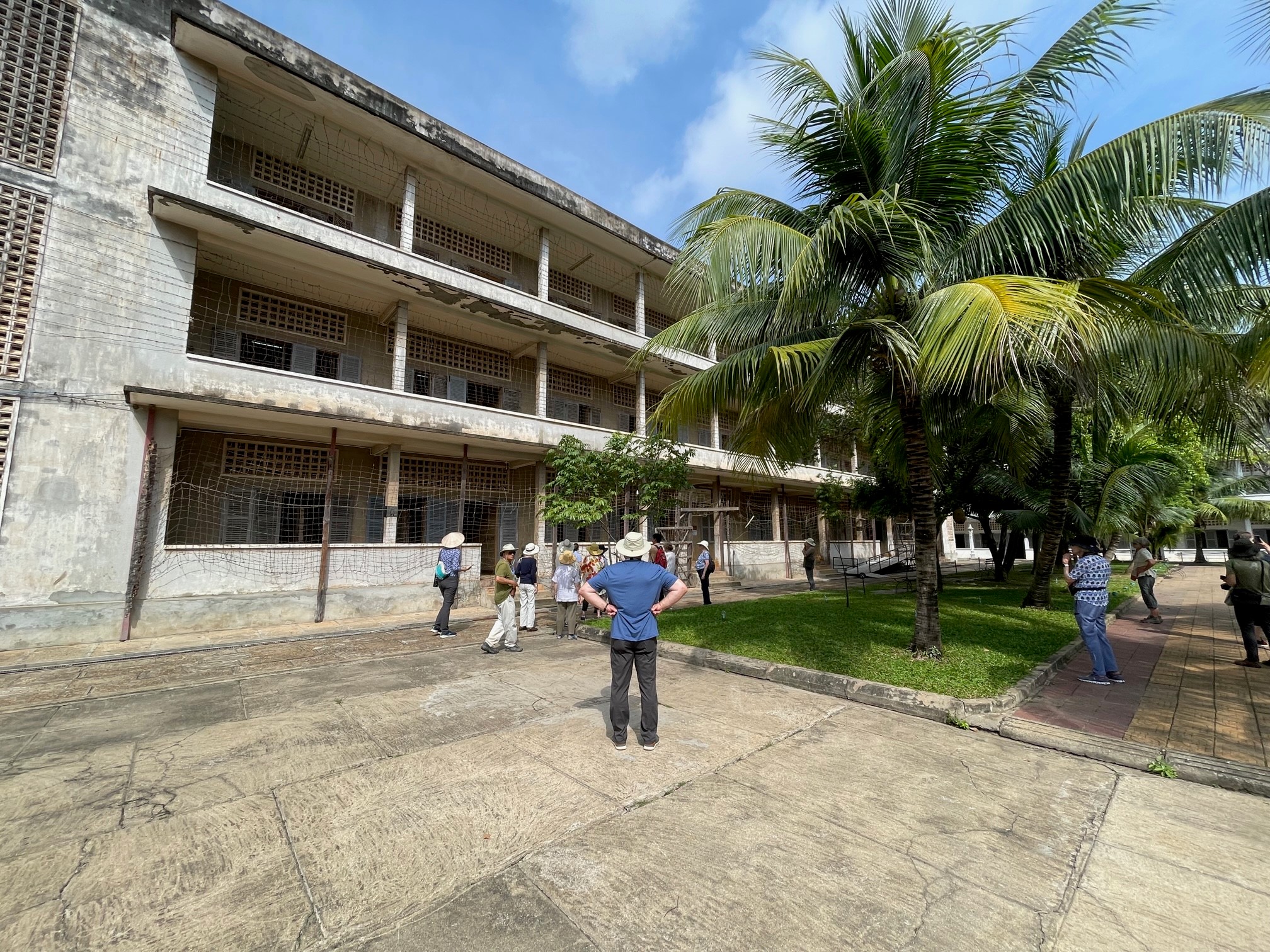
View of the S-21 prison in Phnom Penh
A former high school turned into the infamous S-21 torture center by the Khmer Rouge
When we entered Cambodia, the National Trust ensured that our group visited two of the places in that country with the most difficult of histories: the infamous S-21 torture center and the killing fields used by the Khmer Rouge. The fact that these atrocities are internationally known does not make the preservation and interpretation any easier.
Gallows used to torture prisoners at S-21
Site of a mass grave at the Killing Field outside Phnom Penh
During my talk and also in the conversations with our local guides, our group discussed how important it is to engage with local communities in understanding these places. Our Cambodian guide also mentioned that virtually every family in Cambodia was affected by the genocide.
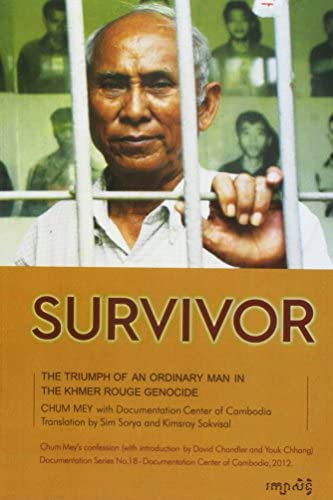
At S-21, we were privileged to meet one of seven survivors of the prison, a man by the name of Chum Mey. As he tells in his book Survivor: The triumph of an ordinary man in the Khmer Rouge Genocide (2012), Chum Mey was fortunate. His life was spared because, as a mechanic, he was able to fix a broken typewriter for his captors, who then kept him alive in order to work on other machinery at the site. The book, told in the first person, is a raw and moving story of a poor Cambodian peasant, whose parents died when he was young. His dream to be a car mechanic led him to learn the trade, and then to go to Phnom Penh after the Khmer Rouge takeover because that was where the buses and cars were located. Like many in Cambodia, he was arrested under false pretenses and sent to Tuol Sleng, the name for the S-21 prison and torture center.
Building at S-21
Chum Mey at S-21 today, as one of seven survivors from the torture center
There he was interrogated and beaten. But once they learned he could fix broken equipment, his fortunes changed. His story of the arrest, interrogation, beatings, work, escape, and liberation brings a human voice to the understanding of history. He told us that he missed being selected to go to the killing fields to be executed due to a mix-up one day at the prison.
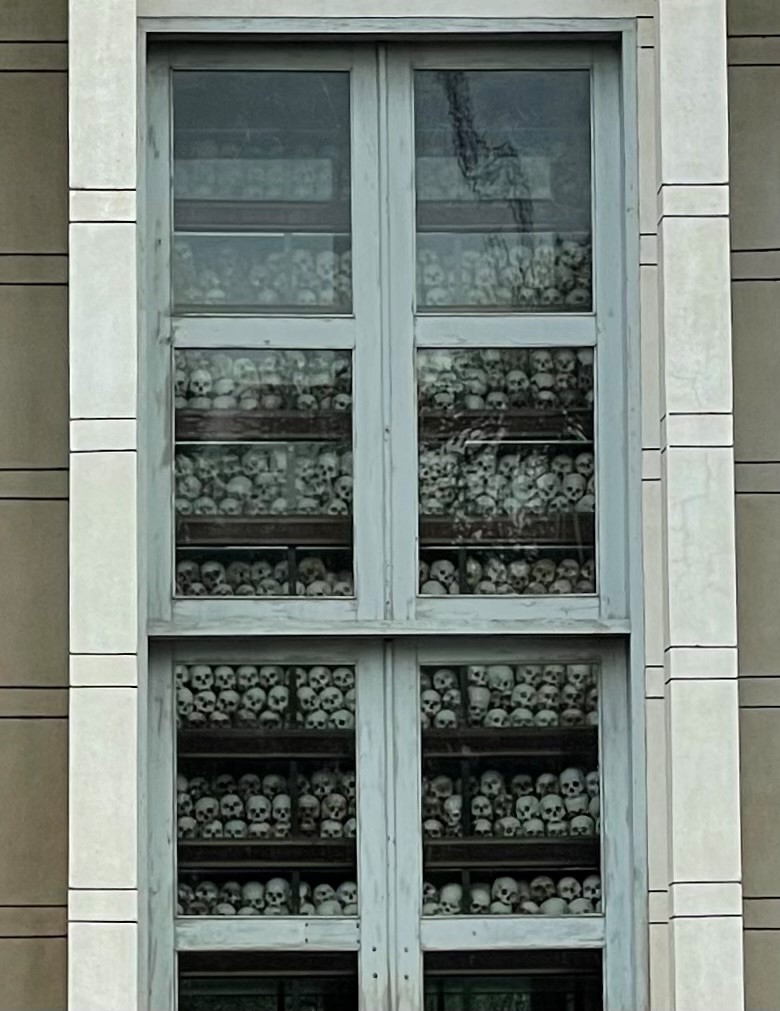
Had that not occurred, Chum Mey’s body would have been tossed into one of the mass graves at the site, and his skull could have been included in the haunting memorial. As he said, “had that happened, I would not be here today talking with you.”
Skulls of victims of the Khmer Rouge killing fields
Chum Mey’s story has had international impacts, as he traveled to Germany to see the Nazi camps of World War II, which reminded him of S-21, and then he testified at the Khmer Rouge tribunal. These stories are hard to hear, but so very necessary.
For far too long we have chosen to save that which reflects well on us ― beautiful buildings and sites that uplift. One of the challenges we face now, in the U.S. and in Southeast Asia, is to find ways to preserve and interpret sites that tell the stories of those who have traditionally been marginalized and often brutalized, harshly mistreated, or killed, stories that are not part of the long-told narrative.
Tree of shame, against which children were beaten
Memorial at the Killing Fields outside Phnom Penh
At the Cu Chi tunnels, the War Remnant Museum, S-21, and the Killing Fields we certainly were confronted with very difficult stories and histories. It was important for our group — and the world — to hear them.
More to come…
DJB
Image of a monument at the Killing Fields outside Phnom Penh by DJB
As part of a fascinating National Trust Tour, we have joined some 20 other travelers in cruising the Mekong River in Vietnam and Cambodia over the past week. My first post from Vietnam followed my initial talk with the group around the differences between Eastern and Western conservation practices. Today I want to simply capture a number of images we’ve seen in this most intriguing and complex of places. The third post, to come in a couple of days, will examine how we respond to and help build understanding around sites with difficult and disputed histories.
Typical scene on Gieng Island in Vietnam
Weaving scarves on a traditional loom (most villagers on Hong Ngu island, including this family, use modern mechanical looms)
Learning about the various uses for the traditional scarf in Vietnam and Cambodia
Building a traditional sampan on Gieng Island in Vietnam
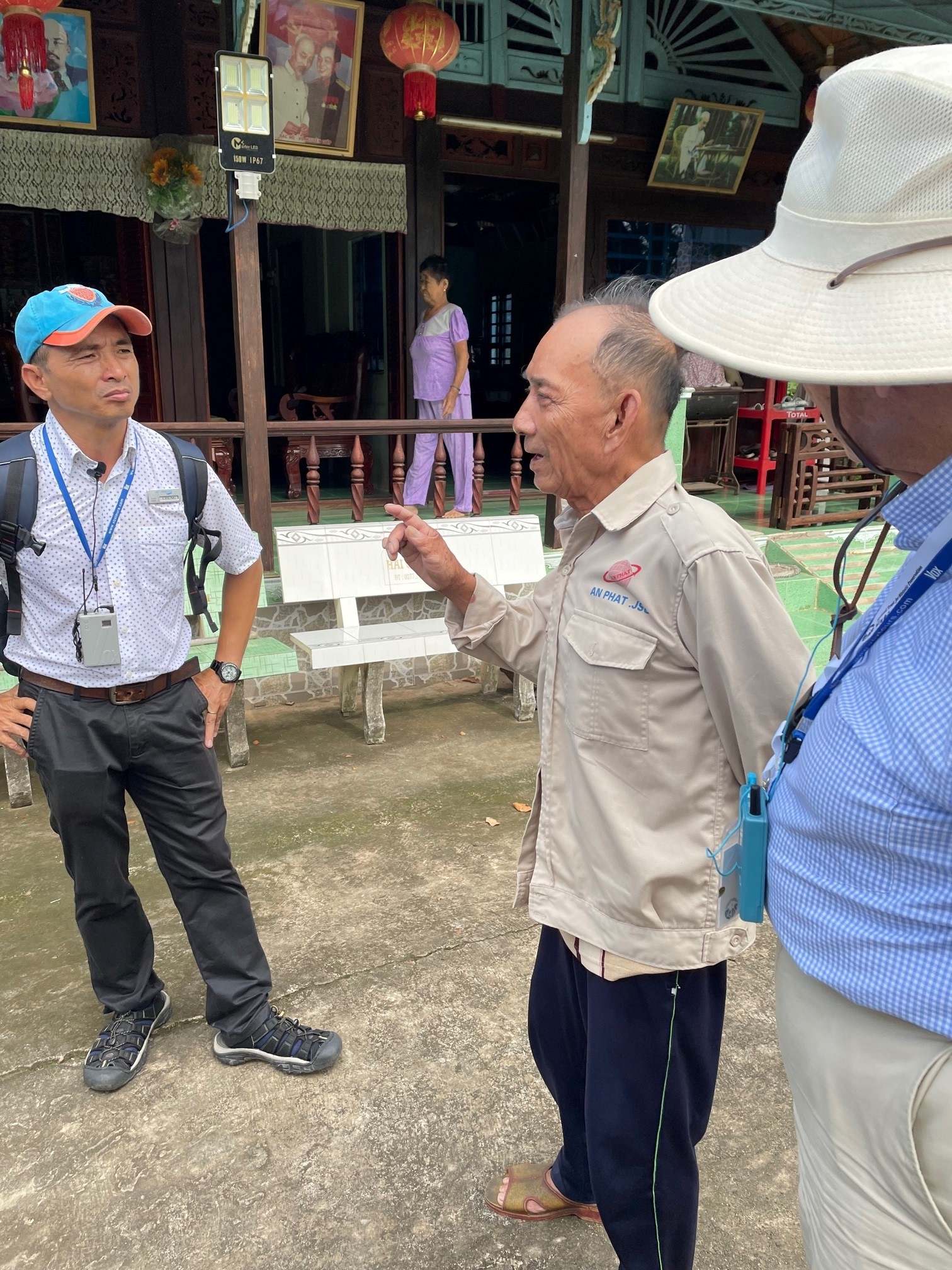
Visiting the home of a former Viet Cong medic on Hong Ngu island
Hearing the story of a former Viet Cong medic
Phanixo monastery and school grounds on Gieng Island in Vietnam. The monastery was built by the French in 1879.
Phanixo Monastery in Vietnam where the monks helped care for locals stricken with leprosy.
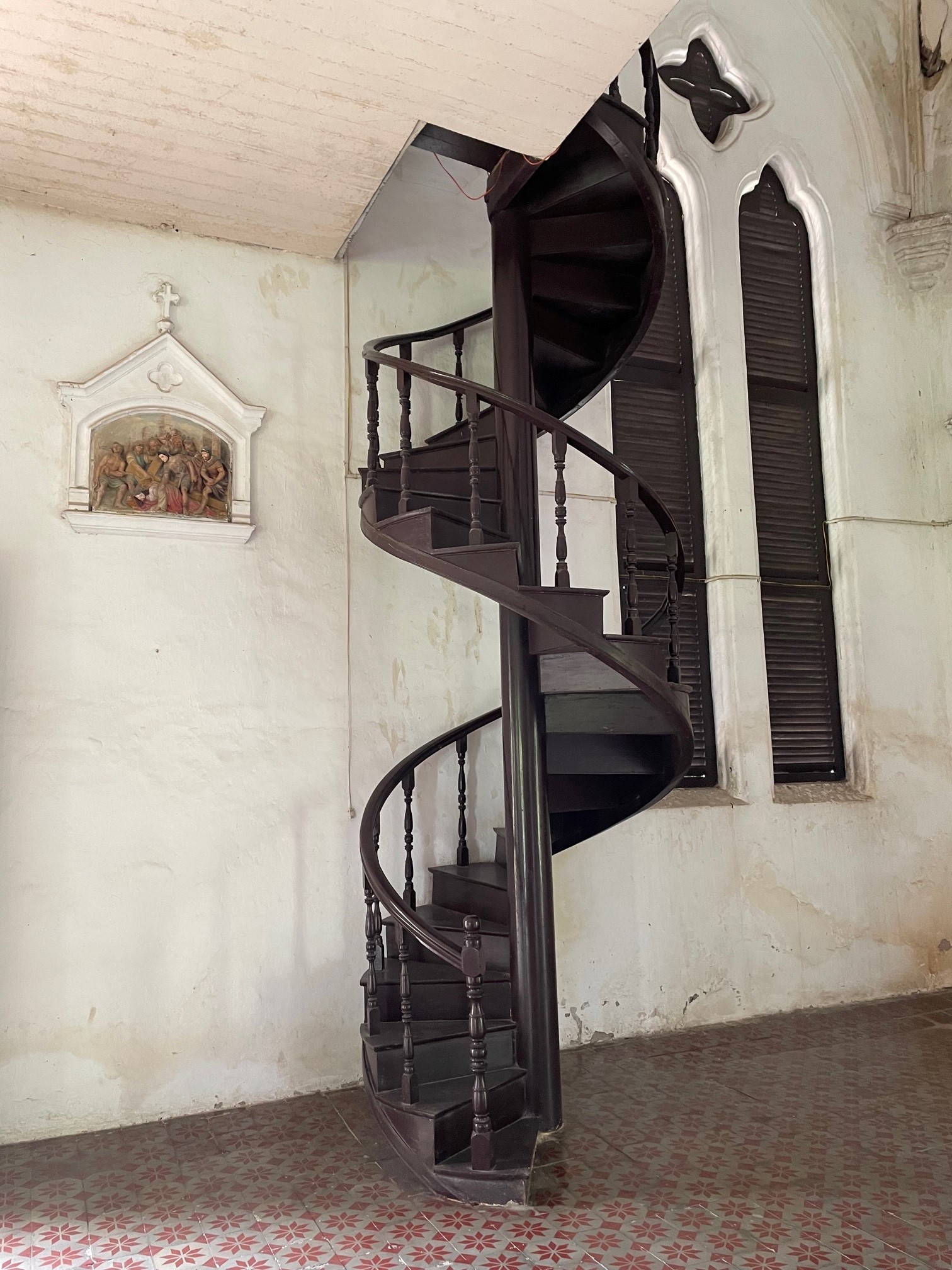
Stairway to the monastery’s loft
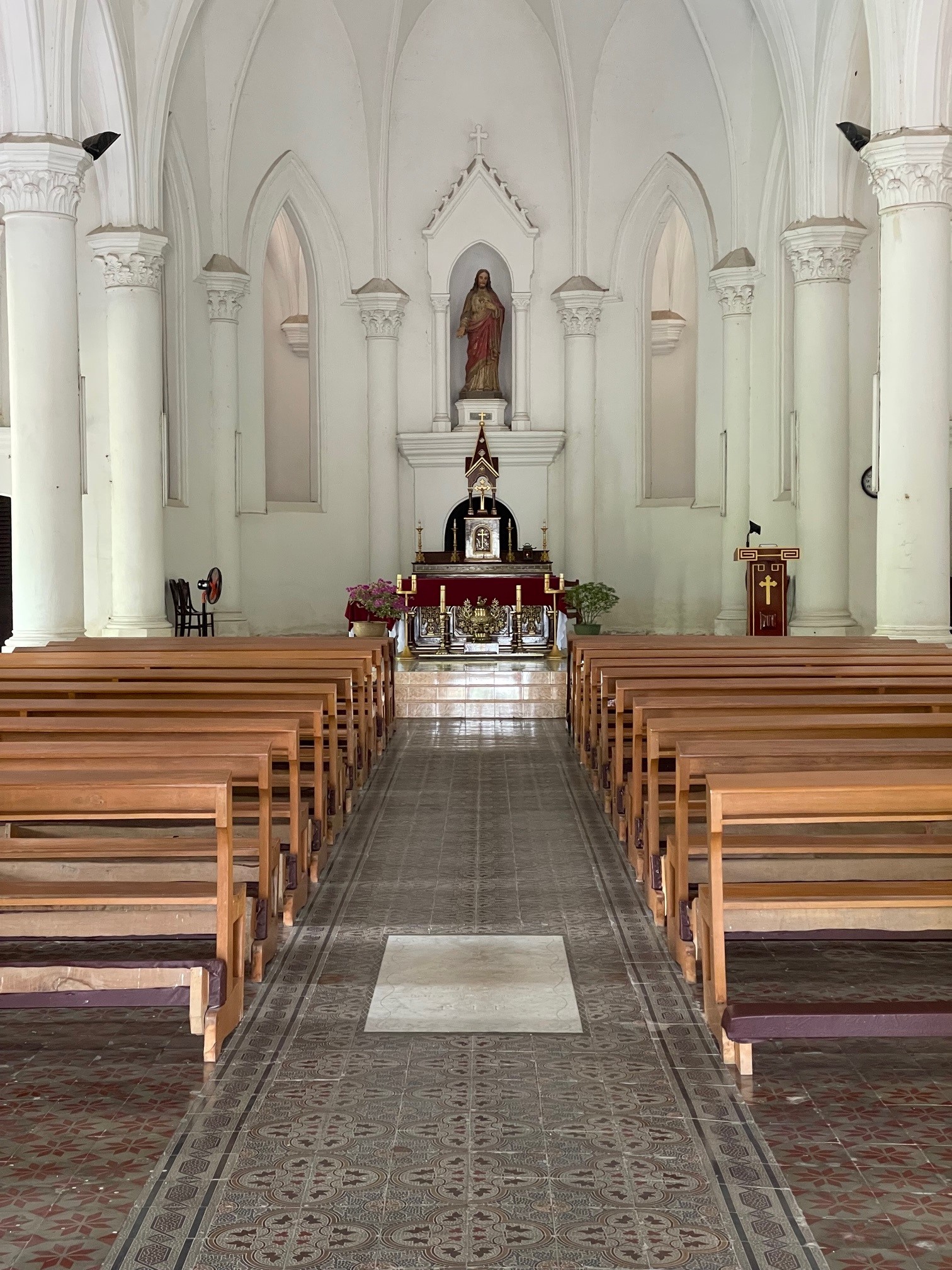
Monastery altar
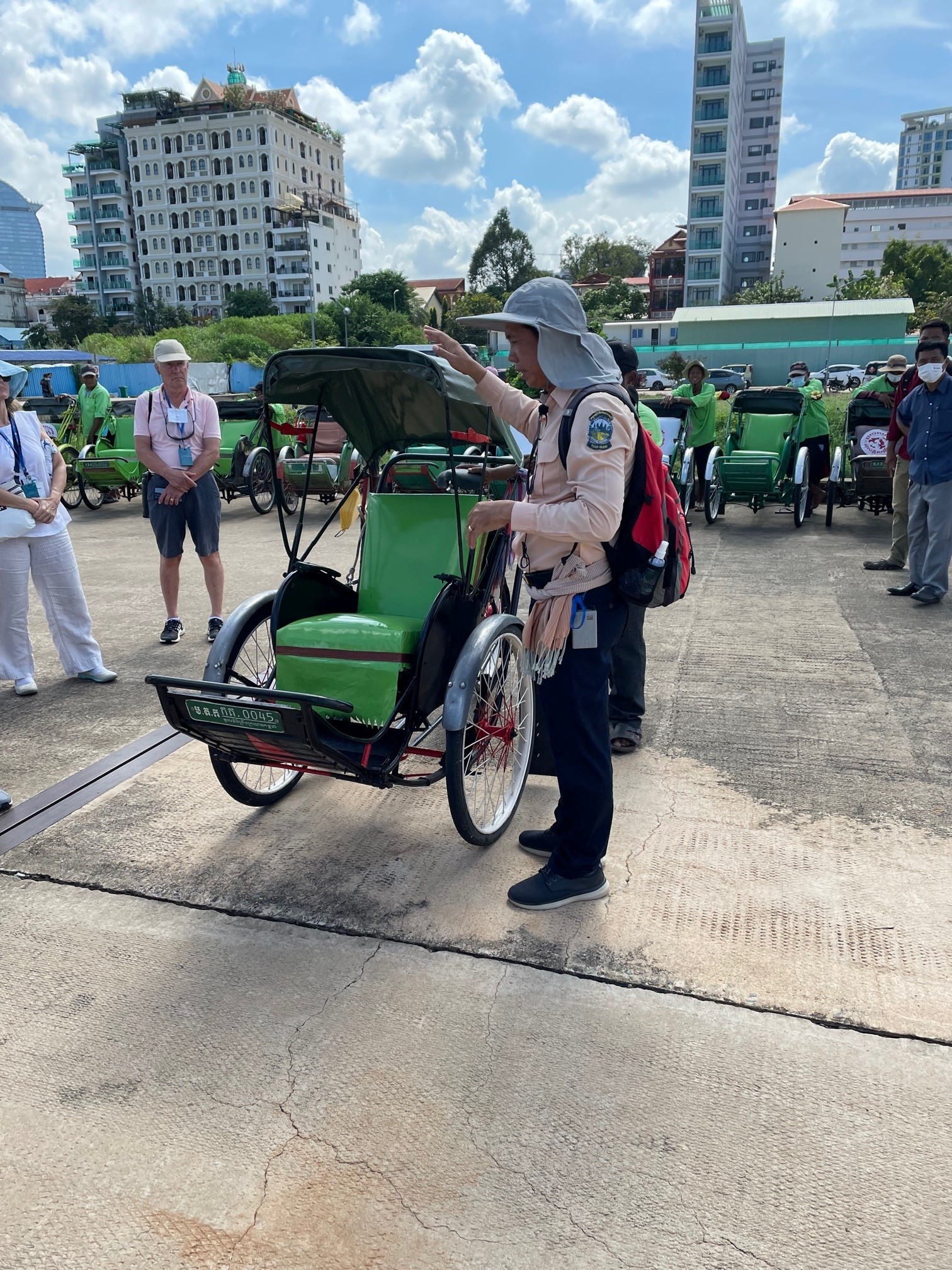
Our mode of transportation in Phnom Penh, Cambodia
DJB is apprehensive but ready for the cyclo tour
And away we go!
Sunrise in Cambodia
I’ll post more scenes from Phnom Penh and Cambodia in the coming days.
More to come…
DJB
Image: Building a traditional sampan in Vietnam by DJB
My father, an enthusiastic but terrible singer, was also a fan of piano and big band jazz music. My older brother Steve and I occasionally put one of his old 78 rpm albums on the record player so he could reminisce about seeing these musicians in places like Chicago, where he was stationed during the war.
On the rare times he would sit down at the piano, Daddy would play one of two songs. The first was The St. Louis Blues. The second ― which came from his love of the elegant jazz pianist Teddy Wilson ― was Body and Soul. I can still remember that tune and the way he imitated Wilson’s graceful stylings. I have to admit that I didn’t know the song had lyrics until much later. Thankfully, my father did not sing along!
I was thinking aboutBody and Soulin the context of our trip on the Mekong River when I was reading from the works of Malaysian architect Laurence Loh, one of the foremost conservation specialists in the region. Loh writes and speaks about how historic sites convey a spirit of place, or their cultural essence. And he suggests that the concept here in Southeast Asia may be better understood if one alludes to the notion of “body and soul.”
Vietnamese home in the village of Ben Tre
Sampan working its way through the Nipah palms
Part of the lush flora of Ben Tre village
For Loh, the body is “the physical fabric of the heritage site. The soul is the sum of the site’s history, traditions, memories, myths, associations, and continuity of meaning connected with people and use over time.” As the song suggests, the singer is “all there for you, body and soul.” It isn’t body or soul. Similarly with heritage places, the two are intertwined, but that isn’t always how these places are perceived in the West. Differences between preservation and conservation practices in the West and in Southeast Asia was the theme of my first lecture on the trip, and I explored those differences in terms of how time is interpreted in the two cultures, the importance of intangible heritage in Southeast Asia, and the need for cultural mapping to fully understand our heritage areas.
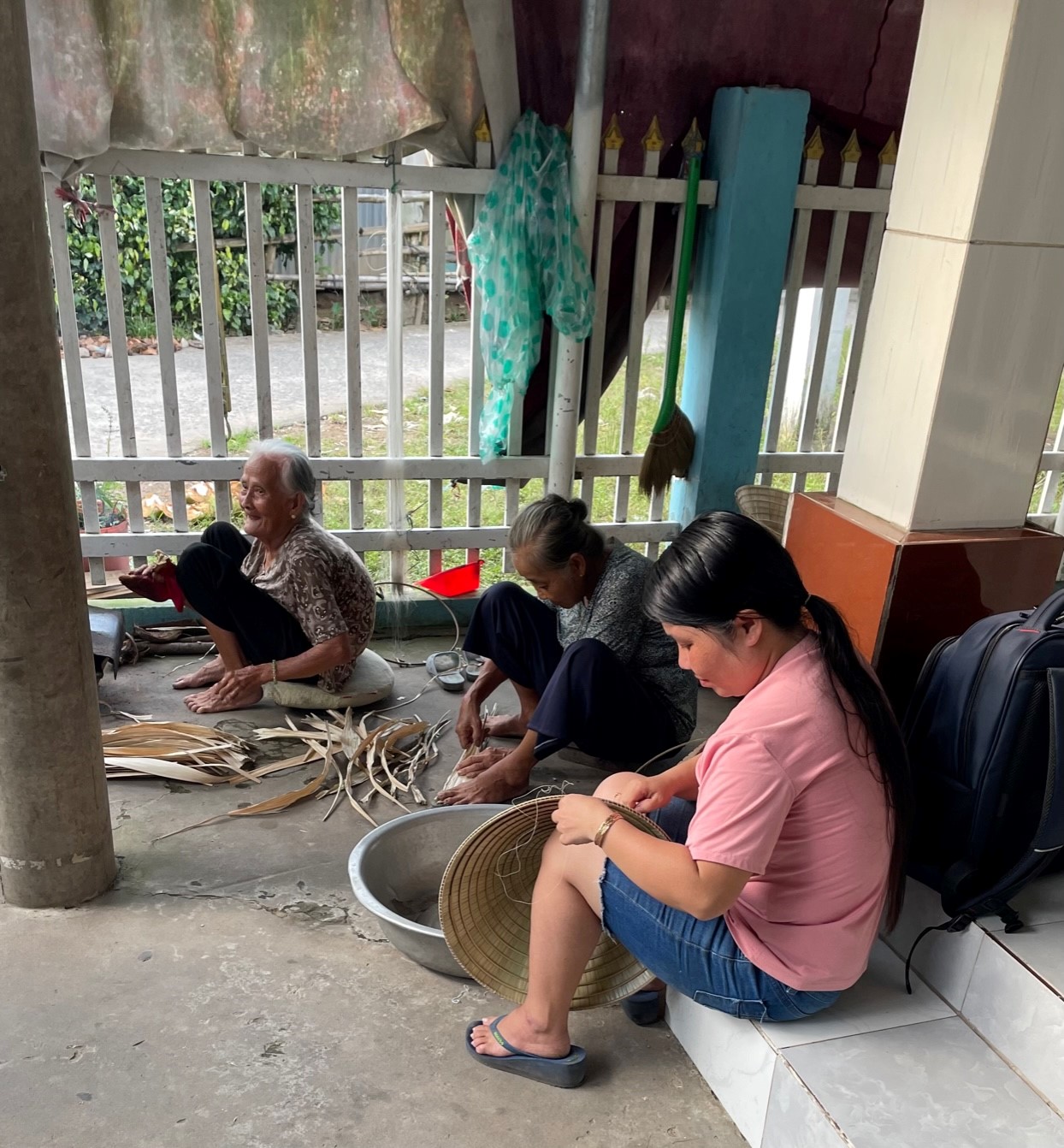
Making traditional conical hats in Hoa An village
Three generations of one family work together to make the traditional hats
The craftsmanship of the traditional hats
I won’t go into detail in this post, as I simply wanted to capture some of the places and people we encountered in our first few days in Vietnam. This Eastern approach to time, however, where the culture doesn’t see people as trying to control time, was evident everywhere we turned and in the comments of our local guides. The adaptation of humans to time is seen as a viable alternative to our western (linear) approach. “Time is viewed neither as linear nor event–relationship related, but as cyclical. Each day the sun rises and sets, the seasons follow one another, the heavenly bodies revolve around us, people grow old and die, but their children reconstitute the process. Cyclical time is not a scarce commodity. There seems always to be an unlimited supply of it just around the next bend.”
As they say in Southeast Asia, when God made time, He made plenty of it.
The longevity of civilizations has meant an appreciation for tradition, for things old. This has included appreciation for traditional buildings, traditional ways of working, for both the tangible and the intangible elements of culture — the body and soul. Of course there are challenges to this approach including Western-style development, Western approaches to preservation focused on monuments, and interventions from other countries such as with China’s Belt and Road program — issues I explore more completely in my second lecture on this trip.
Old and new mix along one of the many waterways in Ho Chi Minh City (Saigon)
Scenes from Ho Chi Minh City
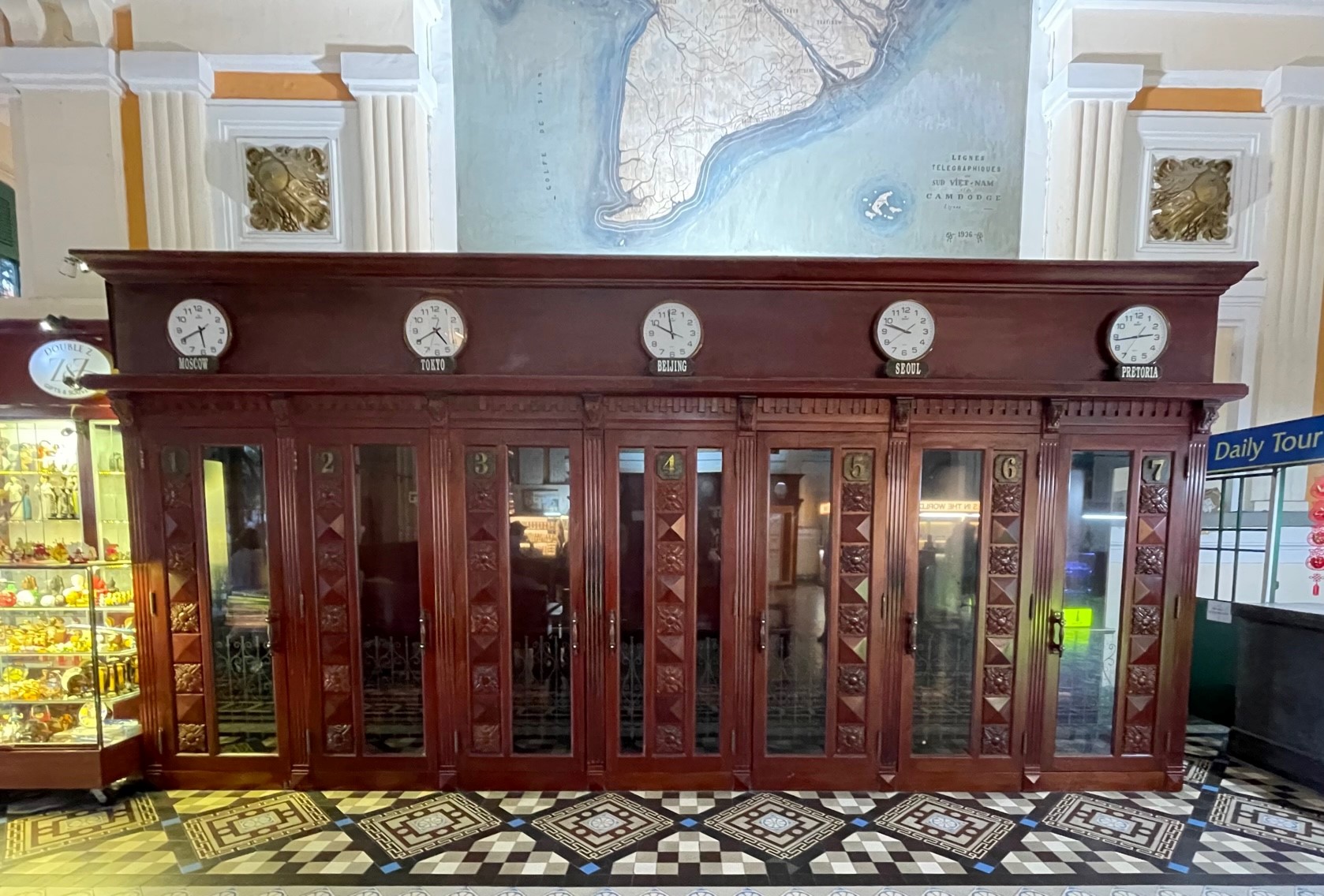
The interior of the Old Post Office, built during French occupation of Vietnam in the early 20th century
Telephone booths and world clocks in the Old Post Office
A temple in Can Tho, the bustling capital of the Mekong Delta
Hanging incense, with prayer intentions included in the center
Laurence Loh says that the tangible/intangible plays out in conservation practice by allowing what is living to stay alive and true to the place. “It is about letting the architecture, the traditions, and the cultural essence live on with minimal intervention. If change is necessary, the change must be so seamless that very quickly it becomes absorbed in the original value system. Before long, it attains its own meaning and becomes part of the collective memory, as if it has always been there as part of the place.”
Buddhist beliefs around permanence and time also affect attitudes about architecture. If humans go through a cycle of birth, life, death, and re-birth why shouldn’t buildings do the same? Both East and West would agree that the spirit of place resides in its authenticity, and that’s a critical element in heritage conservation.
Identifying the authentic elements that define the character of a place and convey its spirit is usually not a cut and dried process. To do so successfully, we have to engage with and listen to those who live in these communities.
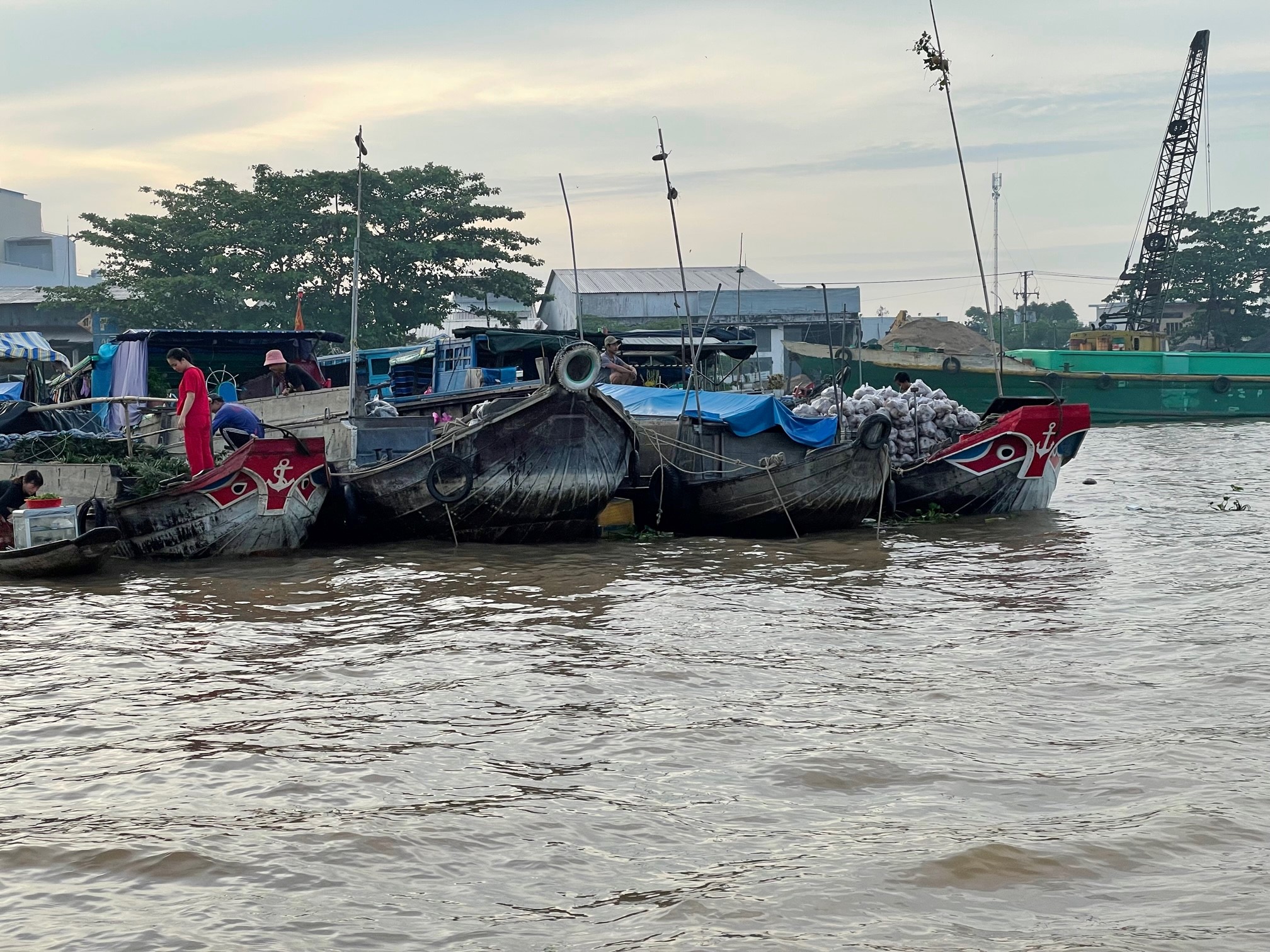
Scenes from the Cai Rang floating market
“There is authenticity in form and function as well as meaning, helping to preserve the cultural essence, enhancing the spirit of place.” Function and meaning provide authenticity that a simple focus on restoring architectural details cannot. “Spirit of place comes alive not just in the ways a site is conserved and presented, but in the way it is used and valued by people.” Laurence Lou notes that good conservation and preservation, in the eastern understanding of the words, helps a community animate the space. How a place is animated by its community gives it meaning.
In the best of the eastern preservation and conservation projects, the community has a role to play. “By taking part in the conservation work, and the using and maintaining the building after it is conserved, the community breathes life into the site, invigorating its spirit of place.
Scenes from the flower gardens in Hoa An
A simple meal and a beer at the end of the working day
While it should not be true in any context, it is especially important to understand that authentic places in the East are not preserved in amber. And their authenticity comes not only from the physical structure, but from the history, traditions, memories, myths, associations, and continuity of meaning connected with people and use over time. What’s known as the intangible heritage of a site.
We saw that in abundance in our first days here along the Mekong River.
More to come…
DJB
Image of mountains in Vietnam from Pixabay. All other images by DJB.
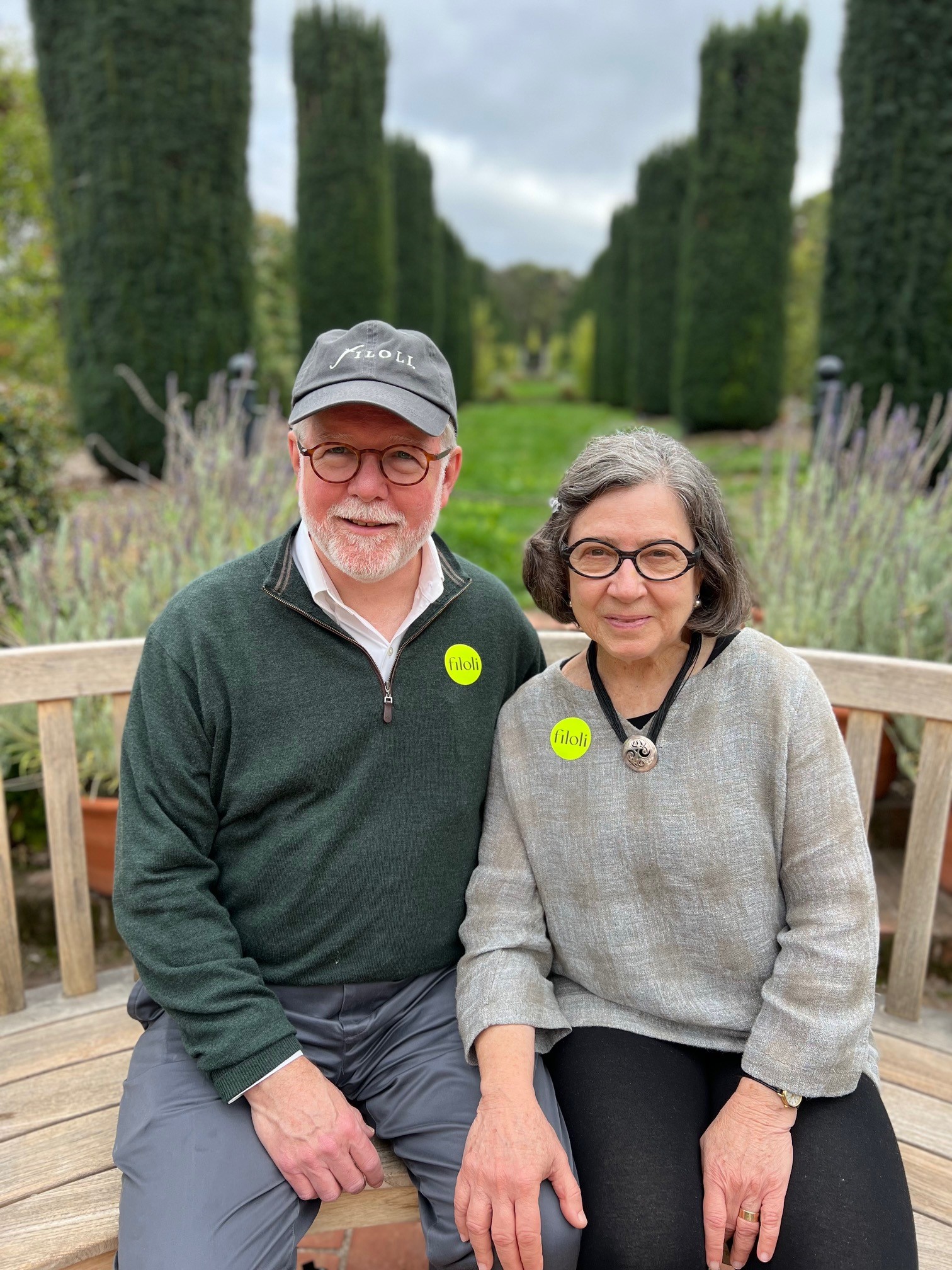
Last Sunday, Candice and I spent the afternoon with our daughter Claire at Filoli, the National Trust historic site in Woodside, California. We were visiting before the two of us headed off to Southeast Asia for a National Trust Tour where I’m one of the study tour leaders. It was a very satisfying afternoon.
For readers not familiar with Filoli, here’s the basic description of the estate from the National Trust website:
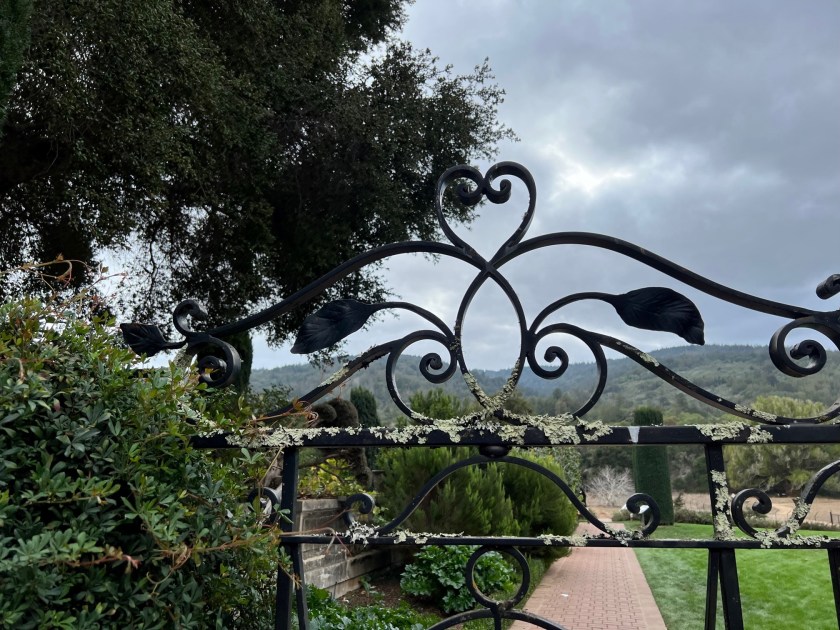
Filoli is an expansive landscape situated on the unceded ancestral lands of the Ramaytush Ohlone. Today, this estate serves as a community cultural center open daily to the public. The estate boasts 654 acres of beauty nestled along the slopes of California’s coastal range.
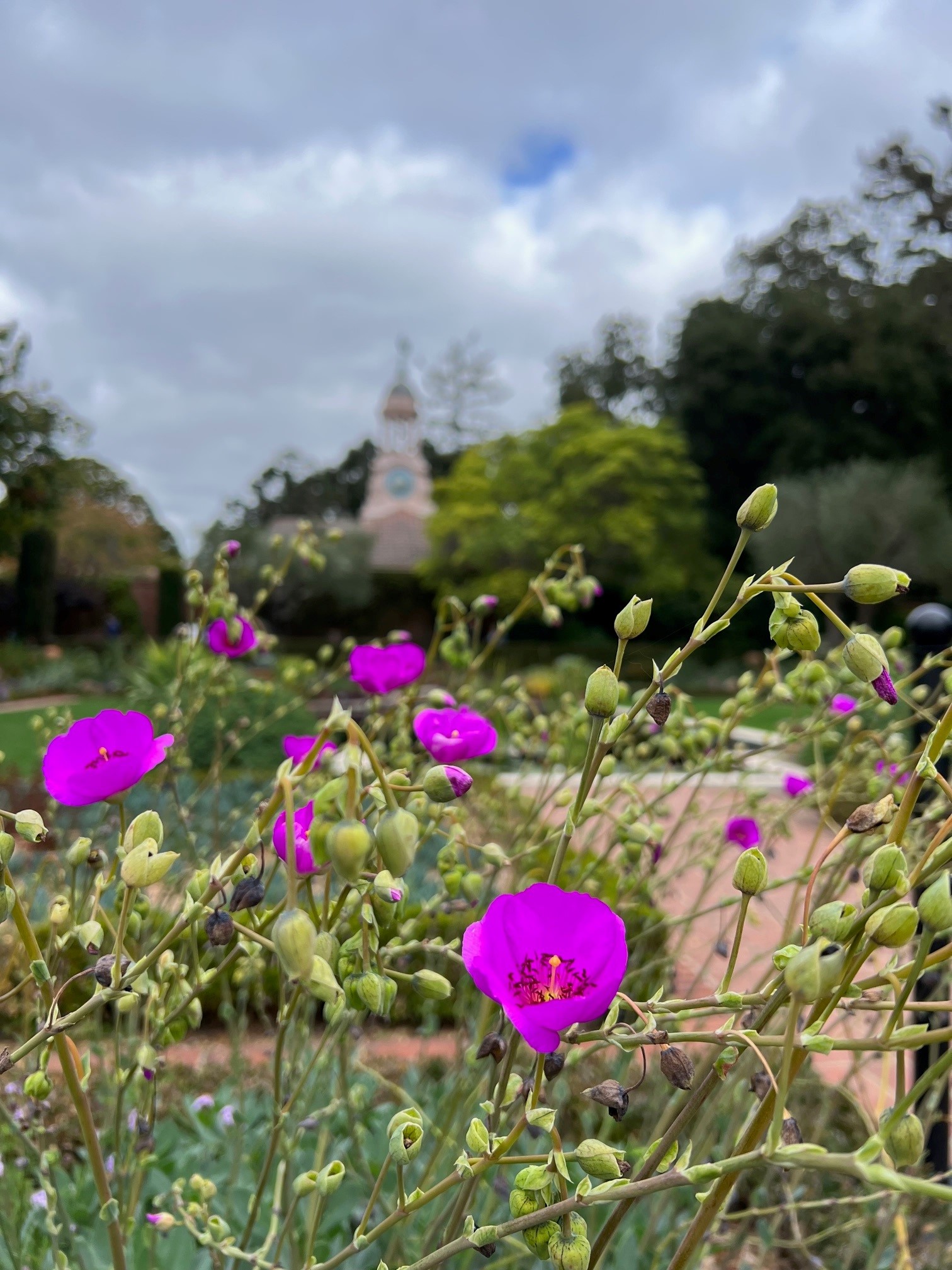
Originally built as a private residence in 1917, Filoli was opened to the public in 1977 as a 501(c)(3) nonprofit organization and site of the National Trust for Historic Preservation. The property is considered one of the finest remaining country estates of the 20th century, featuring a 54,000+ square-foot Georgian revival-style mansion, 16 acres of exquisite English Renaissance gardens, a 6.8-acre Gentleman’s Orchard, and a nature preserve with eight miles of hiking trails.
Filoli is dedicated to connecting our rich history with a vibrant future through beauty, nature and shared stories, so that one day all people will honor nature, value unique experiences, and appreciate beauty in everyday life. Filoli’s mission and vision strive to live Mr. Bourn’s original credo authentically: to fight for a just cause, love your fellow man, and live a good life.
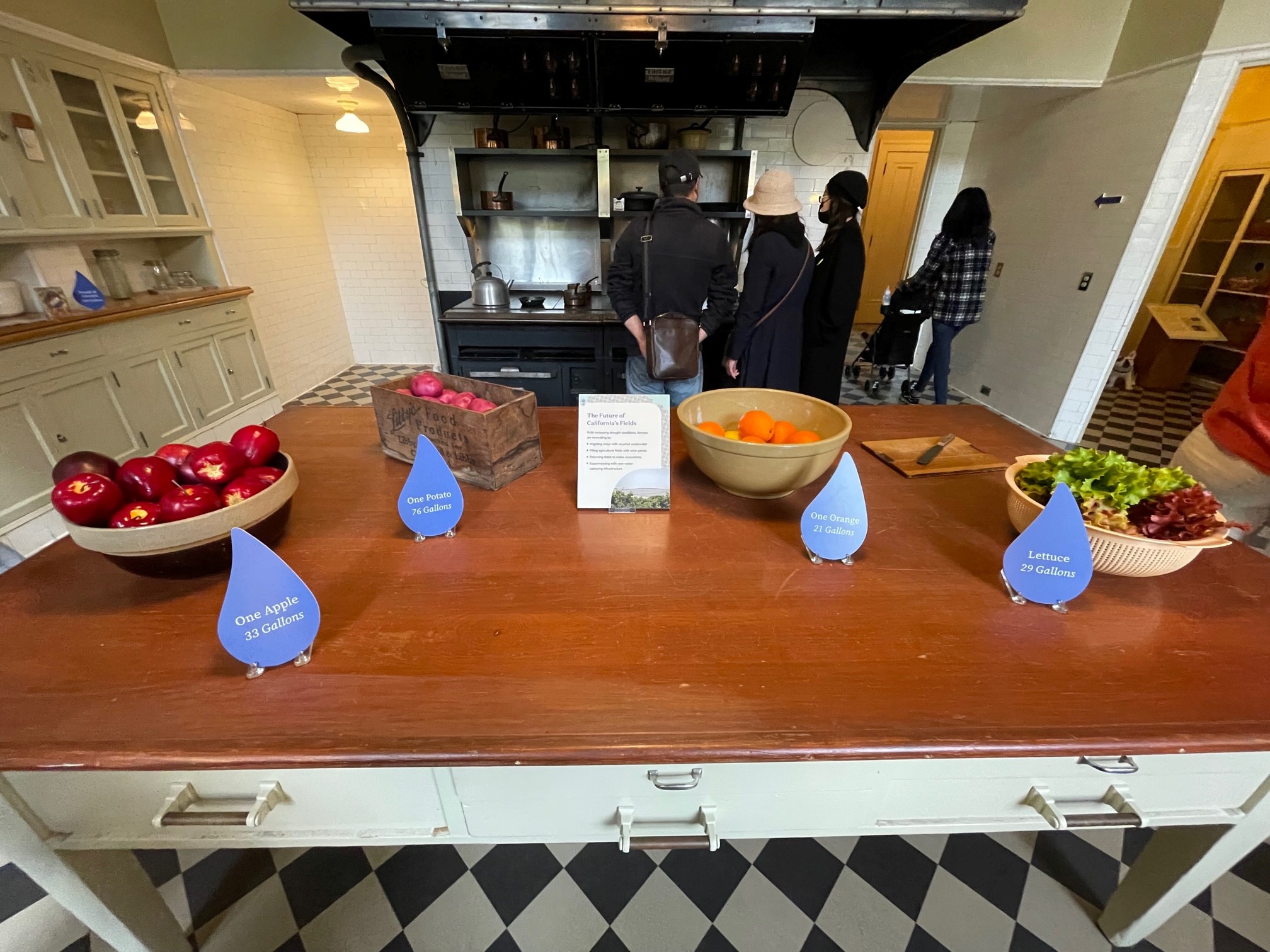
While I’ve been to Filoli many times, the new interpretation entitled Blue Gold told the site’s story in ways that opened it up for so many more people to understand. The place was packed — we parked in the overflow parking lot — and the visitors who came learned about how the privilege of water helped build this magnificent home and estate.
Clean water was once a privilege. In some parts of the world, it still is.Helping us understand how much water it takes to grow certain foodsBlue Gold interpretive panel
Not only did the exhibit provide great historical detail, but many panels brought the story up to the present and helped us look toward the impacts of climate change in the future. There were interpretive panels on drought and sustainable gardening techniques, among many others. The new interpretation was funded by a grant from the NTHP Interpretation and Education Fund.
This is a big step forward in understanding Filoli’s past and its relevance for today. Kudos to Filoli CEO Kara Newport and all involved.
This year much of the baseball postseason is passing me by. I’ve only been able to watch the wild card round and the start of the division series and then — depending on how many games are involved — I may catch the end of the World Series once I return from my travels. In an effort to scratch the itch that always comes up for me this time of year, I turned to my favorite sportswriter and his new book, the aforementioned 869-page behemoth, to do the trick.
The Baseball 100 (2021) by Joe Posnanski — the self-described “writer of sports and other nonsense” — is characterized by the publisher as “a magnum opus…an audacious, singular, and masterly book that took a lifetime to write.” This is Joe’s intimate and very personal look at baseball history through the lives of the 100 greatest players of all time. It is pure baseball bliss, especially when one is missing the most important games of the season, or when your team decided to tank and recorded the most losses in MLB in 2022, or when your team looks to repeat that feat next year and perhaps the year after that…or, well, you get the point.
I needed this.
Joe originally wrote this countdown of the 100 greatest players in baseball history over a 100-day stretch for the web pages of The Athletic (which comes with my NY Times subscription.) I had read several over that time, but it is much more satisfying in this compendium. And the rankings are important — and instantly give the reader a chance to argue with Joe, which he encourages. But they serve the larger purpose of providing this talented artist and lifelong fan with a chance to explore baseball’s rich, deep, diverse, and at times challenging history. A history that — like all history — is under construction.
Posnanski works to ensure that baseball’s shameful history of segregation, relegating many of the game’s greats to the Negro Leagues, is addressed in multiple ways, including with rich descriptions of the best of those teams in their rightful place among the 100. Players everyone has heard of, like Satchel Paige, and ones more people should know, like Oscar Charleston.
It is in his description of Charleston that Posnanski explains how his rankings came to take the form they have in this book. He talks about the fairly intricate formula he uses to set the rankings, and then some of his personal quirks that set the players in certain places (e.g., #56 for Joe DiMaggio for his historic 56-game hitting streak; #42 for Jackie Robinson for his uniform number, the most famous in baseball). But mostly he wants these rankings to “give this book shape and spark a few feelings.” And they do.
I happen to strongly agree with his number 1 ranking, but I know others who would disagree.
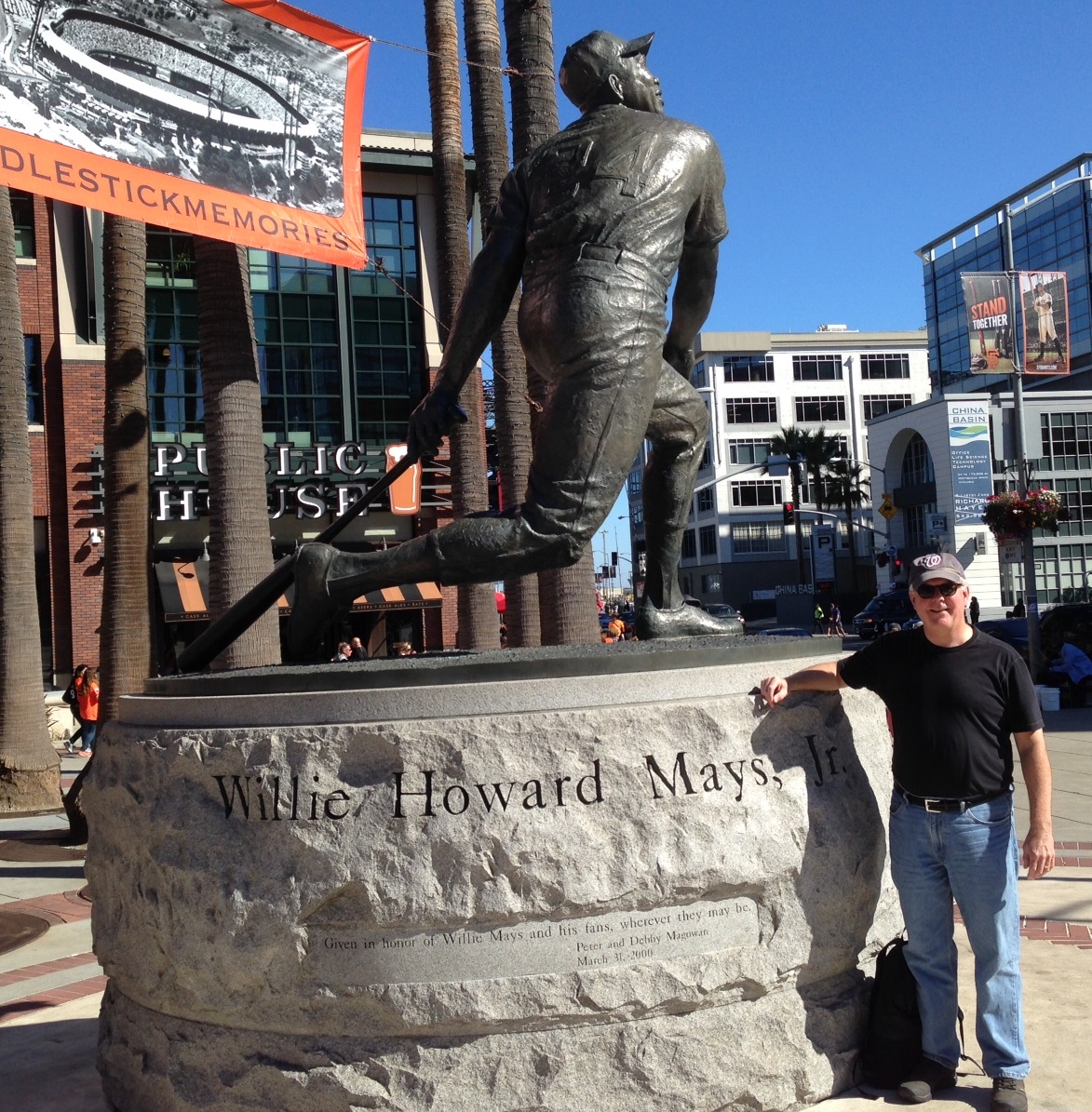
With my childhood hero, Willie Mays – the Say Hey Kid – outside then AT&T Park in 2014
Early on we learn why Roberto Alomar, who comes in at #97, is included, when Barry Larkin, who had an almost identical slash line for his career, is not. But Larkin had only four seasons where he played in 150 games, while Alomar had eight such seasons. As Joe says, “one of the most underrated talents in baseball, and in life, is just showing up.”
There is so much to mention in this book that is wonderful. I love the small details, like the fact that the great hitter Tony Gwynn faced Hall-of-Famer Greg Maddux 107 times in his career and never struck out. That’s incredible. Maddux struck out more than 3,300 batters and faced 11 different batters 100 or more times in his career, including Hall of Famers Jeff Bagwell, Barry Larkin, Craig Biggio, and non-Hall of Famer Barry Bonds. “He struck them out a combined 169 times. But he never struck out Tony Gwynn.”
Speaking of Maddux, Joe includes a discussion around how good a pitcher Clayton Kershaw is in the twenty-first- century game compared to Greg Maddux dueling with the juiced hitters of the nineties. And yes, speaking of juiced hitters, Barry Bonds gets full consideration and inclusion, but Joe does it in his inimitable way. He writes two stories — one for Bonds fans and one for Bonds critics. As he says, “If you veer into the wrong section, you do so at your own peril. That’s just the deal with Barry Lamar Bonds.”
I also love the stories that make me cry. Many of those involve fathers and sons. Like Cecil and Carlton Fisk, and the opportunity Carlton had — when making his Hall of Fame induction speech — to finally say to his dad that on this day he would be known as “Carlton Fisk’s father” instead of how Cecil usually phrased it, that “Carlton was his son.” It’s a great book that can make you cry, on multiple occasions, while flying through the night over the Pacific Ocean.
This is a wonderful baseball treasure. So good, it can’t even be diminished by the inclusion of a foreword by my least favorite baseball pseudo-intellectual, George Will. He even gets it right when he writes, “Posnanski must already have lived more than 200 years. How else could he have acquired such a stock of illuminating facts and entertaining stories about the rich history of this endlessly fascinating sport?”
Joe’s introduction is worth the book’s hefty price tag, as he talks about his mother, Frances Posnanski, who came to the United States in 1964.
In her entire life, I suspect that my mother has not watched a complete inning of baseball. I don’t mean in a row; I’m talking cumulatively. I sincerely doubt that she has actually seen three baseball outs.
But while she never watched baseball herself, she did help a nine-year-old Joe collect and coordinate the complete set of 1976 Topps baseball cards. She could never resist the joy of organizing, even if it involved baseball cards.
And she was probably the only person to ever call loveable Boog Powell a “gantse macher” which “is Yiddish for ‘big shot,’ but not really; like all Yiddish terms it’s more sarcastic than that, more like ‘Ooh, looks who’s such a big shot.'”
All of which sets up his closing beautifully.
It reminds me of another baseball moment I shared with my mother, this one after I had my first-ever baseball story published in the local newspaper.
“I read your story,” my mother said that morning. “And it was very good. But I have one question.”
“Yes.”
“In here, you talk about this team scoring an unearned run.”
“Right.”
“Who are you,” my mother asked, “to decide whether a run was earned or unearned?”
Who am I, indeed? I hope you enjoy.
If you love baseball and want to learn more about baseball history than you could possibly know, read The Baseball 100. You can send me your thank you note once you’ve finished.
Enjoy!
More to come…
DJB
This Weekly Reader features links to recent articles, blog posts, or books that grabbed my interest or tickled my fancy. I hope you find something that makes you laugh, think, or cry.
No visit to Alameda, California, would be complete without a stop at Books, Inc. We were in town for a few days to visit our daughter Claire, and just as on my first visit last spring to this charming Bay Area community, I quickly made a beeline on Friday morning for the West’s oldest independent bookseller.
While there, I picked up a short novel with a New York Times Book Review blurb on the cover about the hypnotic effect of the writer in this work that was “easy to devour in one sitting.” Some three hours later, I turned the last page, wishing there was more.
Lemon (2021) is the first novel translated into English by the Korean writer Kwon Yeo-sun. A crime novel in structure, it is much more in fact. The story revolves around the murder years earlier of a beautiful 18-year-old woman and how the case turns cold when the two prime suspects cannot be convicted. Yet the murdered woman’s sister begins her own journey to find the truth, a journey that intersects with the lives and fears of two other women also haunted by the incident. As many reviewers have noted, Yeo-sun’s writing is taut, pulling the reader along page-after-page to follow the unfolding, complicated, and contradictory paths each of the women take.
The whodunnit style is merely a device to have the reader consider issues of fear, guilt, grief, and trauma. It is, in the end, a work to consider how we cope and eventually go on after trauma. It is also, as more than one review has noted, a “shrewd diagnosis of a culture that disempowers women — commodifying and consuming them, one after another, until their appeal wears out.”
Yet another in my ongoing effort to find and hear new voices, Lemon is among the best I’ve discovered on this journey. I suspect that Kwon Yeo-sun is a writer we’ll continue to hear from in the years ahead.
The self-guided walking tour is a staple of local preservation educational efforts. It has been around for so long that back in the dark ages, when I was in college, I was on a team of students that developed one for my neighborhood, the East Main Street corridor in Murfreesboro.
In close to 50 years as a preservationist, I’ve seen the good, the bad, and the ugly of historic and architectural walking tours. So when Claire suggested that we stretch our legs on Saturday afternoon and take the walking tour of her new neighborhood in Alameda, California — an area known as the Gold Coast — I was all in but a little unsure as to what we’d discover. Since the town is known for its “seasonal celebrations,” I figured that at least we’d see some interesting Halloween home decorations.
And we weren’t disappointed. In the first couple of blocks we encountered a skeleton doing a cannonball into the kiddie pool as well as an ABBA-themed bare-bones band.
At the pool…the skeleton family catches some rays and dives in the pool, with the always popular cannonball splash
I knew that ABBA was old…
However, I’m delighted to report that the Alameda Architectural Preservation Societyhas a top-notch tour, beginning with a great app that provides useful information and descriptions. Alameda architectural expert Denise Brady provides commentary that is informative, and the mix of current and historical photos is a nice touch.
It helps that the Gold Coast neighborhood is a gold mine of architectural styles, from the 1880s Victorian era through the mid-twentieth century. The range of architects involved in designing these homes is just as impressive, and our family was especially pleased to see several designed by the trailblazing architect Julia Morgan in the mix.
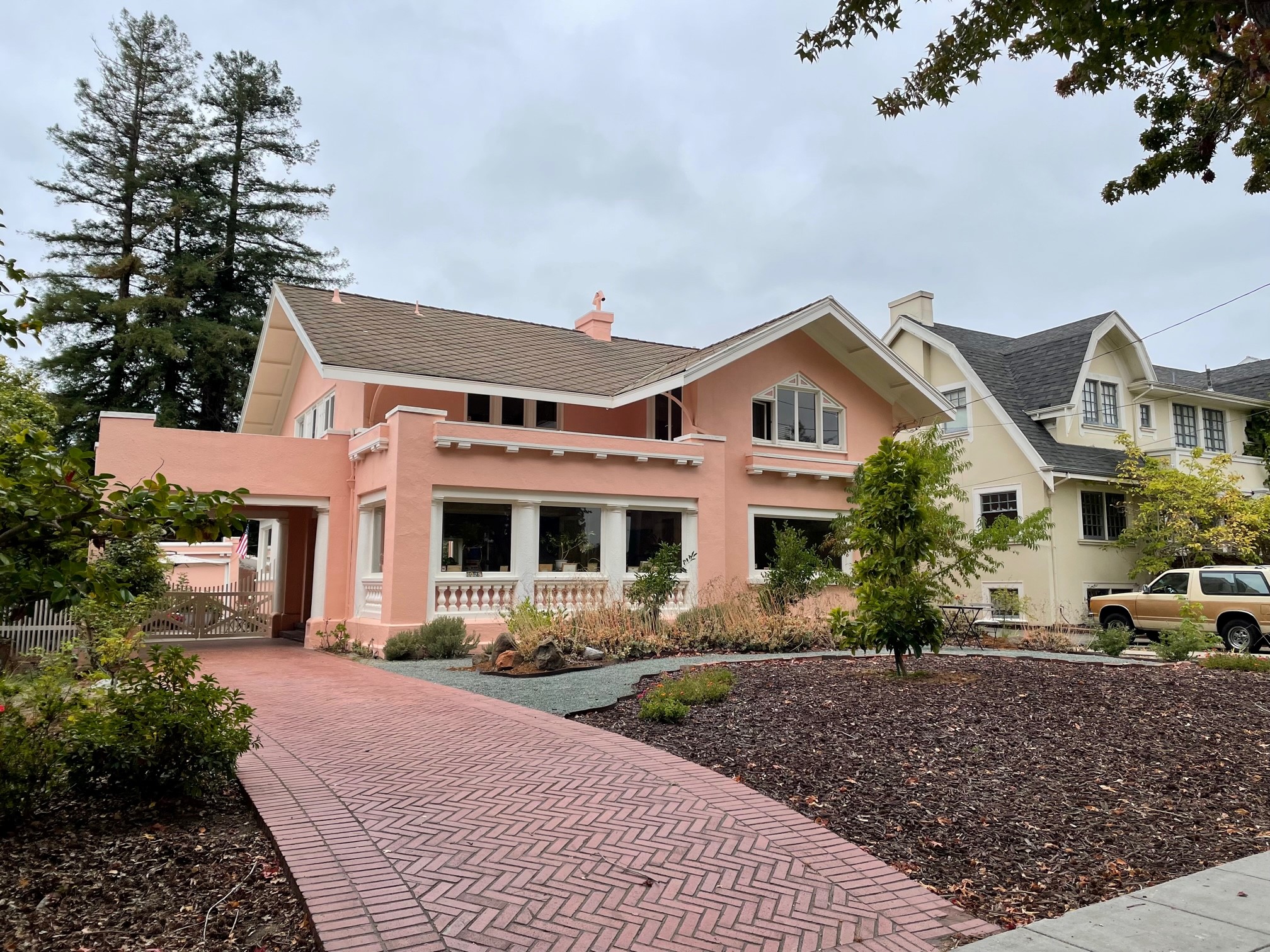
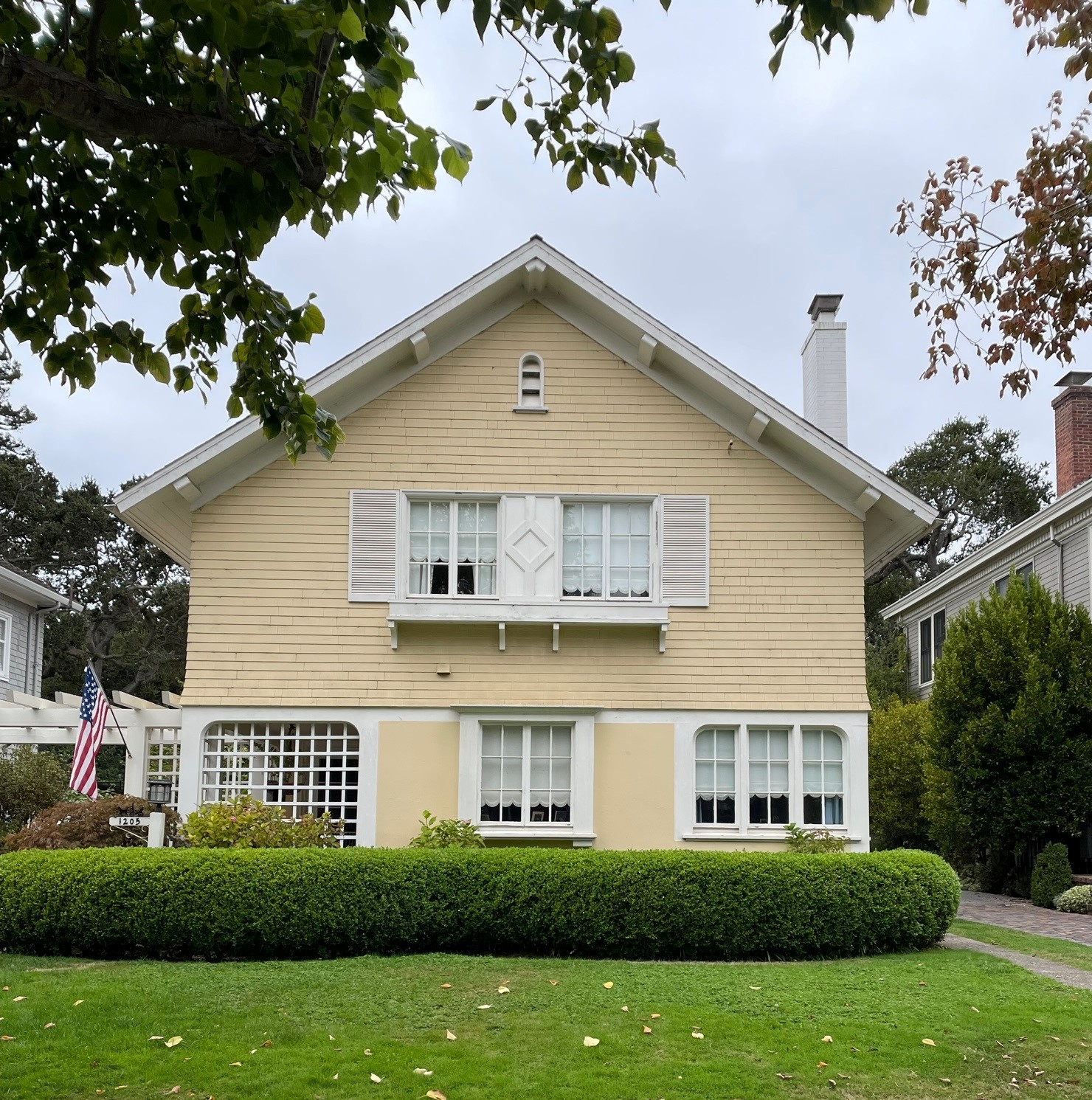
1025 Sherman Street, built in 1913 and designed by architect Julia MorganA Julia Morgan-designed 1912 Craftsman-style house at 1205 Bay Street
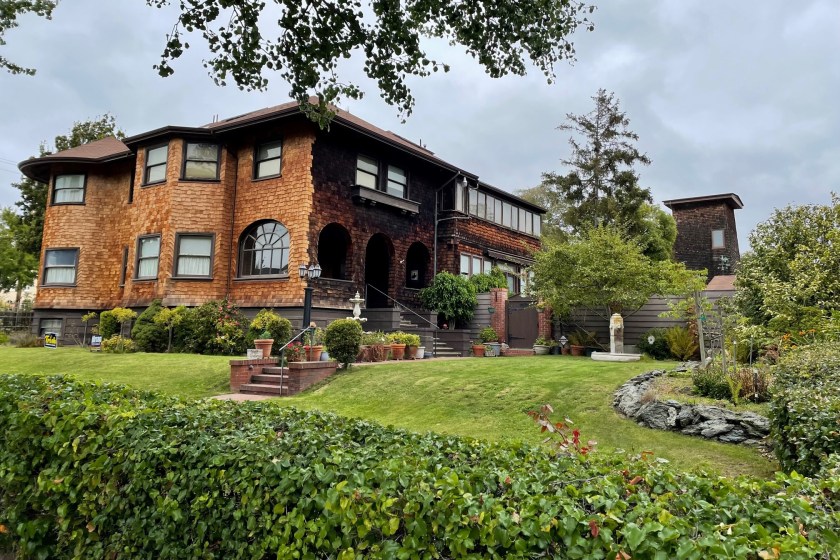
To give you a sense of our afternoon of touring, I hope you will enjoy my photos of a few of the almost 60 houses included in the tour.
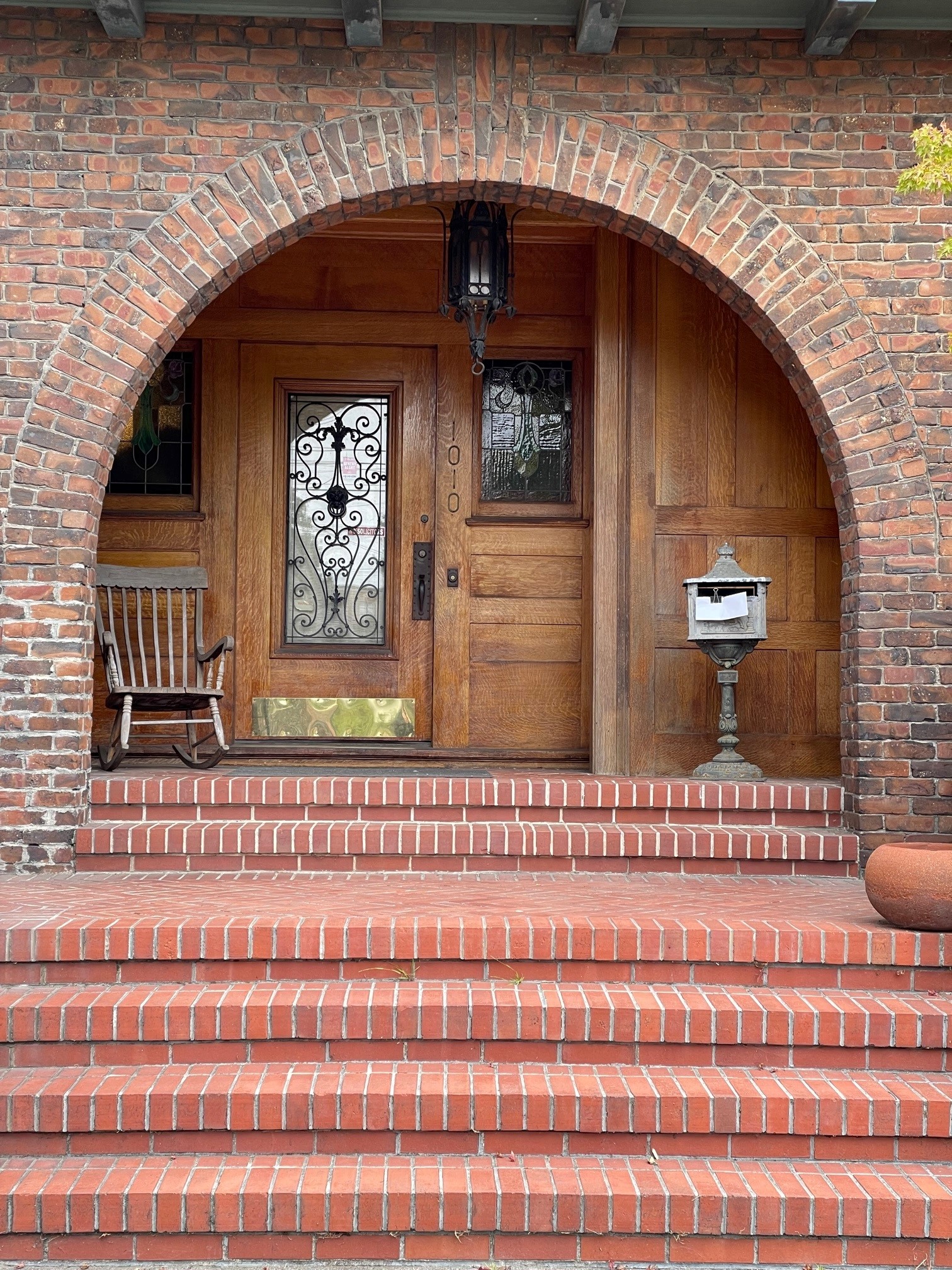
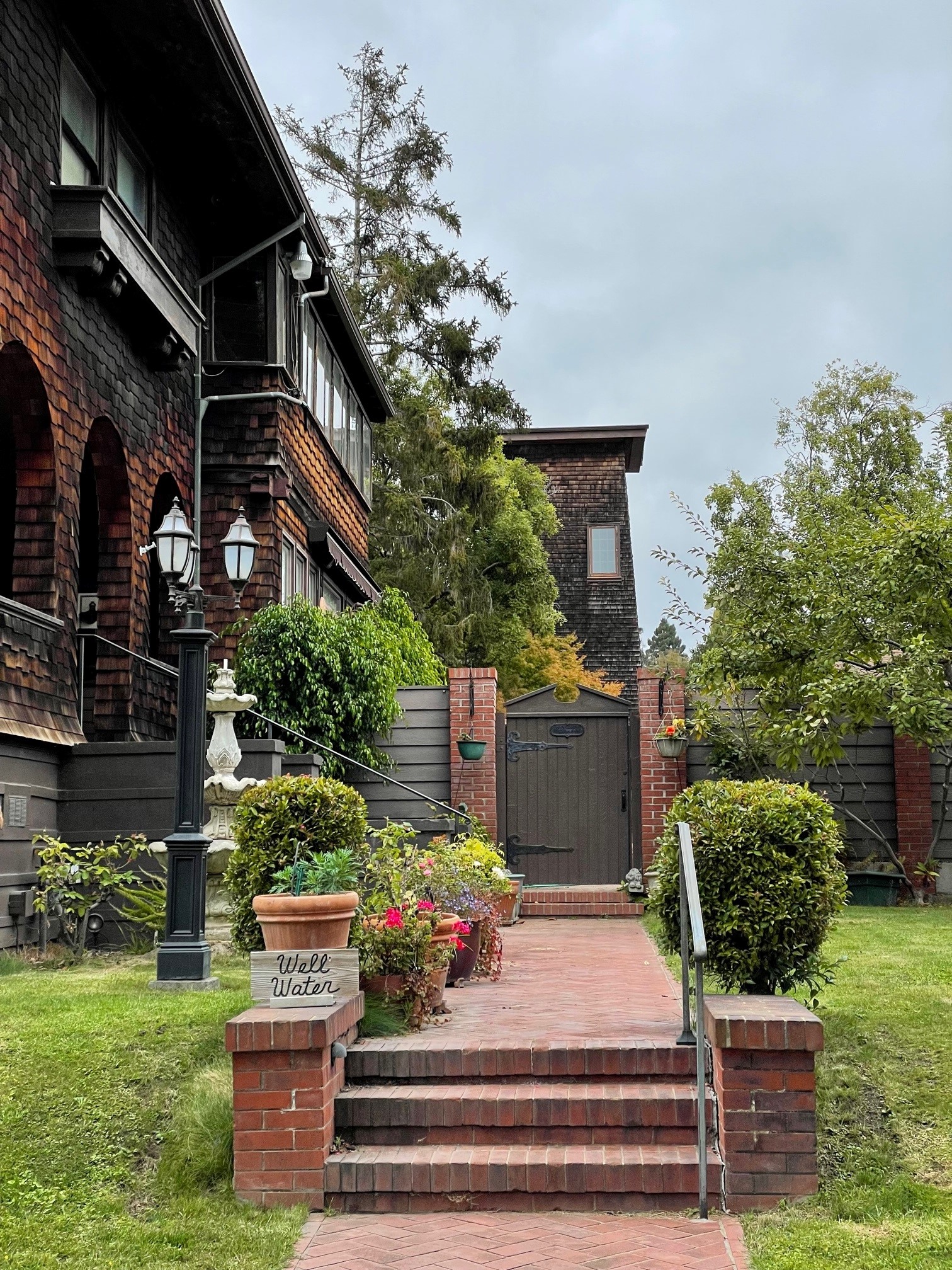
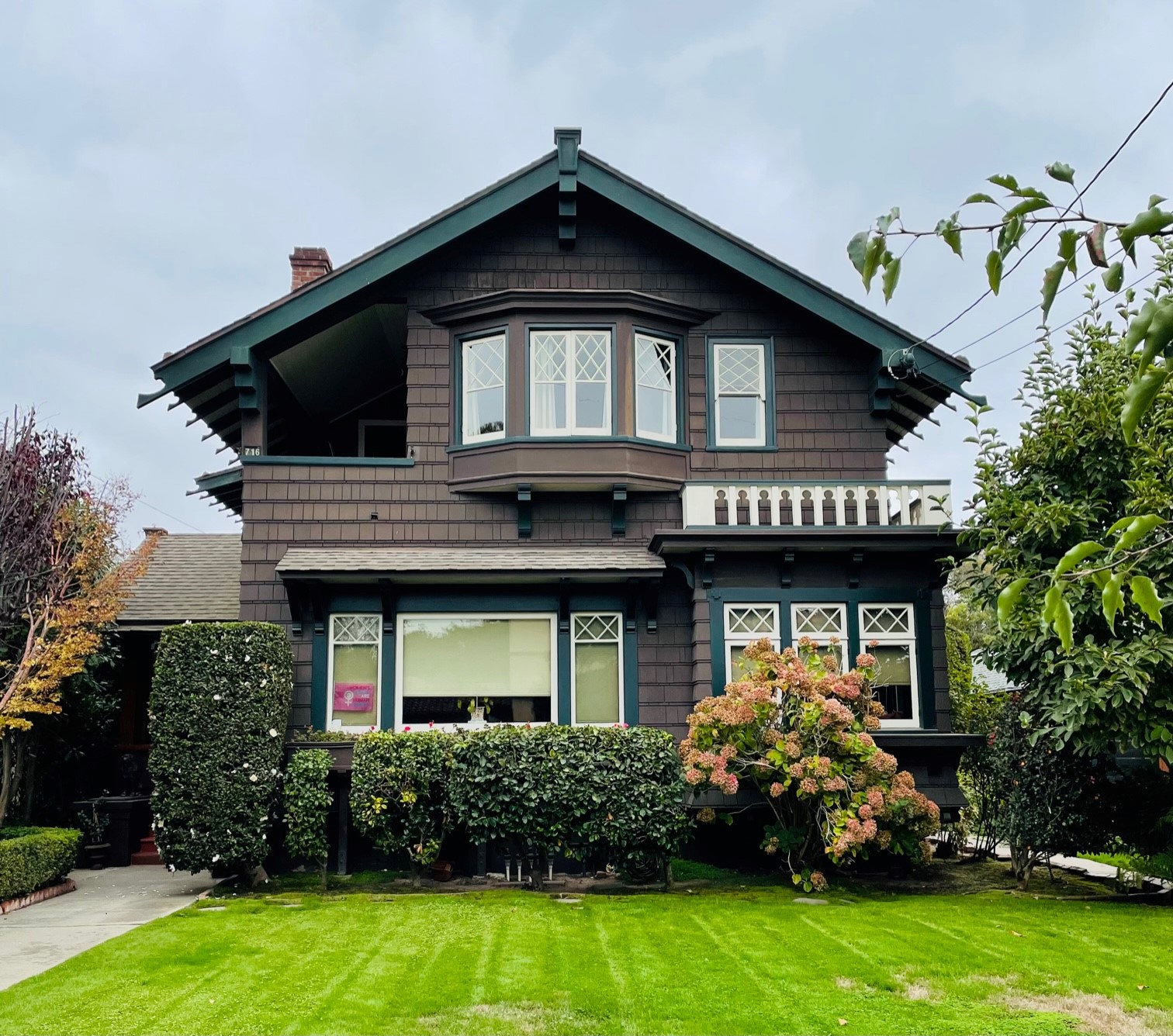
An 1896 Colonial Revival designed by Joseph Littlefield, all decorated for HalloweenFront door detail from a 1902 transitional Colonial Revival home designed by Bert Engels RemmelA rare extant original water tank that served the homes surrounding 1305 Dayton AvenueA two-story Craftsman from 1908 designed by architect C.M. Cook at 716 Paru Street
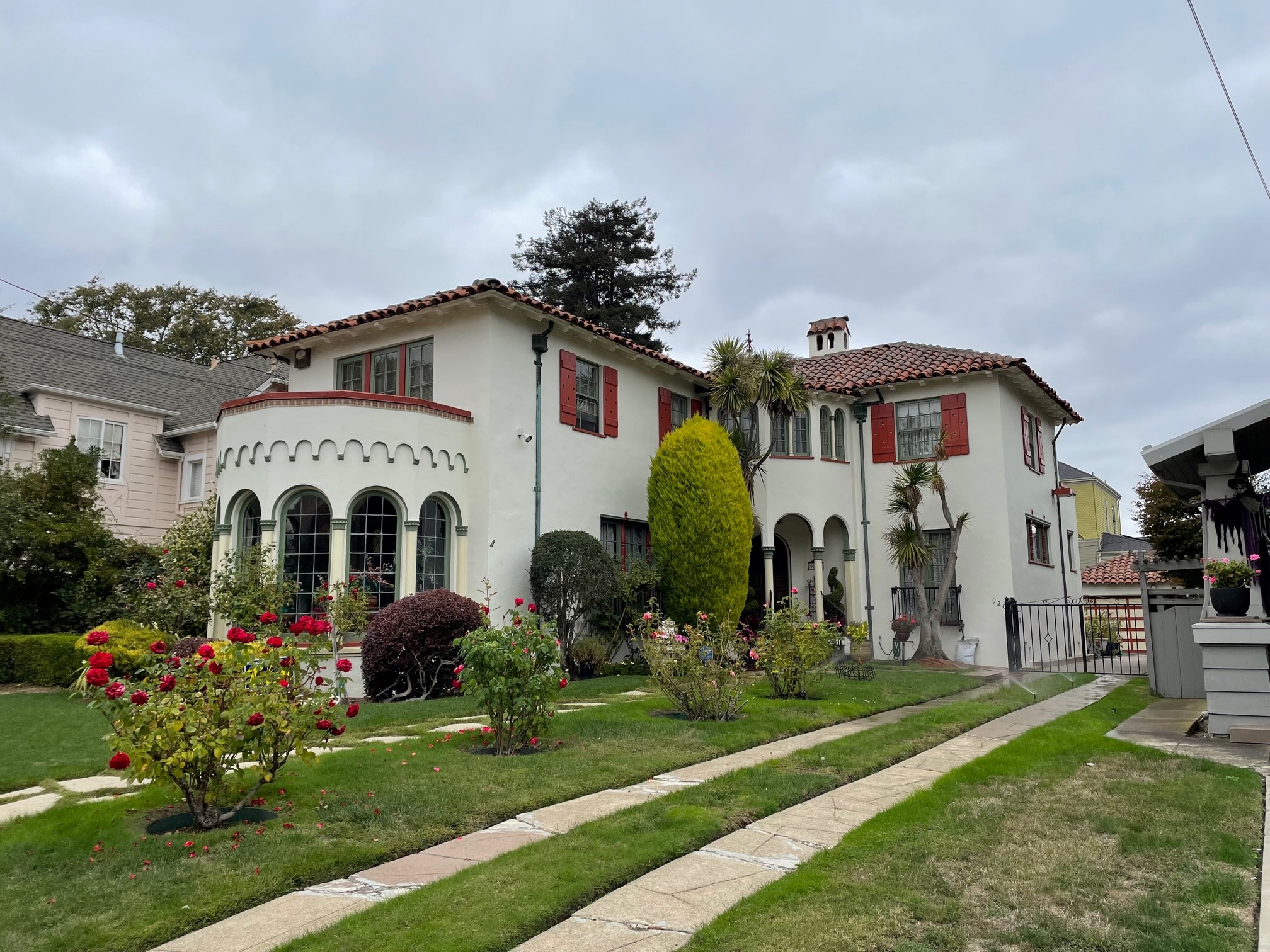
A beautiful 1928 Mediterranean style home at 920 Paru Street. Check out the seven-sided front bay.
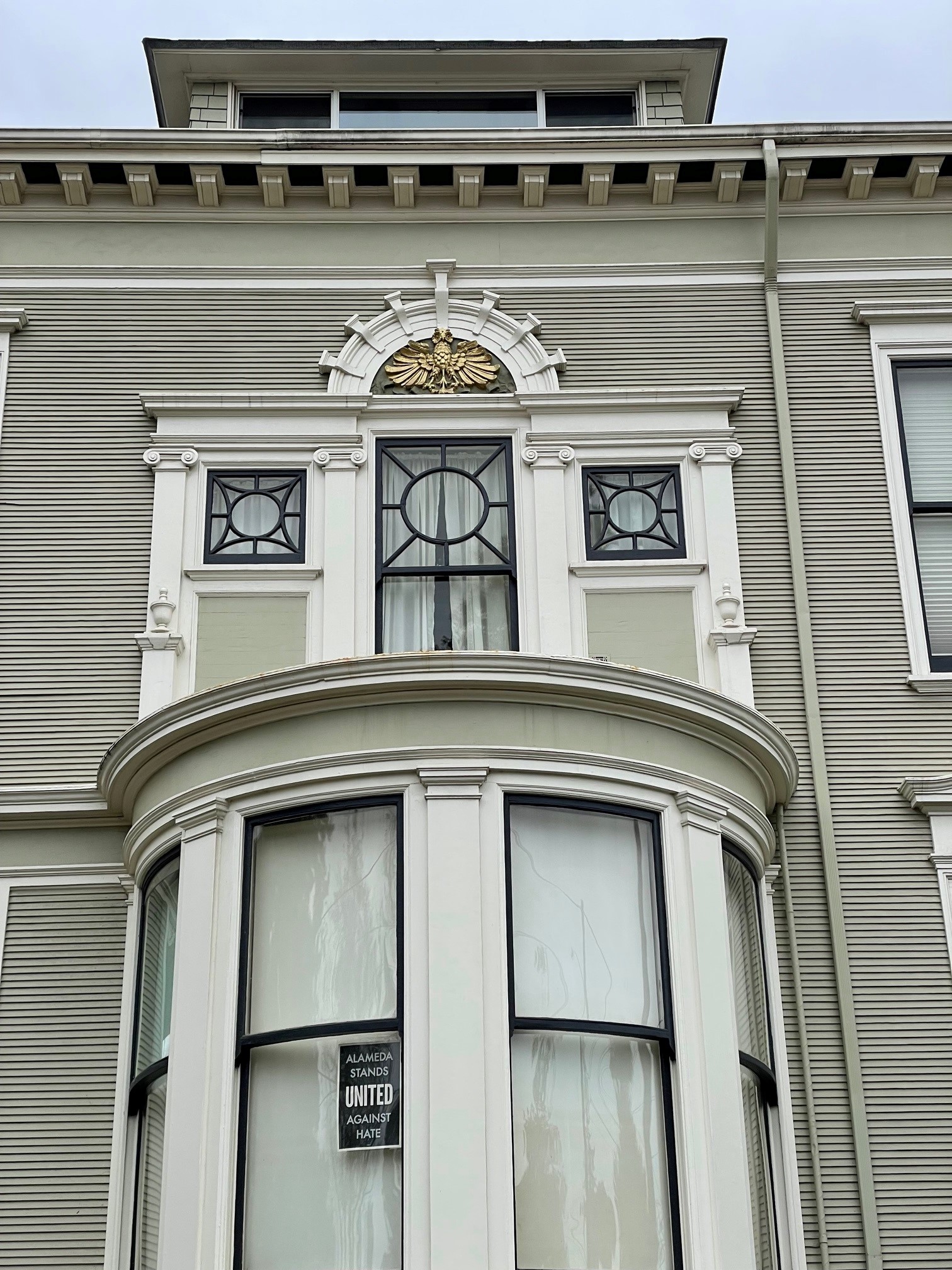
A horned owl sits where a rounded window would normally be found on this 1896 Colonial Revival home
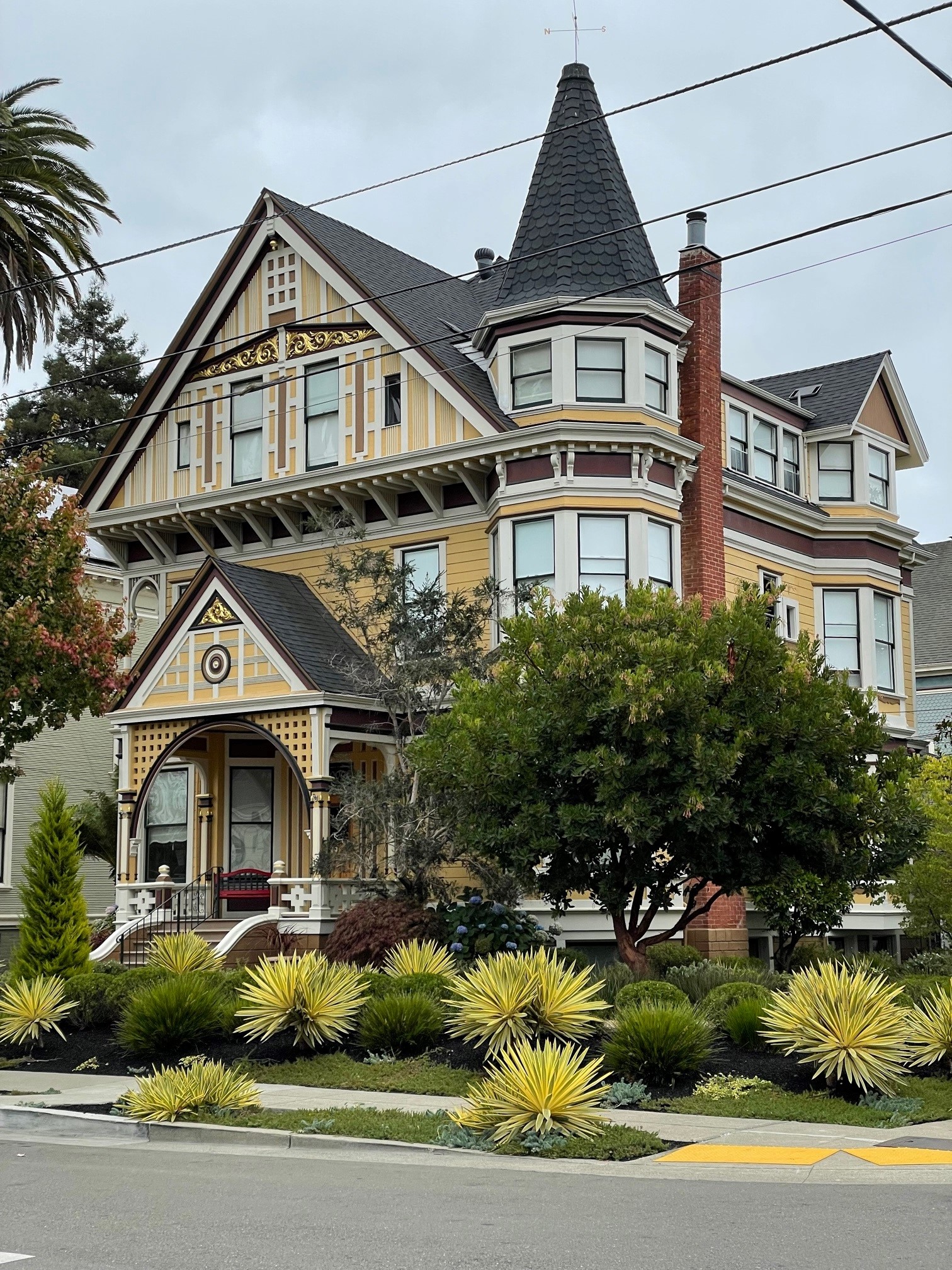
This beautiful transitional Queen Anne-style home was designed by Otoo Collischonn in 1893
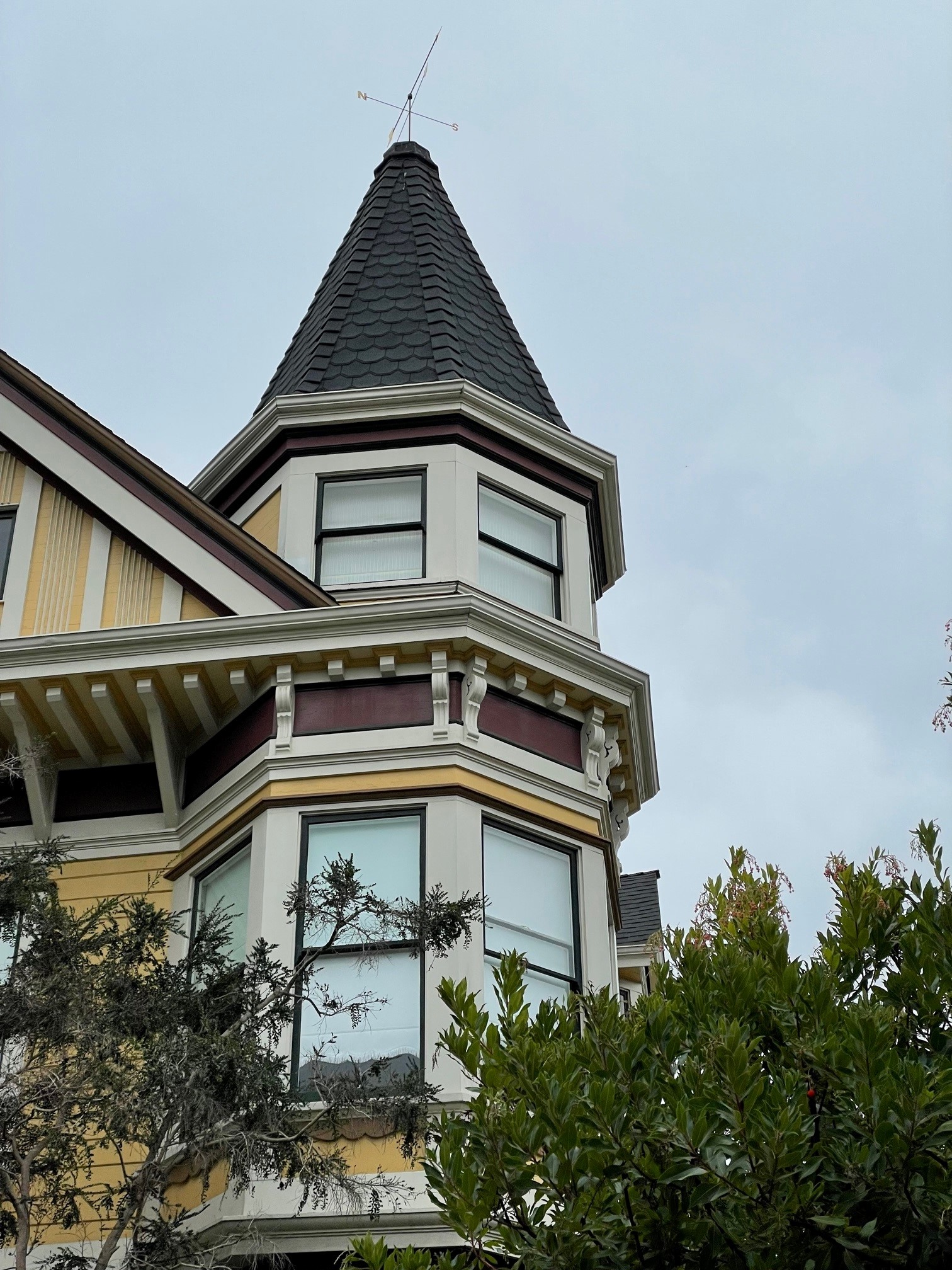
Corner tower on an 1893 Queen Anee-style home at 1000 Paru Street, designed by Otoo Collischonn
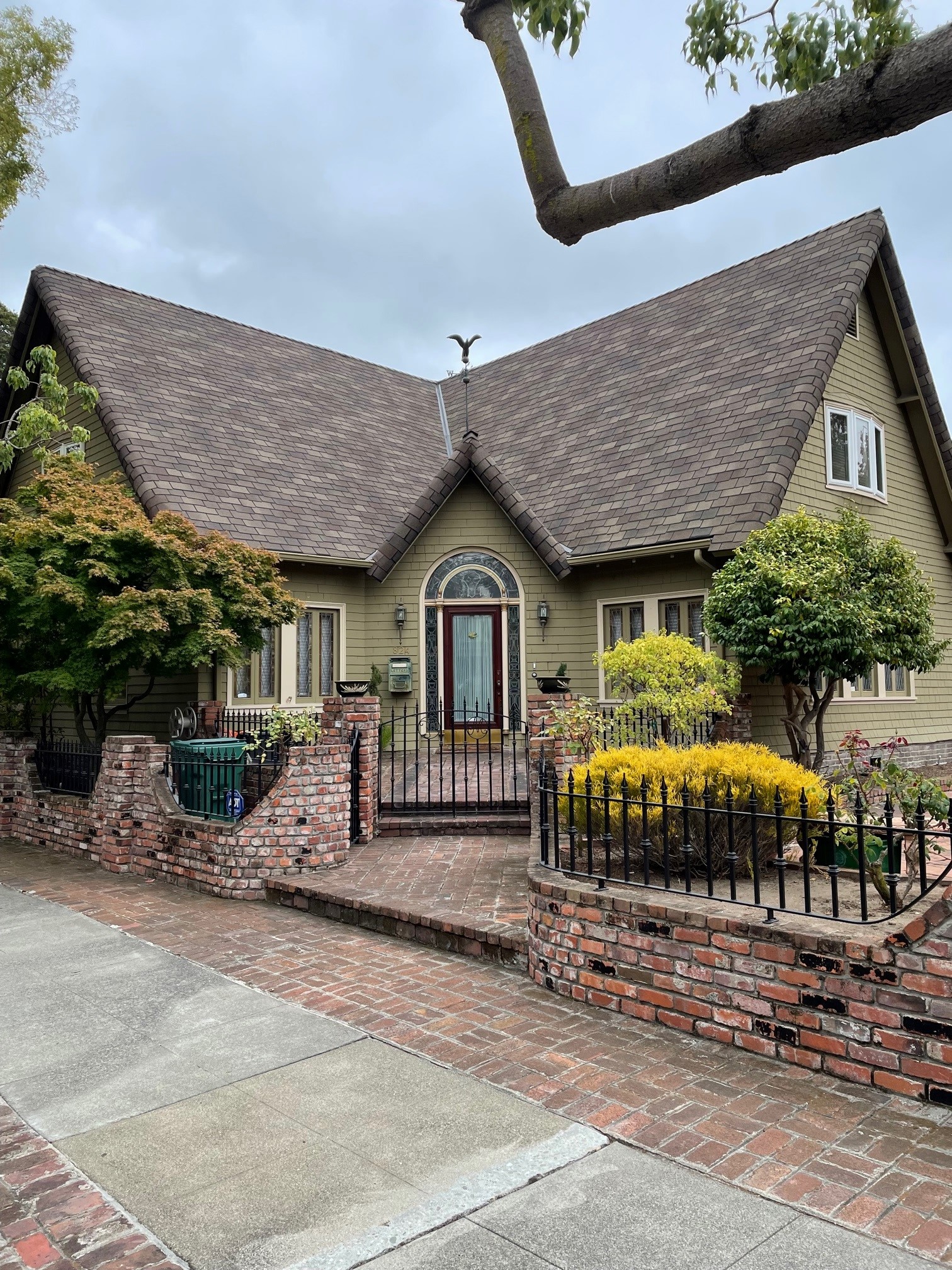
We’ll end with this sweet little English Cottage-style 1921 home at 824 Paru Street by an unknown architect. These historic European styles were popular after the end of World War I.
Thanks to the Alameda Architectural Preservation Society for producing such a great tour for residents and visitors alike. It certainly made for a satisfying afternoon for our family on what turned out to be a crisp fall day.