I’m in the San Francisco Bay Area this weekend, so I thought it would be appropriate to point readers toward the collaboration of two musical icons from the area: Jerry Garcia and David Grisman.
Grisman was known as a creative and daring mandolin visionary who came out of the 1960s New York City folk scene in Greenwich Village. Garcia was playing folk ballads, banjo, and early rock n’ roll in California. They first met in the summer of 1964 at a bluegrass show at Sunset Park in West Grove, Pennsylvania. Kindred spirts in pushing the boundaries of music, the rest, as they say, is history.
By 1965, Garcia was playing in the seminal rock band The Grateful Dead, where his legacy was cemented. Grisman, after first playing professionally with the Even Dozen Jug Band, Red Allen and the Kentuckians and Earth Opera, became a record producer and session player on recordings with Tom Paxton, Judy Collins, James Taylor, Linda Ronstadt and many others. In 1969, Garcia invited Grisman to play on the Grateful Dead’s classic American Beauty. Garcia famously dubbed him “Dawg” and their musical friendship led to the legendary bluegrass band, Old & In The Way, which first played in 1973 in Sausalito, California. Legendary fiddler Vassar Clements later replaced Greene in the band. With some personnel changes including having Taj Mahal join on bass, the band morphed into the Great American String Band in 1974 and played less than a dozen concerts.
Old and In the Way with David Grisman (center) and Jerry Garcia (right) along with John Kahn, Richard Greene, and Peter Rowan (credit: Acoustic Disc)
As Garcia was becoming famous with the Grateful Dead and a variety of other projects, Grisman “unleashed an acoustic musical revolution with his 1977 release — The David Grisman Quintet, forging a ground-breaking style rooted in high-energy bluegrass, interlaced with elements of jazz and world music.”
As Grisman gravitated to the Bay Area, he maintained his musical friendship with Garcia. In 1990 the two friends played together as a duo for the first time in Mill Valley, California. Grisman gave Garcia the space to return to his acoustic and folk roots with a fellow traveler along the winding musical path they both had taken.
One of their early collaborations was Not for Kids Only, a terrific album that featured folk tunes geared for the younger set. Both of my children can attest to the fact that we listened to There Ain’t No Bugs on Me from that album many a day in our car when they were very little. We all still laugh as we remember the first time Claire sang out the line “How in the hell can the old folks tell / If it ain’t gonna rain no more” from her car seat, with gusto!
The old folk tune Shady Grove was the title track of another Garcia and Grisman album, while the B.B. King chestnut The Thrill is Gone is from another of their Acoustic Disc collaborations.
Garcia passed away in August of 1995, while Grisman continues to make music with his son Samson in the David Grisman Trio and remains a force in acoustic music through his Acoustic Disc label.
Peace, love, and bluegrass from the City by the Bay.
Enjoy.
More to come…
DJB
Image: Garcia Grisman Band live in 1990 (credit: Acoustic Disc)
This is the fifth in a regular series of political cartoons during this mid-term election season. With election deniers, the January 6th committee bringing the goods, the Supreme Court turning down Trump’s motion on the steal of national security documents (and who knows what else), and more, these cartoonists should be getting paid overtime!
If you want to see the earlier editions of ‘toons from this political season, visit here, here, here, and here.
Now, let’s get to it. Not much editorial explanation needed.
A reminder of what fighting fascism looked like in 1944 and 2022
Margaret Renkl is an opinion writer who covers flora, fauna, politics and culture in the American South for the New York Times. In September she wrote about the joy of finding people who love the same books you do. It is a wonderful essay that helps explain why I read…and why I tell you, dear readers, about the books I read.
Each month my goal is to read five books on a variety of topics and from different genres. I read in order to learn and to start conversations with readers and others I encounter along the way. Here are the books I read in September 2022. If you click on the title, you’ll go to the longer post on More to Come. Enjoy!
Bronze Drum (2022) by Phong Nguyen brings to life a true story from ancient Vietnam of two sisters who rise up to lead an army of women, overthrow their hated colonizers. and create an independent nation. Their resistance, which was ultimately defeated by those colonizers, the Han Chinese, nonetheless reflects a fierce desire for independence that the Vietnamese never forgot. Both the French and Americans learned about that desire first-hand almost 2,000 years later. This is a terrific book on multiple levels, with lively writing and vivid descriptions. Most importantly, it shows how a country’s history can be shaped by memory — and the telling and retelling of the stories of the past — until it becomes integral to the present.
Nothing Ever Dies: Vietnam and the Memory of War (2016) by Viet Thanh Nguyen examines the many ways we remember wars and how those memories are shaped through the years. This is a comprehensive look at what Americans call the Vietnam War and what the Vietnamese call the American War that pushes the reader to think beyond simple frames, self-serving myths, and established timelines. To create what he calls “Just” or “Ethical” memories, Nguyen calls for a process of commemoration which remembers one’s own as well as remembers others in a way beyond simply identifying them as “The Other.” The book is Nguyen’s effort to help us construct those just war memories and is as current and important as today’s headlines over who owns and who sets the narrative of American history.
History Myths Exploded: How Some of History’s Biggest Ideas are Wrong (2019), by Christopher R. Fee and Jeffrey B. Webb, describes how much of what the general public knows about history — from the myth of the 300 Spartans at Thermopylae to Abraham Lincoln and the freeing of the slaves to the myth of the radical 60s in America — is at best incomplete and at worst wrong. Why is that? Professors Fee and Webb explain that “although most of us recognize the value of good history, we often find truthful accounts of the past, frankly, less than inspiring.” What really excites us? A tale well told.
On Earth We’re Briefly Gorgeous(2019) by Ocean Vuong is a stunning piece of writing, especially for a first novel. Vuong has created a letter to his mother, who he knows will probably not be able to read it because of her limited grasp of English. But the work is much more about processing difficult memories, from his childhood in Vietnam to the move with his mother and grandmother to America, to his first love. This is not an easy book to read. The memories are painful yet written with a bluntness that is honest and real. This is a masterful work, very much worth the read.
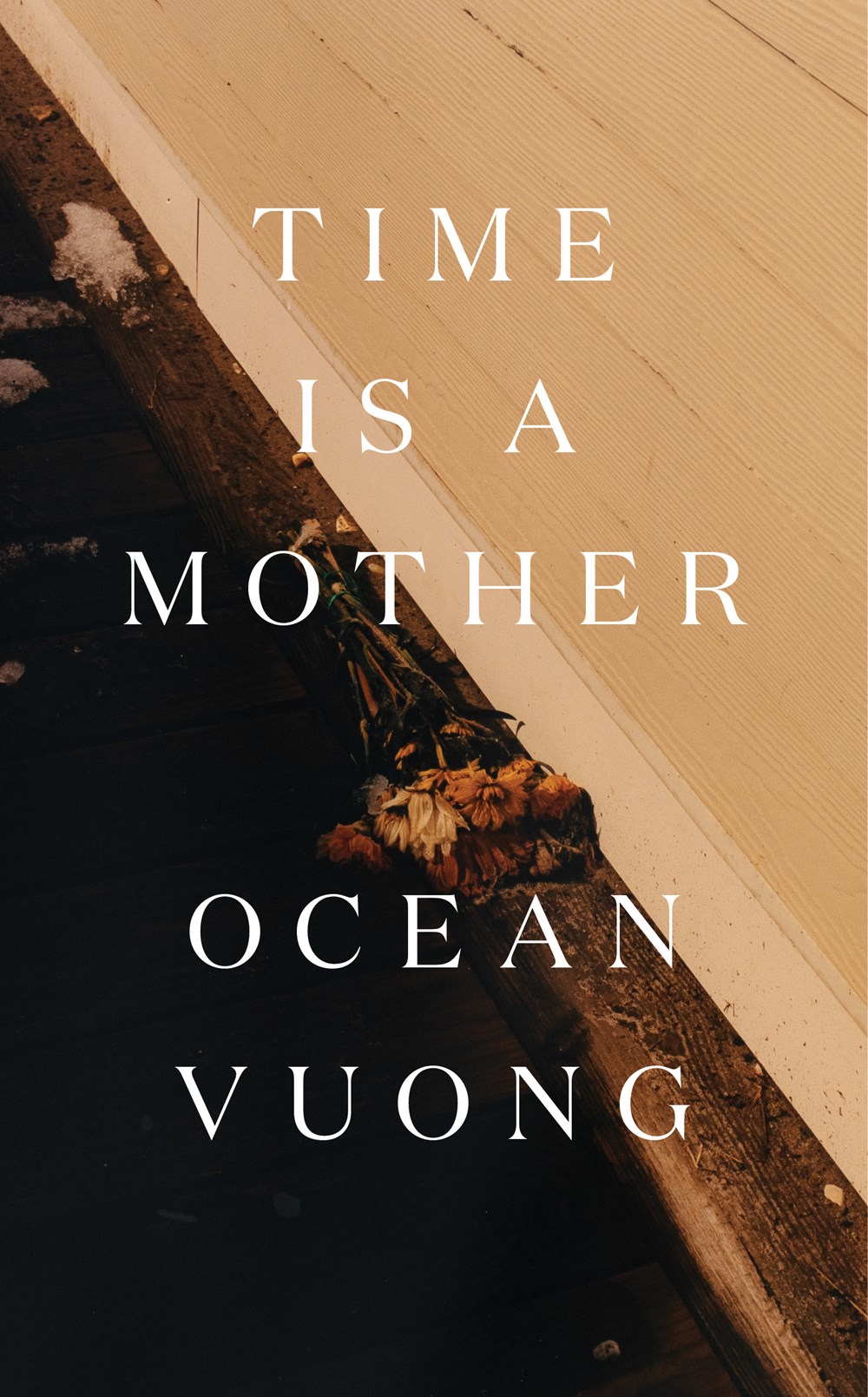
Time is a Mother (2022) is the second book of poetry by Ocean Vuong. It was written after his mother passed away and he describes the aftershocks from the realization of her death. Time is a Mother is a very intimate book that was challenging for me, as someone who doesn’t read poetry on a regular basis. As others have written, this work embodies “the paradox of sitting within grief while being determined to survive beyond it.”
This Weekly Reader features links to recent articles, blog posts, or books that grabbed my interest or tickled my fancy. I hope you find something that makes you laugh, think, or cry.
The lair of a modern-day movie villain changed in the mid-twentieth century from a spooky castle to a sleek modernist home. What film was instrumental in that change?
When a picture of an old Victorian mansion with a 1930s motel in the front yard is shown, our minds immediately go to a famous bathtub murder scene in the movies. Do you know how this setting came to carry such a potent and disturbing message for a mid-century movie-going audience?
Apartment buildings and skyscrapers are appealing for telling certain types of stories in the movies. What California architecture school became skilled at designing both, within certain parameters, for movie sets in Hollywood?
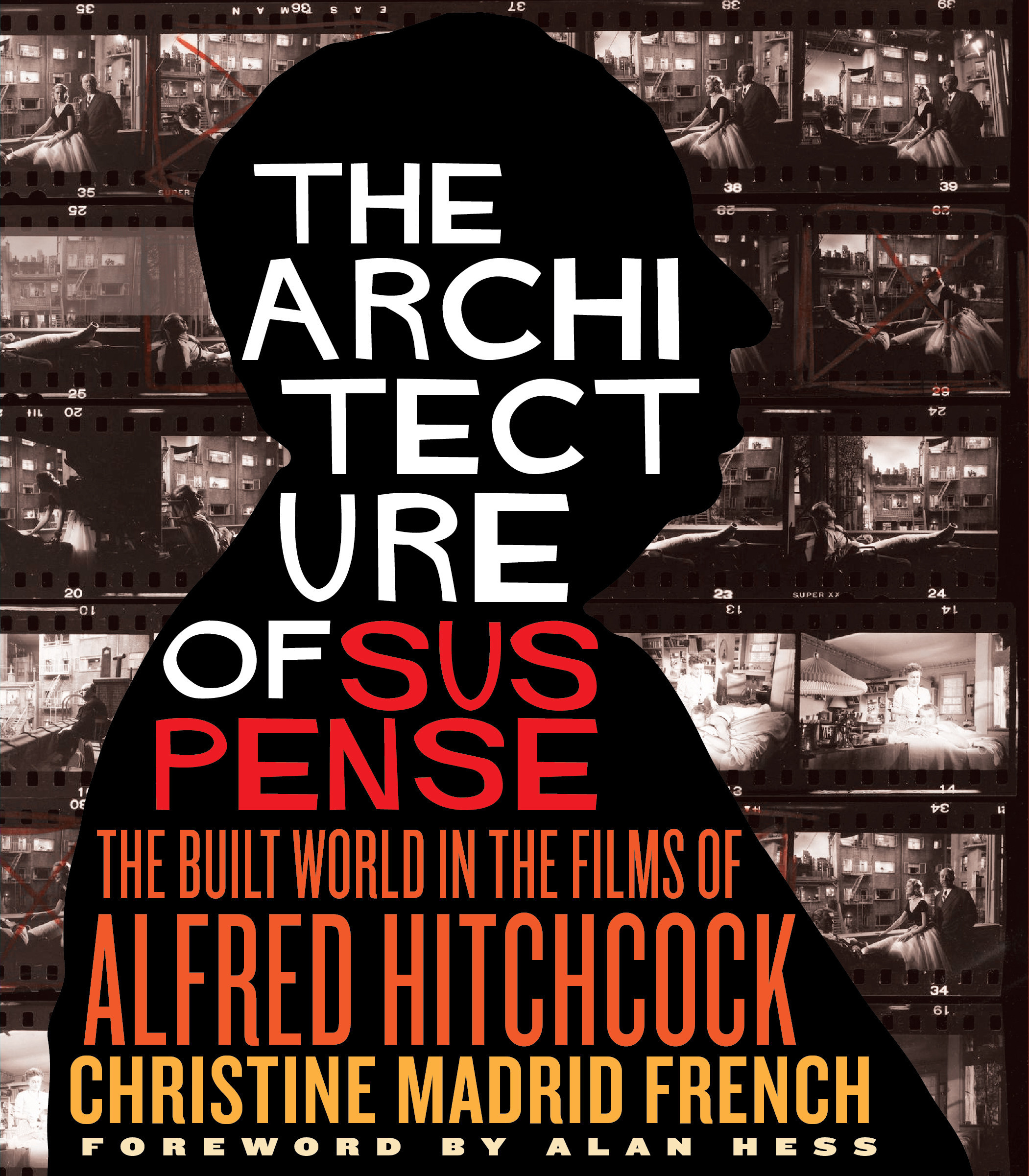
The Architecture of Suspense: The Built World in the Films of Alfred Hitchcock
If you know the answers to these questions — or are simply intrigued to learn more — then Christine Madrid French‘s new book The Architecture of Suspense: The built world in the films of Alfred Hitchcock (2022) is for you. Chris has written one helluva good read, the rare book from an academic publisher (the University of Virginia Press) that is academically sound in its field (architectural history), insightful in its conclusions, instructive in its suggestions as to how her findings can be applied in the real world (through historic preservation), and — perhaps best-of-all — a page-turner that a reader simply cannot put down. Chris has managed all of this and more.
The book opens with a thought-provoking foreword by architect and historian Alan Hess, who suggests that while “lairs, gloomy mansions, and motels rarely appear on conventional lists of influential twentieth-century buildings” perhaps — after reading French — they will begin to take their place in such hallowed listings.
French begins her book with a scene-setting chapter on Hitchcock, his early work in European film, and his move to America in 1939 where his legend grows until he is known as one of the unquestioned masters of cinema. She really hits her stride and showcases her long-nurtured love of modern architecture with the second chapter on modernist houses as villain’s lair. In this, as in each of the three key chapters on building types, Chris provides the architectural history critical to understanding Hitchcock’s employment of buildings as a character in his films. She also highlights films that preceded Hitchcock’s work, and then the many that followed in his footsteps.
The modernist house as villain’s lair was casting against type in many ways, as movie-goers were accustomed to thinking of their villains of the age (e.g., Bela Lugosi and Boris Karloff) in creepy castles high on a mountaintop. Hitchcock, in the mid-century film North by Northwest, changes all of that at a time when the portrayal of evil characters was “morphing from a frazzled Dr. Frankenstein into a handsome Captain Nemo.” An attractive, distinguished, yet somewhat creepy villain was appealing to audiences and the new archetype (they are usually male) required a new home that was equally modern, sleek, and attractive, yet somehow both transparent and impenetrable at the same time.
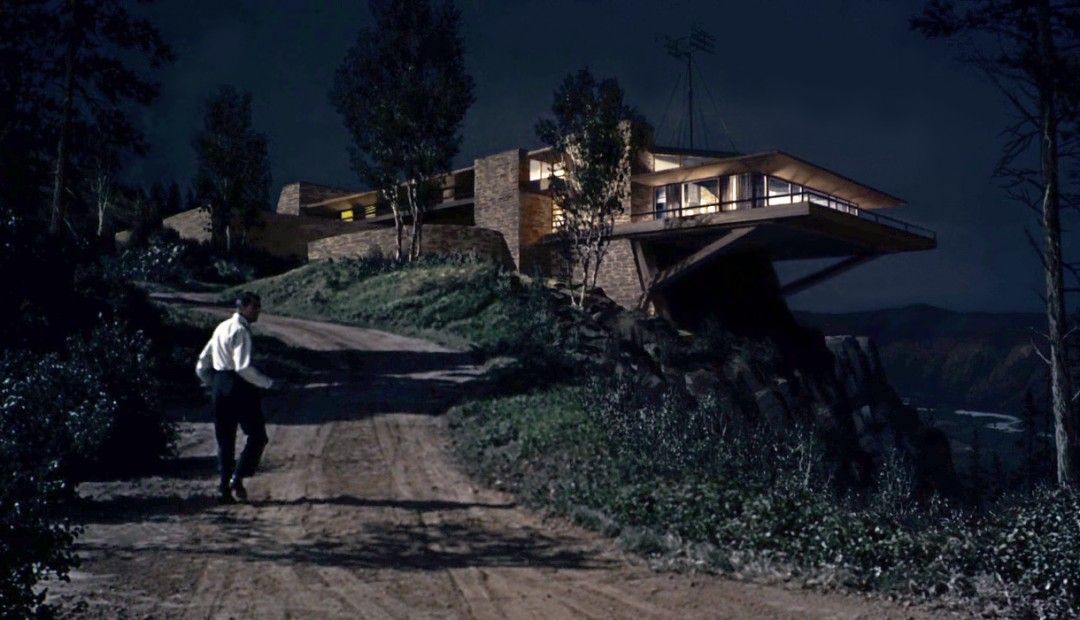
Cary Grant as Roger Thornhill sneaks up to the Vandamm House in North by Northwest (Metro-Goldwyn-Mayer)
The modernist designs pioneered by architects Mies van der Rohe and Frank Lloyd Wright fit the bill for Hitchcock. The movie begins in a New York City being transformed by modernist skyscrapers. It ends in that most middle-America of places, Mount Rushmore, with a cantilevered lair — the Vandamm House, named for the murderous spy Phillip Vandamm, portrayed by the elegant James Mason — which is set into the monument’s rock in a way that calls to mind Wright’s masterpiece at Fallingwater.
Frank Lloyd Wright’s Fallingwater (image by DJB)
Chris explains how Hitchcock uses this modernist design to provide an appropriate lair for the new type of villain. A great mini-segment on the staging of a murder in the cafeteria of the Mount Rushmore visitors center under the ever-watchful eyes of the four presidents even allows Chris to bring in the ground-breaking Mission 66 design program. Hitchcock used the setting to challenge “the notions of nationalism, safety, and security.” As she moves to wrap up this chapter, Chris highlights other famous modernist villain lairs, including the Sheats-Goldstein House in Los Angeles.
After an excellent chapter on the urban honeycombs of skyscrapers and apartments, which provide both the anonymity and soul-crushing sameness which helps drive murder mystery plots, Chris turns to one of the most famous of Hitchcock’s architectural types — the mansions and motels of America’s roadside.
Even if you haven’t seen Hitchcock’s 1960 movie Psycho, it is such a part of America’s collective unconsciousness that, as one writer noted, you’ve seen it. And as Chris notes at the beginning of a terrific chapter, the “long-standing public fascination with this landmark film elevated two American vernacular structures into enduring architectural symbols: the Mansion and the Motel.” Sixty years later we still recognize the striking image “of the dilapidated Victorian house towering above a low-slung, outdated motel.” Hitchcock played with the “cultural subtexts of these two buildings to create sentient structures that spoke to the audience” and helped cement the film into what none other than Stephen King called “the definitive horror film of the period.” Chris explains how that came to be.
The longevity of this architectural imagery can be attributed to Hitchcock’s precise capture of a unique turning point in the history of mid-twentieth-century American cultural landscapes. Both the Victorian mansion and the roadside motel forms had, in the past, represented the height of ‘modernity’ when introduced and popularized in the late nineteenth and early twentieth centuries, respectively. Coincidentally, both building forms also crashed into disuse and abandonment at the same moment amid a nationwide tsunami of design innovation and construction propelled by post-World War II economic prosperity. At that point, the cultural impression of the motel and the mansion changed from ideal representations of modernity to symbols of a disowned past.
These derelict buildings are displayed in disrepair, only adding to their isolation that occurred as the interstate highway system became the preferred method of travel for Americans. Finally, that isolation then resulted in a noticeable uptick in crime, as various criminal elements preyed upon the few who used these long-forgotten motels. Christine goes into this entire story with expressive detail, so that by the time the three-minutes of horror strikes Janet Leigh in the shower, we fully understand the cultural context brought by those sitting in the theatre.
The final chapter looks at architects and the art of film. The architecture school at the University of Southern California comes in for special mention, as many of its graduates came to work at Hollywood’s movie studios, especially during the Depression when other design jobs were scarce or nonexistent. Hitchcock made full use of these excellent design craftsmen (again, usually male) which is highlighted in The Architecture of Suspense.
In the end, the book succeeds on such an important level because as Hess points out in the foreword, “Hitchcock also suggests a way to look at buildings that stretches beyond the usual didactic categories.” Historic preservation has long been driven by professionals in the design and architectural history fields who focus on these important elements. But as Chris states so eloquently in the introduction,
Preservationists and historians overlook the enduring quality and power of human emotion as a critical factor in public outreach with their wholesale rejection of nostalgia countered with a dogmatic embrace of objective analysis. But building on cinematic narrative foundations can be effectively utilized to save endangered structures. The key is storytelling.
Architectural critic Herbert Muschamp once wrote, “Landmarks are not created by architects. They are fashioned by those who encounter them after they are built. The essential feature of a landmark is not its design, but the place it holds in a city’s memory (emphasis added).” Malaysian architect Laurence Loh, one of the foremost conservation specialists in that region, also writes and speaks about how historic sites convey a spirit of place, or their cultural essence, and suggests that the concept in Southeast Asia may be better understood if one alludes to the notion of “body and soul.” The building fabric is important to authenticity, but so is the story.
Christine Madrid French — a former colleague of mine at the National Trust for Historic Preservation — is speaking this fall at various venues around the country. In The Architecture of Suspense, she is making the point that preservationists can learn from those who are attuned to public opinion, and we can advance our cause in significant ways if we focus on telling our stories — using the flair in storytelling that is encouraged and enriched by these special places.
After a delightful few hours of reading, I suspect most will find, as I did, that The Architecture of Suspense is a book that’s arrived — like a good horror movie — just in time for Halloween!
More to come…
DJB
Image of the set for the Bates Mansion and Motel from the film Psycho, Universal Studios, 1959
I spent the better part of this week in Dundee, Scotland. On the Sunday before I arrived, the Washington Posthad a thoughtful and forward-looking feature on Dundee, written by none other than David Brown.
No, not this David Brown, although I wish I could take credit. Had I written the piece, I wouldn’t have had to buy a drink in this city all week!
Seriously, I’ve been attending the international conferences of National Trusts for two decades* and I don’t know when I’ve felt more encouraged about the movement’s future. Since my brain and body are lodged somewhere between the Scottish and U.S. time zones, I will post this as a series of short observations, interspersed with photos of this most interesting of cities.
Dundee’s commercial core
Let’s say a few words up front about the city. Dundee had a world-class industrial past that can be seen in places large and small. It is definitely a working-class town, much like Baltimore, where the Post writer David Brown lives. And there is a lot of it still to be seen and appreciated. These photos only give a glimpse.
Once proud institutions are being repurposed and reused, often by small businesses.
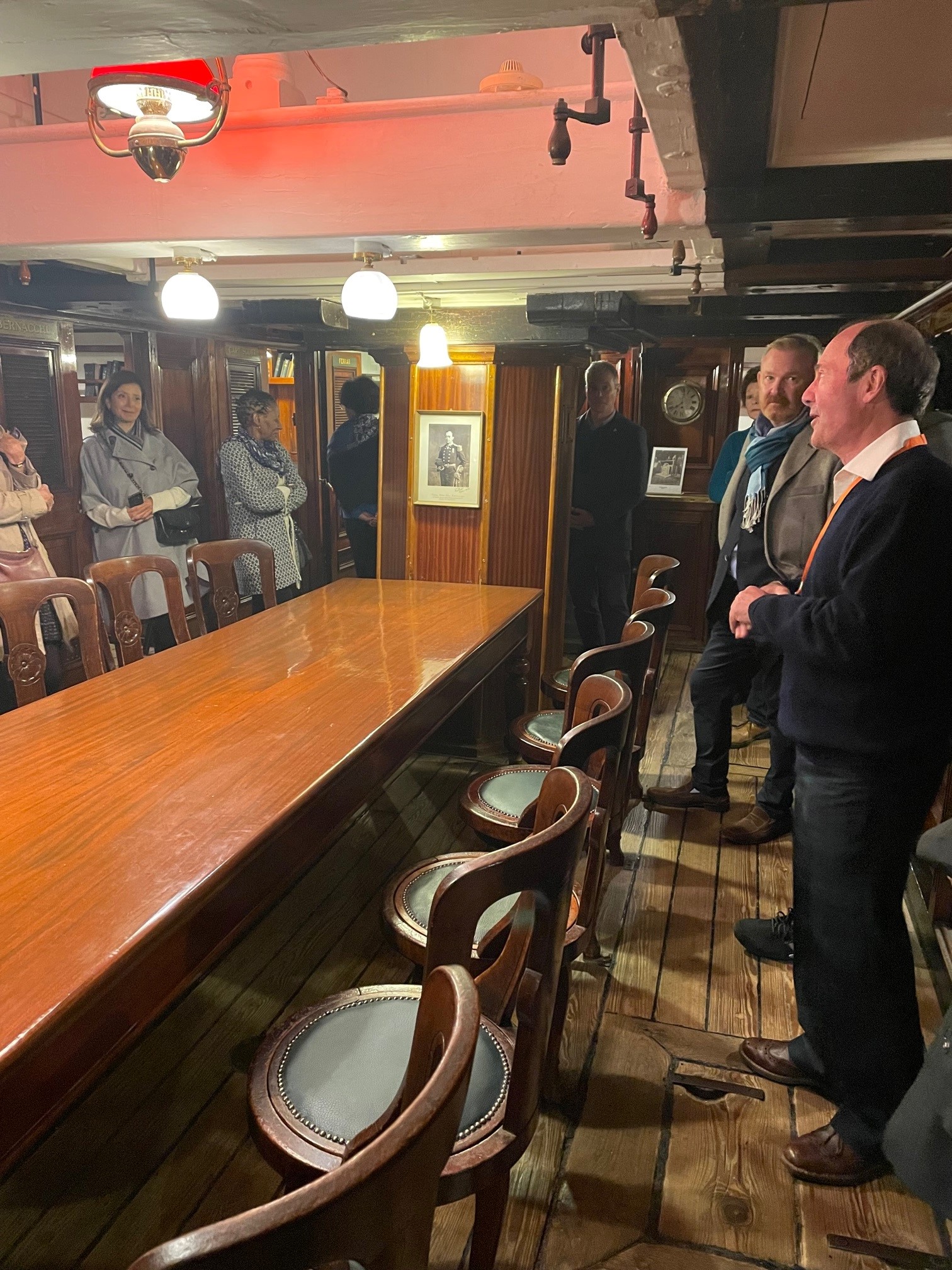
The INTO Dundee 2022 conference began for me on Monday evening when I was invited to join the board and some other key supporters for drinks and a tour of the Discovery,
Dundee is a port on the Firth of Tay, the place where the river widens into a tidal estuary before entering the North Sea. It was built on trade, and for many centuries it was Scotland’s second most important city, behind Edinburgh. Its maritime past is telegraphed in street names (Chandlers Lane, East Whale Lane), stone workshops along the waterfront, a compact Maritime Trail where its piers and shipyards once stood, and a small collection of historic ships.
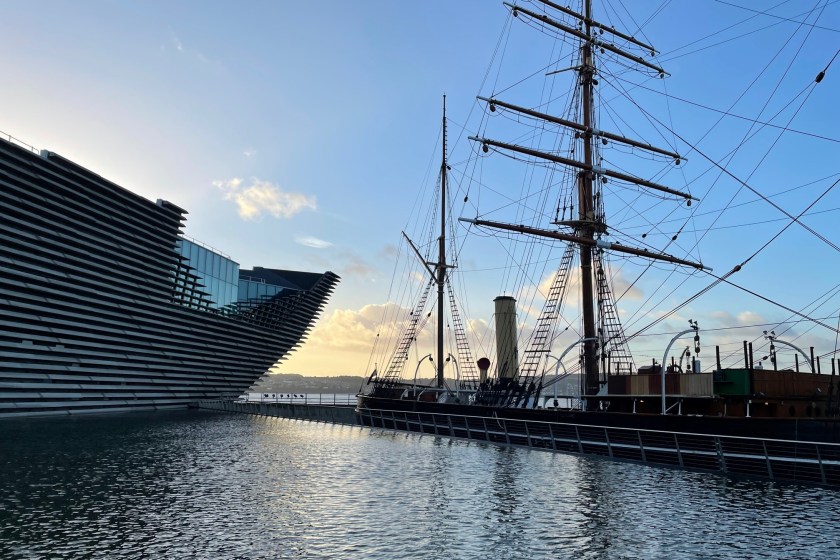
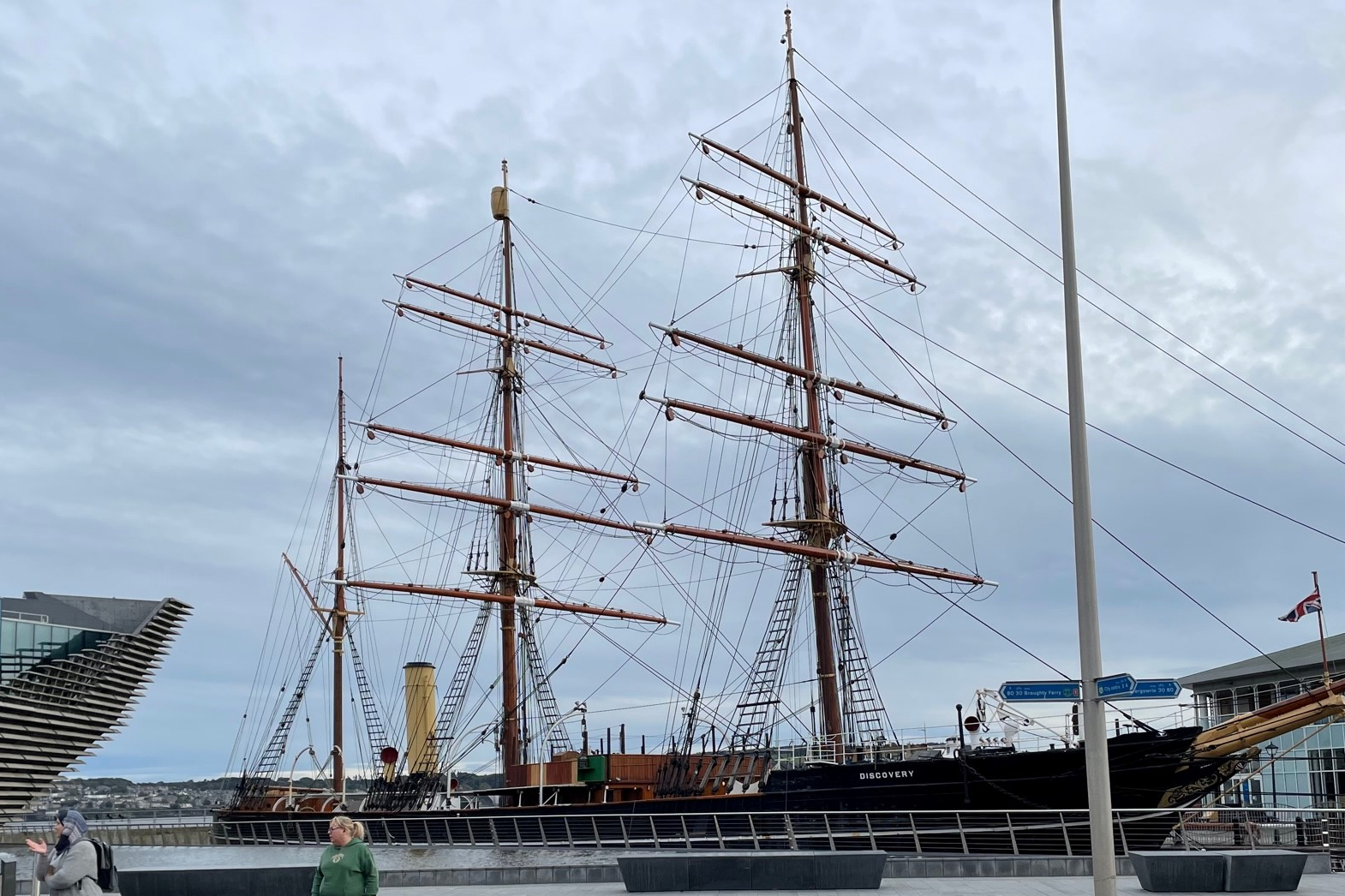
Of the last, the most notable is the Discovery, a three-masted sailing vessel that also had a steam engine. Billed as the first ship designed specifically for scientific research — there was no iron or steel within a 30-foot radius of its “magnetic observatory” — it was built in Dundee in 1901 and owned by the Royal Geographical Society.
The Discovery
The Discovery’s most famous voyage was a four-year trip to Antarctica featuring two of Britain’s legendary explorers — Robert Falcon Scott, the captain, and Ernest Shackleton, the third officer. Visitors are allowed to go almost anywhere on it. (In that regard it’s better than Baltimore’s estimable Constellation, built in 1854 and used to catch slave traders, among other tasks.)
Our guide (right) gives a tour of the Discovery on Monday evening)
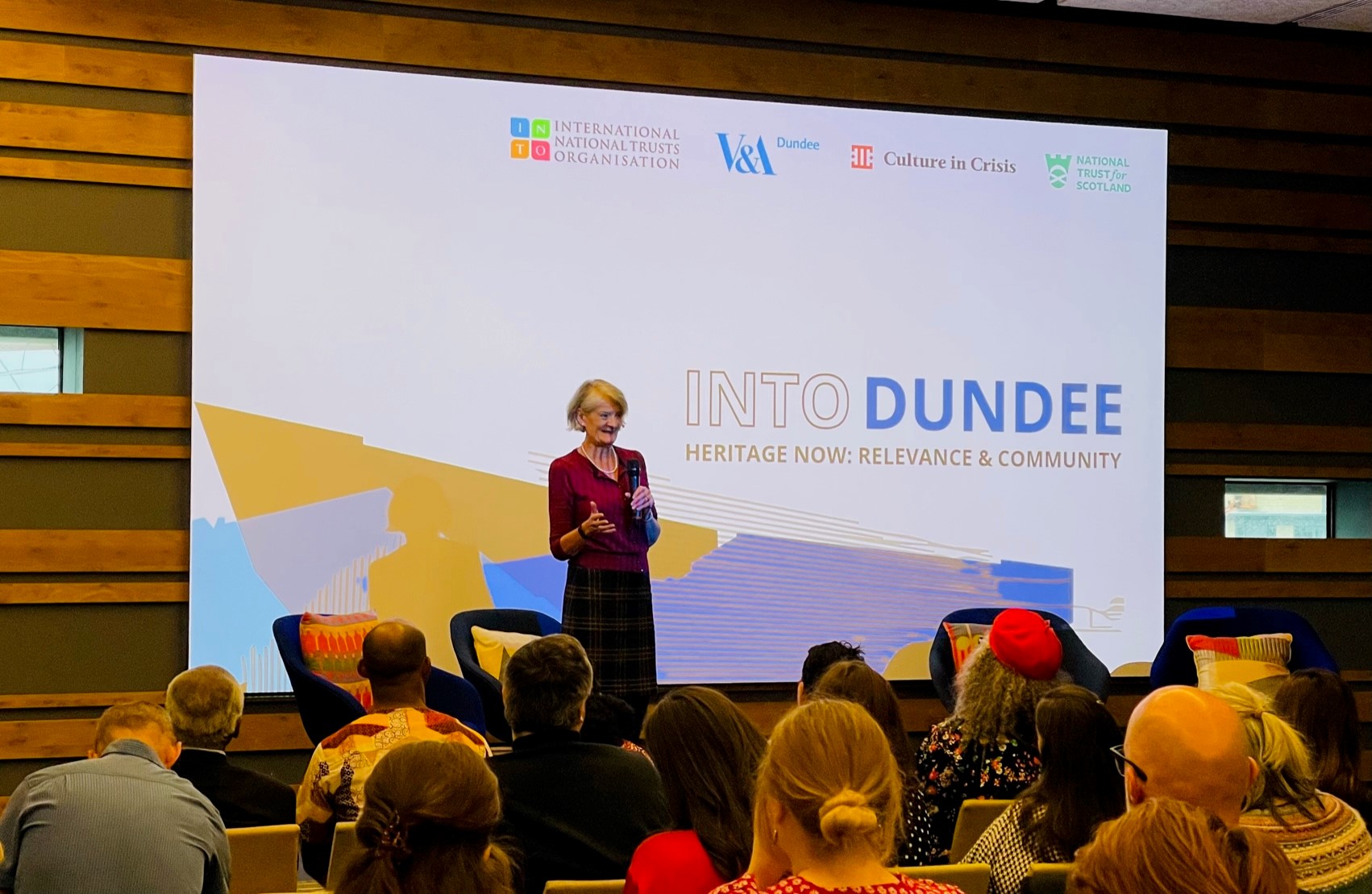
We met in the V&A Dundee, a wonderful modern building which is part of the Victoria & Albert Museum group, located next to the Discovery. This facility, dedicated to design, opened in 2018. Dame Fiona Reynolds, Chair of INTO, welcomed us on Tuesday morning. Throughout the week, Fiona demonstrated, in her own quiet and steady way, the exemplary leadership she provides to the organization. Fiona graced us with insightful, short, and pointed commentary throughout and it was such a delight to see her in person — the first time since she had me as a guest at High Table in 2019 in Cambridge. Through the years I’ve seen how Fiona nurtures relationships, speaking to everyone in ways to support and uplift others while never forgetting a name.
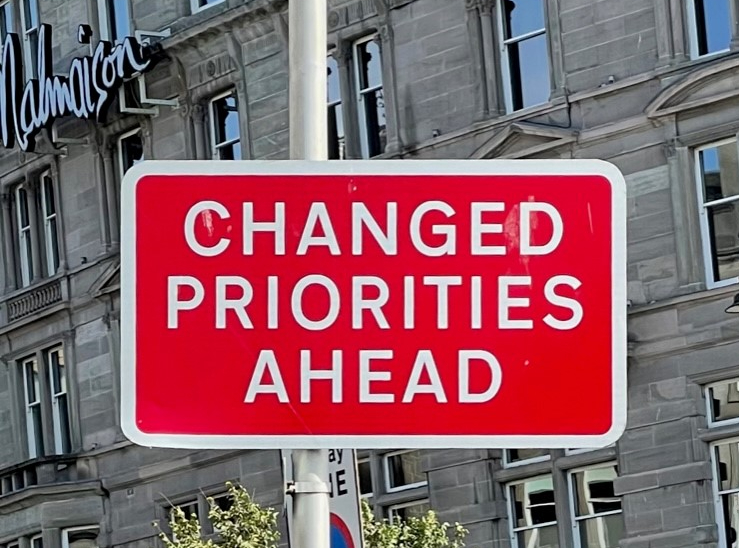
Outside our hotel, I came across this street sign.
A sign?
Given that this was my first INTO conference where I wasn’t representing the National Trust for Historic Preservation in the U.S. (NTHP) but was there in my capacity as a consultant for INTO, I took it as a metaphorical sign (**) that I am allowed to have different priorities at this point in my life and career.
One of the issues I have been addressing through my work, writing, and speaking engagements is the use of heritage as a weapon in the culture wars. So early in the conference, at a Q&A session after several very impressive presentations, I raised this issue as one that we were skirting, perhaps at our peril. That led to a 10-to-15-minute discussion among the panelists and the conference-goers that continued throughout the week. Some two dozen delegates told me how much they appreciated the raising of that issue. A young delegate from Bosnia put it so very well when she said, “The weaponization of heritage is our life, something we have to battle every day.”
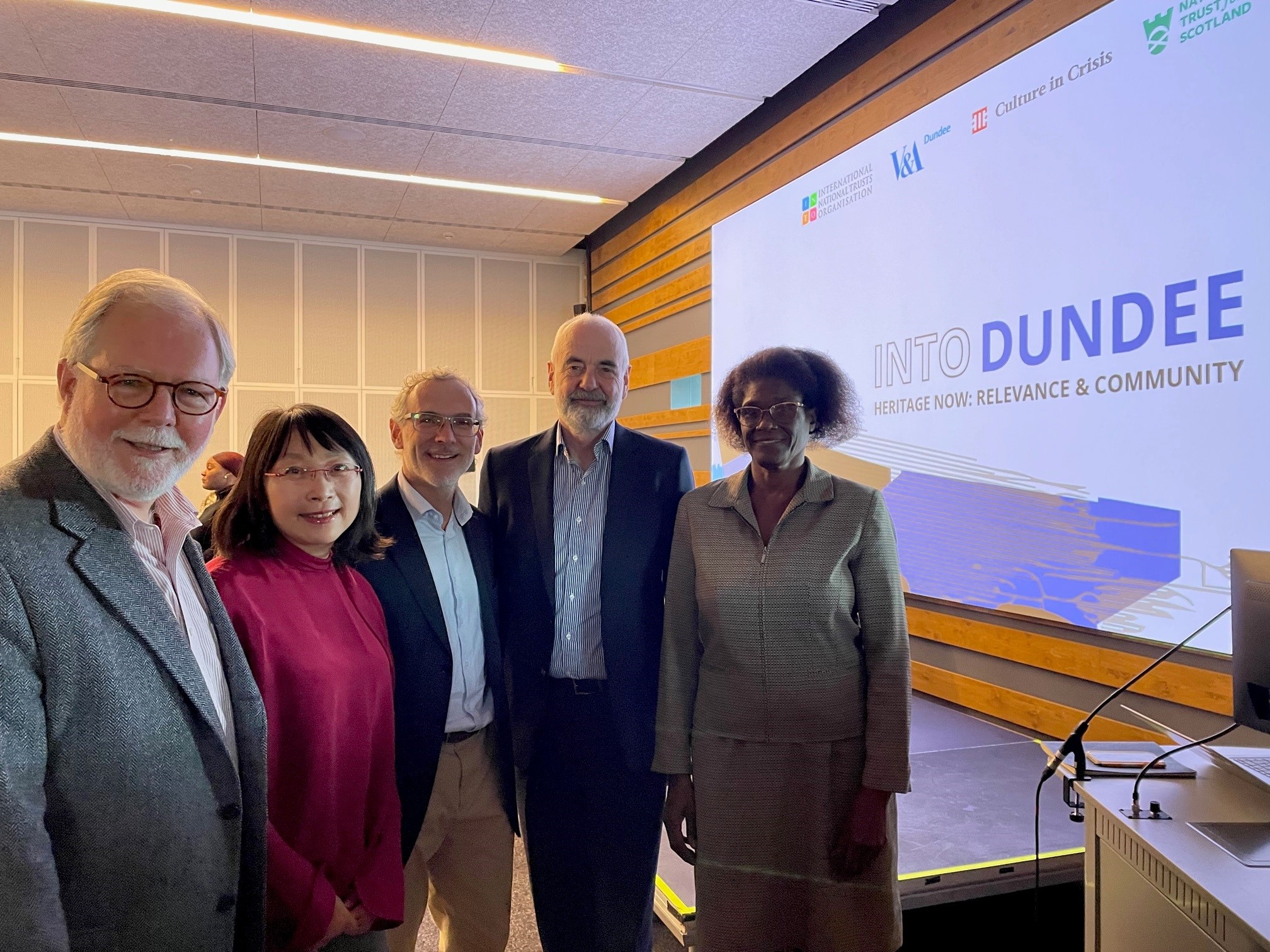
Our panel on Balancing Tourism and Conservation
Speaking of the delegates, they came from some 72 countries, easily the most we’ve ever seen at an INTO conference. There were a great many more from Asia, Africa, and Latin America than have ever been able to join us in the past. Their experiences and perspectives added immensely to the discussion, opening my eyes in new ways and — yes — changing some of my priorities.
The panel I moderated on Balancing Tourism and Conservation — a follow-on to the study on Putting the Local into Global Heritage our firm produced for INTO last year — is a perfect example of this diversity of perspective and experience. We had terrific presentations and insightful comments from (left to right in the picture above) Qin Zhang of the Ruan Yisan Heritage Foundation in China, Miquel Rafa of the Fundacio Catalunya La Pedrera in Spain, Ranald MacInnes of Historic Environment Scotland, and Evelyn Thompson of the Jamaica National Heritage Trust.
Some of the other great presentations and panels that really spoke to me and helped change my priorities included:
Bernard Donoghue, CEO, Association for Leading Visitor Attractions in the U.K. with his insights on new developments in heritage visitation.
Kara Newport, CEO of the NTHP Historic Site Filoli along with Simon Ambrose of the National Trust of Australia – Victoria, and their workshop session on changing historic places to adapt for changes in climate.
Sarah Holloway, Program Manager, Heritage Open Days with her infectious enthusiasm for giving communities the say in what and how they showcase their heritage to others.
Elon Cook-Lee, Director of Interpretation and Education at NTHP and her entire panel on the riveting subject of (Re)Interpreting Relevance.
HRH Princess Dana Firas, UNESCO Goodwill Ambassador and President of the Petra National Trust, on the hard and never-ending work to engage with local communities in areas where those communities have many different priorities.
Philip Long, CEO, National Trust for Scotland, who reminded us that when a conservation organization takes over a site, it is also taking over a long-existing image and story. Sometimes the conservation values align with that image and story…sometimes they don’t. But we can’t simply decide to prioritize conservation over those local stories without doing serious harm.
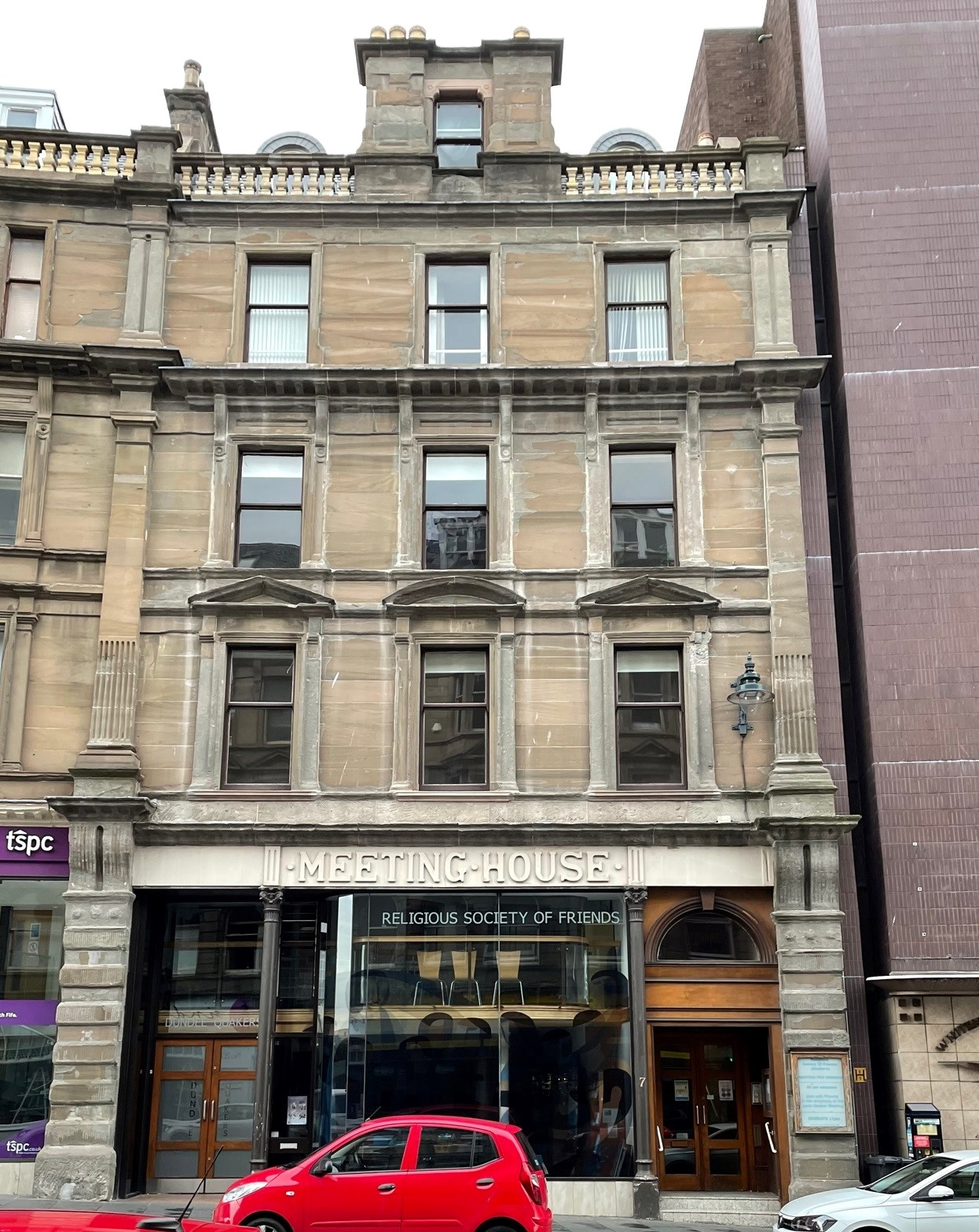
The Quaker Meeting House
High Street in Dundee on a Thursday morning
Detail of the local art and history museum building
DJB outside the Discovery and V&A. My good friend Kara Newport took this picture because she was so pleased to see me representing her historic site – Filoli – with my stylish hat!
It was so good to see long-time friends and colleagues in person. Catherine Leonard, INTO’s Secretary-General and one of my dear friends, along with Alex Bishop, Deputy Secretary-General of INTO, put together a first-rate conference under tough circumstances. It was also wonderful to meet many new (and younger!) INTO members this year, and to feel that the future of the organization and the National Trust movement is in good hands.
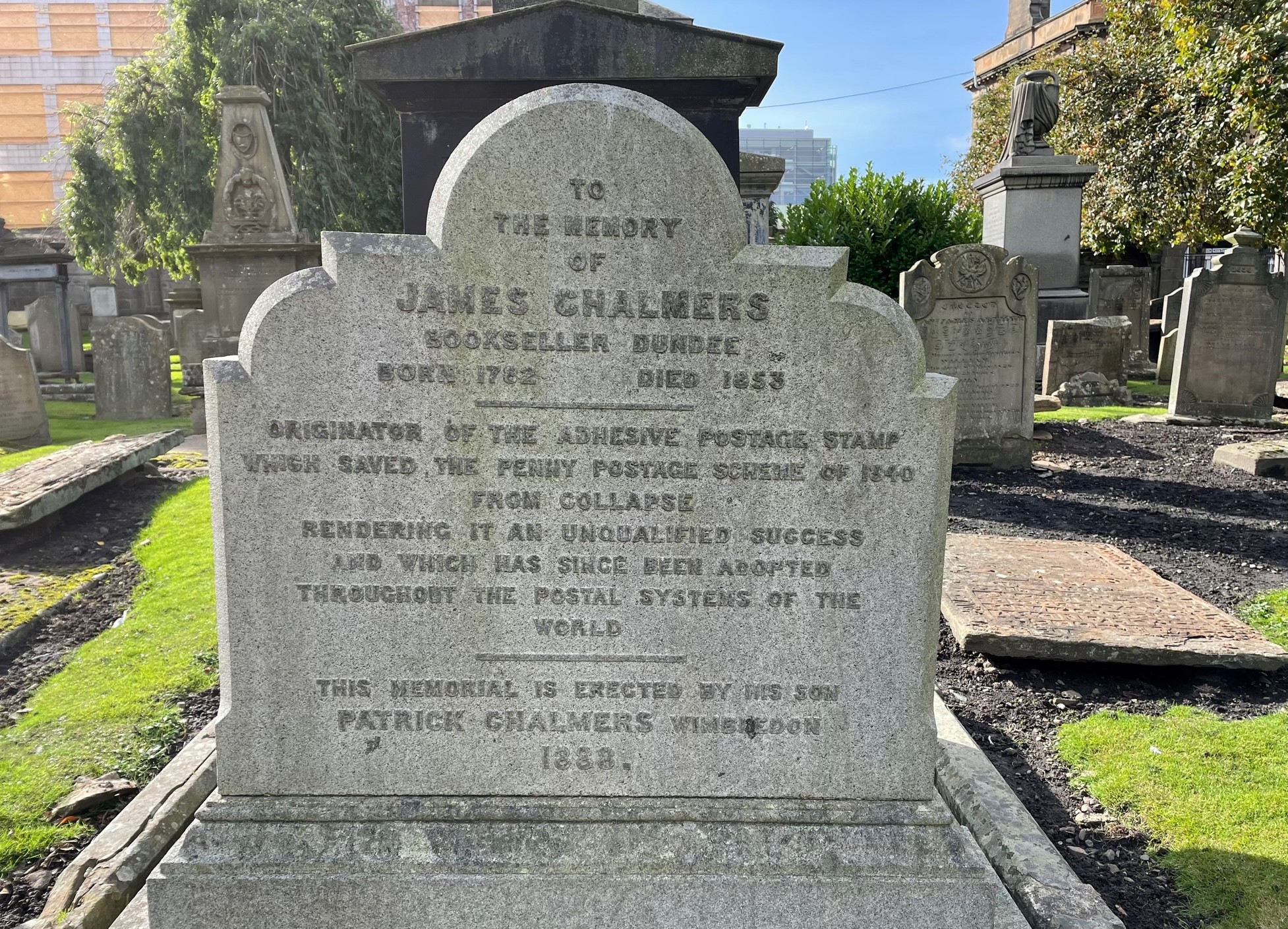
Finally, the city of Dundee was a terrific host. I found that this city of discoverers and inventors and workers — known worldwide for its marmalade — was also home to the man who invented the adhesive postage stamp, James Chalmers!
This post is going up on a Saturday, when I normally feature roots music. We had some traditional Scottish music on Wednesday evening during the conference, so I’m posting a video of my favorite Scottish folk musicians, the Battlefield Band, playing Eight Men of Moidart.
As my dear friend Catherine likes to say, “Brilliant!”
More to come…
DJB
UPDATE: In wrapping up photos from the trip, I forgot about this one, which I’ve entitled, “A Rose by any other name.”
What is the old saying about two people separated by a common language?
*I’ve attended International National Trust conferences in Edinburgh (2003), Washington (2005), New Delhi (2007 where INTO was formed), Dublin (2009), Cambridge (2015), and Bermuda (2019). I had to miss the 2011 and 2013 conferences due to illness and other commitments, and by 2017 I had rotated off the board of INTO after a 10-year run. I returned to the conference in Bermuda to give a keynote address on my last day at the National Trust for Historic Preservation after a nearly 23-year career.
**Hope I’m using this correctly. I often get figuratively and metaphorically confused.
Image of Discovery and V&A Dundee in the morning light by DJB
Timothy Snyder is one of the most knowledgeable voices on authoritarianism writing today. His slim 2017 volume On Tyranny is a must-read for everyone in this day and age.
I’m only going to quote three short sections, because you should read the entire piece. His post begins with this:
War is ultimately about politics. That Ukraine is winning on the battlefield matters because Ukraine is exerting pressure on Russian politics. Tyrants such as Putin exert a certain fascination, because they give the impression that they can do what they like. This is not true, of course; and their regimes are deceptively brittle. The war ends when Ukrainian military victories alter Russian political realities, a process which I believe has begun….
After a few more paragraphs, Snyder turns to an overarching question that I believe is spot on about how our narrow thinking or frame of reference gets in our way.
Before I lay this out, we will first have to clear away the nuclear static. Speaking of nuclear war in a broad, general way, we imagine that the Russo-Ukrainian War is all about us. We feel like the victims. We talk about our fears and anxieties. We write click-bait headlines about the end of the world. But this war is almost certainly not going to end with an exchange of nuclear weapons. States with nuclear weapons have been fighting and losing wars since 1945, without using them. Nuclear powers lose humiliating wars in places like Vietnam and Afghanistan and do not use nuclear weapons.
Near the end of his analysis, Snyder points out that what we think is ultimately much less important than what Putin is thinking.
If this is what is coming, Putin will need no excuse to pull out from Ukraine, since he will be doing so for his own political survival. For all of his personal attachment to his odd ideas about Ukraine, I take it that he is more attached to power. If the scenario I describe here unfolds, we don’t have to worry about the kinds of things we tend to worry about, like how Putin is feeling about the war, and whether Russians will be upset about losing. During an internal struggle for power in Russia, Putin and other Russians will have other things on their minds, and the war will give way to those more pressing concerns. Sometimes you change the subject, and sometimes the subject changes you.
Read the entire piece. It is long, but worth it.
More to come…
DJB
Image of field of sunflowers by Claire Holsey Brown
One of the highlights of travel is the way it focuses and redirects your mind, both before, during, and after the trip. Before several recent ventures abroad, I’ve taken the opportunity to read books and hear talks from writers with life stories and perspectives that differ from mine. In preparing for an upcoming trip to Southeast Asia, I’ve taken advantage of this time to turn to writers who are new to me. These new voices have moved me in unexpected ways.
Among the talented and widely recognized new artists I’ve found in these explorations, the award-winning Vietnamese American writer Ocean Vuong stands out. As noted in his website biography,
Ocean Vuong is the author of The New York Times bestselling poetry collection, Time is a Mother (Penguin Press 2022), and The New York Times bestselling novel, On Earth We’re Briefly Gorgeous (Penguin Press 2019), which has been translated into 37 languages. A recipient of a 2019 MacArthur “Genius” Grant, he is also the author of the critically acclaimed poetry collection, Night Sky with Exit Wounds, a New York Times Top 10 Book of 2016, winner of the T.S. Eliot Prize, the Whiting Award, the Thom Gunn Award, and the Forward Prize for Best First Collection.
Vuong was born in Saigon, Vietnam and raised in Hartford, Connecticut, in a working-class family of nail salon and factory laborers. He began his study at a nearby community college before transferring to Pace University and then eventually finding his was to Brooklyn College, where he graduated with a BA in Nineteenth Century American Literature. He subsequently received his MFA in Poetry from NYU.
I read Vuong’s two most recent works. On Earth We’re Briefly Gorgeous is a stunning piece of writing, especially for a first novel. Vuong has created a letter to his mother, who he knows will probably not be able to read it because of her limited grasp of English. But the work is much more about processing difficult memories, from his childhood in Vietnam to the move with his mother and grandmother to America, to his first love. As Heller McAlpin describes the plot for NPR,
Abused by his loving but mentally ill mother and tormented by schoolmates, the narrator, Little Dog, eventually finds solace in his first love affair, a tragic relationship with a rough American teenager ravaged by drugs. His true salvation, however, comes mostly in reading and writing, which cracks open his understanding of his family’s history.
Another part of the McAlpin review rang true to me.
Vuong writes of the new immigrant’s temporary nail salon work that becomes permanent, “a place where dreams become calcified knowledge of what it means to be awake in American bones — with or without citizenship — aching, toxic, and underpaid.” He writes of Tiger Woods, another mixed-race byproduct of the Vietnam War, and of Hartford, the former city of Mark Twain and Wallace Stevens, now a place of gunshots “where fathers were phantoms, dipping in and out of shadows and their children’s lives.”
This is not an easy book to read. The memories — as with the descriptions of growing up in the nail salon or when Little Dog comes out as gay to his mom, only to have her use that occasion to tell him that she had a forced abortion at age 17 — are painful yet written with a bluntness that is honest and real. This is a masterful work, very much worth the read.
Because the two books go hand-in-hand, I also read Vuong’s most recent book of poetry, Time is a Mother. It was written after his mother had passed away and he describes the aftershocks from the realization of her death.
Time is a Mother is a very intimate book that was challenging for me, as someone who doesn’t read poetry on a regular basis. As others have written, this work embodies “the paradox of sitting within grief while being determined to survive beyond it. Shifting through memory, and in concert with the themes of his novel On Earth We’re Briefly Gorgeous, Vuong contends with personal loss, the meaning of family, and the cost of being the product of an American war in America.”
The two books, so completely linked and yet so important separately, have vaulted Vuong to where he is now seen as one of the rising voices of literature.
UPDATE: I thought I might get around to doing a separate post with photos from my time earlier this week in Edinburgh, but that never happened. So I’ve added a few photos, without any comment beyond the captions, to the end of this post. – DJB, October 8, 2022
Recently, I wrote of how one historian delineates between history and heritage. In that piece I quoted Jeffrey Webb as he outlined important distinctions between the two. History, Webb noted, is all that “happened in the past that we find to be meaningful and significant, and it presupposes a ‘warts and all’ approach.” History involves making people feel uncomfortable when their cherished myths are exposed as falsehoods.” Heritage is “something else entirely.” Webb notes that it is the part of history that we in the present “choose to commemorate and celebrate in our communities” with statues, parades, special holidays and the like. As I noted earlier, the head of a prestigious local historical center liked to say that “heritage is history without the hard parts.”
I saw a great example of this earlier this week in Edinburgh.
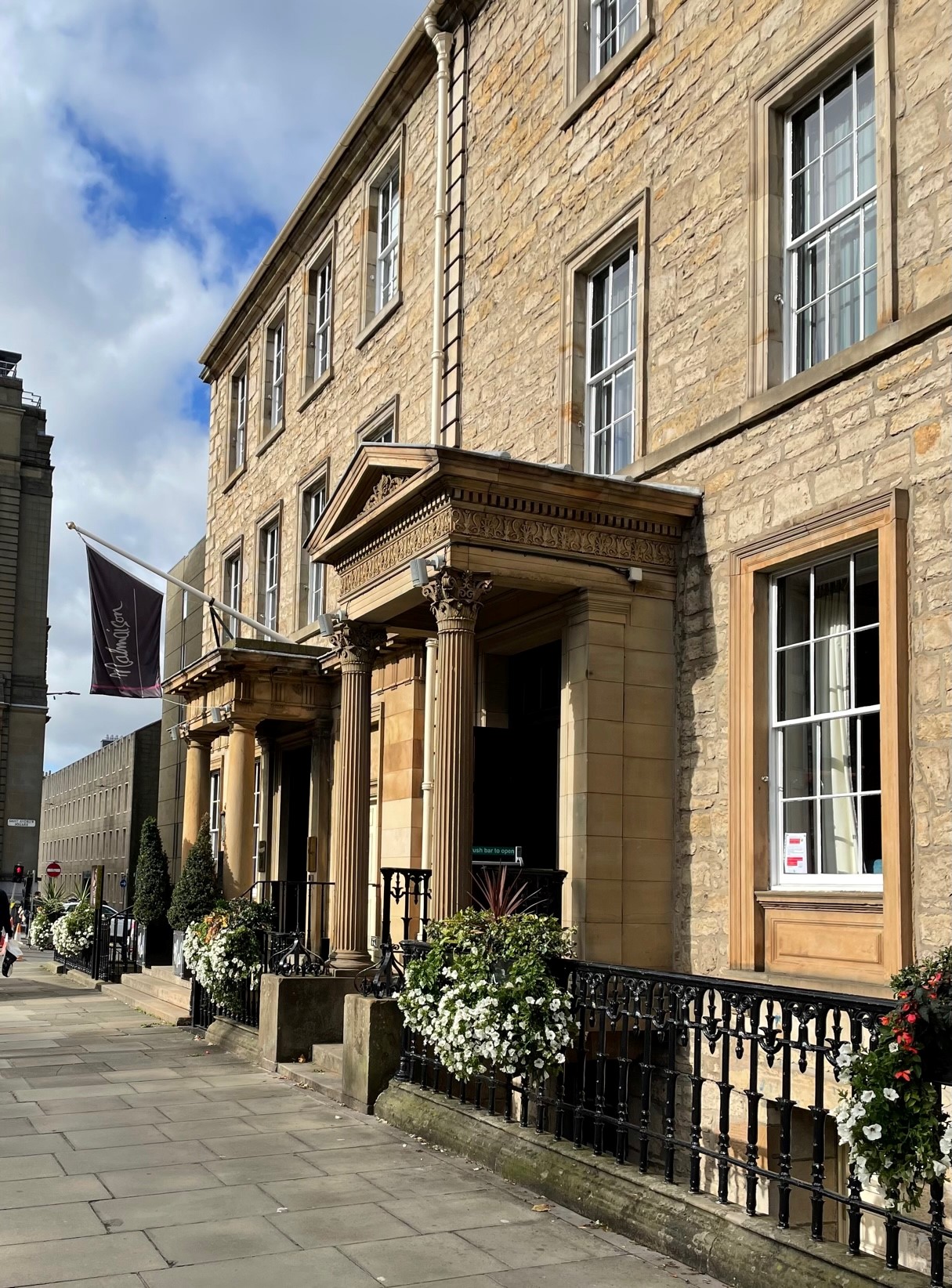
I’m in Scotland for a conference and spent a day in Edinburgh before catching the train to Dundee (more on that tomorrow). My hotel was on St. Andrew Square, in the heart of the city. And right outside my window, I could see this monument.
As I walked over to get a closer look, I saw this sign.
As you can see at the top, this piece of heritage — something that was erected at a point in time to commemorate Lord Melville — has being updated to recognize his role in delaying the abolition of the slave trade.
In the book I reviewed last month, Professor Webb looked at the issue of the removal of Confederate statues and notes that instead of “destroying” our history, what we are doing is readjusting that part of the past that we are choosing in the present to commemorate and celebrate. “The statues and the public monuments are not history, but heritage, and heritage is constantly changing and shifting as each generation chooses what part of the past it wishes to celebrate in the present.”
The Melville monument in Edinburgh is a perfect example.
History, as I said in the title to my earlier piece, is always under construction.
More to come…
DJB
Some of the historic buildings around St. Andr3ew’s Square in Edinburgh
Edinburgh Street scene
Newly discovered Van Gogh self-portrait at the National Gallery in Edinburgh
Image of Sir Walter Scott in Edinburgh, Scotland by DJB
One of my wife’s high school friends who happens to be a regular reader of More to Come recently used her Facebook page to post part of a speech the late John C. Bogle, the founder of The Vanguard Group, delivered as the commencement address for MBA graduates at Georgetown University in May 2007. Candice said it sounded like something I would think or say, and I believe she’s right.
At a party given by a billionaire on Shelter Island, the late Kurt Vonnegut informs his pal, the author Joseph Heller, that their host, a hedge fund manager, had made more money in a single day than Heller had earned from his wildly popular novel Catch 22 over its whole history. Heller responds, “Yes, but I have something he will never have . . . Enough.”
Enough. I was stunned by its simple eloquence, to say nothing of its relevance to some of the vital issues arising in American society today. Many of them revolve around money — yes, money — increasingly, in our “bottom line” society, the Great God of prestige, the Great Measure of the Man (and Woman).…
Kurt Vonnegut loved to speak to college students. He believed, if I may paraphrase here, that “we should catch young people before they become CEOs, investment bankers, consultants, and money managers (and especially hedge fund managers), and do our best to poison their minds with humanity.”
Enough. Yes, it is an eloquent word in this context. It also has other meanings, as in I’ve had enough of the billionaires who never have enough money and power and try to run (or is it ruin) our lives.
To be honest, I’m both lucky and privileged (as a white, Christian, male), and — except for that climate denial stuff leading to a much harsher planet on which to live — much of what the ultra-wealthy are trying to accomplish doesn’t harm me directly. Some of it even benefits me. But that doesn’t mean that I don’t see the real harm they are inflicting on the country. Nope, I am a firm believer that we have to change, and soon, or we are going to lose this wonderful experiment called America.
As I’ve written on multiple occasions, I was raised by a New Deal Democrat whose mother taught him that “money flows East” to the hands of the bankers on Wall Street. He had a strong belief in the power of government to work together for the common good and — as a life-long Baptist in the truest sense of that tradition — a keen understanding of the importance of the separation of church and state. Through his nine decades of life, my father became decidedly more progressive, unwilling to look the other way when the rich and powerful used their position to hurt those less fortunate than themselves. He liked to say, “I wouldn’t want to be them on Judgment Day.”
I think I’m on the same trajectory.
So, just what is it that has me agitated at this point in time? Let me count the ways. And here’s a spoiler alert: this is a rant, so stop reading if you aren’t interested in my perspective on the issue.
I’m exhausted by the efforts of some of the world’s richest people — like Jeff Bezos, Mike Bloomberg, Mathias Döpfner, and Rupert Murdock — to buy up every media platform in sight to parrot their talking points and, in the process, demolish our free press.
I’m tired of individuals such as Peter Thiel, Stephen Schwarzman, Ken Griffin, Steve Wynn, Mike Lindell, and Patrick Byrne thinking that the country will be better off if theyfund insurrection and authoritarians because they want us to believe that unfettered capitalism is the same as democracy, when that’s clearly not true.
I’ve had it up to here with the ultra-wealthy telling us they are superior human beings who “did it on their own” when six of the 10 wealthiest Americans alive today are heirs to fortunes passed on to them by wealthy ancestors, and others — Jeff Bezos, Bill Gates, and Elon Musk are examples — used their parents’ wealth to build their empires.
I’m tired of billionaires like the Lerner familybuying things that should be public trusts — like baseball teams — and then draining every last dollar they can out of those community assets before selling.
I’m exhausted by having to combat — again-and-again — the billionaires and their totally phony and widelydiscredited myth that their wealth trickles down to the rest of us, a myth most recently debunked by the Congressional Budget Office.
New CBO report: The poorest *half* of America — ~150 million people — hold only *2 percent* of the country's total wealth
Wealth of top 10 percent has grown markedly since 1989
I’m appalled by billionairessetting up phony “public interest law firms”which are little more than scams to use our country’s legal system to file bogus lawsuits to tear down our rights in order to support their interests.
I’m saddened by billionaires, the ultra-wealthy and their political and media enablers preying on the fears of a population that feels economically, religiously, or culturally dispossessed by backing authoritarians who promise to bring back a mythological world in which its members were powerful, only to find out that they were used as tools to put in place someone whose decisions are absolute and who is no longer bound by the law.
I’m exasperated by thehypocrisy of wealthy and famous people labeling those in need as welfare cheats, but refusing to call out one of their own, such as Brett Farve, who cheats the welfare system for his or her own gain.
I’m flummoxed that more don’t see that mega philanthropy by billionaires is “too often just another way for wealthy people to flex their muscles and continue to inappropriately exert social and political influence.”
I’ve had enough of billionaires and their corporate judicial system headed by John Robertsdeciding that corporations are people with political rights, opening the floodgates to billions in dark money to change the course of our country from “we the people” to “I, me, mine.”
And I could certainly spend an entire column just ranting aboutfake billionaires who would get in bed (figuratively and probably literally) with a foreign enemy of the U.S. to keep their big lie afloat. But I won’t.
Most of this comes back to the fact that capitalism is not democracy and working for the common good is not socialism…but the rich are increasingly trying to tell us that those two things are true. This one paragraph lays out a pretty devastating attack on those falsehoods.
The Tenement Museum in New York’s Lower East Side is a national treasure. It is always important as a place for telling the story of American immigration. But during times like these, when immigrants are being targeted by right wing politicians, its value increases ten-fold.
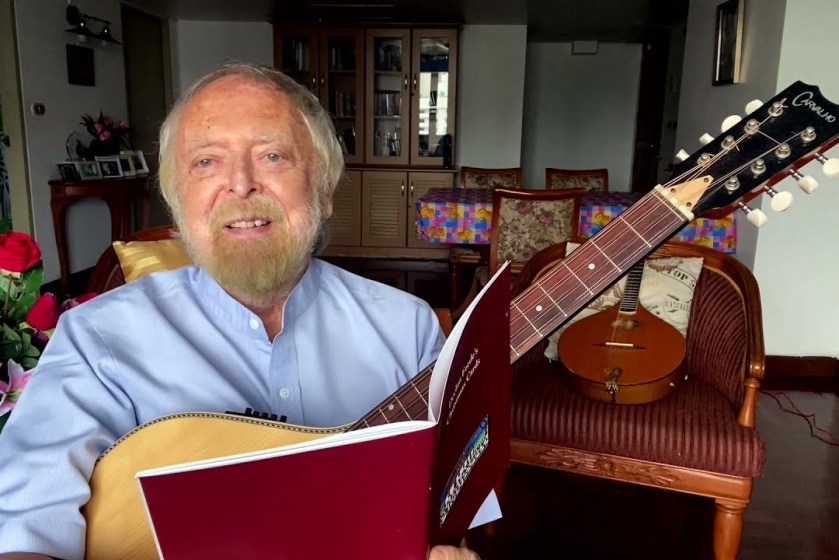
Because it is a historic site of the National Trust, I worked with the talented staff at the museum when I was at the Trust and our family has continued to support it financially. That means I get the museum’s e-newsletter, and I was so pleased when the most recent one had information and a link to a musical wake for the late Dr. Michael “Mick” Moloney.
After an evening much like any other, “Mind yourself” were the last words Mick Moloney said to his longtime friend Lenwood Sloan. A sweet send-off meant with the care Mick shared with all he knew – friends, collaborators, and students alike.
Here’s what you’ll find if you click on the video:
Join us for an intimate, musical celebration of the life and work of Dr. Michael “Mick” Moloney with some of his closest collaborators and friends. Moloney was a performer, folklorist, and historian of Irish American music whose work, among many other firsts, helped explore the connections between Irish and African American music and cultural traditions. Dr. Miriam Nyhan Grey will be in discussion with Lenwood Sloan, a longtime friend and partner of Moloney’s on Irish and African American traditions. Throughout this Tenement Concert, broadcast live from our recreated 1860s tenement parlor, they will host four musicians for an evening of memory, song, and stories that honor Moloney’s passion for the connections between people and cultures.
After brief introductory remarks, Dr. Grey and Lenwood Sloan have a short conversation. The group music begins around the 11-minute mark with the beautiful Hard Times Come Again No More. Music and conversation flow throughout the hour.
The live musical performances are by Athena Tergis, Daniel Neely, Brenda Castle, Liz Hanley, Brendan Dolan, and Anna Colliton.
Mick Moloney (credit MickMoloney.com)
This program is one of a series of informative, entertaining, and thought-provoking sessions the museum offers online and in person. A few months ago, our family joined in a delightful online program on cooking. Tenement Museum President Annie Polland is the latest in a line of amazing leaders at the museum, beginning with founder Ruth Abram and including President Emeritus Morris Vogel. I’ve been honored to work with — and most importantly learn from — each of them as well as other key members of the staff through the years.