As always, this Weekly Reader features links to recent articles that grabbed my interest or tickled my fancy. I hope you find something that makes you laugh, think, or cry.
As we face our racist past, many are just discovering the troubling ties between Nazi Germany and the United States.
“‘The U.S. led the world in eugenic thinking in the 1930s,’ said John Treat, a historian who teaches an honors humanities seminar at the University of Arkansas that covers Krieger. ‘We were the model for the Nazis.’…
Not much is known about Heinrich Krieger. He was a German lawyer who attended the University of Arkansas in 1933 and 1934 to study business and American race law — particularly laws regarding Indigenous Americans. The Nazis had long been interested in American race law; in his book ‘Mein Kampf,’ Nazi leader Adolf Hitler said the U.S. was ‘the one state’ in the world creating the kind of racist society the Nazi regime wanted.“
In the battle with home-grown fascism in America in 2021, this is a history that needs to be understood, not swept under the rug.
“Mr. Biden is currently the subject of some bishops’ braying and bleating about his fitness to receive communion. From the time of his election, through the upcoming annual June meeting of the United States Conference of Catholic Bishops, the right flank of the Conference has been rehearsing its old songs…(and) set up a committee to consider how to respond to a Catholic president who doesn’t interfere with the law of the land when it comes to abortion. How do you solve a problem like Joe Biden? was their hit tune.“
“stood in sharp contrast to Pope Francis’ kind, diplomatic words of welcome to the second Catholic president of the United States. The Bishops acknowledged Mr. Biden’s personal piety, but charged that he “has pledged to pursue certain policies that would advance moral evils and threaten human life and dignity…” They weren’t referring to building walls, supporting the death penalty, interfering with voting rights, and/or withholding healthcare from those made poor. The chorus was a tired refrain: “abortion, contraception, marriage, and gender.” It was as if Catholics cared about nothing else during a global pandemic when systemic racism and economic inequality reign. The timing was rude, the content familiar, the impact minimal.” (emphasis added)
With the archbishop who chairs the Conference’s Pro-Life Activities Committee, “we have a bishop, not of the president’s diocese, who tells a practicing Catholic that he is not devout.” In terms of hidden agendas, Hunt suggests that the most vociferous bishops on these questions “tend to be the ones who’ve had their heads measured for new regalia because they’re banking on being named cardinals, especially after Pope Francis is conveniently, for them, out of the picture.”
The radicalization of politics
Ted Cruz’s agenda is never hidden.
Author and lawyer Teri Kanefield has an interesting piece on her blog entitled The Radicalization of the Republican Party. She begins with a Wall Street Journal op-ed by Cruz where the Texas Senator calls out corporate America for pushing back against the Republican party’s radical politics, and he ends by posting his conclusion, which he also tweeted:
“Social media understood right away this was a stunning admission that Ted Cruz takes corporate money in exchange for doing their bidding. But of course we know that. The other reaction on social media was, ‘Ted Cruz turn away corporate money? Don’t make me laugh.‘
…Are the right wing extremists and Corporate America on a verge of divorce? Is Ted Cruz singing, ‘You’ll be back?’…Will the Republican Party, which started as the party of business and industry, jettison the industry and business portion and become purely the Party of White Grievance and extremists?“
The party that began as the anti-slavery pro-business party would end up, Kanefield notes, as the party of white supremacists and insurrectionists.
This weekend our family has been celebrating what I will call a “significant” birthday for my wife.
When Andrew, Claire, and I began to think of ways to recognize this milestone, we settled on something called a Boombox.* Through the wonders of the internet, we invited others to join us in sending best wishes. More than 100 of Candice’s friends and family members responded with cards, notes, poems, photos, newspaper clippings, and anecdotes.
Candice’s Big Birthday Boombox
In our combination in-person/Zoom celebration on Saturday, Andrew, Claire, Blair, and I gave the gift and — knowing the good wishes she would discover — sat back to enjoy the reaction.
Candice opens her Boombox as Claire and Blair join in from California.
Candice has touched many lives in so many positive ways that this project was an easy sell. Today I’m sharing how a sampling of those who have been part of Candice’s life expressed their appreciation for, as one person described it, the “blessing of our friendship.”
Candice with her parents, Dr. and Mrs. Andrew C. Colando, 1955
Forever friends…for friends around the world
Childhood friends, siblings, and cousins reached out with the perspective that more than one individual described as, “I knew you when…” and then proceeded to use a childhood nickname (that we don’t mention!). These “almost forever friends” had stories of birthday parties, Girl Scout cookies, measles outbreaks, and more for someone who has “such a warm and good soul.”
One reason she has so many friends from every part of her life is that Candice stays in touch. “I remember I always looked forward to the cards from Uncle David and Aunt Candice growing up,” wrote one niece. Then she added a line that was mentioned again and again: “The great handwriting always inspired me.”
“Your warmth and humility shine through your eyes and your smile and it’s a magnet,” wrote a friend from the World Bank.
Amazement at the calm in the middle of a (twin) storm
Several friends reached out with stories from when our children were young and as they grew into — in the words of their first grade teacher — “two adorable, talented, and thoughtful young people.” But man, were they a handful when they were little!
“I realised how challenging it was to be the mother of twin toddlers when one day you asked me to watch Andrew and Claire in the children’s library while you popped upstairs to the adult section,” wrote a friend who now lives in Europe but whose children shared play dates with the twins in the early 1990s in Staunton.
“‘Sure!’ I answered, without a second thought. Within two minutes, I had no idea where either of them were! Fortunately, they couldn’t go too far in that safe environment, but I felt tremendous respect for the energy you had to keep up with your busy little two!”
“Although we haven’t lived in the same place for many years, you and your family have had such an influence on me,” wrote a young friend who now has a family of her own. “You and David trusted me with your BABIES, even though they could outsmart me even back then!” Another friend we’ve known since her birth mentioned the time that she “stayed” with Andrew and Claire…when she was five years old. “Thanks for letting me ‘babysit’ your twins so many years ago — didn’t know then it was training for my future!”
Did I mention that this young woman now has twins of her own?
“Your unconditional love,” wrote one of my brothers, “has found its finest expression in the lives of Andrew and Claire.”
Flowers for a special birthday
One who lives as if what we give is more important than what we get
Candice was a Bible & Religion major at Agnes Scott College, and she has forgotten more scripture than I ever knew (and I was raised a Baptist, where quoting scripture is what it takes to get into the dining hall at summer camp!) But she has gone well beyond the simple memorization of text to living her faith in a way that is recognized and appreciated by a wide circle of friends. Not with a certainty of what scripture says and certainly not bound up in a cultural Christianity, but with a seeking mind and loving heart. A wise person “of intelligence and discernment and faith” as a dear friend/priest wrote.
Candice happens to havea number of friends who are in the priesthood, permanent diaconate, or work professionally in spiritual formation. Many of those priests/friends are female. One with a good sense of humor wrote,
“’Birthdays are good for you. Statistics show that people who have the most live the longest.’ I am grateful (understatement) to have been around for at least two decades worth of yours. That gratitude is evoked by things like countless occasions of worshipping with you, watching you mother — and listening to your stories of mothering — two wondrous children (now adults themselves!); sharing vicariously in the kind of joy you express over delights of family time, of travel, of deep wisdom; of giving of yourself so generously to church, community, school, friends; being beneficiary of having a bird’s eye view of your gifted ways of moving through challenges of health, disappointments, and more. Much more.“
When the twins were still toddlers, Candice undertook a four-year Education for Ministry(EFM) class through the University of the South. I said she took it because it required that I watch Andrew and Claire one night at home each week while she went to class. That, of course, wasn’t anywhere near the truth.
EFM required extensive reading and study. One of her classmates wrote, “Candice, you are one who loves to be engaged in serious things, and you take them on with enthusiasm and vigor….You were always prepared in EFM for anything the mentor threw our way.” Another long-time friend who is also a priest wrote, “I am blessed with your friendship, a friendship spanning many years and much of life….I have learned so much from you. You inspire me and are an amazing, wise, and delightful woman.”
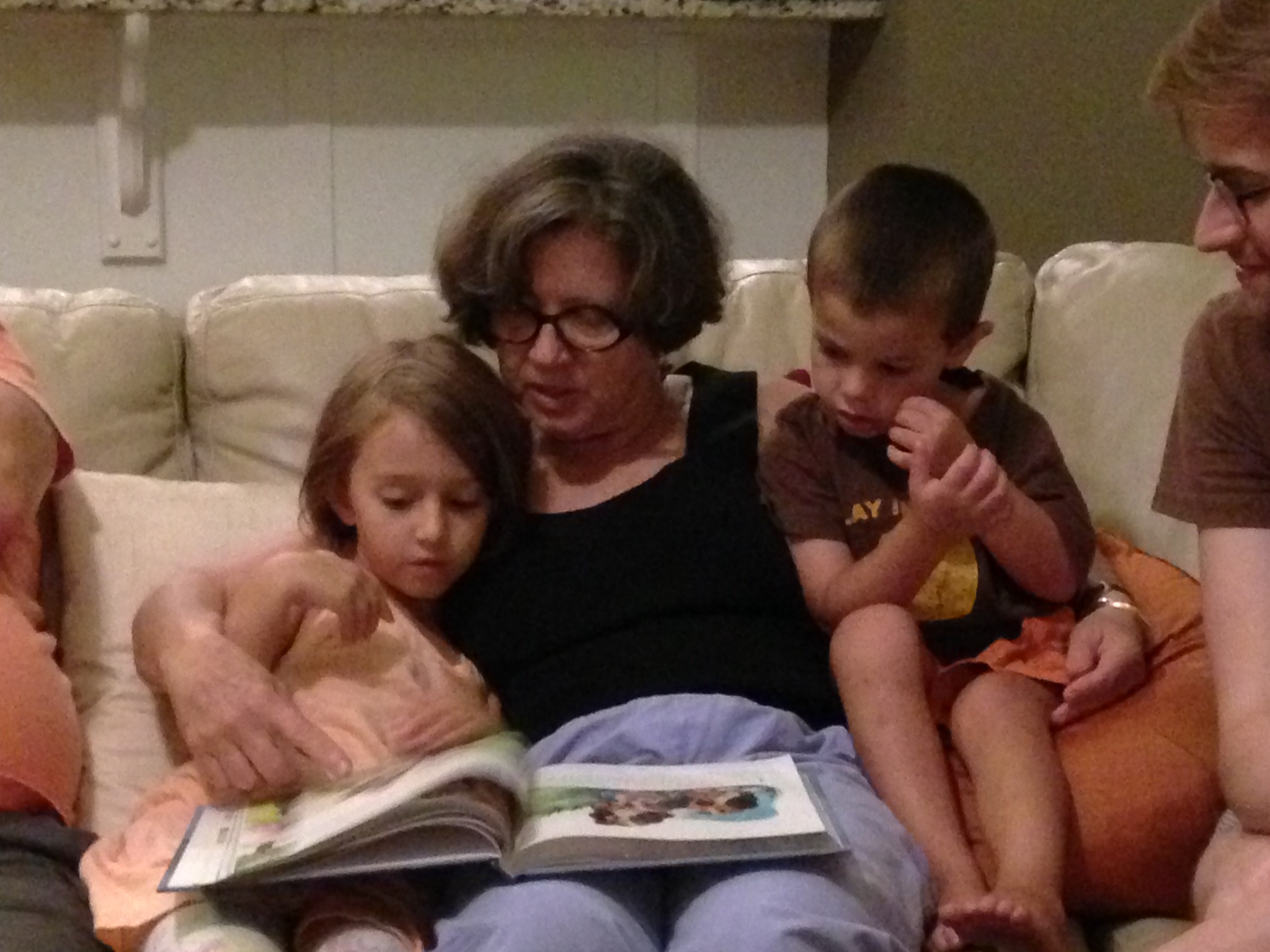
Reading with her great niece and great nephew
Time to listen, with respect, empathy, and love
Over and over again, Candice’s friends mentioned her willingness to stop what she is doing and talk with anyone, anywhere, for any length of time.
Listening is an act of love. Time and again individuals mentioned the way Candice makes herself accessible and vulnerable in a most direct and powerful way: by listening.
“I think we first met in the Nave of the Cathedral on some music-oriented occasion where 10-year-old Andrew and our daughter were performing,” wrote another friend. “You were instantly warm, friendly, and inclusive, qualities I saw in abundance over the next fifteen-plus years with many others.”
“You have a wonderful way of making me, and others, I am sure, feel as if you have all the time in the world to have a conversation. I have enjoyed our wide-ranging chats about our children, our lives, big ideas, and art.”
“Your ability to genuinely care and a willingness to listen to and not be afraid of the burden of others’ pain is extraordinary. It is a courage that I envy and admire,” wrote another friend. “Once…I was overwhelmed with single motherhood and sobbing in a church pew. You found me and told me what a good job I was doing. Your reassurance was repeated often in the following years, and it nurtured me.”
Several friends also mentioned Candice’s ways of connecting with children. “I have learned so much from you about how to honor and support children, particularly in their lives of faith,” wrote a priest/friend. “I love how you notice the details with the kids in our Sunday School — their talents, their questions, the things they love and the things they pray for. They’re blessed to have you as a mentor.”
“Love is both presence and action,” wrote a family member, “and I can’t tell you how grateful I am that I’ve always felt both throughout my life, at peaks and valleys alike.” That presence at all stages of life came through time and again.
Food, a thirst for travel, more conversation, and love
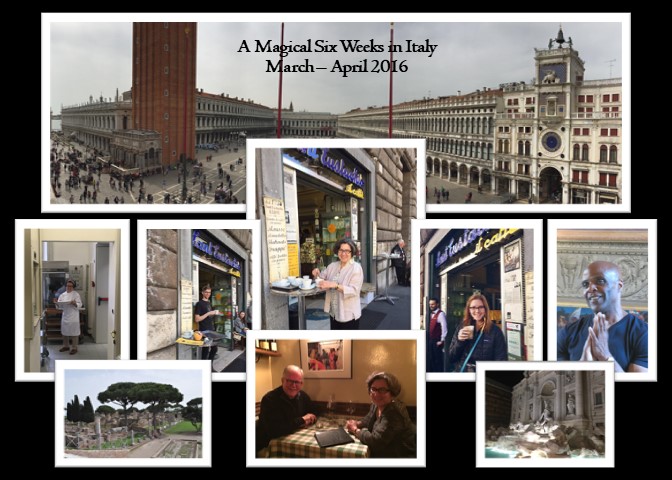
We made several new and life-long friends during our six weeks at the American Academy in Rome in 2016, where we got to know people from around the world over those amazing dinners of food and wine from the Rome Sustainable Food Project. One of those friends knew instinctively that Candice would hear from a large number of individuals, given “the gentle, insightful, and nurturing kind of person you are.” A priest/friend added the hope “that you know beyond words just how deeply and truly you are loved.”
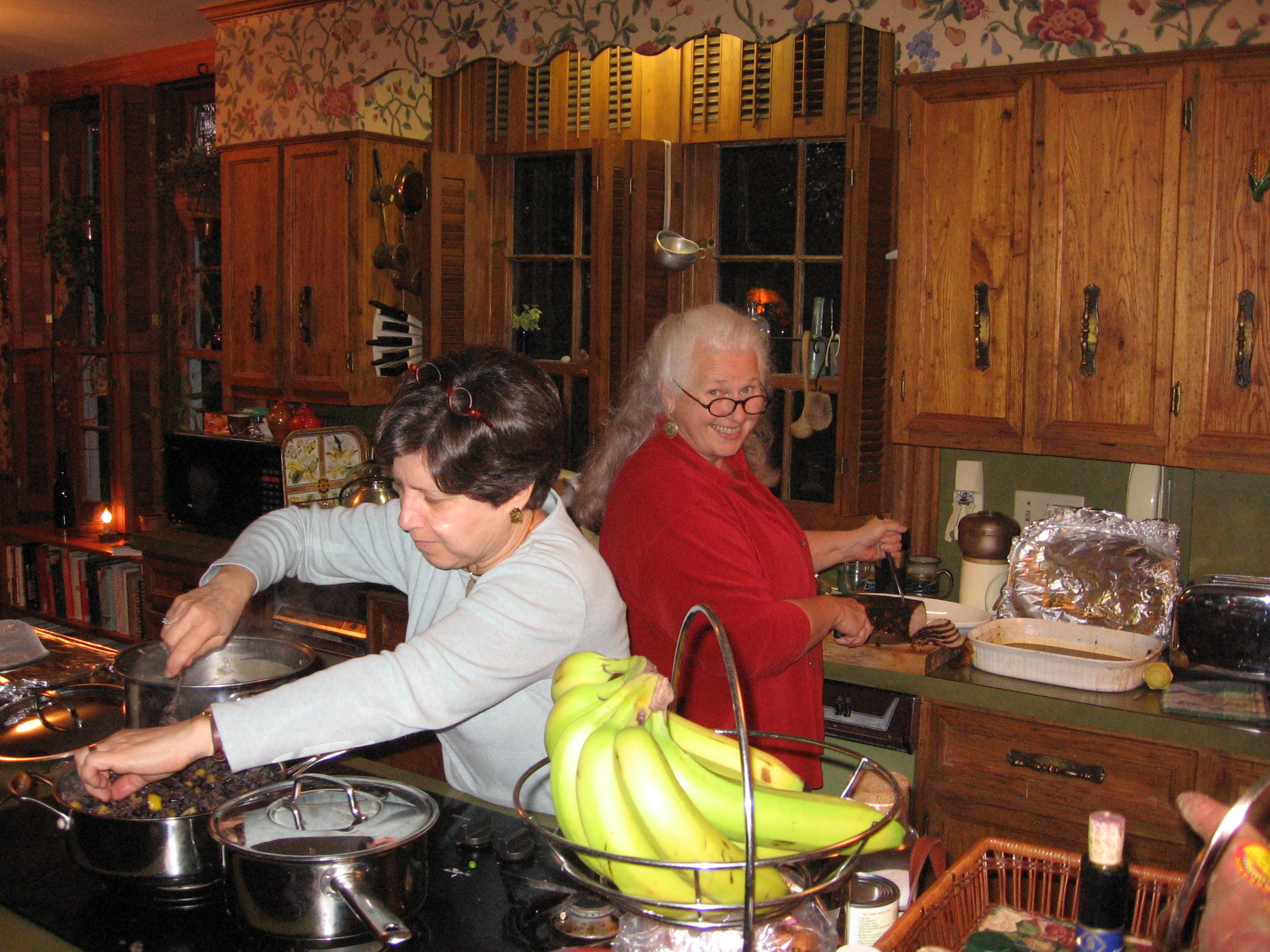
Candice and Margaret – two thirds of the catering team at Table Grace
Longtime friends from our life in Staunton wrote, “We treasure the shared history and long easy conversation, the pleasures of preparing and eating superb food together, the comfort and inspiration of your spirituality and your loving concern for others.”
And another friend from that time told of a “fabulous contribution” made to her family’s culinary repertoire.
“One summer you tutored our son, who was struggling in school after a year with a hard-nosed and unsympathetic teacher. In the course of the fun ways of learning you showed him, you provided a recipe for shortbread that a young child could make successfully. He took to it and made a pie-pan of it for every big family and church occasion the rest of his years at home. I took it up from there and over three decades must have made hundreds of pans of shortbread for entertaining friends, for gifts, and in huge numbers by popular demand for church bazaars and bake sales that have raised hundreds of dollars for good works….Wherever you go you become a blessing to those whom you meet.“
Candice enjoys a morning coffee at the Marcel Breuer House, a National Trust Historic Site
Role model
“You have been a role model to me as I’ve grown into a woman and mother. You’re a phenomenal mother and wife, yet you have maintained your own identity as you’ve supported your family,” wrote a friend we’ve known for decades. “I admire your values and the way that you have remained true to yourself over the years.”
Another friend also spoke of her presence and thoughtfulness.
“You are such a positive influence on those around you that my goal is to think of others and chart my own path as thoughtfully as you have done. All our lives are all greatly enhanced by your extraordinary love and care.“
A friend who has been through a difficult time recently with the loss of a spouse wrote, “You have been such a wonderful friend: kind, considerate, encouraging, spiritual, compassionate, a fabulous mother, and an amazing cook. Your thoughtfulness about life, friends, family and the world are an example for us all.”
Another friend who is a priest (see the pattern here) wrote that “The first time I heard your name, it was on a sick list. They told me you’d been badly hurt. That you had a long recovery.” (Candice had fallen and suffered a serious concussion where the recovery took 12 months.) “But when you came back to church, you had a smile on your face and in your heart — because nothing can keep you down.” This friend has seen Candice as a mother and wife and much more “but above all, as a person who knows how to love well, and to tend the hearts of all those around her.”
A dear friend and former colleague of mine summed up Candice’s impact on the world very well when he wrote, “She is fantastically lovely in every way!”
Happiest of birthdays and much love, dearest Candice, from all your family and friends.
Two quick confessions. First, I can’t play a lick of jazz. Second, my idea of great jazz is clicking on the Oscar Peterson playlist and sitting in amazement as I take it all in. The bassists highlighted in this Soundtrack primarily come out of that tradition, swinging with style, verve, and technique.
Ray Brown (1926-2002) is the bass player I most associate with Oscar Peterson and the swing rhythm section. Brown played 15 years with Peterson who once said, “I don’t think another group has achieved that closeness, that ‘breathe together’ bond that we had.” But Brown and his warm mellow tone supported countless incredible musicians throughout his stellar career. Since we ended last week’s post with Christian McBrideplaying a bass duet with Edgar Meyer, we’ll start this one with McBride and Brown kicking off Now’s The Time. Oh, and did I mention that Herbie Hancock and Hank Jones are playing piano, Kenny Burrell is on the guitar, the rest of the band is equally accomplished…and then Betty Carter joins in on vocals!
At the 1977 Montreux festival, Peterson and Brown played a concert together with another giant on the acoustic bass, Niels Henning Ørsted Pedersen (1946-2005). NHOP as he was known is my favorite acoustic bassist in jazz and many consider him among the best on the instrument. His technique was incredible and those in the know point to the ways he elevated others around him. Just listen to these three masters play off each other, first in You Look Good to Me and then in No Greater Love.
Rick Beato has an informative video on the “insane playing of NHOP.” Go to the 4:10 mark and watch the Joe Pass/NHOP duet. Caution: when they take off on the melody your head might explode! As Oscar Peterson says, “Niels didn’t play the bass, he was the bass.”
I listen to Christian McBride more than any current jazz bassist through his Conversations with Christian show each Saturday morning on the SiriusXM Real Jazz channel. Take in his opening solo on Steps with the late Chick Corea on piano, Kenny Garrett on saxophone and the ageless Roy Haynes — at 85 years old, mind you — on drums. Music is the fountain of youth!
Charles Mingus (1922-1979), another of my favorites, is among the most influential bassists in jazz history. I love this version of Take The A Train. As one commentator noted, only Mingus can have a band with a stride piano break followed by the most progressive Free Jazz bass clarinet solo you’ll ever want to hear. It is like a history of jazz in one performance.
Ron Carter is the most recorded jazz bassist in history. “After playing with Chico Hamilton, Jaki Byard and Milt Jackson in the early 60s, Carter joined Miles Davis’ quintet in 1963, and stayed for five years, playing on classic albums such as ESP and Miles Smiles.” For some great Ron Carter, give a listen to Third Plane.
Another jazz bassist who has grabbed my attention through the years is Dave Holland. He replaced Carter in Miles Davis’ band and has had a remarkable and lengthy career. Enjoy the warm tone he gets out of this solo blues piece.
I know I’ve left out so many talented jazz bass players. (Where’s Jimmy Blanton you might ask). But perhaps this sampling will whet your appetite to jump in and hear some yourself. And because I simply cannot get enough of Peterson, Brown, and NHOP, let’s have them take us out with a spirited Reunion Blues.
We are approaching the 100th anniversary of the 1921 Tulsa Race Massacre, among the worst single instances of racial terrorism in American history. While many recognize this event and its aftermath as the horrific tragedy it is, there are others who are using the weapons of choice for those who want to push back against history and shift responsibility for racism to others. If we are to live so that we will be a people worth remembering, we must learn to follow and understand the truth of our memories. Of our history.
As always, this Weekly Reader features links to recent articles that grabbed my interest or tickled my fancy. I hope you find something that makes you laugh, think, or cry.
“In the span of about 24 hours between May 31 and June 1, 1921, a white mob descended on Greenwood, a successful black economic hub in Tulsa, Oklahoma then-known as ‘Black Wall Street,’ and burned it to the ground. Some members of the mob had been deputized and armed by city officials.
In what is now known as the ‘Tulsa Race Massacre,’ the mob destroyed 35 square blocks of Greenwood, burning down more than 1,200 black-owned houses, scores of businesses, a school, a hospital, a public library, and a dozen black churches. The American Red Cross…said the death toll was around 300, but the exact number remains unknown….Those who survived lost their homes, businesses, and livelihoods. Property damage claims from the massacre alone amount to tens of millions in today’s dollars. The massacre’s devastating toll, in terms of lives lost and harms in various ways, can never be fully repaired.“
What the 1921 Tulsa Race Massacre Destroyed is a 3D model in the New York Times of what was lost in terms of property and intergenerational Black wealth. It is worth your consideration.
Blowback against the impacts of racism can be seen in conservative attempts to take one of the aspirations for the civil rights movement — King’s famous line that individuals would one day “not be judged by the color of their skin but by the content of their character” — and strip it away from considerations of power, hierarchy, or structure. Sociologist Eduardo Bonilla-Silva, author of Racism Without Racists, notes that color-blind racism is an ideology that “explains contemporary racial inequality as the outcome of non-racial dynamics…(W)hites rationalize minorities’ contemporary status as the product of market dynamics, naturally occurring phenomena, and blacks’ imputed cultural limitations.” Such explanations “exculpate [white people] from any responsibility for the status of people of color.”
“(T)his new (Oklahoma) law undermines efforts to reckon with our collective past, and it will chill classroom discussions of this history. H.B. 1775 instructs educators to emphasize that although the perpetrators of the Tulsa Race Massacre did bad things, their actions do not shape the world we live in — even though White rioters murdered scores of Black Tulsans and destroyed more than 1,200 buildings in the Black Greenwood neighborhood, annihilating decades of accumulated Black wealth.” (emphasis added)
As the reality of our nation’s deep racial divide highlights white privilege and white terrorism, many who have benefitted from those systems and actions feel uncomfortable. Generations are affected by actions such as occurred in Tulsa in 1921. Yet too many would rather our history be taught in the old “patriotic” way. The attempt to shift blame onto anyone but those who have controlled power since our nation’s founding shows the desperation felt by the country’s shrinking but well funded and highly vocal group of white supremacists.
We should understand our history and live out those consequences so that we will be a people worth remembering.
More to come…
DJB
(Image: During the Tulsa race riots in 1921, more than 1,200 black businesses and homes in the Greenwood District in Tulsa, Oklahoma, were destroyed at the hands of white residents. Bettmann Archive/Getty Images)
The first time I met my new boss was at a one-on-one getting to know you session over lunch. At some point over the salads and iced tea I heard, “I don’t understand your job.”
Gulp #1. And it wasn’t the tea.
I no doubt stumbled a bit in describing my work and finally turned to the truth. “As the job is currently configured,” I responded, “it lacks clear-cut responsibility and authority.”
Gulp #2. What had I done?
This individual went on to become one of my most influential mentors and a good friend, but at that first meeting I certainly could not predict what lay ahead.
Without knowing it at the time, what was taking place was the first of many lessons on maintaining focus in the face of an unpredictable world. In trying to handle all my responsibilities and whatever else the job threw at me each day, I found myself struggling to set priorities.
So much of how we focus is making intentional choices about what to do and what not to do. I had practiced making focused, intentional choices during different parts of my life. In leading a start-up organization early in my career, we engaged with more than 150 groups and many wanted very different things. Over time we honed in on two key elements of our mission.
It turns out I was very good at one of our priorities and not as skilled at the other. After losing a bruising legislative battle and learning that lesson the hard way, I hired someone who could provide the leadership we needed in that part of our work while also pushing myself to learn more about the ins-and-outs of this critical piece of our mission. We allocated our resources, made clear-cut choices about how to compete, and came back with a legislative victory that proved transformative. In other words, we focused.
I knew the importance of focus, but needed to grow in turning that knowledge into lifelong practice. My mentor helped me see how one inculcates these short-term bursts of sharpness into a way of life.
The work of staying focused never ends
Peter Drucker said that “People in any organization are always attached to the obsolete — the things that should have worked but did not, the things that once were productive and no longer are.”
Staying focused is hard work. People and organizations go through periods of focus and then quickly forget what it was that brought success. Too soon they have faced a crisis; taken on more work that they have the capacity to complete; seen leadership changes; grappled with personal challenges; or — no surprise here — get caught in trends and cross-winds that are difficult for even the best to navigate. The long-term performance of the businesses Tom Peters and Jim Collins highlighted in their management bibles is a cautionary tale.
Saying no is just as important — perhaps more important — than saying yes
“People think focus means saying yes to the thing you’ve got to focus on,” said Apple founder Steve Jobs. “But that’s not what it means at all. It means saying no to the 100 other good ideas that there are.” Organizations and people fail far more often from trying to do too much, than trying to do too little. One has to choose carefully. Ryan Holiday, in distilling the wisdom of the Stoics, suggests we “say no (a lot).”
The unpredictable nature of life must include clarity about the right resources needed to focus
Focus in an unpredictable world requires working with real people, not burying your head in technology and data. Technologies try to “force fit a predictable model onto a world that is infinitely surprising.” Instead of relying solely on technology, try to associate with the smart, strategic, and nimble people who make you better. Being focused on what matters isn’t always the most efficient way forward, but it does require relentless preparation, the ability to attempt new things, and the ability to discard those things that don’t work.
“Preparedness, coalition building, imagination, experiments, bravery. In an unpredictable age, these are tremendous sources of resilience and strength. They aren’t efficient. But they give us limitless capacity for adaptation, variation, and invention.”
Finally, it takes bravery to be focused
My mentor showed me time and again how hard it is to stay focused, and the bravery that is required to succeed. It is actually much easier to be unfocused. If you can stand the clutter, you can give the appearance of being busy. But clutter is costly.
Sometimes I think we chose not to focus because we fear making choices. Rich Harwood makes this point in his upcoming bookUnleashed: A Proven Way Communities Can Spread Change and Make Hope Real for All. As human beings, he notes, we fear the ambiguity and uncertainty.
“There is concern about being blamed for something going wrong or awry…But here’s what I know, more than anything: change only happens when we make intentional choices.”
Focus is all about intentionality. Building a daily practice of intentionality that leads to a focus in your life is satisfying. You can still be imaginative and creative as you live a life of focus. But without committing to focus on what really matters, the work you imagine and create will fall short of its true potential.
As Saturday afternoon’s bright sunlight faded and darkness descended on the eve of Pentecost, I found myself in the nave of the Washington National Cathedral, fully enthralled with Les Colombes, the multimedia art installation of German artist Michael Pendry.
Andrew, Candice, and I had come to an evening exhibit walk, which is part of the public showing that began this month as the city opens up. Les Colombes means “white dove” in French, and the installation has three components: a flock of 2,000 origami paper doves hung in a winding column down the nave, a lighting display, and a mystical soundscape.
Just before Christmas, Pendry installed the Les Colombes exhibit in the grand nave of Washington National Cathedral. Across cultures and religious traditions, doves represent hope, peace and rebirth. Many of the over 2,000 paper doves that make up Les Colombes are inscribed with hopeful and prayerful messages. The doves were installed to encourage a feeling of optimism as we ended a challenging 2020 and began a new year. The Cathedral notes that “This sculpture is arranged to give new life to the Cathedral, embody our resolve to be kind to our fellow human, and to do our part in making a better tomorrow.”
Les Colombes has previously appeared in Salisbury Cathedral in Salisbury, England; St. Martin-in-the-Fields in London; Mount Zion in Jerusalem; Heilig-Geist Viktualienmarkt in Munich; and Grace Cathedral in San Francisco.
“What does the symbol of the spirit, the white dove, look like in our present days? Does this symbol still exist and is it still appropriate? Does it function properly when transformed into the 3rd dimension and what does that possibly mean for a modern art installation today ?
The spirit – a very abstract term in our modern hightech and consumer orientated society – apparently of little importance and difficult to understand. The installation is seeking an approach to the idea of the spirit, the “Holy Spirit” on various levels and angles with a full range of stylistic devices – a physical and emotional experience in unique spaces.”
MichaelPendry.de
Andrew, Candice, and I all felt a real sense of optimism as we entered the Cathedral for the first time in more than a year — a space where we’ve worshipped, made music, learned, and been inspired hundreds if not thousands of times since we moved to the city in 1998. We were not disappointed.
If you are in Washington and have the chance to see Les Colombes, I encourage you to do so. Hopefully the doves — simple yet powerful — can point us towards a more peaceful world.
As any thinking person would realize, this is not a Saturday Soundtrack about Meghan Trainor.* In fact, just to be safe I thought about naming this version Catching some bass, which is the title of a wonderful article I discovered early in my blogging career written by Miss Music Nerd. Her piece is about the difference between the instrument or voice with the lowest register in a musical ensemble and a fish with a name that is spelled the same but pronounced differently. But even that sentence is confusing, so I went with my original instincts.
DJB on the bass, with my brother Joe and a very young nephew Joseph!
For as long as memory serves, I have been captivated by the beautiful, deep, resonate sounds of the acoustic bass. When first listening to bluegrass, roots, and acoustic music in the late 1960s, I loved hearing those mandolins, fiddles, and guitars grounded in the wooden music that can only come from the acoustic double bass. And as my tastes broadened into a greater appreciation of jazz, the cool cats on the bass again mesmerized me with their clear groves. Mind you, I don’t really play the bass (the picture above notwithstanding), but simply love what a good musician can do with this instrument.
So this will be a two-part Soundtrack. Today we’ll focus on roots music bass players from the bluegrass, folk, new acoustic, and Americana genres. Next week, we’ll explore some jazz cats. Oh, and while a good Paul McCartney bass lick pleases me as well as the next baby boomer, no electric basses need apply for this review.**
Most of the musicians in the roots field point to the importance of Tom Gray, the bassist with two of the more influential bands in bluegrass music: The Country Gentlemen and The Seldom Scene. Tom was influenced by the music of George and John Shuffler, flashy bass players with The Stanley Brothers, as well as the jazz bass of Keeter Betts, who played with guitarist Charlie Byrd. But in the 1960s and 70s, he built a sound that worked to support the strong vocals and instrumental skills of the Gentlemen and the Scene, and in the process became the best-known bluegrass bass player of his generation.
Tom can play flashy instrumentals, and one of his showpiece tunes with the Seldom Scene was Grandfathers Clock, heard here on 1975’s Live at the Cellar Door album.
Bassist extraordinaire Tom Gray and Dobro master Mike Auldridge with the Legends of the Potomac (photo by DJB taken at Evensong Farm on 10.10.10)
I got to know Tom when he began helping his daughter Julie at the Silver Spring Farmers Market. If he wasn’t too busy, we would chat a bit and discuss who he was playing with that weekend. You can see Tom from this era, with the late Dr. John Starling and another former member of the Seldom Scene, Ben Eldridge, in this 2014 Smithsonian Folkways video of With Body and Soul (featuring wonderful background vocals by Emmylou Harris).
One of the musicians who can play outstanding bluegrass but, just as importantly, helped showcase the possibilities of the acoustic bass in the new acoustic music of the 1970s is Todd Phillips. An original member of the David Grisman Quintet, playing both mandolin and bass, Phillips went on to play bass for many years with Tony Rice, helping Tony create both his jazz-influenced work as on the tune Mar West and making bluegrass history with the Bluegrass Album Band.
Fat Kid, the opening cut from Phillip’s 1983 album Released, features Tony Rice on guitar, DGQ bandmate Darol Anger on violin, and Phillips on both bass and mandolin. The bass and mandolin interplay to kick off the tune is worth the price of admission.
Phillips has also explored his jazz and bluegrass roots as a part of the Phillips, Grier, and Flinnertrio, heard here in 2019 on Tennessee Blues.
Phillips’ turn playing Thibodaux with the Claire Lynch Band gives me the perfect segue to my next bass hero. Phillips was in Claire’s band at that time because her regular bassist, Mark Schatz, was playing the 25th anniversary reunion tour with Nickel Creek.
Claire Lynch and Mark Schatz hot foot it at Merlefest
Mark Schatz is an amazing bassist (and a great banjoist, dancer, and hambone player to boot) who has played with damn near everyone in the roots music field — Claire Lynch, Tony Rice, Bela Fleck, Nickel Creek, Tim O’Brien…the list goes on and on. I have always loved the set at Merlefest where Rice fronts a super group of Sam Bush, Fleck, Mark O’Connor, Jerry Douglas, and Schatz. Here they play Bela’s tune Whitewater. Bring out the fire extinguishers!
In looking around the internet, I came across this really delicious banjo/bass duet, Banjo Meltdown, from 1992 with Schatz and Bela Fleck. At about the 3:20 mark, Bela backs off to give Schatz some room to stretch out.
And in another segue, this bass duet on one bass takes this post from Schatz toEdgar Meyer.
“Throughout a lifetime of performing and composing, Edgar Meyer has turned the double bass into a modern virtuoso instrument that is equally at home in classical music and in the American vernacular. In 1994, Meyer became the first bassist to win the Avery Fisher Prize. He is also a recipient of the prestigious MacArthur Foundation “Genius” Award and three Grammy Awards. Meyer has found devoted audiences through a vast range of projects, from his own double bass concertos that he continues to perform regularly to recital collaborations with Emanuel Ax and Amy Dorfman and performance and recording projects with artists including Joshua Bell, Yo-Yo Ma, Bela Fleck, Zakir Hussain, Mark O’Connor, Sam Bush, Jerry Douglas, Mike Marshall, and many others. The New Yorker calls him ‘the most remarkable virtuoso in the relatively unchronicled history of his instrument.’”
Many of us came to know Meyers’ music through the acoustic supergroup Strength in Numbers with Bush, Fleck, Douglas, and O’Connor. Meyer has a tasty bass solo in Duke and Cookie beginning at the 1:50 mark.
We’ll continue our tour of Meyer’s work with two of his duets with Chris Thile. Those are followed by an incredible Tiny Desk Concert from 2010 with Meyer, Fleck, and Zakir Hussain. This amazing music is well worth the listen.
As a foretaste for next week’s Soundtrack, here’s Meyer with jazz bassist Christian McBride in a wonderful bass duet entitled Solar.
There are many other roots and bluegrass bass players I could feature, including Byron House, Bryn Davies (check out the solo at 5:50), and the wonderful Missy Raines.
I love Missy’s version of the old Flatt & Scruggs tune Darlin’ Pal of Mine with Alison Brown because Todd Phillips and Mike Bub (another terrific bluegrass bassist who has played with everyone from Del McCoury to Sturgill Simpson) show up to join in the fun and add the only triple bass playing on the double bass I’ve ever seen!
That’s enough for now. Just remember, its all about that bass!
Enjoy.
More to come…
DJB
*To my ears, the best version of Meghan Trainor’s pop hit All about that bass (no treble) is from the folks at Postmodern Jukebox, where vocalists Haley Reinhart, Morgan James, and Ariana Savalas rock some great Andrews Sisters- style harmonies. Most importantly for these purposes, it also features a “sweet four hand bass solo by Casey Abrams and Adam Kubota.”
**But careful readers will know that by clicking on the two links in the Paul McCartney sentence, you’ll get Come Together and Day Tripper…two wonderful bass lines from the many in the Beatles catalog.
A former colleague posted an article from Medium on her LinkedIn page this morning that immediately drew my interest. It was entitled 50 Very Short Rules for a Good Life From the Stoics by the author Ryan Holiday, and it turned out to be a great list.* Holiday, author of the book Lives of the Stoics: The Art of Living from Zeno to Marcus Aurelius, based it the premise that the work of philosophy is to define your rules. Then live by them.
This is a short but thoughtful read as you head into the weekend. It is hard to pull out the “best” of these rules, because virtually every one resonated with me. But to whet your appetite (and to encourage you to click on through to see the full list), here are a baker’s dozen to ponder:
Over the last two weeks, the backlog of articles I’d like to share has reached the point where I’m using the old baker’s dozen approach to point you toward works you may find of interest. With 13 articles in the mix, I hope you can work your way through the full list. To help, I’ve placed them in groups with similar themes or issues.
As always, this Weekly Reader features links to recent articles that grabbed my interest or tickled my fancy. I hope you find something that makes you laugh, think, or cry.
Why we get history so wrong
One of the best reads of the week came from Michael Harriot at The Root. He went looking for the history textbooks used by the (virtually all white) Senators opposing the teaching of Black history in the 1619 Project when they were in school and suddenly everything makes sense.
The Textbooks Used By Senators Who Oppose ‘The 1619 Project’ outlines some points of view of the textbooks that these senators pine for. This will be the one article where I spend some time with the quotes, as I want us to look at one of those involved: Senator Marsha Blackburn from my home state of Tennessee (who is NO Albert Gore…Senior or Junior!)
“What she read: Although she represents Tennessee, Marsha Blackburn attended elementary and high school in Laurel, Miss. In 1959, the year Sen. Marsha Blackburn would have entered kindergarten in Mississippi, the state legislature handed control of choosing textbooks to Gov. Ross Barnett. At the request of the Mississippi State Society of the United Daughters of the Confederacy (UDC), the state had already mandated a ninth-grade course in Mississippi history, which means Blackburn learned the history of her state from John K. Bettersworth’s textbook Mississippi: a History.
The New York Times wrote in 1975 that Bettersworth’s catalogs “treat blacks of old as complacent darkies or as a problem to whites.” When The Root reviewed the text, we noticed that the entire history of the 250-year institution of slavery was reduced to five pages. Bettersworth’s book was based on UDC propaganda that taught children that the slave master treated his slaves ‘as his own,’ but noted that most of the human chattel were so lazy that ‘it took two to help; one to do nothing.’ However, Bettersworth was sure to point out the kindness of the masters who educated the enslaved ‘as they taught their own children.‘
Mississippi: A History also treats the Supreme Court’s Brown v. Board of Education case as a travesty, insisting that Mississippians were largely satisfied with segregated schools. ‘Incidents had been extremely rare,’ it explained. ‘[F]or by and large, each race—its parents, its pupils and their teachers, had found it advantageous to remain in an ‘equal but separate’ status.‘
The United Daughters of the Confederacy play an outsized role in the way we learn history. Formed in the late 19th century, the group is not only responsible for most of the Confederate monuments in America but perhaps their biggest memorial to the white supremacist utopia known as the Confederacy is how they instilled their beliefs in schools across America. By turning Southern housewives into lobbyists for the Lost Cause ideology, they transformed history into a fictional version of the past, complete with happy slaves and brave, honorable white men who just wanted low taxes. By the early 1920s, they had become so powerful that a history book didn’t stand a chance of being approved if it contained a negative portrayal of the Antebellum South or the Civil War.“
How the media portrays civic life and the fight for democracy
Why were progressives were so fooled by President Joe Biden’s agenda? Anand Giridharadas in The Atlantic says progressives thought they knew what a Biden presidency would look like, but they were wrong, in his article Joe Biden and the New Progressive Era.
“But for now, a capital that has been defined in recent years by the absence of useful action bubbles with generative possibility. And many of us who thought we knew what a Biden presidency would look like, and didn’t expect much from it, are suddenly asking ourselves: How did we get him so wrong?“
And while the media may still be focused on the old emphasis on bipartisanship and outreach, that has been “displaced in Joe Biden’s Washington with an emphasis on coalition — attending first and foremost to your own side, everyone balancing the holding of their own with the holding of their nose, so as to get the good-enough thing done now instead of waiting for what might never come. ‘
When I first saw the piece in the New York Times that looked down upon President Biden for being deliberative and pushing his staff to bring their “A” game, I was upset. But clearly not as upset as long-time blogger Oliver Willis who wrote NY Times Very Mad Joe Biden Is Not A F*%$#&^g Idiot Like Trump.
“’Aides say he demands hours of debate from scores of policy experts,’ the Times notes, as if that wasn’t what over 81 million people voted for in November 2020.
Discussing Biden‘s attitude when aides don’t bring him clear and precise answers, the Times drops this shocker: ‘Let’s talk plain English here, he will often snap.‘
Reporter Michael Shear put an exclamation point on the Times’ framing by tweeting out the story with ‘SHORT FUSE’ in caps to make it clear what the paper is trying to do here.…
Because Trump’s most trusted policy advisors were Fox & Friends (notorious for roasting marshmallows with plastic spoons) and Tucker Carlson (who keeps his Klan robes just slightly to the left of the camera angle), America suffered. Hundreds of thousands of people who did not have to die, died. Because of Trump, children were stolen from their families and multibillionaires got tax cuts while judges who don’t want to see Blacks and Latinos vote were enshrined on the bench.
But the New York Times got lots of access.“
This story is ridiculous, and the Times should be ashamed of itself.
As Max Boot writes inThere are no Marjorie Taylor Greenes in the Democratic Party for The Washington Post, “let’s avoid any false moral equivalency between the two parties. There is no comparison between the likes of AOC and MTG. One is a progressive who engages in civil, rational discourse. The other is a fanatic who has left civility and reason far behind.”
While Boot wasn’t singling out anyone in particular, the Times, the Post, the WSJ, and CNN — among many others — need to learn basic journalism. It took forever for those outlets to call Donald Trump’s lies a lie. Faux News, of course, is in a whole different category filed under propaganda.
Janisse Ray has an article in The Bitter Southerner about a project that I worked on when I was with the National Trust: A New National Park in Central Georgia.
“Macon is a power spot. Not only is it located on the banks of Ocmulgee’s boiling waters, it’s also where the Muscogee (Creek) people built a civilization with a history that reaches back at least 17,000 years. They established towns, including one of the largest Mississippian mound complexes in North America, which is estimated to have had a population of at least 1,000 in its heyday. By the 1730s, the town at Ocmulgee was abandoned, although it continued to be a sacred site for the Muscogee (Creek), who returned for ceremony and trade.
Beyond that, you know what happened to the Native people of North America. Crushed, almost destroyed, by European viruses and bacteria, they were pressured off their lands. In 1830, when President Andrew Jackson signed the Indian Removal Act, most of the Creeks and Cherokees who remained in Georgia were marched to Oklahoma on a weeping walk, leaving behind life as they had known it for tens, hundreds, thousands of years.“
Let’s end with a look at the 100-day marker that pundits like to use to quickly handicap the success (or lack thereof) in a presidency. Writing in The Washington Post, Robin Givhan looks at President Joe Biden’s late April speech to Congress on the eve of his 100th day in History writ large and small.
“The night was full of history. There was that singular, dramatic moment that announced the future. The presence of two women in these dazzlingly high positions of power — one of them Black and Asian American — is a reminder to keep pressing forward. The sight of Harris and Pelosi together is an image of inspiration for generations of strivers whose hopes are rooted in what they can see rather than what they can imagine.“
And Dr. Lindsay Chervinsky, writing in The Hill, says “enough already” in 100 days is a ridiculous way to judge a presidency. Based on the first 100 days of FDR’s first term, in 1933, she notes the marker is a historical aberration. For example, on March 4, the Senate unanimously confirmed FDR’s entire Cabinet without hearings on the day of his inauguration.
“While pundits might focus on the first 100 days, voters should not apply this historic, but unrealistic standard to the 21st century. Instead, they should evaluate the accomplishments of the first 18 months of the Biden administration when they go to the polls in November 2022.“
Rounding the corner on my morning walk, I spotted the first one. The next house had one as well. Before reaching the end of that short block, I’d stopped to admire two more.
It was at the fourth sighting of a patch of iris in full bloom that I lifted up my eyes and said a silent, “Hello, Mom.”
My mother loved the old fashioned iris. We had our own garden patch on East Main Street when I was young. When I see them today my thoughts inevitably turn to her and the lessons she taught me about beauty, respect, life-long learning, and empathy.
Mom’s been on my mind at this moment in time as I have been reading about the hollowing out of public goods and public education by those who would have everyone suffer before they would consider sharing resources with those of other races. I think of her because I am old enough to have attended segregated public schools in my youth. Mom’s actions in that moment are part of my story.
Capshaw Elementary School, Cookeville, TN (credit: The Living New Deal)
In the fall of 1963, I was a rising third-grader at Capshaw Elementary School in Cookeville, Tennessee. A WPA building constructed in 1939 as part of the New Deal, the Capshaw in my memory is a one-story, low slung brick building, with wide halls, wooden floors, rooms full of light, steps at the entrance near the administration offices and the school cafeteria, and interior stairs to navigate through a schoolhouse built into a hill. It certainly wasn’t a new building when I arrived, but it was top-of-the-line compared to the six-room, frame with brick veneer Darwin School, which housed all the community’s Black students.
Although the historic Brown vs. Board of Education Supreme Court decision ordering school desegregation was handed down in 1954, the public schools in Cookeville, Putnam County, and throughout the Upper Cumberland region in Tennessee were still segregated at the beginning of 1963. The federal government had not pushed for compliance, and state and local governments were not in a rush to end the Jim Crow practice of “separate but equal.”
That all began to crumble in Cookeville when the Darwin School burned to the ground in January. Arson was suspected but never proven. For a time, the students were taught in make-shift classrooms at local Black churches. But in April, a group of Black parents came before the county board to state that they wanted their children to begin attending white schools. In Cookeville, the debate over whether to rebuild Darwin began to shift as the more progressive voices in the community argued for desegregation and compliance with the Supreme Court order.
Mother took on the position as head of Capshaw’s Parent-Teachers Association, or PTA, in the fall of 1963. She certainly understood the issue of integration and was supportive of the change. But as she endured pushback and anger, it would be a year she never forgot.
The decision was made to integrate the schools, and I recall the addition of Black children to our classrooms, already crowded to near capacity thanks to the baby boom. We generally accepted the change and I do not have any strong memories of conflict. But anytime I was called to the principal’s office, I knew that Mr. Oliver Bohannon — someone I generally tried to avoid — wanted me to take PTA materials home to mother. Often they related to the integration of the public schools.
Even with a relatively small number of Blacks and the leavening influence of Tennessee Tech University, which accepted its first Black student around the same time, Cookeville still saw pushback against the change. Giving up a privilege that is seen as a birthright — no matter how randomly and cruelly the advantage was gained — is a bridge too far for many. Years later Mother would reflect that it was one of the most difficult years of her life. “We never had a problem with the children,” she noted. It was always the parents — the alleged adults in the situation — who made her job miserable.
My parents came from families that were steeped in the Jim Crow traditions of the South, so Mother knew the mindset of other adults in the community. Both sets of grandparents lived in and generally supported a separate-but-equal world. Mother and Daddy recognized the injustice of the inequality and supported slow yet progressive change. It was in showing respect through interpersonal relationships where they first made their mark on me. Our mouths would face a date with a bar of soap if the n-word was used. We were all taught to call the Black cooks at church Mr. and Mrs. Smith, instead of using the first names in an informal and disrespectful way that we would never think to use with our friend’s parents.
As they grew older, Mother and Daddy came to turn from the way they were raised as they began life with their own family. Both saw the Black citizens in Cookeville, and later in Murfreesboro, as people to know and love; as fellow Children of God, in their religious worldview. Years later I had conversations with my father where he suggested that the turning away from their cultural upbringing included a forgiveness of their parents as well as the asking of forgiveness for their own culpability in supporting injustice.
Which brings me to 2021.
There was a time, a moment as integration began to take hold in the 1950s and 60s, to change the course of our nation’s history and the narrative about our past. Some, like my mother, tried. But soon the divide-and-conquer tactic of those in power began draining public pools, building segregation academies, and pushing racial fear to keep the middle and lower classes from realizing that their prosperity came from working together. These were tactics similar to those used after the Civil War when the opportunity of Reconstruction was pushed aside for the harshness of Jim Crow.
Because of all that we’ve witnessed over the past year, we are at another moment in time when we can change the course of our nation’s history and the narrative about who we are through our actions. Once again, Mom’s example is shaping my response.
My mother, the librarian, was a life-long reader who instilled that discipline in her son. She read to learn, and I have turned to books as one way of learning about our racial divides. In this year of pandemic, I have leaned on the many good books available to help in understanding our past, the potential of this moment, and the chance to change the future. This was my time to pick up writings by authors I may not know to gain a broader, deeper, and more nuanced perspective of what racism has done, and continues to do, to America.
Books like Dr. Jennifer Eberhardt’s Biased, and Ibram X. Kendi’s How To Be An Antiracist, the latter usually found right at the top of the list of recommended works to read in order to understand the systemic racism in our country and how best to respond.
Two highly influential works that have shaped my thinking are Ta-Nehisi Coates’ Between the World and Me and Bryan Stevenson’s Just Mercy. The same is true of Michelle Alexander’s The New Jim Crow: Mass Incarceration in the Age of Colorblindness as well as Democracy in Chains by Duke historian Nancy MacLean, which helps the reader understand how unfettered capitalism became more sacrosanct than democracy in America, thanks to a stealth plan based on divide-and-conquer racism by the radical right.
We are at a moment where we can change as a country. We can learn if we will just be open to narratives from other perspectives that differ from the exceptional nationalistic one we were taught in grade school. We can learn from the ordinary people in ordinary places who do extraordinary things. We can respond with the tools of grace and love instead of hatred and violence. We can follow the example of those who have walked this path before us and help bend the arc of history a little further toward justice.
When I see the patch of iris, I am reminded that Mom is still here, helping me see that we are facing another moment in America where we can change our narrative and our future. It will not be easy, but we have to continue to try, for ourselves, and for our children and grandchildren.