All posts filed under: Historic Preservation

Ceiling detail

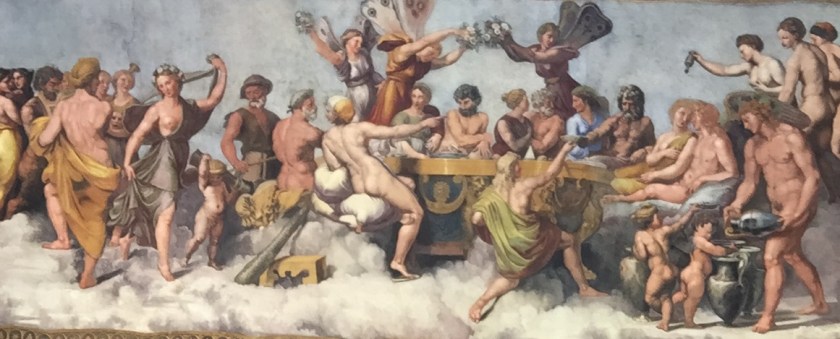
The pleasures of Villa Farnesina

If yesterday’s post – full of gruesome scenes of martyrdom from Santo Stefano Rotondo – turned your stomach, we found the antidote today in the pleasures of Villa Farnesina. Commissioned in 1508 by the wealthy Sienese banker Agostino Chigi and designed by Baldassarre Peruzzi, this suburban villa is at the foot of the hill from the American Academy in Trastevere.  We joined our friend Jeff Cody there for a guided tour and concert of Renaissance music on a beautiful Sunday spring day in Rome. The Wikipedia entry gives a good description of the difference between this suburban villa and an urban palazzo (or palace). Renaissance palaces typically faced onto a street and were decorated versions of defensive castles: rectangular blocks with rusticated ground floors and enclosing a courtyard. This villa, intended to be an airy summer pavilion, presented a side towards the street and was given a U shaped plan with a five bay loggia between the arms. In the original arrangement, the main entrance was through the north facing loggia which was open.  Today, …

At Prayer in Santo Stefano Rotondo

Three churches (part one)

On Andrew’s last full day with us in Rome, he joined Candice and me in visiting three very different churches with widely varying histories, architecture, and art work.  It was a great introduction and send-off for Andrew, as we hoped to whet his appetite for future visits to the city. It turns out that we’ve had two tours, each consisting of visits to three different churches, this week. So I’ve titled this post “Three churches (part one)” and I’ll get to the other three in a later post. The first we saw with Andrew is one of the city’s best-known historic sites and regularly shows up on “must see” lists.  The second was recommended by friends at the academy as a “lovely and troubling space” rolled into one.  And the third was found entirely by accident (which is the way we often find hidden gems). The 12th-century Basilica of San Clemente al Laterano is a minor basilica  that consists of three separate buildings located one on top of the other and dating back to ancient …

Detail from Triumphs and Laments

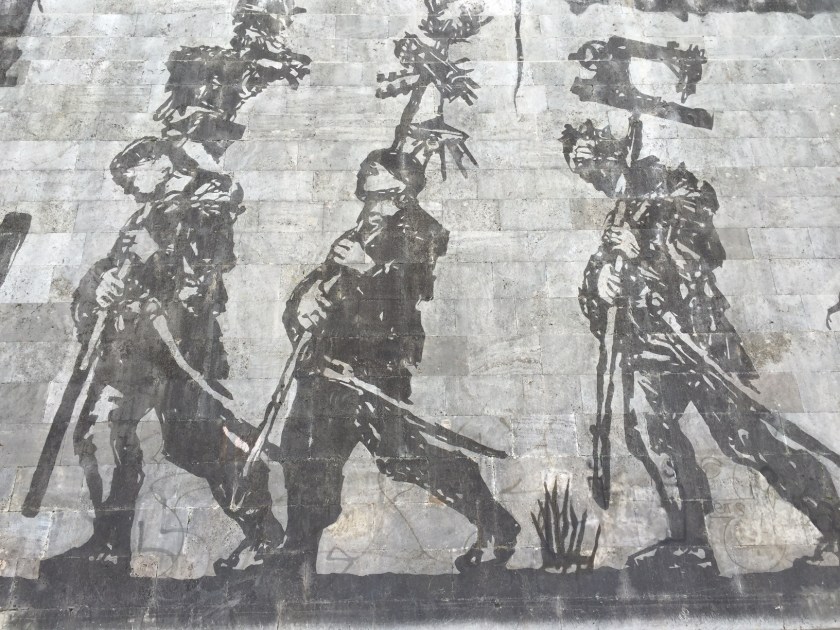
Contemporary art in historic Rome

One of the delights of spending time in the American Academy is having the chance to get to know artists – young, older, new to their craft, and famous – and to see their work through open studios, concerts, readings, and performances. Rome, simply, continues to inspire.  And isn’t that what preservationists mean when we say that we need old places because they provide continuity, serve as part of our memory, enrich our individual and civic identity, and inspire creativity? Candice and I have been privileged to get to know several of these creative and talented individuals who came to Rome to seek inspiration and to inspire others. The first people we met at the Academy four weeks ago were the talented graphic designer Michael Bierut and his wife Dorothy. Michael and I quickly reconnected, realizing that we had worked together on two projects through the years for the National Trust.  It was a treat to attend Michael’s lecture at MAXXI, where he spoke about his work based on his recent book How to use …

Observations From the Road (The “Quick” Edition)

About three weeks ago I realized I was going to have too much material to post from Rome and too little time in my six-week schedule to do it justice. Right now I have one draft written that needs some editing, (fully understanding that many regular readers don’t believe I actually edit this stuff), an entire weekend in Venice that is calling for my attention, visits to amazing historic sites that I want to capture, and so much more that I can barely keep it in my head.  Oh, and I’m trying to meet as many people as I can at the academy, attend lectures and tours, visit places throughout the country, and do some work on my project. But at least I’m not stressed!  That would be very un-sabbatical-like. To help out, I’ll rely on my trusty “Observations From the Road…” formula and will throw out some very quick and unrelated posts to ensure that I don’t lose these thoughts.  As always, these may not be worth seeing the light of day, so feel …

Aspe in St. Cecilia

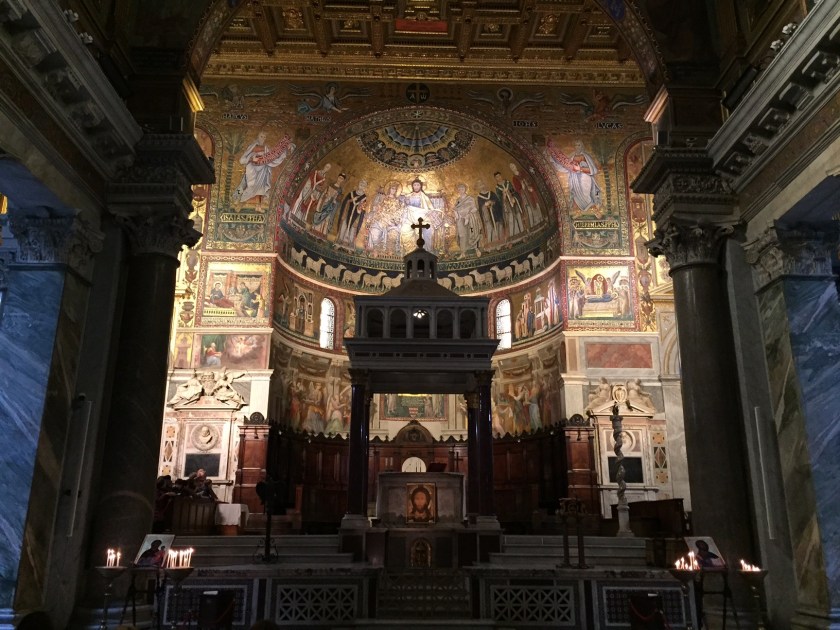
The power of art and place: St. Cecilia in Trastevere

We were directed to the Basilica of St. Cecilia in the Trastevere neighborhood of Rome by two of the more accomplished artists in residence at the American Academy.  When we were talking about the power of place in art, they mentioned having visited this basilica and spoke of its impact.  Candice and I decided to see it for ourselves. Parts of the basilica date from 822, when an earlier church constructed over the ruins of the home of Cecilia, the young Roman woman who was martyred for her faith, was rebuilt. The outside – with a 12th century tower and 1725 facade – do not prepare you for the work inside. Cecilia’s story has to be told to understand the power of this place.  From the website Sacred Destinations: “Cecilia is one of the most popular of Roman saints. She lived in the 3rd century and the first legend of her life was written in the 6th century. A noblewoman from a senatorial family, Cecilia took a personal vow of virginity and pledged her life …

View of Rome from Villa Aurelia

New thinking about old places

Last week, Cristina Puglisi, Deputy Director for Administration at the American Academy in Rome, took a group of architects, preservationists, and landscape architects at the academy on a tour of Villa Aurelia. Cristina — the key staff liaison for the restoration of this villa — had an audience that wanted to delve deeply into the thinking behind the work and decision-making around the building’s preservation, and we all enjoyed the give-and-take during the 90 minute tour. Cristina is an American-trained preservationist who has worked for years in her native Italy.  Her insights into the different approaches to preservation in the two countries was especially enlightening to me as I think about new paths for preservation in the U.S. in the 21st century. She mentioned many of these in her tour, which led me to a follow-up conversation over lunch earlier this week in which she fleshed out several of her comments. For some background, here’s the history of the villa, from the AAR website: “The Villa Aurelia, originally built for Cardinal Girolamo Farnese around 1650, …

Basilica di Santa Maria

Observations from the road: Scenes from Holy Week in Rome

Sorry.  No pope sightings (or even attempts at pope sightings). We have had a relatively low-key Holy Week while in Rome, but that doesn’t mean it hasn’t had its memorable moments. Olive Trees and Palm Sunday:  Our week began last Sunday with a Palm Sunday processional at the neighborhood Basilica di San Pancrazio in Monteverde.  A 6th century basilica that was extensively renovated following Garibaldi’s 1849 attack on Rome, San Pancrazio was a lively place last Sunday. We met about a block away from the basilica and followed priests and musicians through the streets, waving olive branches in place of the palms we see in the United States.  During the service, conducted (of course) entirely in Italian, we only understood the occasional word. But we knew the shape of the liturgy and could follow along without getting lost.  The nave was filled with worshipers, while the aisles were used by parents and nuns to walk or stroll young children throughout the service.  The music was similar to Catholic folk masses in the U.S. these days …

Cars in the Coppede Quarter

Cars, shared streets, and lovable cities

I know I’m in Rome to think (and learn) about architecture and preservation (past and future), but recently my thoughts turned to cars. There’s a connection here.  Trust me. If you need a car in Rome, you can find one.  We’ve taken taxis on several occasions, and from those rides I can attest that there are no shortages of cars on the street.  But the interesting thing — from my perspective — is how the cars and their drivers interact with others who share the street: pedestrians (of which there are many), cyclists, motorcycle riders, street vendors, buskers, and patrons at outdoor cafe tables. Rome’s transportation patterns are somewhere between the very rational (and orderly) Copenhagen model, and the free-for-all that is New Delhi. Probably a little closer to Delhi, truth be told. Traveling in Rome is a dance, and cars are not privileged in the way they are in the United States.  (We have changed our cities and planned our suburbs in a way that deifies cars, instead of supports people.) While there are …

Observations from the Road: (The “We Learn So Much Every Day” Edition)

A couple of quick thoughts about recent days in Italy. Orvieto update – To no one’s surprise, Orvieto (which I wrote about yesterday) is the favorite town of several of our friends and colleagues.  We can see why.  A long-time and dear friend from our days in Staunton, Sally James, wrote to say that Orvieto is her “home away from home!”  In my original post, I didn’t mention the chapel by Fra Angeloco and Luca Signorelli, which is the topic of Sally’s first book, Signorelli and Fra Angelico at Orvieto: Liturgy, Poetry and a Vision of the End Time. The decoration of the Cappella Nuova, commenced by Fra Angelico in 1447 and magnificently completed by Luca Signorelli in 1499 and 1504, displays an awe-inspiring Last Judgement and Apocalypse and, below it, scenes from Dante and classical literature. This was yet another magnificent space in an incredible building full of wonderful art and architecture.  Sally encourages us to look for the next issue of Gesta, probably in April, to see her article on the frescoes of …

Umbrian landscape

Orvieto: A jewel in Umbria

Candice and I decided early in our stay to take a day trip outside of Rome once each week during my sabbatical. A colleague had sent along a blog post on the 10 best day trips from Rome, which whetted our appetite, and with the prospect of seeing one of Italy’s best cathedrals, we jumped on a train last Tuesday to visit the Umbrian hill town of Orvieto. What a marvelous decision! 75 minutes after leaving Rome, we pulled into the Orvieto train station on a beautiful, sunny spring day.  My first thought was about how we would navigate getting up the 984′ rock plateau that serves as the base for the town.  But immediately across from the station was a funicular station, and my spirits soared. Let me pause for a second to say how much I love funiculars (or incline railways).  When we were young, my father (the TVA engineer) use to take us to see old and new engineering projects, and one of my earliest recollections was taking a small funicular to …