All posts filed under: Historic Preservation

Posts about places that matter

Why Should We Care About an International National Trust Movement?

We have just completed a wonderful International Conference of National Trusts here in Dublin—the 13th in the history of the National Trust movement. I suspect that when a small group of Anglophiles gathered together in the 1970s in Scotland for what became the first gathering of the world’s National Trusts, they could not have imagined either the spread of their movement or the diversity of people, countries, issues and models that we have seen this week from among the 200+ delegates in attendance. To read my full post on the wrap-up to the ICNT13, visit the PreservationNation blog. More to come… DJB

Irish History: As Fresh as Today’s News

As part of today’s International Conference of National Trusts, I joined a tour into the countryside to explore a bit of Irish history and see rehabilitation and interpretive efforts at work. Our host for the conference, An Taisce, the National Trust for Ireland, owns a 1748 canal running through Ireland’s valley of the kings along the River Boyne.  The canal is under restoration and we had a chance to meet with the energetic project manager and learn about his work. The lock at the top is where the salt water from the sea meets the fresh water of the river.  The picture below is a historical view from the An Taisce web site of the canal in operation. This important part of the Irish attempt to capitalize on the Industrial Revolution was only one of the sites we visited.  I mentioned earlier in the week about seeing the silver at Christ Church Cathedral donated by King William in honor of his victory in Ireland that solidified his hold on the English throne.  Today, we visited …

Heritage of the World in Trust

Every two years the world’s preservation and heritage conservation community comes together for the International Conference of National Trusts, a wonderful gathering of colleagues and friends working together across the globe to protect, enhance and responsibly enjoy our planet’s fragile heritage.  To read my full post on the opening of ICNT13, check out the PreservationNation blog on the National Trust web site. More to come… DJB

Santiago Calatrava’s Dublin Bridges (And More) By Dawn’s Early Light

I am blessed with two talented children who teach me so much every day.  Claire has an imaginative and artistic eye that she uses to great effect in her photography of buildings and landscapes.  Andrew has been fascinated by architecture since he was a toddler and stood in our hall to carefully run his hand over the curved beaded siding on our wall.  As a preservationist and father, I love talking with them about their passions. So when Andrew texted me on Friday morning to say, “Dad, there are two Santiago Calatrava-designed bridges in Dublin,” I knew they must be special.  I wanted to see them not only based on Andrew’s message, but because I had seen the Spanish-born Calatrava’s Milwaukee Art Museum (a building I’ll be in again in a few weeks) and was intrigued as to  how he handled his designs in this city of bridges. To make a long story short, I left in dawn’s early light this morning and went on a 1 1/2 hour walk, beginning at Calatrava’s James Joyce …

Dublin, By Day and Night

During last evening’s three-hour ringing of the bells at Christ Church Cathedral here in Dublin (apparently, a Friday evening tradition), I looked out the window to focus on the music and noticed the beautiful sunset.  I raced out of the hotel and took a few pictures to capture in my mind the wonderful juxtaposition of the bell ringing and the Irish sunset on the medieval portion of the city. Today was all business, but we had a chance to conduct it in wonderful space.  An Taisce, the National Trust for Ireland, is our host this week and our INTO meeting today was in their headquarters – the old Tailors Hall.  I took a few pictures, including the view out the window from my seat.  I will talk more about the meetings in follow-up posts, but wanted to include the photos of the Hall as a post for today. Enjoy the photographs. More to come… DJB

An Afternoon of Dublin Cathedrals

I arrived in downtown Dublin mid-morning local time with the better part of the day free before my meetings began for the International National Trusts Organisation (INTO).  We’re here because An Taisce, the National Trust for Ireland, is hosting the 13th International Conference of National Trusts. So with the city’s two cathedrals located just steps from my hotel, I awoke from a short nap and headed out to explore these great historic landmarks.  (And as I’m writing this, my connection with the cathedrals continue, as I’m listening to the late afternoon peal of 19 bells from the Christ Church bell tower.) Christ Church Cathedral (pictured at the top of the post) was my first stop.  This is the Anglican-Episcopalian cathedral of the Church of Ireland and it dates from 1030, when Viking Dublin’s first cathedral was built on the site.  The current building took its present shape in 1180, and was extensively remodeled in the 1870s. It is a beautiful fall day in Dublin, so the light was streaming into the building through the stained …

Jane Jacobs, Robert Moses and the Future of the American City

One of the blogs I check on a regular basis is The Edge of the American West. It features a variety of viewpoints, sharp writing, and intelligent discussions on history.  On the about page, the blog features the quote:  History is Philosophy teaching by example. Today there’s a post on the site entitled “I hate the government for making my life absurd” – a quote from urban crusader and preservation heroine Jane Jacobs. The writer is highlighting a new book on the relationship between Jacobs and the New York City power broker Robert Moses, which was featured in the New York Times on Tuesday. Writing in the Times, reviewer Dwight Garner provides the background for the Wrestling With Moses: Moses and Jacobs clashed during the 1950s and ’60s over three of the huge public works projects Moses tried to force on Manhattan. It is hard even to list them now without cringing — or nearly weeping with gratitude that they never came to pass.There was his plan to build a four-lane highway through the middle …

Modernism and baseball stadiums

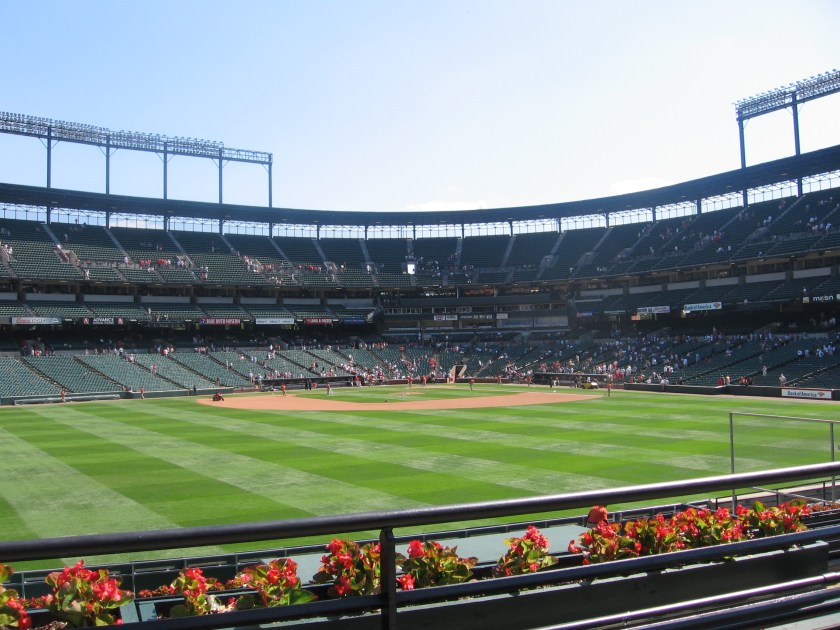
My colleague Dolores recently pointed me towards a springtime blog rant by long-time preservationist – and baseball fan – Clem Labine.  Entitled Hey Nick – Get REAL, the blog goes after New York Times architectural critic Nicolai Ouroussoff for panning the two new baseball stadiums in New York City by saying that “American stadium design has been stuck in a nostalgic funk, with sports franchises recycling the same old images year after year.”  Read it for the writing, if nothing else.  (Clem was the founder of The Old House Journal eons ago and you’ll see his way with the written word.) Camden Yards in Baltimore (photo at the top of the post) began the trend toward throwback stadiums. Having attended many a ballgame there (and in other similarly inspired parks), I agree with Clem that these ballparks work AND give the fans what they want. But my recent trip to Kansas City gave me the chance to visit one of the first of the good modernist sports venues – Kauffman Stadium.  The architects here show …

Northern Ireland Photos

Late last month, Claire and Andrew took a trip to Northern Ireland with their youth group.  While there they walked the wonderful coastline of County Antrim and the Giant’s Causeway; visited sites of the National Trust of England, Wales, and Northern Ireland; met with groups focused on peace and reconciliation; and took lots and lots of photographs. In looking at those photos, my mind went back a decade to my own trip to Northern Ireland for the National Trust for Historic Preservation.  Like the children’s trip, mine was an eye and mind-opening experience.  I recently looked at my diary from that trip and enjoyed reliving my experiences. So I’ll share Andrew’s (color) and Claire’s (black-and-white) photos from June/July 2009, and I’ll share a few diary entries from December 1998. 12/8/98 – I found Crom Castle most interesting.  As we arrived, Irish deer – with huge racks – stared at us from the deer park…had my first Irish whiskey of the trip.  Great for warming chilled bones! 12/8/98 – We have a late afternoon stop at …

Bluegrass Nights at the Ryman

Next week begins the summer Bluegrass Nights at the Ryman series at Nashville’s historic Ryman Auditorium.  Known as the Mother Church of Country Music and the home of the Grand Ole Opry from 1943 through 1974, the Ryman bills this series with the line, “Experience the best in bluegrass on the very stage where bluegrass was born over 60 years ago.”  That would be the evening where Earl Scruggs stepped on stage with Bill Monroe.  Here’s how Richard D. Smith describes that night in Can’t You Hear Me Callin’:  The Life of Bill Monroe: For Earl’s first night on the Opry, Monroe picked out a fast number that would show off the newcomer’s dazzling style – “White House Blues,” an old song recounting the 1901 William McKinley assassination.  It was a perfect selection.  Scruggs stepped up to the microphone with apprehension, knowing that nothing like this had been heard to date on the Opry or even over WSM radio. Use to the banjo as a country comedian’s prop, or hearing it picked or strummed in …