All posts filed under: Historic Preservation

Take Me Home Down Route 66

Just arrived home after a week in Tulsa for the National Preservation Conference.  National Trust staff posted some great updates throughout the week on the PreservationNation.org blog which I recommend.  I did see some great art deco architecture and thought the Gilcrease Museum was a real treasure (check out the amazing Ansel Adams exhibit).  But since I spent the better part of the week in partner and board meetings, I’m not the best judge of all the city had to offer.  So I’ll just post this picture from last evening’s terrific closing party with Asleep at the Wheel and say thanks to Marty, Marcia, Cliff and all our hosts from Oklahoma for a great week. We’ll let Ray Benson and Asleep at the Wheel take us home with a great version of Route 66! More to come… DJB

Will Rogers: Why can’t new public schools be this cool?

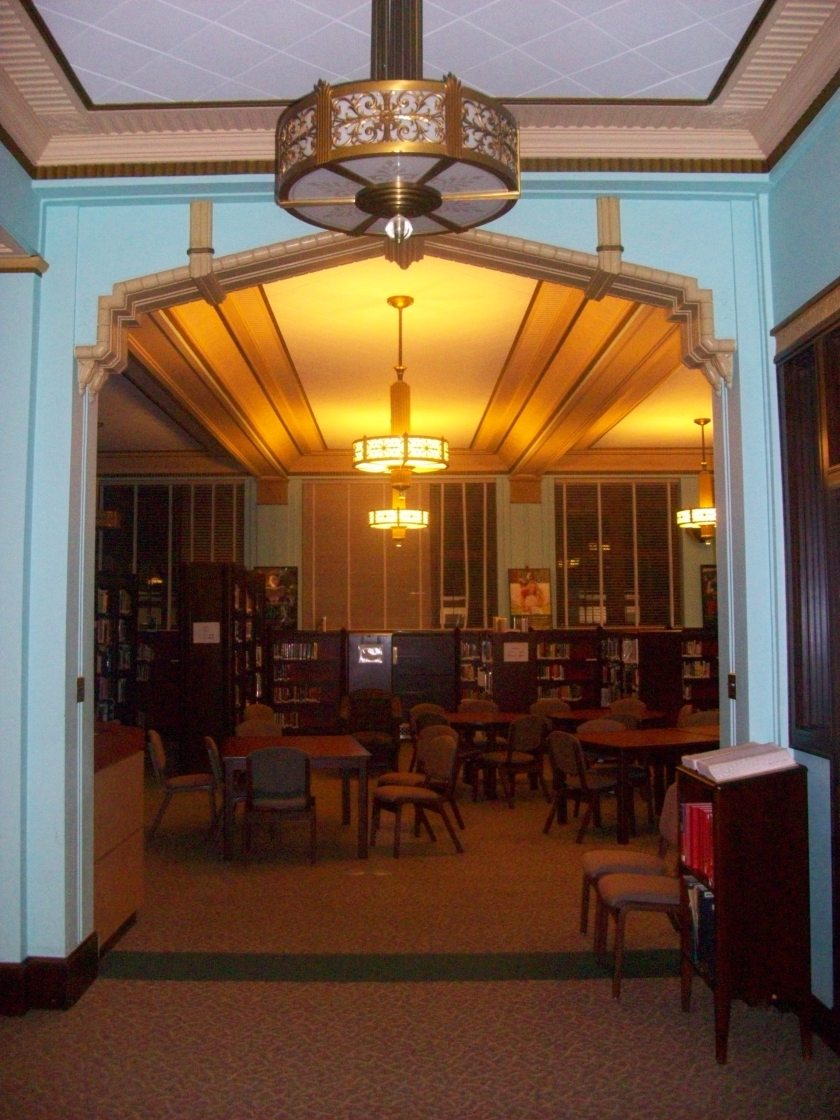
As regular readers know, I’m in Tulsa, Oklahoma, this week for the 2008 National Preservation Conference.  Tonight’s event was in this great building, Will Rogers High School, which reminds us all that public schools weren’t always bland, boring spaces. As we drove through a non-descript neighborhood, my colleagues were doubting that anything of great value could be found in this landscape.  And yet, the moment the school, with its towers rising above the treetops, came into view, it was clear we were in for a treat.  The school was built in 1938 as part of the Public Works Administration (PWA). The auditorium was an Art Deco wonder, the library a pleasant surprise, and the entire building a delight for the eyes which has to be a treat for the discerning and observant student.  I’ve posted a couple of pictures to give you a hint of what we enjoyed. More to come… DJB

An Art Deco masterpiece

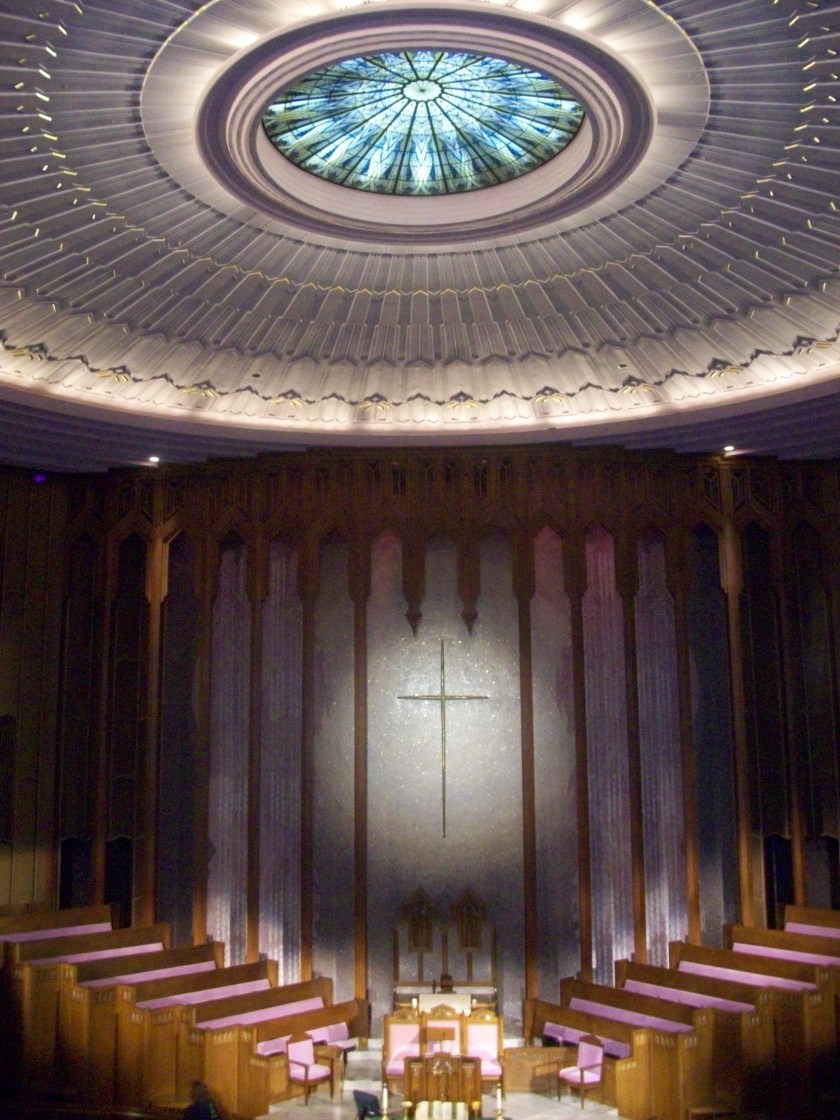
Today’s opening plenary of the National Preservation Conference was held in the spectacular Boston Avenue Church – a National Historic Landmark and Art Deco masterpiece.  Seldom have I been so surprised – and moved – by an interior. The church was built in 1929 and is filled with great detail large and small.  I took numerous pictures of the interior, several of which I’ve posted.  Today has been a gray, rainy day in Tulsa, so the exterior shot doesn’t show off the building at its best.  The stunning setting was a great place to hear the Cherokee Youth Choir, with a group of middle-school and high-school boys and girls who sang three beautiful songs in their native Cherokee. The keynote speaker was Chief Wilma Mankiller of the Cherokee Nation.  She gave a terrific talk about indigenous people, ending with the old Mohawk proverb: It is hard to see the future with tears in your eyes. More to come… DJB

Taking a Look at Tulsa

I’m in Tulsa, Oklahoma for the 2008 National Preservation Conference and took some time this afternoon to become acclimated to my home for the next week. Tulsa is known for its great collection of art deco architecture, and on my way to the TV studio this morning to do a stint on Good Morning Tulsa I drove past the magnificent Boston Avenue Methodist Church.  What a building!  It was highlighted on the cover of the July/August 2008 issue of Preservation magazine in a beautiful photograph and – seen in the morning light – is even more stunning in person.  I hope to take some photos later in the week when we’re there for conference events. In walking around downtown on a beautiful fall day, I found a range of 20th century architecture – not just art deco.  The photo at the top of the post just gives a hint of the range of styles one sees when walking around with an open eye. The newest landmark in Tulsa just opened last August – the Cesar Pelli-designed …

Rosenwald Schools – Invested with Meaning

I’m reading Mary Hoffschwelle’s The Rosenwald Schools of the American South, an inspiring story of a remarkable program.  Mary (Dr. Hoffschwelle) is a friend who happens to be married to Van West – one of my oldest friends from childhood and a professional colleague.  In this 2006 book, she captures the story of the Rosenwald School building project which eventually resulted in the construction of more than 5,000 school buildings for African Americans across the Southern states in the first half of the 20th century. Through its Rosenwald Initiative, the National Trust for Historic Preservation has worked with community groups to try and save the approximately 1,000 remaining Rosenwald schools.  It is very important work.  I spoke at a Rosenwald Schools conference at Fisk University several years ago and was inspired by the many stories of the former students.  I recommend a tour through the initiative’s web site to learn more about these remarkable community centers and what’s being done to preserve them.  I recommend Mary’s book as well. I came across the following in Mary’s …

Get your kicks…with vintage signs from Route 66

On our family’s western travels this summer, we regularly crossed or traveled historic Route 66, as when we visited the beautiful — and beautifully restored — La Posada Hotel in Winslow, Arizona (see photo at the top).  So it was great to learn that the Vintage Roadside folks were traveling to the National Preservation Conference in Tulsa by road trip along historic Route 66 – and blogging about it along the way. Vintage Roadside celebrates the “incredible history and advertising graphics of mom and pop businesses from the 1930s through the early 1960s.”  The folks at Vintage Roadside partner with the National Trust for Historic Preservation, the sponsors of the National Preservation Conference in Tulsa.  You can also read about their trip on the PreservationNation.org website of the National Trust. So take a look at their blog, order one of their great t-shirts with a roadside sign from America’s past, and get your kicks on Route 66. More to come… DJB

Touring Old Salem

Last weekend I had the chance to tour Old Salem while on a work trip to Winston-Salem.  It had been more than 10 years since I visited this historic home of the Moravians in North Carolina, and it was a great way to reconnect to this very historic – and special – place. I knew the day would be a treat when a long-time and dear friend, Martha Hartley, stepped on our bus with her husband Mo to give us the traditional Moravian escort from the boundaries of Wachovia.   Martha and I worked together in preservation many years earlier in Virginia, and I didn’t know she had been tapped as the organizer of the day’s tours.  Mo and Martha traded special insights back and forth about the founding of Salem, the impact of the landscape and waterways, and the practices of the Moravians. After the short organ recital on the David Tannenberg Organ by Janette Fishell (see my earlier post In Praise of Tracker Organs), we spent the rest of the morning touring the town, …

In Praise of Tracker Organs

While traveling on work today in North Carolina, I had an unexpected treat: the chance to hear Bach on a beautiful historic tracker organ that had been restored by some dear friends. First, a bit of background.  As Wikipedia notes, tracker action is a term used in reference to pipe organs that “indicates a mechanical linkage between keys or pedals pressed by the organist and the valve that allows air to flow into pipe(s) of the corresponding note. This is in contrast to electrical or electro-pneumatic actions, which connect the key to the valve through an electrical link or an electrically assisted pneumatic system respectively.” Tracker organs are built the same today as they have been for hundreds of years.  I came to love tracker action organs while living in the Shenandoah Valley and becoming friends with George Taylor and John Boody.  George and John are the founders and principals of the world-renown Taylor & Boody Organbuilders located just outside Staunton, Virginia.   These two men and a small group of craftsmen build and restore some of …

A few more Memphis Highlights

A few quick observations after spending the last 24 hours in Memphis… Any first-time visitor to the city has to make time to see the National Civil Rights Museum.  (Photo at the beginning of the post.)  I spent an hour on a tour with the museum’s curator and the head of Memphis Heritage this morning, and I’ve seldom been as moved as when standing between the restored rooms 306 (Dr. Martin Luther King’s room) and 307, viewing the balcony at the Lorraine Motel.  One listens to excerpts from his final “Mountaintop” speech, delivered the night before, and then looks up to see the boarding house across the street where history changed.  Later in the tour, the view is reversed, as you stand next to James Earl Ray’s bathroom and see the balcony, with the historic cars parked outside beneath a large wreath.  Very powerful. Tracey gave us an insiders tour.  We talked a great deal about the decisions behind the original exhibit and the thinking now underway for future exhibits.  I was pleased to see a section added with the support …

Modernism, ribs, and Wynonna

I’m in Memphis for a talk sponsored by AIA Memphis and Memphis Heritage and I soon discovered that this is a city that surprises. Nothing catches your eye so quickly as the wealth of historic buildings that remain throughout the downtown and surrounding neighborhoods.  In fact, according to Memphis Heritage the city ranks sixth in the nation in the number of properties listed in the National Register of Historic Places. The day began with a tour of a terrific preservation project at the Lincoln American Tower.  In the past ten years, the downtown has seen a number of buildings brought back online by enterprising developers such as Willie Chandler and architect Chooch Pickard.  (The “Chooch” is a high-school nickname for “Choo Choo Charlie.”)  Willie and Chooch gave me a top to bottom tour of the Tower and adjacent Lowenstein Building (see photo at right) which is under renovation right on Main Street.  This mixed-use development has incredible views of the downtown, Court Square Park, and – of course – the Mississippi River.  Downtown housing units …