All posts filed under: Recommended Readings

Beach Reading

Read when it is inconvenient

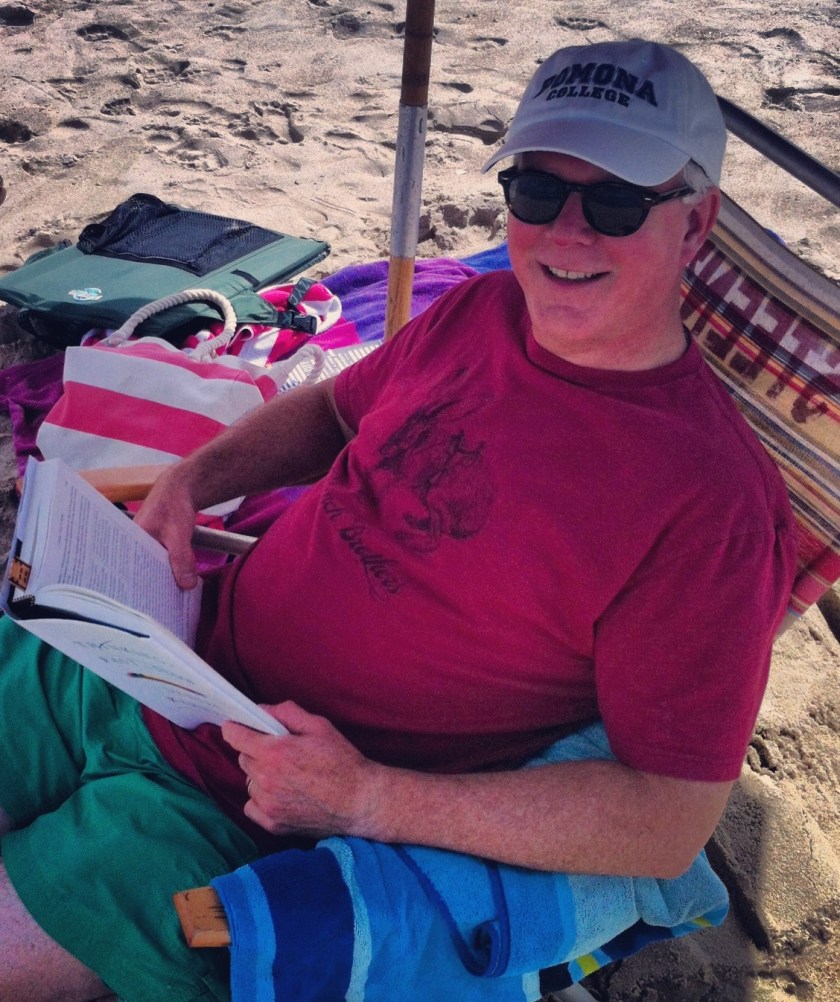
For the past week I’ve been carting around the new Ron Chernow biography of Ulysses Grant.  Chernow (the Pulitzer Prize-winning biographer of George Washington and Alexander Hamilton) and Grant were companions on my cross-country trip last week and they will be companions on my Metro ride for at least another week or two.  (Did I mention that it was 900+ pages?) As the son and brother of librarians, reading has been a large part of my life for more than sixty years.  However, when I returned from sabbatical in 2016 I made a renewed commitment to drop some of the things that had begun taking up large portions of my life (like television) and replace those time-wasters with reading.  (This is one reason I’m pretty clueless when it comes to pop cultural references.)  The most frequent question I get about these Monday blog posts is “how do you find time to read so much.”  Well, I read almost any chance I get.  I read when it is convenient, and perhaps when it isn’t. I recently …

Running Dog Guitar Ought-3

Practicing

Over the holidays I returned to a book I first read some ten years ago.  Glenn Kurtz’s Practicing:  A Musician’s Return to Music is, in its simplest form, a memoir of a young child prodigy on the classical guitar who attends the prestigious New England Conservatory of Music and then quits playing in his early 20s when he realizes he won’t be the next Segovia.  Fifteen years and a career change later, Kurtz returns to the guitar and finds, in the process, a richer love for music. But like all good memoirs, Practicing is so much more than a simple life’s story. Kurtz has been practicing since he was eight years old, but it isn’t until he returns after his hiatus that he begins to understand all the richness of the various aspects of preparing for performance, or life. “Practicing is training; practicing is meditation and therapy. But before any of these, practicing is a story you tell yourself, a bildungsroman, a tale of education and self-realization. For the fingers as for the mind, practicing …

Responding to Anger

Our recent national conversations too often seem soaked in anger. I don’t know anyone who hasn’t become angry.  It is a trait we all seem to share.  What differs is how we respond to anger:  our own and others. Over the winter holiday, our family visited the National Museum of African American History and Culture.  Last Friday, our divisional management team toured the Mere Distinction of Colour exhibit at the National Trust Historic Site Montpelier.  Both cultural institutions showcased the many ways a people oppressed have responded to anger held against them by others as well as that held inside themselves. While at Montpelier, I picked up Michael Eric Dyson’s book Tears We Cannot Stop, a powerful call for recognition and redemption which brims with this Baptist preacher’s righteous anger. In her collection of essays No Time to Spare:  Thinking About What Matters, Ursula K. Le Guin has a two-part piece on anger. The first half looks at public anger, while the second focuses on our private anger.  I thought of the first in the …

Of Love and Loss

It is a special mind that can take a sliver of historical fact and spin out an imaginative and totally unexpected tale of love and loss as intriguing and captivating as in a new novel I recently read. Lincoln in the Bardo (2017) by George Saunders is an at times perplexing yet ultimately satisfying novel. Saunders builds off the fact that in February 1862, just a year into the Civil War, President Abraham Lincoln’s 11-year-old son Willie dies of typhoid fever.  It is known from contemporary accounts that the President went several evenings to stay in the crypt with his son’s body in Georgetown’s Oak Hill Cemetery. Saunders takes that bit of knowledge and turns it into a rich story populated with dozens of spirits who reside in the Bardo, which is the Tibetan Buddhist name for a transition period between death and rebirth.  They are the primary narrators of Lincoln’s visit, which in Saunders’ telling occurs all in one night.  In the first half of the book, the supernatural narration goes on a bit …

Respect is a Decision

We are heading into a season when generations will mix together with more frequency than they may at other times of the year (around a dining table for a holiday meal, for instance.)  While we interact with people of a variety of ages at work, the differences in generations are often much wider when we move outside the office. I was thinking of the clashes that often arise during these gatherings as I was reading a new book of essays by the science fiction writer Ursula K. Le Guin entitled No Time to Spare:  Thinking About What Matters.  Le Guin is 88 and, in this delightful and insightful book, she is not shy about saying she is old.  In fact, don’t suggest otherwise.  As she notes, “Encouragement by denial, however well-meaning, backfires.  Fear is seldom wise and never kind.  Who is it you’re cheering up, anyhow?  Is it really the geezer?” But what got me to thinking about relationships between generations, and the importance respect plays in all of our dealings with each other, is …

Cotton Fields

Telling the full story

For whatever reason, I’ve been plowing through books this fall.  Perhaps that is what a great deal of time on planes and trains does for one’s reading habits.  In any event, this has been my first chance to stop and reflect on these recent readings for the blog, so I’m seizing the moment. One of the two I’ve included here is a very important work, significantly moving the scholarship forward in its field.  The other is a small, family story that nonetheless captures the heart as it tells of a charming, privileged woman who struggled to live as a lesbian in the South of the jazz age.  Both, now a couple of years old, are recommended. Edward Baptist’s The Half Has Never Been Told:  Slavery and the Making of American Capitalism is a troubling and ultimately persuasive 2014 book by historian Edward E. Baptist.  In this ambitious work, Baptist sets out to to demonstrate, in great detail, that slavery was not the pre-modern institution on the verge of extinction with paternalistic slave-owners as claimed by …

History as an antidote to folly

Kurt Vonnegut has called him America’s greatest satirist, while others suggest he was born of Mark Twain and H.L. Mencken.  Lewis Lapham—editor emeritus of Harper’s Magazine, founding editor of Lapham’s Quarterly, and the object of those accolades—is a writer of great eloquence and “lethal wit.”  I was delighted to see that some of the best of Lapham’s essays from the past twenty-five years have now been collected into a new work, Age of Folly:  America Abandons Its Democracy. This is both a wonderful and important book. Lapham surveys the past twenty-five years to make the case that America’s imperial impulses have shaken our democratic principles.  You can agree or disagree with his premise, but his arguments are lucid, thoughtful, and often challenging. In the very first essay, from 1990, Lapham states his case succinctly and directly. “If the American system of government at present seems so patently at odds with its constitutional hopes and purposes, it is not because the practice of democracy no longer serves the interests of the presiding oligarchy (which it never …

Complicity in a Shared Work of the Imagination

Last week I had the privilege of launching the National Trust’s National Treasure campaign for Clayborn Temple, a landmark in the history of the Civil Rights movement.  It was here where Memphis sanitation workers gathered in 1968 and decided to go on strike, marching with their “I Am a Man” signs that became a potent symbol for all that is at stake in the fight for equal justice.  Clayborn Temple was where the leadership of The Rev. Dr. Martin Luther King, Jr. transformed the strike from a local labor dispute into a national issue, effectively tying the sanitation workers’ cause with the national issues of economic justice and racism. It was to Memphis and Clayborn Temple that Dr. King was returning when he was struck down by an assassin’s bullet. To be in that sacred space with more than 150 Memphis residents, young African American poets and musicians, revered spiritual leaders who walked with the sanitation workers, preservationists of all ages, and current members of the workers’ union was an honor and a reminder of …

The Revenge of Analog: Real Things and Why They Matter

I recently finished David Sax’s new book The Revenge of Analog:  Real Things and Why They Matter.  Appropriately, I bought my hard-back copy in that most analog of places—Portland, Oregon’s Powell’s City of Books—the nation’s largest independent bookstore. Sax, a business journalist from Canada, posits that “while digital technology has certainly made life easier, the analog technologies of old can make life more rich and substantial.”  He argues that in today’s digital world, analog is making a surprising comeback.  What are those analog technologies?  Notebooks and paper.  Vinyl records.  Film.  Board games.  (Vintage Game Night at the Woodrow Wilson House, anyone?) He also looks at the comeback of analog “ideas” in areas such as printing, retailing, and education. Some of Sax’s examples strike me as first-world games of the highly educated. However, as I thought about the tactile nature of the pages as I read, I realized that he had an important point about the impact of real things in our lives. About two years ago I stopped purchasing e-books and have returned to buying …