All posts tagged: Acoustic Music

Getting Ready for Merlefest

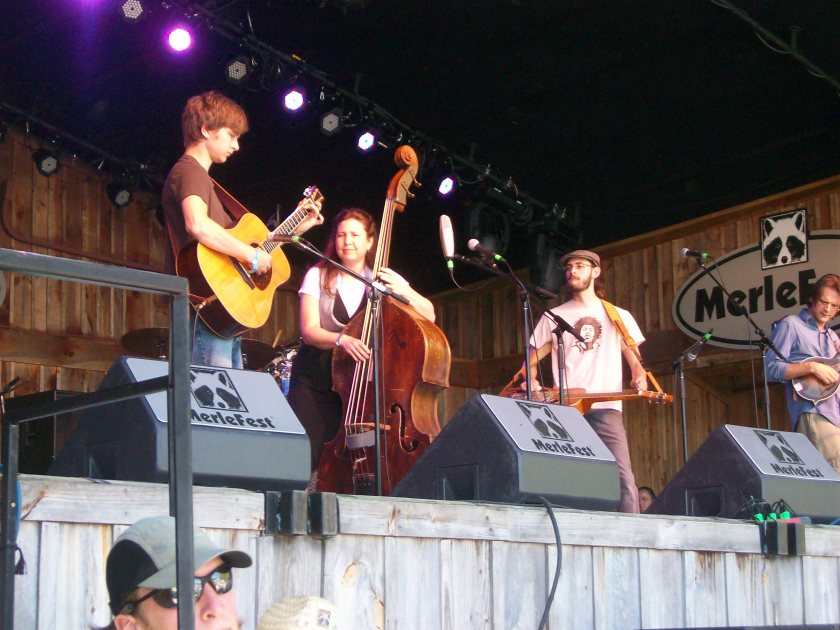
Later this week I’ll head to North Carolina for four days of bluegrass, blues, and Americana music at Merlefest.  I was reviewing the lineup tonight to begin to get a sense of how to schedule my time among the 14 stages.  In the process, I was reminded of recent stories about some of these musicians on More to Come…: Tony Rice Missy Raines and the New Hip Wayne Henderson and Doc Watson Jerry Douglas (with two posts) and the Lovell Sisters. I’ll be adding reviews and updates from Merlefest later this week, so return to find out what’s caught my fancy. More to come… DJB

Nashville Cats

In his 1996 book on the Southernization of America entitled Dixie Rising:  How the South is Shaping American Values, Politics, and Culture, former New York Times Atlanta bureau-chief Peter Applebome compares Charlotte, North Carolina and Nashville, Tennessee.  Much of Applebome’s thesis was turned on its head with the election of 2008.  But one thing he said has always stuck with me and it came back today as I was traveling to New Orleans. In comparing the two cities he notes that Nashville is a lot like Charlotte – except that its major industry is music and not banking.  And that difference makes all the difference in the world. I had a layover today in the Nashville airport.  You have to love a city where the airport has live music (in at least two places, including the food court) AND a photo exhibit by none other than Marty Stuart.  Heck, the musicians could have been employees of the Burger King.  The Lovin’ Spoonful’s Nashville Cats immediately jumped to mind: Well, there’s thirteen hundred and fifty-two guitar …

Good Friday 2009

Good Friday was a day of heightened – and mixed – emotions.  It began with an email from Andrew’s school about the irrational act of a disturbed man that some of the students observed.  In the early evening, Candice and I helped Andrew and Claire’s youth group prepare sandwiches and meals for Grate Patrol.  And while they delivered the sandwiches to the homeless throughout Washington, Candice and I closed out the day with the powerful Good Friday meditation at the National Cathedral. We’ve been around the Washington National Cathedral for years, but I only discovered this Good Friday service a couple of years ago.  It quickly became my favorite. Held in the St. Joseph of Arimethea chapel (photo) – the most appropriate of spaces – the service showcases all that is wonderful about the Cathedral.  The stone and marble combine with the vaults and intimate space to send the music on a magical journey to your ears.  And make no mistake – this is a service made for music. A hauntingly beautiful cello solo – Candice …

Conversation with Fleck (Continued)

On the day after I posted the note about an online conversation between Bela Fleck and Earl Scruggs, our local public radio station – WAMU FM – features an interview with Bela on the Kojo Nnamdi Show.  Bela was there to promote his new album Throw Down the Heart which traces his explorations of the banjo’s roots in Africa.  Click on the link above to listen to the full interview. More to come… DJB

A conversation with Fleck (not Flatt) and Scruggs

Thanks to the wonderful Bluegrass Blog for highlighting a recent online interview between banjo masters Earl Scruggs and Bela Fleck.  Scruggs (photo below) was the inventor of the three-fingered picking style that is integral to the bluegrass sound, and Fleck (photo top) is the banjo innovator who has won 11 Grammy awards and – with his 27 nominations – has the distinction of being nominated in more Grammy categories than any other musician. The interview took place on BMI.com and covers — in just a few short questions — a variety of topics.  Here’s an exchange on their first meeting: BF: Do you remember when John Hartford introduced us by any chance? I’m not expecting you to, but you came over to his place, and he invited me over…I played rhythm guitar, and then at the very end of the session, John said, “Oh, Béla plays a little bit of banjo,” and you said, “Oh, well get it out,” and then I played something for you. I remember, because I thought it was so sweet of …

On the trail of Uncle Dave Macon

Andrew, Claire, and I spent much of today in Readyville, Tennessee, with my brother Joe, sister-in-law Kerry, and their family (more on our visit in a later post).  Joe is an ornamental blacksmith and fellow lover of bluegrass and old-time music.  So it seemed fitting – after a day of playing Old Joe Clark and other tunes with Joe and his son Joseph – that I take Andrew & Claire on an educational trip by hallowed ground:  the burial place of Uncle Dave Macon. Affectionately known as the “Dixie Dew Drop,” Uncle Dave was a vaudeville performer and one of the first stars of the Grand Ole Opry.  He came out of a 19th century performing sensibility, but also was one of the first country musicians to take advantage of the new technology of radio. After his death in 1952, Macon was buried between Murfreesboro and Readyville in the Coleman Cemetery.  A new road to Cannon County now bypasses the cemetery, but I turned off the four lane and went over to the Old Woodbury …

Aereo-Plain

Taking the Steam Powered Aereo Plane to that desert island

The last album in my review of top five albums to take to a desert island may be my all-time favorite.  I’ve long loved John Hartford’s quirky, hippy-bluegrass Aereo-Plain album.   So it was only fitting that last night, as I was returning from a dinner in Nashville with a long-time friend, I turned on Del McCoury’s Hand Picked show on XM Radio’s Bluegrass Junction and what was coming out of the speakers but Steam Powered Aereo Plane.  Damn, Del has great taste in music!  I was reminded all over again of why this album is on my list. What do I love about this album?  Let’s start with the cover. My mother hated this cover when I was a teenager and my wife hates it still.  I loved it so much that I had the father of a high-school friend who was a commercial artist do a charcoal drawing of Hartford with his shaggy beard and aviator glasses.  (My friend Judy’s father had a side business of doing spot-on drawings of photographs from 1970s record albums.)  …

Five Albums for a Desert Island – Sgt. Peppers

There’s not a lot you can add to all the words that have been written about Sgt. Pepper’s Lonely Hearts Club Band.  The Wikipedia entry for the album is one of those that drives people who hate crowd sourcing to rants, because it probably runs longer than the Wikipedia entry for World War II . (I haven’t actually checked that out, but it makes a good line so I’m sticking to it.)  If you want to read about the echo effects, the engineering, the late night recording sessions, even how that great, thunderous E chord at the end of A Day in the Life was produced – you’ll find it all there on Wikipedia.  And that’s just one of countless articles and books written about the Beatles and this music. Sgt. Pepper’s Lonely Hearts Club Band has been a source of endless fascination since it was released, and I was certainly smitten as a young teenager.  This is probably on my list as much for what it represents about my youth as for the album …

Time Out – For More Albums for a Desert Island

This is album #3 that I’d want on my iPod on a desert island (see the earlier two posts below), and it is the only pure jazz album on my list. Growing up, my brother Steve was the jazz fan and my father had always enjoyed Teddy Wilson (one of the two pieces he could play on the piano was “Body and Soul” in the Wilson style.)  I grew up  listening to rock and then gravitated to acoustic folk which led me to bluegrass, Celtic, Americana, blues, and the like.  I wanted to listen to music I could play, and I never stayed with the piano or guitar long enough to be a jazz player.  But I’ve always enjoyed the music and have a healthy sampling on my iPod – everything from a lot of Miles Davis to a lot of Oscar Peterson. Time Out was the first jazz album that really caught my ear, and that’s the reason it is on my top five list.   I was captivated by the changes in time signature and rhythm.  It all …