
Three churches (part two)
Rome is a city of churches. Here are three worth a visit.
Rome is a city of churches. Here are three worth a visit.
I believe it was those sage philosophers Rodgers and Hammerstein* who said, “When the Lord closes a door, somewhere He opens a window.” That describes our Friday in Rome. After seeing the stunning Santa Maria del Popolo in the morning (more on that later), we had planned to take in the Bernini statue The Ecstasy of St. Theresa at Santa Maria della Vittoria and then walk down the street to see Francesco Borromini’s fantastic San Carlo alle Quattro Fontane. Both were closed. Thankfully, I’ve seen San Carlo (and will try to get Candice there tomorrow). But we were disappointed, and the gelato we had after our picnic lunch only partially brought my spirits back. However, as has been our practice, when we walk by a church or open historic building that we haven’t seen before, we’ll ask each other, “Do you want to go in?” More times than not, we’ll say “yes” and head in to find some new hidden gem. We were walking back towards Trastevere when we passed Chiesa di Sant’ Ignazio (the …

Earlier this week Candice and I found time to visit two sites that have taken us at least as far back as the 4th century BCE and up through the 7th century CE. Both were fascinating while serving as good platforms for thinking about historic preservation past and future. On Tuesday, we walked through our neighborhood to get to the Basilica of San Pancrazio, where we had attended Palm Sunday services three weeks ago. We heard a presentation the night before from one of the fellows at the academy on labor practices in the catacombs, and it stirred us to visit the catacombs under the basilica. San Pancrazio’s catacombs are one of the few in Rome that have been consistently visited through the ages. The fact that they were not lost over the centuries has been attributed to the fact that pilgrims from the cult of St. Pancras consistently visited the site throughout the Middle Ages. (Pancras) came to Rome together with his uncle Dionysus after his parents’ death and was decapitated in 304 after …
I absolutely loved Venice. That’s not how I expected to feel following our first trip to the city. For quite some time I’ve been hearing from people connected to all parts of my life (personal, professional, seasoned travelers, first-time visitors), and they inevitably mention the number of tourists, the limited number of “things to see” in the city, the cruise-ship impacts, the obvious effects of climate change, and the food. (If I had a Euro for every time someone said, “You can’t get a bad meal in Rome and you can’t get a good meal in Venice,” I would have enough for at least one good meal in either city!) Our experience was very different. For one of the places on earth that can truly be described as unique, I went to Venice with relatively low expectations. We arrived a week-ago Friday after a three-hour and forty-five-minute trip on the high-speed train. What a luxury! Candice and I stepped out of the terminal and were only a five minute walk from our hotel. Thanks to …
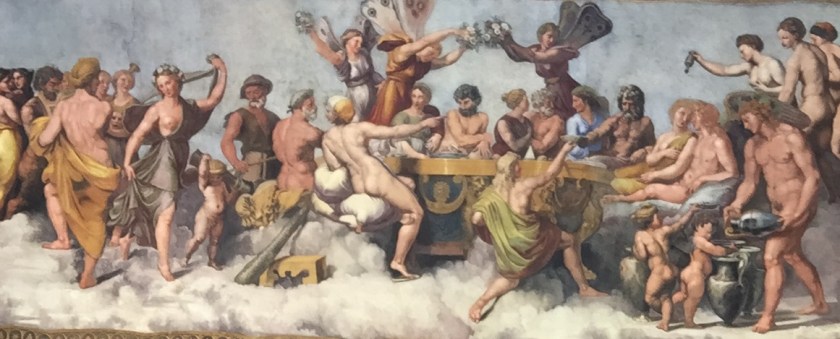
If yesterday’s post – full of gruesome scenes of martyrdom from Santo Stefano Rotondo – turned your stomach, we found the antidote today in the pleasures of Villa Farnesina. Commissioned in 1508 by the wealthy Sienese banker Agostino Chigi and designed by Baldassarre Peruzzi, this suburban villa is at the foot of the hill from the American Academy in Trastevere. We joined our friend Jeff Cody there for a guided tour and concert of Renaissance music on a beautiful Sunday spring day in Rome. The Wikipedia entry gives a good description of the difference between this suburban villa and an urban palazzo (or palace). Renaissance palaces typically faced onto a street and were decorated versions of defensive castles: rectangular blocks with rusticated ground floors and enclosing a courtyard. This villa, intended to be an airy summer pavilion, presented a side towards the street and was given a U shaped plan with a five bay loggia between the arms. In the original arrangement, the main entrance was through the north facing loggia which was open. Today, …

On Andrew’s last full day with us in Rome, he joined Candice and me in visiting three very different churches with widely varying histories, architecture, and art work. It was a great introduction and send-off for Andrew, as we hoped to whet his appetite for future visits to the city. It turns out that we’ve had two tours, each consisting of visits to three different churches, this week. So I’ve titled this post “Three churches (part one)” and I’ll get to the other three in a later post. The first we saw with Andrew is one of the city’s best-known historic sites and regularly shows up on “must see” lists. The second was recommended by friends at the academy as a “lovely and troubling space” rolled into one. And the third was found entirely by accident (which is the way we often find hidden gems). The 12th-century Basilica of San Clemente al Laterano is a minor basilica that consists of three separate buildings located one on top of the other and dating back to ancient …
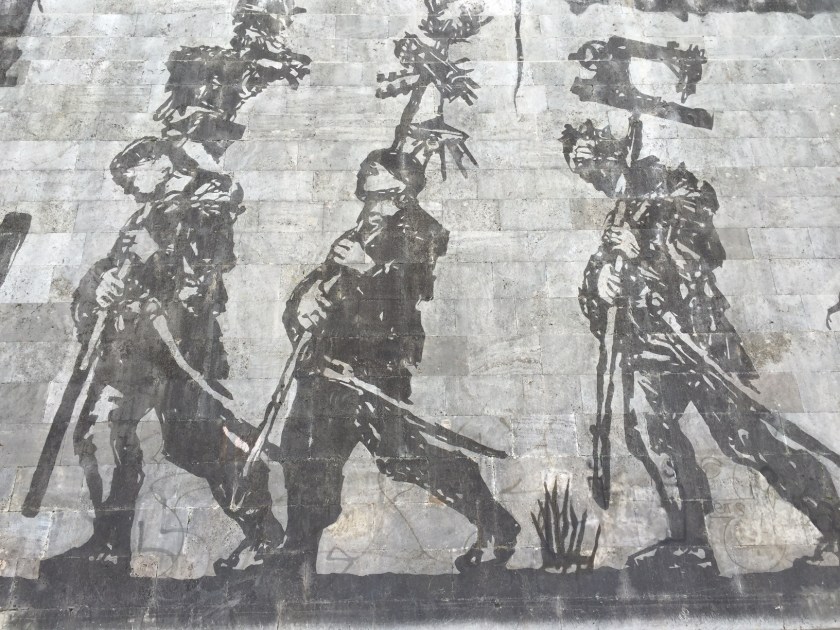
One of the delights of spending time in the American Academy is having the chance to get to know artists – young, older, new to their craft, and famous – and to see their work through open studios, concerts, readings, and performances. Rome, simply, continues to inspire. And isn’t that what preservationists mean when we say that we need old places because they provide continuity, serve as part of our memory, enrich our individual and civic identity, and inspire creativity? Candice and I have been privileged to get to know several of these creative and talented individuals who came to Rome to seek inspiration and to inspire others. The first people we met at the Academy four weeks ago were the talented graphic designer Michael Bierut and his wife Dorothy. Michael and I quickly reconnected, realizing that we had worked together on two projects through the years for the National Trust. It was a treat to attend Michael’s lecture at MAXXI, where he spoke about his work based on his recent book How to use …
About three weeks ago I realized I was going to have too much material to post from Rome and too little time in my six-week schedule to do it justice. Right now I have one draft written that needs some editing, (fully understanding that many regular readers don’t believe I actually edit this stuff), an entire weekend in Venice that is calling for my attention, visits to amazing historic sites that I want to capture, and so much more that I can barely keep it in my head. Oh, and I’m trying to meet as many people as I can at the academy, attend lectures and tours, visit places throughout the country, and do some work on my project. But at least I’m not stressed! That would be very un-sabbatical-like. To help out, I’ll rely on my trusty “Observations From the Road…” formula and will throw out some very quick and unrelated posts to ensure that I don’t lose these thoughts. As always, these may not be worth seeing the light of day, so feel …

We were directed to the Basilica of St. Cecilia in the Trastevere neighborhood of Rome by two of the more accomplished artists in residence at the American Academy. When we were talking about the power of place in art, they mentioned having visited this basilica and spoke of its impact. Candice and I decided to see it for ourselves. Parts of the basilica date from 822, when an earlier church constructed over the ruins of the home of Cecilia, the young Roman woman who was martyred for her faith, was rebuilt. The outside – with a 12th century tower and 1725 facade – do not prepare you for the work inside. Cecilia’s story has to be told to understand the power of this place. From the website Sacred Destinations: “Cecilia is one of the most popular of Roman saints. She lived in the 3rd century and the first legend of her life was written in the 6th century. A noblewoman from a senatorial family, Cecilia took a personal vow of virginity and pledged her life …

Last week, Cristina Puglisi, Deputy Director for Administration at the American Academy in Rome, took a group of architects, preservationists, and landscape architects at the academy on a tour of Villa Aurelia. Cristina — the key staff liaison for the restoration of this villa — had an audience that wanted to delve deeply into the thinking behind the work and decision-making around the building’s preservation, and we all enjoyed the give-and-take during the 90 minute tour. Cristina is an American-trained preservationist who has worked for years in her native Italy. Her insights into the different approaches to preservation in the two countries was especially enlightening to me as I think about new paths for preservation in the U.S. in the 21st century. She mentioned many of these in her tour, which led me to a follow-up conversation over lunch earlier this week in which she fleshed out several of her comments. For some background, here’s the history of the villa, from the AAR website: “The Villa Aurelia, originally built for Cardinal Girolamo Farnese around 1650, …
 MORE TO COME...