
An uneven yet ultimately useful look at how we learn to be brave by Bishop Mariann Budde.
Writing a book about personal lessons learned in how one becomes brave takes a great deal of, well, courage. Or hutzpah. Skill or delusion. The writer has either been told what they are doing is brave, or they feel that way about themselves based on . . . something. It is a journey fraught with danger.
It is not surprising that the Episcopal Bishop of Washington has tackled this subject. She has been in the news in recent years for taking bold—yes, even courageous—stands. And although there are missteps along the way, what she has produced is ultimately useful, if uneven.
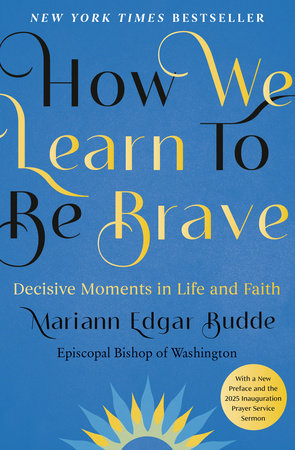
How We Learn to Be Brave: Decisive Moments in Life and Faith (2023 with a new preface and the 2025 Inauguration Prayer Service) by Mariann Edgar Budde opens with a description of the events on Lafayette Square on June 1, 2020 and concludes with the full sermon from the January 21, 2025 Inauguration Prayer Service. Both events were pivotal moments in the life of the nation and the Episcopal Diocese of Washington. Both involved the bishop and the president. In between those two flashpoints, Bishop Mariann * takes the reader through seven lessons taken from her life and others that helped her navigate these and many other decisive moments. She begins, appropriately, with taking the first step. Deciding to go. She ends with the virtue of perseverance. Picking yourself up after the inevitable fall and placing one foot in front of the other.
The early chapters on decisions to go or stay were uneven at best. There are a few long stories, such as one about Eleanor Roosevelt, that either don’t really resonate or are imperfect fits for the subject matter. Her personal recollections from childhood through her time in ministry are much more relatable. She gains her footing when she moves into chapters on what makes us start on a journey and how we face challenges not of our own choosing. I found her thoughts on dealing with suffering—tending to the weakness in our lives and in the world while surrounding those areas with strength—to be personally affirming. Her final chapter on the hidden virtue of perseverance, beginning with examples from the life of Secretary of State Madeleine Albright, tied her thoughts together nicely. The epigraph was a timely reminder.
“And when you get down to it . . . that’s the only purpose grand enough for a human life. Not just to love—but to persist in love.”
Sue Monk Kidd
Full disclaimer: I am an Episcopalian and a member of the Diocese of Washington. Bishop Mariann is my bishop. While I would not say that I know her well, I have had more than a few personal and congregational encounters with the bishop since 2011. Some have been inspiring. Not all have been pleasant. From my personal perspective I found one set of interactions between the bishop and our parish based not so much on bravery and courage but more on expediency and a desire to avoid making the hard call. That’s my perspective and it isn’t shared by all. Bishop Mariann did later return to publicly address the shortfalls in her actions, which took courage.
On the other hand, I have supported her work to speak out for the marginalized in our country on the public stage, which puts her at odds with our current president. I think that’s a key role for a faith leader in troubled times. Again, not everyone will agree with me.
Bishop Mariann is human. Like all humans she has aspirations and failures. I believe this work would be more successful with more joy thrown into the mix. Nonetheless, she has written her book, one that speaks to the many aspects of what it means to persevere in having courage, sometimes in spite of the evidence in front of us.
More to come . . .
DJB
*In the tradition of our church, I always call her Bishop Mariann or occasionally Bishop Budde. I just want to clarify why I don’t simply use her last name in this review, as would be my normal practice.
Photo by Armand Khoury on Unsplash


Pingback: Observations from . . . May 2026 | MORE TO COME...