
Reading Nancy Lemann’s “The Ritz of the Bayou”—her coverage of the 1980s corruption trial of Louisiana Governor Edwin Edwards—proved to be an inspired choice in the last days of a chaotic midterm election season.
I am putting the final touches on this post while watching the early returns from Tuesday’s midterm elections. In Sunday’s print edition, the New York Times editorial board asked “Has America Finally Had Enough of Trump?” The flagrant and self-serving corruption, the moral collapse of key elements of our government, the incessant lying. It never stops with this guy, his crime family, and his enablers.
The voters I am pleased to say made their thoughts very clear.
Ours is not a new problem, just one of unprecedented scale. Today’s conman may be more prominent and more nefarious than most but political corruption is as old as the nation.
Louisiana—where the two great enemies are “boredom and lack of style”—has its own special breed of corruption. Take the lofty architecture of the capitol, for instance, which “describes a megalomaniac grandeur not seen in most state legislatures. It is indeed the work of a megalomaniac, Huey Long.”
Then there is the story of the Pope who was scheduled to come to New Orleans.
“A local columnist joked that in the morning the Pope would hear the Governor’s confession; then he would go to a luncheon. Then he would hear the Governor’s confession; then he would go to dinner. Then he would hear the Governor’s confession; etc. No matter how long he listened, he could not hear the Governor’s whole confession, as it would take too long.”
It was my good fortune at this time of national turmoil to be reading an account of the 1985 racketeering, fraud, and bribery trial of Louisiana Governor Edwin Edwards. The cultural critic James Wolcott described the book’s author—a Louisiana native—as “a mixologist of mood and ardor” who produced her only major piece of non-fiction with this work. In the process this lovely, witty, nutty voice showed herself to be “an unrivaled, unlicensed detective in the art of ‘reading the room,’ the roving mistress of vibes.”
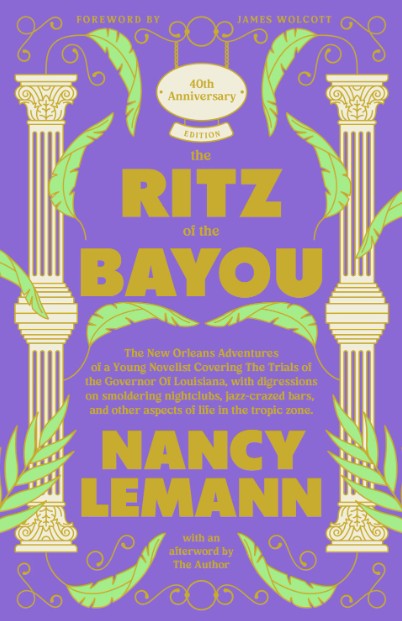
The Ritz of the Bayou: The New Orleans Adventures of a Young Novelist Covering the Trials of the Governor of Louisiana, with digressions on smoldering nightclubs, jazz-crazed bars, and other aspects of life in the tropic zone (1987; 40th anniversary edition republished in 2026) by Nancy Lemann began life as a long-form article commissioned by Vanity Fair‘s legendary editor Tina Brown. When Brown killed the piece in part because it contained little or no actual reporting on “the facts of the case,” Lemann and Knopf editor Gordon Lish saved it from oblivion by reworking the article into a book. A book that Lish knew “had no prayer of commercial success.” Yet the writing—oh that meandering, perceptive, atmospheric writing—was too good to let die. And now, 40 years later, Hub City Press has re-published this work about, nominally, a trial of political corruption, and released it into our own era of politics gone much too far off the rails. It was the balm I needed to read this week.
Lemann sets the stage by introducing the reader to Baton Rouge in 1985. The bullet holes from the assassination of Huey Long are in the walls outside the office of the Speaker of the House in that capitol built on hubris. It is a strange place to come seeking the truth.
“The truth, in the end, I think, is not always to be found in a courtroom, but a great deal of human frailty is. There is a lot of human frailty floating around . . . It is not that I advocate human frailty, but I had never seen so much of it, all at once, and it was a sort of breathtaking spectacle.”
Lemann looks at the courtroom scene in the Edwards case and writes, “My heart was back in business when I saw all that human frailty.”
This was a complicated trial and Lemann does minimal work to let us know about the mostly unforgettable group of lawyers. She is taken, however, with Jim Neal who is representing the Governor in this case and who “employed the Aw Shucks mode of address” to the jurors. And she is especially drawn to the “drawling white-haired gent of seventy called Camille Gravel, a defense lawyer for the Governor, (who) was to me perhaps the hero of the courtroom.” He does not have a law degree, “a not uncommon lack in his day,” and yet he was considered to be the best lawyer on the case. Lemann is smitten.
We are quickly brought into the drawn-out jury selection process and it is clear that this will take time, which Lemann relishes. The judge asks the initial hundred people in the jury pool if a long trial would cause them hardships and “about seventy percent of them lined up to make their lame excuses to the judge.” Everything from “my daughter is sick” to “I’m sick.”
“I think my nephew might know the Governor.”
“I think I might know him, too.”
“‘We all do,’ the judge finally said, wearily.”
The defense lawyers also ask questions to determine the intellect of the prospective jurors. Lemann notes that many of the jurors exhibited “a good deal of intellectual confusion” under questioning, “nor were the prospective jurors a shining testament to the quality of education in Louisiana.” As one hears so often in the South: “Well, at least we’re not Mississippi.” And when the jury selection is described for the second trial (after the first ended in a mistrial), “reporters were saying that this jury made the last jury look like Rhodes scholars.”
But it is the downtrodden and uneducated who have traditionally been the Governor’s supporters, so the defense lawyers knew what they were doing. When a “society juror” delivered his views about the Long tradition in Louisiana he is swiftly disqualified. “It’s his business what he do,” was the answer given by jurors who were accepted. Or “I go to the racetrack, too.”
“The society juror was swiftly disqualified, the downtrodden machine operator was put in his place, and the attitude of the jury chosen was: It’s his business what he do.
A series of jubilant parties broke out in New Orleans at this juncture.”
The quality of the reporters covering the trial is another recurring theme for Lemann, and we often meet them in the bar of the Lafayette Hotel in New Orleans, near the courthouse. One stormy night, two reporters sat here hoping that the Governor’s lawyers would come down for the cocktail hour.
“One was a Yankee and the other a Southerner, but both were covering the South, one for a newspaper above the Mason-Dixon line, and the other for one below. Theirs were the only two newspapers in the country whose Southern bureau is to be found in New Orleans. The Southern Correspondents Assoc., comprised of this lonely band of two, had been formed some months before on a stormy night in Biloxi, Mississippi.”
And—it can only happen in New Orleans—the Governor’s nephew who is on trial for benefiting from the corruption around his uncle is described as “fraud defendant by day, cocktail bar pianist by night, professor of classical religion in Massachusetts ordinarily (this fellow is a jack-of-all-trades, and an unlikely assortment.)” He is “staying at a local hotel free of charge in return for his service at the piano bar.”
There is a trial going on, but the actual arguments—especially those of the prosecutor—don’t excite Lemann as much as the “smoldering nightclubs, jazz-crazed bars” and other diversions included in the subtitle that Wolcott likens to “some 18th century picaresque novel.” She summarizes the basic racketeering charges in a little over two pages. However, what really interests her are the defendants who cannot stop making jokes (a Southern trait). There may be a dark side, “a lot of human condition” in the courtroom, but “the air they breathed was comical. They could not contain their good spirits.” Lemann speculates that their steadfast refusal “to admit the slightest shred of guilt, or to be anything but jolly” was the very theme of their defense.
The book is written in short snippets, which makes it an easy read. Looking back on it forty years later, the author admits,
“The style obscured the substance—or rather the style was the substance. And it isn’t boring. Also it’s pretty funny.”
In a new afterword, Lemann notes that her brother—a journalist—correctly predicted that journalists wouldn’t like The Ritz of the Bayou. But the assignment “to cover the trial of the wily Governor and spend what turned out to be almost a year back in my beloved New Orleans” was irresistible. And she, in her own way, stayed in her lane and didn’t veer over into journalism. Which makes this such a wonderful account.
She ends the afterword where I began: contrasting this trial forty years ago with current events. And Lemann definitely has a soft spot for Edwin Edwards.
“Unlike his current conman counterpart (whose specter haunts my reading of this book forty years after it was written), the Governor was born in a shack with no electricity or water in the middle of nowhere. From there he made his way. His shenanigans seem more embarrassing than demonically destructive. Maybe it was the smaller stage, a matter of proportion. Or maybe he just had charm, a huge advantage and a product of actual intelligence—things which the man on the grander scale lacks.”
As I wrote in my review of Lives of the Saints (her first novel, recently republished by the New York Review of Books), Nancy Lemann is having a renaissance some 40 years after her debut. In this time of chaos and darkness, do yourself a favor and dip into one or more of Lemann’s works to discover her singular, lovely, nutty, witty, melancholy and poignant outlook on life.
“Nuts,” as the narrator asserts in Lives of the Saints, make “life worth living.”
More to come . . .
DJB
Photo by Declan Sun on Unsplash

