
Americans of all political stripes, in all regions of the country, rose up last Tuesday with a voice “too big to rig” to reject rampant corruption, smug oligarchy, the politics of fear, racial hatred, immigrant bashing, Christian nationalism, and a failed ideology that said some people are better than others. It was a glorious thing to behold.
As I was watching the election returns come in on Tuesday evening, my historian’s mind kept returning to Fannie Lou Hamer. Pauli Murray. Barbara Jordan. Stacey Abrams. These Black women, leaders during different eras of the movement for equal rights for all Americans, put in the long, hard, often unnoticed and usually underappreciated work to ensure that everyone has a voice in the future of America.
And “I woke up this morning with my mind stayed on freedom” is as good a description as any of how many of us felt as the returns came in.
I thought of these Black women—Hamer, Murray, Jordan, and Abrams—when Governor-elect Keisha Lance Bottoms was elected to become the first Black woman to serve as governor in U.S. history. She joined seven other Black women in Georgia who won major races on Tuesday night.
Of Georgia’s eight executive offices, seven of them will now be held by Black women. Just let that sink in.

It, of course, didn’t stop there. As Heather Cox Richardson recorded in her Letters from an American newsletter this morning:
“The topline races don’t tell the whole story. Voters elected Democrats up and down the ballot. In Texas, the most prominent example of this phenomenon, Democratic senatorial candidate James Talarico won by about 12 points. Democratic gubernatorial candidate Gina Hinojosa won by 7 points. Voters flipped two congressional seats in districts Trump won by at least 14 points in 2024. Voters elected a Democratic attorney general and four Democratic supreme court justices, and they flipped control of the lower chamber of the legislature.
“Many of the races across the country were not close. Some races flipped by double digits from the margins of 2024. Some flips were as high as 20, 30, or even 40 percent. Observers called the results ‘seismic’ and ‘jaw-dropping,’ not just a blue wave but a ‘tsunami.’ . . .
“In New Hampshire, voters elected Chris Pappas to be the Senate’s first openly gay member. In Texas, voters elected Gina Hinojosa to be the state’s first Latina governor and the state’s first Democratic governor in more than 30 years. In New Mexico, voters elected former Interior secretary Deb Haaland to be the nation’s first female Indigenous governor. Voters in Minnesota sent Ojibwe Peggy Flanagan to the Senate. In Michigan, voters elected Abdul El-Sayed, the nation’s first Muslim senator. Voters in Ohio sent Brian Poindexter, a union ironworker, to the House of Representatives and returned Sherrod Brown, known for his defense of unions, to the Senate.”
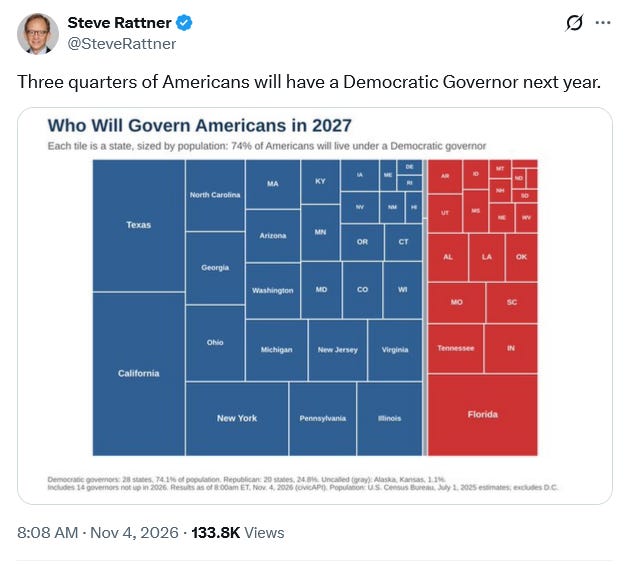
Simon Rosenberg pointed out Steve Rattner’s tweet that three-quarters of Americans will have a Democratic governor next year. Rosenberg ruminates on just “how much power Democrats have been given by the American people all across the country through this historic, transformative election.”
And there is a chance for more. Democratic Senate candidate Scott Colom is ahead of the Republican incumbent in Mississippi in a race that may come down to a few hundred votes. If he wins, Colom will be the first Black senator from Mississippi since Reconstruction. He’s already won the award for best political ad of the campaign.
WE STAND ON THE SHOULDERS OF GIANTS
The seismic change we saw throughout the South, and indeed across the nation, doesn’t happen without Fannie Lou Hamer, the 20th and last child of sharecroppers in Mississippi. Her bio is full of leadership roles and “firsts” including co-founder of the National Women’s Political Caucus, an organization created to recruit, train, and support women of all races who wish to seek election to government office. We’re going to have more than 100 women in the new Congress in 2027.
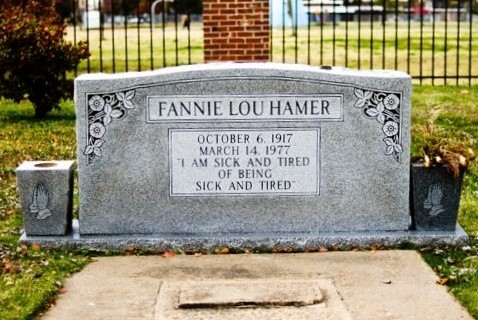
Hamer’s epitaph famously reads, “I am sick and tired of being sick and tired.” Tuesday, Americans had that same sentiment in mind as they voted out the scoundrels.
The times they are a-changing.
The seismic change doesn’t happen without Pauli Murray, African American member of the LGBTQ community, Civil Rights and Women’s Rights activist, the lawyer responsible for producing what Justice Thurgood Marshall called “the Bible of Civil Rights law,” a poet and writer, the first female African American Episcopal priest, and an Episcopal saint. Her legal writing famously inspired Justice Ruth Bader Ginsberg.
The seismic change doesn’t happen without Barbara Jordan, the first African American elected to the Texas Senate after Reconstruction, the first southern black female elected to the United States House of Representatives, a key member of the House Committee investigating Watergate, and the first African-American woman to deliver the keynote address at a Democratic National Convention. The great Molly Ivins wrote of Jordan,
“Her role as a role model may have been her most important. One little black girl used to walk by Jordan’s home every day on her way to school and think, ‘Barbara Jordan grew up right here, too.’ Today Ruth Simmons is president of Smith College.” (Written before Ruth Simmons became the president of Brown University.)
The seismic change doesn’t happen without Stacey Abrams, who ran for Governor of Georgia herself in 2018 and—even more importantly—put together a movement to turn red states into blue. The founder of Fair Fight Action, Abrams turned Georgia into a competitive state based on democratic principles, dreams, and good, old-fashioned hard work. In How to Turn Your Red State Blue, she made the case in 2021 that Georgia, Virginia, and Arizona are leaders in what can happen across the Sun Belt.
“Georgians deserved better, so we devised and began executing a 10-year plan to transform Georgia into a battleground state….Years of planning, testing, innovating, sustained investment and organizing yielded the record-breaking results we knew they could and should.”
There were and are so many more individuals and organizations—both past and present—who worked to make Tuesday’s change possible. In the Latino community, groups such as LULAC have been working for change for almost a century.
Asked if the Democrats would focus on costs or corruption, Senator Rafael Warnock of Georgia told CNN that the Democrats could “walk and chew gum at the same time.” Great answer. Don’t let the corporate media or Republicans frame the task that needs to be accomplished.
The corporate media will try and explain away this change. David Brooks will pretend that he’s never been part of the problem. Even so-called progressive voices will suggest the task before us is too large and we must go slow. But with 90 percent of voters listing corruption as their top concern, it is time for Democrats to be “ruthless”—to use former VP Kamala Harris’ term—in using the power they have to fight those who want to cling to the old system. Fair, yes, but with focus and determination.
Let’s wrap this up with a song that describes the feeling many had after Tuesday night. Mavis Staples and Aretha Franklin bring together two of the greatest and most powerful Soul and Rhythm & Blues voices not just of their generation, but of all time, to sing the gospel tune Oh Happy Day. Gospel has always been a key part of the freedom movement’s soundtrack. And for fun, check out the interplay between these two amazing talents at about the 1:50 segment and then again at 4:00. Good gawd!
Americans can do this hard thing . . . especially since we’re sick and tired of being sick and tired.
Now we all must roll up our sleeves and continue the work.
More to come . . .
DJB
Photo by William Veitch on Unsplash

