Latest Posts

COVID-19 Claims the Life of the Last Surviving Monuments Woman

monuments-men-600x400
Motoko Fujishiro Huthwaite (center) at Congressional Gold Medal Ceremony for Monuments Men and Monuments Women

Motoko Fujishiro Huthwaite had — by any account — an amazing life.

Born in Boston on August 24, 1927 to Japanese citizens, her father was a prominent dentist and professor at Harvard. As noted on the Monuments Men Foundation website:

“The family was befriended by Langdon Warner, the legendary scholar of Asian art and future Monuments Man in Japan following the end of World War II. The Fujishiro household became the center of the Japanese community in Cambridge, Massachusetts. Japanese students, professors, and scholars from the many universities surrounding Boston would flock to parties expertly hosted by Motoko’s mother.”

She and her mother and brother were forced to relocate to Japan following the attack on Pearl Harbor, however, while her father was arrested for espionage and put into an internment camp. He later returned to Tokyo a broken man. Motoko survived the war and became one of 27 women who worked for the Arts and Monuments Commission — popularly known as the Monuments Men. After the war, she reinstated her United States citizenship, lived in both the U.S. and Japan, served as John D. Rockefeller III’s personal secretary on his trips to Japan, and had a rich and rewarding life.

Motoko Fujishiro Huthwaite died of COVID-19, on May 4th. As Robert M. Edsel, Chairman of the Monuments Men Foundation says in his tribute to Motoko,

“It is no small irony that this new war the world is waging against COVID-19 is taking place exactly seventy-five years after the end of the last world war, and that the people who are most susceptible are the heroes whose sacrifices helped build the world and all its freedoms that we enjoy today. To those who, shamefully, say, ‘Well, they were old; they would have died soon anyway,’ I have this response: ‘You have never known, as we have, the mettle and dignity of these aged warriors. Their loss is society’s loss. Their loss is your loss, for they take with them knowledge and virtue our nation, in fact the world, needs now more than ever. They are our nation’s treasures, and we should protect them accordingly.’”

Thank you for your service to the country and the cultural heritage of the world, Motoko Fujishiro Huthwaite. May you rest in peace.

More to come.

DJB

Belonging

Puzzle Image by Clker-Free-Vector Images from Pixabay

During this pandemic, many of us are feeling vulnerable. Some may be wondering if or where we belong in a world that has dramatically changed.

Brené Brown says that our belonging to each other can’t be lost, but it can be forgotten. She came to understand the simple yet profound answer to the question of the difference between fitting in and belonging out of a conversation with a group of middle school students. “Fitting in is when you want to be a part of something” they explained. “Belonging is when others want you.”

With my background, Brené Brown’s thoughts on vulnerability and belonging led me to think about history, storytelling, and our use of selective memory to keep others out of our narrative, to ensure they don’t belong. If we confront our feelings during this pandemic, we may come to realize the ways that we have made others feel vulnerable in the past, perhaps by omitting or erasing their stories as if they don’t belong.

History isn’t what happened. It is a story about what happened. Those stories are often intertwined with place. In the study of history we learn that the one who tells the story controls the narrative. Whether intentionally or not, the storyteller may omit key details or confuse the context. Thanks to selective memory, a richer, layered history — someone’s story — is erased and forgotten.

All of a sudden, they don’t belong.

I was thinking of forgotten or erased history and the idea of belonging when considering the origin story of my wife’s family. Everyone has an origin story and many revolve around places. But what happens when someone erases you out of the story?

A cousin sent my wife, Candice, an article entitled Once More to the Old Barn about the indoor training facility for runners at Lincroft, New Jersey’s Christian Brothers Academy (CBA). The training facility is in an oval barn, or galloping shed, constructed in 1926 by the Whitney family of New York at their Greentree Stable farm. This unusual structure provided a space for the thoroughbred racehorses to train during the brutal winter months. CBA bought the property in 1958. And just like the racehorses, the runners at CBA found that having an indoor training facility led to championship outcomes.

So far, so good. The problem is that CBA, in its online history and in stories like the one above, glosses over the fact that the school did not buy the farm from the Whitneys. And why not? Donors and alumni will want to hear of the school’s connection to a wealthy and famous family, and the Whitneys did build the oval barn. CBA also mentions that the well-known cardiologist and running guru George Sheehan was a key factor in ensuring the sale took place. That story, however, leaves out a family that has meaning in our personal history, as well as the reason that Dr. Sheehan had connections to this particular property. That family belongs in the story.

The farm where CBA now sits was known at the time of the 1958 sale as JC Farms. Candice’s maternal grandfather, Charles Valentine Holsey (the C in the name), along with his oldest son, Joseph Holsey (the J), bought the farm in 1949 from a Mrs. Sherman, who had purchased it from the Whitney family. Mrs. Sherman did not retain ownership for long. As a Jew, she felt unwelcomed in the Lincroft community, so she sold the property to the Holseys.* JC Farms remained in the Holsey family for almost a decade until it was sold to CBA. Most importantly from our personal history, it is where my future father-in-law met the young woman who would become his wife, my wife’s mother, and my mother-in-law.

The Holseys — including a young Irene Ann Holsey — lived at JC Farms, where they stabled and trained their own horses. They would also rent out stables for others looking to race at nearby Monmouth Park when the track’s stables were full. One of the horsemen who came looking for space was Joseph J. Colando of Point-of-View Farm in Yardley, Pennsylvania, along with his son Andrew, a young equine veterinarian recently graduated from the University of Pennsylvania. Dr. Colando was training his father’s horses, including the improbably named Uncle Miltie, and they rented stables at JC Farms so their horses could run at Monmouth Park. Dr. Colando met Irene Holsey while training at the farm and in 1950 they were married. Candice was born in 1951, the year Uncle Miltie was an early Kentucky Derby favorite. LIFE magazine took pictures of the horse in anticipation of a significant Derby-related story.** But Uncle Miltie came up sore, finished 8th in the Wood Memorial, and was subsequently pulled from the Derby field.

Candice has fond memories of JC Farms as a child, and we have heirlooms that date to the family’s ownership. And it was the Holsey connection that brings Dr. Sheehan into this story. His sister, Lorretto Sheehan, married William Holsey and they were known to my wife and all the family as Uncle Billy and Aunt Honey. Both were full of life, and I fondly remember Billy and Honey dancing the night away at our wedding. George Sheehan — it turns out — very likely knew of the property through the Holsey family.

I had the same feeling of erasure of history with a house connected to my family. When the Heritage Foundation in Franklin, Tennessee bought a house on Second Avenue just before it was to be demolished, they recognized it as the Bearden-Brown House. Bearden was my grandmother’s maiden name and she married George Brown. They lived here for a number of years. It is the house in Franklin where I went to visit my grandparents until my grandmother came to live with us several years after Granddaddy died. But the family that bought it, and did a wonderful job of restoration, decided they wanted to add their name to the house…so they just dropped the Brown and suddenly it became the Bearden Robertson House. Just like that, decades of Brown-family connections to the property disappeared.

As forgotten histories go, CBA’s gentle erasure of Mrs. Sherman and the Holsey family connections to their historic campus isn’t overly egregious. And the Robertsons were certainly justified in wanting their part of the story attached to my grandmother’s house. The storytellers have decided that these other eras don’t fit in their narratives. That decision doesn’t, of course, erase the family’s memories, but it does disconnect the written histories of these places from the families who cared for them for years.

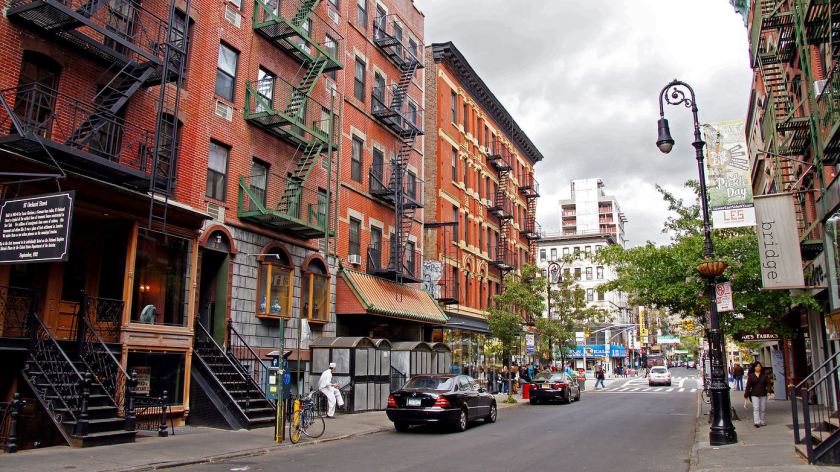
Erasure in history is much more serious when it is intentional and comes with an agenda to distort a story. That intentionality in our nation’s past comes into play in dealing with those often seen on the margins of life. Selective memory is used to forget about all those who truly belong. It took institutions like New York City’s Tenement Museum to tell a fuller, richer, layered history of the millions of people who moved to and around the United States in pursuit of the American Dream.

Four decades after beginning my work in historic preservation, the effort to tell the full story in the places where it happened has expanded in countless ways. Yet there is still much to do.

Places connect with our lives through emotions and memories. Old places always have countless personal stories intertwined with the wood, brick, stone, and mortar; stories holding these places up, literally and figuratively, embedding the connections from the past into our lives today and in the future. Stories such as the one about a place where a family that originally immigrated from Ireland joined with another family that had its roots in Italy, to make a new life in the United States.

Those narratives should not be erased simply because it is inconvenient to tell the full story, or because we want to elevate only those who have wealth and fame. In the end, we’re all richer for understanding those connections and how ordinary places are nothing but extraordinary.

Have a good week.

More to come…

DJB

Image by Clker-Free-Vector-Images from Pixabay.

*The update on the ownership by Mrs. Sherman was provided by my mother-in-law after the original story was posted.

**The pictures in the body of this post of Uncle Miltie are from the LIFE photo shoot. Instead of a major Derby-related spread, the magazine published a small article commenting about the horse’s unusual name. (Uncle Miltie was the nickname for popular comedian Milton Berle). My mother-in-law still has many of the stunning photographic prints from the shoot in her possession.

Saturday Soundtrack: John Hiatt

John Hiatt from JohnHiattmusic
John Hiatt (photo credit @JohnHiattMusic)

One of my all-time favorite rock singer-songwriters is John Hiatt. Described as “a master lyricist and satirical storyteller,” Hiatt “weaves hidden plot twists into fictional tales ranging in topics including redemption, relationships, growing older and surrendering, on his terms.”

Hiatt has been at this for a long-time, with 23 albums to his credit. His songs have been recorded by artists as diverse as Bob Dylan, Bonnie Raitt (Thing Called Love), Emmylou Harris, Iggy Pop, I’m With Her, Rosanne Cash (The Way We Make A Broken Heart), and New Grass Revival and the Jeff Healey Band (both for Angel Eyes).

The acoustic Crossing Muddy Water shows how Hiatt can tell a sad tale of loss with beauty and depth. Perfectly Good Guitar about rock stars who smash their very expensive guitars onstage as part of their act is typical of Hiatt’s clever writing. This version from Austin City Limits has great leads with Mike Ward of The Guilty Dogs doing some awesome guitar shredding.

My all-time favorite Hiatt song is Tennessee Plates, described by one of my favorite music bloggers as “probably the most oblique and powerful tribute song to Elvis Presley ever composed.” You may recall the tune from when it was featured in the iconic film, Thelma and Louise. But rather than reading my thoughts, please take some time to mosey over to Thom Hickey’s fantastic The Immortal Jukebox (I’ll still be here when you return) and read his in-depth take on what Thom describes as:

“A complete movie with; a love story, criminality, cultural commentary, eyeballs out playing from the band (especially Sonny Landreth on guitar) and a twist at the end – all in under three minutes.”

Now that you’re back, let’s end with Hiatt’s anthem that seems so appropriate for these times: Have a Little Faith in Me. And for this version, Hiatt improves on the original by adding that gospel choir at the end!

“When the road gets dark / And you can no longer see

Just let my love throw a spark / And have a little faith in me

And when the tears you cry / Are all you can believe

Just give these loving arms a try, baby /And have a little faith in me

Hiatt and another singer-songwriter legend, Lyle Lovett, were scheduled to play at Strathmore Music Hall in Bethesda on May 13th, but due to the coronavirus crisis the entire tour was cancelled. For now we’ll have to be content with videos and memories of their last area concert on what I call, “the last full day of sanity in the United States.”

Enjoy!

More to come…

DJB

Beyond the pandemic

To no one’s surprise, nostalgia is very much in vogue in the middle of this pandemic. That’s understandable. Psychologists say that experiencing distress, or “negative mood” is a very common trigger of nostalgia. As a temporary reprieve from the pressures of the present world, these past happy memories can be a helpful coping device.

But as a long-term strategy for getting through and — more importantly — thriving on the other side of the pandemic, nostalgia alone will not be enough. With past pandemics and crises as a guide, the world never goes back to the old way of doing things after such a shock to the system. As someone whose entire career has focused on ensuring that history is part of our present and future, I want to make certain that we don’t discount the past. But this pandemic will require that we adjust to the reality of inevitable change.

We can adjust, becoming more effective in our jobs and in life while also promoting our cognitive health, by embracing enthusiastic learning during and after this crisis. Which brings me to my yoga practice.

Let me say upfront that I’m not very good at yoga. Yet.

I can pretty much nail the basics of the corpse pose — which involves lying flat on one’s back and breathing — but even something so simple has multiple layers and levels of understanding. I’m sure that with just about every other pose and movement, I have something misplaced or out of alignment. And I know that I’m breathing in all the wrong places, if I even remember to breathe at all. Yet, I’ve come to realize that I’m learning a whole different set of lessons from yoga than the things I would have expected. Lessons I can apply in this time of crisis.

I have, of course, learned about mindfulness and flexibility. That was my intention, and it is what many individuals reference when discussing the benefits of their yoga practice.

But more importantly, I’ve learned to let go, make mistakes, and not really care that I am doing my poor imitation of a yoga pose in a studio full of flexible, mindful people, many of whom have forgotten more than I’ll ever know. I am reminded, again, of the value of always trying new things without worrying about competence or skill or the judgment of others.

My colleague and friend Andi Stevenson has an insightful TEDx talk entitled The Importance of Being a Rookie. She reminds us that while we rightly enjoy being talented and competent at our jobs and hobbies, “We can’t overlook the value of being absolutely terrible at something new. Inspiration, innovation and joy come from hurling ourselves into new challenges and embracing the role of rookie: an enthusiastic, humble, undaunted learner.”

Being a rookie, from Andi’s perspective:

  • kills perfectionism,
  • increases empathy,
  • changes our approach to the new and difficult, and
  • helps you find what saves your soul.

These are all spot on, and I encourage you to watch the entire talk to hear her explanations. Once we try something new, we are open to other experiences where we may not have knowledge, expertise, or mastery. And that’s a good thing for our growth and well-being. My example of being a rookie is my yoga practice. What was Andi’s? Well, she took her competent, Type-A, executive, nerd personality to a class where she had to wear spangled dresses — with so many sequins and so much beading that “you could see it from space” — and learn ballroom dancing. I can’t imagine…but that’s her point. It was totally new, frightening, challenging, and ultimately life changing.

As I advanced in my career I became better at what I did and took on more responsibility. I also took on more concerns that I present myself as knowledgeable, competent, and professional. One way to do that is to stop trying new things while continuing to hone the skills one’s already acquired. Yet pushing back against learning new things will make life more of a challenge as we come through the coronavirus crisis.

Our lives will be different individually and in our communities, and there are already predictions as to what that new way of living will entail. On a personal level, we may adjust our thinking about how and where we live. Families may decide to drop the current, never-ending push for more activities and reclaim their weekends.* In our professional lives, we will think differently about remote work. Jobs and businesses that once existed will be gone, while new jobs and new business opportunities will begin to grow. As a nation, perhaps we’ll come to see child-care as an essential need and we’ll recognize teachers and nurses for the amazing professionals they are, while undertaking the hard work to make those changes stick. I hope we’ll take voting more seriously because we see government as something helpful rather than part of the problem.

Some will, no doubt, be nostalgic, trying to hold on to their old way of doing things and their old privileges. But like the owners of the buggy whip factories of the late 19th century, they will fail. To successfully navigate this new reality, we need to be willing to be an enthusiastic learner. As I’ve seen through my yoga practice, we lose so much by not trying new things where we may feel uncomfortable or are not very good (yet). With yoga, once I got passed those concerns and met two insightful and patient teachers in Michele Russ and Amy Dixon, I found I really enjoyed the practice, at whatever level I’m capable of at the moment. During this time of sheltering-in-place, my thirty minutes of daily practice — before coffee or electronics or anything else in the morning — has helped center my day. And I still see Michele and Amy to get the benefit of their wisdom, only now it comes online.

The writer Ursula K. Le Guin notes in No Time to Spare that there are people who, in her words, realize the incredible amount we learn “between our birthday and our last day.” If we are flexible enough in mind and spirit to recognize “how rich we are in knowledge, and in all that lies around us yet to learn,” we can maintain the seeking, trusting capacity for learning and life that we had as a two-year-old.

In this time when everything has changed, why not consider embracing your inner student or your inner rookie, as Andi calls it. Use this time to cultivate a sense of wonder. We are going to need new ways of addressing the problems of our families, organizations, businesses, and country. This is as good a time as any to become an enthusiastic learner.

Stay safe, well, and resilient this week.

More to come.

DJB

*It was Bill Watterson, the creator of Calvin and Hobbes, who said, “Weekends don’t count unless you spend them doing something completely pointless.”

Images by Gerd Altmann from Pixabay

The elegant swing of Teddy Wilson

For the final Saturday Soundtrack post of April, I’m going to recognize Jazz Appreciation Month by highlighting my father’s favorite jazz musician: the elegant pianist Teddy Wilson.

Wilson was born in 1912 in Austin, Texas, but moved at age six with his parents to the famed Tuskegee Institute in Alabama. His father was the head of the English Department while his mother later became the school’s head librarian. Wilson began his musical instruction at Tuskegee, where he studied not only the piano, but also violin, oboe, and clarinet. Around 1930, when playing music in Toledo, Ohio, Wilson met the great Art Tatum and the two played together often during that period. Wilson eventually moved to New York City, with the encouragement of jazz supporter John Hammond, and went on to join Benny Goodman‘s band. It was with Goodman and drummer Gene Krupa that Wilson became the first African American to play in a racially mixed, high profile musical group in the United States. Wilson performed with Goodman, off and on, for many years, including for his famous Carnegie Hall Concert of January 16th, 1938, which was called, “the most important concert in jazz history,” by Phil Schaap, curator of Jazz at Lincoln Center. Schaap produced the Columbia Records album reissue of the 1938 concert and says the event – with no dancing and no booze — elevated jazz to an art form.

“Outside of music, the concert was culturally historic. In 1938, music venues were segregated. But Goodman took more than half a dozen African American musicians with him onto the Carnegie Hall stage, including pianists Teddy Wilson and Count Basie, vibraphonist Lionel Hampton and saxophonist Lester Young. Benny Goodman made a stand for integration onstage nine years before Jackie Robinson broke the color barrier in baseball.”

My father —  Tom Brown — loved Wilson’s style, which has been described as “understated, self-assured, cool, controlled, elegant.” Daddy passed that love onto me, and one of my great musical memories is hearing Teddy Wilson live with his trio in an Atlanta jazz club in 1980. One of the sides in my father’s collection of 78 RPM records is Wilson, on solo piano, playing the classic Body and SoulThat was one of the few tunes my father could play on the piano, so when I listen to this memories flood my heart.

Wilson’s playing with Goodman is on another planet. Listen to this group, in their prime in 1937, play I Got a Heartful of Music.

Oh my! These guys are in overdrive! Channeling his mentor Art Tatum, Wilson’s amazing solo takes off at the :30 mark, and those big hands go racing up and down the keyboard, with the bass lines in walking tenths (except they are running here)! When the quartet (Lionel Hampton on vibes) made this 1972 recording (with George Duvivier on bass) of Avalon, they were older and some were semi-retired, but nonetheless this group can still swing. Wilson’s cool solo begins at the 2:20 mark. From that same concert, listen to the group play their hit Moonglow.

Many commentators have noted that the great jazz singer Billie Holiday did some of her best work when backed by Teddy Wilson on the piano. From 1937, here’s I’ll Never Be the Same which has an extended Wilson introduction. More Than You Know is another classic from this period, showing Wilson’s understated, but perfect, accompaniment. His solo begins around the 1:25 mark. One of Holiday’s signature songs, I Cried for You, was recorded in 1936 with the Teddy Wilson Orchestra.

In 1963, Wilson played a concert at Chicago’s Civic Opera House with Jim Atlas on bass and Jo Jones on drums, and the three have some amazing interplay on Honeysuckle Rose. And since it was another of the songs my father could play on the piano, I’ll end with Wilson’s rendition of St. Louis Blues from a concert in Copenhagen with the Teddy Wilson Trio, featuring drummer Ed Thigpen and the Danish bassist Hugo Rasmussen.

Since we can’t go out and hear live music, this is the perfect time to pull up a swing playlist on your electronic device and take yourself back to the 1930s and 40s. Teddy Wilson will certainly be there!

Enjoy!

More to come.

DJB

Image: The cover of my father’s set of Teddy Wilson 78 RPM records on Columbia Records

Responsibility

Responsibility has been in the news lately.

In a time of never-ending obfuscation, gaslighting, spitefulness, and mendacity, it seems appropriate to return to the plain spoken wisdom of Harry Truman.* President Truman had a sign on his desk in the Oval Office that simply said, “The buck stops here.” Truman received the sign as a gift and only kept it on his desk for a short period of time, but the message and image stuck with him for the rest of his life.

Truman was saying that he was responsible. There is no need to blame anyone else for this. I own the issue.

Responsibility has always been at the heart of leadership because it is inherently focused on others as opposed to self-preservation. Truman is just one example, but there are many others in our country’s history. There are famous individuals who regularly took responsibility for their actions — such as Roger Williams, George Washington, Harriet Tubman, Abraham Lincoln, A. Philip Randolph, and General Dwight Eisenhower — just as there are millions of less famous examples we can turn to. Individuals such as the soldiers who charged up Utah Beach and Omaha Beach at Normandy on D-Day, accepting responsibility to rid the world of an especially horrible example of bigotry, xenophobia, demagoguery, and fascism.

History doesn’t look kindly on people in positions of power who refuse to accept responsibility for their actions. Historian Joseph J. Ellis has described Thomas Jefferson as someone “who combined great depth with great shallowness, massive learning with extraordinary naivete, piercing insights into others with daunting powers of self-deception.” Jefferson famously wrote of slavery, “We have the wolf by the ear, and we can neither hold him, nor safely let him go.” Emancipations by well-known figures of the era such as Robert Carter, Edward Coles, and Richard Randolph (Jefferson’s cousin), as well as hundreds of property owners forgotten to history, show, however, that Jefferson abdicated responsibility. In reality, he was not looking for an answer to the question of what happens once the slaves are freed.

When we blame someone else or outside events for our situation, we are focusing on protecting ourselves and passing the buck. And when we do so, blame becomes part of our language and part of our culture. As leadership consultant Dan Norenberg wrote on the topic, “When blame becomes prevalent…you see the following:

  • Problems don’t get solved
  • Mistrust replaces trust
  • Collaboration suffers as people start working against each other rather than with each other.”

Unfortunately, we have an individual in the White House who came into the office blaming others: immigrants, the previous administration, bureaucrats, foreign governments, our allies…the list is almost endless. Thus it has always been with Donald Trump, who through a checkered business career never took responsibility for multiple bankruptcies and failures. Blaming someone else wasn’t a bug of his campaign, it was a key feature. It is reactionary politics, which as legal- and social-policy writer Stephen L. Carter noted in another context, is “designed to bypass the rational faculties of its targets.”

Refusing to take responsibility is about the “me” instead of the “we.” True, virtually every successful politician is preoccupied with his or her own feelings, interests, or situation. That’s natural. In watching the Ken Burns documentary The Roosevelts: An Intimate History on PBS during the pandemic, I’ve seen how even those who are preoccupied with self can still accept responsibility. One would be hard-pressed to find two more self-absorbed individuals than Theodore and Franklin Roosevelt. Alice Roosevelt Longsworth’s famous quote about her father, Teddy, sums it up nicely: “My father always wanted to be the corpse at every funeral, the bride at every wedding and the baby at every christening.” Yet both men worked through difficult personal traumas, were aware of the needs of their fellow citizens, and they acted on that awareness. Their “me” turned into a “we” and the country was transformed for the better.**

Recently, the citizens of our country and, in fact, the world have — by and large — accepted responsibility for each other. We have set aside our own wants and needs so the most vulnerable among us wouldn’t die a preventable death. We don’t know the people who will be saved by our sheltering in place, but we are taking those actions in any event because we are accepting responsibility for the well-being of our fellow citizens. As an anonymous author recently wrote:

“When you go out and see the empty streets, the empty stadiums, the empty train platforms, don’t say to yourself, ‘It looks like the end of the world.’ What you’re seeing is love in action. What you’re seeing, in that negative space, is how much we do care for each other, for our grandparents, for the immuno-compromised brothers and sisters, for people we will never meet.

People will lose jobs over this. Some will lose their businesses. And some will lose their lives. All the more reason to take a moment, when you’re out on your walk, or on your way to the store, or just watching the news, to look into the emptiness and marvel at all of that love.

Let it fill and sustain you. It isn’t the end of the world. It is the most remarkable act of global solidarity we may ever witness.”

Donald Trump has consistently stated that he doesn’t accept responsibility. To a greater degree, the president and those trying to shield him from political accountability are even more upset when others accept responsibility by their actions to stay at home. It is not surprising, but just another in an ever-growing list of examples of the leadership vacuum in the White House and in today’s Republican Party, that — it saddens me to say — has turned itself into a cult devoted to obtaining and maintaining power.

Stephen L. Carter noted in a 2012 interview that, “Democracy cannot flourish when electoral politics is exalted above all things. The entire point of the concern for civil society is that a successful nation needs its people to be focused on matters more important than transitory partisan advantage.”

We now face an existential crisis in a global pandemic. We also have a growing economic crisis and a long-simmering crisis around whether our democracy will survive. It is time for our leaders to take responsibility for something more than transitory partisan advantage. To focus on the “we the people” instead of on “me and mine.” Or it is time they give up — or more likely be relieved of — their positions of power.

Be responsible. Live with a generous and loving mindset. Stay safe and stay healthy this week.

More to come…
DJB

*I’ve quoted Truman recently in another post. And yes, I realize this sentence isn’t a good example of plain speaking. So if you are wondering, I’m speaking of a time of cover ups, psychological manipulation, meanness, and lying.

**Teddy Roosevelt lost his mother and wife on the same day — Valentine’s Day in 1884 —and Franklin Roosevelt contracted polio at age 39.

Sara Watkins

Red Wing 07 11 15 056
Sara Watkins at 2015 Red Wing Roots Music Festival

Today, I’m wrapping up my Saturday Soundtrack feature on the three members of the roots music trio I’m With Her with this look at the gifted fiddler, singer, and songwriter Sara Watkins.

Watkins is probably the best known of the trio’s members, due to her status as a founder and fiddler with the Grammy-award-winning and highly influential progressive bluegrass group Nickel Creek, where she debuted in 1989 along with her brother Sean and mandolinist Chris Thile. Since 2007, when the band took an indefinite hiatus (broken by 2014’s 25th reunion tour), Watkins has played both solo gigs and in a variety of groups including, of course, I’m With Her. In addition to singing and playing fiddle, she also plays ukulele and guitar, and played percussion while touring with The Decemberists. With her brother Sean, Sara has also hosted the Watkins Family Hour, which has been described as an “oasis from the rigors of the road, a laboratory where they can try out new material, or master beloved cover songs.” The monthly show is held at the Largo in Los Angeles and it has been hailed as a convivial, communal event where they welcome an impressive array of musician friends old and new.

Watkins has a wide range of musical interests. Let’s begin with something completely different — the rocker/murder ballad Hayloft from Nickel Creek’s reunion tour. With the lyrics, “My daddy’s got a gun / you better run…” you can guess the subject matter. Thile described Hayloft as like a “Gatorade shower” on the listener, and reviewers note that in the hands of Nickel Creek this oddity becomes a romp with chops.

Another rocker/ballad (if that’s a genre) is her Young in All the Wrong Ways from the 2016 solo album of the same name.

Watkins can still sing straight-ahead bluegrass, as seen in this live version of Hold Whatcha Got with the great Mark Schatz on the bass. (Well, this version is as straight ahead as the Nickel Creek folks can play it.) One of my favorite Watkins performances is her version of John Hartford‘s Long Hot Summer Day, first as a fiddle/vocal solo and then in a version with Nickel Creek. The Watkins Family Hour Tiny Desk Concert from 2015 has a surprise appearance by singer Fiona Apple, who howls a bit on In the Pines, sounding as if she just walked down from the North Georgia mountains to join in the Saturday night party.

In her response to the Chris Thile challenge to record a song from her house for the Live from Home performance series, Sara Watkins offers up a lovely Iris DeMent tune, Sweet is the Melody. No one knows when musicians and bands will begin touring again, but note that the Watkins Family Hour was to be performing at Ram’s Head on April 29th, and at Sixth & I in DC on April 30th. Both shows have been postponed, so check their websites for updates.

Until we can get out to hear some live music, enjoy the videos and stay safe!

More to come…

DJB

Click on these links to check out the features on the other two members of I’m With HerSarah Jarosz and Aoife O’Donovan.

John Prine

Remembering John Prine

There is no better way to honor the memory of the late John Prine than to pull out an acoustic guitar, play his music, and tell stories about this American Oracle.

It is certainly how many who knew John best have been remembering him over the past week. In recent days I’ve been looking through YouTube, print media, television, and blogs to sample the flood of tributes that his musical fans — famous and otherwise — have posted about the songwriter that many called our generation’s Mark Twain.

What most of the tributes lack in technical excellence in this time of sheltering at home, they more than make up for in sincere love for the man and his music.

The always inventive folks at the NPR Tiny Desk Concert series have pulled together one of the most satisfying remembrances, gathering six singers and songwriters to perform in a “tribute from home” to John Prine. It is among the most touching Tiny Desk concerts ever. Margo Price and husband Jeremy Ivey, begin — appropriately enough in their bathtub — singing That’s the Way That the World Goes Round, which has the delightful verse,

I was sitting in the bathtub counting my toes,
When the radiator broke, water all froze.
I got stuck in the ice without my clothes,
Naked as the eyes of a clown. /

I was crying ice cubes hoping I’d croak,
When the sun come through the window, the ice all broke.
I stood up and laughed thought it was a joke
That’s the way that the world goes ’round.

Price and Ivey are followed by the talented Courtney Marie Andrews, singing an absolutely lovely version of one of my favorite Prine songs, Speed of the Sound of Loneliness. I suspect her inclusion here will be a big eye-opener for many soon-to-be-fans. John Paul White, follows with a version of Prine’s classic Sam Stone that is almost guaranteed to make you cry. The final two songs come from Nathaniel Rateliff with All The Best and then Brandy Clark wraps up these moving 21 minutes with her version of Speed of the Sound of Loneliness.

Amanda Shires was a long-time Prine friend and favorite collaborator, and her I So Lounging home livestream of a few days ago was a celebration of John Prine that wins the “most idosyncratic tribute” award. It begins with her husband, Jason Isbell, singing Angel from Montgomery, followed by stories and their versions of Clocks and Spoons and finally Illegal Smile (with Shires — wearing absolutely outlandish sunglasses — singing the lead on those tunes). There’s a great story around the 29:00 mark of how they asked John and his wife Fiona how they stayed married for so long. Both responded in unison, “stay vulnerable.”

In other videos, Wilco’s Jeff Tweedy plays the quirky Please Don’t Bury Me (about donating your organs…such as the knees to the needy), the incomparable Norah Jones sings a beautiful That’s the Way the World Goes RoundPink Floyd co-founder Roger Waters performs a slow blues of Prine’s Paradise, and My Morning Jacket frontman Jim James plays a string of Prine songs, including Spanish Pipedream.

Stephen Colbert — a famous Prine fan and supporter — has been featuring musicians on The Late Show this week playing John’s songs. Colbert tells how his then-girlfriend / now-wife, introduced him to Prine’s music and then recalls several interactions with the singer, recounting how he even had the chance to sing a duet with Prine. He then introduces Brandi Carlile to sing the haunting Hello in There. As she says in her introduction, many people who didn’t know John Prine are about to get a whole lot of truth dumped on them. Dave Matthews also performs his version of Speed of the Sound of LonelinessAnd for those who can’t get enough of Bonnie Raitt singing Angel from Montgomerycheck out this 2019 version from The Late Show.

I recommend you find the time to watch some of John’s shows from his later years. One of the best is this intimate concert from 2019 on The Strombo ShowGordon Lightfoot, who is one of John’s songwriting heroes, sits in the front row enjoying it as much as anyone, and you can watch him sing along with the familiar chorus of Far From Me: “Ain’t it funny how an old broken bottle / looks just like a diamond ring.” John also does a bit of mouth music in the song Crazy Bone and then says, “Please don’t mistake that for scat singing, that’s my shaving song in the morning. Somewhere between Popeye and Fred Flintstone.”

Classic.

It is clear that Prine’s death from COVID-19 has touched deep places in our souls during this pandemic. And it is good that this is the time “we’re getting a whole lot of truth dumped on us.” A bungled response to the pandemic deserves to be placed up against all that we’re losing as a result of the incompetence and lack of empathy. As Prine himself once said, after playing his song Caravan of Fools which equates wealth with idiocy, he wanted to add a disclaimer: “Any likeness to the current administration is purely accidental.” Of course, it wasn’t.

I hope John’s checked into that sweet hotel, enjoying a vodka and ginger ale at The Tree of Forgiveness right about now. How can you not love a man who could write, “I want to see all my mama’s sisters / cause that’s where all the love starts / I miss them all like crazy / bless their little hearts”?

More to come…

DJB

Find your benefactor moments

I was reading a journal the other day where the author was describing ways to tap into self-compassion. In it, she suggested that we recall “a benefactor moment, an instance in life ‘when we felt seen, heard and recognized by someone who showed us genuine regard and affection.'” She was quoting Thupten Jimpa, PhD, adjunct professor of religious studies at McGill University and author of A Fearless Heart.

By way of example, the author suggested we think of a time when we were speaking during a big work meeting and a colleague begins talking over us. In the moment we begin to question ourselves, wondering if our point had value. But when he’s finished, “your boss redirects the conversation back to you, because she wanted your take. Benefactor moments like these make us feel valued.”

The suggestion was that when you question your sense of purpose or usefulness, call upon those moments from your past as reminders that you do have value.

In The Wise Heart: A Guide to the Universal Teachings of Buddhist Psychology, author Jack Kornfield tells the story of a high school history teacher who provided an entire class with a benefactor moment they would never forget. On a day when the class was fidgety, she stopped mid-lesson and asked her students to take out a piece of paper and pencil. She then wrote the names of all 26 members of the class on the blackboard. After the students copied the names on their papers, she asked them to use the rest of the period to write one thing they liked or admired about each of the other students. Then she collected the papers. Several weeks later, when the students were again unruly, she stopped the class and handed each of them a sheet of paper with their name at the top and the 26 things their classmates had written about them pasted below. They became quiet, then began to smile as they read how other classmates described what they admired in them and their value to the world.

A few years later, this teacher attended the funeral for one of those students. He had been killed in the Gulf War. The student’s mother came up, with tears in her eyes, and showed the teacher a piece of paper, folded many times. It was one of the few things the military recovered from his body. The paper that the soldier carried to his death was the list of the 26 things his classmates had said they admired about him. Several other students joined the conversation, pulling their individual lists out of their purses and wallets, or mentioning that it was framed on their kitchen wall, or saying that they had incorporated the list into their wedding vows.

Benefactor moments. When someone saw the good in us and valued us. Or when we see the good and the valuable in others and ennoble them through praise, a comment, recognition, a simple gesture, or a note. The Nobel Laureate Nelson Mandela once said: “It never hurts to think too highly of a person; often they become ennobled and act better because of it.”*

I’ve thought about benefactor moments several times during this coronavirus crisis, as so many of us are facing new realities and perhaps questioning our place in this new world. We may need, as the author of the article suggests, to think about those times when someone else was a benefactor to us. We may also see others who are struggling, perhaps questioning their value or future, and we may be in positions where we can be benefactors to them. Both are important.

The singer Iris DeMent recently highlighted the work of another benefactor. She used the Mandela quote in her short remembrance about the late John Prine last week in Rolling Stone magazine. DeMent said,

“We all know that John ennobled the characters in his songs. Any of us lucky enough to have seen one of his shows knows he also did this for his audience. I, for one, happen to know he did it at truck stops and Dairy Queens, too. John was one of the all-time great ennoblers of others.”

How did he do it? By caring enough to look at everyone he met until he saw what was noble. Given Prine’s unique gifts as a songwriter, he then “wrapped us up in melodies and sung us back to ourselves.”

We may not be able to see what is noble in someone and then come up with lyrics that get quoted across generations at the dinner table or around guitar pulls in the music room. But we can ennoble someone — we can be a benefactor — by caring enough to look. By reaching out to talk. By seeing something of value. By dignifying those around us. By honoring our fellow travelers through this world.

By saying hello in there.

Stay safe and healthy this week.

More to come…

DJB

*We need to recognize the elephant in the room. Sometimes people in power are so enveloped in sociopathic or narcissist tendencies that we endanger others by speaking too highly of them, especially when the praise is less than genuine; is obsequious and sycophantic in nature. These authoritarians are not ennobled by praise. Instead, they use flattery to feel enabled to tell more lies to make themselves look good or to gain more power and a political advantage.

Image by Couleur from Pixabay.

Saturday Soundtrack: Holy Week

Flowers from Pomona Family Weekend

I was fortunate in my earlier life to sing Baroque and Renaissance music as part of the Shenandoah Valley group Canticum Novum. Custer LaRue, one of the eight-to-twelve singers depending on the gig, was definitely our ringer. I’ve seldom heard such a pure soprano voice. Along with a number of recordings and other highlights in her career, Custer was the “singing voice” of Reese Witherspoon in the movie Vanity Fair. (Custer also sang a solo at our twins’ baptismal service, accompanied by yours truly on guitar. While I doubt it made her musical resume, it was definitely a highlight of my musical career.)

The other ringer was Carol Taylor. An award-winning choral director at McGill University, Carol fell in love with the sound of tracker organs and then fell in love with George Taylor, who happens to build world-class tracker organs (with his partner John Boody) in little Staunton, Virginia. I count myself very fortunate to have had the opportunity to sing with Custer, and with Debbie Hunter, Lucy Ivey, Shari Shull, Kay Buchannan, Constance Harrington, Peter Hunter, John Boody, Mark DuVall, and Dick Coleman, (plus others) under Carol’s magnificent direction.

It is possible that our son Andrew’s move to a professional career in music came because of what he heard around the house growing up. In fact, when his Madrigals group at Brown University sang their senior concert, Andrew floored me with his introduction to the Magnificat (Short Service) by Orlando Gibbons — a beautiful piece with a quick scale up in the soprano part for the word “servant” that always struck fear into every treble’s heart for centuries, in no small part because it always fell just after a page turn somehow! In any event, getting back to his introduction, Andrew said it was important to him to have this piece included because he had heard it as a young boy on a recording of his father’s early music group, and always loved its simple beauty. He noted that I was in the audience that evening, and then the Madrigals sang that wonderful composition — bringing memories from my heart and tears to my eyes.

Suffice it to say that Andrew and I share a deep love for unaccompanied vocal ensembles singing beautiful and intricately-crafted compositions from the classical canon. When I realized that my Saturday Music post would fall on the final day of Holy Week, I reached out to Andrew — who is in his London flat, sheltering in place during his final year at the Royal College of Music  — and asked for some help. He was all in!

© 2015 | Kristina Sherk Photography | www.Kristinasherk.com
Andrew Bearden Brown (credit: Kristina Sherk | https://www.kristinasherk.com)

For this edition of Saturday Music, I’m pleased to present this curated selection by Andrew Bearden Brown of five of his favorite pieces of the season(Selections by ABB; notes and any mistakes by DJB.)

Tallis Scholars, Lobo, Versa est in luctum

We’ll begin with the Tallis Scholars, who “over four decades of performance and a catalogue of award-winning recordings have done more than any other group to establish sacred vocal music of the Renaissance as one of the great repertoires of Western classical music.” In this video, we hear their version of Alonso Lobo’s Versa est in luctum. Lobo, who was active in the later Renaissance, composed his most famous motet in 1598 upon the death of Phillip II of Spain. The motet is for six voices, and the performance notes for the piece indicate that, “Out of the slow river of beautiful notes, stunning phrases sometimes emerge, or bold homophonic internal gestures divert the forward motion somewhat. The full choir is present almost throughout, and Lobo creates, with his wall of gorgeous sound, an appropriately majestic work of mourning.”

Versa est in luctum cithara mea,
et organum meum in vocem flentium.
Parce mihi Domine,
nihil enim sunt dies mei.

My harp is turned to grieving
and my flute to the voice of those who weep.
Spare me, O Lord,
for my days are as nothing.

VOCES8, Byrd, Ne Irascaris Domine | Civitas Sancti Tui

The English composer William Byrd has long been a favorite, and in this video VOCES8 sings Byrd’s double motet Ne Irascaris Domine and Civitas Sancti Tui in the Gresham Centre in London. The Catholic Byrd wrote these motets in the 1580s as a protest against the Elizabethan Catholic persecutions, and the text refers to the Babylonian captivity of the Jews. One online commentator wrote, “This is perfection (and an exceptionally brilliant piece of writing by William Byrd). The perfection of the upper voices (not the slightest hint of a vibrato), and the sonority of the lower voices make for a magical performance of this epic masterpiece.” VOCES8 regularly performs in the U.S.; ranks among my personal favorites thanks to the wide range of music they perform with impeccable style and taste; and finally, in full disclosure, has added Andrew as a singer on occasion in recent months with the Choir of the VOCES8 Foundation.*

Ne irascaris, Domine, satis
et ne ultra memineris iniquitatis nostrae.
Ecce, respice, populus tuus omnes nos.
Civitas sancti tui facta est deserta.
Sion deserta facta est, Jerusalem desolata est.
(Isaiah 64 v. 9)

Be not angry, O Lord, still,
neither remember our iniquity for ever.
Behold, see, we beseech thee, we are all thy people.
The holy cities are a wilderness.
Sion is a wilderness, Jerusalem a desolation.

TENEBRAE, Howells, Like as the Hart

Tenebrae, under the direction of Nigel Short, is one of the world’s leading vocal ensembles renowned for its passion and precision. Their version of Like as the Hart by the English composer Herbert Howells is a beautiful and thoughtful rendering of this classic, which is based on Psalm 42 vv. 1–3. Howells taught composition at the Royal College of Music for almost 60 years, and this particular composition — which I sang back in the day — has long been another favorite of mine.

Like as the hart desireth the waterbrooks,
so longeth my soul after thee, O God.
My soul is athirst for God,
yea, even for the living God.
When shall I come to appear before the presence of God?
My tears have been my meat day and night,
while they daily say unto me,
“Where is now thy God?”

THE SIXTEEN, Poulenc, Vinea mea electa

The Sixteen stands today among the world’s greatest ensembles, “peerless interpreters of Renaissance, Baroque and modern choral music, acclaimed worldwide for performances delivered with precision, power and passion.” Their performance in this video of French composer and pianist Francis Poulenc’s motet Vinea mea electa is another beautiful reading that is especially meaningful for Holy Week. Poulenc’s Quatre motets pour un temps de pénitence (Four Penitential Motets), FP 97, are four sacred motets composed in 1938–39. He wrote them on Latin texts for penitence, scored for two choirs (eight unaccompanied voices). Andrew notes that they are remarkably economical given their tonal and sonoral complexity. Vinea mea electa (Vine that I loved as my own), is a responsory for the matins of Good Friday.

Vinea mea electa, ego te plantavi: quomodo conversa es
in amaritudinem, ut me crucifigeres et Barrabam dimitteres?

My chosen vineyard, I planted you : how have you turned
into bitterness, so as to crucify me and free Barabbas?

CAMBRIDGE SINGERS, Durufle, Ubi Caritas

Finally, we’ll end with the Cambridge Singersunder the direction of John Rutter, singing one of my all time favorite pieces of choral music, Maurice Duruflé’s setting of Ubi CaritasThis hymn of the Western Church, long used as one of the antiphons for the washing of feet on Maundy Thursday, comes from a Gregorian melody composed sometime between the fourth and tenth centuries. Duruflé’s choral setting makes use of the Gregorian melody, but incorporates only the words of the refrain and the first stanza.

Ubi caritas et amor, Deus ibi est.
Congregavit nos in unum Christi amor.
Exsultemus, et in ipso jucundemur.
Timeamus, et amemus Deum vivum.
Et ex corde diligamus nos sincero.

Where charity and love are, there God is.
The love of Christ has gathered us into one.
Let us exult, and in Him be joyful.
Let us fear and let us love the living God.
And from a sincere heart let us love each other (and Him).

Whatever your religious tradition or beliefs, Andrew and I hope you can enjoy the beautiful choral music of Holy Week.

More to come…

DJB

NOTE: For those looking for the fourth and final installment of my Saturday Music series on the trio I’m With Her and its individual members, we’ll return next week with a celebration of the music of Sara Watkins.

*Shameless parental promotion: to hear Andrew sing with VOCES8, check out the tenor aria Ach mein Sinn at the 31:00 minute mark of the video of the Bach St. John Passion.  And while it is in the wrong season, I have to send you to the VOCES8 rendition of the Philip Stopford setting of the Coventry Carol, the traditional English carol dating from the 16th century. Stopford’s Lully, Lulla, Lullay — filmed by VOCES8 in St. Stephen’s Walbrook Church, London — is so haunting, and soprano Eleonore Cockerham’s soft, clear, yet ethereal voice is a treasure. I love this carol and this version.