There are times when the personal takes on global implications. Last week was one of those times.
It began when I discovered that a former National Trust colleague, Raina Regan, has begun a fascinating self-help project for preservationists. Here is Raina’s description of this work:
“One of my goals for 2019 was to be more intentional with my free time, which resulted in a rekindled love of reading. I was really drawn to self-help books, and according to my count, I’ve read two dozen of them in 2019. As I read each one, I considered how they would apply to me and my work in historic preservation. At some point, I decided I wanted to take what I’ve learned and share it more broadly with the world—and Uplifting Preservation was born.“
Those of us in the field believe strongly in the value of our work, yet the shaming can have a toll on one’s mental health. Raina looks at the effect of shaming on the profession, and suggests ways to combat it through the insights gained by reading the works of Brené Brown.
With more than 40 years in the preservation field, I’ve seen the type of vilification that Raina describes in an up-close and personal way. Even well-meaning friends think they are being funny by describing what I do as working for the “hysterical” society.
Yep, never heard that one before.
This came home to me again when I was having a recent conversation with the developer of Downtown Silver Spring. He thought it was okay to denigrate the historic preservation professionals in Montgomery County, who were keeping him from transforming our older buildings into the garish rumpus room-look he envisions for the rest of his downtown development. (That description is, admittedly, my take. He would have a different perspective.)
Downtown is something of the living room for our community, and, as an area with a history, it contains excellent historic buildings like the 1930s Art Deco-style AFI Silver Theatre and one of the country’s earliest shopping plazas with a street-facing parking lot. Nearby Woodside Park is the area’s first automobile-oriented suburb and is considered one of the region’s best examples of 1920s-30s residential development. The theatre and shopping plaza are protected by the county preservation ordinance, and all bring both good design and beauty to our community, in addition to generations of personal stories from those who live here. Those protected structures won’t change, thank goodness, and will instead remain authentic and unique to Silver Spring.
At the global level, I was reminded of the value of what preservationists do amidst the fragility of cultural resources when our president threatened to target centuries-old cultural resources for destruction in Iran. Preservationists and conservationists across the globe stepped up to call this out for what it was—a war crime—and to note that attacks against the cultural heritage of one country are attacks against culture and humanity worldwide. Thankfully, in spite of calls by some Trump supporters to follow-through on the president’s warning, the wider immediate backlash seemed to have put a pause on those plans. But the threat remains real, and our work remains vital.
While I think I’ve become immune to the denigration of preservation by the media, public officials, and some in related professions, Raina’s new project reminded me of how much it can still sting to hear your life’s work disparaged, often simply because you are asking the community (or the world) to think about how the past connects to the present and future in ways that can be uplifting and inspiring.
Thanks for the good work Raina! I didn’t realize how much I would appreciate this project until you conceived of it.
One of the all-time great lyrics. And the inspiration for Red Molly, a talented Americana/folk group that features smart songs, tight 3-part harmonies, and an infectious spirit.
I’ve always appreciated how this band moves easily between country, blues, folk, and bluegrass, incorporating and weaving pieces from all those various strains—and more—into their music. Red Molly’s website notes that their “innovative instrumentation is suited for roots-rock and heartful ballads alike,” and “the alchemy of their personalities onstage draws even back row listeners into a sense of intimacy.”
I can vouch for that last description, as their onstage alchemy also draws in viewers on the internet. With a little bit of luck, I had the good fortune last evening to catch their live-streamed show from the famous Caffe Lena in Saratoga Springs. The band’s bio page provides the basics about these talented musicians. Dobro player Abbie Gardner’s songs and performance “have the punch of rhythm and blues.” On guitar and tambourine, Laurie MacAllister “draws inspiration from classic folk and singer-songwriters. Her voice stretches octaves, warm and romantic one moment, playful and subversive the next.” The newest member of the group, Molly Venter, “has a smoky voice that is unforgettable,” and brings “a moody approach to song-smithing.” Originally formed in 2004, the band was reinvented in 2017 with the addition of upright bassist Craig Akin and percussionist and electric guitarist Eben Pariser.
Now, back to that lyric. Red Molly’s name comes from the classic Richard Thompson song, 1952 Vincent Black Lightning, which they performed on 2014’s The Red Album as well as on last evening’s live stream.
There are several memorable versions of Thompson’s tale of a biker and his loves, and it is appropriate that Red Molly actually waited ten years before putting their personal version on an album. Good things come to those who wait.
Clinch River Blues is a darker tune for the band that is “instantly addictive. Being bad never felt so good” reads the liner notes.
Finally, Sing to Me is a beautiful lullaby written by Molly Venter that speaks to the feelings of being away from the ones we love. The song showcases the tight harmonies that make Red Molly so appealing.
New York-based readers should not worry if you didn’t make it to Saratoga Springs last evening. The band plays at The Bowery Ballroom in New York City on Sunday evening. Their tour continues in the spring, with dates in Chattanooga; Decatur Georgia; and New England, before moving south to Philly and Virginia.
Catch Red Molly at a venue near you…or on a live stream…and enjoy.
“For all who love great old-time fiddle tunes, here’s a little luncheon treat.
One of my favorites among the old-time tunes is the Eighth of January, which many will remember from the old Johnny Horton country hit The Battle of New Orleans. (The date of the battle was January 8, 1815, and Jimmy Driftwood, an Arkansas school principal who wrote the words to the song to interest children in history, used the fiddle tune for the music.) The Eighth of January is a sweet little melody that’s relatively easy to play but has lots of possibilities for variations.
So, on January 8, 2010, enjoy the Eighth of January in a more timeless mode.”
UPDATE: I was reminded of the post here in 2020 because a friend’s birthday falls on this auspicious day. In wishing her a happy birthday, I told her that it was great to have your birthday align with the anniversary of a historical event. (January 8th is also Elvis’ birthday…but we won’t go there.) For instance, my birthday was, until 1937, inauguration day in the U.S.
On New Year’s Day, I finally saw the delightful movie, A Beautiful Day in the Neighborhood, starring Tom Hanks as the beloved children’s television star Fred Rogers. I waited until the last day this critically acclaimed film was showing at our local theatre because we wanted to go as an entire family and needed to align multiple schedules in our short window of opportunity over the holidays. Like millions of Americans, Mister Rogers’ Neighborhood was a part of our children’s childhood, and it just seemed right to sit down together to take it in as if watching around the television set.
There is much to like about this film, from the cast to the skillful direction of Marielle Heller, from the smart screenplay to the transitional shifts taking place between the toy set and the real life scenes of Rogers and journalist Lloyd Vogel (played expertly by Matthew Rhys). Vogel is, as one reviewer notes, “a magazine writer who actually may be the one person on the planet who doesn’t love Mr. Rogers.” Rhys’ character is based on real-life journalist Tom Junod, who wrote a profile of Rogers for Esquire in 1998. If you saw the film and are at all cynical about the use of some of the scenes (such as with the children on the subway), I recommend you read the original piece, to see how much it impacts the story and script.
As we came home from the showing and sat around the dining room table over a late lunch, all agreed that we were especially taken by the pauses in Fred Rogers’ style. The most famous, of course, is the scene in the Chinese restaurant, which was based upon a real life example from Rogers’ acceptance speech upon receiving a lifetime achievement award at the 1997 Emmys. Beyond that particular instance, however, we all commented on the thoughtful—and sometimes awkward—pauses that Rogers used in everyday conversation. He would ask a question and then stop. And wait. And let you think. And then wait some more.
It just so happened that I had recently completed my New Year’s Day post, and was reminded of my Life Rule #3: Listen more than you talk. In our luncheon conversation, we discussed listening and talking as well as the value of space between the two. Our daughter mentioned that in therapy circles, there is an acronym that has proven helpful to her in thinking about when to talk and when to listen.
The acronym is W.A.I.T. It stands for: Why Am ITalking?
Why am I talking indeed? That’s a great question for therapists to ask themselves when in conversation with clients and those they are trying to help. I use to remind fundraisers who worked with me that they should stop talking after making an ask for support, and let the potential donor think and talk it through. While talking is a critical part of communication, when I find myself going on too much, it is often because I am uncomfortable or want to fill up awkward spaces. I’ve also talked when I shouldn’t because I think I may be protecting the other person in the conversation. I know someone who talks a great deal because he is hurt and is missing the regular support of someone to step in and ask questions to help him work through his pain. There are so many reasons we talk without thinking. There are many good reasons to stop and listen. Listening is, after all, an act of love.
How we talk and how we listen are both important. The next time you find yourself dominating a conversation, think about Mr. Rogers and then stop to ask yourself the question behind the acronym: W.A.I.T.
Amythyst Kiah has burst on the roots music scene in recent years with her powerful vocals and insightful songwriting. The native Tennessean is a self-described “Southern Gothic” singer of “alt-country blues” who has been receiving rave reviews and is nominated for a 2020 Grammy in the Best American Roots Song category for her spell-binding “Black Myself.”
Our Native Daughters is the name of Kiah’s recent collaboration with 2017 MacArthur Fellow Rhiannon Giddens, Leyla McCalla, and Allison Russell (from Birds of Chicago). Early last year the supergroup delivered a full-length album, Songs of Our Native Daughters, produced by Giddens and Dirk Powell. “Polly Ann’s Hammer” is a Kiah/Allison Russell song that reimagines the old John Henry tune from the point of view of his wife, and it certainly is one of the album’s standouts. “Black Myself,” the opening track, grabs the listener right from the beginning and is described by NPR as “the simmering defiance of self-respect in the face of racism.”
In the liner notes to the album, Kiah writes about “Black Myself” in saying,
“This song was inspired by a line from north Mississippi hill country musician Sid Hemphill’s ‘John Henry:’
‘I don’t like no red-black woman Black myself, black myself’
This sentiment is linked to the history of intraracial discrimination, the idea that being a lighter shade of black is more desirable because it means that you look closer to being white than black. And from that I thought about how this negative connotation of blackness was integral to slavery, segregation, and then the “white flight” to suburban neighborhoods after desegregation. I thought of my experience as a black girl in a white suburban neighborhood in the 1990s, and how, once puberty hit, the doors of my neighbors would soon be suddenly closed to me. And thus the refrain and title of this song are intended to be an anthem for those who have been alienated and othered because of the color of their skin.”
Kiah’s solo projects have been turning heads now for several years. In addition to her own songs, such as 2019’s “Firewater,” Kiah presents powerful interpretations of traditional tunes, as in “Darling Corey” from the album Dig.
Rolling Stone noted that Kiah and Our Native Daughters arrived
“…as a crucial pronouncement in folk music. It’s the culmination of a movement of 21st-century singers, artists, songwriters and instrumentalists of color who have been reclaiming the racially heterogeneous lineages of folk, country and American roots music.
‘In the past 10 or 15 years, there’s been this real sense of need to bring forth this cultural history,’ says Kiah. ‘You’ve got people now who are interested and invested in bringing attention to the history of folk music, who really bring things full circle and show that this is America’s music. This isn’t something that only black people or only white people do.'”
It is time, once again, when I first look back over the past twelve months and then think ahead to where I want to go in the year to come. This annual review is one small part of a larger practice to have an honest conversation with myself in the hopes that I’ll then be able to have real conversations with the larger world.
During 2019, I’ve thought a great deal about place, privilege, and—given the tenor of the times—paths forward individually as well as collectively.
Why place? My career has been focused on older and historic places, what those places can tell us, and how they can nurture us (or not) into the future. Although I took a gap year from full-time work in 2019, I didn’t stop thinking about my life’s work. Knowing that emotions flow through place, in my writing over this year I’ve focused more on the buildings and landscapes in our cities and towns that, while coming from my professional life, also have deep personal meaning for me.
Why privilege? In observing these special places and reflecting on the stories behind the people who shaped them, I’ve increasingly recognized the privileges I’ve been granted due to my gender, race, and economic status; privileges that are denied others for no reason other than they do not fit within the same groups.
Why paths forward? Well, by finally stepping back to give myself time to think, question, sometimes dawdle, practice, and attempt to be open to grace in a time of trouble, I am working to discover hopeful and helpful pathways forward for the years ahead.
In this reflection, I am—as always—pushed, informed, and blessed by the writers I admire. Ursula K. Le Guin, in “The Horsies Upstairs” from her collection of essays No Time to Spare: Thinking About What Matters reminds me of the richness of knowledge available throughout my life, if I’ll only take advantage of it.
“What it made me think about above all is how incredibly much we learn between our birthday and last day—from where the horsies live to the origin of the stars. How rich we are in knowledge, and in all that lies around us yet to learn. Billionaires, all of us.”
Labyrinth in memory of our family friend Andrew Lane at Trinity Church, Staunton, VA
Knowledge is acquired in multiple ways. During 2019, I was blessed to travel extensively, from Europe to Asia. However, the trick is not to require travel to open up our inner places, but to live more of our lives as we do when we travel to be moved. Or, as Marcel Proust once said, “The real voyage of discovery consists not in seeking new landscapes, but in having new eyes.” Rebecca Solnit, in “Labyrinths and Cadillacs” from her book Wanderlust, reminds me that symbolic travel, as in a labyrinth, also has important lessons for life.
“That circle became a world whose rules I lived by, and I understood the moral of mazes: sometimes you have to turn your back on your goal to get there, sometimes you’re farthest away when you’re closest, sometimes the only way is the long one.”
And in thinking ahead to paths forward in life, I—like all of you—are living in an age that some have dubbed “post-fact” or “post-truth.” How does one deal with that? Well, I’m fond of saying that while something may not be “factual,” it is still true. The trick is to understand when we are being gaslighted with false facts that don’t point to truth. Recollections have a way of changing through the years, so that the facts may shift with each telling. However, if the essential truth remains, I am inclined to cut the storyteller a great deal of slack. The late Nobel laureate Toni Morrison wrote that for her, the crucial distinction
“…is not the difference between fact and fiction, but the distinction between fact and truth. Because facts can exist without human intelligence, but truth cannot.”
I have worked for several years now with a set of life rules (rather than annual resolutions) for living the next third of my life. As I look at my eight life rules every morning, I want to use 2020 to continue to focus on ways to live with compassion, grace, insight, integrity, and love.
A fall morning in downtown Silver Spring
Rule #1. Be Grateful. Be Thankful. Be Compassionate. Every Day. This is a habit I took on several years ago, as I wanted to move beyond regret and angst to make gratitude a larger part of my life. Gratitude, while generally for something that happened in the past, says much about the present. By saying thank you to one person each day, I found that I was reminded of how much we are all connected and depend on each other. It is a habit that has also made me richer in spirit. As I transitioned out of my full-time career in 2019, I was the recipient of a great deal of thankfulness and kindness, which helped me remember how much this habit impacts more than just one individual.
There is a whole inspirational industry built up around “small acts of kindness.” I’ve come to believe that there is no such thing. Small acts have ripple effects that we can’t even imagine. You never know who is watching or who is touched and where the ripples will reach.
In today’s world, there is a great deal of emphasis put on getting all you can for yourself and your loved ones, while leaving others behind. Being grateful, thankful, and compassionate is, to me, about equality. If we are honest with ourselves, we realize that we are all in this life together.
Rule #2. Exercise six days a week for the rest of your life. This was an important goal for me as I transitioned from full-time work to my gap year and semi-retirement, in part because of the integrity required to maintain a discipline. In 2019 I knew I had to build and sustain a daily ritual of long-distance walking into my mornings. About halfway through the year, I also took on a yoga practice, where I work on flexibility, stamina, and balance. Both practices have been very satisfying. In the year ahead, I look forward to growing this exercise practice even more fully into the structure of my life.
Rule #3. Listen more than you talk. I was successful at this…except when I wasn’t. Seriously, I’ve noted in the past that this is a tough one to measure. Listening is an act of love. There is also insight to be gained as well as grace both given and received from listening. As much as I try to act out of love for others, this is obviously a part of my practice in life that needs more work.
Recognition is only part of the solution. Active, intentional listening requires more. In Rebecca Solnit’s insightful new book Whose Story is This? Old Conflicts, New Chapters, the author quotes the actor Chris Evans, in the context of the #MeToo movement, as saying of well-meaning men, “The hardest thing to reconcile is that just because you have good intentions doesn’t mean it’s your time to have a voice.”
Rule #4. Spend less than you make. 2019 was the year when the rubber met the road on this life rule. Retirement (even of the semi variety) will have that effect. It doesn’t mean that I was able to transition successfully all at once. This is a work in progress, and a late year review of how I’d done in the first eight months suggested I have more to do in this area. As I’ve noted in year’s past, when I do spend money (e.g., good restaurants, good wine, good books) I tend to treat myself and others well. Those expectations will need to continue to be adjusted.
I just counted, and I now have 48 books in my “to be read” pile. One way to spend less is not to buy a new book until I make a serious dent (or even, gulp, complete?) that pile! I’m going to start a page in my bullet journal of “books to buy…when I finish all the ones in my pile.” That should be an incentive!
Rule #5. Quit eating crap! Eat less of everything else. I need to reframe this challenging life goal in part as a way of showing love to those who care for me. Now that I’m eating more frequently at home, the quality of what I’m having has improved. “My Fitness Pal” tracker remains a good measure of my weight trend line for the year (flat for 2019) as well as for the types of food I’m eating. When I turn 65 in three months, I want to be well on my way to a new practice in this area of my life.
Rule #6. Play music. I continue to believe that the world is a better place when I play music. My music is better when I play with others. And this is one area where my gap year has brought improvement. My tracking charts for 2019 show that I pulled out my guitars an average of 6 days/week. I also began working through some on-line lessons and learning new tunes. My goal here is to learn at least one new tune each month in 2020, and share it with musical friends. Life is good.
Rule #7. Connect and commit. Again, this was an area of practice that improved with semi-retirement, in part because I quickly realized how important connection with others is to my sanity. I now have a three-month rolling schedule to remind me to get together for lunch, coffee, or dinners with friends and former colleagues. We’re also working as a family to have others over more frequently. I’m an introvert at heart, but also require the human touch.
Brené Brown has noted that her plan for reaching out to others in 2020 is to be awkward, brave, and kind, which seems to be good advice. She writes:
“These aren’t easy for me—especially if being predictable and consistent are important. But I’m going to keep crawling my way back to them in 2020. Especially when I’m tempted to act cool OR choose comfort over that crappy, hard conversation OR when I’m dying to be judge-y and blame-y instead of empathic and compassionate.“
Rule #8. Don’t be a Grumpy Old Man.Enjoy life! I’ve written in past years that this is not a concern on a daily basis, but more of a reminder that it can be easier to lose the joy of life as one moves through the years. I have had the privilege later in life to explore new practices and untapped sources of wisdom. In that work, there is the challenge of opening up our inner places to those experiences while combating the natural tendency toward rigidity in mind and spirit. We’ve all seen people who, as they move through life, fear what’s next and want to hang on to what they have and what they wish to be true. As Ursula K. Le Guin notes in No Time to Spare, these are the ones who have “given up on the long-range view.”
Fortunately, there are also those who, in Le Guin’s words, live in a country that has a future. If we are flexible enough in mind and spirit to recognize “how rich we are in knowledge,” and all that we have the opportunity to learn, we can maintain the seeking, trusting capacity for learning that we had as a two-year-old.
Author Madeleine L’Engle wrote, “I am still every age that I have been.” Even with a late-in-life gap year, there is opportunity to create something new at the intersection of experience and innovation. That’s my goal for 2020 and beyond.
Bring it on!
More to come… DJB
Installment #19 of The Gap Year Chronicles
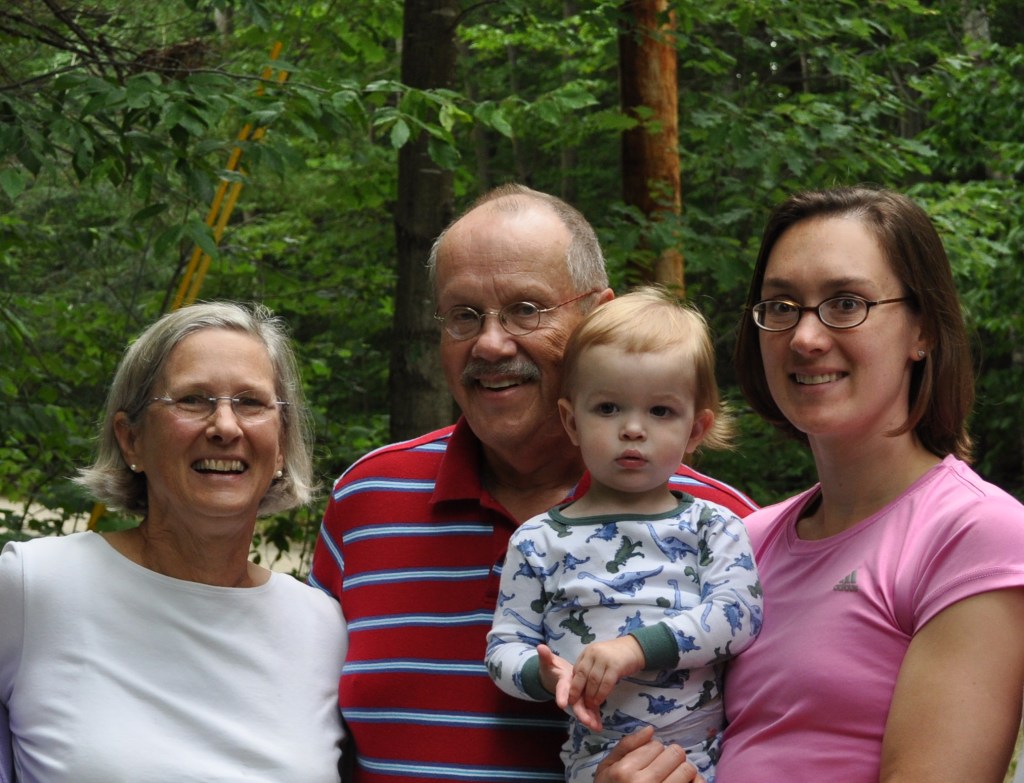
Image of The Browns, December 2019, credit Ellen Pentz
I’ll jump on this bandwagon by highlighting the Top Ten Posts on More to Come as selected by you—the readers—in 2019. Here they are, in chronological order:
A recent view of my Reading Pile bookshelf
My 2018 Year-End Reading Listactually dates from December 29th of 2018, but the majority of the views came in this year. I have provided a short synopsis, with links to the longer posts, from the 21 books I read last year. Given that this one topped my list of views this past year, I’ve already posted the 2019 edition.
Two of the top ten posts resulted from my writings around my semi-retirement into a gap year. The first, Kindness, came about when I announced I was stepping down after 22 years from my position at the National Trust and was blown away by the kindness of the responses. As I said in the post, I felt like I woke up in the casket at my funeral and decided to stay there for a while and listen to the nice things people were saying. On Becoming Who You Arewas the post on my first day of unemployment (although planned) since 1977.
Don’t Create Followers, Create More Leaders focuses on my thoughts about the responsibilities of leaders after viewing several unexpected leadership lessons from long-time colleagues and friends in the U.K. It was management guru Tom Peters who said, “Leaders don’t create followers, they create more leaders.”
History Was All Around Me: PreserveCast podcast of my career in preservation (so far)ties to a podcast looking at my work at the National Trust for Historic Preservation and more. When PreserveCast host Nick Redding began our conversation on the award-winning Preservation Maryland podcast with a question about my path to preservation, my thoughts went to my childhood home, grandmother, and a favorite downtown theatre.
Create at the Intersection of Experience and Innovationwas a fun post, as I had a chance to highlight the creativity and thoughtfulness of singer Linda Ronstadt. Her comment in a recent documentary—“People would think I was trying to remake myself, but I never invented myself in the first place”—was the jumping-off point for this piece of writing. The documentary on Ronstadt’s life that was the source of this quote can be seen on CNN on New Year’s Day at 9 p.m. ET.
And Now We Dance
As you can imagine, I was very excited about the Washington Nationals run in the 2019 playoffs to become baseball’s World Series Champions. Apparently, my readers were as well. They Finished the Fight, the post that went up moments after the Nats won their improbable championship, was a big favorite, with comments from as far away as Red Sox Nation in Boston.
The always popular Year in Photos made the list as Our Year in Photos—2019. As I wrote in my monthly More to Come update email, this is pure “brag on the family” territory. If you like that kind of thing and want to see what the four of us have been up to for the past 12 months, revisit some of our travels, or check out the newest addition to the family (a cat, not a person), then this is the place to visit.
The Importance of Being Interestingwas a last minute addition to this list. But I’m not surprised that my friend Janet Hulstrand’s “breezy and digestible” book on how to live with the French shot up near the top of my charts. I found Janet’s take on how to understand these sometimes curious, somewhat frustrating, occasionally mystifying, but always interesting people to be delightful, informative, and useful all at once.
I hope you’ll find something among these ten posts that you missed the first time and want to read, or a favorite you’d like to revisit.
Thanks, as always, for reading, and have a good week.
Over the Thanksgiving holidays, I was listening to a live performance by blues guitarist Joe Bonamassa from Madison, Wisconsin, on the SiriusXM B.B. King’s Bluesville channel. In between songs, Bonamassa recounted a story from the band’s current tour, noting that they had recently found themselves with a rare couple of days off while staying in nearby Chicago. Instead of going to their customary Days Inn, the band decided to treat themselves to two nights at the Four Seasons.
Bonamassa said the accommodations were just what you’d expect from a luxury, four-star hotel, with the only downside being the 1200 “yuppies” who were attending a financial convention in the hotel. He ran into a group of these young, well-paid professionals at the elevator, and with his “street person” appearance and guitar case in hand, he became an instant target for a bully who clearly had more money than brains. Here’s how Bonamassa told of the interaction:
Yuppie Bully: “Hi. What’s in the case?”
Bonamassa: “‘It’s a guitar,’ I replied. ‘I wasn’t going to tell him that it was Tommy Bolin’s Les Paul‘” (one of many vintage guitars owned by Bonamassa.)*
Yuppie Bully: “‘Oh? Are you playing here at the hotel?’ he says with a smirk.”
Bonamassa: “No, I’m staying here.”
Yuppie Bully: Laughs to his gang, turns to Bonamassa, and says, “How does a guitar player afford to stay at the Four Seasons?”
Bonamassa: “Because I’m f**king good!”
It was the quietest 44-floor elevator ride imaginable.
Bonamassa is good. Scary good. He grew up listening to the British blues artists favored by his father, and his career began onstage when he was only 12 years old, opening for B.B. King in 1989. Today, he is acknowledged as one of the greatest guitar players of his generation. Bonamassa has released 21 solo albums on his own label, J&R Adventures.
Bonamassa’s country rock side comes out in this cover of Tennessee Plates, with guest vocals by the song’s writer, John Hiatt. To see Bonamassa’s work in contrast with other blues stylists, check out Going Downfrom the Rock and Roll Hall of Fame Induction of Freddie King. As one online commentator noted, Billy Gibbons (ZZ Top) plays classic Texas style blues, guitar god Derek Trucks (Tedeschi Trucks Band) is other-worldly on slide, and Bonamassa puts in more notes than should be humanly possible with his modern shred style blues.
But if you choose to only watch one Bonamassa video, make it this live version from Amsterdam of the Etta James classic I’d Rather Go Blind with the incredible blues rock singer Beth Hart. But don’t watch it in front of the kids…it gets intense, and you might have similar reactions as well!
Enjoy yourself some year-end blues.
More to come…
DJB
*Tommy Bolin was an American guitarist and songwriter who played with Zephyr (from 1969 to 1971), James Gang (from 1973 to 1974), and Deep Purple (from 1975 to 1976), in addition to maintaining a notable career as a solo artist and session musician.
Welcome to the 2019-20 college football bowl game season! Try to contain your excitement.
The only college football bowl game I ever attended was back in 1968 when Terry Bradshaw and the Louisiana Tech Bulldogs beat the Akron Zips (now there’s a great sports team name!) 33-13, in a cold and sparsely attended Grantland Rice Bowl in my hometown of Murfreesboro, Tennessee. In fact, it was the last Grantland Rice Bowl played there, as the sponsors moved the game to Baton Rouge the following year. I vaguely remember getting free tickets as a member of the 8th grade football team (yes, that was my one and only foray into the sport) and going with some friends. We knew that Bradshaw was good, but we may have paid more attention (and kept our ticket stubs) had we known that Bradshaw would be the #1 selection in the NFL draft the following year and go on to play for the Pittsburgh Steelers, winning four Super Bowl titles in a six-year period.
As for the bowl’s name, Grantland Rice, one of the first well-known sportswriters of the early 20th century, was born in Murfreesboro. Recognized especially for his elegant prose, Rice is best known for being the writer who dubbed the great backfield of the 1924 Notre Dame Fighting Irish football team the “Four Horsemen” of Notre Dame. This was a Biblical reference to the Four Horsemen of the Apocalypse. Rice’s famous account of the Notre Dame vs. Army game played at the Polo Grounds was published in the New York Herald Tribune on October 18:
Outlined against a blue-gray October sky the Four Horsemen rode again. In dramatic lore they are known as famine, pestilence, destruction and death. These are only aliases. Their real names are: Stuhldreher, Miller, Crowley and Layden. They formed the crest of the South Bend cyclone before which another fighting Army team was swept over the precipice at the Polo Grounds this afternoon as 55,000 spectators peered down upon the bewildering panorama spread out upon the green plain below.
Now that’s writing deserving of a bowl name!
I bring this up because several years ago I wrote about the rash of silly college bowl names. I was prompted to comment on this turn-of-events after my father’s alma mater had just made it to something called the “BBVA Compass Bowl.”* My father and I were clearly thinking along the same lines, because the day before he’d sent the cartoon at the top of this post along with a link to a 2014 New Year’s Day article in the LA Times entitled “Bowl names are an embarrassment to college football.”
The author of both the cartoon and the article, David Horsey, thought that perhaps 35 bowls had somehow cheapened the prize. “Being a Rose Bowl champion or an Orange Bowl victor carries a tradition that means something special,” Horsey wrote in 2014. “Winning a bowl named after yet another restaurant chain—Outback Steakhouse, for instance—seems just a bit cheap.”
Well, here we are in the 2019-20 college bowl season, and there are now 40 bowl games to choose from. And there are still sportswriters opining on the nature of the names of those bowl games.
Culpepper sees the current trend as a personal attack on our national “brand.”
So many of our bowls have clunky names, which are an inveterate threat to our national coolness, yet we sit there inertly and take it even as everyone can agree that the cool bowl names involve stuff that sprouts from the soil.
Somehow we have named only seven of the 40 current bowls (for things that grow from the ground)…thusly: Rose, Sugar, Orange, Cotton, Peach, Potato and Camellia.
Special commendation goes to the Potato and the Camellia, so named in 2011 and 2014, respectively, for laudable attempts in a modern era to stem a dreary tide that claimed even the late, great Poinsettia.”
Culpepper clearly has some favorites from the past, such as the aforementioned Poinsettia and the Tangerine, that he’d like to see resurrected. He notes that, “As names go, the Astro-Bluebonnet Bowl still ranks No. 1, lifetime, in overall funkiness.” And he clearly wouldn’t mind if the Bad Boy Mowers Gasparilla Bowl had to come up with a new name. Culpepper also has some suggestions in mind.
If I went to college and played for a team and told people later in life that I had played in a ‘Longleaf Pine Bowl,’ I would know I hailed from a country of singular vividness.
Treat yourself to a few minutes of laughter this holiday bowl season by reading Culpepper’s column. Who knows, you may decide just to skip this year’s BBVA Compass Bowl. Oh, wait. They dropped that name after 2014, and you’d actually be going to the TicketSmarter Birmingham Bowl on January 2nd.
Maybe we should all hold out until we get a Green Chile Bowl, Saguaro Bowl, Mesquite Bowl, or even a Salad Bowl.
More to come…
DJB
*BBVA Compass, for those who don’t know, is a bank holding company that is a subsidiary of the Spanish multinational Banco Bilbao Vizcaya Argentaria. You can see why they abbreviated it to BBVA for Americans!
I’ve long been a fan of the pithy proverb that contains truth in 20 words or less. Perhaps my love for the short and to-the-point adage came from my Grandmother Brown, who was known to say things such as, “The graveyard is full of people who thought the world couldn’t get along without them.”
I admit I might have heard that particular one when she thought I was getting too big for my britches.
Grandmother and Granddaddy Brown
To capture some of my favorite sayings without having to write an entire blog post about them, I created a feature on More to Come that I labeled More to Consider. (Clever, huh?) Every other week or so I update these quick bursts of truth. This section of the website is easiest to see on a laptop, where it resides near the top of the right hand column. But most people read my posts from their phones, where you have to scroll almost to the bottom before finding the saying for the week. With that in mind, I thought I’d share some of the more recent ones, with little or no additional comment.
As this is posted, the current iteration of More to Consider is from one of my favorite authors, Rebecca Solnit.
“Difficulty is always a school, though learning is optional.”
Before Solnit’s quote made it to the top of the queue, I featured a line from President John F. Kennedy, which seemed appropriate for the Thanksgiving holiday season.
“As we express our gratitude, we must never forget that the highest appreciation is not to utter words, but to live by them.”
In November, I also called on a historical figure—First Lady (and First Mother) Abigail Adams—for a reminder that we learn through difficulties, which seemed as appropriate a lesson in 2019 as it did in 1780, when she wrote to her son, the future president John Quincy Adams.
“The habits of a vigorous mind are formed in contending with difficulties. Great necessities call out great virtues.”
Far from Abigail Adams in place and time, but on the same train of thought, was Washington Nationals manager Dave Martinez. I posted his inspirational comment, which he credits to his mother, made after his team—against great odds and through a season of upheavals—won the National League championship (and then the World Series championship) in baseball.
“Bumpy roads often lead to beautiful places.”
Martinez isn’t the first baseball player/manager to make an appearance in More to Consider. I called on the great Negro League pitcher Satchel Paige in August of this year for the following:
“Ain’t no man can avoid being born average, but there ain’t no man got to be common.”
Good songwriters are masters of the pithy hook, and I’ve been known to succumb to their talents at times. Butch Hancock, Jimmie Dale Gilmore, and Joe Ely—known collectively as The Flatlanders—hit the nail on the head with,
“It’s the fearless who love and the loveless who fear.”
There’s a lot of truth for our times in that line.
There have been several instances where I’ve used the More to Consider space to highlight my love of reading and writing. First, this gem from Annie Dillard:
“Who would call a day spent reading a good day? But a life spent reading—that is a good life.”
And then this bit of advice from writer Colum McCann:
“On occasion we write a sentence that isn’t, in fact, correct, but it sings. And the question is: Would you rather be the ornithologist or the bird?”
And finally, from the late Toni Morrison:
“A writer’s life and work are not a gift to mankind; they are its necessity.”
My grandmother made it clear that complaining wasn’t allowed in her house. That may be why this George Bernard Shaw quote resonated with me the first time I saw it.
“The true joy in life is to be a force of fortune instead of a feverish, selfish little clod of ailments and grievances complaining that the world will not devote itself to making you happy.”
I’ll end with my favorite saying from Grandmother Brown, which I heard on more than one occasion. It seems especially appropriate for this time in our nation’s history. Change and progress require hard work, and cynics often want to avoid the responsibility of that work. Change and progress also require hope, and as I’ve written before, “hope demands things that despair does not.” Hope is risky. But hope is also in love with success.
We need to remember that our country’s values and ultimate success “rests on the habit of holding our fellow citizens in thoughtful regard not because they are exceptional (or famous, or beautiful, or rich) but simply because they are our fellow citizens.” And, we need to understand that “What joins the Americans one to another is not a common nationality, language, race, or ancestry (all of which testify to the burdens of the past) but rather their complicity in a shared work of the imagination.”
As we look ahead to 2020, and all the work to be done to get our country back on the right track, we could do worse than to keep Grandmother Brown’s words in mind: