Latest Posts

Panama Hotel

Those who do not know their history…

The recent executive order temporarily banning travel from seven predominantly Muslim countries brings to many minds an earlier, ugly incident from American history.  As is often the case, those who do not know their history are destined to repeat it.

An op-ed in yesterday’s New York Times spoke to this earlier, discriminatory ban.  When Lies Overruled Rights tells the story of the internment of Japanese-Americans during World War II.

“Seventy-five years ago on Sunday, under President Franklin D. Roosevelt’s Executive Order 9066, all people of Japanese ancestry living on the West Coast were forced to leave their homes and report to incarceration camps. Two-thirds were American citizens. Fred Korematsu, my father, then 23, refused to go. A proud and loyal citizen, he had tried to enlist in the National Guard but was rejected and was wrongly fired from his job as a welder in an Oakland, Calif., shipyard He was arrested and tried for defying the executive order. Upon conviction, he was held in a horse stall at a hastily converted racetrack until he and his family were moved to a desolate camp in Topaz, Utah. My father told me later that jail was better than the camp.

He appealed his conviction to the Supreme Court. In his case, and in cases brought by Minoru Yasui and Gordon Hirabayashi — among the most infamous cases in American legal history — the court in 1944 upheld the executive order. Justice Frank Murphy vehemently opposed the majority decision, writing in a dissenting opinion, “Racial discrimination in any form and in any degree has no justifiable part whatever in our democratic way of life.” In the hysteria of war and racialized propaganda, my father’s citizenship did not protect him. For him and the 120,000 other Japanese-Americans incarcerated during World War II, there was no attempt to sort the loyal from the disloyal.”

The entire op-ed is worth a read.  And I’m pleased to note that the National Trust has been working to save one of the places that tells the stories associated with the Japanese-American experience: the Panama Hotel.

Japanese Bath
Japanese Bath at the Panama Hotel

“The Panama Hotel, an early 20th century five story brick structure, is an outstanding example of the single-room occupancy hotels that characterize Seattle’s pre-World War II Nihonmachi (Japantown). Constructed in 1910 and designed by Seattle’s first Japanese American architect, Sabro Ozasa, the structure, building design, materials and uses are remarkably intact. The basement includes the Hashidate Yu, the best surviving example in the U.S. of an urban Japanese-style bath house or sento. Also, in the basement is a large storage area containing the belongings of Japanese Americans incarcerated in World War II as well as remnants of the early operations of this commercial building.”

Bath House sign
Bath House sign

The Panama Hotel is a place that speaks to the true resilience of the American spirit. It is a poignant place that reminds us of what happens when lies and fear take precedent over our constitutional rights. This is a historic place as relevant today as it was 70+ years ago.

More to come…

DJB


Quest for the Best (Picture) – Part 3

Film ReelEarlier this week Candice and I saw the fourth of this year’s Best Picture nominees.  Manchester by the Sea is both a tragic story and a well-crated, artful movie.  It is very much a deserving nominee for the Oscar for Best Picture of the year.

The script is the first star here, in that the movie tells a story full of flashbacks and dreams that let the story unfold at a pace that is never rushed yet seems appropriately paced.  Lee Chandler – played masterfully by Casey Affleck – returns to his hometown after his brother Joe dies of heart failure.  He quickly learns that Joe has made him the guardian of his 16-year-old son, Patrick, played by Lucas Hedges.  The relationship of Lee and Patrick could normally be seen as sharing a common grief – if from different perspectives – but as the movie unfolds it becomes clearer that Lee’s grief is much deeper and longer, and is sparked by a return to a town he had to leave in order to live.

There is a great deal to unpack in this movie.  First of all, it takes the viewer seriously.  This movie looks at the lingering – perhaps never-ending – affects of unspeakable tragedy, and accepts that neatly tied bows are for sit-coms, not life.  However, there is also a good bit of humor in this movie.  One reviewer noted that Lee and Patrick – for all the awkwardness in their relationship – make a great comedy team.  There were numerous times when our audience was laughing out loud – appropriately – at the short comments that punctuate the dialogue.  Heck, just watching Lee learn of – and then try and negotiate – Patrick’s two simultaneous romantic relationships is a mini-comedy in and of itself.

As Candice and I drove home from seeing Manchester-by-the-Sea, we commented on the Irish-Catholic overlay to this movie.  In reflection, part of the tragedy of the story is the loss of exceptionalism felt by the white male.  That the prerogatives of the white male exists can easily be seen in Lee’s ordeal at the Manchester police station.  This line of thinking is developed more fully in A.O. Scott’s review of the movie for the New York Times, and this element helps make the movie relevant in this day and age.

Manchester-by-the-Sea is a tragic story, but a movie well worth seeing.

So now with the fourth movie under our belt, here’s my (always changing) ranking:

1A.  Hidden Figures

1B.  Manchester-by-the-Sea

3.  Moonlight

4.  La La Land

We are hoping to catch a couple more before Candice heads out of town…and I’ll be left to my own devices to watch what’s left.

In any event, this is shaping up to be a great group of Best Picture nominees.

More to come…

DJB

The Power of Habit

Habits are not destiny

“Most of the choices we make each day may feel like the products of well-considered decision making, but they’re not.  They’re habits.”  That’s according to Charles Duhigg, author of The Power of Habit:  Why we Do What We Do in Life and Business.

I got to thinking about the habits that we undertake while reflecting on the discussions from a recent management team retreat.  We were probing how and why we do certain things to see if there were routines – or habits – we wanted to break or establish.

Scientists tell us that habits emerge because our brains are looking for ways to save effort.  We all can identify habits – both personal and professional – that impact our lives.  Just as we have good and bad personal habits, organizations have good and bad routines.  We want to avoid habits that turn important decision-making over to a process that occurs “without actually thinking,” but at the same time we want to build routines that support our goals and aspirations.

Thankfully, habits and routines can be changed.  They aren’t destiny, to quote Duhigg again.  At their most basic, habits include “cues, routines, and rewards.”  Once we recognize the cycle – and understand that we can change the routine to override a bad habit – we can decide to change it.  But we have to make that conscious decision.

I’ll end with a short story that Duhigg uses to illustrate his point:

“The way we habitually think of our surroundings and ourselves create the worlds that we each inhabit. ‘There are two young fish swimming along and they happen to meet an older fish swimming the other way, who nods at them and says ‘Morning boys. How’s the water? … And the two young fish swim on for a bit, and then eventually one of them looks over at the other and goes, ‘What the hell is water?’’

The water is habits, the unthinking choices and invisible decisions that surround us every day – and which, just by looking at them, become visible again.”

As we begin the new year working on New Year’s resolutions and strategic plans, this might be a good time to consider which habits and routines are holding us back and need attention.

Have a good week.

More to come…

DJB

The priorities in life

I have read two books recently where I could simply and honestly say, “You should read this.”  The second of the two, which I finished reading Saturday morning, seemed to be the appropriate one where I should sit down and capture my thoughts immediately.

WHen Breath Becomes Air
When Breath Becomes Air by Paul Kalanithi

When Breath Becomes Air by Dr. Paul Kalanithi has been on the New York Times Bestseller list and was a top book of 2016 on many lists.  There’s a reason.  This is a book where, as the Times reviewer noted, “Finishing this book and then forgetting about it is simply not an option.”

Paul Kalanithi was a neurosurgeon and writer who – at age 36 and near the end of residency training at Stanford – was diagnosed with stage IV lung cancer.  This memoir is his look at confronting death with all the knowledge of a top-trained doctor and all the uncertainty of a human being who imagined a whole life of promise in front of him.

Kalanithi studied English literature, human biology and philosophy before turning to a decade of medical school training.  A classic seeker and striver, he was asking the essential questions of life and death while reading literature, seeking answers in words. Then he turned to the real time grappling with life and death that doctors face every day.

The first half of the book explains how he reached that point, of how he fought the idea of becoming a doctor because of his cardiologist father’s absences from his family while Paul was growing up.  Paul’s search was for “what makes life meaningful?”  He eventually turns to the medical profession, which would “allow me a chance to find answers that are not in books, to find a different sort of sublime, to forge relationships with the suffering, and to keep following the question of what makes human life meaningful, even in the face of death and decay.”

At the end of this section entitled “In Perfect Health I Begin,” Kalanithi writes about the suicide of a fellow resident, after a difficult complication in a surgery he is performing.  It is an agonizing segue to the book’s second part, “Cease Not Until Death.”

“Most lives are lived with passivity toward death—it’s something that happens to you and those around you.  But Jeff and I had trained for years to actively engage with death, to grapple with it, like Jacob and the angel, and, in so doing, to confront the meaning of a life.  We had assumed an onerous yoke, that of mortal responsibility.  Our patients’ lives and identities may be in our hands, yet death always wins.  Even if you are perfect, the world isn’t.  The secret is to know that the deck is stacked, that you will lose, that your hands or judgment will slip, and yet still struggle to win for your patients.  You can’t ever reach perfection, but you can believe in an asymptote toward which you are ceaselessly striving.”

Where the book’s first half looks unflinchingly at the challenges of being a neurosurgeon, Part II takes an equally direct look at facing death.  Especially facing death at a time where one’s whole life and promise is still assumed to lie ahead.

There are many brave and wise souls who show up in Kalanithi’s inevitable march.  Chief among them is his lung cancer oncologist, Emma Hayward.  As the doctor overseeing Kalanithi’s treatment, she shows up throughout the story.  But to Kalanithi, her gentle but persistent questions about what really mattered to him and his family, knowing that would change on a regular basis as they faced death, was key.  In a 2014 interview for a Stanford Medical Journal, Kalanithi explained this important aspect of the work of the oncologist:

“Patients are bombarded with well-meaning advice, from dietary recommendations to holistic therapy to cutting-edge research. It can easily occupy all a patient’s time, when you ought to also spend time thinking about the priorities in your life (emphasis mine). Physicians can also advise patients, as my dad would insist, that they can stop skipping dessert.”

In his beautiful yet straightforward prose, Kalanithi writes about hope in light of medical statistics, and he notes that “It occurred to me that my relationship with statistics changed as soon as I became one.”

There are many elements of the story of Paul and his wife Lucy’s journey worth mentioning.  Especially touching is their decision to have a child, who is born eight months before Paul dies.  The book is dedicated to Cady – that child – and Kalanithi’s last paragraph is focused on her life and the meaning of her existence.  The epilogue, written by Lucy after Paul’s death, is also heart rendering.  I made sure not to read that on the train, as I knew – accurately – that my eyes would well up with tears that I couldn’t control.

But there is one final segment I want to highlight:  Paul’s faith.  He talks in a straightforward way about his time of doubt, but well before his diagnosis he had returned to his roots in faith.

Paul Kalanithi wrote that although he spent much of his 20s believing in a “material conception of reality” and a “scientific worldview that would grant complete metaphysics” except for “outmoded concepts like souls, God and bearded white men,” he found a problem.

The problem, however, eventually became evident: to make science the arbiter of metaphysics is to banish not only God from the world but also love, hate, meaning — to consider a world that is self-evidently not the world we live in.

That is not to say that if you believe in meaning you must also believe in God,’ he added. ‘It is to say, though, that if you believe that science provides no basis for God, then you are almost obligated to conclude that science provides no basis for meaning and, therefore, life itself doesn’t have any. In other words, existential claims have no weight; all knowledge is scientific knowledge.

This is a wonderful book.  But Kalanithi would not expect us to find all the answers here. Just like Emma, his voice comes through this book, saying, “You have to figure out what’s most important to you.”

In the end, it cannot be doubted that each of us can see only a part of the picture.  The doctor sees one, the patient another, the engineer a third, the economist a fourth, the pearl driver a fifth, the alcoholic a sixth, the cable guy a seventh, the sheep farmer an eighth, the Indian beggar a ninth, the pastor a tenth.  Human knowledge is never contained in one person.  It grows from the relationships we create between each other and the world, and still it is never complete.

Just read it.

More to come…

DJB

Image from Pixabay.

Quest for the Best Picture (2016), Part 2

Film ReelAfter this weekend, Candice and I are one-third of the way towards our annual goal of viewing all the “Best Picture” Oscar nominees.  We’ve seen three very different films, but all terrific in their own way.

Last weekend we saw Hidden Figures, a wonderful movie with an inspiring story just right for our times.  On Friday we again walked up to AFI Silver Theater, this time to see Moonlight.

This coming of age film was both difficult and yet ultimately very satisfying. I was initially uncomfortable, because I was disoriented by the context.  The story of a young, gay, African American male learning about who he is through the bullying, teasing, and uncertainty was one I could understand. However, the setting – amidst the poverty, racism, and drug culture of Miami – was not familiar.  Once I sorted that out in my mind, I saw the strong qualities of this movie on multiple levels.

The acting is superb, beginning with Mahershala Ali as Juan, the drug dealer who befriends the main character, Chiron, and Naomie Harris as Chiron’s mother Paula. It was also nice to be introduced to Janelle Monáe in the first two films we saw the week, in Moonlight as Teresa and as Mary in Hidden Figures.

Moonlight is a well-crafted film on several levels, and is worth a view.

On Sunday, we decided to go in a different direction and took in La La Land at the nearby Bethesda Row Cinemas.  This film has much to recommend it.  The music is infectious.  The acting – especially Emma Stone – is superb.  The opening musical sequence is incredible – and worth the price of admission.  Do I think it is the year’s best movie?  No.  Do I think it is worth your time?  Absolutely.

So my first ranking looks like this:

  1.  Hidden Figures
  2. Moonlight
  3. La La Land

Two and three are actually interchangeable, and they might change as I see more.  But I think the time is just right, and perhaps even critical, for Hidden Figures.

We have some more to see, so check back!

More to come…

DJB

He (or She) Who Hesitates is Not Always Lost

Right or lefgt

Right or left

A couple were riding in their car recently when they approached an intersection and pulled into the right lane in order to make a turn.  Immediately in front of them was a car with the left blinker engaged.  The husband made the comment – with irritation in his voice – “Why does this guy think he can turn left from the right hand lane?”  A few seconds later he looked up, realized that the four-lane street dead-ended into another four-lane road, and that the overhead signage indicated that the right lane could indeed be used for either left or right turns.

Turning to his wife, he pointed to the sign and said, “Never mind.”

His wife, speaking with a tone of voice that reflected more than three decades of patiently waiting for him to observe the obvious, replied, “Several years ago I came to a realization that changed my life.  When I faced a situation where I thought someone was in the wrong,” she said, “I stopped myself from judging them and asked instead ‘What is here that I do not understand?’”  She continued, “That simple change helped me hold back from being too judgmental and sent me down a path of empathy and understanding.”

“Oh,” said the husband, clearly realizing that he needed to think more deeply about his wife’s point of view.

This story came to mind as I was reading about a call for the practice of hesitating.  The author said, “By hesitating, I am not talking about being demure nor about being spineless.  I’m speaking here of reverencing those whom you find alien.”  Every day in both work and our private lives we are called upon to make judgments, including some snap judgments, about people and situations.  Some of that is pragmatic, while some of it occurs on a deeper level.  “We have to make judgment calls about confrontations and interventions.  We must judge when someone has done too much or gone too far…”

By hesitating, by asking ourselves “What is here that I do not understand about this person or this situation?” we encourage ourselves to take a wider, more generous view. And I think that’s a good thing, for there’s almost always more going on than meets the eye…. if we take the time to understand.

Have a good week.

More to come…

DJB

Annual Super Bowl Rant

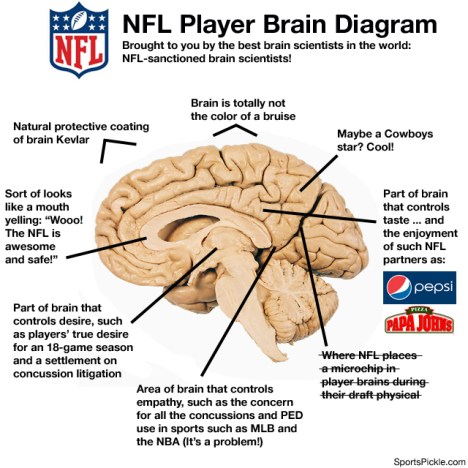
NFL Brain Diagram via SportsPickle.com

NFL Brain Diagram via SportsPickle.com

I thought I would just be upfront about it, and title this post accurately.  No alternative facts here, folks – just truth in advertising!

Ever since Super Bowl 48, when I famously (at least in my mind) declared it to be my last, I’ve gone back and explained why it is time to give up on the NFL.  Surprisingly, they still play the thing, and here we are at Super Bowl 51.  (Reason #10 I gave up on the NFL was those stupid Roman numerals.)

So, here we are on Super Bowl Saturday, and I’ll just give you a few more reasons you may want to go to your local theatre and watch Hidden Figures – my early front-runner for Best Picture of the Year.

(And since I gave you ten perfectly good reasons back in 2014, I’ll begin with reason #11.)

11.  It’s the damn Patriots.  Again.  Is there anyone more insufferable in sports than Bill Belichick/Tom Brady? (Wait, I’ll answer that.  Maybe Coach K. But that’s another post. And I know that Belichick and Brady are actually two people, but I’ve grouped them as one because they synch their grating to perfection.)  They push rules up to the line and over, and then act like their sainthood has been challenged when they are caught.  I hate Roger Goodell – he of the $40 million+ salary as a nonprofit executive (seriously) – but even I don’t wish for a Patriots victory so he has to eat crow and give them the trophy the year after Deflategate.

12.  The game is on FOX.  OMG.  You will recall that the last time FOX carried the Super Bowl, fans were subjected to Bill O’Reilly’s Gift for the Ages – otherwise known as the highly disrespectful “interview” of President Obama by the FOX News blowhard and original spinner of alternative facts.  So this year, will we be treated to the coronation of King Donald by Sean Hannity?  Will we learn that the most recent jobs report (the reporting period of which ended prior to Trump’s inauguration) reflects what a tremendous job Donald is doing?  (The Best!) Will we also learn that jobs report reflects the 76th consecutive month of job growth – the longest on record?  (That’s a trick question.  Of course we won’t.)  And once the annual game begins, will Donald finally get his military parade?  (That’s also a trick question, since FOX has been militarizing sports for decades.)

13.  It is all about the concussions.  Troy Aikman, who is providing color commentary for the game on FOX, says he cannot remember a playoff game that he won, due to a concussion that he suffered during the game.  Concussions are serious.  ‘Nuff said.

That’s enough ranting for this year.  And by the way, pitchers and catchers report in 9 days.

Winter bad.  Baseball good.

More to come…

DJB

Courage

Refuse to be afraid

In anticipation of next Sunday’s Super Bowl game, I’m going to pass along a football story.  However, those who know me well know that I don’t watch much football, so this tale will come via a baseball source, Pittsburgh Pirates manager Clint Hurdle as recounted in the book Big Data Baseball(And if you don’t want advice from a sports figure, just jump to the bottom for a little Tolkien.)

According to the book’s author, Hurdle recounted the following story for his team after a difficult patch of games:

“Tim Wrightman, a former All-American UCLA football player, tells a story about how, as a rookie lineman in the National Football League, he was up against the legendary pass rusher Lawrence Taylor.  Taylor was not only physically powerful and uncommonly quick, but a master at verbal intimidation.  Looking Tim in the eye, [Taylor] said, “Sonny, get ready.  I’m going left and there’s nothing you can do about it.”

Wrightman coolly responded, ‘Sir, is that your left or mine?’

The question froze Taylor long enough to allow Wrightman to throw a perfect block on him.

It’s amazing what we can accomplish if we refuse to be afraid.  Fear — whether it’s of pain, failure, or rejection — is a toxic emotion that creates monsters in our mind that consume self-confidence and intimidate us from doing our best or sometimes even trying at all.”

In his personal life Clint Hurdle faced alcoholism; rejection in his chosen field as both a player who never met the high expectations others had for him and as a manager who was fired; two failed marriages; and — once he married his third wife — the birth of a child with a genetic disorder.  But he kept pushing ahead, ultimately found himself, and achieved success.  He dealt with his anxieties through courage. He refused to be afraid.

Anxiety is a part of life, our “primal insecurity.”  I read a short essay recently that began, “Most theologians agree that the ‘feel’ of existence is anxiety.”  But the way past anxiety is hard, leading the essay’s author to note, “…courage, the only adequate resolution of our primal predicament, is the road less taken. Courage requires a steadfast, honest gaze at the human condition, but we are paralyzed by the thought of doing it alone.”  I was thinking of this type of courage yesterday as I watched the marvelous new movie Hidden FiguresNo matter the challenge, in the end courage is the only way through anxiety.  As J.R.R. Tolkien has written, “A man that flies from his fear may find that he has only taken a shortcut to meet it.”

Advice for these times from a baseball lifer, a theologian, and a fantasy novelist. That’s what is called a mixed bag!

Have a good week.  (And in case you were wondering, pitchers and catchers report in 15 days.)

More to come…

DJB

Quest for the Best (Picture) Returns

Film ReelAfter skipping a year, Candice and I are back and enthusiastic about choosing this year’s Best Picture winner for the Oscars.

We started this annual review of the top picture nominees from two highly unqualified movie critics around 2012, and did our last round in 2015.  Sometimes in year’s past, we weren’t interested in seeing up to a third of the nominees due to violence or other graphic content (I’m looking at you Quentin Tarantino).  But in reviewing the trailers for this year’s class, we’re excited about all of them.  We have a month…so let’s go!

Today, we walked up to AFI Silver to see Hidden Figures – a marvelous movie that we both highly recommend.  A colleague at work told me she had seen it three times already!  The story is compelling (especially since it is true) and the ensemble acting is superb.  Octavia Spencer as Dorothy Vaughan was especially compelling, but all three female leads were terrific from my perspective.

Get yourself to see this movie.  Oh, and bring your hanky.  Even though you know how the basic story ends, this is still a well-crafted tale that will probably spring some tears from those tear ducts.

We’ve set a high bar right out of the box.  I’ll post again after we get a couple more under our belt.

More to come…

DJB

The Healing Powers of Connection

Soiund of a Wild Snail Eating

“The Sound of a Wild Snail Eating” by Elisabeth Tova Bailey

Several years ago Candice was recovering from a severe concussion and was home bound for several months. During that time a friend gave her a small book, thinking she might relate to Elisabeth Tova Bailey’s story of isolated recovery from a mysterious illness. We had not thought about that gift for a long time until I went looking for a short read to pack on a recent trip.  I happened upon Bailey’s The Sound of a Wild Snail Eating and was immediately captivated by this strange yet reassuring tale.

To summarize the book might lead friends to question your reading choices. Bailey – an active and curious woman of 34 – contracts a mysterious disease while vacationing in Europe and finds herself bedridden and unsure that she will live.  A wild snail arrives in the bedroom where she is convalescing, brought in by a friend and placed in a pot of field violets. Over twelve months – and 178 pages – Bailey watches the snail explore its terrain, eat, sleep, eventually hatch 118 offspring, and return to the wild.  The book is filled with fascinating snail biology (they can mate with themselves!) and links to more snail literature than I could ever have imagined existed.

More than a natural history of gastropods, however, this meditation focuses on the healing powers of connection.  “Survival,” Elisabeth Tova Bailey writes, “often depends on a specific focus: a relationship, a belief, or a hope balanced on the edge of possibility.”  In her case, the key to survival from her mysterious virus lay in the sound of a tiny mouth – with more than 2,600 teeth – munching. One of my favorite lines in this witty memoir relates:

“I found myself experiencing tooth envy toward my gastropod companion.  It seemed far more sensible to belong to a species that had evolved natural tooth replacement than to belong to one that had developed the dental profession.”

To survive, Bailey reminds herself – like the snail – to “think not of the amount to be accomplished, the difficulties to be overcome, or the end to be attained, but set earnestly at the little task at your elbow, letting that be sufficient for the day.”

Snail (Algonquin Books)

Snail (credit: Algonquin Books)

It strikes me – especially in these times – that connections do have the ability to heal and get us through to the place where we need to be. The work of preservation connects people to place and people to the stories of other people.  Both are important.  Throughout this thoughtful and marvelously written book, Bailey makes the case eloquently and simply that connecting helps us get to where we belong and where we can thrive.  She quotes Edward O. Wilson from his Biophilia, noting that “The crucial first step to survival in all organisms is habitat selection.  If you get to the right place, everything else is likely to be easier.”

Here’s to a good week of connections.

More to come…

DJB