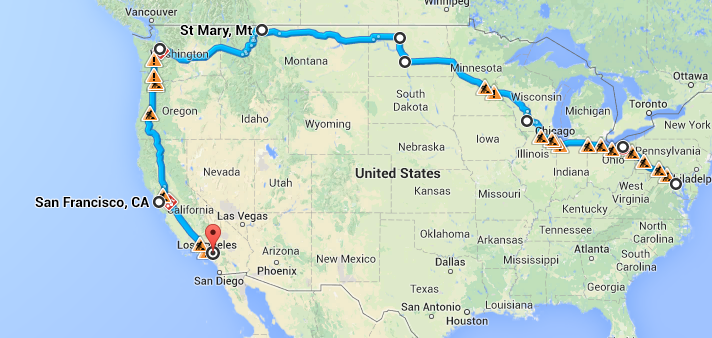
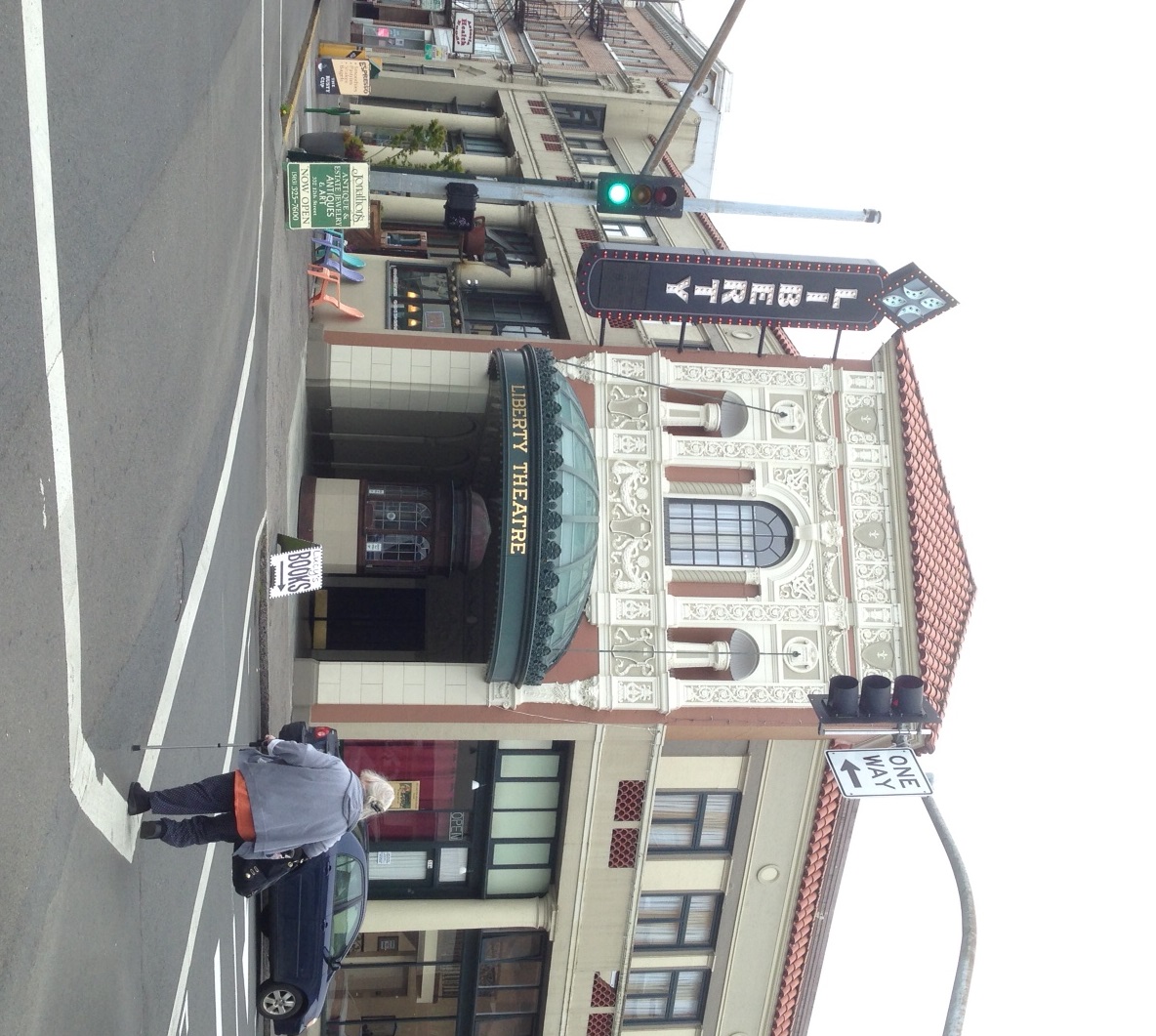
One could look at today’s itinerary for the Not All Who Wander Are Lost tour and think that our main goal was to go from Point A (Seattle) to Point B (Portland) as quickly and efficiently as possible. But those who think that way miss the point of our cross-country trip.
We avoided most of Interstate 5 – the main line between Seattle and Portland – and struck out from Gig Harbor, Washington, to get to Astoria, Oregon on the coast via the crooked road.
And think of what we would have missed had we taken the straight and narrow way.
Why, we wouldn’t have known that Montesano, Washington is the home of the Tree Farm. (It says so right on the sign.) We would have missed the fact that South Bend, Washington is the Oyster Capital of the World. Given the amount of “working forests” one sees in this section of the state, I suspect this is where America’s supply of paper is produced. And who knew that McCleary, Washington will be celebrating the 55th annual Bear Festival this year?
Plus, who could miss Raymond, Washington – the town of metal people! Roadside America describes it this way:
Along Highway 101, the “Raymond Wildlife Heritage Sculptures Corridor” is a display of dozens of rusty metal cutouts — a mixture of area wildlife and logging industry scenes. In some places, bear and fox frollick next to loads of logs pulled by teams of oxen or horses. The Corridor was created with the work of local artists starting in 1993. It is eye-catching mostly due to the quantity and density of pieces. For the weirder statues, stop in town.
If we had stayed on I-5, we would have missed pulling up behind not one but TWO green vintage Volkswagen vans trying to chug up the mountains as fast as they could…which is not very fast. Instead of getting mad, however, this reminded me of my youth, and the green VW bus that our family bought (on the Friday JFK was shot, no less). It was the original Fred Flintstone car, in that you felt that if you pedaled with your feet you might get up the hill faster. We saw it as kinda dorky when we first bought it, but later in the 60s and into the 70s it was cool to drive your friends around in the VW microbus (to quote Arlo Guthrie). I would have missed the chance to tell Claire those stories.
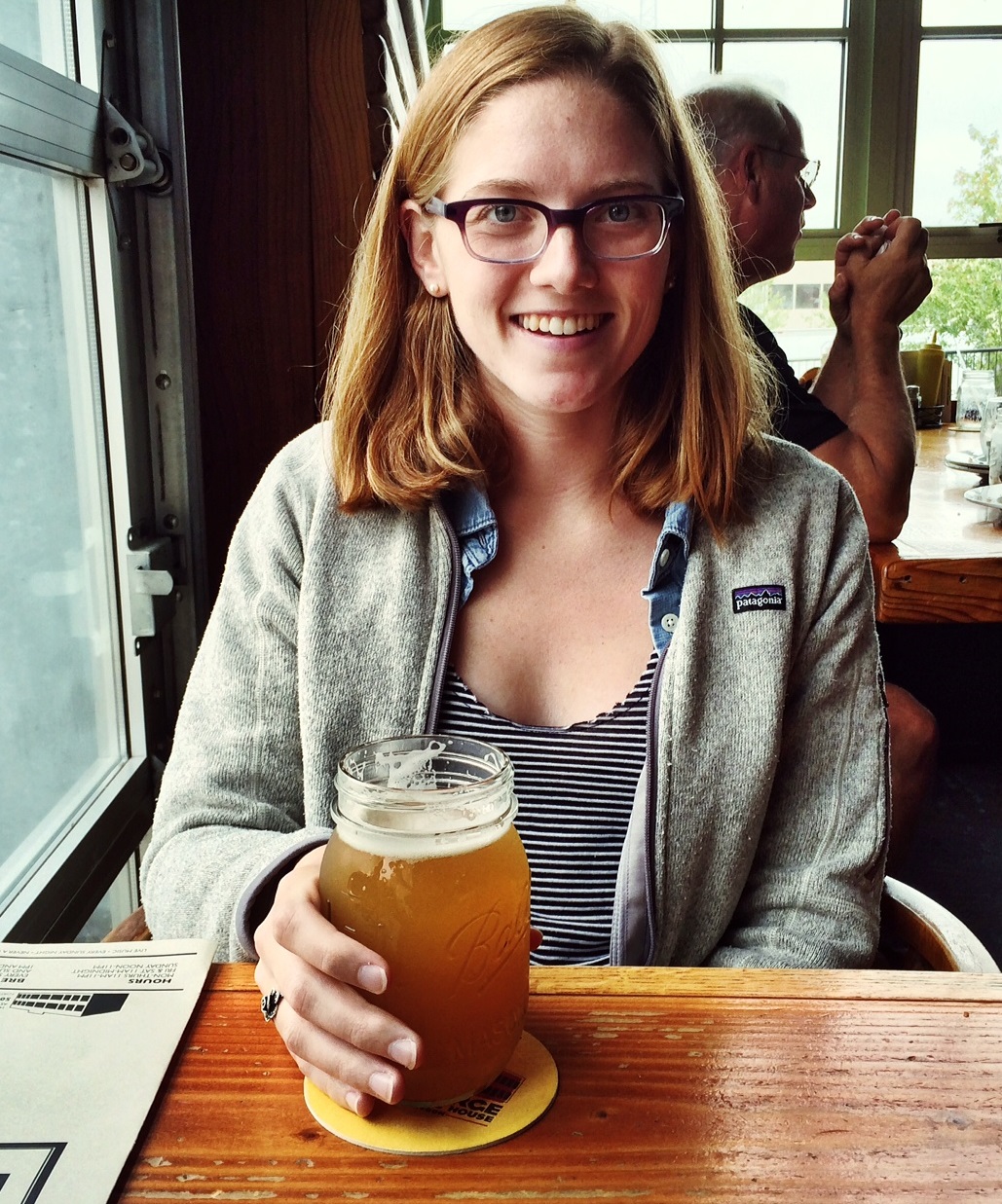
All of that before we made it to the fantastic town of Astoria, Oregon (shown at the top of the post). This jewel of a Main Street is where Lewis and Clark spent the winter of 1805-1806, meaning that we caught two winter campgrounds on this tour. We took in the town and – thanks again to Yelp – ended up at the wonderful Fort George Brewery + Public House for a meal of oysters and sausage topped with the seasonal Three Way IPA.
Thanks to the crooked road, we arrived rather late in Portland, where we met up with a long-time friend and former colleague Constance Beaumont. Constance took us on a quick driving tour of the historic neighborhoods and downtown of Portland, before we landed for dinner at Raven and Rose – a wonderful restaurant that I discovered on my last trip to the city. We sat at the counter to watch the cooks do their work in the wood-fired oven and to enjoy the conversation. Satisfied, we left and returned to Constance’s home where we’ll get an early start tomorrow for the long drive into California.
But before we leave Oregon, here’s a perfect tune for our day today. I have a lot of Darrell Scott on my playlist, but I love this acoustic solo version of his tune A Crooked Road. I hope you’ll enjoy it as well.
After the long and draining drive on Sunday in our Not All Who Wander Are Lost tour, we spent Monday resting, meeting up with friends, and simply enjoying Seattle.
I always love my trips to this Northwest city, but none more so than this visit when I was able to share some special places with Claire, who was seeing it for the first time. On recent business trips I have discovered a new favorite hotel in Seattle – the Paramount – and so we woke up Monday morning smack in the middle of Seattle’s downtown.
But we didn’t wake up too soon. We needed the morning to catch up on sleep and exercise and to finish up the previous day’s blog post, so we had a leisurely morning. And – as you can see – my late nights have caught up with me and these posts are now coming out the following morning. (I know that a few folks are reading, because at least one family member called Candice to make sure we were okay after not seeing a post early yesterday morning. Sorry for the scare!)
Yelp came through for us again, as we began walking the streets in search for a breakfast venue.
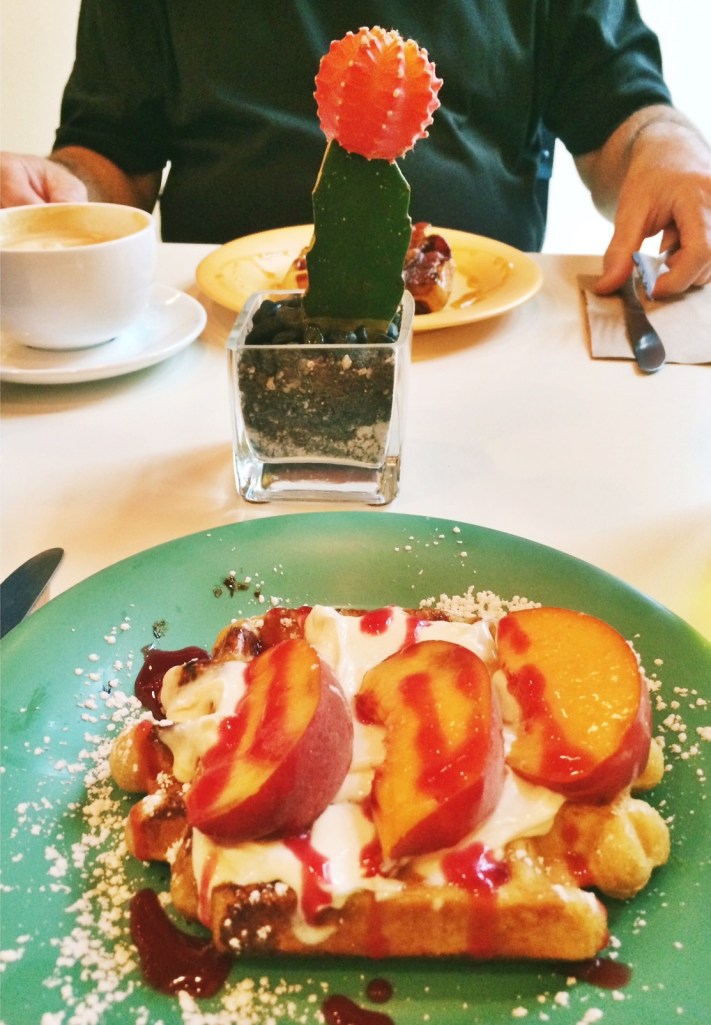
Sweet Iron was a great start to our day, but it wasn’t the last time we encountered tasty Washington State peaches.
Suitably fortified, we spent a couple of hours looking at fountains, stores, and buildings downtown. I recommended we run through a fountain that – in design – was supposed to have a dry passageway between the walls of water. In execution…well, we experienced some dampness. Luckily, Monday was the day Seattle topped its high temperature for the year – at 96 degrees – so we dried out before we hit the original, downtown Nordstroms and a few other stores.
As lunchtime grew near, we checked out of the Paramount and headed up to the Pike/Pine neighborhood of Seattle. Not for Tourists describes the area as
…the epicenter of Seattle hipster culture, where twenty-something bohemians waste their youth in assorted tattoo parlors, carefully-designed dive bars, and vintage clothing stores.
Now, while somewhat true, that seems a little harsh. In fact, the National Trust has an office in Pike/Pine and there are wonderful restaurants and stores, beyond the dive bars and places for vintage clothing.
Claire met up with her college friend Gailyn at Plum Bistro in Pike/Pine…which I chose because it is conveniently located above the offices of the Preservation Green Lab, so I could have lunch with my Seattle colleagues at the same restaurant. The food and company (at both ends of the room) were terrific. Then we wandered over to one of the great independent bookstores in the country – Elliott Bay Books – for some shopping. As I was checking out, the man behind the counter – finding out I was from the DC area – asked what was my bookstore. I replied, “Why, Politics and Prose, of course.” He quickly agreed, and said that they had a friendly competition over which store had more – and the more interesting – events. I love independent bookstores…and later today Claire will get introduced to one of the granddaddy’s of the genre: Powell’s City of Books in Portland. We skipped Stumptown in Pike/Pine (my favorite coffee shop)…but maybe we’ll catch that today in Portland as well.
We were in a bit of a rush. I wanted to show Claire “The center of the known universe” – aka Fremont. For those who know DC, think Takoma Park with more restaurants and dreadlocks.
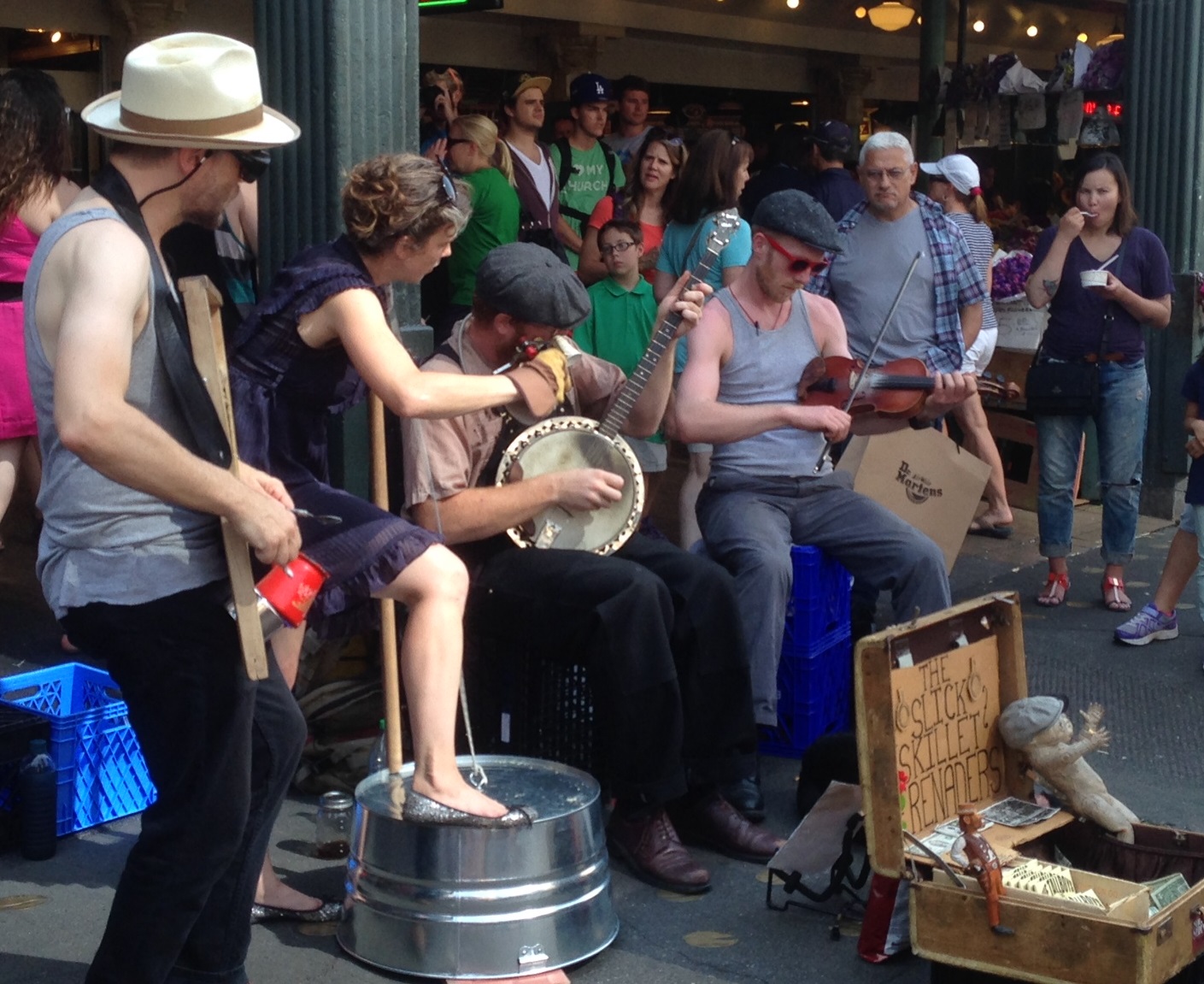
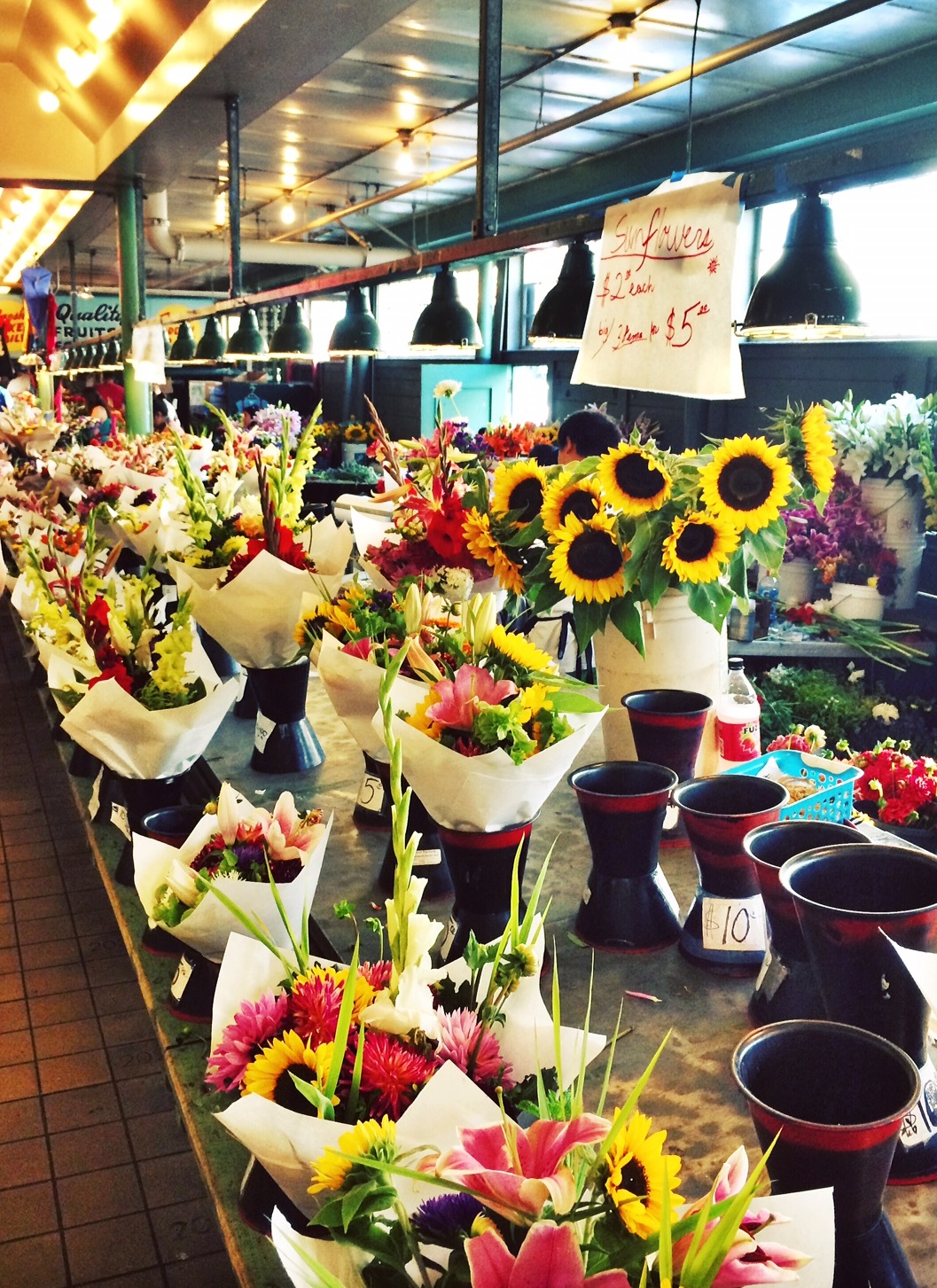
Then we had to take in Pike Place Market before heading south. Claire captured a flying fish on camera at the Pike Place Fish Company (a bit hard to do, as there are many more of us tourists trying to take pictures than there are people actually buying fish that the guys can toss back and forth between the counter and the folks working the floor). Nearby, The Slick Skillet Serenaders were busking to an appreciative crowd (photo at the top of the post), and the shops were brimming with people, flowers, and so much more.
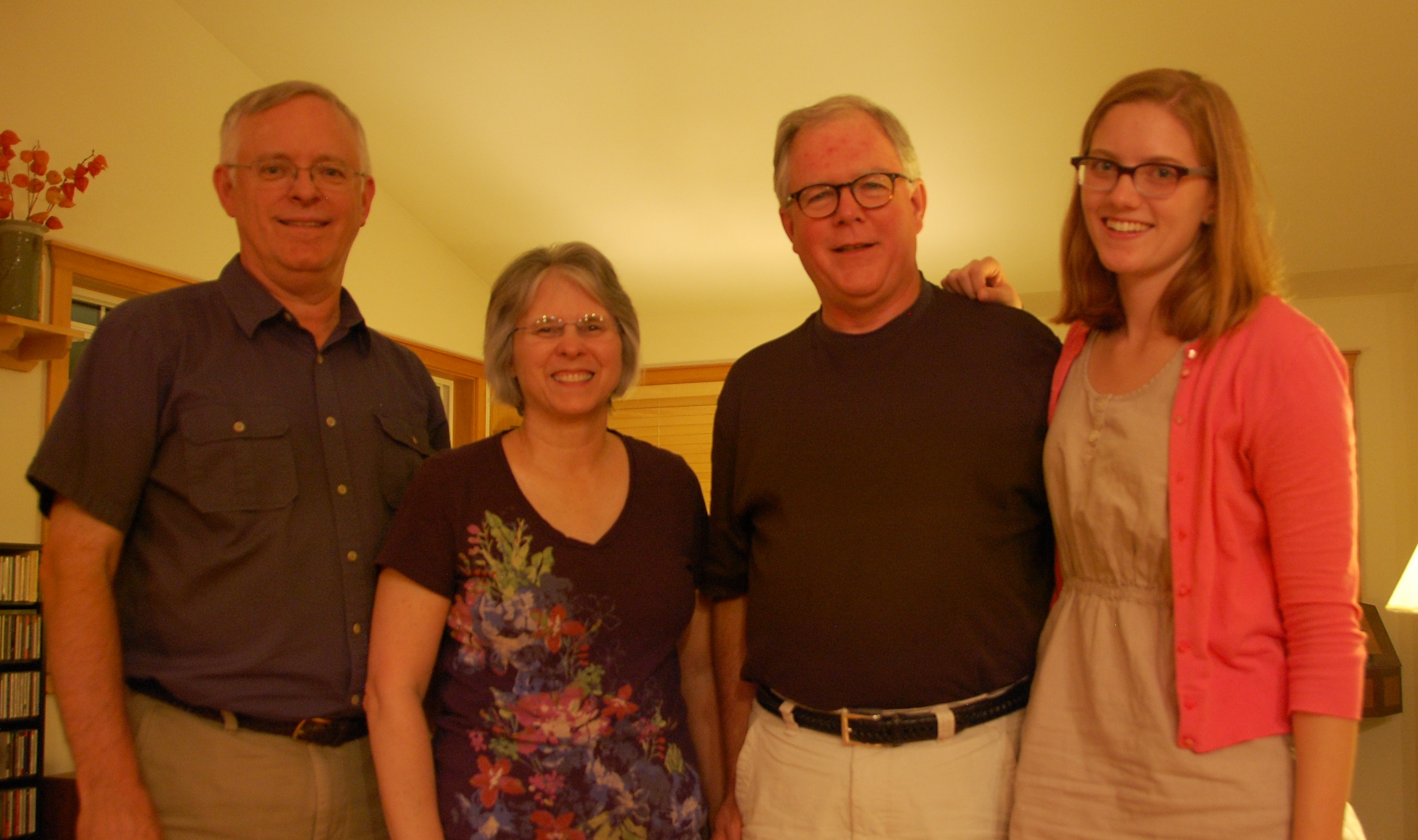
We stopped by to look into the original Starbucks (where we saw our second Nats hat of the trip) and then we bid good-bye to Seattle and headed out for the short drive to Gig Harbor, Washington, where we spent the night with our good friends Shari and Bruce Shull.
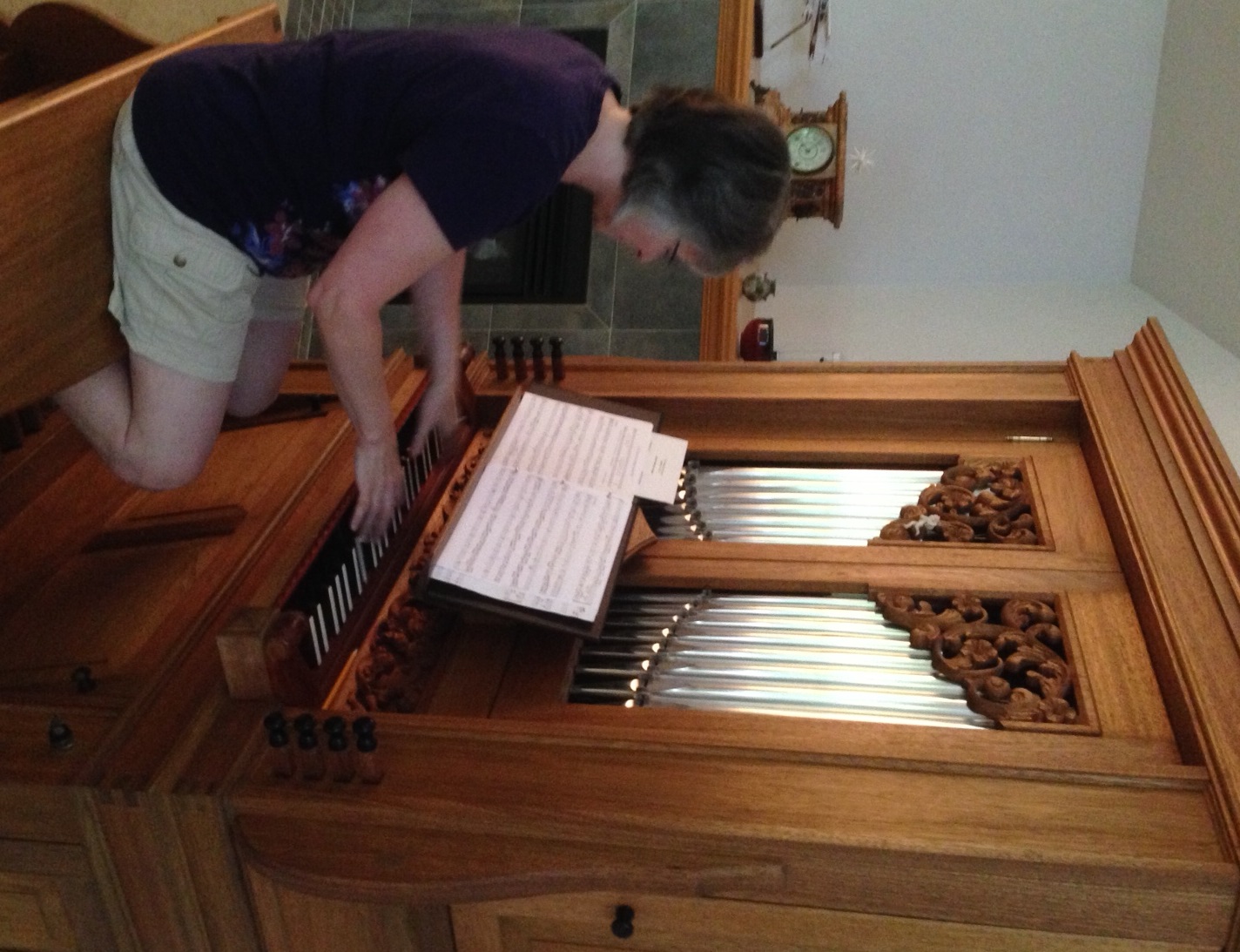
We got to know the Shulls in Staunton, where I sang with Shari in an early-music ensemble called Canticum Novum and Bruce was an organ builder with our friends at Taylor and Boody Organs. Nine years ago, Bruce and Shari moved west where Bruce joined the organbuilders at Paul Fritts and Company. I have written about my love of tracker organs in the past, so as soon as I saw this sweet little organ in their living room, I asked Shari to play some really old-time music for us – which she did with great skill, given that she is a professional organist.
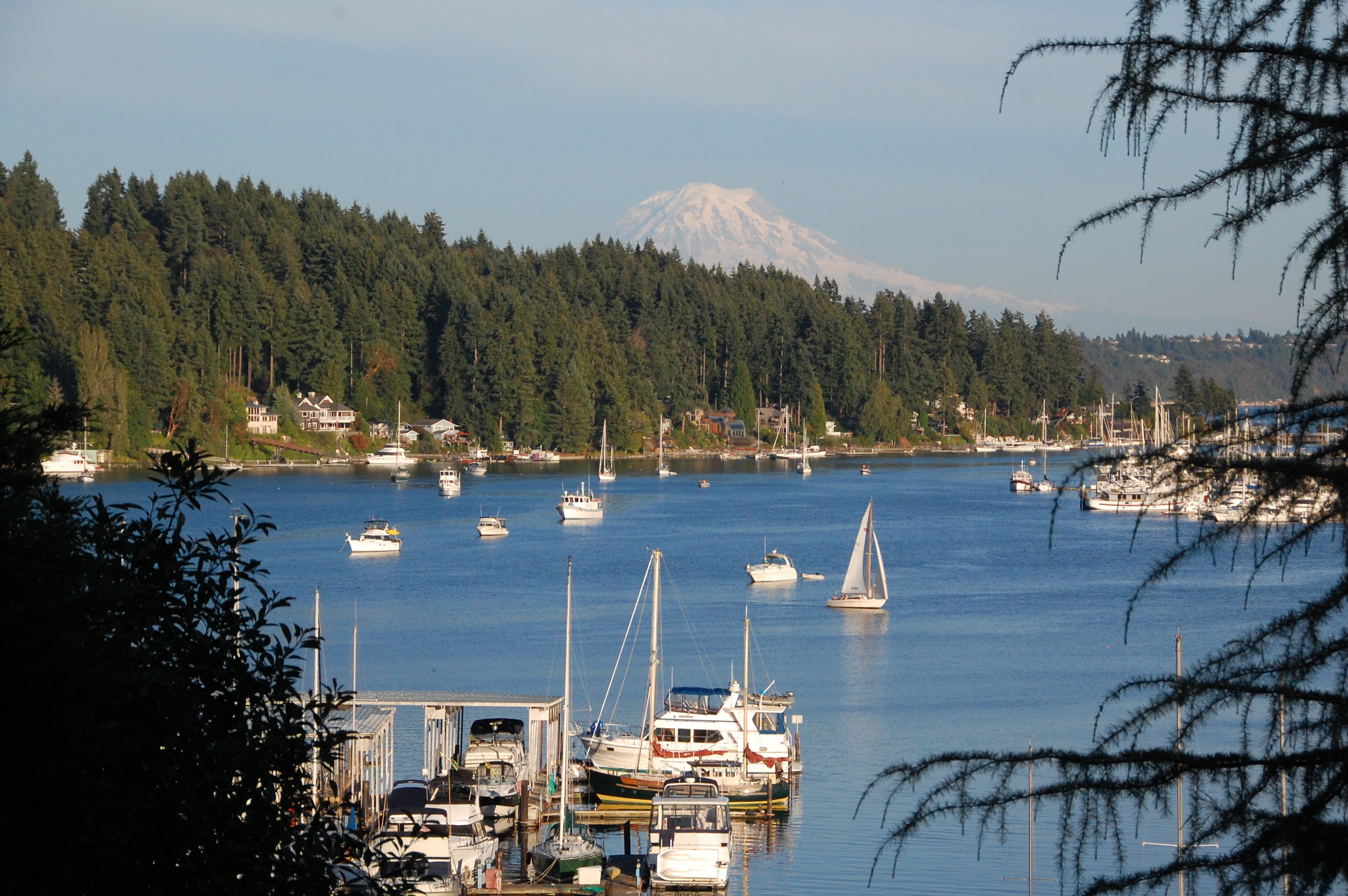
After catching up on family, business, quilt making, planes (Bruce is also a pilot), and the like, the four of us headed down to Gig Harbor (shown above in the photo by Bruce), where we enjoyed a delightful seafood dinner at Anthony’s…and, yes, we did split a sinful peach and ice-cream dessert. It was a wonderful evening.
Today…we’re off to Portland, Oregon which is another of my favorite cities (do you see a theme here?). In fact, Claire mentioned last evening at dinner that she was using this trip to check out places where she might live after college! Be still my heart – a real chance to come to the Pacific Northwest on a regular basis? I can just hear Candice sigh all the way across the country.
Oh well, I have a couple of tunes for yesterday. First, the Old Crow Medicine Show is one of the few bands on both Claire’s playlist and mine, so when Wagon Wheel came up on our drive south yesterday, I told Claire I was going to add that video in honor of the buskers at Pike Place Market. But then, after hearing Shari play the organ, I decided it was time for a second video, this time of Leon Berben playing on a historic Arp Schnitger organ…which happens to be a favorite organ builder of the Shull family. (I can’t tell how I know this secret!)
Arriving in Seattle Sunday evening, Claire and I celebrated making it cross-country with a dinner in the revolving restaurant atop the Space Needle. We did the Atlantic to the Pacific thing! I can check off one bucket list item. Who hoo!!
Of course, we’re just one day into the second half of our tour. Now that we’ve done the width of the country, we still have the length to go. Southern California or bust!
So this edition of Observations From the Road is the “We Made It (Well, In One Sense)” edition.
Sunday was a long day on the road – from Kalispell, Montana to Seattle, Washington. Three states (Idaho is in the middle there, for those who are geographically challenged.) That’s why this post is being finished on Monday morning. The trip was made longer by an hour-long back-up on I-90 in Washington State. There might have been an incident, but we suspect it was tied up as people gawked at the forest fire smoke that was coming over the mountains. More on that later. But long days give you great time to talk about such important items as:
Aloe Blacc, stage names, and television viewing habits – When Aloe Blacc‘s song Wake Me Up (Acoustic) came up on Claire’s playlist yesterday, I first said, “I like this guy’s voice.” Then I looked at the radio monitor and said, “Who would name their kid Aloe?” Claire replied, “I guarantee you that’s a made-up name” to which I replied, “Well, let’s Google it to find out.” (Careful readers are seeing a pattern here.) Sure enough, the guy’s real name is Egbert Nathaniel Dawkins III. Boy, if anyone is in need of a stage name it is END III! (Hey, why didn’t he choose that?!)
But the story doesn’t end here.
Somewhere else along the road, Claire was talking about going to Joshua Tree National Park this year, before she completes college. I have been to this wonderful place in the desert and I encouraged her to go. She mentioned that there was a television show she was watching that had a section about Joshua Tree, and then she added that it was on The Bachelorette. We laughed when I said I was hoping to hear if it was something like National Geographic Discoveries or some similar serious series. But then I admitted that the only TV I watch is sports. We both agreed that we don’t get our intellectual stimulation from television.
Now, back to Aloe Blacc. As we were nearing Seattle, his song The Man came on. I said, “I know that tune. It is the music for Beats by Dr. Dre headphones.” She said, “Huh?” And I said, “Oh, it is on ESPN all the time, with these famous athletes wearing his headphones and listening to The Man while people scream at them.” She responded, “Oh…television sports” and didn’t have to say more. We laughed. Again. Bottom line: don’t come to me for pop culture trivia unless it stars some sports guys.
Montana gets more and more interesting as you drive west – The eastern portion of Montana is very interesting, if a bit big. The western slice, on the other side of Glacier, is amazing. We drove by Flathead Lake – which is beautiful in the morning sun – and then took the road to Wallace, Idaho through some of the most stunning mountain scenery I’ve ever seen. Claire’s panorama above is beautiful, but you don’t get the sense of the heights of the mountains here that one has as you drive. The road literally hugs the mountains and separates them from the river for miles on end. We pulled over several times just to gawk. Amazing.
Solitude and other thoughts – I had so many wonderful conversations with Claire on Sunday. They are too numerous to mention (and some too personal to post). That’s the wonder of long periods together in the car. But one that struck me was her take on nature and solitude. As we were driving through Montana – where you can go for miles without seeing a house, much less a person – Claire began talking about her readings while on a special summer environmental studies class during high school at Sanibel Island. This was an experience that profoundly changed her and helped her, for the first time, think deeply about who she is and what she wants to do with her life. It is when she became a vegetarian – a practice which she maintains to this day. But in yesterday’s context, she was talking about the necessity for solitude. As part of the creative reading and writing portion of her Sanibel class, she had read the famous environmentalist John Muir’s take on solitude – then she had spent the day alone and had to write about the experience. It moved her deeply, and yesterday’s landscape reminded her of how these places can feed the soul.
We also spent a good time in conversation talking about personal gifts. I was able to remind Claire that one of her personal gifts is the ability to think sensitively about how others feel, and then to act on that understanding. She is very wise this way, and helps lead our family into a deeper respect for others – and especially others who are very different from us. It took the conversation into many different areas of our life but – as is usually the case when I talk with Claire – I came away enriched.
But just so you don’t get the feeling that we’re getting all heavy on you, we also discussed the only major difference we have as travelers. Claire likes the shower head set to the “beat the hell out of you” setting, while I prefer the “gentle rain” version. Of course, since she takes her showers in the night, I am always surprised by the pelting I get when I step into the shower in the morning. You’d think I would learn.
Never stop near the interstate exit for food…unless you are in Wallace, Idaho – My colleague Sheri Freemuth had recommended that we stop in Wallace, Idaho, a beautiful historic town tucked underneath (yes, you read that right) the interstate. To avoid wiping out part of the town, they literally put an interstate bridge over the top of one edge. In this case, with the mountains at play, it works.
We arrived Sunday shortly after noon (11 a.m. local time, since we just switched over to the Pacific time zone), but this little town was already awake and buzzing. We checked out the buildings, and then headed over to the Smoke House BBQ and Saloon. What a find!
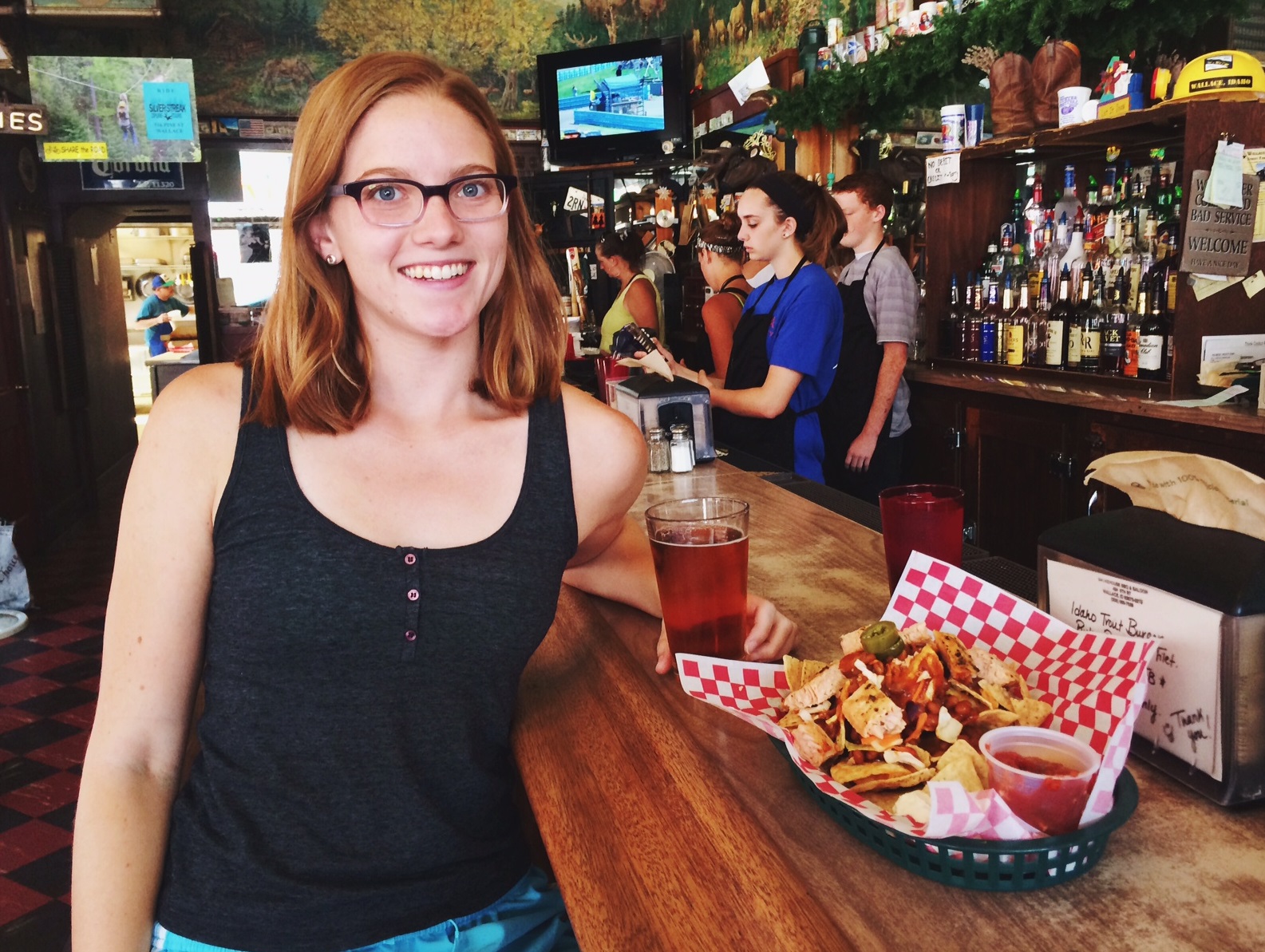
We had already spotted the local Wallace Brewery across the street (which didn’t open until 1 p.m.), so we had to try their I.P.A. Tasty! And we split some salmon-covered nachos, as we were going for two small-plates experiences instead of lunch. Very tasty! But more than the food and beer, I loved the ambiance – and the feistiness of the wait staff. We carried on a running conversation with the 3-4 folks behind the bar, learning about their late-night exploits from Saturday night in the process! The restrooms were also a trip. To begin with, these one-holers had “Man” and “Woman” on the door. Claire said that was a more truthful way to let you know the capacity! Me, I loved the old Borax soap containers. I haven’t seen, or used, Boraxo in years…but it was fun to tell Claire about the 20 Mule Team strength of Borax! My mother is smiling somewhere today.
Oh, and did I mention that the landscape here in “Northern Idaho” is just as stunning as the Montana landscape to the east? What an incredible 3+ hour drive.
Never stop at the interstate for food…especially when you can drive into Ellensburg, Washington – The Yelp app is one amazing tool for today’s traveler. As we were looking for our second food stop later in the day, Claire pulls up Utopia Frozen Yogurt and Coffee House across from Central Washington University in historic Ellensburg. Frozen yogurt – the perfect second small plate offering to go with our nachos! So we pull off and drive through a beautiful and thriving historic Main Street – which I later found out was a National Trust Dozen Distinctive Destination winner in 2007. I concur!
Oh, and the Washington State landscape isn’t too shabby either – Much like Montana, you get a little bit of everything driving east to west across Washington. The landscape around Spokane is a bit dull as agricultural landscapes go, but at least they have this little patch of drive where they actually post signs telling you what’s growing in the fields beyond. We saw beans, field corn, sweet corn, peas, and Timothy. Timothy? What the hell is Timothy? Turns out, it is a type of hay. Who knew? Then we also passed over the Columbia River, where Claire got this amazing panorama view. And coming into Seattle, one feels you are tumbling down a very long mountain…which I suppose in one sense you are. There is a lot of elevation drop to get to sea level!
Forest fires are devastating the west – This is not news to those who pick up a paper or listen to the radio and TV, but we saw it first hand today. First, we saw a helicopter carrying a bucket of water, then we began to see the smoke from what I suspect is the Snag Canyon Fire near Ellensburg. The smoke coming over the mountaintop was massive. One of the smartest writers about this topic is the New York Times’ Timothy Egan (you can see his link on the side of More to Come… in the “writers” section). Egan is the author of the excellent book The Big Burn: Teddy Roosevelt and the Fire That Saved America. In last week’s Times, Egan had an opinion piece where he calls out the bad public policy debates we have over things like wildfire prevention. Recommended. This is a very sad testament to our dysfunctional political system where gaining points to fire up a right-wing base are more important that people’s lives. End of sermonizing.
Music for the trip – We listened to a lot of music during the day. I thought of posting Paradise by Coldplay in honor of Paradise, Montana – but it didn’t seem to fit. But the music that fit the Montana and Idaho landscape best for me is the work by the Matt Flinner Trio – the best mandolinist no one knows. So I’ve posted a video of his Winter Harvest, which seems to fit this landscape and – in some ways – is a lament for the terrible things we do to it today.
Wow! On a picture perfect August day, Claire and I visited Glacier National Park, The Crown of the Continent. It was an experience we’ll never forget.
We had always envisioned this day – at the midpoint in our cross-country road trip – to be one of the highlights. But as first time visitors to this park, we just couldn’t have imagined how wonderful it would be.
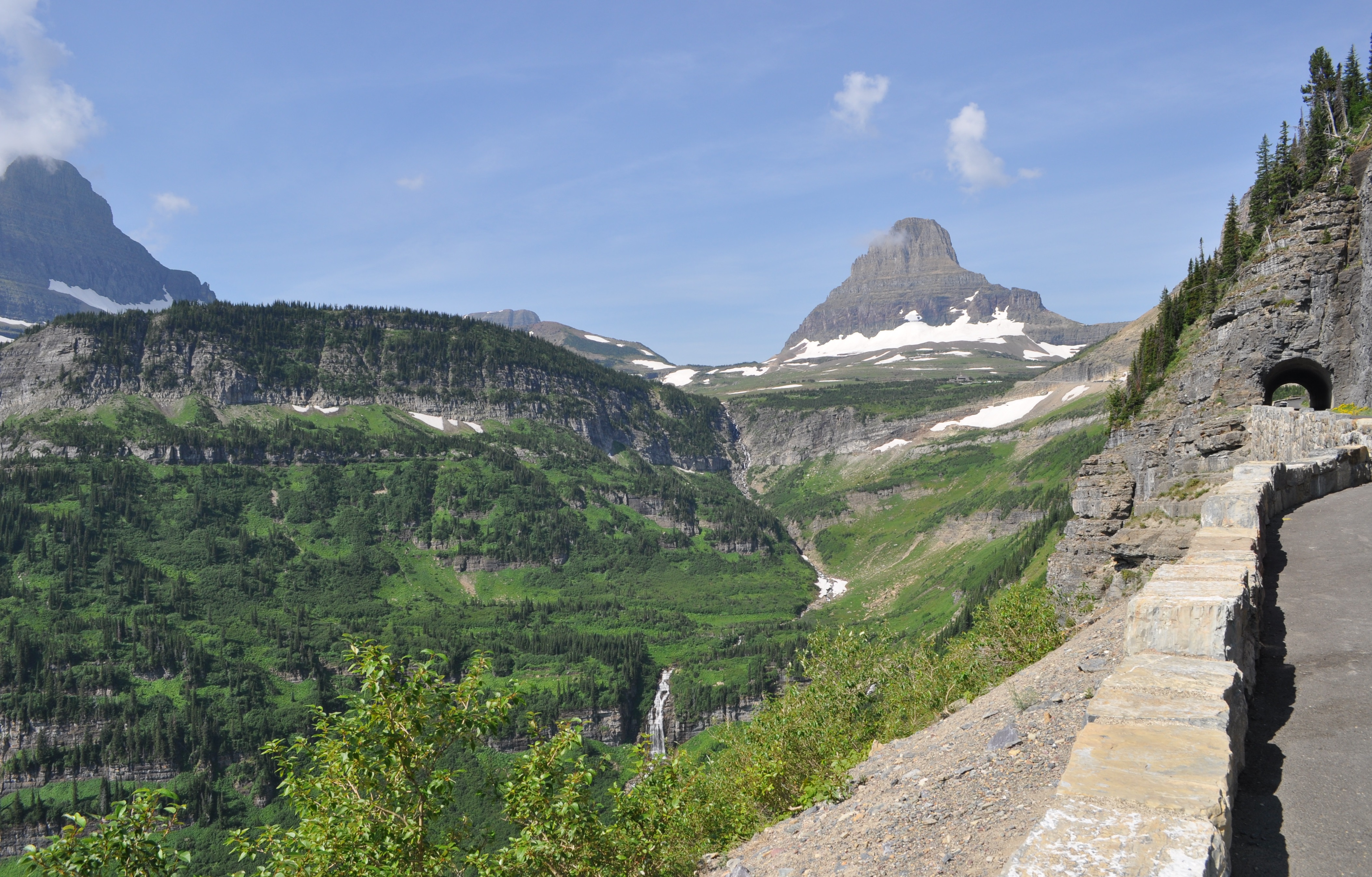
Knowing that we wanted to beat the crowds, we left our hotel early and drove into St. Mary, the eastern gateway to the park. On the advice of several friends, we planned to focus our visit along the famous Going-to-the-Sun Road – a National Historic Landmark and a National Engineering Landmark.
According to the National Park Service website:
The road officially received its name, “The Going-to-the-Sun Road,” during the 1933 dedication at Logan Pass. The road borrowed its name from nearby Going-to-the-Sun Mountain. Local legend, and a 1933 press release issued by the Department of the Interior, told the story of the deity, Sour Spirit, who came down from the sun to teach Blackfeet braves the rudiments of the hunt. On his way back to the sun, Sour Spirit had his image reproduced on the top of the mountain for inspiration to the Blackfeet. An alternate story suggests a white explorer in the 1880s concocted the name and the legend. No matter which version is accurate, the road named Going-to-the-Sun still inspires all who travel it.
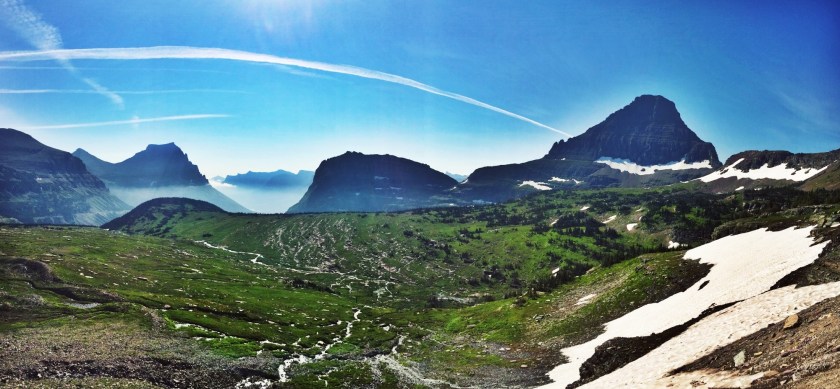
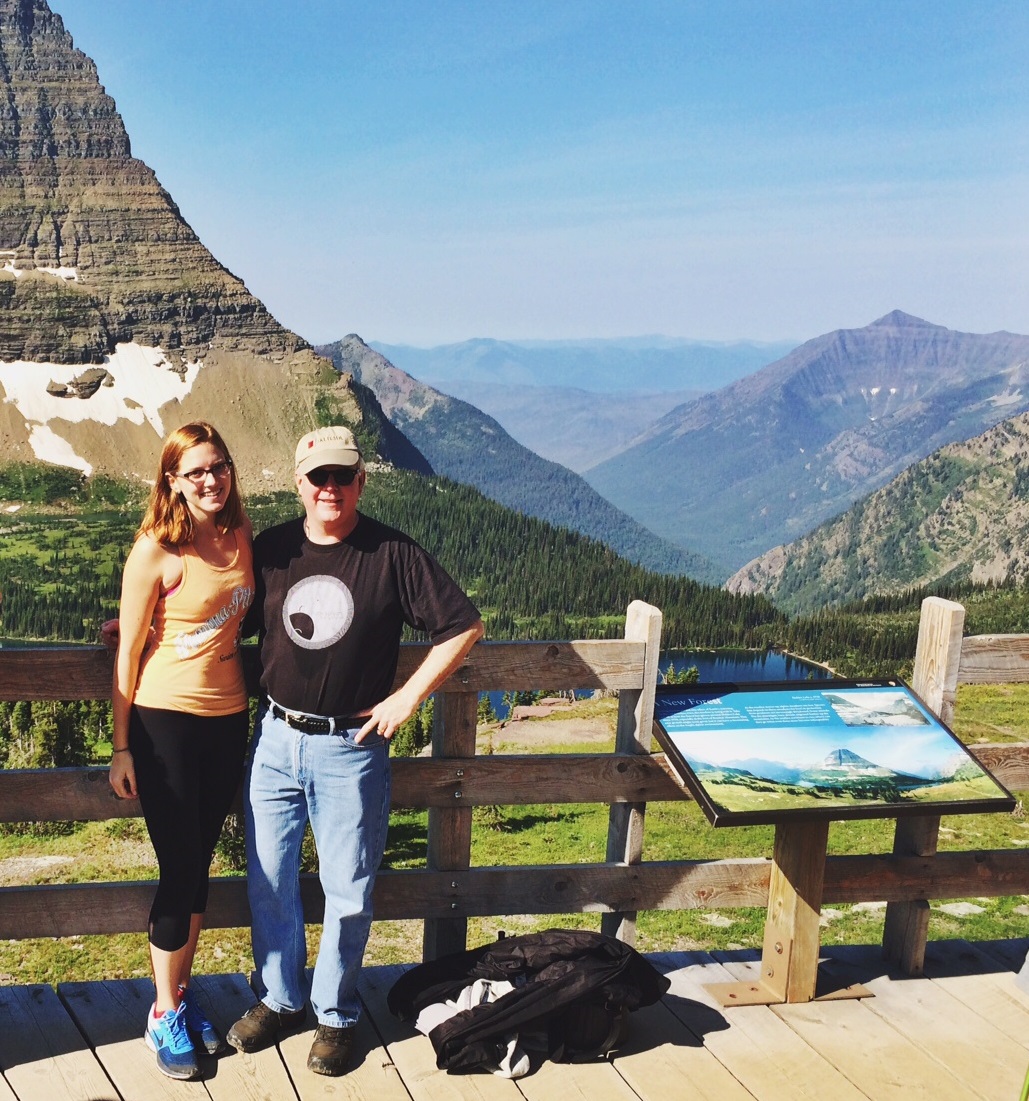
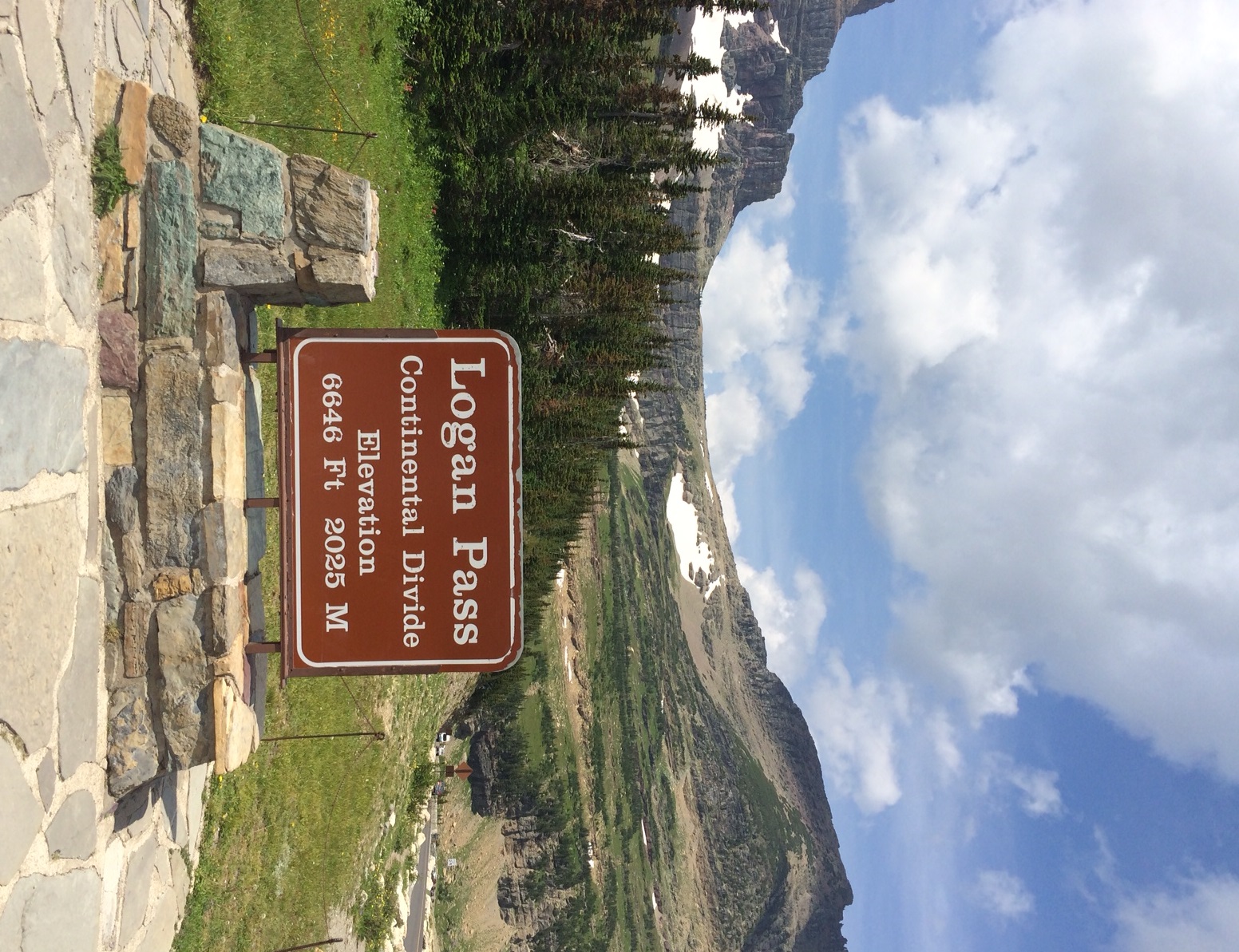
Logan Pass is among the most famous – and popular – spots along this 50-mile engineering marvel, so we headed there first. As the highest point along the road, the pass is part of the Continental Divide. It is also the trailhead for day hikes in multiple directions. We chose to strike out for Hidden Lake on the advice of the ranger, as this part of the park is above the tree line.
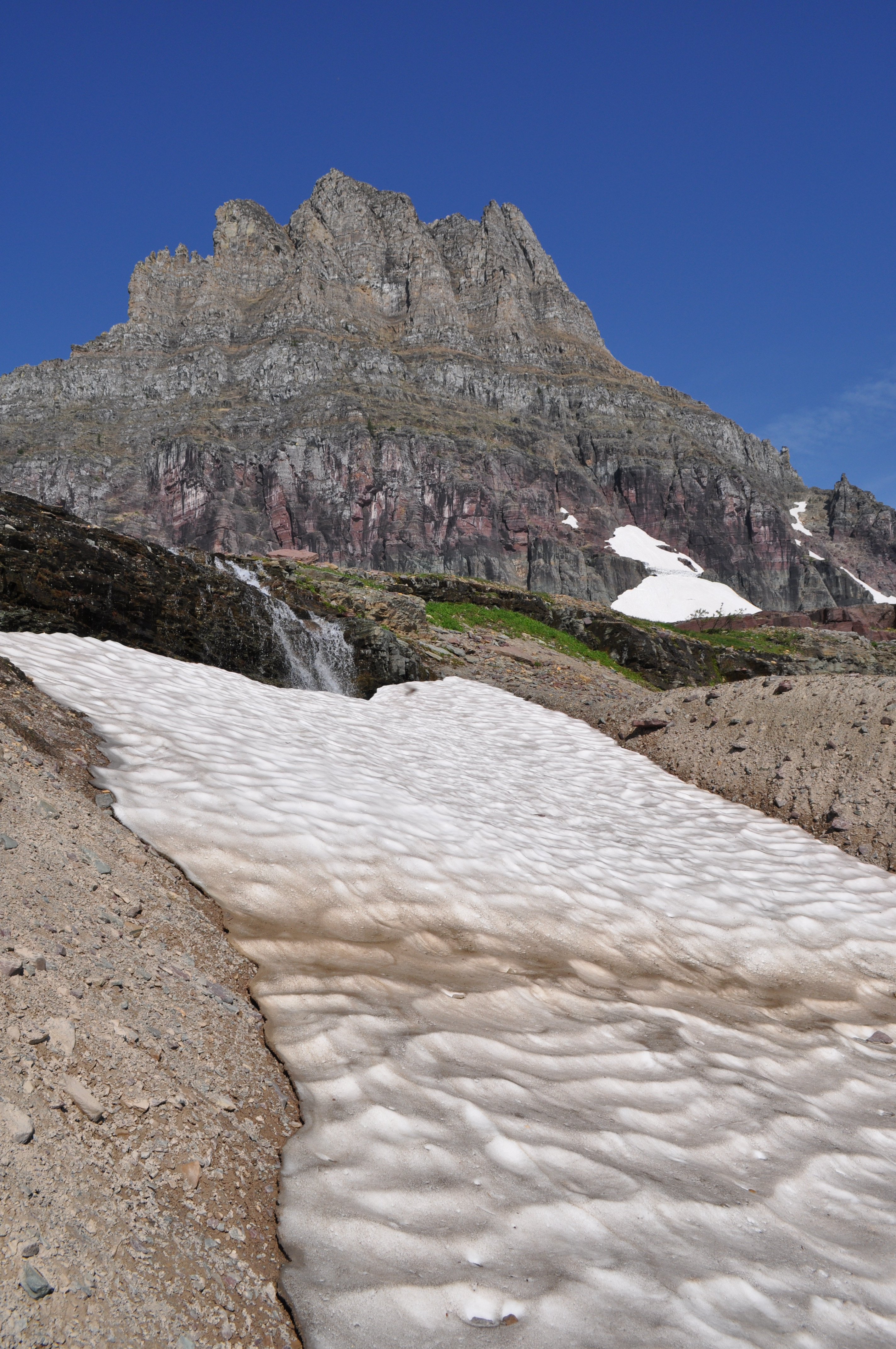
On this trail we encountered small waterfalls and snow packs…
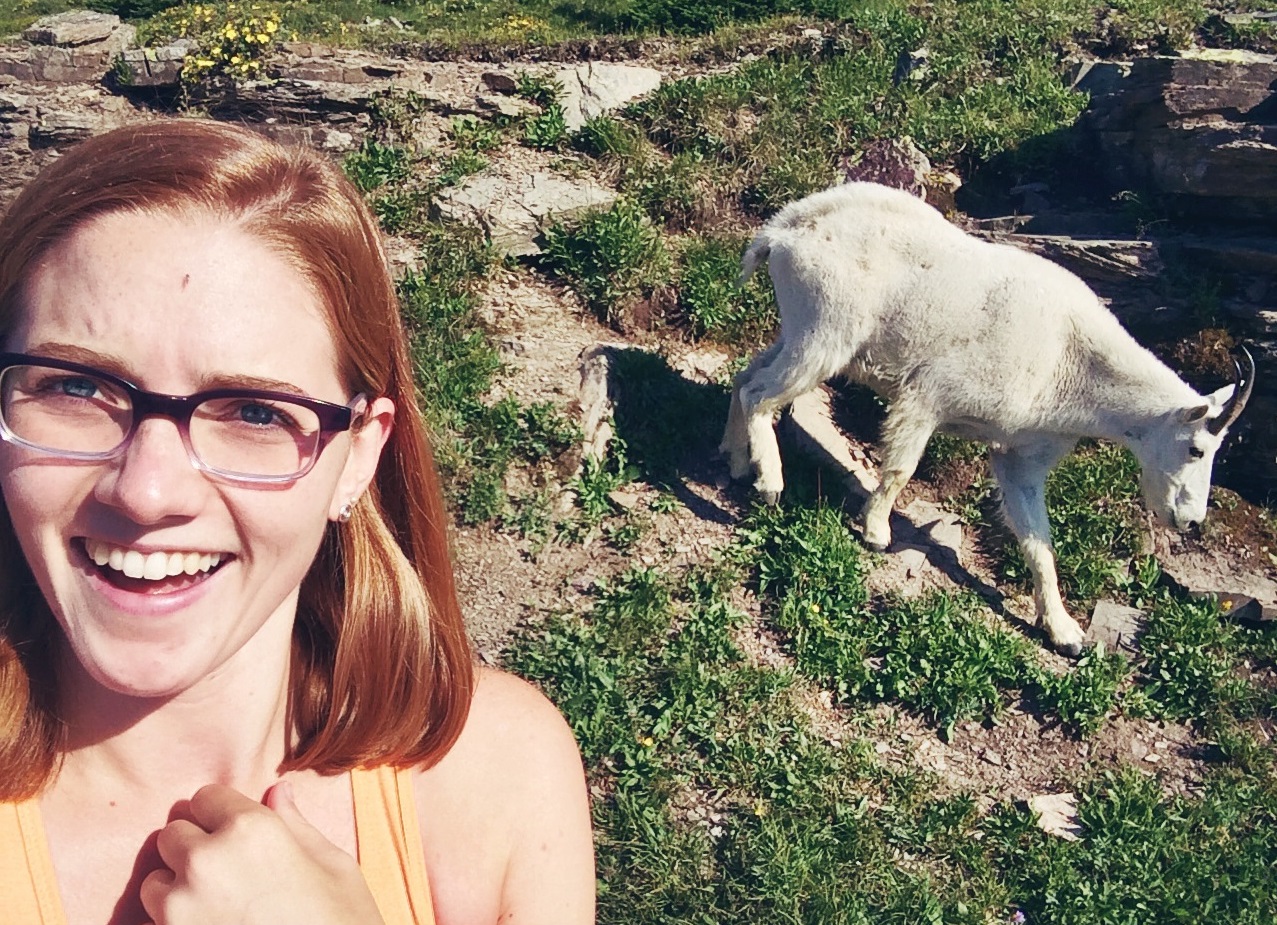
Mountain goats (which Claire tried to become a bit too familiar with)…
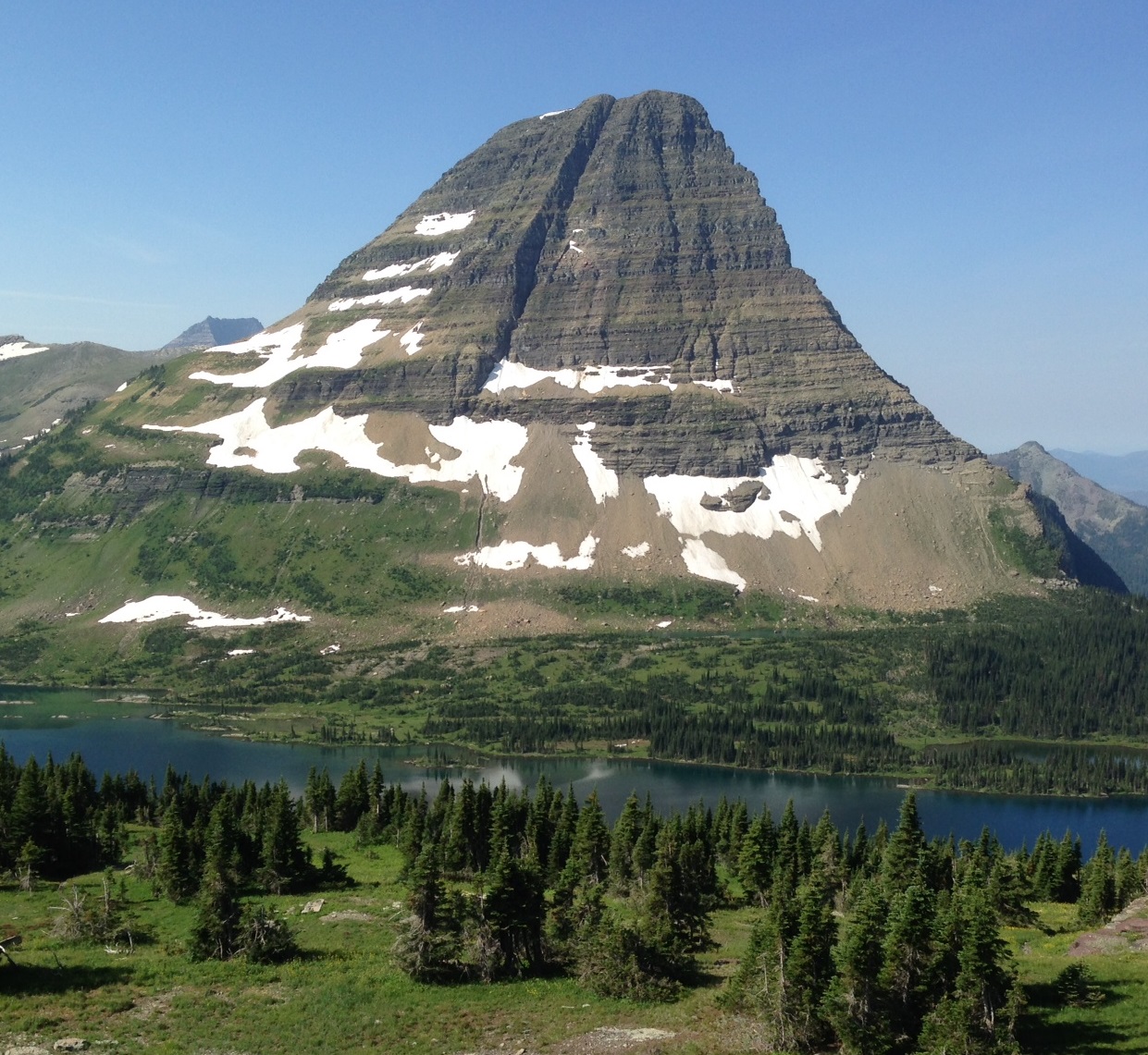
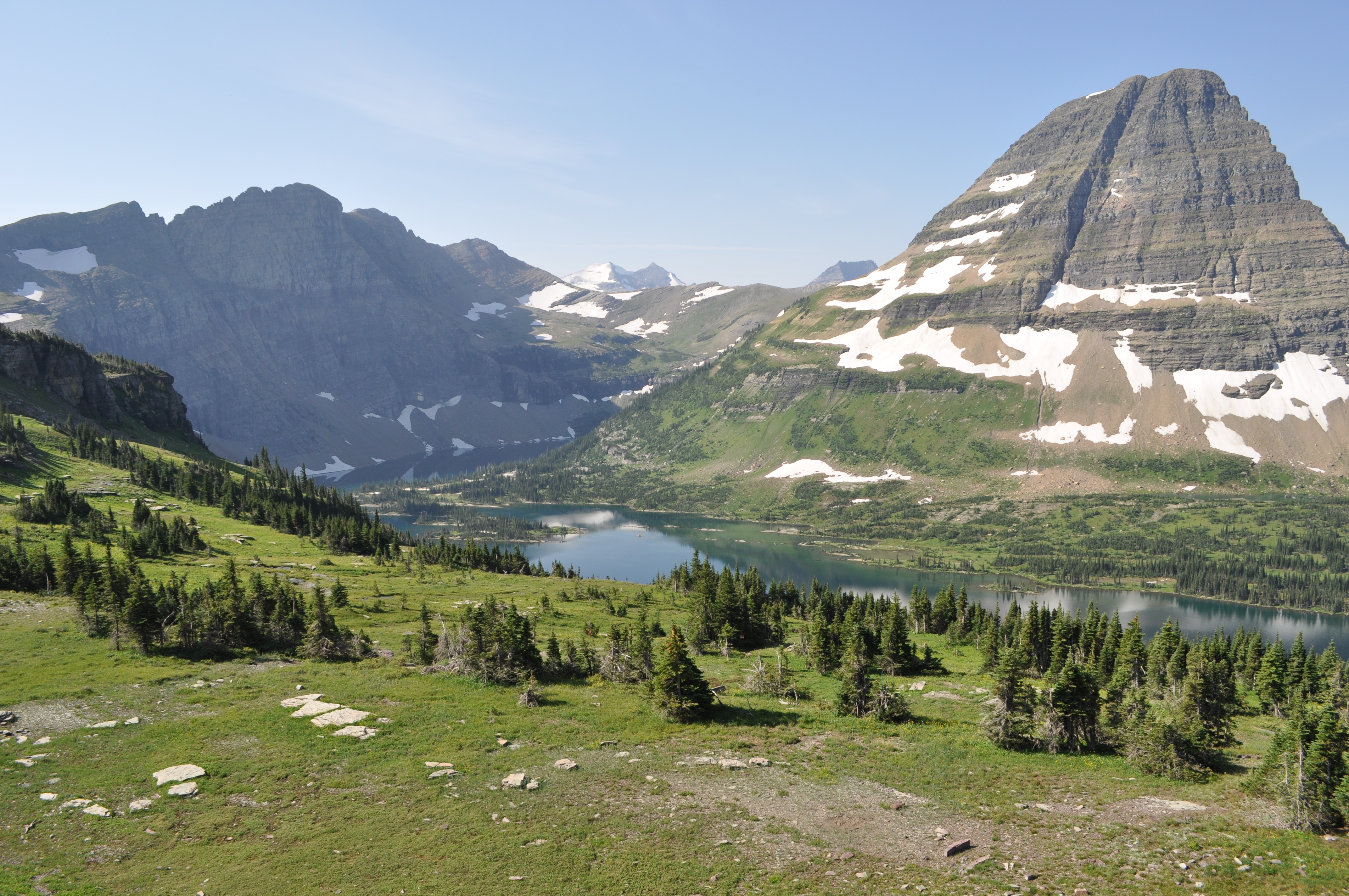
And finally, the beautiful Hidden Lake.
Next we retraced our steps east so we could stop and see the one glacier visible from the Going-to-the-Sun road – Jackson Glacier (shown below) – and do some pullouts for the scenic views.
We took our second hike of the day to reach the St. Mary Fall – a beautiful, crystal-clear waterfall that feeds into St. Mary Lake situated along the eastern edge of the park.
And then we headed west, finally ending up at Lake McDonald where we had a late lunch at the historic Lake McDonald Lodge.
It was a wonderful day. As we relax in our hotel, getting ready for our long drive tomorrow to Seattle, we’ve both reflected on our time in Montana and the chance to see the unique landscapes that make up Big Sky Country.
On Friday morning, as we began our second week on the Not All Who Wander Are Lost tour, Claire and I drove the 20 miles up from Fort Peck to Glasgow, Montana where we reconnected with U.S. Route 2. Now mind you, we had driven two-and-one-half hours in Montana the day before just to get to Fort Peck – which is in the eastern part of the state. So imagine our surprise when we clicked on the Google maps direction finder to head west to Glacier National Park from Glasgow and the young lady on the smart phone who has become our traveling companion says:
Go west on U.S. Route 2 forever.
Well, I may be exaggerating a bit.
It was actually something like 259 miles. But after a long day of driving through Montana’s plains along the original Hi-Line (New York City’s High Line is late to the party), it seems like forever. This Hi-Line refers to the northernmost route of the Great Northern Railroad and U.S. 2, near the Canadian border.
But, as always, six plus hours in the car gave us a great deal of time to make additional observations. So here we go – with the “Jeez, Montana is a Big State” edition of Observations From the Road. (Not to be confused with editions #1, #2, and #3 from this same cross-country trip.)
Round bales have definitely won the Hay Bales War – We have seen at least 3 million bales of hay today – probably 5 million when you add in the North Dakota bales from yesterday. In that whole time, we passed two farms – TWO – that used the old rectangular shaped bales of my youth. Those must have been “heritage” farms, or else the farmers were just better at keeping their old hay-baling equipment working. You can’t spit in Northern Montana this week without hitting a bale of hay. Actually, truth be told, it looks rather pretty. And I’m sure the livestock will enjoy it when the snow is five feet deep this winter.
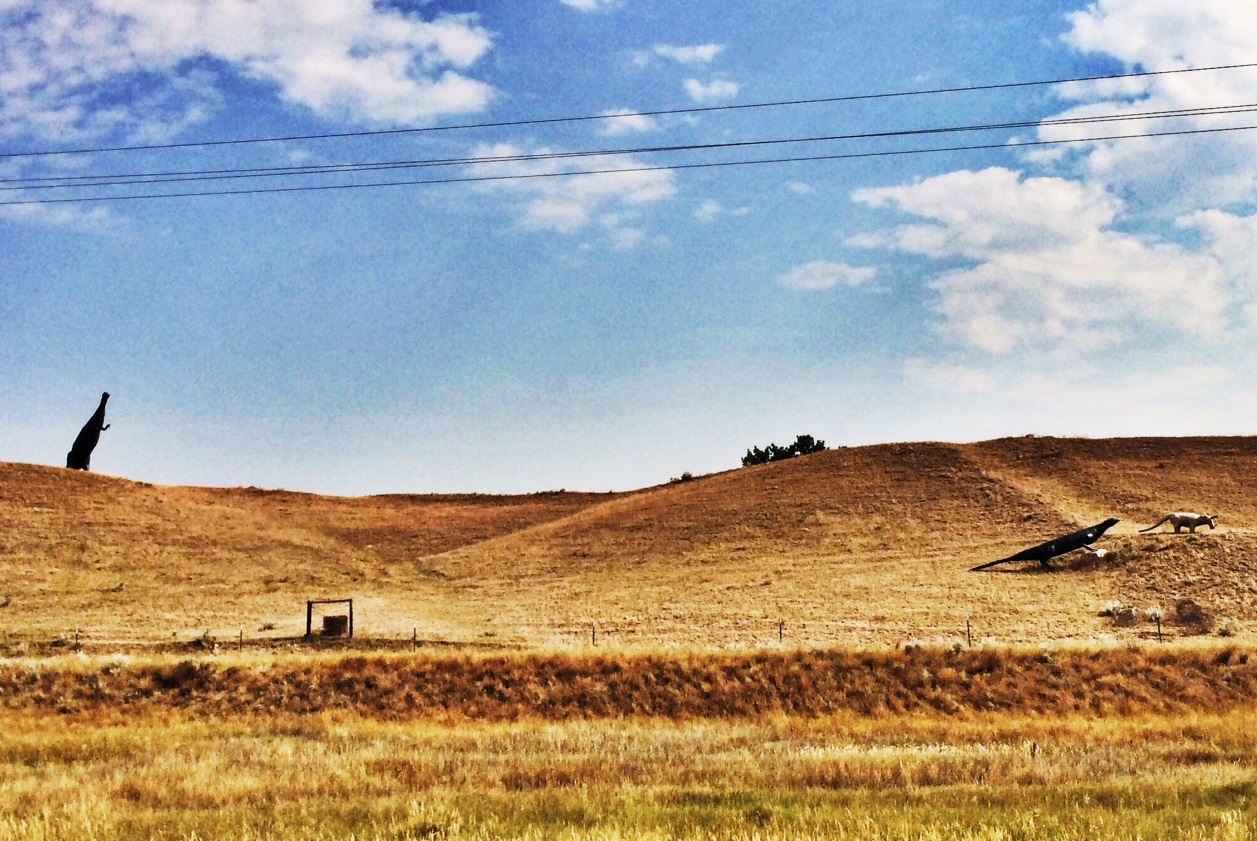
This is what happens to public art when NEA funding is cut – Just outside of Glasgow, when we were still fresh and not hallucinating from the drive, we slammed on the brakes as we passed a collection of dinosaur sculptures alongside the road. After taking several pictures, we drove on and then saw the sign for the shop where you could purchase one of these for your own backyard. As you can guess from the scale of the picture, your backyard better be pretty large.
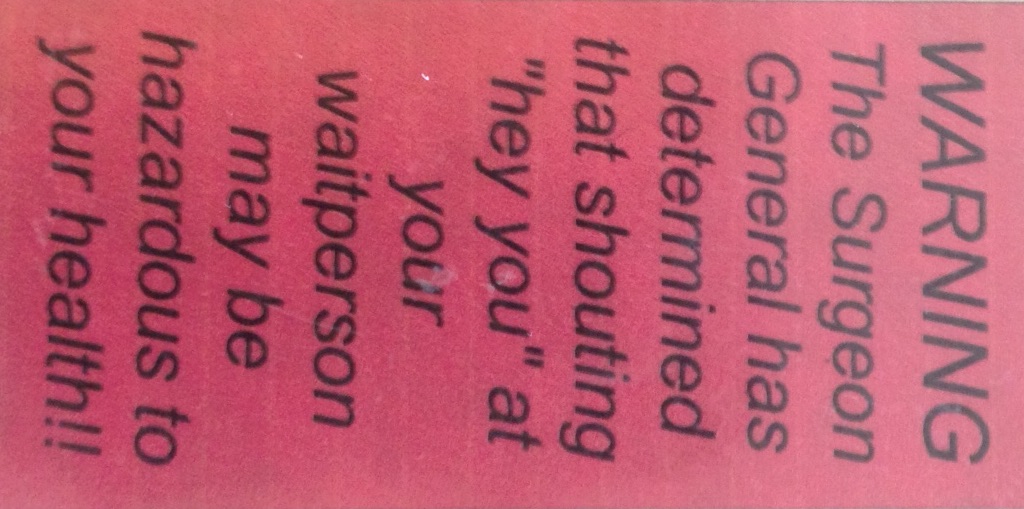
Small town cafes are the best – Today, as part of our “no chains” tour, we stopped in the Lunch Box Cafe in downtown Havre, the largest city on the Hi-Line. The cafe has dozens of sandwiches, each with a clever description. (One had Montana in the name, and the menu noted that “It had to be good; otherwise we would have called it the North Dakotan.”) The little warning above was part of the menu. Claire and I chuckled throughout the entire ordering process. (And yes, the sandwiches were good, as they bake their own bread.)
Urban areas don’t have anything on Montana when it comes to multi-modal transportation – I began to notice all the ways people get around in Montana after we passed the first dozen or so bicyclists on Route 2. Most of these were clearly serious cyclists going cross-state (or perhaps cross-country) – many on recumbents. (I especially liked the guy who had added a bug-shield window to his recumbent. Very useful, as the windshield on our rental car can attest.) However, in addition to bicycles, we passed several Amtrak stations (and one Amtrak train that clearly had a lot of passengers). Vans and buses were also plentiful, especially on the reservations. And finally, long freight trains were a dime a dozen for the hobo-inclined. I have to say the last (and only) horse and buggy we saw on this trip was in the Amish communities of Wisconsin, outside Spring Green.
Traffic fatalities in Montana occur in the most random places – Speaking of getting around…in Montana, the state marks traffic fatalities with small white crosses. (I guess you are out of luck if you are Jewish or Muslim.) But we began to notice that they occur in the most random of places – like on stretches of road that go on for miles without a curve. So – as Claire and I are want to do – we started speculating on how these fatalities occurred. Claire, of course, quickly Googled the question, and found this information on the Montana DOT website. It turns out that these crashes happen in places where you least expect it because Montana has one of the highest alcohol-related fatality rates in the nation per vehicle mile traveled. In addition, inattentiveness, carelessness, and driving speed accounted for over 50% of the crashes in the past 10 years. Just so you know, we haven’t been drinking and driving (despite all the beer references, as we’re usually in for the night or the other person drives after one of us has a beer). On the speed front, I haven’t been able to drive 75 mph legally since I was a teenager driving before the oil crisis, so sticking to the speed limit works fine for me. And we are staying very attentive (as you can tell from these snappy observations we make along the way).
Not much to be said for the first view of the Rockies from the road that Claire’s beautiful photograph doesn’t already say – Claire was driving probably 70-80 miles out from St. Mary’s (the gateway to Glacier National Park) when she exclaimed, “There are the Rockies.” We had to pull over and take this picture. I can’t imagine the feeling that must have hit those who came on horseback, or by boat, or by wagon. However, we have some sense of the awe from Meriwether Lewis’ account of May 26, 1805:
“In the after part of the day I also walked out and ascended the river hills which I found sufficiently fortiegueing. on arriving to the summit one of the highest points in the neighbourhood I thought myself well repaid for any labour; as from this point I beheld the Rocky Mountains for the first time these points of the Rocky Mountains were covered with snow and the sun shone on it in such manner as to give me the most plain and satisfactory view. while I viewed these mountains I felt a secret plaesure in finding myself so near the head of the heretofore conceived boundless Missouri; but when I reflected on the difficulties which this snowy barrier would most probably throw in my way to the Pacific, and the sufferings and hardships of myself and party in them, it in some measure counterbalanced the joy I felt in the 1st moments in which I gazed on them; but as I have always held it a crime to anticipate evils I will believe it a good comfortable road untill I am compelled to believe differently.”
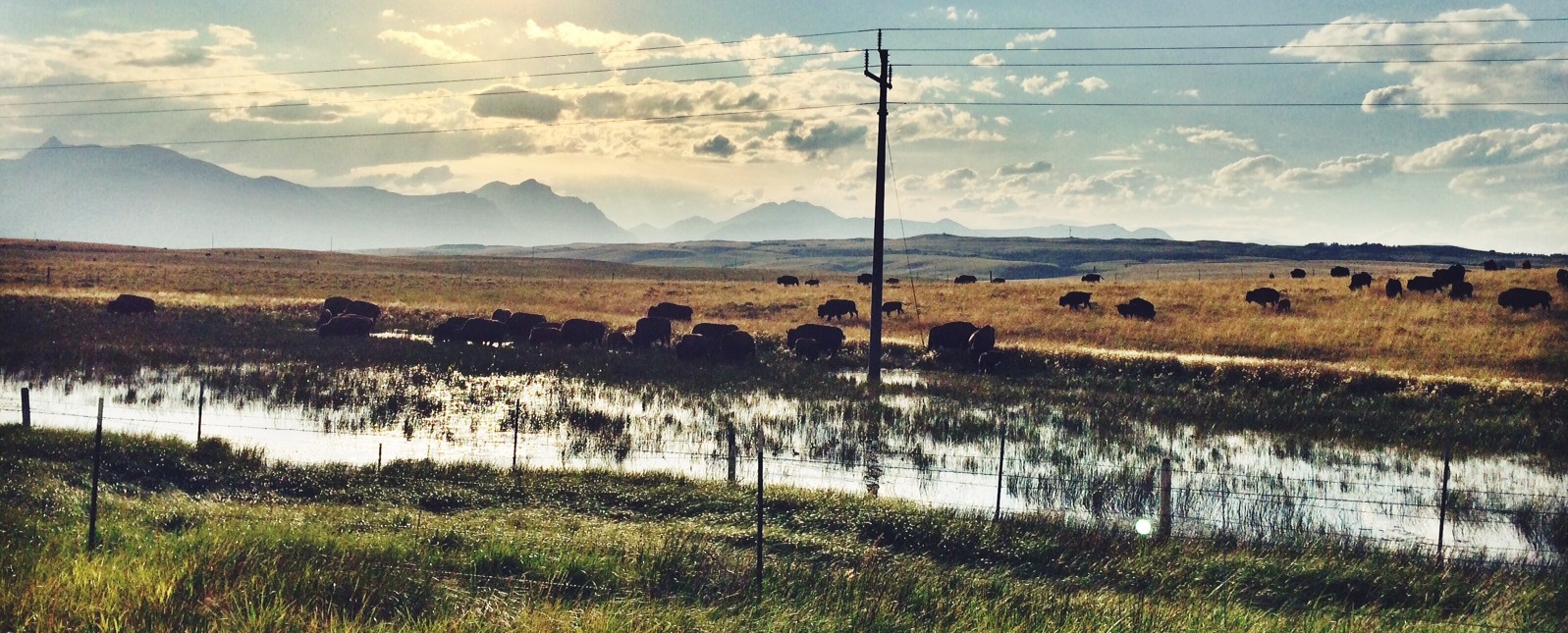
Somehow our first sighting of Buffalo didn’t bring out the same awe in Claire – We passed this Buffalo herd outside of East Glacier Park this evening, and Claire asked me to turn around so she could get a picture. We did, and she did…and then she posted it to her Instagram account with the description: “What did the daddy buffalo say to the baby buffalo when he left for school? #bison. (Groan)
Finally, I’ve decided that the Mark O’Connor/Pinchas Zukerman version of Ashokan Farewell is the perfect soundtrack for large portions of the Montana landscape – Somewhere along the road today, my favorite version of the beautiful and haunting fiddle tune Ashokan Farewell from the Mark O’Connor album Heroes came up on my iPhone playlist. Zukerman begins this version with a fairly straightforward yet incredibly deep statement of the melody, then O’Connor adds a verse that sounds like a country fiddler who has died and gone to heaven. After the simple yet beautiful guitar lead by Russ Barenberg, O’Connor and Zukerman duet – with Zukerman hitting the final notes that will take your breath away. It fit our mood today, and I hope you’ll enjoy the video from the album. It is a nice, mellow way to end this post.
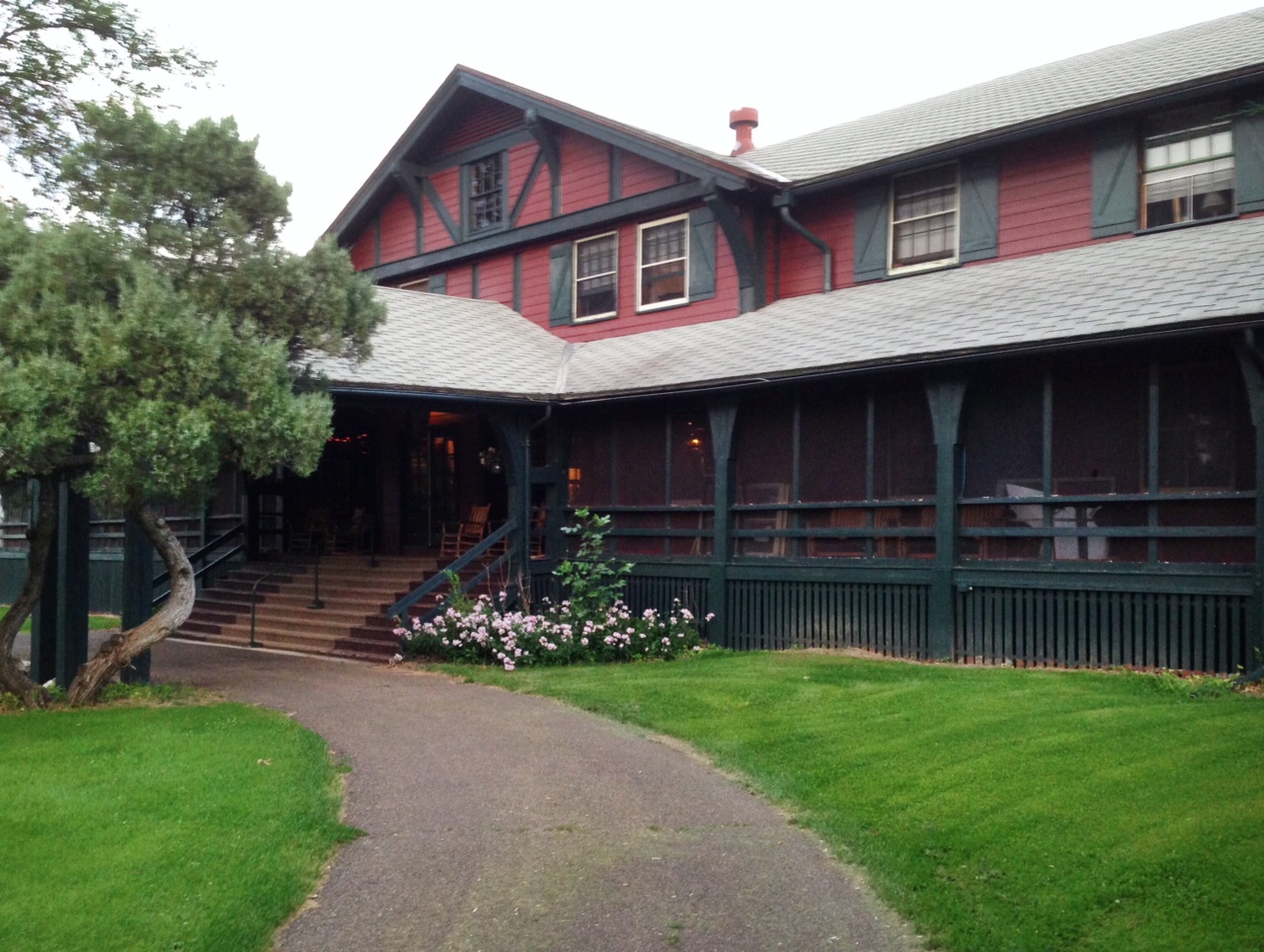
Having been warned that we will lose cell and online coverage as we enter the mountains portion of our trip over the next couple of days, I’m writing my next set of “Observations from the road: The prairie edition” from my outpost here on the front porch of the historic Fort Peck Hotel in Fort Peck, Montana. (The beautiful and flat part of Montana, as their website describes it.) You can catch earlier parts of the “Observations” series here (the Central Time edition) and here (essentially the Pennsylvania, Ohio, and Indiana edition).
Fort Peck Hotel, Montana
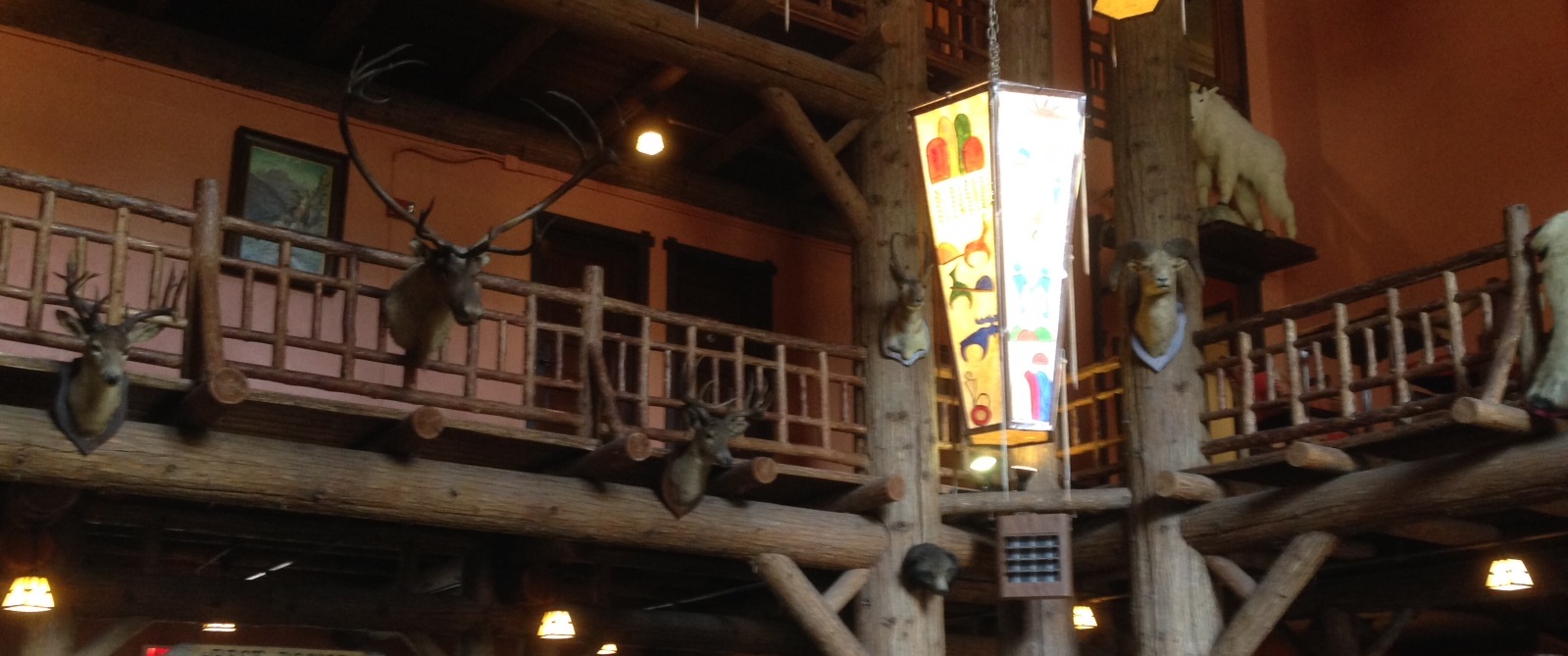
Fort Peck dam was built in the 1930s as a WPA project, and this building was originally constructed to house the workers. It was converted into a hotel in the 1930s, and has served sportsmen, patrons of the Fort Peck Summer Theatre Playhouse, and wayward travelers like Claire and me ever since. The rooms are small and simple but the lobby (where I wrote last evening’s post) is down home and friendly with a well-stocked bar. The only disappointment was that the dining room doesn’t serve dinner on Thursday evenings. Essentially — for those of you old enough to remember — think of us staying at the Shady Rest Hotel in Petticoat Junction…but with a Montana theme. Claire was marveling at the size of the moose head on the wall.
As always with these observations, take them or leave them (or don’t even read them). You’ve been warned.
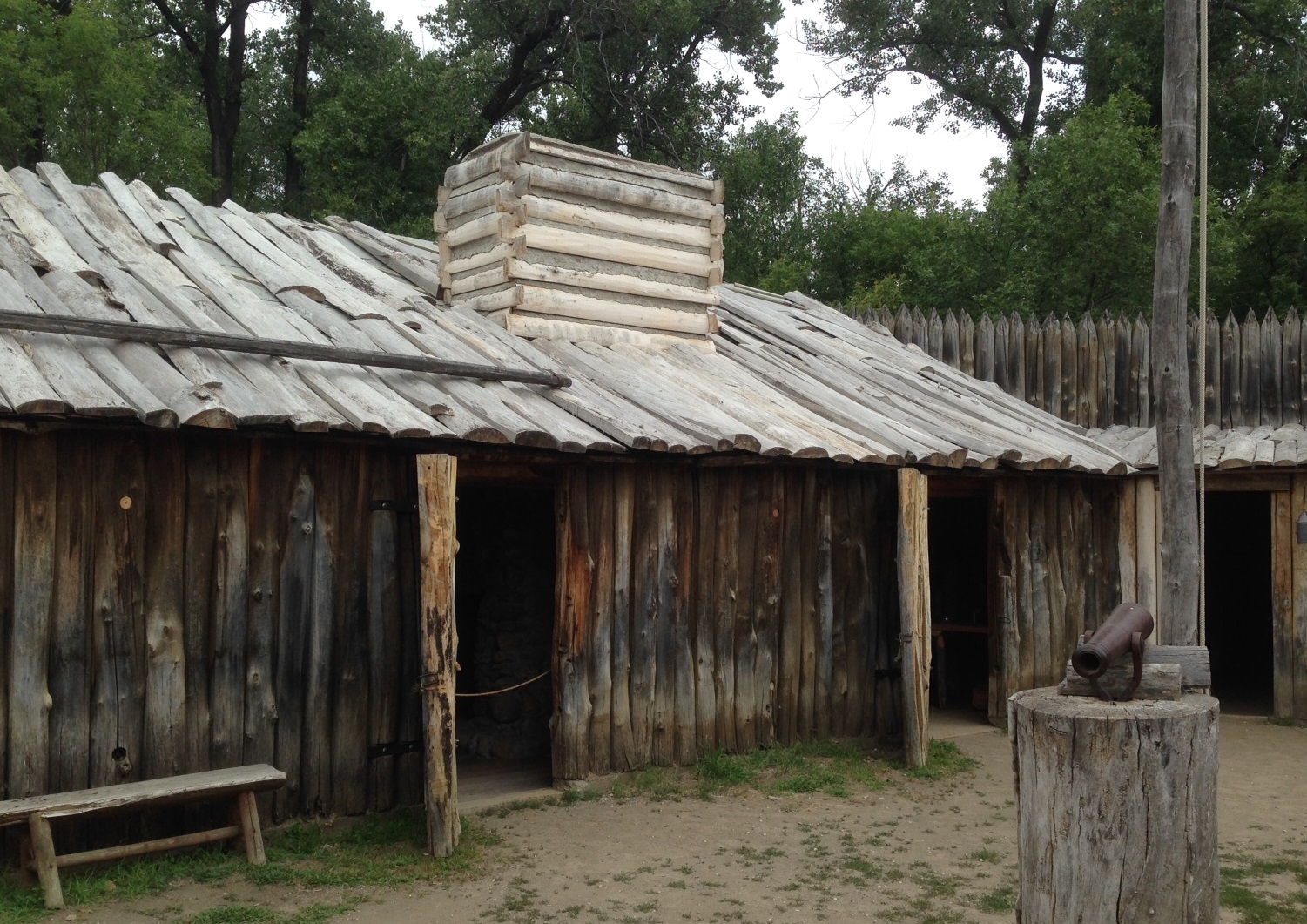
Lewis and Clark slept here — We have been traveling through Lewis and Clark country, and as a result I’ve had the chance to discuss our country’s relationship with Native Americans with Claire. We stopped at the excellent Lewis and Clark Interpretive Center at Fort Mandan yesterday, thanks to the recommendation of my colleague Barb Pahl. They have done an excellent job with the museum, and the interpreters are very upfront about the limitations of the reconstructed fort (shown above). But you certainly can begin to understand the hardships faced by Lewis and Clark and their men as they endured their first prairie winter. Claire noted, as we were touring the exhibits, how much the perspective of the people who have assembled the exhibit and tell the story plays into our understanding. Bingo! This is one of the first things all historians and preservationists must learn, if we are to truly capture the richness and layers of history in this country.
You don’t begin to understand the devastating impact of our country’s insatiable thirst for energy until you have driven through the northern parts of North Dakota and Montana — We headed north from Bismarck up to Minot (pronounced MY-not by the natives, although the internet will give you three or four different options), and then west on Route 2. Barb had warned me that this was the “industrialized” section of North Dakota, and man was she right. The oil and gas boom has turned this landscape upside down, with heavy trucks jockeying for position on highways that shouldn’t have cars on them for miles. About every ten miles there is a “camp” made up of trailers and manufactured housing – some of it stacked on top of each other – for the workers. North Dakota public radio had a report the other day about the worker shortage in the state, due to the boom, and I believe it. We passed under a pipeline that spanned a four-lane highway, saw more oil rigs than I’ve seen since driving through Texas, and basically saw that we, as a country, have sacrificed this haunting and beautiful landscape so that we can waste energy at amounts unseen in human history. Unlike West Virginia, where they hide the raping of the mountains for coal off the main roadways, there is no place to hide it in a landscape where you can see for miles. We did pass through one large wind turbine farm, and while the impact on the landscape there was certainly visible, when put into the context against the extractive industries, I’ll take the wind turbines every time. Claire talked about her readings and discussions in her environmental class at school, and noted that we will always need some coal, which I understand. But I shudder to think what the rest of our country could look like if northern North Dakota is the future of the oil and gas industries.
Thank God for the sunflower fields — North Dakota (and to a lesser extent the part of Montana we’ve been through) has an extraordinary agricultural landscape. All you have to do is look out the window (or listen to the agricultural reports on public radio) to understand that this is big business in this state. Without getting into the impacts of “Big Farming” – which is certainly evident here — the fields of wheat, corn, and other crops are stunning in their beauty. And none more so than the fields of sunflowers.
The first sunflower field we passed by almost caused us to wreck the car, as we gawked at the endless view of these distinctive beauties. After the tenth one, we decided we had to get a picture. So somewhere between Bismarck and Minot we pulled off the road so Claire could capture the scene at the top of the post. The rural postman came by as she was taking the picture, and told her that the heads turned to face the sun, which explains why all the fields on our side of the road (going north) were facing east yesterday morning. He also said that in another week or so, this field would be a total mass of yellow. We Googled sunflowers in North Dakota when Claire got back in the car, and found out this was a crop for the seeds — with some plants yielding up to 1,000 seeds. So the next time you see a baseball player spit out sunflower seeds, think of this picture and the North Dakota farmers who grow them. As a Southerner now living on the east coast, I’ve never seen such a sight.
You can find Nats fans all across the country — When I first started wearing my Nationals hat several years ago, I would often get strange looks. Today, Nats fans are everywhere – including the Big Time Bistro in Minot, North Dakota. Claire and I walked into this historic downtown eatery (remember, we have a “no chains” policy on eating), sat at the bar (because all the tables were filled), and looked up to see the cook working next to us wearing a Nats cap. We struck up a conversation, and it turns out he is a Nats (and Redskins, and Capitals) fan from Virginia Beach, who is in Minot to be with his brother, sister-in-law, and his niece and nephew. By the way — did you see that Bryce Harper finally got his home run stroke back yesterday, with a walk-off in the 13th no less?! Go Nats!
That’s enough for today. I have to go and see if Claire is awake so we can hit the road. We have 5+ hours ahead of us as we land tonight at the foot of Glacier National Park. I’m not sure when you’ll hear from us next, but we’ll be certain to keep the memories and pictures coming…just on a time delayed basis.
More to come…
DJB
Image: Field of sunflowers (by Claire Holsey Brown)
Some of the most amazing finds on the road occur in the most unlikely places.
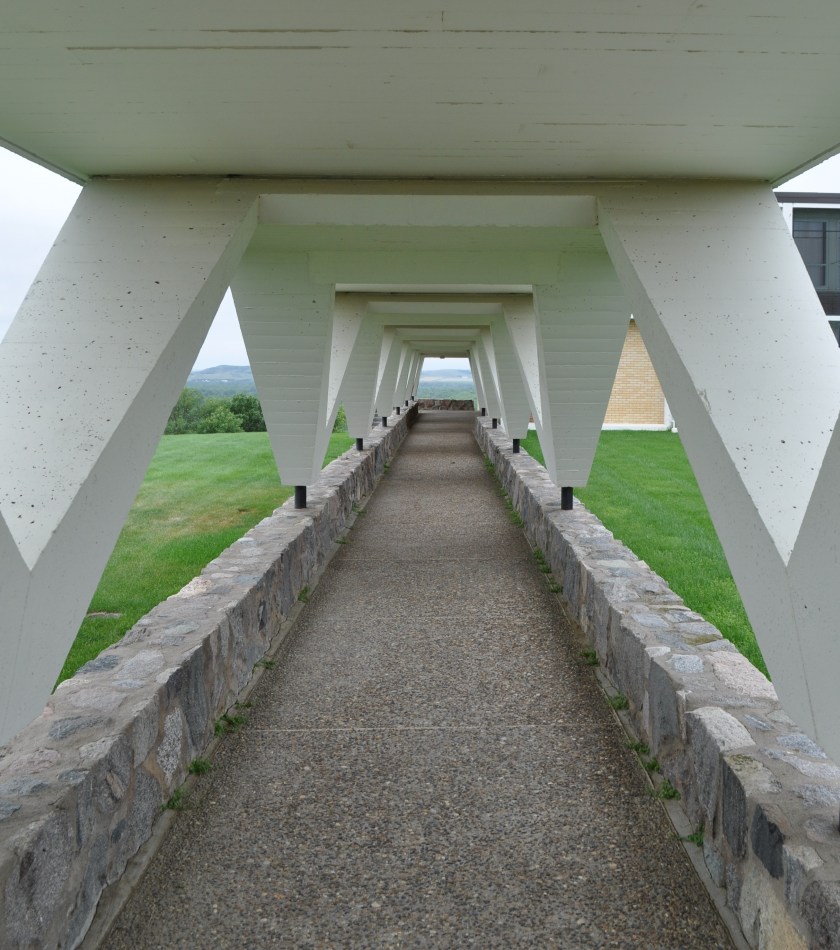
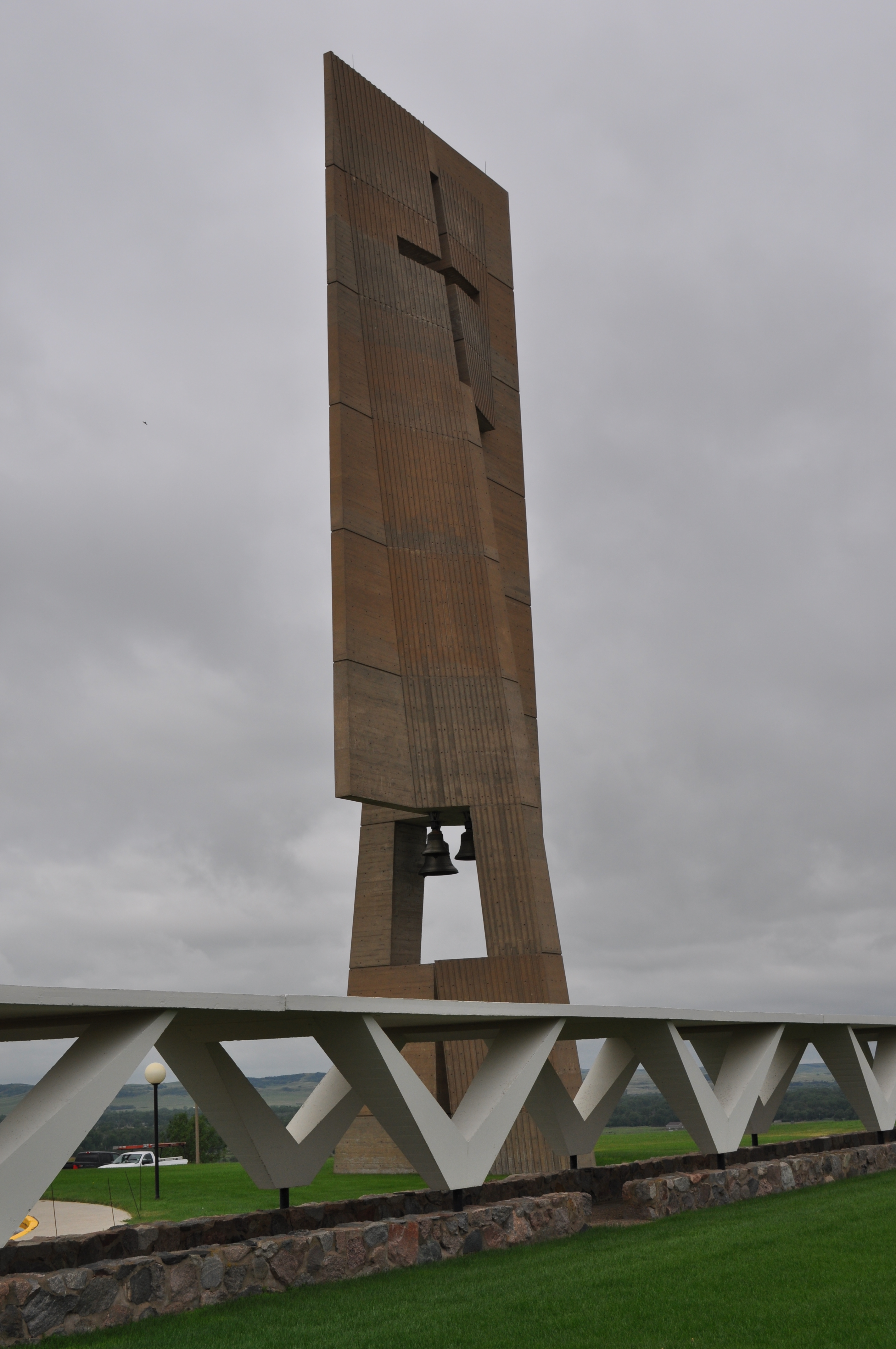
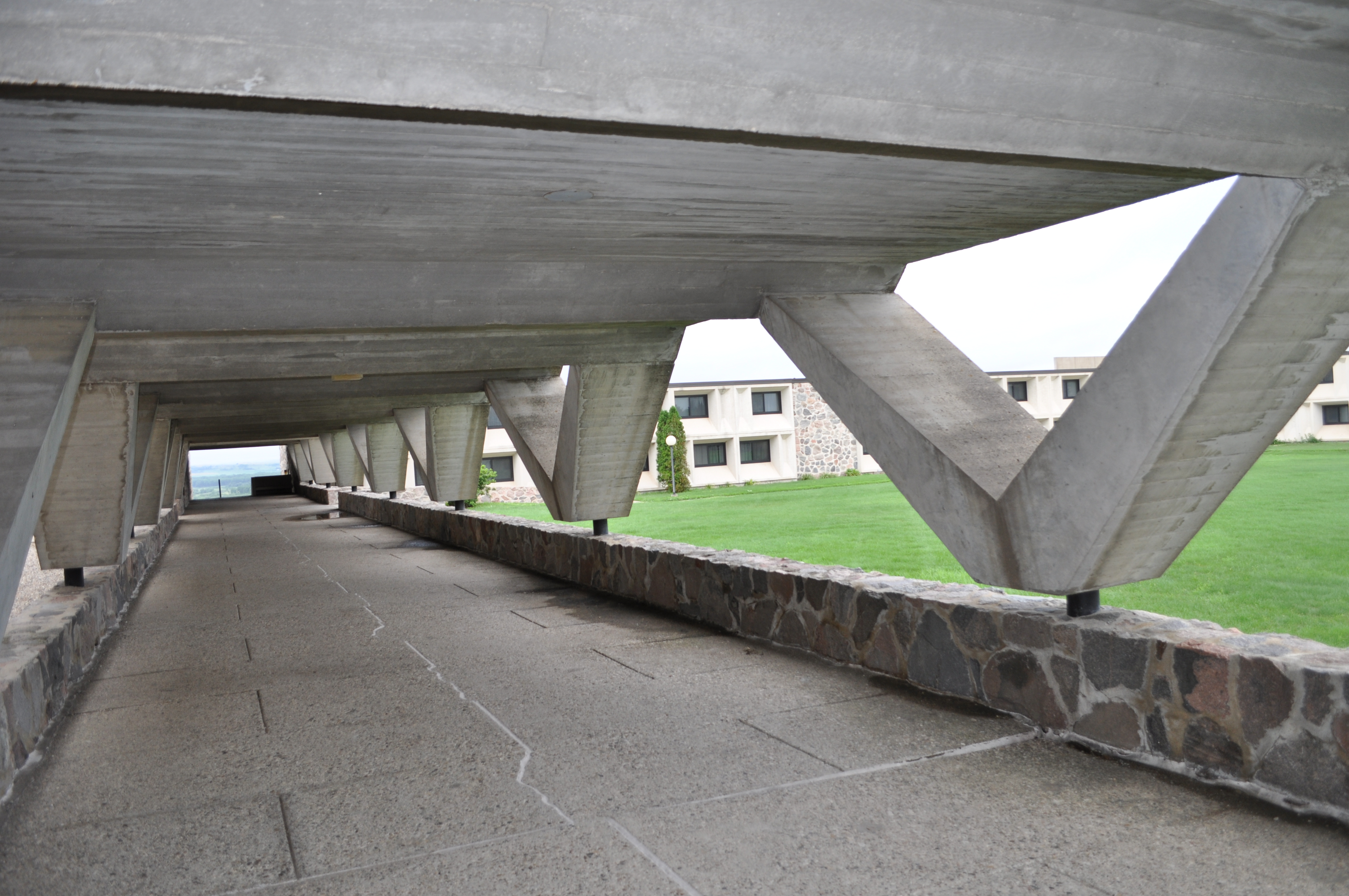
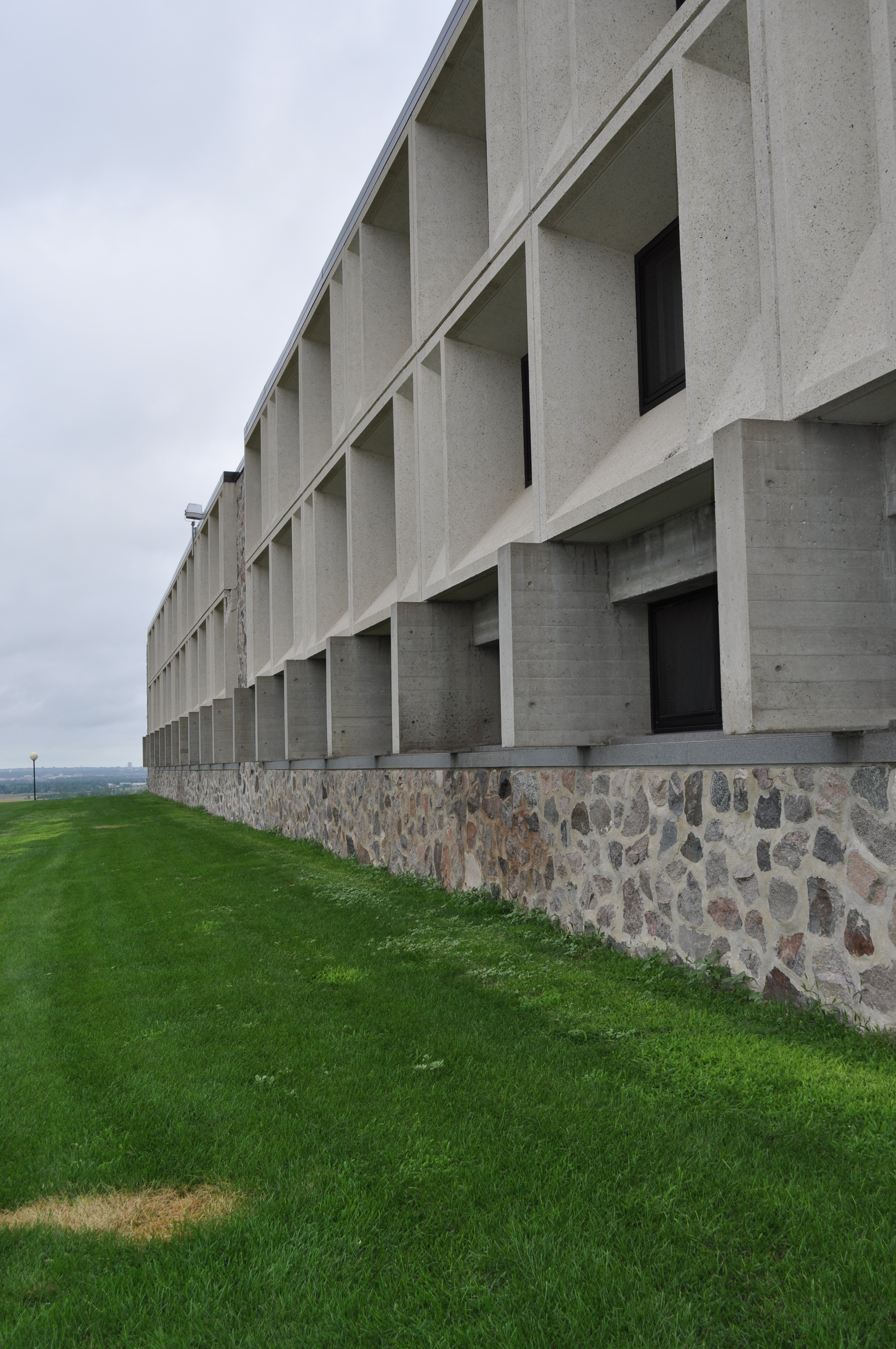
When my colleague Jenny Buddenborg learned I was traveling cross-country with Claire – and taking in North Dakota in the process – she directed me to one of America’s hidden gems: a college campus in Bismarck, North Dakota designed by Marcel Breuer, one of the masters of Modernism.
The University of Mary is a small, Catholic school located on rolling hills about 7 miles outside of Bismarck. The university’s website picks up the story from here:
In the 1950’s, when the Benedictine Sisters of the Annunciation founded their original priory and later planned for the first campus buildings for Mary College, they asked Breuer if he would create the architectural designs. To their delight he accepted and conceived expansive structures of native prairie stone and exquisite concrete shapes, notable for their interplay of light and shadow.
Breuer called it his “jewel on the prairie.” After an hour touring the campus this morning, I wouldn’t disagree.
Thanks to Jenny and the good efforts of Amy Sakariassen, Elizabeth Gross, and Neal Kalberer of Bismarck, I met Jerry Anderson at the foot of the beautiful Breuer-designed bell-tower this morning for an hour’s tour of the campus. Jerry has worked at the university for more than 25 years and brings a design eye to his tours of the Breuer buildings. He was able to explain the design philosophy behind the campus, and also added fascinating details (such as the fact that Breuer placed the cut-out cross in the bell tower so that at noon on Christmas Day the sun shone through and placed a cross at the door of the main chapel).
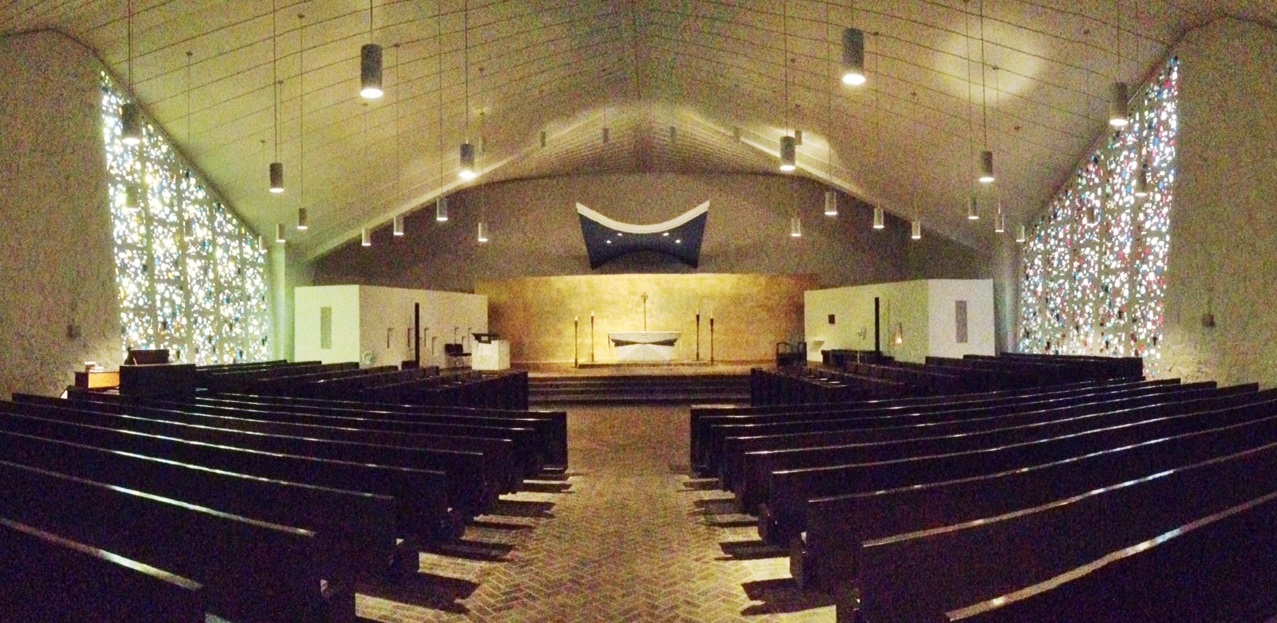
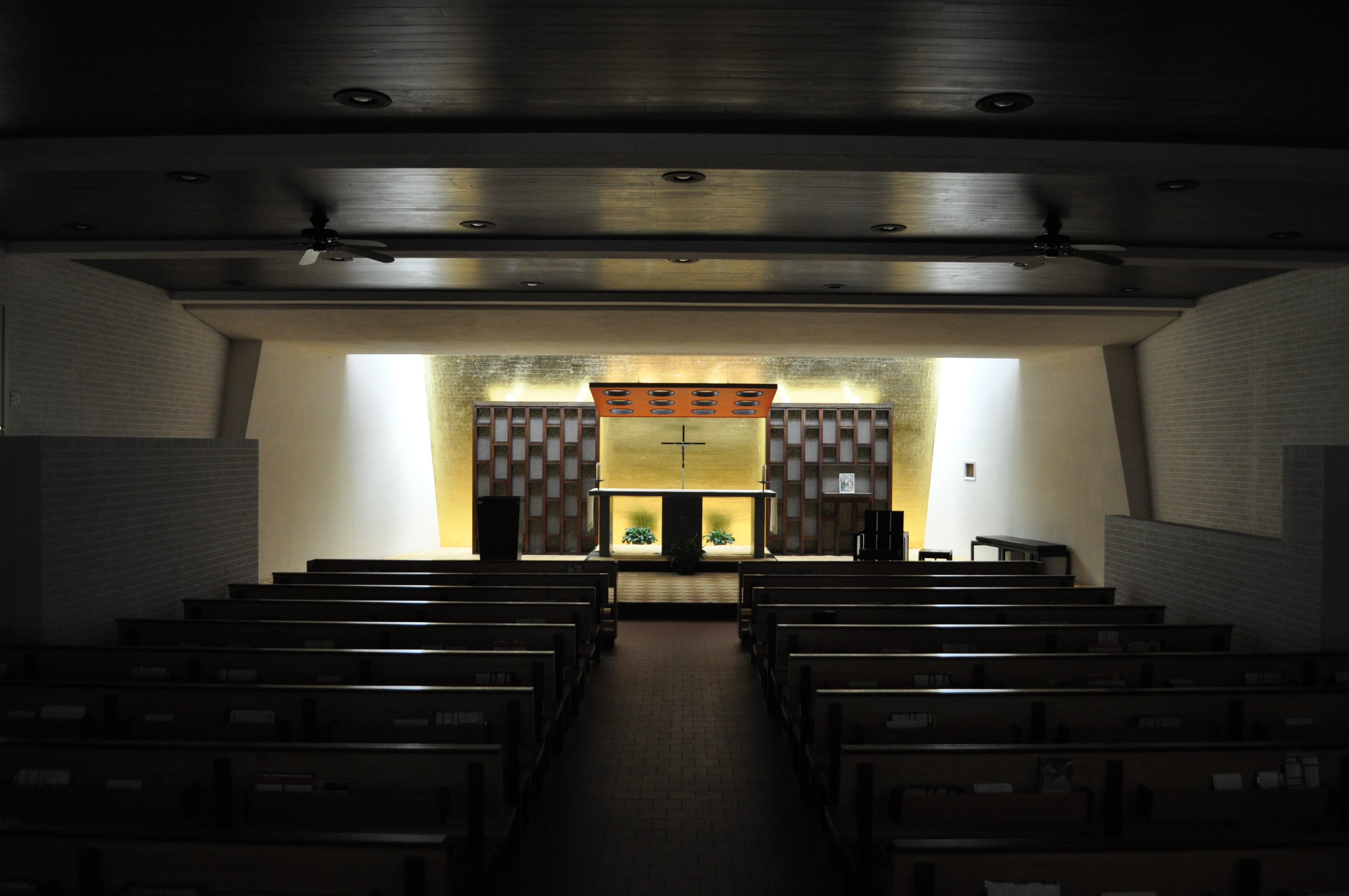
We began our tour in the main chapel. The impact is immediate and stunning.
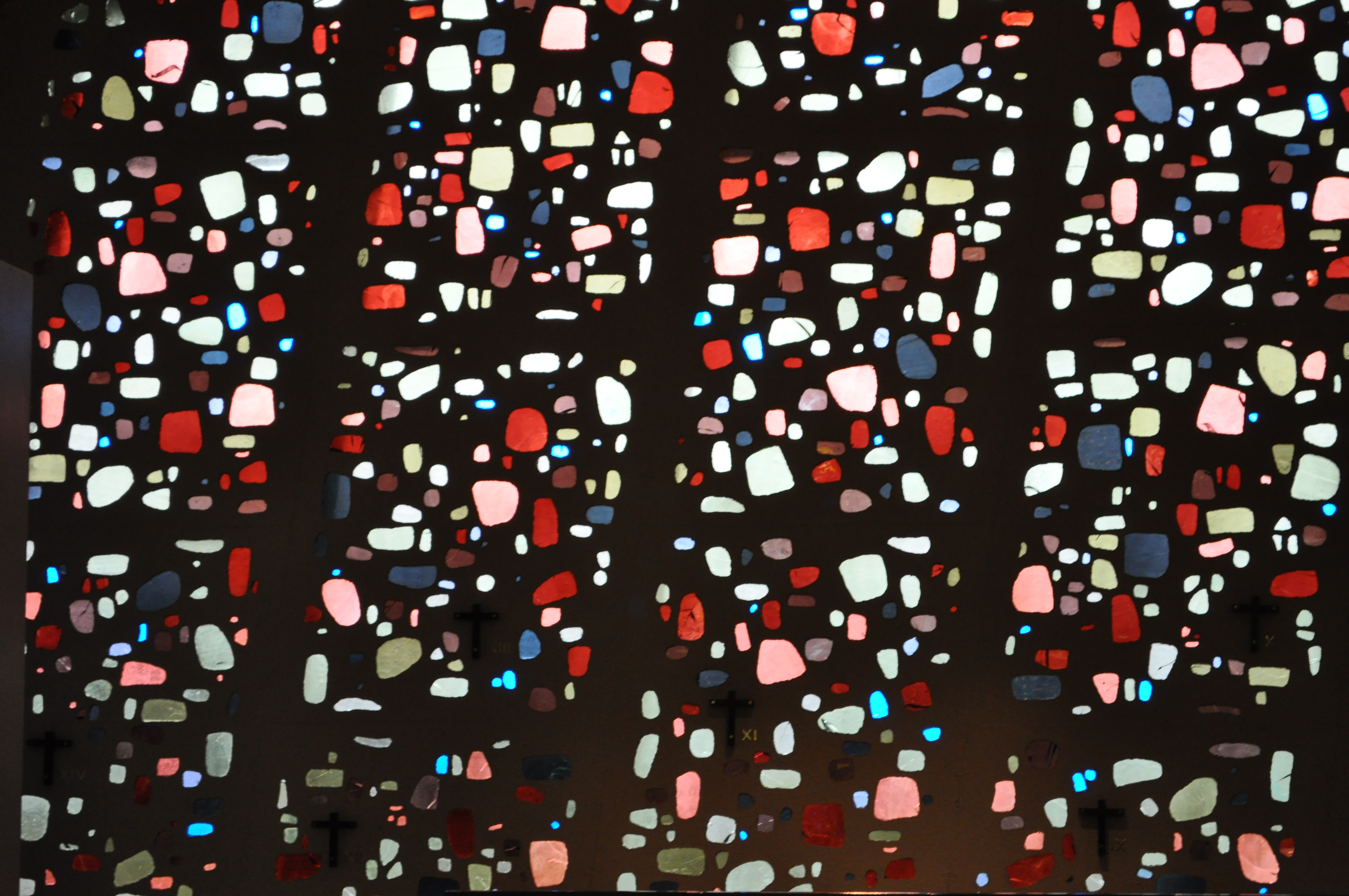
The native fieldstone that Breuer employs throughout the campus is painted white on the walls of the chapel. The beautiful stained glass on the right, as you look at the altar, captures the rose colors of the morning sun…
While the opposite window captures the golden glow in the afternoon.
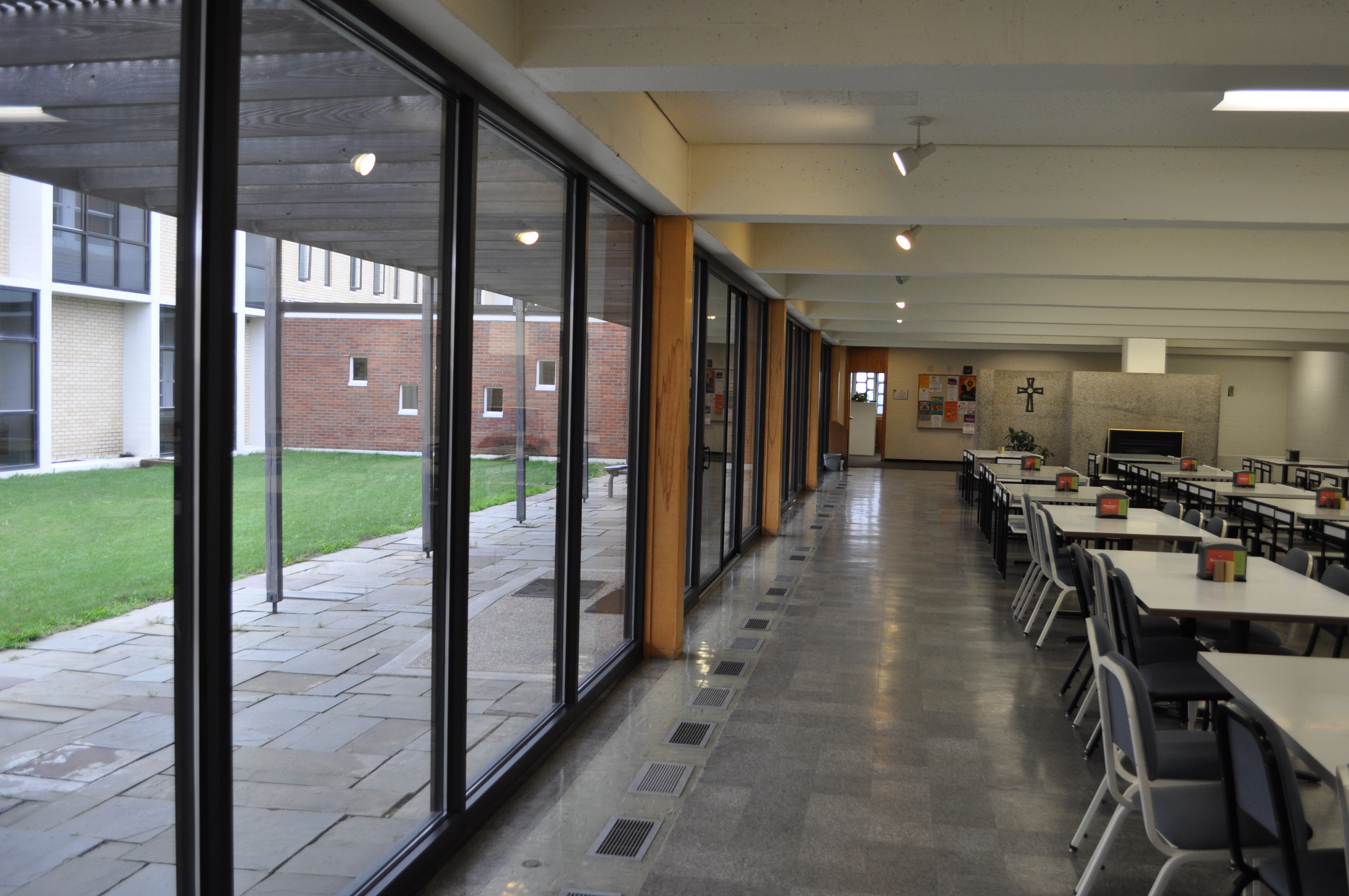
Everywhere one looked, Breuer created spaces with wonderful light and shadows that brought the outdoors into the building and framed the wonderful natural vistas available on campus.
The tour had to end much too soon, so we could get on the road. But in a short hour, I came away incredibly impressed with the vision – of both the Sisters and Marcel Breuer – which is maintained to this day.
Thank you Jenny, Amy, Elizabeth, Neal, and Jerry. A fabulous way to end our time in North Dakota…with a jewel of the prairie.
Claire and I were driving through the heart of Central Minnesota today when the Pokey LaFarge paean to Middle America – Central Time – popped up on the iPhone playlist.
Yet another omen!
The Missouri is my right arm, the Ohio is my left
But I’m livin’ on the Mississippi River where I like life the best
I don’t mind the west coast, and I don’t mind the east coast
Oh, baby, but I ain’t gonna live on no coast.
I’m just a plain ole Midwestern boy,
Getting by on Central time
So thanks to Pokey’s reminder, here are a few (more) observations from the road – in the Central Time edition.
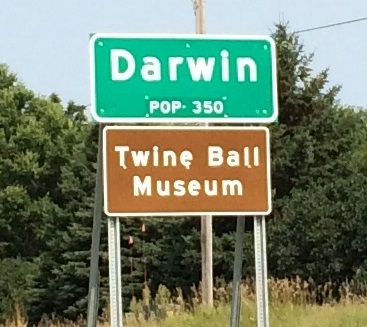
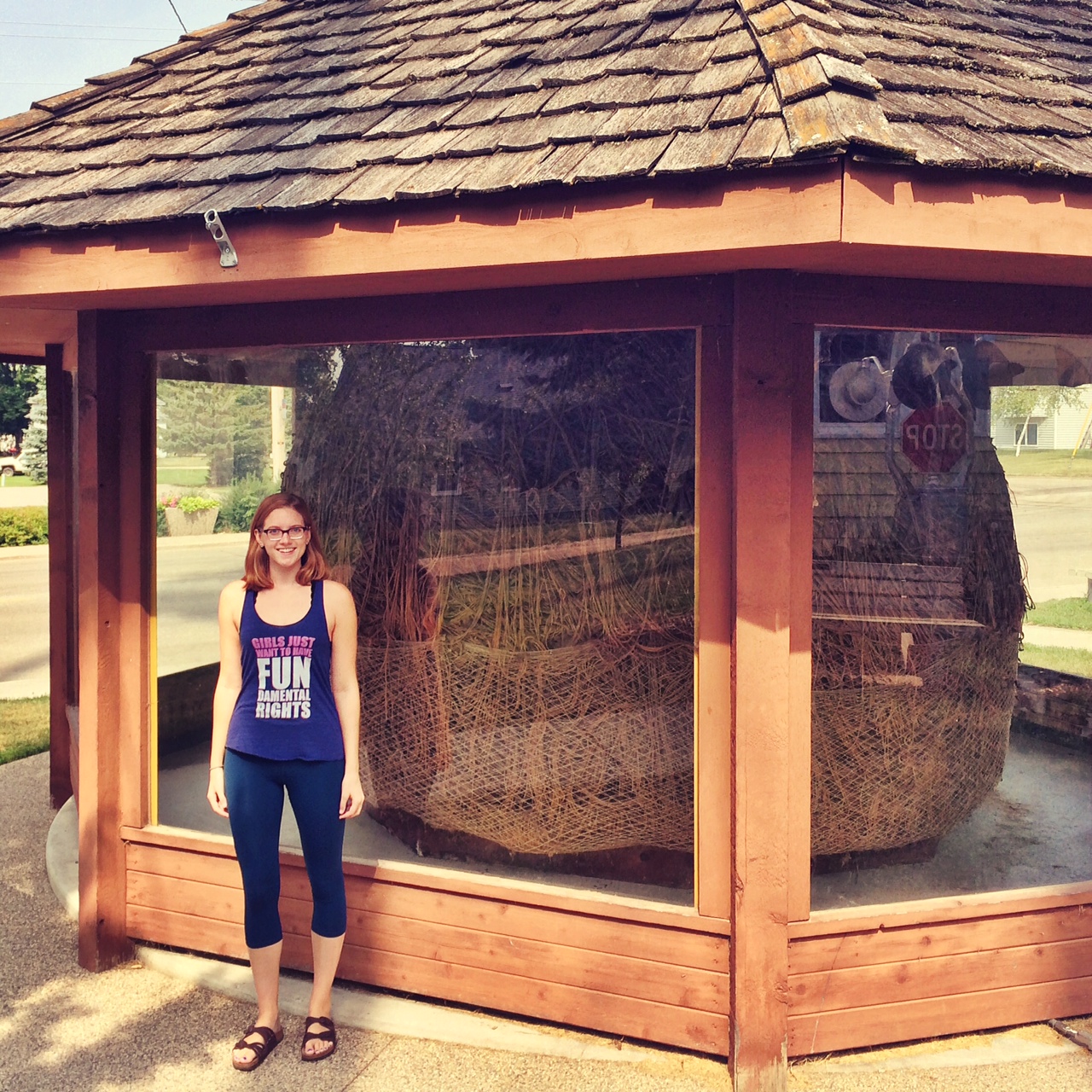
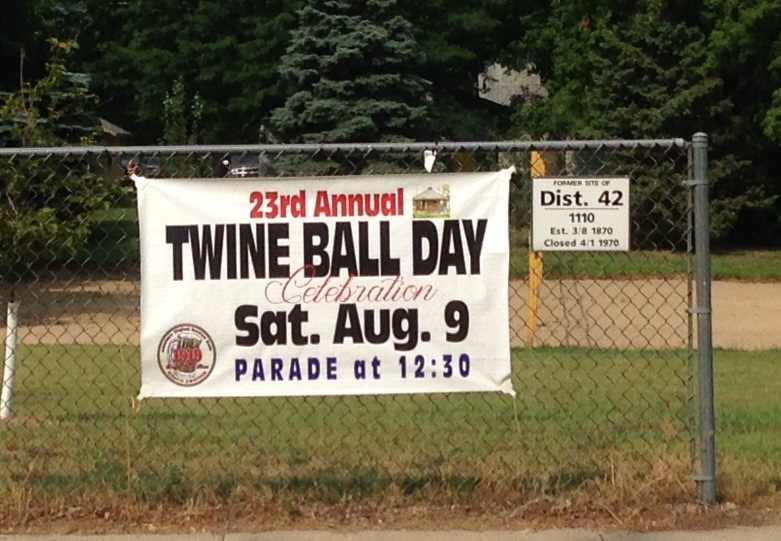
Some oddities really are worth seeing – We went an hour out of our way today to see the largest ball of twine rolled by one person, and it was SO worth it. As the great post on the Roadside Americablog puts it, “One runs across more than a few balls on the obsession landscape…But special tribute must be paid to the Mother of the moss gathering pursuits – the giant twine ball.”
We left Minneapolis in a fever (to paraphrase the great Johnny Cash) in anticipation of our trip to Darwin, Minnesota. At this point, I’m going to turn it back to Roadside America:
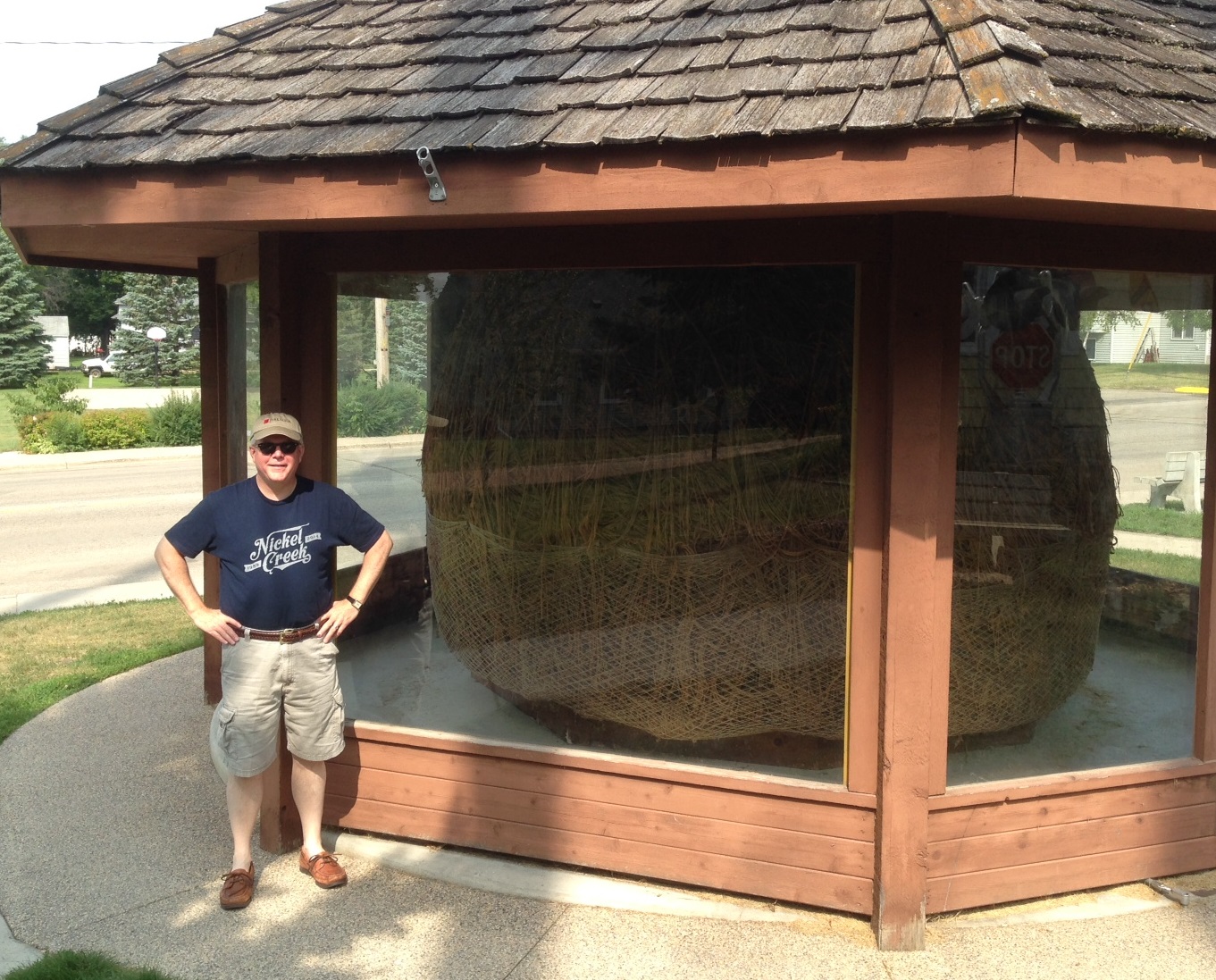
Francis A. Johnson was a quiet man who spent his entire life in Meeker County (His dad, Magnus Johnson, was briefly a U.S. Senator from Minnesota). For reasons that are lost to time Francis began rolling a ball of twine in his basement in 1950. Francis rolled twine four hours a day, every day. He eventually moved the ball onto his front lawn and used railroad jacks to ensure proper wrapping; Johnson cared as much about his ball’s roundness as its diameter. For 29 years this magnificent sphere evolved at Johnson’s farm, and he eventually built a circular open air shed to protect it from the elements.
Johnson didn’t stop until 1979. By then his ball weighed almost 9 tons and was 12 feet wide. He died of emphysema, and the town figured that nearly thirty years of twine dust killed him. But Darwin was also proud of Johnson, and somehow rolled his big ball next to the water tower. It’s known as “World’s Largest Twine Ball Rolled By One Man” because a rival twine ball in Cawker City, Kansas, is regularly added-to by visitors and townspeople. Darwin feels that this is cheating.
While the “Twine Ball Museum” was closed, the ball itself is fully accessible. We spent a good 15 minutes checking it out and taking photos. I suggested the hashtag #perseverance to Claire, but she used “Look what I did” #justkidding instead.
If you are near Minneapolis, DO THIS! Your life will otherwise not be complete.
Candice makes the best trail mix. Period. – When we left on Friday, Candice sent us off with lunch and two big bags of homemade trail mix. One-third of the way through the trip, we are still working on the first bag. Today – with seven hours in the car – was especially hard on the supply, but this wonderful mix has remained fresh. Thank you, my darling, for providing for us in such a tasty way!
Too many places to see, not enough time to stop (round two) – As I mentioned in the first edition of these observations, there are way too many places to stop and see given the time allotted for this trip. Today’s candidates in the “We know you are there, but we just couldn’t stop” category include the Roger Maris Museum in Fargo, ND; the Kensington Runestone in Alexandria, MN; the Sinclair Lewis Interpretive Center Museum in Sauk Centre, MN; the Grumpy Old Men Movie Town in Wabasha, MN; and the world’s largest buffalo in Jamestown, ND.
When you are in a car with your daughter for eight hours a day, you’d best be ready to talk about anything – During our time in the Central time zone (since last Saturday), we’ve discussed life after college, dysfunctional families, relationships and love, living in the present, why neither one of us can do a decent pull-up, reasons to cut back on sugar, Ebola, immigration, what it means to be the level-headed one among the siblings, and good names for bands. On that last one, we decided that one of the best names we’ve seen pop up on our various playlists is The Asteroids Galaxy Tour (on Claire’s playlist), while one of the best album names is the Tim O’Brien/Darrell Scott album We’re Usually a Lot Better Than This (on David’s playlist). And speaking of sugar, I’ve stopped adding it to my coffee on this trip – at Claire’s suggestion.
Google Maps need some work – I have planned this trip based in part on the times Google Maps told me it would take to get from Point A to Point B. The only problem is, those times are only accurate if you never stop for a bio break, gas, or lunch. Unfortunately, I haven’t figured out how to manage that feat. We couldn’t get to Bismarck in time this evening to make our planned visit to the Marcel Breuer-designed University of Mary. We’ll work it in tomorrow, but it is frustrating to think you have all the angles covered, only to have it pointed out to you (again) that you really have no control over anything.
Always ask the server for a recommendation on the local beer – Claire and I are trying out craft beers along the way. So when we get to a restaurant – as we did today at the Broadway Bistro in the heart of historic downtown Alexandria, Minnesota – we ask for a recommendation for a regional I.P.A. or something with “some hops” that we could split. So far, we’ve never been disappointed. Today, the chef/owner – Matthew Jensen – recommended Bells’ Smitten Golden Rye Ale, and it was wonderful. Plus we had salads (and are feeling somewhat healthy again).
Claire is a wonderful, sensitive, and thoughtful individual – which, of course, I knew in the Eastern time zone before I left on this trip. But I just wanted to say it again today. She is one in a million.
Tomorrow we continue to cross North Dakota (Motto: We have way more bales of hay than people!) and enter into Montana and the Mountain time zone. So let’s turn to Pokey again to take us out on Central Time.
Main Streets and baseball. What could be more American? More importantly, can you have a bad day when these two things converge? Not in my book. But how did the rhubarb crisp replace apple pie? Well, you’ll just have to read on to find out.
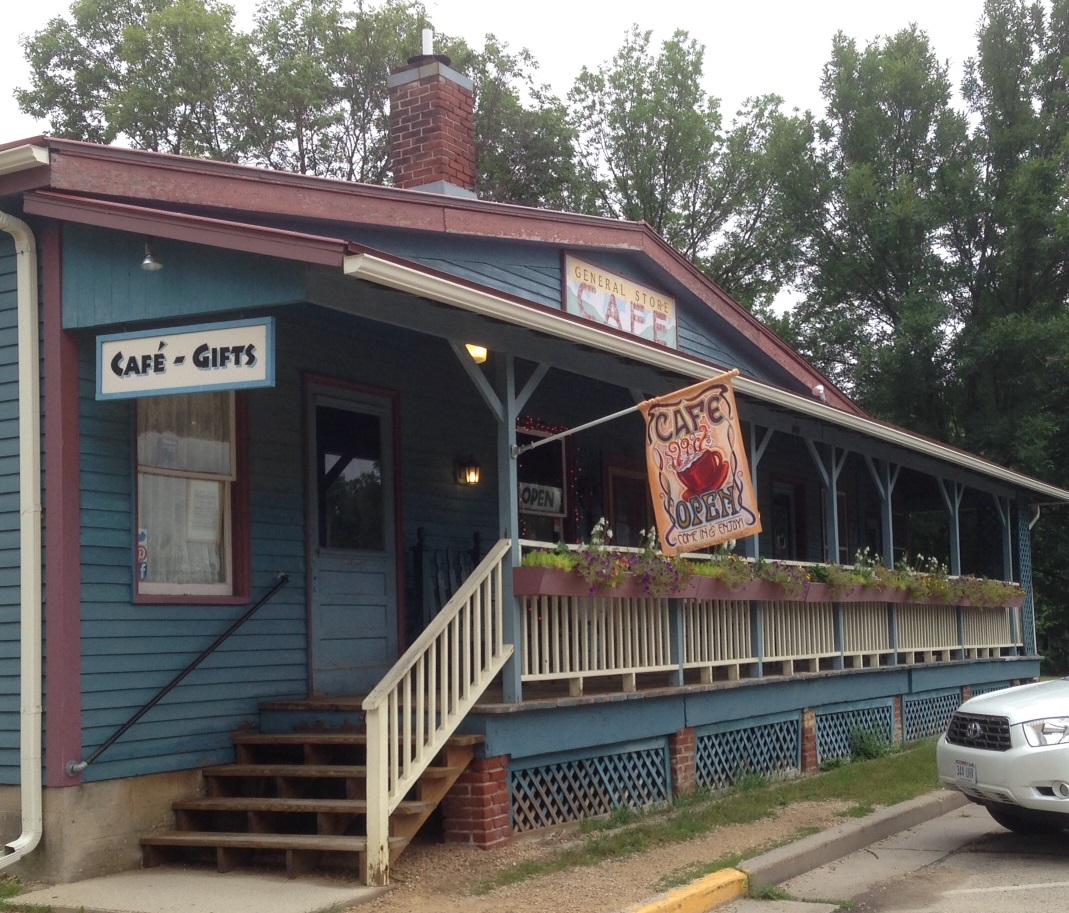
We began our first Tuesday – Day 5 on the Not All Who Wander Are Lost cross-country tour – in tiny Spring Green, Wisconsin. For a town of 1400 (I love town signs that post the population), Spring Green had much to offer. The downtown has a variety of interesting shops and services, and my friend Oakley Pearson – who drives through this area each year on his way home to Minnesota – recommended the Spring Green General Store for breakfast. Claire and I took him up on that recommendation, and after a great bowl of oatmeal (see, we can eat healthy food), we’re glad we did. Business was hopping with a great mix of patrons. I stopped by one table to tell the guy wearing the 1952 Vincent Black Lightning t-shirt that I was glad to see a Richard Thompson fan here in Spring Green. When he looked at me quizzically, I quickly said, “Oh, you must like the Del McCoury version” to which he replied enthusiastically, “Yes! Del McCoury!”
Suitably fortified, we hit the road to Minneapolis – but sticking to the back roads and the small town Main Streets along the way. We passed through Viroqua – a Wisconsin Main Street community – and we crossed the Mississippi at La Crosse, a winner of the 2002 Great American Main Street award. Oakley had suggested we take the river road up the Minnesota side, and so we drove through the fantastic Main Street along the river’s edge at Winona, and stopped for lunch in the thriving Main Street community of Red Wing.
The St. James Hotel (pictured above) is a Historic Hotel of America, but we had our sights set on another Red Wing institution – Bev’s Cafe.
As Claire declared at the end of another satisfying meal, “The rhubarb crisp (with ice cream, of course) at Bev’s makes any stop in Red Wing worthwhile.” Amen. Amen! Amen!! Can I have an Amen!?!
Oh, and did I mention that we passed through the town where water skiing was invented (Lake City, MN) and the birthplace of ski jumping (Red Wing)?
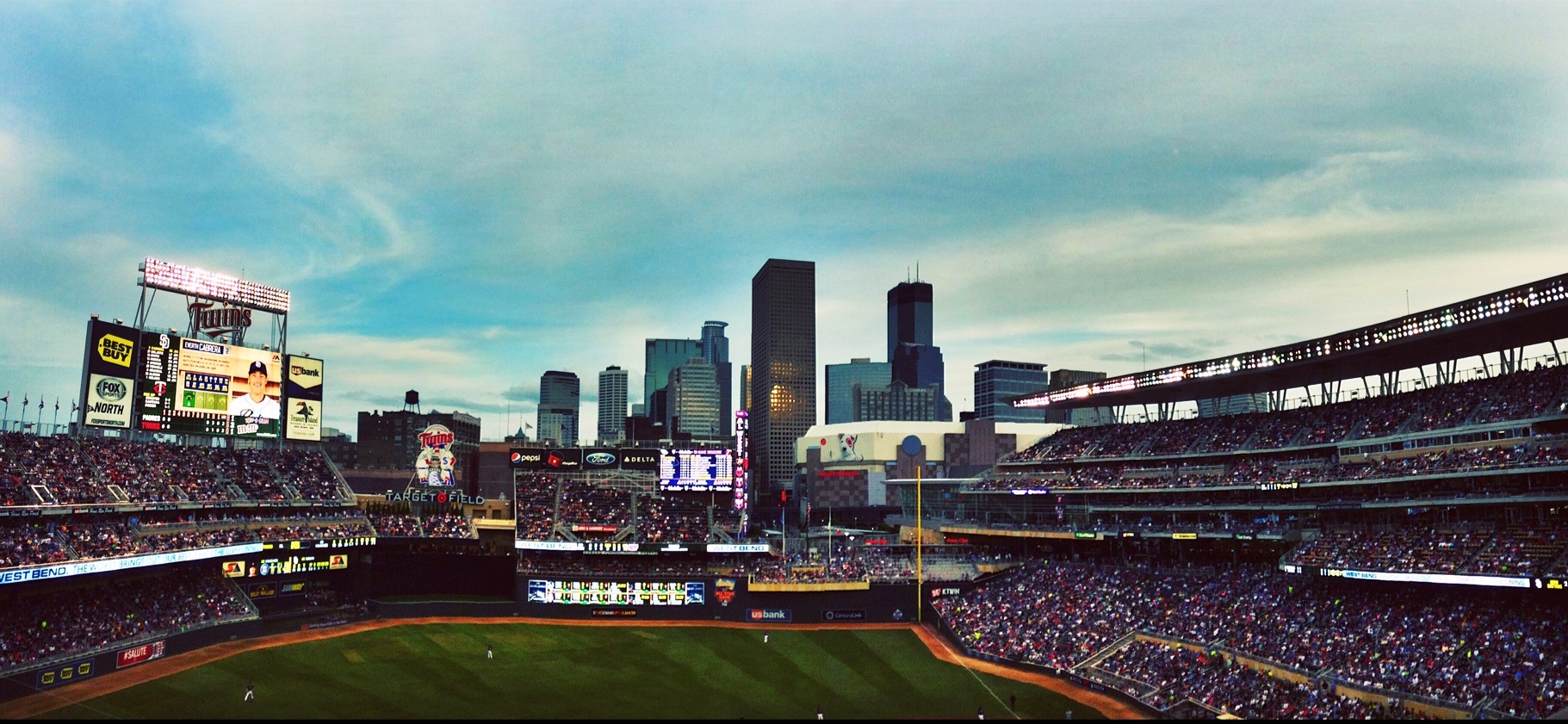
We ended our day in Minneapolis – tired but satisfied. And yet, another adventure awaited us. One of my former assistants and a dear friend – Liz Welsh McGonagle and her husband Dave – joined Claire and me for a night of Minnesota Twins baseball at Target Field. On my scorecard, where it asks for the weather at first pitch, I simply wrote “Perfect!”
The hometown Twins – in front of almost 35,000 fans – played smart baseball and beat the Padres 3-1 in a crisp game (especially by American League standards). Kennys Vargas hit his first major league home run for the Twins, and it just happened to be the game winner. Along the way it was great to catch up with Liz and Dave, and it was also terrific to check another ballpark off my bucket list.
This was also a landmark day for Claire. Earlier in the day she texted her friend Kyra to ask about fried cheese curds. Kyra replied, “They are like mozzarella sticks, only better.” So tonight, Claire got some at the ball park, for the first time.
Here’s the text exchange between Claire and Kyra that followed:
Claire: My life has been forever changed!
Kyra: You can now divide your life into two parts: pre-cheese curds and post-cheese curds.
I will say that the stadium is wonderful – a great place to watch a ballgame. While I still prefer the Nationals scoreboard for detail, the information at Target Field was an improvement over Cleveland’s Progressive Field scoreboard. But the mascot race was lame. They were too nice. (Imagine that, in Minnesota Nice.) Heck, at National’s Park Abe Lincoln would have cleaned the clock of Wanda the walleye well before she reached the finish line.
So I’m down to an even dozen! Woo hoo!! For those keeping score, here’s the ballparks visited list:
Atlanta Braves – Fulton County Stadium (multiple visits in 1980s; still need to visit Turner Field before they tear it down, but this counts given my rules)
Baltimore Orioles – Camden Yards (multiple visits in 1990s and 2000s)
Boston Red Sox – Fenway Park (1988)
Chicago Cubs – Wrigley Field (1964, 2007, 2012)
Chicago White Sox – US Cellular Field (2013)
Cleveland Indians – Progressive Field (2014)
Colorado Rockies – Coors Field (2008, 2013)
Kansas City Royals – Kauffman Stadium (2009)
Milwaukee Brewers – Miller Park (2005)
Minnesota Twins – Target Field (2014)
Oakland A’s – Oakland Coliseum (2008)
Philadelphia Phillies – Citizens Bank Park (2008)
Pittsburgh Pirates – PNC Park (2013)
San Francisco Giants – AT&T Park (2012)
Seattle Mariners – Safeco Field (2009)
St. Louis Cardinals – Busch Stadium (old – 1993; new – 2012)
Tampa Bay Rays – Tropicana Field (2012)
Washington Nationals – RFK (multiple times) and Nationals Park (multiple times + part of a season ticket group since 2012)
And here are the ballparks remaining to visit list:
Arizona Diamondbacks – Chase Field
Cincinnati Reds – Great American Ball Park
Detroit Tigers – Comerica Park (Another park I’ve seen but haven’t made a game.)
Houston Astros- Minute Maid Park
Los Angeles Angels – Angel Stadium
Los Angeles Dodgers – Dodger Stadium (This is the only park that a family member – Claire – has seen before I have had the opportunity. That’s just not fair!)
Miami Marlins – Marlins Park
New York Mets – Citi Field (I think this is an easy one to do, but it never works out.)
New York Yankees – Yankee Stadium (I know – how can I not have made it to Yankee stadium yet?! Just goes to show I’ve never been a big Yankees fan)
San Diego Padres – Petco Park
Texas Rangers – Texas Stadium
Toronto Blue Jays – Rogers Centre
That’s it for the ballparks on this trip, but it was great to share my passion with Claire and with Liz and Dave.
On Wednesday, we’re off to see the world’s largest ball of twine (rolled by one person). Be still my heart!
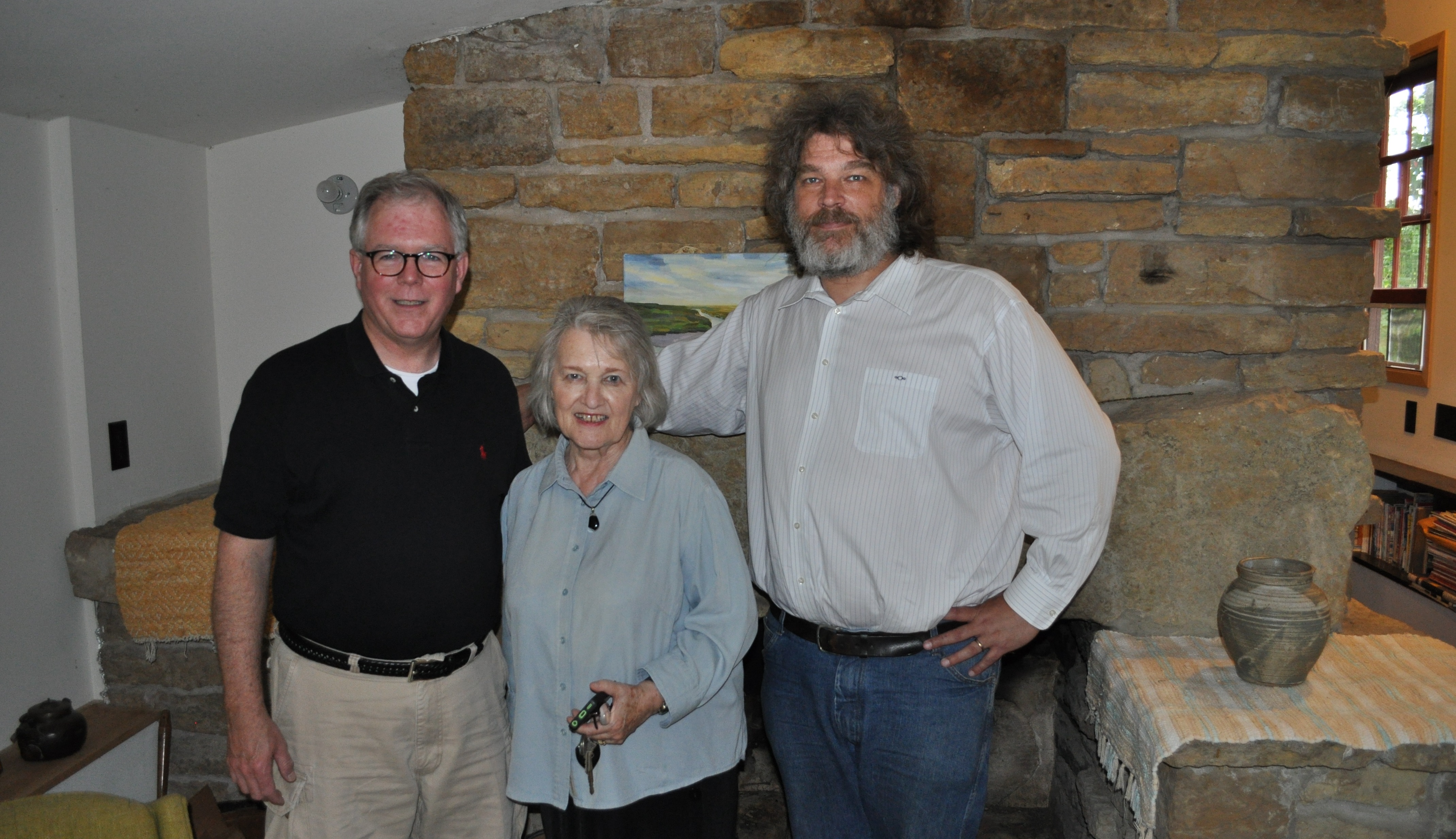
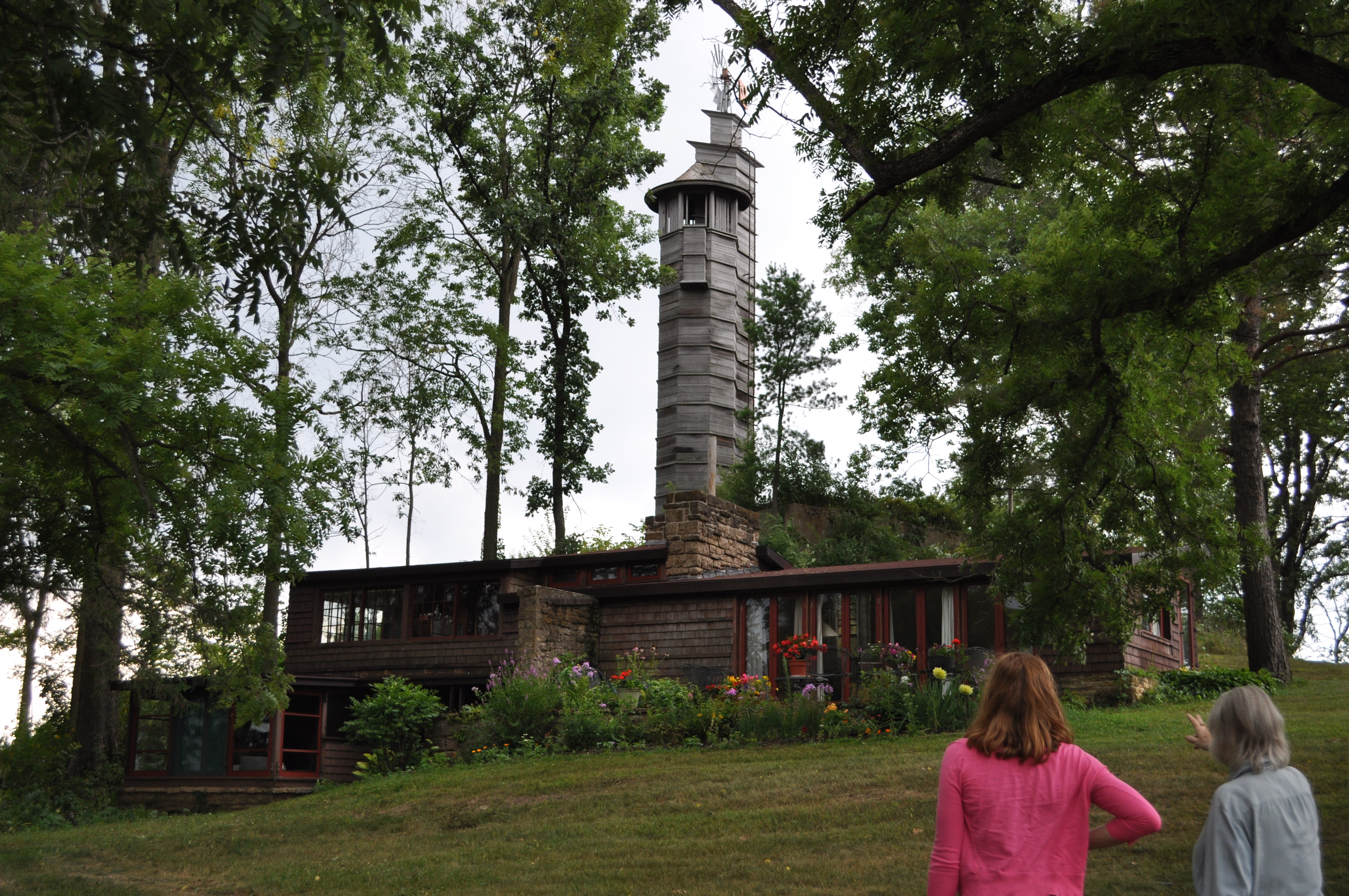
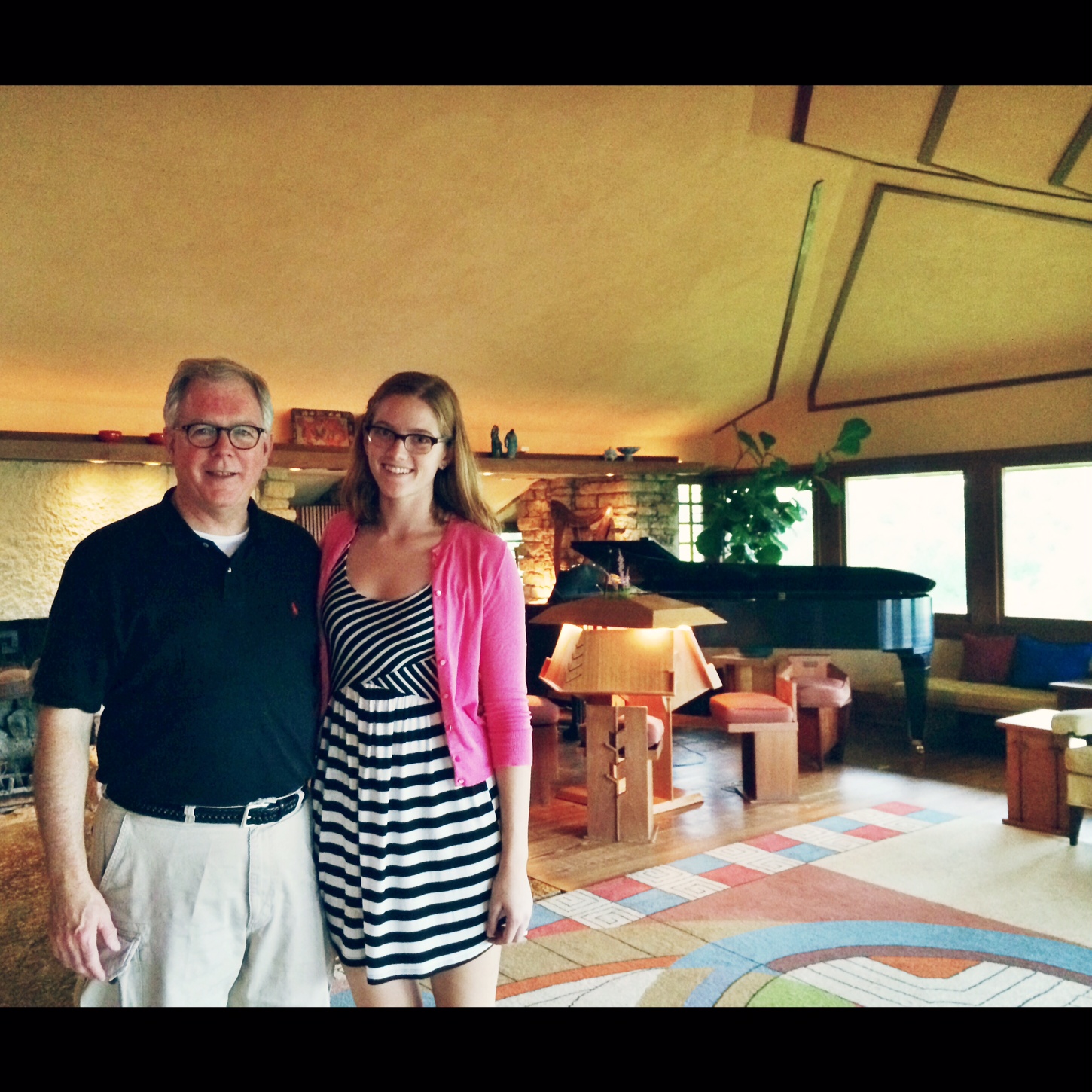
Our cross-country road trip includes a couple of places that are clearly what one could tag as a busman’s holiday. Thanks to the generous offer of my good friend Jeff Grip of the Frank Lloyd Wright Foundation, Claire and I were met at Taliesin – Wright’s Spring Green, Wisconsin, home – by Effi Casey, a member of the Taliesin Fellowship; a graduate of the architecture school at Taliesin; the widow of the long-time dean of the Frank Lloyd Wright School of Architecture, Tom Casey; and an accomplished violinist who serves as the Director of Music at the school. We were also joined for the afternoon by Floyd Hamblen, a member of the Taliesin Fellowship who serves on the faculty of the Frank Lloyd Wright School of Architecture, is a practicing architect, and lives year-round with his family at Taliesin. I’m pictured with the two of them inside Effi’s home on the grounds, known locally as the Engineer’s House. We were later joined in the main house by Victor Sidy, the current dean of the School of Architecture.
Having the opportunity to be with three such accomplished, yet humble, individuals who wanted nothing more than to ensure that we had the chance to see and understand Wright’s vision of Taliesin made a lasting impression on both of us. As we drove off more than three hours later, my lovely Claire said, “Dad, they even talked to me throughout the afternoon, and they were interested in what I was doing, not just in talking preservation with you. But what they had to say about Taliesin was so interesting, I loved it.” Effi, Floyd, and Victor all were so gracious with their time, knowledge, and perspectives. When we first sat down in the dining hall of the studio building, Effi began by saying, “I read your recent posts on the future of preservation, and I like where you are going with those writings. So much of preservation is stuck in the past, but your emphasis on people in preservation and the thought that the ‘period of significance is now’ rings true.” That was just the start of an afternoon of thoughtful conversation.
For the uninitiated, here is a short history lesson on Taliesin, taken from the website:
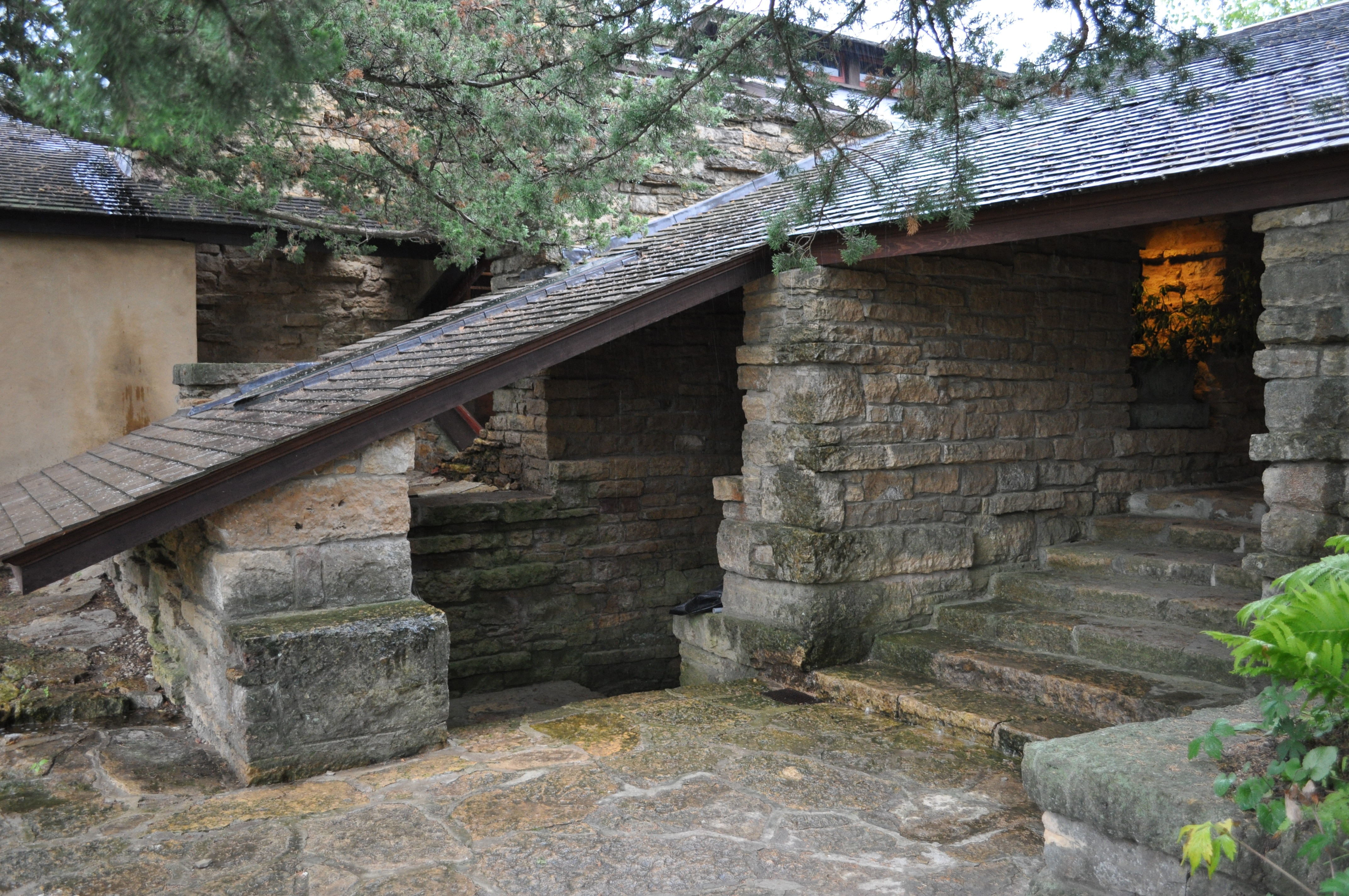
“Taliesin was the home of architect Frank Lloyd Wright. He first designed the home for himself in 1911. From that time until his death in 1959, Wright continuously changed the home and the surrounding landscape, which included buildings that he had designed for his family.
At the time of Frank Lloyd Wright’s death, “Taliesin” referred to the home, the surrounding 600-acre estate, and 4 other Frank Lloyd Wright-designed structures.“
Having heard of Taliesin for years, visiting this iconic National Historic Landmark that has a thriving present and a future as visionary as its past was more than just a bucket list check-off while on a cross-country trip. Understanding the philosophy behind Taliesin’s educational purpose and preservation, and then seeing it in practice, has already started wheels turning in my head about work we do at the National Trust, both at our historic sites and with our National Treasure campaigns. But I won’t go into that here, other than to say I love how the stewards of this place are all working – through their own understandings of the way forward – to continue its use as a thriving, alive, and purposeful place for the future.
Those who tour Taliesin are not allowed to take interior photographs, and out of respect for that policy I have only posted two interior photos – the one above in the Engineer’s House and one below taken by Floyd Hamblen of Claire and me in the living room of the main house at Taliesin. There are plenty of interior views online for the curious. In addition, it was a gray, windy, and occasionally rainy afternoon, so these are photos best understood in that light.
We began our tour at Hillside, where one finds the drafting studios, the dining hall, and the theatre. (If you are lucky enough to be in the Spring Green area this Sunday, get a ticket to hear the Brahms Requiem that Effi has organized in the beautiful theatre space.)
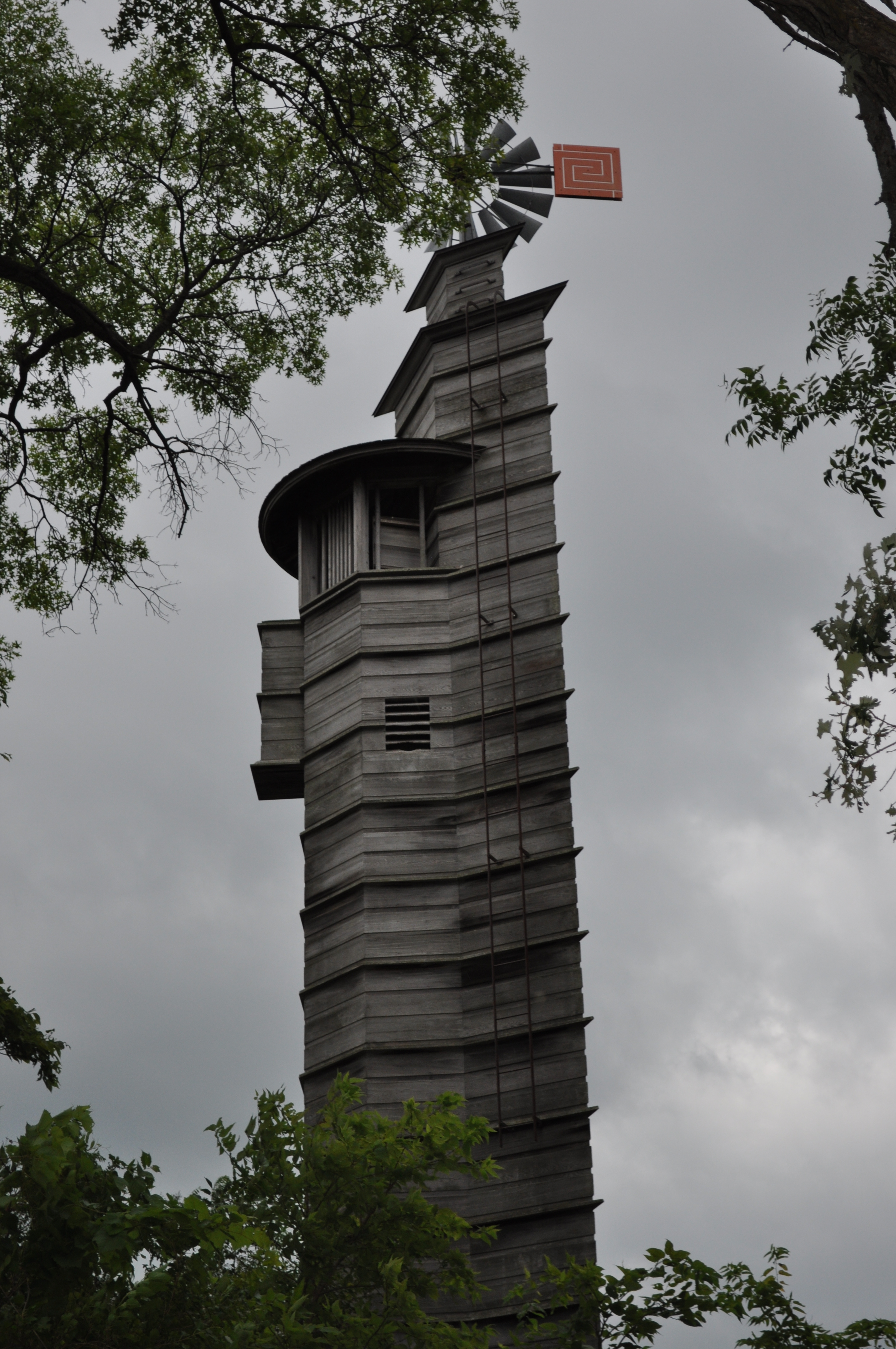
After a wonderful tour of the theatre, drafting studio, and dining hall, we drove up to the Engineer’s House – where Effi opened her home to us – and we also toured the recently restored Tan-Y-Deri. Wright’s “Romeo and Juliet Windmill” makes for a unique rural backdrop to these two homes.
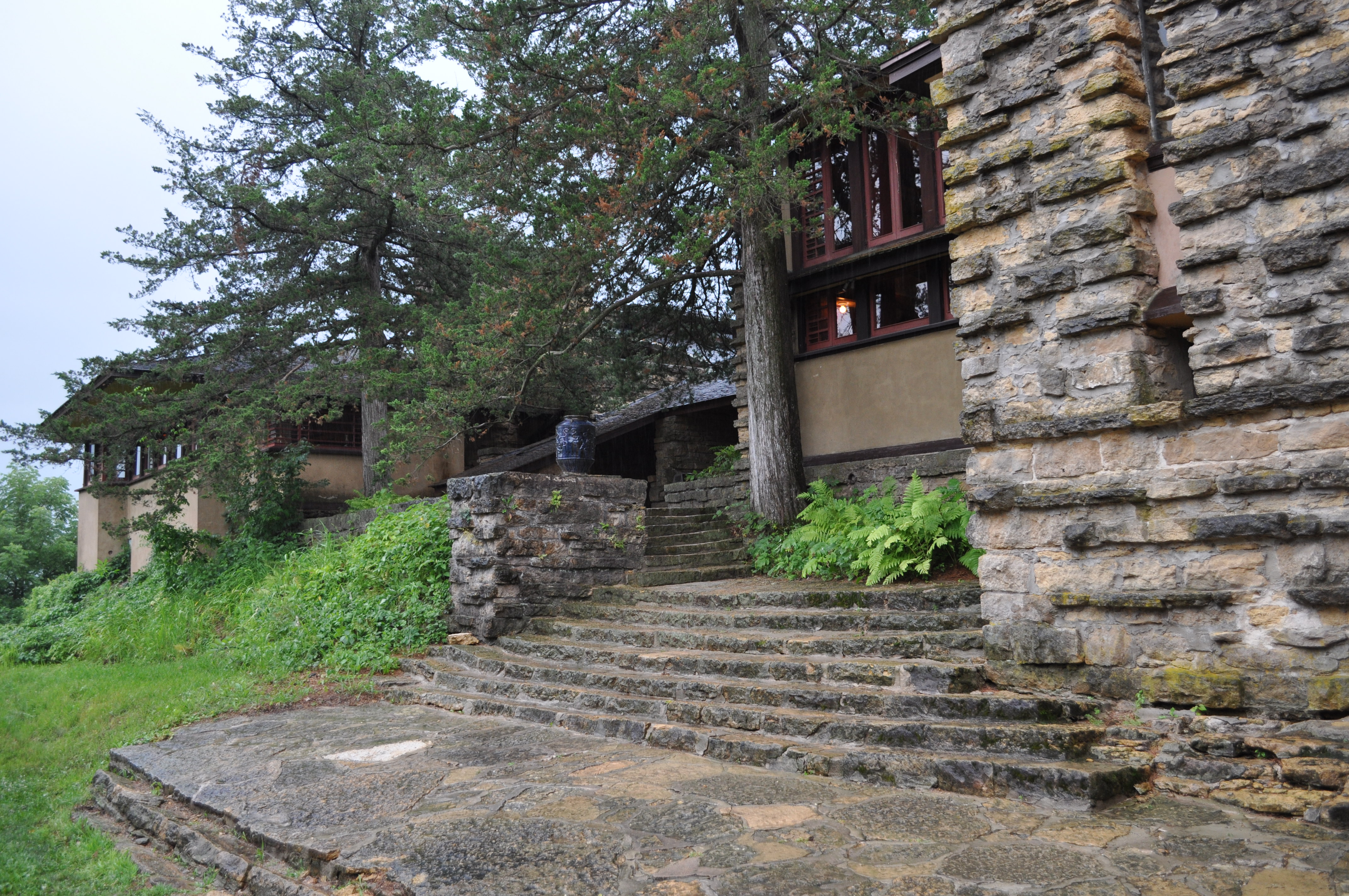
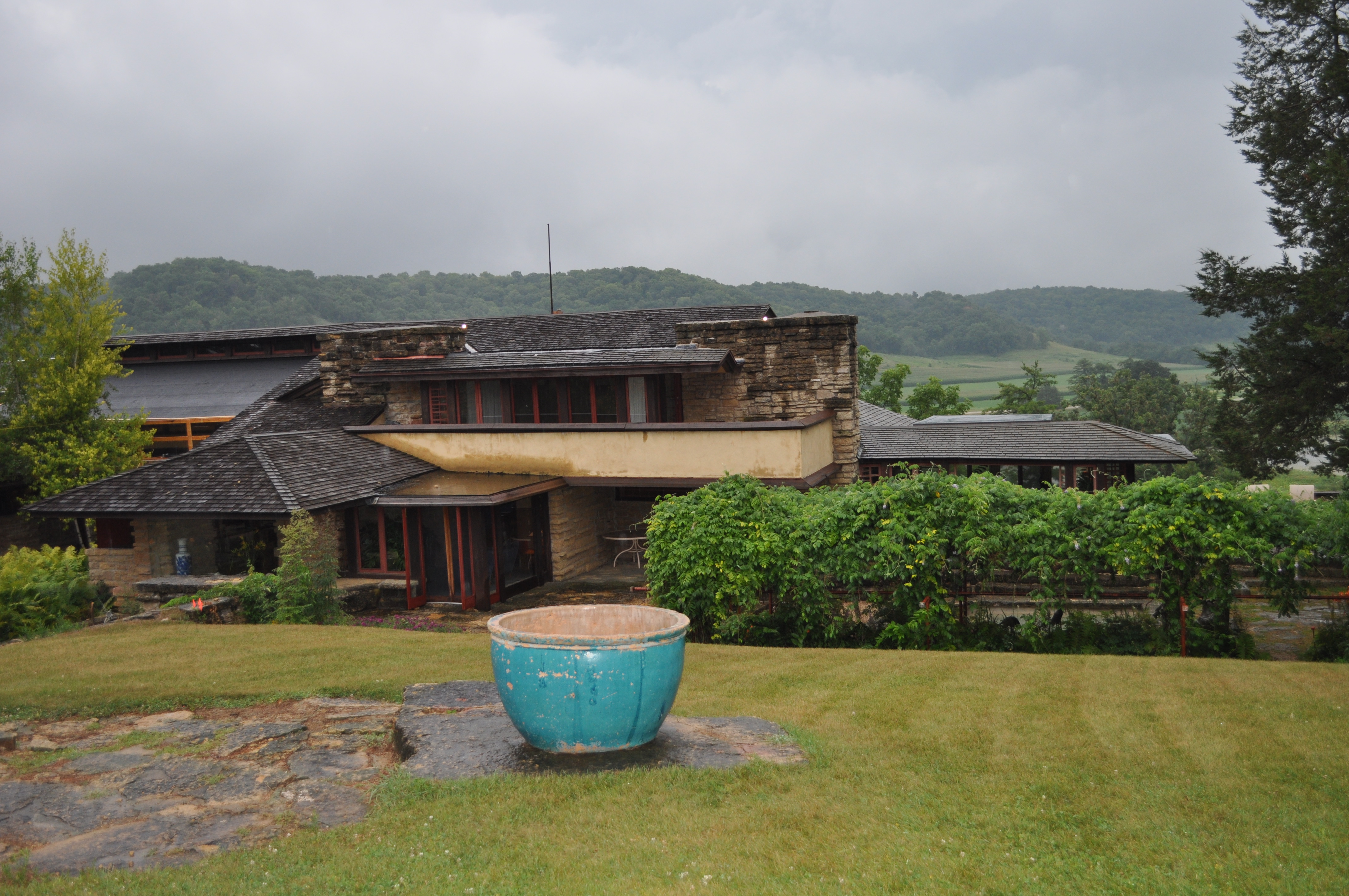
Finally, we ended our day at the main house. When Wright designed his own home, he gave it the Welsh name Taliesin, meaning “shining brow.” Frank Lloyd Wright placed Taliesin on the brow of a hill, leaving the crown, or top, open – as you can see in the next two pictures.
We toured throughout the main house, seeing the variety of preservation projects underway.
And finally, we ended on the brow of the hill, looking at the exterior – and the view.
There is so much more to see and say…but this will have to do in whetting your appetite. Taliesin is about 3 1/2 hours from Chicago and less than an hour from Madison. Don’t wait as long as I did to see it.
Thanks again to Jeff, Effi, Floyd, Victor, Taliesin Preservation, Inc., the Frank Lloyd Wright Foundation, the Frank Lloyd Wright School of Architecture – and everyone who helps this wonderful place stay fresh and alive.
 One could look at today’s itinerary for the Not All Who Wander Are Lost tour and think that our main goal was to go from Point A (Seattle) to Point B (Portland) as quickly and efficiently as possible. But those who think that way miss the point of our cross-country trip.