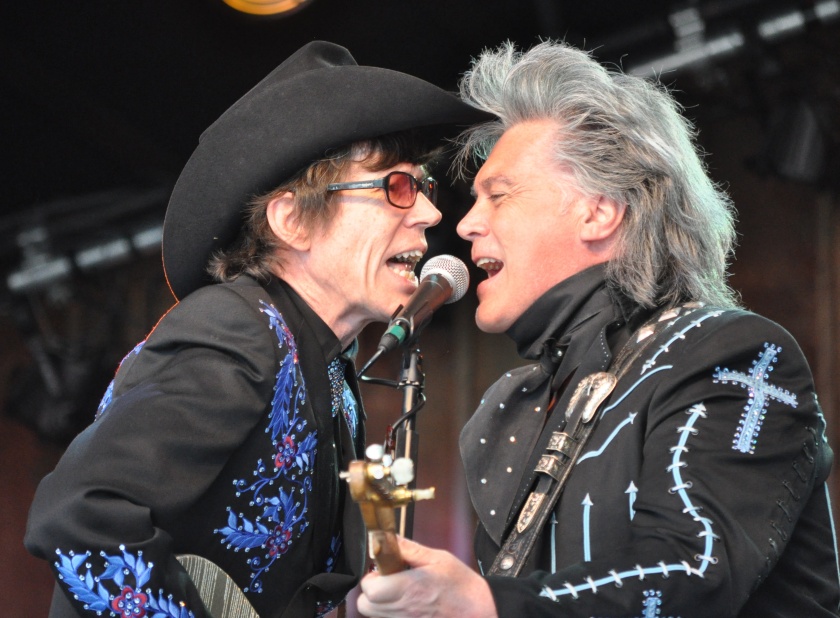
On more than one occasion I’ve suggested that Marty Stuart found the perfect name for his incredible band: The Fabulous Superlatives.
Best band name ever. Period. Full stop.
Comprised of “Professor” Chris Scruggs on bass, “Handsome Harry” Stinson on percussion, “Cuzin'” Kenny Vaughan on guitar, along with Stuart on guitar and mandolin, these four gentlemen can play anything with incredible skill and apparent ease.
Last week, the folks at NPR Music “graced the roots music world” with a release of a Tiny Desk Concert featuring Marty Stuart and His Fabulous Superlatives. As The Bluegrass Situation noted, the group demonstrates how interconnected all of our roots music genres really are. “Stuart straddles limitless folk and country aesthetics, from classic, old-school sounds to bluegrass string band vibes to psychedelic surf rock.”
There’s a four-song set list—“Tempted,” “Streamline,” “Tomahawk,” and “Heaven“—spanning album releases from 1991 to 2023. The NPR folks give us the basics of Stuart’s musical history.
“When Stuart was just 12 years old, he went on the road for the first time with a Pentecostal gospel bluegrass group called the Sullivan Family Gospel Singers. Almost 55 years later, he’s still performing and is a five-time Grammy winner, Country Music Hall of Famer and AMA Lifetime Achievement Award recipient.“
Along the way, Stuart played with just about every country and bluegrass icon: Johnny Cash, Doc Watson, and Lester Flatt among others.
This concert was recorded just a few days before Easter, and . . .
“. . . the set ends appropriately in the spirit of the church. ‘When we first put our band together, the way we learned to sing together was singing gospel songs,’ said Stuart. ‘I was in love with the Staple Singers as always, Mavis and Pops and Cleotha and Pervis, and they are all like family and so bluegrass music all figured in. So we finally got around to writing a few songs for ourselves and here’s one we got to do called ‘Heaven.’”
And then it really doesn’t get any better than a 2011 performance of Country Boy Rock and Roll on David Letterman. Kenny Vaughan just goes off in a way that is other-worldly . . . and all without any special effects. Then Stuart and Vaughan top it off with a few bars of double guitar leads. Oh my!
Just a magical twenty-five minutes between these two videos. Enjoy!
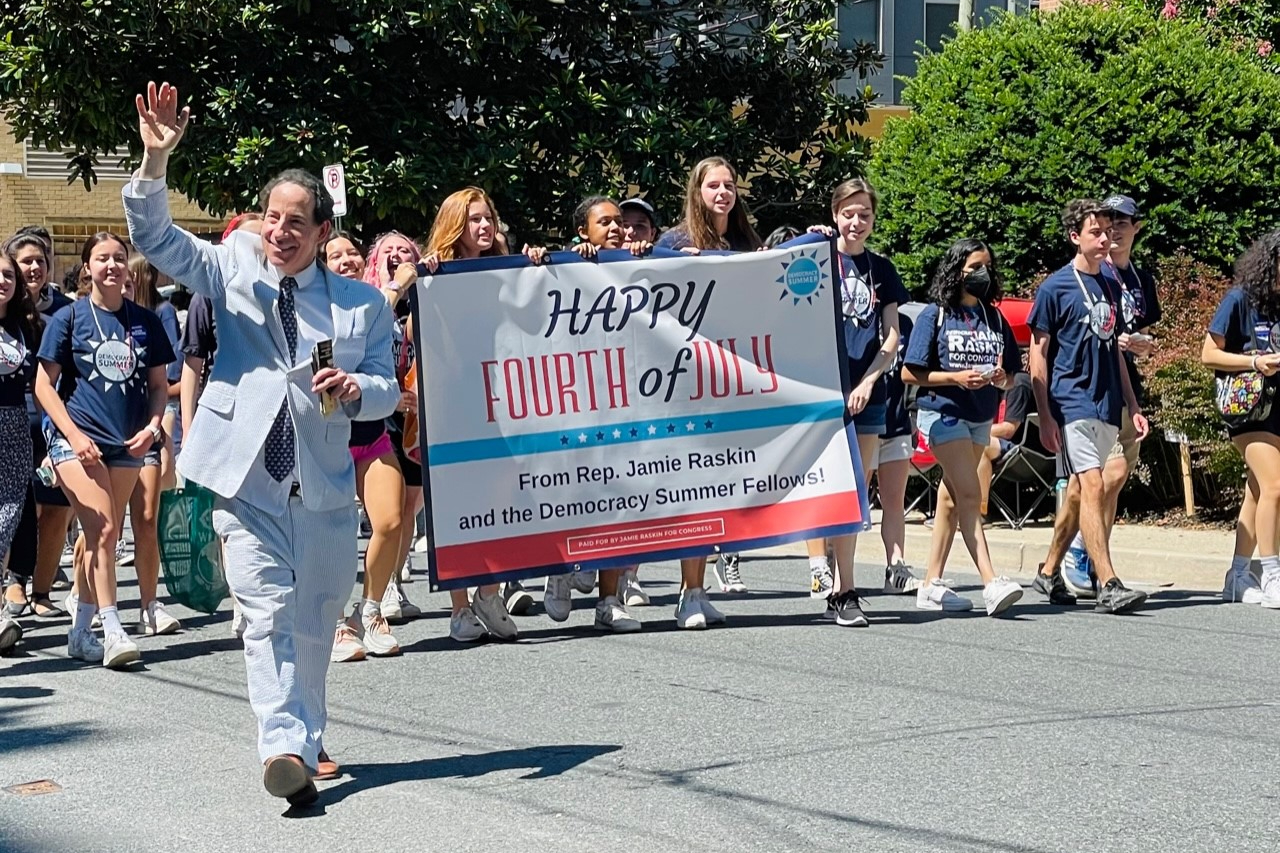
Two weeks ago I received an email from a senior photo editor for The New York Times. He was working on a story that described a moment at a parade in 2022 which involved Maryland Congressman Jamie Raskin. I was there and my photo of Raskin walking the parade route caught the editor’s eye as he searched the internet. He was asking to license this image for one-time use for the Times.
Jamie Raskin at Takoma Park’s July 4, 2022, parade (by DJB)
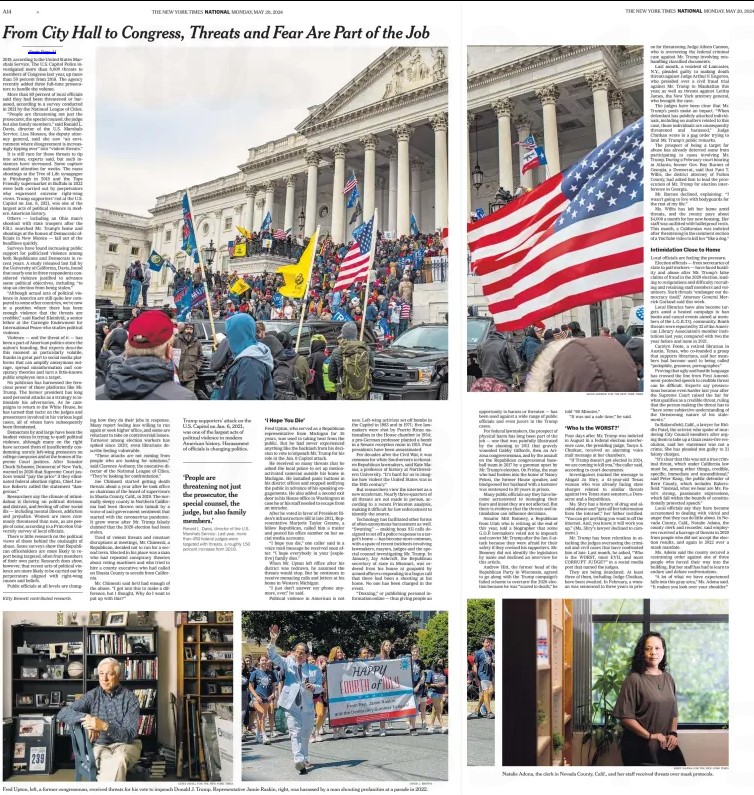
When the photo was not used in the May 19th online edition, I suspected I had been left on the proverbial cutting room floor. However, when our Monday Times was delivered to the house, I saw that the story—“Threats and Fear Are Transforming U.S. Politics”—was front page.
Then I discovered my photo and byline made the spread on the jump to page 14!
How did I happen to take this picture? Well, Congressman Raskin shows up in several of my parade photos over the years. (Check out 2023, where he’s sporting one of his stylish Stevie Van Zandt bandanas.) At those parades, Raskin arrives and sweeps through the street like a whirlwind, enthusiastically working the crowd, shaking every hand he can reach and waving to the ones he cannot touch. In 2019 I likened him to James Brown: the “hardest working man in politics.”
I am a Jamie Raskin fan, admiring his courage, his politics of inclusion, and his unwavering commitment to democracy. Most importantly, Jamie Raskin has a clear love for people and a zest for life. *
I’ll admit that I was pleased to have made The New York Times for the first time as a photographer. (I have had quotes in a few stories, a short op-ed, and letters to the editor in my former life.) But regular readers know I have a conflicted relationship with the Times. We’ve been subscribers for decades and relish much of the information the paper provides. However, in my estimation they keep downplaying the most important political issue of our lifetime.
Read the story about the political violence—threatened and real—that is tearing apart our country. It is clear and sobering. I thought my Raskin picture was especially appropriate as it showcased where political violence can break out. There’s nothing more American than an Independence Day parade, so it points to the truth of: “If they’ll attack here, they’ll attack anywhere.”
In 2019 I pointed readers to historian Joanne B. Freeman’s Field of Blood, which looks at political violence in the decade before the Civil War. This is a very serious issue that goes back generations, as historians have repeatedly noted.
Today is an especially appropriate day in history to discuss political violence. As historian Heather Cox Richardson reminds us, “on May 22, 1856—exactly 168 years ago today—South Carolina representative Preston Brooks beat Massachusetts senator Charles Sumner nearly to death on the floor of the Senate after Sumner criticized southern enslavers, particularly Brooks’s relative South Carolina senator Andrew Butler.”
I have returned to the problem of political violence and the damage it brings to democracy several times in my newsletter. For instance, I wrote in that 2022 article:
“As he does every year, Congressman Raskin was marching in today’s Takoma Park July 4th parade. He was there in spite of threats made to members of the House Select Committee on January 6th. Why are the members being threatened? Because the January 6 committee has made the work of uncovering truth ‘the lodestar of its public hearings.’”
While they have covered our current outbreak of political violence before, the Times could have been writing a variation of this story on an almost daily basis since 2015 and at least as recently as May 18th of this year when Donald Trump, in a speech to the NRA, alluded to the execution of President Joe Biden.
That’s not normal. It’s not normal when extremist will tolerate no dissent. Yet the Times coverage didn’t mention it.
The newspaper’s editor, Joe Kahn, has said “that democracy-related coverage wasn’t the Times’s most important focus,” even though—as Margaret Sullivan and many others have pointed out—we’re in an incredibly dangerous moment for American democracy. Kahn’s position troubles me.
Sullivan is one of the nation’s most astute media observers, a skill shown once again in a recent Substack post. She states that most sensible people know the difference between, “Shouldn’t The New York Times be vitally interested in preserving democracy and shouldn’t its news coverage reflect that?” and “Why isn’t The New York Times joining forces with the Biden campaign?” That’s not the question, even though Kahn took the interviewer’s opening query in that direction.
Sullivan suggests that audience growth and the lucrative nature of expansive coverage . . .
“. . . is one of many reasons for this emphasis on “independence,” which is both a journalistic virtue and code for Big Tent. But to my mind, that stance can tip over too easily into a kind of performative neutrality in politics coverage in which unequal candidates, parties and positions are equalized. (Trump has been charged with dozens of crimes and is sitting in a courtroom defending himself in a hush money/campaign finance case involving a porn star? Well, let us restate that Joe Biden is old!)“
In its place, Sullivan would like for the top decision-makers in mainstream media “to make it clearer” in coverage, emphasis, framing, and public statements that the “news organization is aware of the threats to democracy on the ballot in November. And that it is a core part of your mission to stand for democratic principles and to have news coverage reflect that consistently.”
Another commentator suggests that if media outlets are tied to the horserace theme, at least stop covering the odds and talk about the stakes.
Sullivan also addresses the issue of framing.
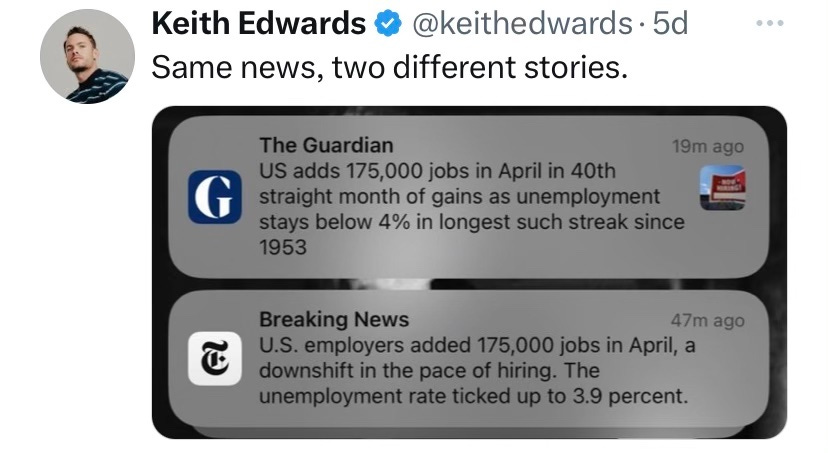
“While you’re at it, you could also stop doing everything possible to put a negative spin on Biden’s legitimate accomplishments, as these two news alerts—one from the Times, one from the Guardian—illustrate. This is one of innumerable examples.“
So yes, I’m pleased that The New York Times has used one of my photographs. But I do wish the Times would take its role in protecting our democracy more seriously. When virtually every candidate to be Trump’s vice president refuses to abide by the election results and we hear daily escalation of violent rhetoric, the stakes seem pretty clear.
More to come . . .
DJB
UPDATES AND RELATED STORIES
After this post went up, commentator Mark Sumner called out the Timesfor killing stories for Trump, just like another “newspaper” that has been in the news during the former president’s New York trial.
Brian Klaas in his The Garden of Forking Paths newsletter also went into a deeper dive about the roles the Times and other media play in the inversion of reality. It is worth a read.
Everyone who reads this newsletter knows that I had cataract surgery over the last two months.
I announced this not-so-uncommon news in March when I suggested I was Seeing the world with new eyes. There I recounted my 60-year history of wearing glasses (complete with embarrassing photos) because I’ve always worn glasses. When my doctor passed along the good news that while I would need a pair of reading glasses I probably wouldn’t have to wear corrective lenses for driving and normal activity, I decided to give what I called the “naked look” a chance.
Let’s just say that the change to my self-image felt weird, which was right in line with the weirdness of the actual procedure to remove the cataract and the subsequent changes in how I saw the world.
Then April arrived. After having the cataract in my left eye removed, I wrote about that experience in Most of what we see is behind our eyes. The seeing thing was still weird because for the first time in over 60 years I was no longer nearsighted. The clarity came when I looked off into the distance. For the first time in forever everything from the end of my outstretched arm to the horizon was beautifully clear and crisp. Yet when I pulled out my phone, it was all fuzzy. As my doctor had predicted, reading glasses were a necessity for everything from work on the computer to navigating a menu to reading books in bed. Yikes!
I tried to adjust to reading glasses for about five weeks but finally decided it was time to return to normalcy. For those who saw the headline and thought I was going to write about some new discovery to break the fever of the Trump cult, I’m sorry to disappoint. This is all about going back to what I’ve known since I was in third grade.
At my last checkup I asked for a prescription for new glasses. I didn’t care if the top part was just clear glass because I was tired of fooling with reading glasses all the time. My doctor agreed that it would be easier. With prescription in hand I met our friend Garrett Drake at Apex Optical. * We selected several options for frames and then Garrett let me take the top two choices to New York so that Andrew and Candice could weigh in with their preference after seeing them in person. A choice was made and last Wednesday I picked up my new glasses!
The “new” old look
Whew!
Even now that things “feel right” I’m going to work hard to remember what it was like to take a different approach to seeing the world. Instead of coming to the table with preconceived notions I’ll try looking afresh at what is right in front of me.
It is always good to remember what Marcel Proust once said: “The real voyage of discovery consists not in seeking new landscapes, but in having new eyes.”
Here’s to new eyes . . . and a new pair of glasses.
More to come . . .
DJB
*Garrett is our friend in part because we’ve bought more than 20 pairs of glasses from him for our family through the years. We are very good customers . . . and we recommend him highly.
Those who watched the Ken Burns film will recall Harlan Howard’s famous line that Country Music is three chords and the truth. One of Nashville’s most successful Black songwriters says that “Country Music is three chords and four very particular truths: life is hard, God is real, whiskey and roads and family provide worthy compensation, and the past is better than the present.”
“The last truth is one of the places where Country experiences a racial split. In the world of white Country, the past that is better than the present exists in a longed for and lost mythical Dixie. In Black Country, the past that is better that the present exists in a longed for and lost Africa before colonization. In my life it was the Detroit past that was better than the Washington, D.C., present.”
My Black Country: A Journey Through Country Music’s Black Past, Present, and Future (2024) by Alice Randall is memoir, history lesson, and manifesto by the first Black woman to cowrite a number one country hit, Trisha Yearwood’s XXX’s and OOO’s.* Randall’s story could not be more different than the stereotypical country songwriter: born of an activist yet difficult mother and a loving and wise father in Detroit in a marriage that didn’t last, raised in the nation’s capital during its Chocolate City days where she attended the prestigious and preppy Georgetown Day School, a graduate of Harvard University where after discovering a connection with British and American metaphysical poetry she was surprisingly propelled towards Country Music, and a decades-long resident of Nashville who writes modern Black fiction and screenplays and has emerged as an innovative food activist committed to reforms that support healthy bodies and healthy communities.
Not exactly the hayseed who fell off the pickup truck.
But the story that upsets the stereotype is what My Black Country is all about. Randall wants us to know the truth behind two statements that she heard from her father: “Black folk invented Country Music” and in a nod to the way the unknown writers of many folk songs are credited, “Traditional is a Black woman!” She is sitting in Quincy Jones’ Los Angeles house when she has the ephinay that gives her life a new and higher ambition: she is to “lay a velvet carpet for my pearls” just as Jones had done when he recorded Miles Davis late in life as a way of ensuring remembrance. Randall’s life goal is to make certain that everyone recognizes and remembers the First Family of Black Country Music: “DeFord Bailey, the father; Lil Hardin, the mother; Ray Charles, their genius child; Charley Pride, DeFord’s side child; and Herb Jeffries, Lil’s stepson.” This book is only one step along that path.
Growing up outside Nashville in the 60s and 70s, I knew three of the five of Randall’s first family: Bailey, Pride, and Charles, although I never considered Ray Charles a country musician. I knew he had recorded the iconic Modern Sounds in Country and Western Music, but Randall sets the record straight for me with multiple links between the “genius” and Country Music. Just listen to the piano solo in Worried Mind beginning at the 1:10 mark and then try and tell me the man’s not country.
On the other hand, DeFord Bailey’s story of being pushed out of the Opry because he was Black was one I knew. Bailey wasn’t merely one of the Opry’s first stars—he was the first musician to perform the Saturday that announcer George D. Hay coined the name of the world’s longest-running radio show—the Grand Ole Opry. He not only helped popularize the harmonica in the United States, he was country’s first big star and the one who was selling the tickets to the shows that others like Roy Acuff benefitted from. “He was the draw that got a lot of folks tuning in to the Opry.”
His train songs were one of the reasons. Trains suggested a future, a way out.
Black folk needed a sound that was an escape, a sound that was a positive possibility, a sound that took them away from where they were to some place better. We needed what “Pan American Blues” provided and DeFord Bailey delivered: reliable escape most Saturday nights for a good long while.
Bailey was also “the first musician to hold a recording session in Nashville, setting the stage for a scene that would change the world.” Given all that, Randall lays down her marker.
“DeFord isn’t just the father of Black Country, DeFord is the Father of Country and was Country’s first superstar. Period exclamation mark. How in the f**k does that get forgotten?”
Charley Pride, who died in 2020, was an undeniable Country Music superstar. He had twenty-nine #1 songs on the country charts during his career and was an important music publisher. He became the Grand Ole Opry’s second Black member and was inducted into the Country Music Hall of Fame in 2000, five years before DeFord Bailey and twenty-one years before Ray Charles. As a Black man in a white world, Pride was dignified, talented, full of rural bona fides, and someone who paved the way into the Hall of Fame for the elders who had paved the way for his musical success.
The other two members of the first family were unfamiliar to me, but Randall makes the strong case for their inclusion. Lil Hardin, who is better known in jazz circles, played piano on one of the most influential Country songs of all time, Jimmie Rodgers Blue Yodel #9. Along with Louis Armstrong, the three of them made musical history. The song—also known as Standin’ on the Corner—was recorded in 1930 at Hollywood Recording Studios, in Los Angeles. Along with the other 12 Blue Yodels Rodgers recorded in his very short life, it made him a national star. And he was accompanied by two Black musicians.
Herb Jeffries was America’s first Black singing cowboy, an important figure in country’s development. Jeffries’s first film, Harlem on the Prairie, appeared in 1937, followed by Two-Gun Man from Harlem, The Bronze Buckaroo, and Harlem Rides the Range.
Randall tells mesmerizing stories as one would expect from a talented songwriter. She also drops a song or reference on just about every page that reinforces her thesis that Black people are essential to country’s development. Along the way we meet well-known stars and those, like the Wooten Brothers, who are less well known in country circles. (I first heard them with banjo legend Bela Fleck.)
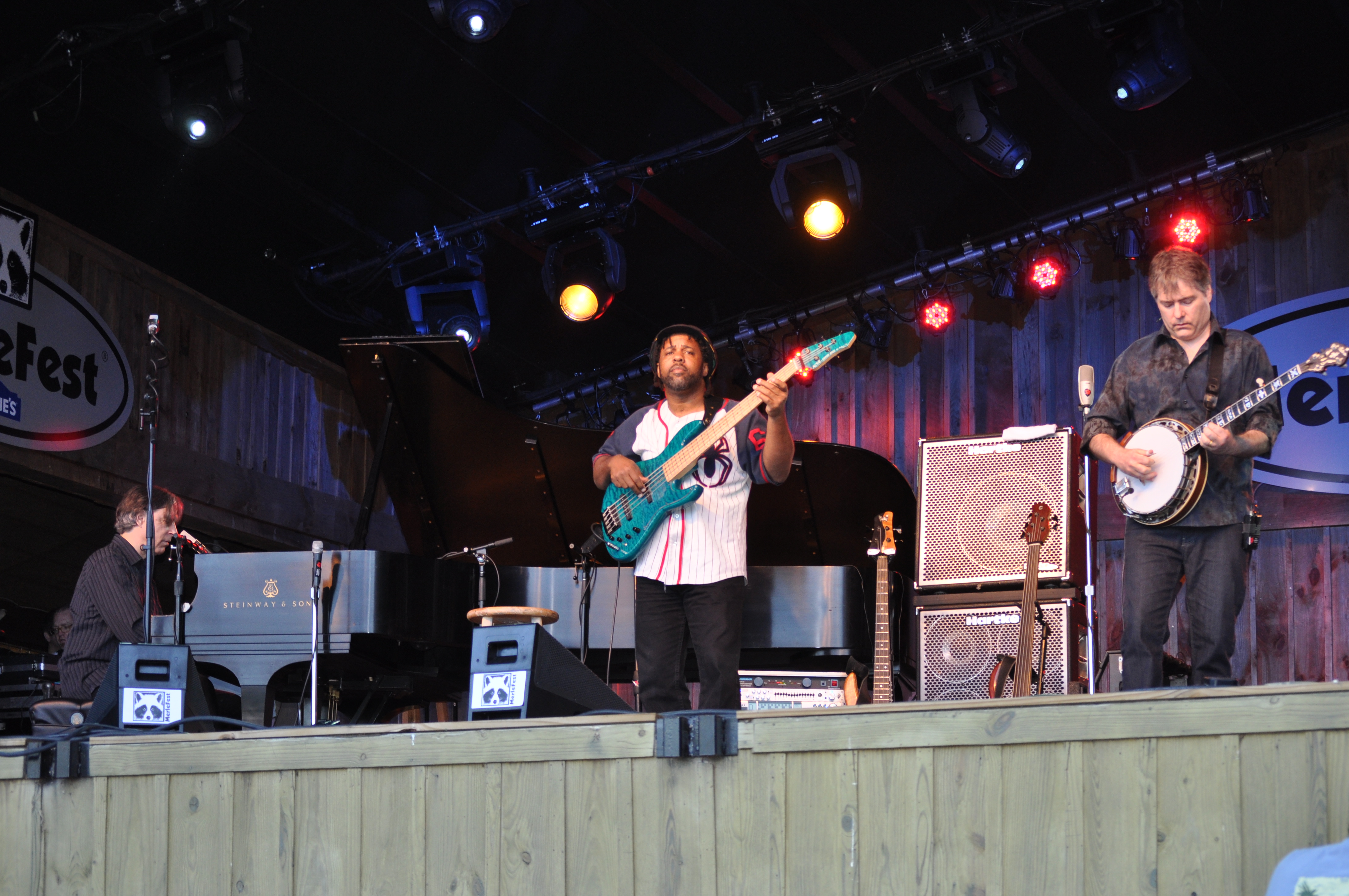
Roy “Futureman” Wooten with brother Victor (drums) and Howard Levy (keyboard and harmonica) play Merlefest 2012 with Bela Fleck as the Original Flecktones (photo by DJB)
The other main thrust of this book points to the future, with many of the artists I’ve highlighted through the years making an appearance.** Randall has written songs performed by Glen Campbell, Moe Bandy, Marie Osmond, Jo-El Sonier, Judy Rodman, Radney Foster, and Holly Dunn, as well as Trisha Yearwood. A collaborative album, also called My Black Country featuring young Black female artists playing the Alice Randall songbook, was being conceived and recorded as Randall wrote the book. Enjoy Valerie June, Caroline Randall Williams, Rhiannon Giddens, Adia Victoria, Allison Russell and others sing the works that Alice Randall created.
Randall mentioned that the John Cowan/Mark O’Connor version of The Ballad of Sally Anne—a song about lynching—was her favorite of any of her songs . . . until Rhiannon Giddens reinterpreted it for My Black Country.
I especially love Allison Russell’s feminine reimagination of Many Mansions.
The album stands as a wonderful set of music while the book is a great revelation. Enjoy them both.
More to come . . .
DJB
*Randall tells the great story of how she once had the opportunity to meet Aretha Franklin backstage at a concert. Franklin was notoriously stingy with passes, but she was welcoming to Randall and mentioned her song XXXs and OOOs. There was one line in there that made it all happen.
“As a Black woman who had once been a colored girl in Detroit, it felt sweeter than sweet to celebrate Aretha in a Country song in such a way that it made her smile. We did it, Matraca [Berg] and me, with eighteen words: ‘She’s got her God and she’s got good wine, Aretha Franklin and Patsy Cline, she’s an American girl.’
Those words opened the Queen’s door for me.“
**For previous MORE TO COME posts on Black Country artists see:
The religious writings of The Rev. Dr. Pauli Murray—the trailblazing 20th century Civil, Women’s, and LGBTQ-rights advocate—were gathered together by Anthony B. Pinn in 2023’s To Speak a Defiant Word. Murray’s story is as fascinating as it was impactful: an African American member of the LGBTQ community raised in Durham, North Carolina; Civil Rights and Women’s Rights activist; the lawyer responsible for producing what Justice Thurgood Marshall called “the Bible of Civil Rights law;” a poet and writer; the first female African American Episcopal priest, and an Episcopal saint.
In a Pentecost sermon from 1978, Murray notes that as one of the successors to Martin Luther King, Jr. she hopes to address herself to the possibility of reconciliation. Racial division in the United States has led to the situation where although blacks and whites share the same geographical space, they have had a different historical experience. The same is true for men and women. “And much of our social turmoil today stems from our inability to share those different experiences, to share those experiences . . . to hear one another speaking in our own language” to harken back to that first experience of Pentecost.
Hearing one another won’t happen if we stay within our tribal boundaries. It can only come with the joining up of the human race. With the celebration of Pentecost coming this Sunday, it seems an appropriate time to hear her words.
But reconciliation cannot come without a simultaneous transformation of our society into a caring, humane society—where people are not just numbers in a computer; where human services are not tainted with the idolatrous notion of profit, power, and privilege; where the elderly are seen as repositories of our collective wisdom and not inconveniences to be endured . . . and where it is the national ethos that human beings are our most important resource, that spiritual and physical energy is as important as energy from coal and oil.
Then she lays out examples of what reconciliation requires. It is not easy.
Reconciliation cannot come without pain and suffering—the suffering of a well-intentioned white person when a Negro/Black rejects his/her kindly gesture because it is seen as arrogant and paternalistic; the suffering of an inadequately trained white male when he suddenly finds the jobs or positions he has been accustomed to get are taken by better trained Blacks, other minorities, or white females; . . . the anger and suffering of a young Black when he or she finally realizes the extent to which he or she has been robbed of a heritage and then penalized for “inferior” performance. Yes, we must suffer with and for one another before we will be healed of the sickness of our common history, before we will be free to face one another and walk together toward a brighter future.
America has never had the type of reckoning on race that brings forward truth and offers the hope of reconciliation. There were calls for candid national conversations after the murder of George Floyd in 2020, but yet, “with some exceptions, the idea of a national, formal reconciliation process has not been a central part of the discussion about how the country can move forward,” and few politicians in 2020 were pushing such a measure. As Sarah Souli, a writer in Athens, Greece, who covered worldwide efforts at truth, dignity, and reconciliation, wrote:
“There are more intangible factors, too—including denial. ‘People in the U.S. refuse to make the connection between slavery, Jim Crow and all the institutional racism going on currently,’ says Ereshnee Naidu-Silverman, a South African-born senior program director at the International Coalition of Sites of Conscious, a global network of sites and initiatives that memorialize victims of atrocities. ‘In the U.S., we very often deny things that are right in front of us and think America is the exception to many things that are occurring every day,”’
In the light of today’s hatred, ignorance, and misinformation, the reality of the difficulty of truth and reconciliation can be hard to face. Small steps and local attempts to hear each other speaking in our own language, are often the most successful. However we get there, reconciliation—as Pauli Murray suggests—is necessary for our physical wellbeing and our spiritual survival.
More to come . . .
DJB
For another Pentecost Eve post, check out 2021’s Les Colombes.
The Weekly Reader links to the works of other writers I’ve enjoyed.
I live in a family of puzzle lovers. My father filled out the newspaper crossword seven days a week. In ink. He passed along his obsession to both Andrew and Claire. When we gifted them a games subscription to the New York Times so that they could solve the puzzles online, you would have thought we opened up a bank vault. We still hold on to the Sunday magazine so Andrew can solve the puzzle in the hard copy format. Yes, in ink. Candice has long loved jigsaw puzzles, and we can count on one or more coming out over the holidays or on vacation. The entire family plays Wordle, posting our daily results to a family text thread, while Claire and Candice also play Connections. Candice and Andrew are big Sudoku fans. In retirement, I’ve become absorbed in the special puzzles that are murder mysteries.
Morning is “puzzle time” at our house. Whatever the number at home, we usually arrive at the breakfast table at very different times. Nonetheless, out will come the paper and pen, phone, or tablet. I’m generally first and I usually tackle mine over coffee, fruit, and eggs. That meal, along with the day’s puzzle and news, is what I think of when I think of breakfast.
“There was something about the ritual of a leisurely morning feast—and especially eggs, which Pippa had always thought of as brain food—that made the heart lift.
As far as she was concerned, it was something people didn’t do enough of: to take a few moments to yourself, when your mind was at its clearest. To reflect on the endless possibilities of the day stretched before you. To spoil yourself before the world spoiled you. She swore by it.“
The Pippa in this excerpt is Miss Pippa Allsbrook: polymath, a professional enthusiast of crossword puzzles, creator of The Sunday Times puzzles using the pseudonym Squire to conceal her gender, and—most importantly—Chief Cruciverbalist, Founder and President of The Fellowship of Puzzlemakers. She is one of thirteen members of the Fellowship who live together in her historic family estate, Creighton Hall, in the English countryside.
The Fellowship of Puzzlemakers (2024) by Samuel Burr is a delightful tale of a group of extraordinary minds who live unusual lives. Besides Pippa you have Earl Vosey, the handsome Master of Mazes who conceives and executes his designs at English country houses. Jean Watkins is the Chief Trivialist while Geoff Stirrup, a former accountant, is the Fellowship’s Lead Arithmetician. Miss Nancy Stone—the London cabdriver with a photographic memory—is the Queen of Quizzes. The grumpy Eric Stoppard is Minister for Mechanical Puzzles, while Jonty Entwhistle serves as Wordsmith and Riddler. The sometimes-troubled Hector Haywood is the Jigsaw Artist and Deputy President while Angel Webster is the group’s housekeeper who came along with the property when Pippa bought it to return it to her family and provide the group a home. The youngest member, Clayton Stumper, serves as the Club Secretary and Estate Manager. His name is especially appropriate since he arrived as a baby on Creighton Hall’s front stoop, nestled in a hatbox with no parents in sight.
Throughout this uplifting debut novel, the cast of characters moves through the many puzzles put before them with a focus on the Fellowship’s motto: VENI, VIDI, SOLVI (I CAME, I SAW, I SOLVED). And the book is full of crosswords, Caesar shifts, anagrams, codes, mazes, and other puzzle delights.
Burr takes all manner of stories and weaves them together in a way that keeps you turning the page. Each chapter covers a different period, from the founding of the Fellowship in the upper room of a London pub to Pippa’s funeral at Creighton Hall and Clayton’s subsequent quest to solve her final puzzle and learn the truth about his life, past and future.
It is that final story that makes the book so endearing. Clayton is twenty-five when Pippa—the only mother he’s ever known—dies and leaves him with a series of clues to uncover. This quest will “require a passport” as he learns at the earliest stage of his discovery. He may be in his twenties, but “he dresses like your grandad and drinks sherry like your aunt.” Raised by Pippa and the “sharpest minds in the British Isles,” he now “finds himself amongst the last survivors of a fading institution.”
Clayton’s discoveries are interspersed with earlier scenes that provide the backstory to his coming to the Fellowship and to his search. It is all told in such a kind, warm, even elegant way that you can’t help but love the characters and be sorry that you must leave them behind when you reach the final page. Burr is “cryptic yet uplifting” in his writing.
The Fellowship of Puzzlemakers is ultimately about the puzzle each of us faces to belong, to find our own missing pieces, to discover who we really are. Of course life is not really a puzzle, but a mystery. In Radical Uncertainty, Mervyn King and John Kay draw a distinction between two kinds of problems: puzzles and mysteries. Puzzles are relatively easy. Mysteries, loosely defined problems with radically uncertain outcomes, are hard. Unfortunately, many humans “think we know the answer to questions that are fundamentally unknowable” because they treat mysteries as puzzles. “And that produces hubristic decision-making.”
Burr recognizes that in solving Pippa’s puzzles, Clayton will answer some knowable questions (who were my birth parents) but only get a glimpse of how to live going forward within life’s mysteries. Along the way, all the characters learn that “to go further, go together.” It is a favorite saying of Pippa’s, yet even she has to relearn that important lesson again and again.
Life isn’t always straightforward for this cast of misfits, but as Pippi is fond of saying, “nothing worth solving ever is.”
Bluegrass was formed out of a number of cultural influences, but among the strongest is Irish music as brought over by the Irish diaspora. And while there are many examples of American bluegrass and roots musicians who travel to Ireland to explore their musical heritage, there are not a lot of examples of bluegrass bands from Ireland who cause a stir in America.
Until now.
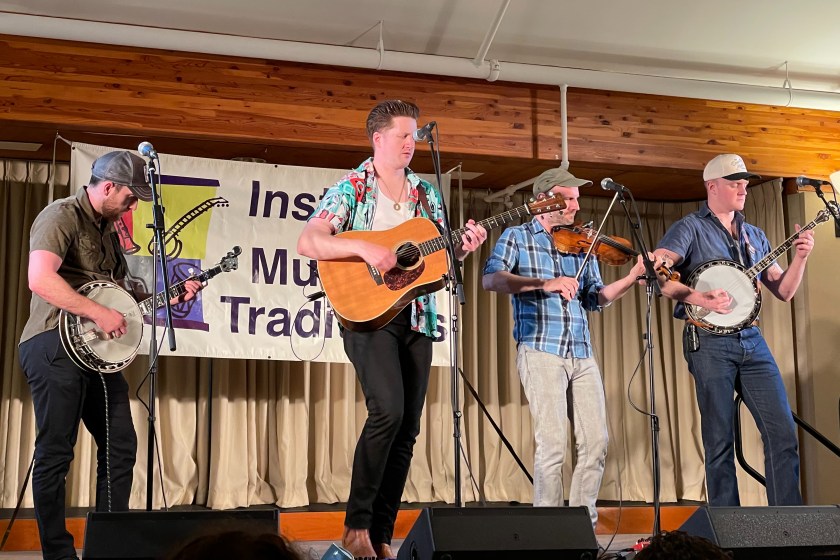
Toward the end of April, I went to hear JigJam—described as the “best Irish band in bluegrass”—play a spirited set for the Institute of Musical Traditions concert series. Their website promises “foot stomping, high energy badassery” when you see them live, and that’s a pretty good description of the evening’s offering.
Guitarist and lead singer Jamie McKeogh along with fiddler Kevin Buckley
The band is composed of Jamie McKeogh (Lead singer and guitar) and Daithi Melia (5 String Banjo and Dobro), both from Offaly, Ireland; Tipperary-born Gavin Strappe (Mandolin and Tenor Banjo); and the only non-Irish member of the band, Kevin Buckley (Fiddle) from Missouri. They don’t have a bass player, but in its place they play a PorchBoard stompbox which creates a “ground shaking low-end beat” that seemed to work effectively with their music.
It wouldn’t be an Irish bluegrass band if they didn’t have a song about Irish Whiskey. JigJam has that covered in Tullamore to Boston.
Red Paddy on the Ridge gives the boys a chance to stretch out their instrumental chops, and you can hear how Irish and Bluegrass music have come together so easily. Hello World is an original tune written by McKeogh.
The band ended their debut at the Grand Ole Opry—and their IMT show—with the spirited June Apple.
The band left IMT to head to their first engagement at Merlefest. I’m sure they won over many new fans at that iconic festival.
As their website notes,
“Bluegrass has its roots in Irish music and Irish immigration. JigJam is what happens when the Irish find their prodigal son.“
Each month my goal is to read a minimum of five books on a variety of topics from different genres. Here are the books I read in April 2024. If you click on the title, you’ll go to the longer post on MORE TO COME. Enjoy.
How to Be: Life Lessons from the Early Greeks (2023) by Adam Nicolson looks at the pre-Socratic philosophers from between 800 and 450 BCE who moved us beyond the oppressive world of god-kings and their priests. Focused on the importance of place—and specifically Megale Hellas (Greater Greece)—in shaping how they thought, Nicholson makes the brilliant case that day-to-day existence in the “bustling port cities” of archaic Greece, where there was an emphasis on “fluidity . . . interchange and connectedness,” gave birth to philosophy. Trade, along with the coming and going of peoples and ideas that trade brings, required “new ways of thinking about the world, of configuring our relationships with one another.” It required, Nicholson asserts, a “harbor mind.”
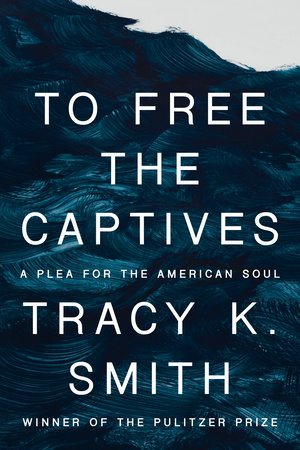
To Free the Captives: A Plea for the American Soul (2023) by Tracy K. Smith, the former Poet Laureate of the United States, is a “memoir-manifesto” which examines her life and her family history as a microcosm of the Black experience in America. Smith writes of the spirituality of the soul, her move toward sobriety and accountability, and her own growing spiritual practice. She makes the case that the soul is not merely “a private site of respite or transcendence,” but it is also a tool forfulfilling our duties to each other, and a sounding board for our most pressing collective questions, such as how to bridge the gap between free and freed. It is a powerful and moving prayer for Americans to accept accountability and do the hard but necessary work of living together with others.
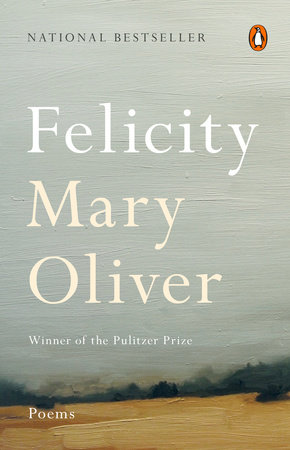
Felicity(2015) by Mary Oliver is a work filled with joy and beauty, released a few years before the poet’s death. “Poems arrive ready to begin. Poets are only the transportation,” she asserts in Humility. This is a book where “great happiness abounds,” notes one reviewer. “Our most delicate chronicler of physical landscape, Oliver has described her work as loving the world. With Felicity she examines what it means to love another person.” Beginning with Don’t Worry, the work’s very first poem, we begin to understand the notion that love, like time, works in ways mysterious and wonderful.
The Problem with Everything: My Journey Through the New Culture Wars (2019 with a new 2022 Foreword) by Meghan Daumcould be summarized as a work about “feeling old, spending too much time online, and getting ornery about the politics of young people.” That quick, somewhat snarky characterization from the New Yorker review could be seen as both accurate and yet somehow incomplete. Yes, there are plenty of times when Daum comes across as that person yelling “get off my lawn” at the kids. But there are also thoughtful questions around outrage vs. empathy. “To deny people their complications and contradictions is to deny them their humanity.”
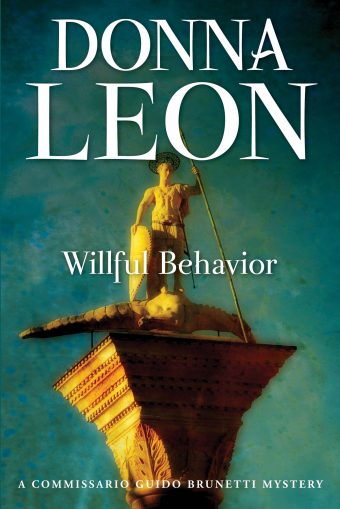
Willful Behavior (2018) by Donna Leon is the eleventh in what is now a 33-book series featuring the Venetian detective Guido Brunetti. The story begins as Brunetti receives a visit from one of his wife’s students “with a strange and vague interest in investigating the possibility of a pardon for a crime committed by her grandfather many years ago.” At first the detective dismisses her request, but soon the girl is found stabbed to death and Claudia Leonardo becomes Brunetti’s next case. The plot twists and turns and the detective begins to unlock long buried secrets of Nazi collaboration and the exploitation of Italian Jews during World War II.
What’s on the nightstand for May (subject to change at the whims of the reader):
The human costs of war are vast and incalculable. Americans as a people came to see this firsthand during the Civil War. In the insightful This Republic of Suffering, historian and former Harvard President Drew Gilpin Faust reveals the ways that death on such a massive scale, in an army made up almost entirely of volunteers, and usually occurring without relatives nearby to help with the nursing and grieving, changed not only individual lives but the life of the nation.
In her work, Faust describes “how the survivors managed on a practical level” and how a deeply religious culture of the time “struggled to reconcile the unprecedented carnage with its belief in a benevolent God.” She uses the voices of real people—soldiers and their families, statesmen, generals, preachers, poets, surgeons, nurses, northerners and southerners—to make it personal and to give the reader a vivid understanding of the Civil War’s most fundamental and widely shared reality.
Ukraine is going through a similar catastrophe today. Russia’s unprovoked attack and the unconscionable dithering by House Republicans to provide the support this democracy needs continues to result in great horror, destruction, and unnecessary death.
As in Faust’s book, the stories of those who have died, who have seen their dreams interrupted and then denied, have a power to force us to stop and think of what is at stake. I recently came face-to-face with forty of those stories, told in a most powerful way, at a place devoted to peacemaking.
United States Institute of Peace
TheUnited States Institute of Peace is a national, nonpartisan, independent institute, founded by Congress in 1984. The Institute is:
. . . dedicated to the proposition that a world without violent conflict is possible, practical and essential for U.S. and global security. In conflict zones abroad, the Institute works with local partners to prevent, mitigate, and resolve violent conflict. To reduce future crises and the need for costly interventions, USIP works with governments and civil societies to build local capacities to manage conflict peacefully. The Institute pursues its mission by linking research, policy, training, analysis and direct action to support those who are working to build a more peaceful, inclusive world.
Lauren Baille, Katie Ruppert, and Ambassador Bill Taylor (l-r) speak during the USIP Open House
I attended the April monthly open house at USIP, where the focus was on Ukraine. Short presentations were made by Katie Ruppert, Senior Program Officer in USIP’s Europe and Russia Center; Lauren Baillie, Senior Program Officer, Atrocity Prevention; and Ambassador William B. Taylor, Vice President, Europe and Russia at USIP. However, the most moving statements were silent, coming from the displays set up around the great hall.
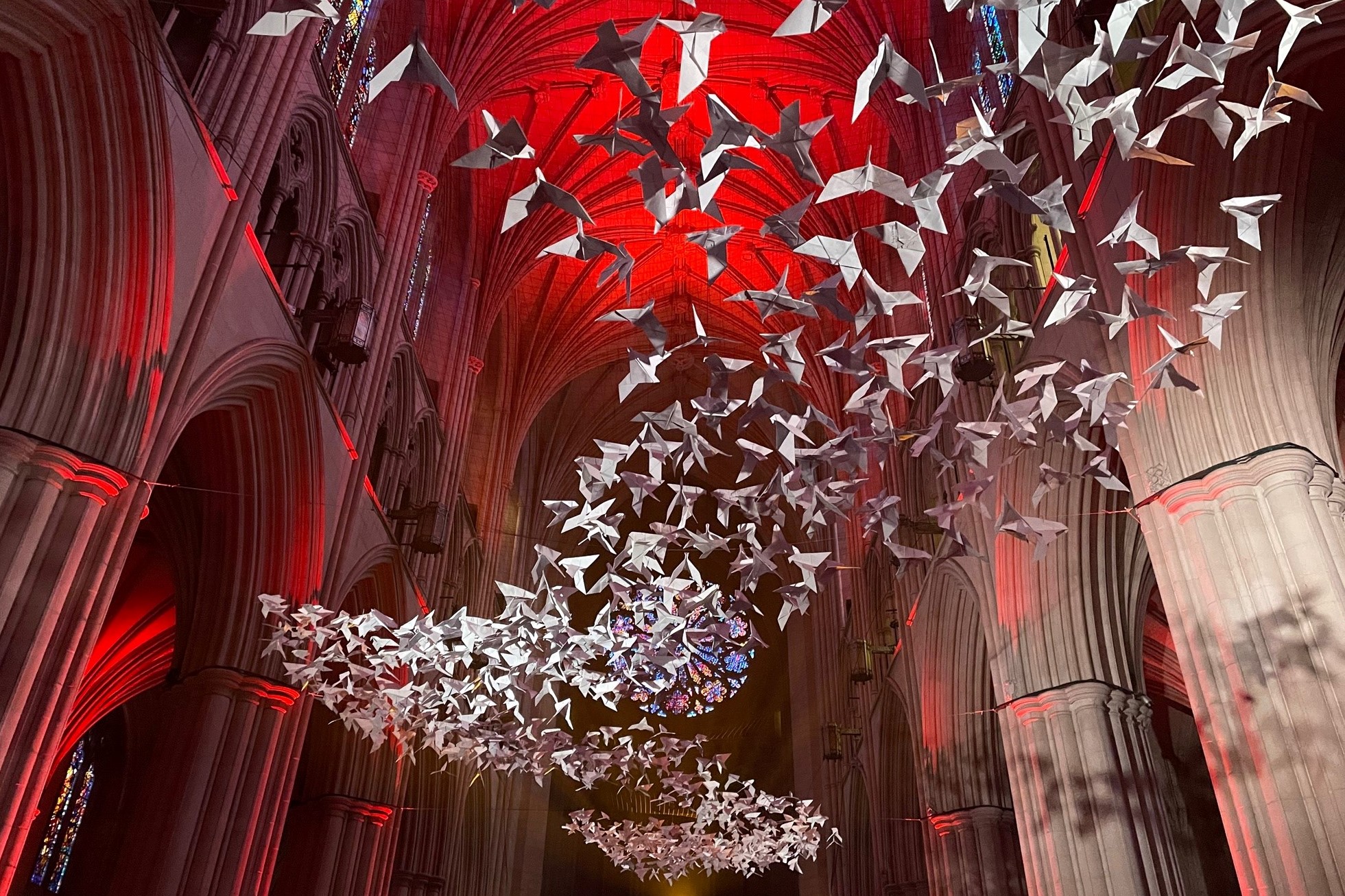
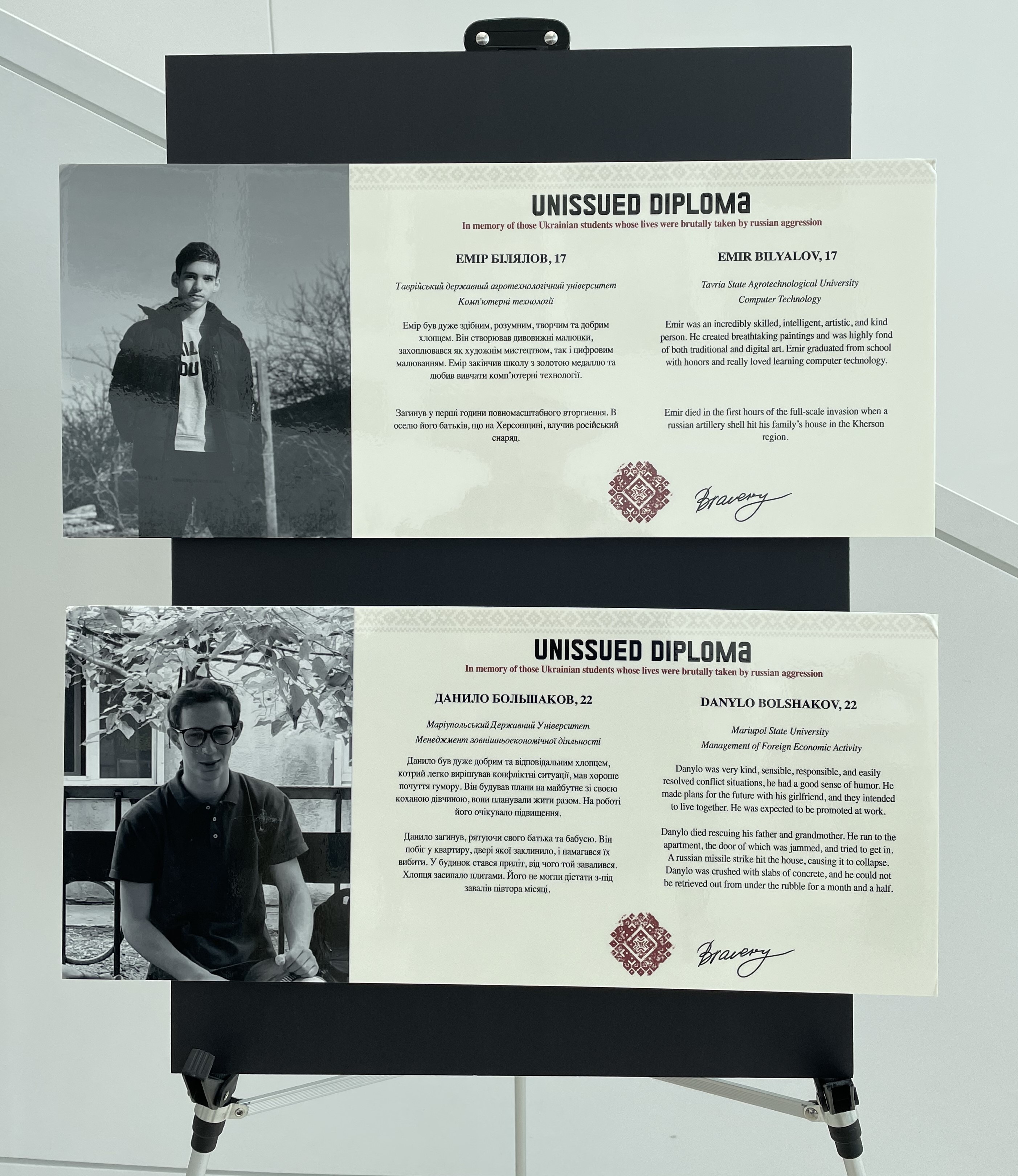
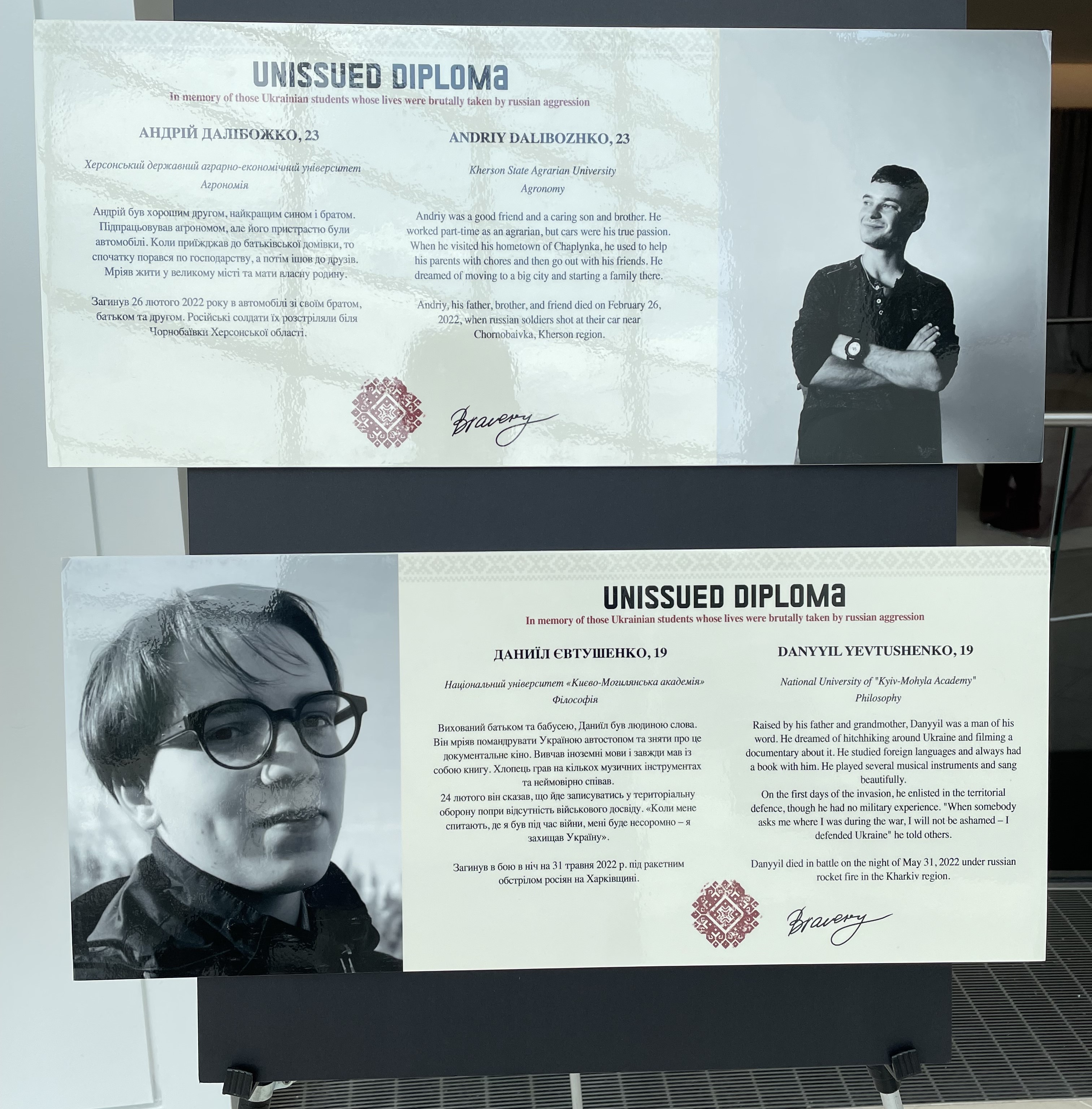
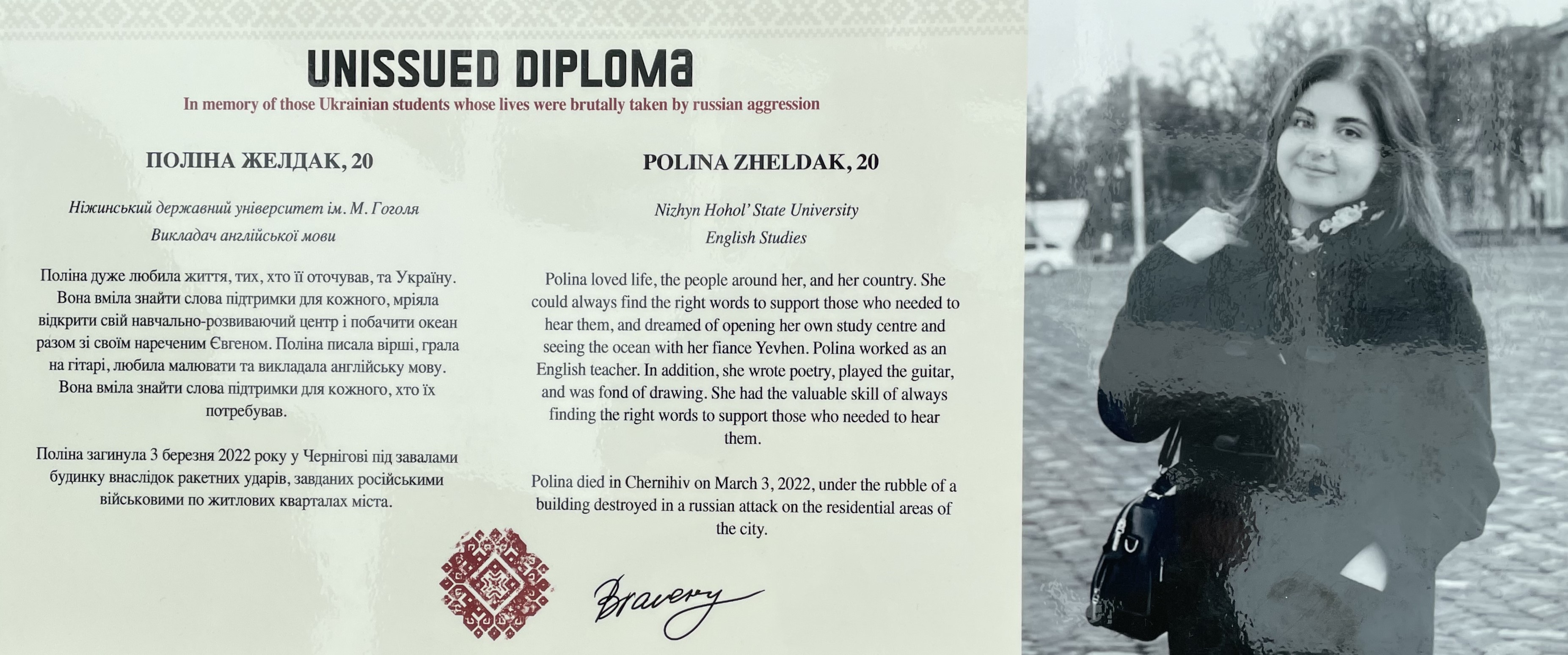
Unissued Diplomas is a powerful exhibit reminding the world about the ongoing war . . .
. . . and the price Ukrainians pay daily in their fight for freedom. Unissued Diplomas honors the memory of Ukrainian students who will never graduate because their lives were taken by the Russian invasion.
Some enlisted and died while fighting the war. Others were civilians trying to go about their daily lives. Current estimates—although difficult to verify—are that 70,000 Ukrainian soldiers have been killed in action, and perhaps as many 10,582 civilians, including 587 children, have died. The Russian—who are employing a “meat grinder” strategy to wear down the country—have suffered heavy losses as well in the process.
The stories we read are utterly heartbreaking, showing what we lose in war. An English teacher, lover of poetry, and guitar player who died in a Russian attack on a residential area of her city. A mother of twins with a dream of being a landscape designer, who lost not only her life but those of her children when Russia bombed her home. A boy who was unbelievably good at waltzing, later enlisted, and lost his life fighting on the front.
And then there are those like Leah Krylova, age 20, who was studying tourism at Mariupol State University. We don’t know her story because she died with her whole family when a Russian shell made a direct hit on her father’s home.
Similar stories can be found around the world in Gaza, Israel, and Palestine; in Sudan; in Bolivia; in Afghanistan; and in many other countries. Not all those affected look like us or think like us, yet we are all intimately connected by our humanity.
Originally drawn by Lorraine Schneider, this poster first appeared in 1966 in reaction to the Vietnam War. Its timeless message is as potent now as it was then.
More to come . . .
DJB
For other posts on the Ukrainian War on MORE TO COME, see:
The fifteen years our family lived in Staunton, Virginia, remain among our most important and treasured memories. We essentially began our married life in this wonderful Shenandoah Valley community when I took a job as Executive Director of Historic Staunton Foundation that would lead to a four-decade career in the nonprofit world of preservation. The twins were born during our time here, and we made lifelong friends we still see on a regular basis. The town continues to thrive in part because of the dedication of a group of citizens who know that great communities don’t remain that way by chance.
I know—from personal experience—that Staunton is a place where old and new came together . . . where natives welcome and embrace newcomers and their ideas and where new citizens learn about the traditions of the town. Historic Staunton Foundation provided the context where everyone now thinks about historic buildings, neighborhoods, and landscapes as tools for the future of the city, but there are many organizations and individuals who are involved in this work.
One of my favorite “new” campaigns in an “old” building in Staunton is The Arcadia Project. A non-profit community cultural center, Arcadia is restoring the historic New Theater building at 125 E. Beverly Street into a sustainable, adaptive mixed-use facility featuring a movie theater; an event space to host conferences, events, and performing arts; digital media classrooms; and a small specialty food café.
Postcard of the Historic New Theatre on Beverly Street in Staunton
After stabilizing the exterior of the building, paying off a loan, and selling the adjacent property, Arcadia received a $1.5M grant from the Industrial Revitalization Fund which provides the core funding to renovate the 1936 theater. The group—led by a dynamic board and director—is currently fundraising to furnish, light, and equip what will become a permanent community cultural center in Staunton.
We’ve come to know Thom and Pam Wagner through our friends Margaret and Oakley Pearson. Thom—an Emmy Award-winning producer, writer and composer, and Pam, an Emmy Award-winning documentary filmmaker—join us as we play music at the Pearsons on the Friday evening after Thanksgiving. They are part of the “new” contingent that continues to refresh Staunton year-after-year.
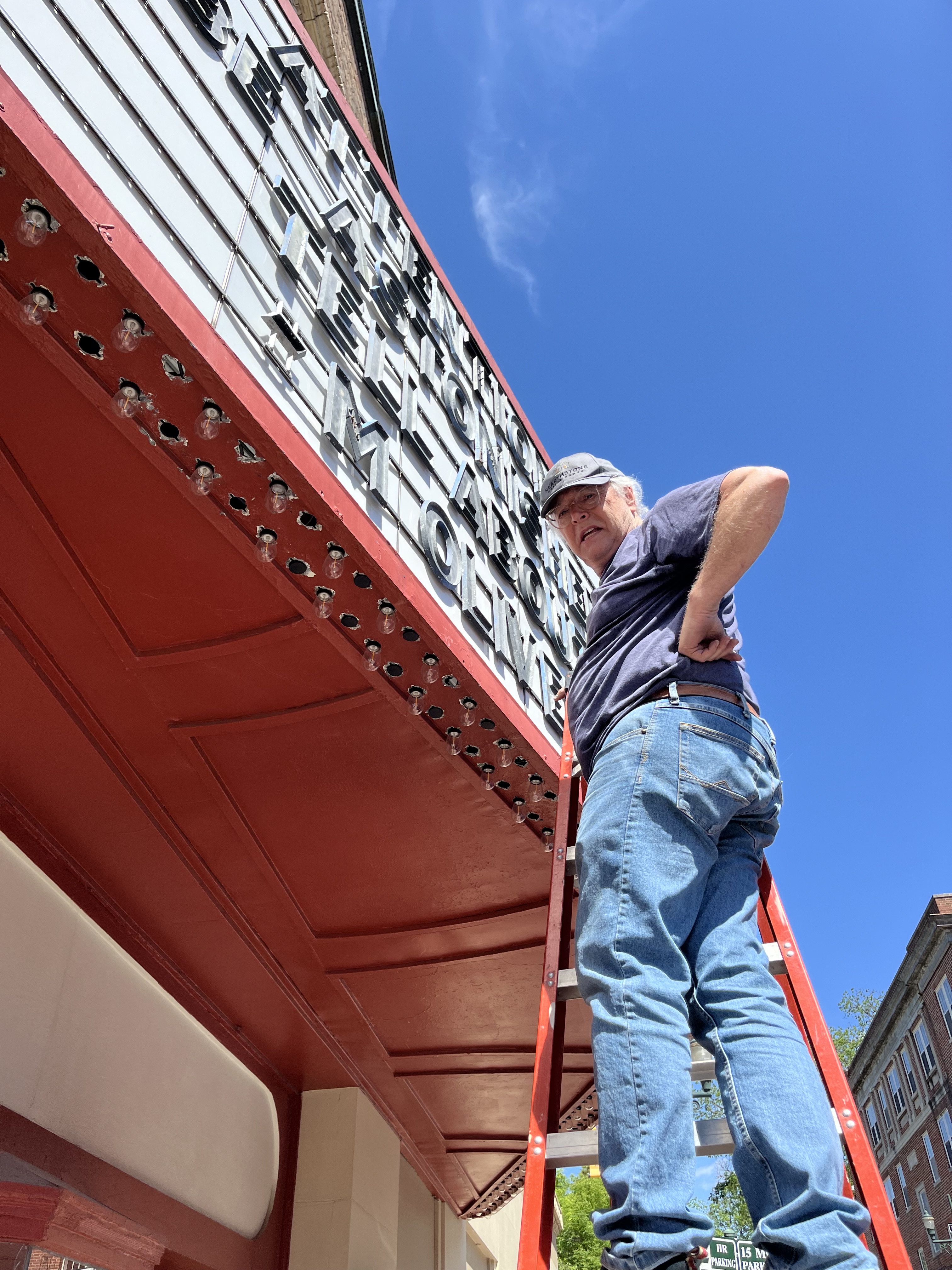
Thom places our “marquee message” up for the town to see
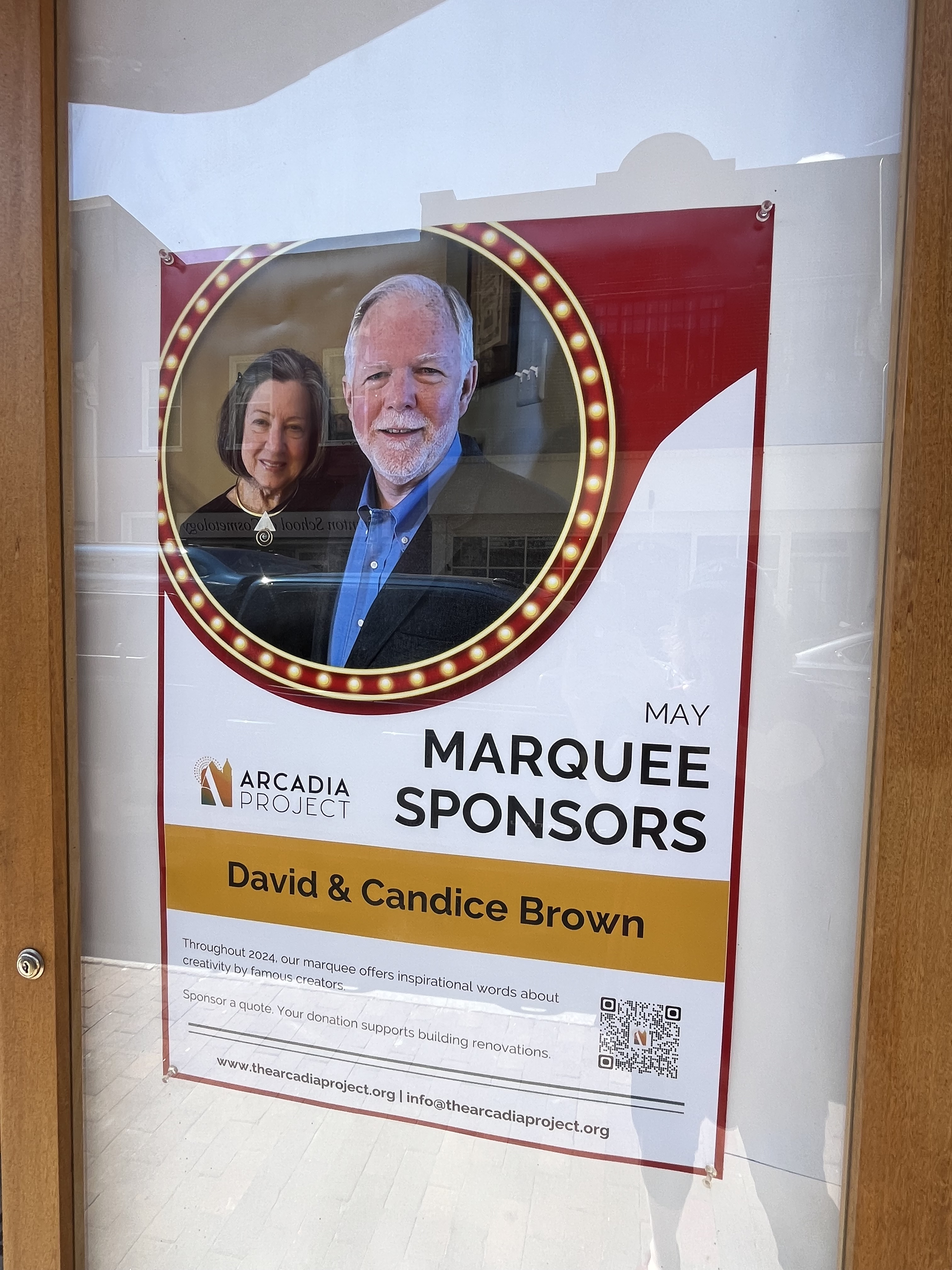
One of their innovative fundraising efforts is the Sponsor a Marquee Quote at the theatre. Sponsors can honor a business, birthday, anniversary, or loved one by giving the gift of inspiration: a quote from a famous creator. The selected quote appears on the marquee for one month and the sponsors are recognized in the sidewalk display case.
Candice and I decided we wanted to help out and sponsor a quote, and Thom placed our inspirational message on the marquee last Wednesday, May 1st! We’re now smiling at the folks in Staunton who walk by the project this month.
And for our quote, we chose the “instructions for life” by one of our favorite poets: Mary Oliver. You’ve seen it here before in MORE TO COME, and now our friends and other visitors to Staunton will be able to be inspired by it for the entire month of May.
Pay attention. Be astonished. Tell about it.
That’s a great way to discover and celebrate the wonder in the world.
Our Marquee Quote with Mary Oliver’s “Instructions for Life”
Thanks to the Wagners and all the supporters who are bringing this great landmark back to life.
UPDATE: Pam sent along this photograph with the message “looks even cooler at night!” Couldn’t agree more!




















 MORE TO COME...