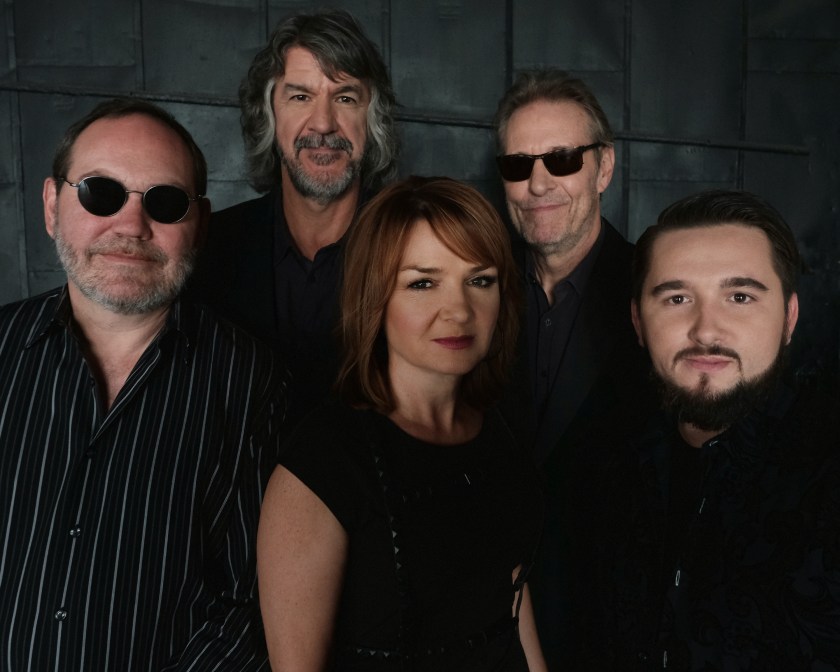
“Guitars, whiskey, guns, and knives / Three’s a crowd and four’s a fight,” is just one of a dozen memorable lines from The Steeldrivers‘ catalog showing how the band has made a living exploring the heartbreak of broken affairs (or what Dolly Parton calls “sad ass” songs.) In spite of personnel changes, this Saturday Soundtrack will look at how the band continues making their own distinctive mark on that well-trodden road.
Songs of drinking, fighting, and bad loving pour out of The Steeldrivers like illegal corn liquor from an upended still. One commentator noted that a trio of dysfunctional relationship songs starts their album Hammer Down; however, it is something of an anomaly if one of their tunes doesn’t go down this path. Over the course of a show, they will sing some of the best sad country phrases around:
“Drinking dark whiskey, tellin’ white lies / One leads to another, on a Saturday night.”
“If you can’t be good, be gone.”
“You put the hurt on me like I never felt before.”
And the classic: “Never woulda loaded up a 44 / Put myself behind a jailhouse door / If it hadn’t been, if it hadn’t been for love.”
This Nashville-based bluegrass band with day jobs as songwriters and session musicians has shown up on More to Come for years after I first mentioned their performance at Merlefest in 2009. In 2011, I wrote a review of their live show at the Ram’s Head in Annapolis. Their third album, Hammer Down, was included in my list of best bluegrass albums of 2013 when I highlighted traits that have remained with the band through changes in personnel: great songwriting, soulful vocals, and skillful instrumental treatments. In 2015, I again highlighted a Steeldrivers album — The Muscle Shoals Recordings — as being among my list of best roots music of that year. (It later won the Grammy for Best Bluegrass album that year.) The following year I wrote about Adele’s cover of the band’s songIf It Hadn’t Been for Love. And I’ve also featured the band when showcasing their original lead singer — the soulful Chris Stapleton — as well as in my New Year’s Eve ode to drinking songs from 2020.
After the Muscle Shoals album, the band seemed destined for new heights. But singer Gary Nichols decided to go his own way and the band was once again facing the need to reset. To go along with original members Richard Bailey (banjo), Tammy Rogers (fiddle), and Mike Fleming (bass), they had already added Brent Truitt on mandolin. Replacing the lead singer to follow Stapleton and Nichols was harder, but after a while they found one in a 25-year-old rock and roll singer from Berea, KY named Kelvin Damrell.
The choice isn’t as strange as it sounds. The band has always had a soul and R&B vibe that is unique among bluegrass bands. Damrell simply had to figure out how his vocal talents fit in this context. The band — which has always prided itself on its songwriting — also took the time to work on new material, primarily led by Rogers and her collaborators.
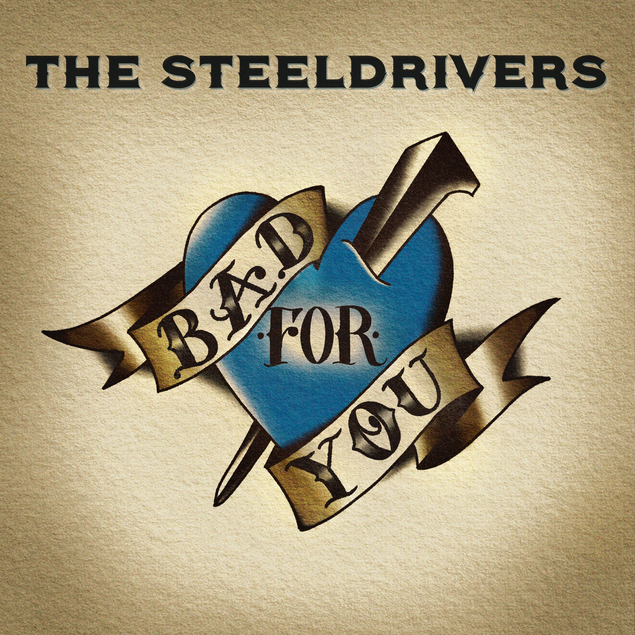
Bad For You, the band’s fifth album, arrived after this period of adaptation. And having covered so much of the band’s earlier work on More to Come, that 2020 album is what I want to focus on for this edition of the Saturday Soundtrack. The title track, shown here in a live video, opens the album. It sounds like a classic Steeldriver song, full of desperation and danger, with the harmonies and skill you’d expect from Nashville professionals.
The Bartender, shown as part of a series of performances from The Paste Studios, contains another great line of dysfunction. “Some may call me a sinner / but when its all said and done / I don’t pull the trigger / I just load the gun” captures the main character wrestling with his “role as a friend-in-need…or an accessory to a crime.”
Lonely and Being Alone (as in “there’s a difference in lonely and being alone”) is classic country bluegrass. Written by Rogers with Verlon Thompson, it makes the point that just because we’re by ourselves, that “doesn’t mean we’re lonely. We’re alone, and we’re good with that” as one reviewer noted. I Choose You is upbeat, by Steeldriver standards, and is about devotion over dysfunction. What a concept!
The Paste Studio session includes one old Steeldriver song from the Stapleton years, Blue Side of the Mountain. Damrell shows he can handle the band’s classic tunes as well, which will be a relief to Steelheads everywhere.
The Steeldrivers are beginning to tour again, and they will be at the historic Birchmere music hall in Alexandria, Virginia, on July 29th, if everything continues to improve on the pandemic front.
This is a band to catch live, so keep an eye out for when they may be coming to your city over the next year.
April is National Poetry Month. “Many Americans, probably a vast majority of Americans, feel they can get along just fine without poetry” writes Margaret Renkl in a recent New York Times opinion piece entitled Thank God for the Poets. But we really need poets, just like we really need libraries. Our Weekly Reader will begin with a celebration of both.
As always, this Weekly Reader features links to recent articles that grabbed my interest or tickled my fancy. I hope you find something that makes you laugh, think, or cry.
Renkl’s take on American’s need for poetry continues:
“But tragedy — a breakup, a cancer diagnosis, a sudden death — can change their minds about that, if only because the struggle to find words for something so huge and so devastating can be overwhelming. “Again and again, this constant forsaking,” Natasha Trethewey calls it in her poem “Myth.”
Renkl began her piece with a nod to the poet Amanda Gorman, who spoke at President Biden’s inauguration.
“Ms. Gorman’s poem — addressed to “Americans, and the World” — was timeless in that way of the most necessary poems, but it was more than just timeless. After a year of losses both literal and figurative, she offered a salve that soothed, however briefly, our broken hearts and our broken age.
But suffering isn’t the only time when we need poetry.
“Thank God for our poets, here in the mildness of April and in the winter storms alike, who help us find the words our own tongues feel too swollen to speak. Thank God for the poets who teach our blinkered eyes to see these gifts the world has given us, and what we owe it in return.“
“By 1981, when the feelers went out to Dr. Gregorian, the library — the main research edifice at 42nd Street and Fifth Avenue and 83 branches in Manhattan, the Bronx and Staten Island — was broke, a decaying Dickensian repository of 7.7 million books (the world’s sixth largest collection), many of them rare and valuable, gathering dust and crumbling on 88 linear miles of stacks.
The underpaid, overworked staff was demoralized. The beautiful Gottesman Exhibition Hall had been partitioned into cubicles for personnel and accounting. Tarnished chandeliers and lighting fixtures were missing bulbs. In the trustees’ board room, threadbare curtains fell apart at the touch. Outside, the imperious marble lions, Patience and Fortitude, and the portals they guarded, were dirt-streaked. Bryant Park in the back was infested with drug dealers and pimps and unsafe after dark.“
Gregorian, coming out of academia, seemed to be an odd choice to bring the institution back to life.
To Dr. Gregorian, the challenge was irresistible. The library was, like him, a victim of insult and humiliation. The problem, as he saw it, was that the institution, headquartered in the magnificent Carrère and Hastings Beaux-Arts pile dedicated by President William Howard Taft in 1911, had come to be seen by New York City’s leaders, and even its citizens, as a dispensable frivolity.
And his vision for what the library should be carried the day.
“‘The New York Public Library is a New York and national treasure,’ he said. ‘The branch libraries have made lives and saved lives. The New York Public Library is not a luxury. It is an integral part of New York’s social fabric, its culture, its institutions, its media and its scholarly, artistic and ethnic communities. It deserves the city’s respect, appreciation and support. No, the library is not a cost center! It is an investment in the city’s past and future!’”
Two recent stories on race in America showed how some institutions are making change, even if ever-so-slowly, while a third demonstrates that others that need a reckoning have yet to take those steps.
“You mean to say that a baseball franchise with a racially insensitive name, which does all it can to harm any argument that their name isn’t just insensitive, but outright racist, by encouraging its fans to do racist chants; which moved out of team’s urban core and into another county, in order to cater to its white fans, while positioning the ballpark better for driving than mass transit; which relegated a memorial patch for the greatest player in team history to a tiny number on the back of its caps, rather than a sleeve patch…
…that team booted its response to Major League Baseball moving the All-Star Game out of Atlanta?!“
Yep. That team.
“When you move your team to the suburbs for the specific purpose of getting away from Black people, you don’t get to act like stripping a big event from your ballpark is going to hurt Black people. And the once-in-a-generation event can still return to Atlanta in a few years, just as the Super Bowl came back to Arizona once the state finally recognized Martin Luther King Day as a holiday.“
“I’m no economic determinist, but if you want to understand how the right got the way it is, follow the money. The GOP highlights culture-war issues to shake down rank-and-file donors while cutting taxes to please wealthy donors. Republicans have won the presidential popular vote only once since 1988, but they can’t afford to broaden their appeal by embracing a more populist economic agenda or by toning down the divisive social messages because either move would jeopardize the flow of fundraising. The right-wing money machine has become the tail wagging the Republican elephant.“
“An infection rate of 5,800 infections out of 77 million fully vaccinated people is less than 0.008 percent — a remarkably low rate. Compare this with 68,000 daily new infections in the United States — which, over a 30-day period, is nearly 100 times higher than the infection rate for those vaccinated. Put another way: A total of 5,800 infections among the inoculated is orders of magnitude better than 68,000 infections per day in the general population.“
Next, Anand Giridharadas interviews ProPublica investigative reporter Alec MacGillis in The Ink on the power and tactics and cultural significance of Amazon in The one-click civilization.
Reckonings require honesty. To face false beliefs and turn harmful habits into positive action for change, we have to begin with deep introspection at the personal level. We have to understand what we have given up of great long-term value for attractive, short-term gains.
Over the past month, three books have pushed me to deepen the serious look at my beliefs and privileges; my past actions and potential pathways forward. As three historians delved into their own lives and principal areas of study, they unknowingly illuminated key elements of my life, my story.
Sometimes we need words designed to trouble our minds and sear our souls.
What is my story?
First, I was raised in a culture that honored people who led a rebellion against a democratically elected government in order to perpetuate slavery, with ramifications that are as present as the nearest cable news show.
Second, my father spent his career working for one of the best-known and longest-lasting legacies of the New Deal, a legacy that continues to matter today even if it is often dismissed and under attack.
Finally, I was raised in a religious tradition that was founded to perpetuate chattel slavery and that has used the cudgel of morality and racism to disenfranchise those — especially people of color — who are viewed as different.
In each instance I’ve moved beyond childhood beliefs and heroes. But these three historians helped me see that reckonings are a lifelong journey of understanding, gaining knowledge of what we’ve surrendered of great value to obtain our personal mess of pottage.
The past two Mondays, I’ve considered this story on More to Come. Southerner and West Point historian Ty Seidule wrote of his reckoning with the Lost Cause beliefs in his life and the need for facing the myths in our personal histories, mine included. Last week, I reflected upon historian Eric Rauchway’s work on why the New Deal matters. His call for recognition that belief in a common purpose can serve as a model and inspiration in our current crises was a reminder of the many ways my father modeled that “building for the public good” mentality in his life.
Which brings me to the third piece of my personal story.
Historian, associate professor of religious studies at the University of Pennsylvania, and public commentator Anthea Butler has written a valuable and timely book full of powerful truths we need to hear today. White Evangelical Racism: The Politics of Morality in America is part history, part personal reflection, part call to action all wrapped together in a vital sermon that pulls no punches. For those who see the title and respond, “But not all evangelicals are racists” or might add that there are progressives within the evangelical tent, she tells her story of being marginalized as a person of color even by “good people” in that tradition. It is a story worth considering.
Butler’s introduction — entitled Evangelical Racism: A Feature, Not a Bug — sketches the key points one will find in this short yet important work. She provides a concise history of the evangelical movement, but more importantly she focuses on “the racist and racial elements that imbue its beliefs, practices, and social and political activism.” This book is aimed at two audiences, beginning with those who grew up in, or continue as a part of, the evangelical tradition. People like me. She also wants those who cannot comprehend “evangelicals support for current-day politics that seem draconian and unchristian” to understand that their support for those policies is linked inescapably to the tradition’s foundational history.
Butler asserts that
“The hard truth is that evangelicals are one of the most, if not the most, polarizing voting groups in America, and the racism, sexism, and patriarchal structure of their movement has embedded itself within the Republican Party…Racism is the key to this strange story. Because of racism, evangelical decency was lost, and evangelicals’ resentments grew.”
In noting that the northern American Baptists and the Southern Baptist Convention (the church of my childhood) still remain separate entities, Butler makes the point that churches exist in, and remain true to, the social structures of the regions where they are located. To make Christianity fit, evangelical leaders have found scriptures to buttress those structures. Not many evangelicals today cherry-pick scripture to support slavery, but there is plenty of selective reading to justify sexism, patriarchal structure, hatred, racism, and exclusion.
In the latter half of the twentieth century, I grew up watching Billy Graham’s “crusades” on the television and hearing that selective translation of the Christian message. Evangelical leaders like Graham, working in concert with anti-New Deal corporate CEOs who wanted cheap labor and politicians who wanted power, focused on communism as the godless threat to America.* It was only a short leap to then view the civil rights movement as “a potential communistic arm of destruction in America.” Today, when evangelicals and Republicans want to demonize an opponent, the go-to epithet is updated to socialism, as if caring for the welfare of citizens is the exclusive province of the right. People of color, and their representatives in government (e.g., AOC), are often among the first to be labeled, fairly or not and with little understanding of what socialism means or stands for in today’s world.
Butler focuses on Graham’s words and actions because he was such a powerful force in taking evangelicalism mainstream. She notes that in Graham’s understanding, “true Christian born-again believers could not possibly hold communistic views.”
“While for white evangelicals personal salvation was the first order of business, during this era the second order was for born-again Americans to embrace ‘Americanism’ as a way to protect the nation and its citizens from the communist threat. Simply put, ‘Americanism’ meant pride in the nation, in the founders, in the Declaration of Independence and the constitution — and, most important, in the idea that America was a nation ordained by God to save the world….”
“If an American citizen did not live morally and become saved, then the nation as well as the individual would suffer. Graham’s take on the linked fate of citizens, government, and nation held the seeds of a nationalistic Christianity, predicated on Christian morals and beliefs as the cornerstone and foundation of the nation, despite the fact that the founders wanted religious freedom for people of all faiths.”**
If you have wondered where the call for patriotic education in the last administration arose, those two paragraphs sum it up pretty well.
There is much to learn from this book, from the whitewashing of racism into the “colorblind gospel” to the story of the political alliance of groups such as evangelicals and Catholics that historically opposed and feared each other. Butler makes the case in her book that racism is, in the end, what brings groups with demonstrably different religious beliefs together in the current politics of morality.
Writing It’s time to break the traditions of white nationalism in our civic institutions in the Washington Post, educator Walter Greason makes the point that white nationalism has infiltrated so much of our civic life, not just religion. Butler would no doubt agree, but her laser-like focus is on the evangelical tradition of her youth, and the intolerance that white nationalism has brought to our nation.
“Evangelicals’ political, moral, and theological concerns had come together to create a harsh and uncaring posture toward suffering and disaster. Rather than seeing events like 9/11 or Katrina as man-made murders or natural disasters, they chose to blame the dead, dying and suffering for moral infractions that violated deeply held evangelical beliefs. At the same time, evangelicals constantly referred to themselves as victims, a persecuted minority because of their faith. These contradictions, and this strategy of evangelicals to use morality as a cudgel to mask racism, became a regular feature of the Bush era and beyond, setting the stage for the much more virulent, in-your-face racism of the 2008 election and its aftermath.”
In a powerful conclusion entitled Whom Will You Serve?, Butler says evangelicals must decide between people and power. She lays out the case that the attraction of power, and the absence of that power for decades as the nation was led by well-heeled Presbyterians and Episcopalians, has led to the evangelical embrace of racism. Whiteness is what gave them power, and although not all evangelicals are white, the underlying agreement is that whenever one is saved they give up whatever racial or ethnic or religious world they came from to embrace the white, Euro-centric version of Christ.
“The bile and hatred of some of the leaders you emulate make it impossible for people to believe whatever witness you have left. While you are clinging to God and guns, mothers are clinging to pictures of children who have been shot dead in classrooms, in streets, in malls, in cars.”***
Butler calls on evangelicals to move beyond the words of well-meaning Baptist pastors after the George Floyd murder. “You must join with people you don’t agree with in order to make a more perfect union, as the founders wanted.” Move out of silos and stop listening to those who profit from your isolation. “I am one of those people,” you need to engage with, writes Butler.
“I know you. I don’t like the lies you’ve told yourself, and continue to tell yourself and others, in order to try to hold on to power….Can you step past the individual sin of racism and understand that your votes, your choices, your actions participate in the structural support of white supremacy and racist policies and policing? Can you start to engage honestly and truthfully the actions of the leaders and politicians you support, to whom you have sold your souls for a mess of pottage? Can you step away from the headiness of being in the position of power to see the brokenness of your neighbors and the nation?”
Butler writes to trouble us and sear our souls. She asks us to think, deeply and profoundly, about the legacy our past and present actions will leave for the future.
Finally, she asks us to be hopeful, understanding that there is time. That time is now.
More to come… DJB
*See my linked review of Kevin Kruse’s One Nation Under God: How Corporate America Invented Christian America
**See that same review for John Barry’s Roger Williams and the Creation of the American Soul
***Speaking of evangelical leaders who diminish (an understatement) the witness of those from this tradition, as this post was being written, news organizations began to report on a $10 million lawsuit by Liberty University against Jerry Falwell, Jr. which claimed that his loose lifestyle hurt their brand.
NOTE: Anthea Butler spoke recently at an event for our local bookstore, Politics & Prose. The video of that conversation is attached.
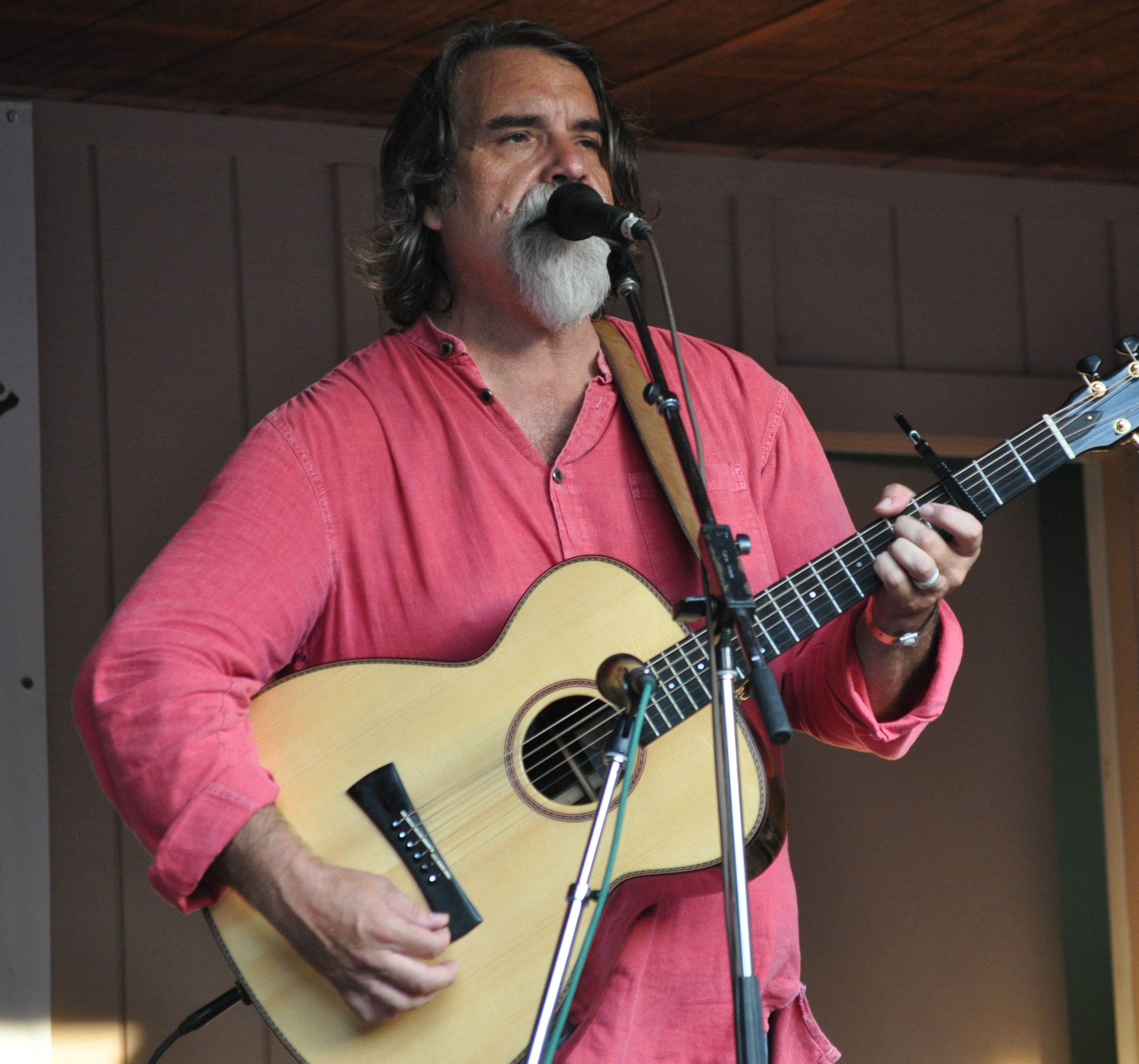
Darrell Scott is a musician’s musician. A talented songwriter and wordsmith, he has crafted hits and musical memories for some of the best. He makes a solo acoustic guitar sound like a full band, with twists and turns on the fretboard that surprise and delight. Scott’s expressive singing voice can take the best-known work of some of America’s greatest songwriters and bring out surprising interpretations that are totally his own. As a collaborator, he easily moves between supporting his bandmates with inventive rhythm tracks on the guitar, banjo, or dobro while stepping forward to add just the right lick or vocal harmony when needed to take the song to new heights.
He is, to put it simply, a favorite for many of those “in the know,” and we’ll explore his musical wizardry in today’s Saturday Soundtrack.
Patagonia fly fishing ambassador, environmentalist, musician, explorer, and talented writer Nathaniel Riverhorse Nakadate has been featured in various fly fishing, surfing, and guitar magazines and publications around the globe. When he writes about Darrell Scott, it is poetry.
“There is an absence of light, before the light. A simple bare stage in the waning gloaming, and I can see Darrell make his way to a lone microphone. He is here to shine that light on matters of the heart─the grit, grease, gristle, and most importantly, the marrow beneath the breastbone.
And what is the path that shapes us as we go along, those true defining moments without which we would be hollow versions of our current selves? For Darrell, it was coming from a musical family with a father who had him smitten with guitars by the age of 4, alongside a brother who played Jerry Reed style as well. From there, things only ramped up with literature and poetry endeavors while a student at Tufts University, along with playing his way through life. This would never change.
When those hands of his make their way across the strings and fretboard, there is palpable loss of air in the theater, as the listeners, our feet and bodies firmly on the ground, watch his sonic wings take him upwards in flight, and realize we are as along for the ride through the skies as he is. Inevitably, to feel this being channeled, privy to this shared physical space, is both heady and inspiring. Small are the number of things in life which allow us to be so deeply immersed and mesmerized by a moment that we are unable to even be aware of the rest of the world humming and whirring away outside. This is Darrell Scott terra firma, where he takes us, with these otherworldly gifts.“
Darrell Scott has been known as a top-shelf songwriter for quite some time. His You’ll Never Leave Harlan Alive, about the life of coal miners in Harlan County, Kentucky, was one of the early songs that demonstrated his uncanny ability to tell a short story in song.
“In the deep, dark hills of eastern Kentucky That’s the place where I trace my bloodline And it’s there I read on a hillside gravestone ‘You will never leave Harlan alive‘
Well my grandad’s dad walked down Katahrin’s Mountain
And he asked Tillie Helton to be his bride
He said, “Won’t you walk with me out of the mouth of this holler
Or we’ll never leave Harlan alive”
Patty Loveless performed a beautiful and heartfelt version on herMountain Soul album, and in the live performance she introduces it by talking about the coal miners in her family. When she and Scott get to the aching chorus, you know they both know where they came from.
“Where the sun comes up about ten in the morning
And the sun goes down about three in the day
And you fill your cup with whatever bitter brew you’re drinking
And you spend your life just thinking how to get away“
Scott also made a pocketful of royalties for writing The Chick‘s hit Long Time Gone. This is a tune that Scott often sings with his collaborator Tim O’Brien since they released it together on 2000’sReal Time album. In this live version taped in Raleigh, NC, you get a sense of Scott’s guitar skills just a little over a minute into the song. Then, check out the interplay between Scott and O’Brien beginning at about the 3:30 mark. With their great improvisations, they sound like two very experienced tight-rope walkers having a blast.
When I mentioned to a client who shares my musical sensibilities that I was going to feature Darrell in a Saturday Soundtrack, he immediately responded by writing, “To me, his opening two tracks on Theater of the Unheard are just incredible — two of the best back-to-back songs on any album I own.” Theatre of the Unheard is an early album of music that was actually written a decade before this release for an unfulfilled project, and to my mind the production is a little heavy handed. However, when my friend wrote that “’He was not my father’s brother, but wished that he could be’ in Uncle Lloyd is one of the more captivating opening lines of any song I’ve heard,” I had to include it here.
“He was not my father’s brother
But he wished that he could be
Told us kids to call him Uncle
We would be his family
He had a wife and kids in Fresno
The youngest one was twenty-four
Daddy brought him into our house
They didn’t want him anymore“
Another example of Scott’s mix of innovative guitar work, stellar songwriting, and soulful vocals can be seen on this live version of Still Got a Ways to Go.
“Time is slowly ticking, taking all our youth Beelzebub and chosen one have both been in cahoots They play us like gin rummy and they’re cheating on the side While we gaze into a broken mirror like Frankenstein’s bride I wish someone could tell me something I don’t already know It’s been some hard living, still got a ways to go
Rooster in the hen house, hit man on the phone Low man on the totem pole, can’t get no time alone I’ve been seeking satisfaction for this gnawing in my soul I build a house like Andrew Jackson if that were my only goal I’m looking for a change to come but brother, change comes slow And it’s been some hard living, still got a ways to go“
Travis Tritt had a country hit with Scott’s It’s a Great Day to Be Alive. In the live version below, the songwriter’s original has a more bluesy feel. His Hank Williams’ Ghost is also another Scott song that I include to show the range of his work.
In 2010, I included a review of A Crooked Road on More to Come to showcase another fine collection of songs.
However, one of my favorite Darrell Scott albums is one where he didn’t write any of the selections. It is his ode to the influential songwriters of his youth, Modern Hymns. As Steven Stone writes in Vintage Guitar,
“This isn’t the first album on which Scott has displayed his interpretive abilities, but here he tackles a wider range of material. Song choices include Gordon Lightfoot’s ‘All The Lovely Ladies,’ Guy Clark’s ‘That Old Time Feeling,’ and Kris Kistofferson’s ‘Jesus Was a Capricorn.’ Others are musically further afield, such as Pat Metheny’s ‘James,’ Leonard Cohen’s ‘Joan of Arc,”’and Paul Simon’s ‘American Tune.’”
Regardless of the source, by the second bar, every song sounds like a Darrell Scott tune. He combines old-timey textures with modern tin-pan alley sensibilities in a unique way, luxuriating in the harmonies and changes of each song. Scott frames Adam Mitchell’s ‘Out Among the Stars’ with a full a capella choir, then performs his most striking musical transformation with ‘Joan of Arc.’ Mary Gauther sings the lead with a world-weary timbre while Scott delivers the answering ‘fire’ part of their duet with an intensity that matches Cohen’s rendition from Jennifer Warnes’ Famous Blue Raincoat album.…
To understand how a songwriter’s mind works, you must listen to how they perform covers. On Modern Hymns, Darrell Scott delivers 12 striking performances that illuminate his unique style.“
Jesus Was a Capricorn resurrected (pun intended) a great, but not-often-heard Kristofferson song with the classic line “I reckon we’d just nail him up if he came down again.” Oh how true. And his interpretation of Adam Mitchell’s Out Among the Stars is, to my ear, the best take anyone has made of this searing and deeply emotional short story.
I’ll end with two other interpretations by Scott of the music of other songwriters. His most recent album is Darrell Scott Sings the Blues of Hank Williams and it includes this lovely version of Lost Highway.
In 2010-2011, Robert Plant revived The Band of Joy for an album and tour, and Scott joined Patty Griffin, Buddy Miller, Byron House, and other stellar musicians for the gig. Each night on tour, Plant asked Scott, Griffin, and Miller to take the lead on a song of their choosing. As Scott tells in the intro to a solo live version, he started playing the old Porter Wagoner hit A Satisfied Mind, and the beauty of the lyrics and harmonies stuck. I’ll leave you with The Band of Joy‘s live version and, I hope, a very satisfied mind.
After four years of an administration that turned the words “Infrastructure Week” into a synonym for any “unsuccessful or clumsy attempt to get an actual policy off the ground,” not to mention that administration’s “odd tendency of pushing infrastructure whenever unfavorable headlines start appearing in the news” (i.e., every week), we have a new gang in town. And guess what? They actually know how to get things done.
As always, this Weekly Reader features links to recent articles that grabbed my interest or tickled my fancy. I hope you find something that makes you laugh, think, or cry.
There are questions, mostly political, about what encompasses infrastructure, but bridges are one thing that falls within everyone’s definition. The Washington Post’s art and architecture critic, Philip Kennicott had a wonderful interactive online piece about the good, bad, ugly, and new in the region’s bridges entitled D.C.’s bridges have a complicated history, with the new Frederick Douglass span rising above the rest. (The rendering at the top of the post is of the new Douglass bridge.)
“But although waterways are omnipresent, and often a nuisance (when rush hour arrives), they don’t really give shape to the city’s psychology. Unlike other cities, where urban life throngs to the waterfront, Washington-area residents seem only intermittently in love with their rivers. We know they’re there, and sometimes we visit. But while the map reminds us that the Potomac is tidal and connects us to oceans beyond, mentally, we are landlocked.
Perhaps that explains why, despite the watery setting, Washington is not quite a city of great bridges. Yes, the graceful arches of Arlington Memorial Bridge have an elegance worthy of an old European capital, and the muscular engineering of the Francis Scott Key Bridge has an appealing formal rigor. But for every good bridge, there is a terrible bridge. The vast majority of commuters who cross a bridge en route to the District enter the city on ugly and utilitarian structures, including the 14th Street Bridge and its dispiriting upstream cousin, the Theodore Roosevelt Bridge. Some of the city’s best bridges — those spanning Rock Creek Park — don’t cross a major river. They were built to a higher standard because they served the interests of real estate developers who were creating a privileged enclave of Whiteness in the city’s Northwest quadrant.
A new bridge, however, is rising in Washington, and its soaring arches signal deeper change. The Frederick Douglass Memorial Bridge, the largest infrastructure project in the city’s history with a price tag near $500 million, isn’t just the first major D.C. bridge to reach for the sky — it represents a revolution in how the city thinks about its waterfront. The people who designed and are building it call it a “gateway,” and that word also indicates a transformation in local bridge thinking. Bridges are both functional and metaphorical, and the Frederick Douglass Memorial Bridge is changing the metaphors the city uses to describe its relation to water, waterways and the waterfront.“
Airports and bus terminals are also part of most definitions of infrastructure. But it doesn’t help when you have a bus terminal in an airport, disguised as a gate. Washington managed to pull that off for a couple of decades. Also writing in the Washington Post, Dan Zak speaks for many of us in his less than fond remembrance: DCA airport’s infamous Gate 35X is gone but not forgiven.
“There was no flourish to its badness. Gate 35X at Reagan National Airport did not have the utilitarian exotica of the Dulles people-movers, trundling across a tarmac Tatooine. It did not have the high-low smack of Union Station, where travelers are welcomed by the Roman arches of Constantine but digested through a boarding area that feels like the waiting room of an ER. Gate 35X wasn’t a vortex like the Springfield Interchange, or a labyrinth like the Metro station at L’Enfant Plaza. Gate 35X didn’t qualify as a municipal quirk, like Washington’s lack of a J Street. Gate 35X was just a bus station. In an airport.
Except, somehow, it was more than that. It was a funnel, a choke point, a cattle call. One gate, as many as 6,000 travelers per day. The ceilings were lower. The seats were all taken, as were the electrical outlets. There was no bathroom down there, no vending machine, no water fountain. Dante’s circles were over-invoked. The complaining was olympic.Queues kinked in our slow sprint to somewhere else, through a bay of four doors, via shuttle rides that were short distances but long journeys, onto small regional jets bound for second-tier American cities.“
I flew in and out of 35X dozens of times. It was just as bad as Zak describes it. Good riddence.
We will end with two pieces about Geico’s Scoop, There It Is commercial. Like so many other fans who watched March Madness, I quickly fell in love with the quirky pitch for cheaper insurance. Now, I knew nothing about Tag Team, or — believe it or not — their hit song. So if you are as clueless as me, you should read Clinton Yates enlightening piece in The Undefeated, Behind the delightful success of Tag Team’s hit commercial with Geico.
When senior copywriter Roger Hailes penned those nine words, alongside just two measures of music, he probably didn’t know how many lives would be changed as a result. For the past two months, one commercial has overtaken the advertising world through an incredible coming together of a classic tune, a powerhouse marketing campaign and, of course, the hip-hop capital of the world: Atlanta.“
“…for D.C. Glenn and Steve Gibson, the rap duo from Atlanta, the track that won the 1994 Razzie Award for Worst Original Song has definitely provided them with the last laugh, as well as laughs for plenty of other families for generations to come. You might have called it corny, they called it positive partying. It is most undoubtedly impactful.“
Read the entire article to learn about the improv actors who join Tag Team to make this a memorable pitch that was almost about soup! Thankfully, we got “sprinkles!”
“None of that was scripted, nor was the sprinkles toss, arguably the top moment of a 40-second ad with like 10 of them.
It was conceived as an ode to LeBron James.
‘You know, sprinkles came from an ode to LeBron James where he goes to the scorers table and throws up the chalk. And I know kids love sprinkles,’ Glenn said. ‘I wanted this commercial to be with little kids, saw it, they’d go, mama, I want to party like that.’”
“’What if I double my GEICO insurance?’ and convince yourself that if you never turn your TV off, the commercial will never stop airing. But these efforts will be futile, as the end of its advertising cycle is out of your control. One of the hardest parts of dealing with loss is realizing you are helpless and that there is nothing you can do to stop the inevitable.”
Have a good week reading.
More to come…
DJB
Image: Rendering of Washington, DC’s Frederick Douglass Memorial Bridge (DC Department of Transportation)
Forces today that would fracture community and democracy in order to gain money and power are reminiscent of challenges from an earlier era. It was March of 1933, and the nation had just chosen a new path out of an economic depression and in the midst of global uncertainty. The leader selected was a new, optimistic president who wanted to get things done.
And so, with that decision made, and a few last weeks of winter to get through before the spring on which so many had placed their hopes, the families huddled in American homes were able to take comfort one weekend, for the first time in a long time, in what the President of the United States had to say to them: that with the ‘money changers’ out of power, it was time to ‘apply social values more noble than mere monetary profit.’…The country must pull together, and ‘realize as we have never realized before our interdependence.'”
In a wonderful new book in the Yale University Press Why X Matters series, historian Eric Rauchway has written Why the New Deal Matters. Rauchway has not sugar-coated the failings of Franklin Roosevelt’s effort to pull the country out of the Great Depression. But he understands—at a fundamental level that the right-wing and libertarian commentators at places like the Cato Institute will never grasp—why it meant so much to America at the time and why it still has resonance today.
The New Deal mattered then, at the cusp of spring in 1933, because it gave Americans permission to believe in a common purpose that was not war. Neither before nor since have Americans so rallied around an essentially peaceable form of patriotism. The results of that effort remain with us, in forms both concrete and abstract (emphasis added).
Rauchway, one of the best historians to ever write about the New Deal, takes the reader to five specific places to look at the impact and legacy of FDR’s brainchild to pull the country from the worst crisis of the 20th century. He ties this work to our present time as a source of inspiration as to how we can respond to the greatest crisis to date in the 21st century. In the process, Rauchway shows how much of the safety net that we take for granted even in the midst of a pandemic—Social Security, rural electrification, small business loans, federal insurance on your bank deposits, a minimum wage, disability insurance, unions, regulation of global finance—is a benefit of the New Deal.
Rauchway begins his trek at Arlington National Cemetery at the graves of two World War I veterans who were shot and killed in Washington, DC, while participating in the Bonus Army. When veterans began to die of starvation in the early onset of the Great Depression, many came to Washington to make the case for government assistance and to demand bonuses that were rightly theirs. The story of that army “allows us to see what might have happened to American democracy if the New Deal had not begun in 1933 and if, instead, the United States had continued policies akin to those of the preceding administration.” As we saw in the 1930s and as we are seeing today, democracy is not a given in the U.S. or around the world. “The foundational belief of the New Deal,” writes Rauchway, “was the conviction that democracy in the United States—limited and flawed though it remained—was better kept than abandoned, in the hope of strengthening and extending it.”
A visit to the Tennessee Valley Authority’s (TVA) Norris Dam on the Clinch River shows that the New Deal matters not only for the legacy of public works projects, but for the visionary thinking about ecology and clean, sustainable energy. Rauchway connects the dots between the economic development in an impoverished section of the country, electrical power, modernist design, and the development of the atomic bomb at Oak Ridge, powered by the energy of the Tennessee River to create “the most destructive force ever put to use in the history of war.”
The Navajo Nation’s Window Rock, along with San Francisco’s Hunter’s Point, are used to address the failings of the New Deal to combat the country’s racism toward Native Americans, Blacks, Asian Americans, and Latinos. At Hunter’s Point, a whole region was transformed in ways that especially affected African Americans. But Rauchway notes that while people of color may have had less reason to feel positive about the New Deal, many of them nonetheless saw the greater promised it held out for the country in the future.
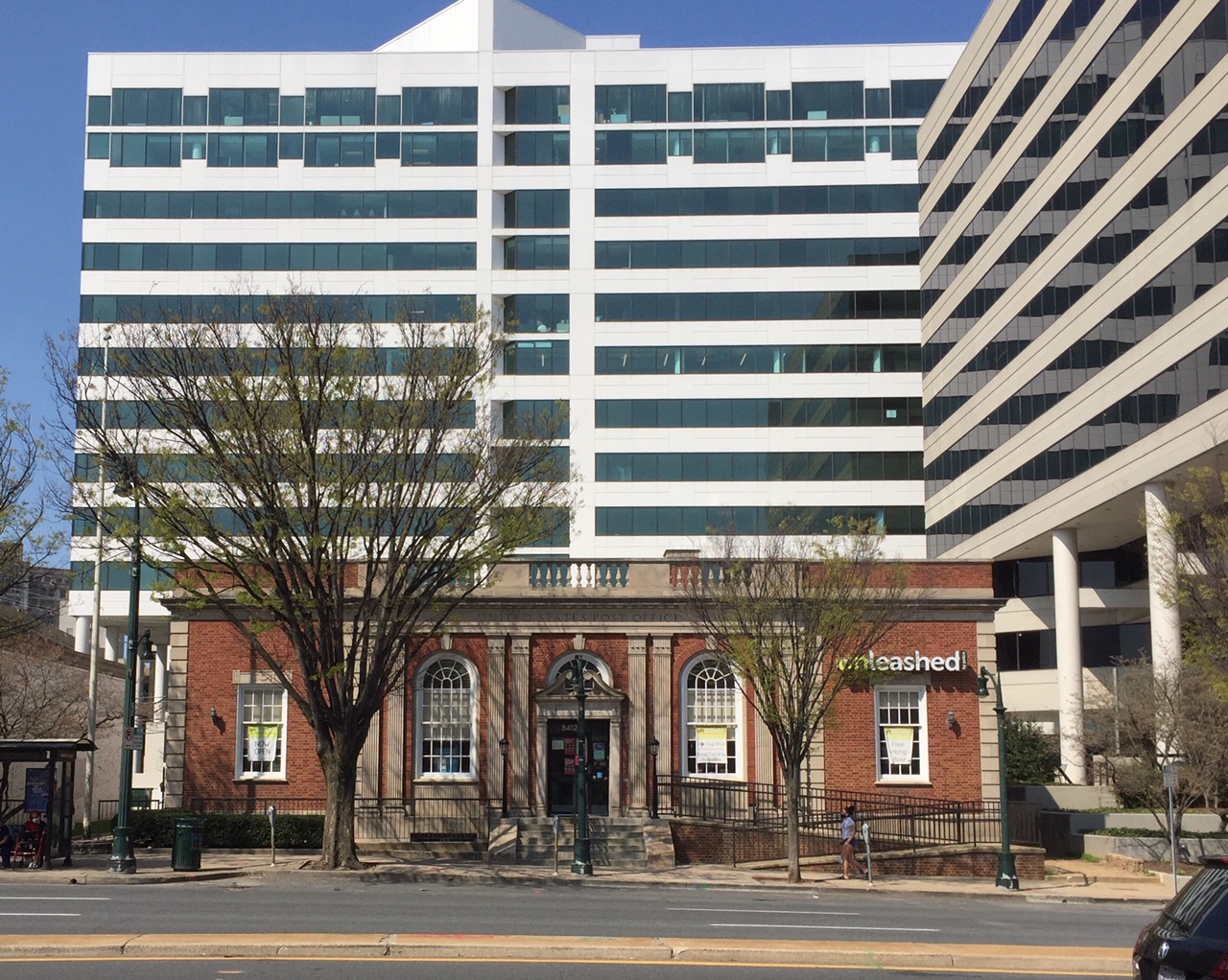
WPA-era post office in Silver Spring, MD
Finally, Rauchway asks us to take a walk around outside our homes, in our neighborhoods. It almost doesn’t matter where you live, because you will find elements of the the New Deal all across the country, in either concrete or abstract ways. It may be a Works Progress Administration-era (WPA) building, such as our old post office, or a WPA roadway, such as the Sligo Creek Parkway, both in Silver Spring. It may be one of the twenty-four thousand miles of new sidewalk laid by the WPA, as near our home in Woodside Park. It may be the commitment to a more inclusive man-made world (to borrow Roosevelt’s phrase), which was the most important characteristic of the New Deal programs for public works and can be seen in sidewalk ramps that were important to a president who struggled with accessibility. It may be through artwork, which told the story of democracy and depicted the value of New Deal labor, playing an outsize role in the program’s success.
Tom Brown at the power station at Sewanee, TN
My father was an engineer with the Tennessee Valley Authority, graduating from Vanderbilt University after World War II on the GI Bill. He worked his entire career to build “for the public good” as the New Deal motto of TVA phrased it. With the inspiration provided by my father, I grew up believing in the common good and in the value of community. I was a child of the New Deal, and believe Rauchway has written a stirring call for using this flawed but ultimately important program as inspiration for our times.
“The ongoing crises of our times have, like the Depression, shown that we need something of the New Deal’s effort to restructure the nation and the world.
The New Deal sought fundamentally to change the United States by introducing, in the phrase Roosevelt used, ‘the broadening conception of social justice’ to American life. The Depression revealed to a wider public the injustice and poverty long visited upon whole classes of Americans: tenants, laborers, farmers—as Roosevelt said in 1937, ‘one third of a nation’—and the New Deal sought to redress these issues….As he had stated in 1932, the nation could not address the present crisis by seeking ‘merely to restore’; it must ‘restore and at the same time remodel.’…
The New Deal’s effort, incompletely realized but doggedly pursued, of improving the economy by improving democracy, remains an outsized ambition even today.”
Multi-instrumentalist extraordinarie David Bromberg burst into my consciousness the first time needle hit vinyl on the 1975 album Midnight on the Water. Here was a guy who had been on the road as the guitar player for Jerry Jeff Walker, produced John Hartford’s seminal Aereo Plane album, and played with artists from Bob Dylan to George Harrison. But my real introduction came as he put out one amazing album after another in the early-to-mid-1970s. His musicianship and ability to play multiple styles, all while singing quirky lyrics with the straightest of faces and most distinctive of voices, hooked me from the beginning. We’ll take a look at his music and legacy in today’s Saturday Soundtrack.
Many people first heard Bromberg with Jerry Jeff Walker in his Mr. Bojangles heyday. Decades later, Bromberg has played the song thousands of times, and still makes the music — and his monologue in the middle at the 2:50 mark about Jerry Jeff’s “not-quite a research project” visit to the drunk tank — seem fresh.
From early in his career, this video is of Bromberg performing Yankee’s Revenge — a medley of Irish fiddle tunes from the Midnight on the Water album — at the Capitol Theatre in Passaic, NJ. Here you can see him as the young guitar slinger at the peak of his talents, flatpicking fiddle tunes and then setting down the guitar to join in on the triple-fiddle ending. This medley originally made me want to hear more from Bromberg, and this video from the era is a wonderful find.
The demands of touring led Bromberg to leave the road in the early 1980s and take time off to study violin making, opening his own violin shop in Wilmington, Delaware. During that time he became one of the most respected experts anywhere on pre-1950 American violins and he and his wife became the owners of a stunning collection of historical violins.
The twenty-two year performing drought ended in 2006 with the release of the Grammy-nominated solo effort Try Me One More Time. The title tune features Bromberg playing acoustic slide on his beautiful signature Martin guitar. That signature guitar is also featured on my favorite song on the album, the cover of Bob Dylan’s It Takes a Lot to Laugh, It Takes a Train to Cry.
Bromberg has always had an affinity for the blues, and 2017’s The Blues, the Whole Blues, and Nothing But the Blues — with one of the great album covers of all time — upheld Texas fiddler Johnny Gimbel’s claim that:
“‘There are only two songs — the Star-Spangled Banner and the Blues.’ The band skipped over the ‘Banner’ and headed straight for the blues, winning the 2017 Downbeat Critic’s Poll for Best Blues Album.“
Here’s a wonderful version of Dr. John’s classic How Come My Dog Don’t Bark When You Come ‘Round? from the Whole Blues album.
Now you say you never met my wife, you ain’t never seen her befo’ Say you ain’t been hangin’ roun’ my crib;
well here’s somethin’ I wanna know… I wanna know what in the worl’ is goin’ down
How come my dog don’t bark when you come around?
I featured a couple of David’s drinking tunes on the New Year’s Eve Soundtrack: Songs for Jack, Jim, and all of their friends. Drink is a subject that returns frequently in his sets, such as in this concert at the Count Basie Theatre in Red Bank, NJ, where he performs Sloppy Drunk.
We will end this celebration of the music of David Bromberg with another favorite, I’ll Take You Back. As in…
“I’ll take you back…
When water ain’t wet / And Congress pays off the national debt.
When James Brown ain’t funky / And King Kong ain’t a monkey!
When the preachers on TV / Start sending cash to me!!
I’ll take you back“
Pour yourself a bourbon and enjoy!
More to come…
DJB
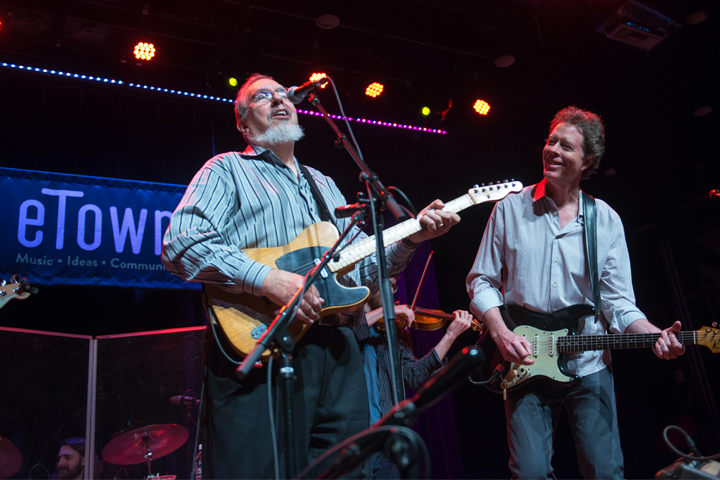
Image: David Bromberg plays eTown with host Nick Forster (Credit: eTown)
My taste in monster movies tends to run toward the Young Frankenstein end of the genre. In other words, comedy. But it has been impossible to watch sports television during March Madness and miss the fact that the “greatest monster battle of them all” — the Battle of the Titans, if you will — has been made into a new movie. When an article about the movie included the words “functional morphologist” in the headline, along with promises to use science to pick a winner, I took the (click)bait.
As always, this Weekly Reader features links to recent articles that grabbed my interest or tickled my fancy. I hope you find something that makes you laugh, think, or cry.
Kiersten Formoso is a vertebrate paleontologist and functional morphologist at USC studying the land-to-sea evolutionary transition — where land vertebrates evolved to go back into aquatic environments. This includes living groups like whales, seals, manatees, and numerous extinct groups like mosasaurs, plesiosaurs, and ichthyosaurs. In The Conversation, Formoso, who also self-identifies as a “huge fan of monster movies,” uses her science smarts and love of the genre to write Godzilla vs. Kong: A functional morphologist uses science to pick a winner.
“Even the most fantastical creatures have some basis in scientific reality, so the natural world is a good place to look to better understand movie monsters. I study functional morphology – how skeletal and tissue traits allow animals to move – and evolution in extinct animals. I am also a huge fan of monster movies. Ultimately, this is a fight between a giant reptile and a giant primate, and there are relative biological advantages and disadvantages that each would have. The research I do on morphology and biomechanics can tell us a lot about this battle and might help you decide – #TeamGodzilla or #TeamKong?
Before she delves into the advantages and disadvantages of each monster, Formoso does want the reader to know that she’s not wacko.
“First it’s important to acknowledge that both Kong and Godzilla are definitely far beyond the realms of biological possibility. This is due to sheer size and the laws of physics. Their hearts couldn’t pump blood to their heads, they would have temperature regulation problems and it would take too long for nerve signals from the brain to reach distant parts of the body – to name just a few issues.
However, let’s assume that somehow Godzilla and Kong are able to overcome these size limitations – perhaps because of their radiation exposure they have distinctive mutations and characteristics. Based on how they look on the big screen, let’s explore the observable differences that might prove useful in a fight.“
It is a fun read, and she doesn’t let the movie ending affect her analysis. So, no spoilers here. You’ll have to read the whole article.
If you lead with Godzilla vs. Kong, one can’t get too serious with the other articles in this weekly collection. We’ll ditch the (serious) politics and look on the lighter side, beginning with the always clever Andy Borowitz. Writing for TheNew Yorker, Borowitz has figured out what’s behind Brian Kemp’s support for a new voter law in Georgia Governor Declares Water a Gateway Drug That Leads to Voting.
“’We’ve consulted a lot of studies on this,’ (Kemp) said. ‘People are much more likely to vote if they are under the influence of water.’”
“Let us be clear. We condemn racism. We extend sympathies to our former colonies, where we hear racism and humidity both occur with disgusting regularity. Here at home, we don’t see racial differences. That’s because there are none – not in elite schools, large corporations, the tabloid press corps, and certainly not the monarchy. Only racist people see race, and we simply cannot envision ourselves seeing it.
We stand by our journalistic integrity. We have plumbed the depths to identify why the divorced, American commoner who married into the curated gene pool of our ceremonial oligarchy is so “grating.” Thus far, our reporting suggests that the Duchess of Sussex is “not the right sort,” which is a character flaw and unrelated to our selective breeding program that involves a handful of church-sanctioned, aristocratic, Northern European families.“
There are memoirs where one is quickly reminded that not everyone shares the same experiences. When well told, moving through these new worlds can be enlightening, jarring, and often gripping. Then again, there is the occasional book where the reader finds a story that mirrors one’s own experience in astonishing detail.
Ty Seidule‘s fearless and direct Robert E. Lee and Me: A Southerner’s Reckoning with the Myth of the Lost Cause — part memoir, part history, part call-to-action — was that reflection for me. In his skillful hands, the story is also enlightening, jarring, and gripping. The Pulitzer Prize-winning historian Ron Chernow may have captured it best when he wrote, “Ty Seidule scorches us with the truth and rivets us with his fierce sense of moral urgency.”
The author’s bio is important in understanding the accuracy of Chernow’s description. Seidule grew up in Alexandria, Virginia, where his father taught at Episcopal High School. Historian Charles Reagan Wilson has called Episcopal a “Lost Cause denominational secondary school.” Seidule then moved with his family to Monroe, Georgia, where he completed his high school studies, graduating from a whites-only “segregation academy” in 1980. Monroe was the site of the only mass lynching to occur in the United States after World War II, yet Seidule knew nothing of that history when he lived in the community. After high school he moved to Lexington, Virginia, where he attended and graduated from Washington and Lee University (W&L). Pulitzer Prize-winning journalist Tony Horowitz has called Lexington “the second city of Confederate remembrance: Medina to Richmond’s Mecca.” Seidule holds a Ph.D. in history from Ohio State University and is professor emeritus of history at West Point, where he taught for two decades. He served in the U.S. Army for thirty-six years, retiring as a brigadier general. His books include The West Point History of the Civil War.
To write such an honest and direct case against all that he had been taught, Seidule brings his professional understanding of history; a long reverence for Robert E. Lee; deep indoctrination into what was expected of a white, Southern male; and a belief that an oath to defend the United States should not be broken. Seidule calls for nothing less than a total reckoning with American history to set the record straight. And he does so by laying out the path to his own personal reckoning with riveting detail, great attention to the facts, and a blunt directness that one would expect from a brigadier general who also happens to be a historian.
Seidule walks the reader through each step of his youthful indoctrination of the myth of Robert E. Lee as the greatest man who ever lived, and who led the Confederate army in a just cause for states rights. Lee, according to the myth, only lost the Civil War due to the overwhelming resources of the North. One learns of the lessons Seidule absorbed in 1960s Alexandria during the Civil War centennial and the civil rights era. Those lessons were heavily imbued with the Lost Cause myth, with Lee’s greatness central to that story. He learned them thanks, in no small part, to the history books the state of Virginia gave him to read in school. Seidule includes deeply personal chapters about his time in Monroe, and in Lexington, and then as a rising young army officer at bases named for Confederate generals who were traitors against the United States. It is at West Point, however, where he had his “a-ha” moment, and recognized that what he learned his entire life was a lie. Throughout he uses the historian’s tools to deconstruct the myth, lie-by-lie, with facts and straight talk.
It is the directness of the language, the refusal to sugar-coat the facts or his own personal failings, that brings the reader to see the righteousness of his work. He admits an adoration for the myth of Robert E. Lee that is a religion. Seidule was in awe when he first walked into Lee Chapel at W&L.
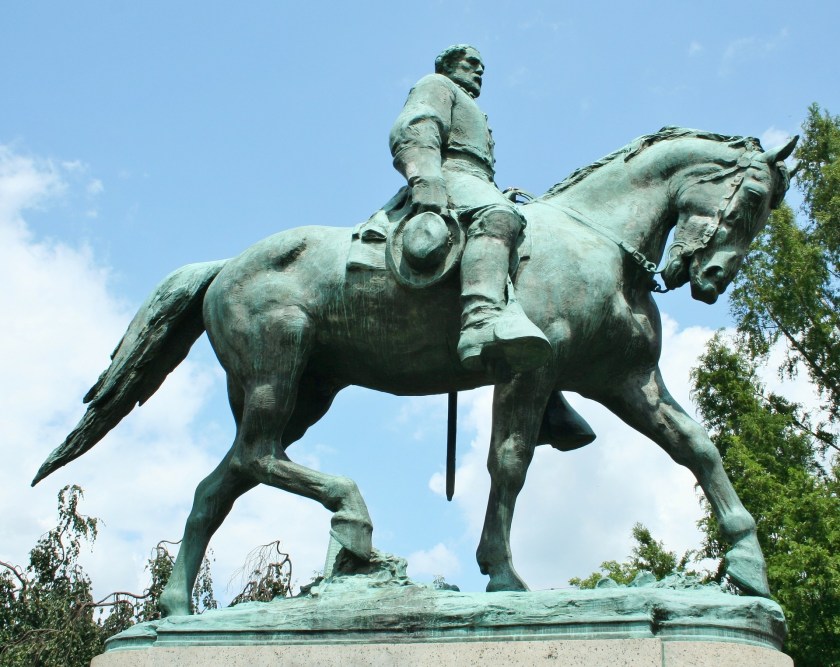
“I saw the altar, the Holy Table. Except that on top of the table lay Robert E. Lee’s statue. My school worshipped Robert E. Lee, literally…At Lee Chapel, we had a church dedicated to the southern saint…Traveller’s bones (from Lee’s faithful horse) became another relic for pilgrims and Lee Chapel became the St. Peter’s Basilica of the Lost Cause religion.”
Seidule doesn’t mince words. Slavery was THE cause of the war as explained before in this blog. How can we be so certain? The leaders of the Confederate states told us so at the time. Use of the word “plantation” sugar coats the reality, so Seidule calls these sites that were central to the southern economy by a more accurate name — enslaved labor farms. He explains that the earliest official name for the war is the “War of the Rebellion” which suits him just fine, because that’s what it was. Civil War is okay as well. But when “War Between the States” or “The War of Northern Aggression” is used, he knows that a Lost Cause myth is behind it.
Then he moves into discussing the two armies who fought in the War of the Rebellion, and how they came to be misnamed (thanks in part to a years-long campaign by the United Daughters of the Confederacy). We usually reference the Union army…
“as though they belonged to an organization that fought only one war. An army relegated to the dustbin of history, as Karl Marx would say. No, the boys in blue fought in the U.S. Army for the United States of America. The names we use matter. By saying Union and Confederate, Blue and Gray, North and South, we lose the fundamental difference between the two sides. The United States fought against a rebel force that would not accept the results of a democratic election and chose armed rebellion.” (emphasis added)
In his final chapter entitled “My verdict: Robert E. Lee committed treason,” the myths about Lee the man are similarly laid bare for the lies they are. Southerners heard that Lee was the only student ever at West Point to go four years without receiving a demerit. In fact, five other students in his class achieved the same honor. Contrary to myth, Lee was not kind to the enslaved persons he owned, received primarily through his wife’s inheritance. He split up families through the sale and the rental of those individuals, and did all in his power to try and ignore the provision in his father-in-law’s will that all the enslaved individuals under his ownership would be emancipated five years after his death. Another part of the myth is that Lee “had” to resign from the U.S. Army because he was a Virginian, and all sons of Virginia put their state above country. In fact, Lee was one of eight U.S. Army Colonelsfrom Virginia at the time of secession. Seven of them remained loyal to their solemn oath to the U.S. Constitution. Only Robert E. Lee resigned and broke his oath. Lee said he was fighting for Virginia, but he quickly resigned his commission leading the State of Virginia’s forces to accept a role in the Confederate States of America’s army. He did so because he profited from slavery.
Robert E. Lee was the only senior officer who was actually in charge of hundreds of enslaved workers and in the U.S. Army in 1861. His views — before, during, and after the war — were much more closely aligned with the large slaveowners of the South than with his fellow Army officers. In 256 hard-hitting pages, Seidule refutes the myth-making around Robert E. Lee point-by-point, and reminds the reader on multiple occasions that the myth was constructed to win the narrative for slave-owners who had lost the war.
Lee’s decision to fight against the United States was not just wrong; it was treasonous. Even worse, he committed treason to perpetuate slavery.
Seidule, a fellow Southerner, is seven years my junior. I was drawn in to the Civil War centennial from 1961-1965 and hiked battlefields with my father from Shiloh to Nashville. While my university years were not spent at one of those colleges that were attracting the “status-seeking white Southern high schooler” (e.g., Sewanee, Duke, Davidson, Vanderbilt, W&L), my friends were there. I lived in Americus, Georgia, during the time that Seidule was in Monroe. Americus has a very complicated history when it comes to civil rights: a few years before I moved to Americus, the deacons of the First Baptist Church stood outside the front doors to keep Blacks from attending, and lynchings were a part of the city’s history. We moved to Staunton, Virginia, in 1983 while Seidule was less than 50 miles away in Lexington. Most importantly, my beloved grandmother was a life-long member of the United Daughters of the Confederacy and a proponent of the myth of the Lost Cause. I read her UDC magazines as well as the works of Douglas Southall Freeman — Lee’s Pulitzer Prize-winning biographer who helped solidify the myth as much as anyone.
Seeing the myth we both were raised on as just that — a myth — has taken time. The truth continues to unfold. Ty Seidule has helped all Americans who wish to know more of that truth understand the facts, and their own personal histories, in a much deeper and richer way with this highly recommended book. As he notes at the end:
Racism is the virus in the American dirt, infecting everything and everyone. To combat racism, we must do more than acknowledge the long history of white supremacy. Policies must change. Yet, an understanding of history remains the foundation. The only way to prevent a racist future is to first understand our racist past.
In our second year of a Holy Week overlaid with the heartache of a worldwide pandemic which is exacerbating the social and economic injustice of our times, a Saturday Soundtrack with lamentations feels right for the season. As was the case in 2020, my son, Andrew Bearden Brown, plays a role in this post. As one of the singers, Andrew is part of the program Lamentations: Music and Reflections for Holy Week from St. John’s Lafayette Square in Washington, DC.
This posting comes early, on Maundy Thursday, to give readers the chance to enjoy the music throughout the weekend.
The 38-minute program alternates between reflections by priests in the church on life in a year in quarantine and beautiful music by Tallis, Tomkins, and other beloved composers and arrangers.
Members of the St. John’s choir provide the music: Tory Wood and Samantha Scheff (sopranos), Charlotte Stewart (alto), Andrew Brown (tenor), and Christopher Jones (bass). The quintet is under the direction of Brent Erstad.
You are encouraged to listen to the entire program, as the reflections are thoughtful and provide context. However, if your focus is solely on the music, you can find the beginnings of each piece in the video by going to the time markings below.
The program includes:
Reflection | Rev. Robert W. Fisher
The Lamentations of Jeremiah I — Thomas Tallis (5:34)
Reflection | Rev. Savannah Ponder
When David Heard — Thomas Tomkins (18:49)*
Reflection | Rev. William Morris
There is a Balm in Gilead — arr. William Dawson (26:40)**
Sometimes I Feel Like a Motherless Chile — arr. Carl Haywood (31:14)
This Little Light of Mine — arr. William Bradley Roberts (33:53)
Whatever your religious tradition or beliefs, Andrew and I hope in this year of lamentations for our broken world, you can find solace in the beautiful choral music of Holy Week.
*I sang this piece with Canticum Novum in the 1980s and 1990s in the Shenandoah Valley. It is one of the most heart-wrenching musical cries of despair imaginable.
**If you are having trouble picking him out under the masks, Andrew begins this piece with the tenor solo.