All posts tagged: Heritage Travel

A Takoma Park July 4th Celebration

Yes, that’s a “precision drill team” made up of environmentally friendly reel mowers you see in the picture.  (See my update at the end of the post) Welcome to the Takoma Park July 4th Parade. Folks who live in the Washington area have a wide range of Independence Day festivities to choose from.  You can have your fireworks on the National Mall, as far as I’m concerned.  My favorite thing is to hop on the Metro, take a short ride to the next station, and then head into downtown Takoma Park, MD, for the annual 4th of July parade.  We’ve done it for years, and it takes some major event to pull us away from this family tradition. Takoma Park is known – to put it mildly – for its political activism and progressive outlook.  For instance, it is the only “nuclear free zone” in the DC metropolitan area.  Takoma Park also has a well-deserved reputation as  being a bit quirky.  Many of our friends from the pool and the twins’ schools live in the …

Oklahoma City National Memorial: The power of remembrance

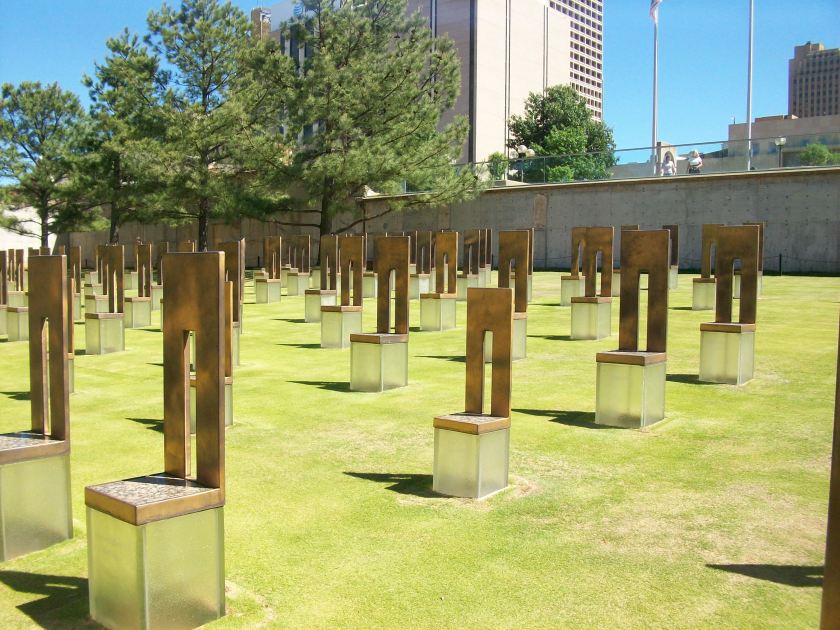
When in Oklahoma City last week, I made the time to visit the national memorial dedicated to the memory of those killed, wounded, or changed forever by the bombing of the Murrah Federal Building on April 19, 1995. It was a powerful experience that would  be moving at any time.  In these days of bombing attempts in Times Square and daily cable television rants against government, the power of remembrance seemed all the more important.  This place – forever altered in horrific ways 15 years ago by the act of an individual angry at the federal government’s actions at Waco and Ruby Ridge – is a somber counterpoint to the hysteria that counts as civic discourse in parts of America today. One enters the outdoor symbolic memorial through a gate marked 9:01 – the minute before the bombing – to represent the innocence of the city.  At the other end of a reflecting pool, the west gate is marked 9:03, after everything changed.  The best known feature of the memorial is the field of empty …

Rugby, Tennessee: Where my preservation career began

Today’s PreservationNation blog has a story and video about Historic Rugby, a 2009 National Preservation Honor Award winner of the National Trust for Historic Preservation.  The blog post brought back great memories. Rugby was established in the 1880s by the successful Victorian-era author Thomas Hughes as a Utopian community for the second sons of English gentry.  Due to the system of primogeniture, these men would inherit little or no property and had very limited career opportunities.  Hughes established this colony in the beautiful but hard-scrabble Cumberland Plateau area of Tennessee.  After some initial success, the colony fell on hard times, ultimately failed and was largely forgotten.  In the mid-1960s, residents of the area began to restore the remaining historic buildings and over the course of five decades have saved this wonderful place and turned it into a thriving community and a favorite spot for tourists. That’s the official story.  The reason it is important to me is because it is where I undertook my first hands-on preservation work, leading to a career that’s now in …

Miami Landmarks Past (and the More Recent Past)

I’m wrapping up a visit to Miami and Miami Beach for work (I know – I love my job) that ended with a spectacular tour of two landmarks of Miami’s past…and the more recent past. Recently the National Trust for Historic Preservation has listed three properties in Miami on the annual list of America’s 11 Most Endangered Historic Places.  We visited two of those sites yesterday and they gave first-hand evidence to the wide range of places that make up the American experience. First up was the 1963 Miami Marine Stadium.  Arriving by boat while listening to the architect – Cuban born Hilario Candela who at age 27 designed this aquatic marvel with its zigzag concourse floating over the stands – was an incredible experience.  It is threatened because the city sees the site as much more valuable for development, even though it doesn’t take a great deal of imagination to understand how this wonderful place could thrive again as a civic center for all South Florida.  Watch the video at the end of the …

Is This A Great Country or What?

If you have had it up to here with screaming right-wing talk show hosts or pontificating left-wing bloggers or just three days of rain, I have the perfect antidote:  the Vintage Roadside 2009 Road Trip Slide Show. Each year Jeff and Kelly from Vintage Roadside travel the back roads from Portland, Oregon to the host city of the National Preservation Conference and take pictures and blog about the experience.  (Vintage Roadside makes great t-shirts that honor the wonderful mom-and-pop roadside attractions, motor courts, motels, tiki lounges, drive-in restaurants, bowling alleys and roller-skating rinks found along America’s back roads.)  This year the trip took them to Nashville, Tennessee.  You will laugh out loud, you will be amazed at the quirky attractions that still remain on America’s roadsides, and you’ll marvel at what a diverse country we live in.  So take my recommendation – visit their slide show and spend a few minutes with this great country. Thanks Jeff and Kelly.  It was wonderful to spend a bit of time with you in Nashville.  Thanks for what …

Why architecture matters: I.M. Pei and Henry Cobb’s Hancock Tower

I’m reading Paul Goldberger’s new book Why Architecture Matters. As you would expect from Paul, it is a smart, well-written work that is designed to help the reader interested in buildings “come to grips with how things feel to us when we stand before them, with how architecture affects us emotionally as well as intellectually.” I’ve already come across numerous passages and examples that resonate, but last evening I was reading his take on I.M. Pei and Henry Cobb’s John Hancock Tower on Copley Square in Boston and was reminded of my last impression of that building when Andrew, Claire and I were visiting the city in March 2008. Paul, a Pulitzer-Prize winning writer and a trustee of the National Trust for Historic Preservation, is describing the Hancock Tower in comparison to New York’s Seagram Building and G.M. Building.  All three are postwar American landmarks. It was great fun to introduce Claire and Andrew to Copley Square when we visited Boston in 2008.  We toured the great H.H. Richardson-designed Trinity Church, of course, and took …

Union Station: A Personal History and a Preservation Success Story

Having just arrived in Nashville for the 2009 National Preservation Conference, I find myself in the lobby of the Union Station Hotel waiting for a room and for my meetings to begin.  That left me time to think…which can be dangerous. Union Station is a Nashville landmark.  It is a beautiful old pile of a building and the lobby (see photo) is stunning.  But I think it is a landmark and was – in the end – saved from the wrecking ball because it has so many personal connections to people in Middle Tennessee.  Take me, for instance. My parents were part of the post-war (WWII) marriage boom that begat the well-documented baby boom.  Both were from the small town of Franklin, located about 20 miles from Nashville.  My father had just graduated from Vanderbilt and he and my mom were married in the First Baptist Church in Franklin.  Before beginning his life-long career with the Tennessee Valley Authority, my father and his new bride had a honeymoon to take. Luckily, they had relatives (my …

Milwaukee City Hall – Looking Back, Looking Forward

If Calatrava’s Milwaukee Art Museum is a symbol of the city’s optimism for the 21st century (see my previous post), then the City Hall is a fine example of the community’s spirit and optimism for the 20th. But not content to remain in the past, City Hall is primed – after a 1988 interior restoration and a beautiful exterior restoration completed in 2009 – to showcase this unheralded gem of a midwestern city. We were meeting across the street yesterday morning at the Pabst Theatre – another fine preservation project – when a number of us walked over to see what a colleague described as “an atrium you don’t want to miss.”  Man, was he right! The pictures here don’t really do the interior justice, but you’ll just have to take my word.  This well in the central section of the building in the portion behind the tower is 20 feet by 70 feet and rises the full eight floors. Enjoy the photos of City Hall (plus one I’ve thrown in of the Pabst Theatre).  …

Moved by Santiago Calatrava’s Milwaukee Art Museum

Oh my…what a building, what a sculpture, what a space, what an experience!  The power of place indeed. Just two weeks after seeing his bridges in Dublin, I had the opportunity to visit the Santiago Calatrava-designed Milwaukee Museum of Art today.  I had seen the building on a drive-by a few years ago, but this was my first time to see it both inside and out.  The internet is awash with both images and verbiage about this wonderful space.  I’ll only quote the dean of the school of architecture at the University of Wisconsin-Milwaukee (and a member, along with our host, of the selection committee for the building) who told our tour group today, “We got Calatrava when he was unknown and yet at the peak of his creative powers – sort of like the early Beatles, before they became superstars and started adding too many orchestrations.“ What you’ll see below is a series of photos showing the “flapping” of the beautiful white wings (really a sunscreen)  from open to close.  Extraordinary as that sounds, …