All posts tagged: Historic Preservation

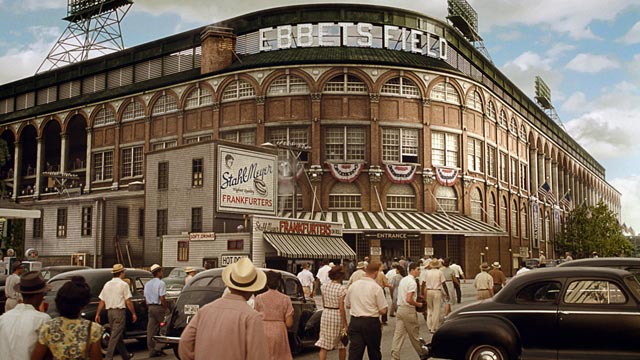
Ebbets Field

Emotions flow through places

It will surprise no one that I read a couple of baseball books and watched several games while on vacation.  But it may surprise you to know that the best piece of writing I read which included baseball as its subject came from the opening pages of psychiatrist Mindy Fullilove’s 2004 book Root Shock:  How Tearing Up City Neighborhoods Hurts America, and What We Can Do About It.  She begins chapter one with several powerful paragraphs.  I’m going to quote extensively from those two pages. “Every once in a while, in a particular location and at a particular time, people spin the wheel of routine, and they make magic.  One such location was Ebbets Field in the heart of Brooklyn, where, through World War I, the Roaring Twenties, the Great Depression, World War II, and the postwar struggles for equality in America, hard-working people enjoyed baseball.  That small, unpredictable, and intimate ballpark was a gallery for characters to strut their stuff, and the characters in the stands took as much advantage of the opportunity as …

I Am Not Invisible

Last evening I spoke in Athens, Georgia, on the occasion of the 50th anniversary of the Athens-Clarke Heritage Foundation.  The topic was the future of preservation, and I took segments from remarks given by my colleague Tom Mayes at the recent EDRA conference on Why Old Places Matter and combined it with the basic elements of our recently released Preservation for People:  A Vision for the Future. The first key concept from the vision is that a people-centered preservation movement hears, understands, and honors the full diversity of the ever-evolving American story. I built on this concept by noting that, “The recognition of our stories and the capacity to see yourself and others in the American narrative has a profound effect on our sense of identity.   A few years when the National Trust conference was held in Nashville, Congressman John Lewis challenged us to believe in the idea that ‘my house is your house.  My story is your story.  The history of my people is the history of all Americans not just African Americans.’” I …

SE Utah Cliff Dwellings

Places teach us, if we let them

I have just finished reading two books about the American West that were written in 1987 and 1994. As I finished the second one on a rainy Sunday afternoon I thought, “I hope I age as well.”  The older of the two—which I actually read second—was the first book cited by the author of the 1994 work in her “Sources” chapter.  Both are written by women I greatly admire as writers and thinkers. So enough of the cat and mouse games. Rebecca Solnit‘s Savage Dreams:  A Journey Into the Hidden Wars of the American West, was republished in a 20th anniversary edition in 2014, with a new preface by the author. I’ve been on something of a Solnit kick lately, as she is one of the most thoughtful of writers exploring a wide variety of issues across the American landscape. This early work is often hailed as a foundational work of environmental thinking.  However, I saw this more as a book about place and unacknowledged history, and the title of the post comes from her …

Living at the intersection of past, present, and future

(Note:  I made the following remarks at the funeral of Dr. James K. Huhta on Monday, May 8, 2017, in Murfreesboro, Tennessee.  Jim was the founder of the Historic Preservation Program at Middle Tennessee State University, an early mentor in the field, and—along with his wife Mary who died 11 months earlier—a dear friend.) I thought I would start my remarks with a history joke…but they’re all too old. Feel free to groan, because I will keep on with the bad puns and jokes if you don’t.  Just as Jim would have done. In recent days, I have talked with people who knew Jim from all walks of life. We all acknowledge the deep pain of the past year to the family, friends, and this community. But like these friends and colleagues, I want to reflect today on his many accomplishments and his impact on others, before the inexplicable challenges of recent years became too much for him to bear. Several people recounted how Jim’s optimism for the future set them on a path which …

Clarity of Vision

We all benefit when we are clear about what matters. I  have always admired the clarity of vision that comes through the work and writings of Morris Vogel, the retiring president of the Lower East Side Tenement Museum.  Morris is one of my colleagues at the National Trust, and I value our professional relationship.  On a personal level, Morris is someone I look to for both advice and inspiration. In these days when the nation is – once again – struggling with its checkered history on immigration, the Tenement Museum has stepped time and again into these conversations in ways powerful, relevant and timely.  I found the following statement, which Morris recently shared with his board and staff, a great reminder of how clarity of vision and mission is so important in finding one’s voice. “Tenement Museum leadership in the museum field means that our colleagues at other institutions regularly ask how we handle difficult issues, and we’ve recently fielded requests for information about how we determined our pro-active response to the government’s refugee ban. …

Problem Solvers

I spent much of last week with eight mayors, and seven other resource panelists at the Mayors’ Institute on City Design in Charleston, South Carolina.  The mayors – two women and six men – came from cities as large as San Bernardino, California, and as small as Juneau, Alaska.  Three of the cities were state capitols, at least two were located on historic Route 66, they spread from coast to coast, every community had a historic core that the mayors saw as vital to their identity and future, and all were ethnically diverse. The political leanings of the mayors – and those of their cities – spanned the spectrum.  Some had been in office for several years, others were relatively new to either the mayoral office and/or public service.  One was a writer on social justice.  Two were accountants by training, while another was a banker.  One had spent much of his career running YMCAs.  As befits the mayor of a city that abuts Canada, the mayor of Juneau had worked for the U.S. Customs …

Panama Hotel

Those who do not know their history…

The recent executive order temporarily banning travel from seven predominantly Muslim countries brings to many minds an earlier, ugly incident from American history.  As is often the case, those who do not know their history are destined to repeat it. An op-ed in yesterday’s New York Times spoke to this earlier, discriminatory ban.  When Lies Overruled Rights tells the story of the internment of Japanese-Americans during World War II. “Seventy-five years ago on Sunday, under President Franklin D. Roosevelt’s Executive Order 9066, all people of Japanese ancestry living on the West Coast were forced to leave their homes and report to incarceration camps. Two-thirds were American citizens. Fred Korematsu, my father, then 23, refused to go. A proud and loyal citizen, he had tried to enlist in the National Guard but was rejected and was wrongly fired from his job as a welder in an Oakland, Calif., shipyard He was arrested and tried for defying the executive order. Upon conviction, he was held in a horse stall at a hastily converted racetrack until he and …

A Wider, More Generous, More Imaginative Perspective: Preservation in 2017

(Note:  This post originally appeared – in a slightly edited form – on the National Trust for Historic Preservation’s Preservation Forum blog.) 2016 was a time of reflection and anticipation for many Americans, including preservationists. We celebrated the 100th anniversary of the National Park Service and the 50th anniversary of the National Historic Preservation Act, but we also used this year to anticipate the future. Moving past those milestones, we have the opportunity—some would say the obligation—to rethink preservation and seek our place of relevance in the changed political and social climate of 2017. Many people contributed to our convenings on the future of preservation. Out of those conversations, we envisioned a preservation movement that grounds its work in human needs and aspirations: “A people-centered preservation movement empowers people to tell their stories and to engage in saving the places that matter to them; plays an increasingly important role in creating sustainable, resilient, equitable, and livable communities; and works collaboratively with a wide range of other fields to fulfill fundamental human needs and achieve essential …

View of Florence

The Well-Tempered City

Jonathan F.P. Rose is a man of many interests and talents.  A developer, Rose builds affordable housing and mixed-income community centers.  He is a jazz aficionado and — as suggested by the title of his newest book — a classical music devotee.  Rose is also an interdisciplinary scholar and writer.  In The Well-Tempered City:  What Modern Science, Ancient Civilizations, and Human Nature Teach Us About the Future of Urban Life, Rose brings those talents and interests together in a wide-ranging and thoughtful look at the past – and future – of the places where 80% of the world’s population will live by 2080. (Full disclosure:  My employer — the National Trust for Historic Preservation — has recognized Jonathan’s work with a Preservation Honor Award, and I have worked with him through his role as an advisor to a couple of our projects.) The Well-Tempered City is a book that reflects a lifetime of work and thought about how cities best serve people.  Early in the book, Rose notes that, “Since the founding of the very …