All posts tagged: Historic Preservation

Lone Cypress

Pacific Grove-by-God

For several years I’ve regularly traveled for work to Monterey, California, a small coastal city some two hours south of San Francisco. So when we went looking for a west coast destination for this year’s family vacation, I suggested we check out the Monterey Peninsula.  Now that we’ve wrapped up a week-long visit to Pacific Grove—next-door neighbor to the city of Monterey—we’re just coming to realize how much we’ve seen and explored in this new (to us) part of the world. Let’s begin with the coastline, the attraction to visitors for thousands of years.  I awoke every day shortly after 6 a.m. and went for walks of as much as two hours along the well-used (and well-loved) Monterey Bay Coastal Trail.  Pacific Grove’s portion of this 18-mile trail, which follows the path of the old Southern Pacific Railroad train tracks, hews close to the water and rock-strewn coastline, while Monterey’s comes inland a bit to incorporate Cannery Row, the Monterey Bay Aquarium, and Fisherman’s Wharf.  My walk often began before sunrise and was shrouded in …

Tenement Museum

A war on whose Christmas?

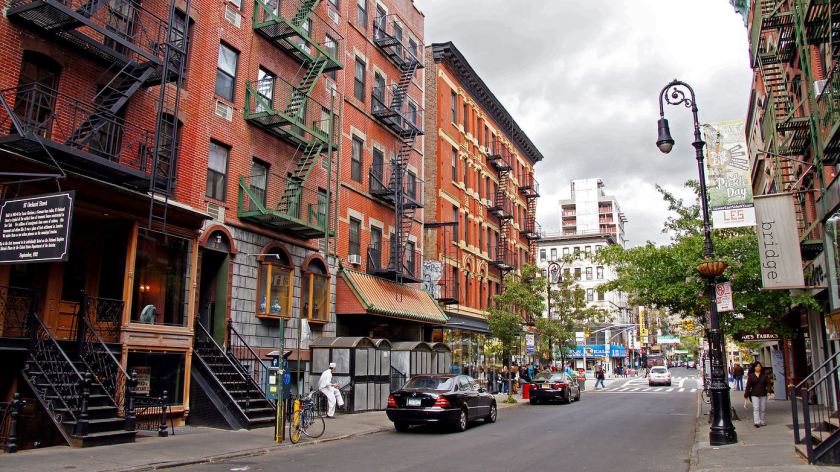
On Tuesday I spent a good part of the day at the Tenement Museum, on New York’s Lower East Side.  I was there to meet with the museum’s new president, Kevin Jennings, and to tour their new Under One Roof exhibit with Annie Polland, the EVP for Programs and Interpretation.  An affiliate historic site of the National Trust, the Tenement Museum tells the full American story about how many have come together to make our nation today. Which brings me to the so-called War on Christmas. The day I arrived, Kevin had just published an op-ed in Newsweek entitled “A War on Christmas?  What Christmas Are You Talking About?”  Early in the piece he asks the key question: “In recent years, a new holiday tradition seems to have emerged in America. From pundits to Presidents, the airwaves fill each December with people decrying the so-called “War on Christmas.” As a historian and museum President, I find myself wanting to ask “War on whose Christmas?” Those bemoaning the “War on Christmas” harken back to a mythical …

We Shine a Light on the Past to Live more Abundantly Now

This week at the National Trust, we are preparing to host the 2017 PastForward national preservation conference in Chicago.  Long-time colleagues and new friends who care about the past and the places that bring that past into the present will gather from all across the country.  I suspect that we’ll share thoughts that challenge the conventional wisdom, offer support for a broader understanding of the American story, and come away with a new appreciation for the work that takes place by preservationists and by those who don’t (yet) identify as preservationists. Why do these people gathering this week in Chicago care about the past?  And what’s with that name, PastForward? In a recent conversation that included Pulitzer Prize-winning historian Annette Gordon-Reed, (The Hemingses of Monticello: An American Family), journalist and author Krista Tippett summed up the answer to those questions with her opening line:  “In life, in families, we shine a light on the past to live more abundantly now.” I think that’s a great summation of why so many of us will gather this …

Complicity in a Shared Work of the Imagination

Last week I had the privilege of launching the National Trust’s National Treasure campaign for Clayborn Temple, a landmark in the history of the Civil Rights movement.  It was here where Memphis sanitation workers gathered in 1968 and decided to go on strike, marching with their “I Am a Man” signs that became a potent symbol for all that is at stake in the fight for equal justice.  Clayborn Temple was where the leadership of The Rev. Dr. Martin Luther King, Jr. transformed the strike from a local labor dispute into a national issue, effectively tying the sanitation workers’ cause with the national issues of economic justice and racism. It was to Memphis and Clayborn Temple that Dr. King was returning when he was struck down by an assassin’s bullet. To be in that sacred space with more than 150 Memphis residents, young African American poets and musicians, revered spiritual leaders who walked with the sanitation workers, preservationists of all ages, and current members of the workers’ union was an honor and a reminder of …

Cooper-Molera Garden

To learn something new (about old places), bring in new partners with different perspectives

At the National Trust for Historic Places, where I work, we believe that historic sites are fundamentally places of intersection. When we allow them to share their stories, historic sites are dynamic spaces where past, present, and future meet in a variety of ways.  One very important way they intersect is with community. About ten days ago, I visited Cooper-Molera, one of our National Trust historic sites where delight and enjoyment are at the heart of our community intersections.  Cooper-Molera is a two and one-half acre property in the heart of downtown Monterey, California’s historic commercial district. There we are implementing a new model that combines commercial uses and interpretation in creative ways.  We will have a bakery, restaurant, and event center in adaptively used historic buildings operating in collaboration with museum uses in one of the adobe residences to reinvigorate the site, sustain it financially and engage audiences that might never visit a historic site or house museum. Those are the people we should all want to meet at this intersection. We call this …

Emotions Flow Through Places – Thoughts After Charlottesville

Last week I referenced Dr. Mindy Fullilove’s book Root Shock with a story that spoke to how emotions flow through places.  I wrote before the events in Charlottesville—and the reactions to that weekend—brought place, memory, and emotion to the forefront of our national conversation. Stephanie Meek’s statement on Confederate memorials and the confronting of difficult history speaks to how emotions that arise from place are not always built upon strong, positive memories.  Of course, Dr. Fullilove understands this all too well.  Root Shock is focused on the difficult history of urban renewal, something seen in Charlottesville’s destruction of the African-American community of Vinegar Hill in the 1960s.  At the Trust, as Stephanie notes, “we believe that historic preservation requires taking our history seriously. We have an obligation to confront the complex and difficult chapters of our past, and to recognize the many ways that our understanding, and characterization, of our shared American story continues to shape our present and future.”  That is especially true of our Civil War history, and the fact that many of …