
When I saw my first old-fashioned iris of the season last Sunday I thought of my mother. And the great educator and civil rights pioneer Mary McLeod Bethune. And the lessons flowers teach us about how to change the world.
Last Sunday morning I saw my first iris of the season. Actually, Candice saw it but she knows the place these flowers hold in my heart and she quickly pointed it out to me. I immediately thought of a post from 2024 entitled The purple iris as the antidote to worry and sorrow. Later on Sunday I came across another essay—this one by Rebecca Solnit—entitled Flowers Bloom on Soldiers’ Graves: Lessons in Power and Consequence.
I want to draw on both of those pieces today.
My post from 2024 begins, as so many do, early in the morning.
On my daily walk in Silver Spring I came upon a tiny handmade sign among some flowers. Since it is my custom to always read the plaque, I stopped to investigate.
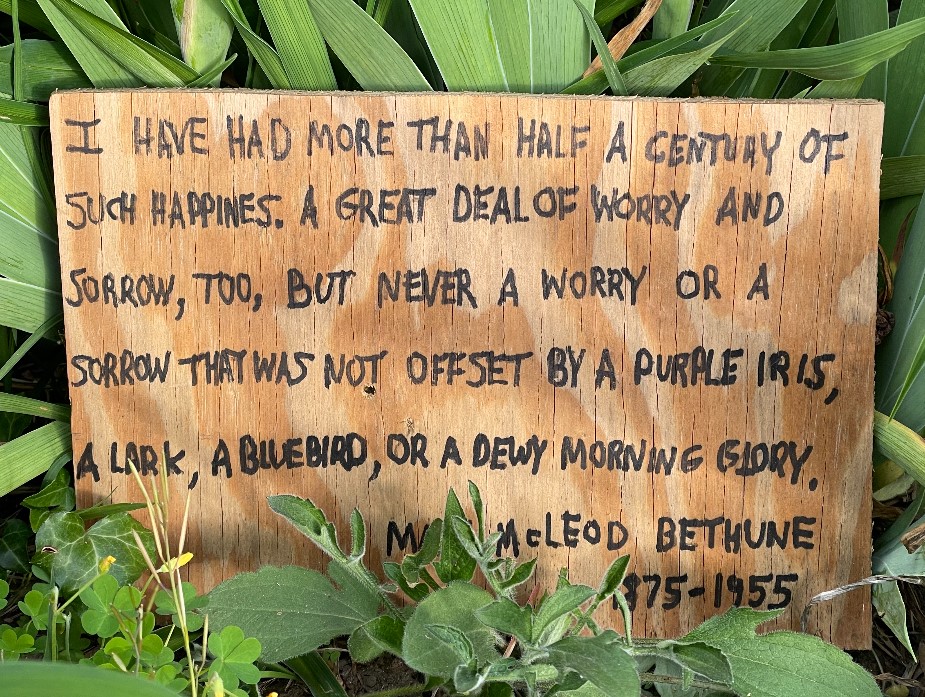
The little plaque reads:
“I have had more than half a century of such happiness. A great deal of worry and sorrow, too, but never a worry or a sorrow that was not offset by a purple iris, a lark, a bluebird, or a dewy morning glory.”
Followed by the name and dates of the author:
Mary McLeod Bethune, 1875-1955
And as I looked up, I noticed that it sat among a stand of beautiful irises in full bloom.
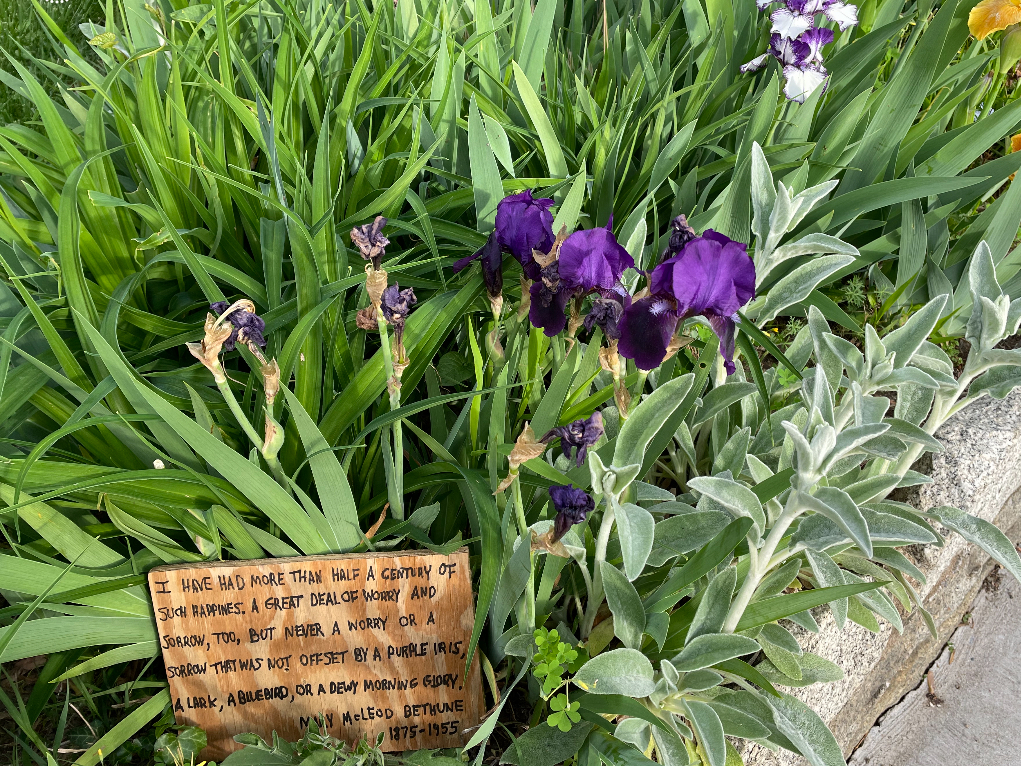
I’ve always had a special place in my heart for the old-fashioned iris. They were my mother’s favorite flower, and we always had some in our backyard on East Main Street. So I’m glad to know that I share at least one thing with the great educator and civil rights pioneer Mary McLeod Bethune.
Here’s some of her bio from the National Women’s History Museum:
“The daughter of formerly enslaved parents, Mary Jane McLeod Bethune became one of the most important Black educators, civil and women’s rights leaders and government officials of the twentieth century. The college she founded set educational standards for today’s Black colleges, and her role as an advisor to President Franklin Delano Roosevelt gave African Americans an advocate in government . . .

A champion of racial and gender equality, Bethune founded many organizations and led voter registration drives after women gained the vote in 1920, risking racist attacks. In 1924, she was elected president of the National Association of Colored Women’s Clubs, and in 1935, she became the founding president of the National Council of Negro Women. Bethune also played a role in the transition of Black voters from the Republican Party—“the party of Lincoln”—to the Democratic Party during the Great Depression. A friend of Eleanor Roosevelt, in 1936, Bethune became the highest ranking African American woman in government when President Franklin Roosevelt named her director of Negro Affairs of the National Youth Administration, where she remained until 1944. She was also a leader of FDR’s unofficial ‘black cabinet.’ In 1937 Bethune organized a conference on the Problems of the Negro and Negro Youth, and fought to end discrimination and lynching. In 1940, she became vice president of the National Association for the Advancement of Colored Persons (NAACP), a position she held for the rest of her life. As a member of the advisory board that in 1942 created the Women’s Army Corps, Bethune ensured it was racially integrated. Appointed by President Harry S. Truman, Bethune was the only woman of color at the founding conference of the United Nations in 1945. She regularly wrote for the leading African American newspapers, the Pittsburgh Courier and the Chicago Defender.“
In addition to being a civil rights pioneer and educator, Bethune was a businesswoman who has been honored with a memorial statue, a postage stamp, and—in 2022—she became the first African American to be represented with a state statue in the National Statuary Hall Collection at the U.S. Capitol.
It gives me great joy to know that such an amazing and transformational leader took the time to stop and admire the iris. And a dewy morning glory.

The essay from Rebecca Solnit’s Meditations in an Emergency Substack looks at the power of flowers to change behavior. She writes that power, at its most essential, is “the ability to influence an outcome on any or all scales, to protect one’s own at a minimum and to influence, even control others at a maximum.” Violence is constantly misunderstood as power, she adds.
“Botanist David George Haskell‘s new book How Flowers Made Our World: The Story of Nature’s Revolutionaries describes a kind of power often ignored or dismissed, just as flowers themselves are. He writes, ‘When flowers arrived, they upended and transformed the planet. They were late arrivals on the world stage, appearing about two hundred million years ago, long after the evolution of complex animals and other land plants. By one hundred million years ago they were the foundation of most habitats on land . . . We often think of power and revolution as about control, authoritarianism, and violence. Might makes right. But that’s not the only way in which revolution and power and transformation take place. Flowers offer a different narrative. They changed the world in revolutionary ways through cooperation, through collaboration, often mediated by beauty, by sensory experiences. So a flower is quite literally speaking to the sensory system of a bee or of a hoverfly or of a bird to draw that animal in to establish a cooperative relationship, a reciprocal relationship. And we’re just the latest animal to become enchanted by the flowers and to become loyal collaborators with the flowers.’”
After exploring the current administration’s misunderstanding of what makes power, Solnit moves to her closing.
“The lesson flowers offer is that when you treat others well, when you meet their needs, you can enter into relationships that serve you as well as them. When you use violence or otherwise exploit and coerce to get what you want, you create adversaries, not allies, and they too often turn out to have power. In a world of increasing equality over the past few centuries, cooperative power matters more, and violence, [as Jonathan Schell in his landmark book from 2003, Unconquerable World: Power, Nonviolence, and the Will of the People points out], has become an increasingly weak way to get what you want . . .”
Flowers provide happiness. They also change the world.
More to come . . .
DJB
For posts in MTC on the writing of David George Haskell see The importance of roots, Eleven ways of smelling a tree, and The networks that sustain and shape us.
Photo of iris by Dewdrop157 from Pixabay


Pingback: Observations from . . . April 2026 | MORE TO COME...